

You're probably dealing with the same problem every new travel manager hits within the first few road trips. The game time is fixed, the roster keeps moving, equipment grows by the hour, and everyone assumes the flight is the easy part. It isn't.
Sports team charter flights only look simple from the outside. The actual work sits in the margins: payload planning, crew legality, FBO timing, bus placement, catering windows, and the last-minute roster change that can force an aircraft swap if you didn't build the trip correctly. Get those details right and the team arrives calm, organized, and ready to perform. Get them wrong and the travel day becomes its own opponent.
On Haute Jets Journal, it's worth treating team chartering as an operations discipline, not a booking task. The aircraft matters, but the process matters more.
The Strategic Advantage of Chartering for Your Team
Commercial travel asks a team to adapt to the airline. Chartering flips that equation. The itinerary adapts to the team.
That distinction is why serious programs rely on charter lift even when finance asks hard questions about cost. Across the NFL, NBA, MLB, NHL, MLS, and college athletics, teams treat charter aircraft as an operational requirement rather than a luxury, because private charters let players, coaches, medical staff, and equipment move together on one flight while preserving schedule integrity and team cohesion, as outlined by sports team air charter guidance.
Schedule integrity wins games before warmups
A commercial itinerary introduces variables your staff can't control. Late inbound aircraft, gate changes, split seating, checked equipment delays, and forced layovers all chip away at preparation time. Chartering gives you control over departure timing, routing, and access to private terminals, which protects the parts of the day coaches care about.
That matters most on tight turnarounds. If a team lands late, checks into the hotel late, and pushes recovery back by even a few hours, the next morning's lift, film, treatment, and meal cadence gets compressed. Once that happens, the entire competitive routine starts drifting.
Practical rule: Don't defend chartering as premium travel. Defend it as schedule protection.
A useful comparison sits in the business travel world too. The same logic behind the strategic advantages of private charter for corporate travelers applies even more sharply to sports, because your travelers aren't just trying to arrive on time. They're trying to perform on arrival.
Recovery and preparation happen in transit
The cabin environment is one of the least appreciated parts of sports team charter flights. On a properly planned charter, athletes can spread out, trainers can monitor recovery needs, coaches can hold meetings, and medical staff can keep critical items close instead of hoping checked bags appear when needed.
That private setting changes behavior. Players rest instead of standing in boarding lines. Coaches can talk scheme without public traffic around them. Staff can move through the cabin and solve small issues before they grow into operational problems.
Team cohesion is operational, not sentimental
Traveling as one unit simplifies decision-making. Everyone departs together, lands together, clears the terminal together, and gets on the same ground transportation flow. That reduces handoff mistakes.
Here's what works in practice:
- One manifest owner: One staff member controls final passenger status and communicates updates to the operator.
- One equipment chain: Equipment travels under one plan instead of getting fragmented across commercial baggage systems.
- One arrival sequence: Players, coaches, and support staff move through the destination in the order the team needs, not the order an airport imposes.
Teams don't charter because it feels exclusive. They charter because fragmented travel creates avoidable stress, and avoidable stress shows up later in performance.
Selecting the Right Aircraft and Managing Logistics
The first mistake new travel managers make is choosing aircraft by headcount alone. That's how you end up with enough seats and not enough airplane.
For sports team charter flights, aircraft selection starts with who's traveling, but it ends with what they're carrying, how far they're flying, and what kind of cabin environment the trip requires. Passenger count is the beginning of the conversation, not the decision.
Start with payload, not preference
A charter provider can source several aircraft that technically fit your group. The problem is that “fit” often means seats, while your operation needs seats plus baggage volume plus equipment allowance plus workable cabin flow.
A critical planning discipline is the 48-hour pre-booking logistical audit that combines equipment weight manifests with roster changes to make sure the aircraft matches the 15,000–25,000 lbs payload threshold typical for elite teams. That process can reduce the 30% failure rate of last-minute rebooking caused by unexpected equipment surges, according to sports team charter planning analysis.
That single step separates organized departments from reactive ones.
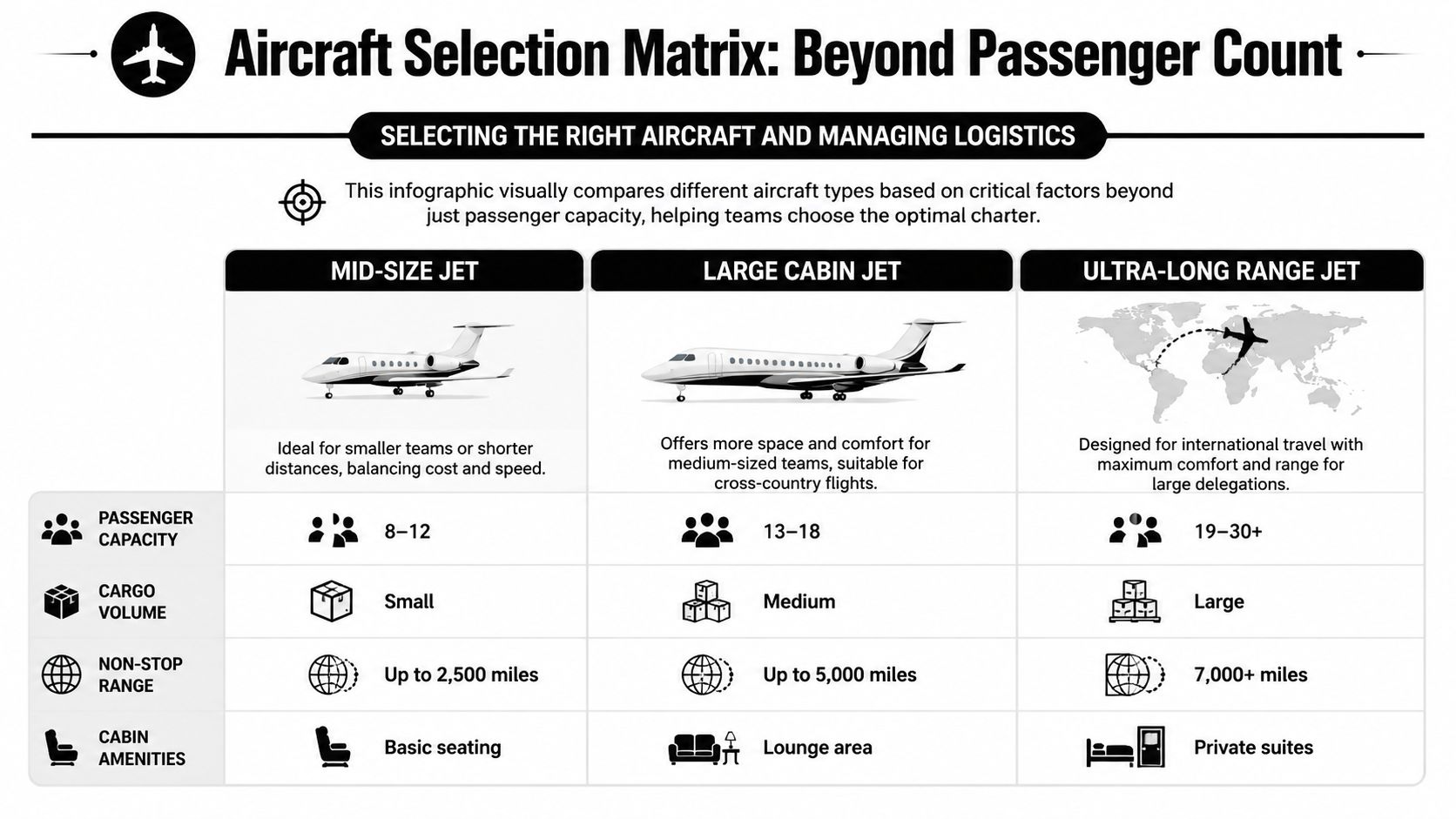
Match the aircraft to the travel profile
For a smaller collegiate group, a regional aircraft may be enough. For a major pro roster with staff and substantial gear, it usually won't be.
The broad decision tree looks like this:
| Team profile | Better fit | Main issue to verify |
|---|---|---|
| Smaller travel party, lighter gear | Regional or smaller aircraft | Baggage and equipment limits |
| Mid-sized group with moderate equipment | Larger cabin or narrow-body solution | Cabin comfort and cargo access |
| Full pro roster with staff and heavy equipment | Boeing narrow-body or larger | Payload, boarding flow, and turnaround support |
For NFL charters, Boeing 737-800 aircraft typically feature 65 first-class seats and cost between $9,000 and $11,000 per hour, while Boeing 757s cost about $15,000 per hour and Boeing 767s reach $18,000 per hour, according to NFL team charter flight analysis.
That pricing tells you something operational, not just financial. Bigger aircraft don't only cost more. They buy cargo tolerance, cabin flexibility, and room for the support ecosystem that follows elite teams.
What to hand your charter provider
If you want accurate options fast, send a real operating brief, not a casual request. Include:
- Final route plan: Departure airport, destination airport, preferred departure time, and any hard arrival requirement.
- Passenger breakdown: Players, coaches, performance staff, medical staff, executives, and media if they're on the same movement.
- Equipment manifest: Trunks, medical kits, training gear, video equipment, and any oversized or unusually dense items.
- Cabin priorities: Meeting layout, quiet rest needs, nutrition setup, or any requirement for staff movement in flight.
The right aircraft is the one that removes risk from the day. Not the one that merely satisfies the spreadsheet.
If your group is larger than a standard executive charter profile, reviewing private jets for large groups helps frame the trade-offs between cabin size, cargo, and mission type. For team movements, those trade-offs are rarely theoretical. They show up at wheels-up time.
Decoding Pricing and Securing Favorable Contracts
Most charter quotes look cleaner than they really are. You see the flight total, compare it against another option, and assume the cheaper number wins. That's how teams approve the wrong trip.
The right way to evaluate sports team charter flights is to separate the visible line items from the operational assumptions behind them. Two quotes can look close on paper and perform very differently once schedule risk, repositioning exposure, and contract terms come into play.
What a quote is really telling you
This visual is useful because it reflects the categories most buyers need to understand before they sign.
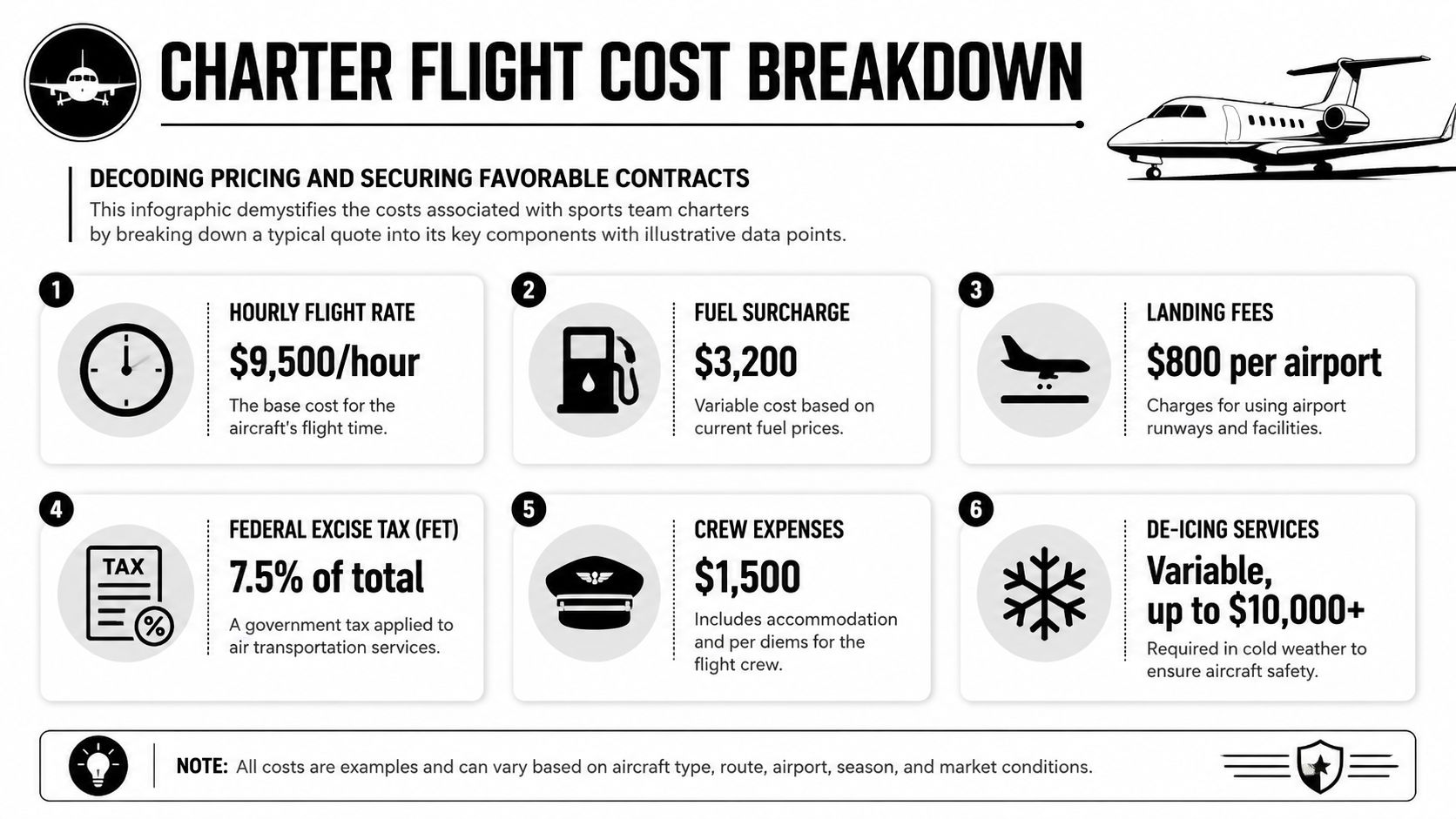
The important lesson isn't any sample number inside a marketing graphic. It's that a quote is built from layers: aircraft time, airport charges, crew costs, weather-related services, and taxes where applicable. Your job is to identify which of those are fixed, which are estimated, and which can expand on departure day.
A few contract questions expose problems quickly:
- Where is the aircraft based: If it isn't already near your departure city, you may be paying to move it into position.
- What triggers extra crew expense: Late departure changes and duty constraints can affect the final bill.
- How are weather services handled: Cold-weather operations can add cost and delay if no one plans for them.
- What's the cancellation language: Team travel changes fast. The penalty schedule matters.
Know where the market splits
Aircraft choice drives cost structure. Smaller teams or college programs often use Embraer 145 or CRJ-200 aircraft at approximately $7,000 per hour, while larger teams in the NFL, NBA, and NHL more often use Boeing aircraft, according to sports charter market overview. The same source notes that the broader US Charter Flights market is projected to reach $52.6 billion in 2026.
That tells you two things. First, there's real supply depth in the market. Second, broad availability doesn't guarantee the right local aircraft at the right time.
Here's where operators and brokers separate themselves. A low quote can hide an inconvenient aircraft position, a fragile crew plan, or weak flexibility if your roster changes. An honest quote usually explains what aircraft is being used, where it's coming from, and what assumptions support the total.
Contract terms that deserve more attention
The most overlooked protections are usually the most boring ones.
- Safety verification: Confirm the operator's third-party audit status and keep written proof in the trip file.
- Specific aircraft language: Make sure the agreement reflects the aircraft type, and where possible, the actual tail assignment once confirmed.
- Delay handling: Spell out what happens if your game, practice, or weather pushes the departure.
- Ground support inclusions: Clarify whether baggage handling coordination and transport timing support are part of the service flow.
For budgeting, it also helps to review how Haute Jets pricing frames charter cost transparency, especially around sourcing and aircraft location. The operational takeaway is simple: if you don't know where the airplane starts its day, you don't yet know the true cost of the trip.
Mastering Ground Operations and In-Flight Coordination
A clean departure can still turn into a messy travel day if the ground plan is weak. Most failures happen after the flight is booked and before the bus leaves the ramp.
The highest-performing team travel departments run the airport like a handoff chain. They know who owns each transfer point, when that handoff occurs, and what backup move applies if one piece slips. That means the operator, FBO, ground transportation lead, equipment staff, and team representative are all working from the same timing plan.
Here's the workflow worth standardizing.
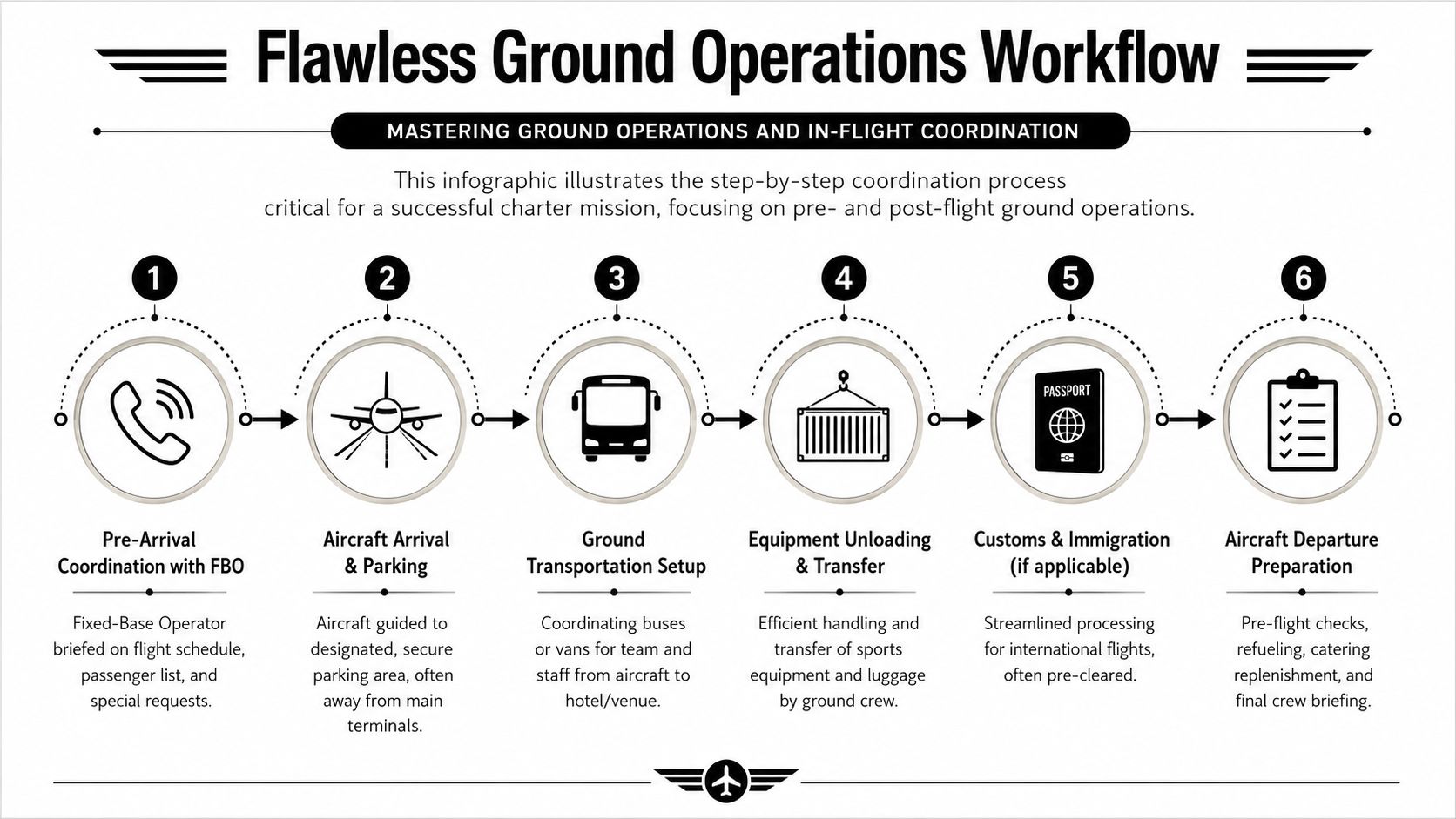
FBO timing is where delays begin
The FBO is not just a private terminal. It's the operating center for your arrival and departure sequence. If the FBO doesn't have the right passenger count, baggage expectations, vehicle plan, and timing updates, your “private” movement becomes disorganized fast.
That risk is measurable. Success rates for sports team charters reach 94.7% when operators hold dual Wyvern Wingman and Argus Gold/Platinum certifications, but a common pitfall remains the 22% incidence of ground transport delays due to uncoordinated FBO arrival slots. Teams that mitigate this see a 35% increase in on-time departure reliability, according to charter efficiency and safety findings.
That's why I tell every travel manager the same thing: your bus plan is part of your flight plan.
If the buses aren't timed to the aircraft door, you don't have ground transportation. You have a delay waiting to happen.
A practical coordination sequence looks like this:
- Lock the arrival slot early: Confirm the FBO can accept the aircraft when you need it, not just sometime in the hour.
- Assign vehicle order: Decide which bus loads first, where staff vehicles stage, and how medical gear moves.
- Name one ramp contact: One person should be accountable for speaking with the FBO on the day.
- Confirm tail-specific details: Equipment handlers and transport leads need accurate aircraft identification before arrival.
Crew rest and cabin execution
Most team staff focus on passengers. Operators also have to protect crew legality. That's not administrative trivia. If the crew times out, your schedule is now irrelevant.
The best operators manage duty limits without making the client absorb every consequence. They flag early if a post-game departure is tight, they build legal rest into the sequence, and they don't wait until the team is at the terminal to disclose a crew problem.
For a quick look at airport-side movement in practice, this walkthrough is useful:
In-flight coordination that actually matters
Don't overload the flight with requests. Focus on what helps performance and simplifies the arrival.
- Seat by function: Keep coaches and analysts where they can work. Give athletes the quietest rest setup possible.
- Load medical essentials in cabin-accessible locations: Don't bury important items under general baggage.
- Keep catering disciplined: Team nutrition should support hydration and recovery, not create cleanup and delay issues before landing.
Ground operations are where polished programs distinguish themselves. The airplane gets the attention. The handoffs decide whether the day runs smoothly.
Building Your Gameday Flight Itinerary and Checklist
It is 5:10 p.m. The buses are loaded, the equipment truck is late, and an assistant coach just added two travelers who were not on the morning list. That is when weak charter planning gets exposed.
A usable itinerary holds up when the day moves. It protects arrival time, crew legality, unloading order, and the handoff to buses and hotel check-in. If one late change forces six phone calls and a pricing dispute, the trip was never built correctly.
Build backward from the real operational deadline
Start with the first moment the team must be functional at destination. That might be hotel check-in, a treatment block, a walkthrough, a meal window, or arena access. Arrival at the airport is only one marker in that chain.
Work backward from that point through drive time, FBO release time, baggage unload, equipment transfer, boarding cutoff, and aircraft door close. Then add margin where delays occur. Security for a charter group may be quick. Bus staging, last-minute manifest changes, and loading oversized gear are what usually consume time.
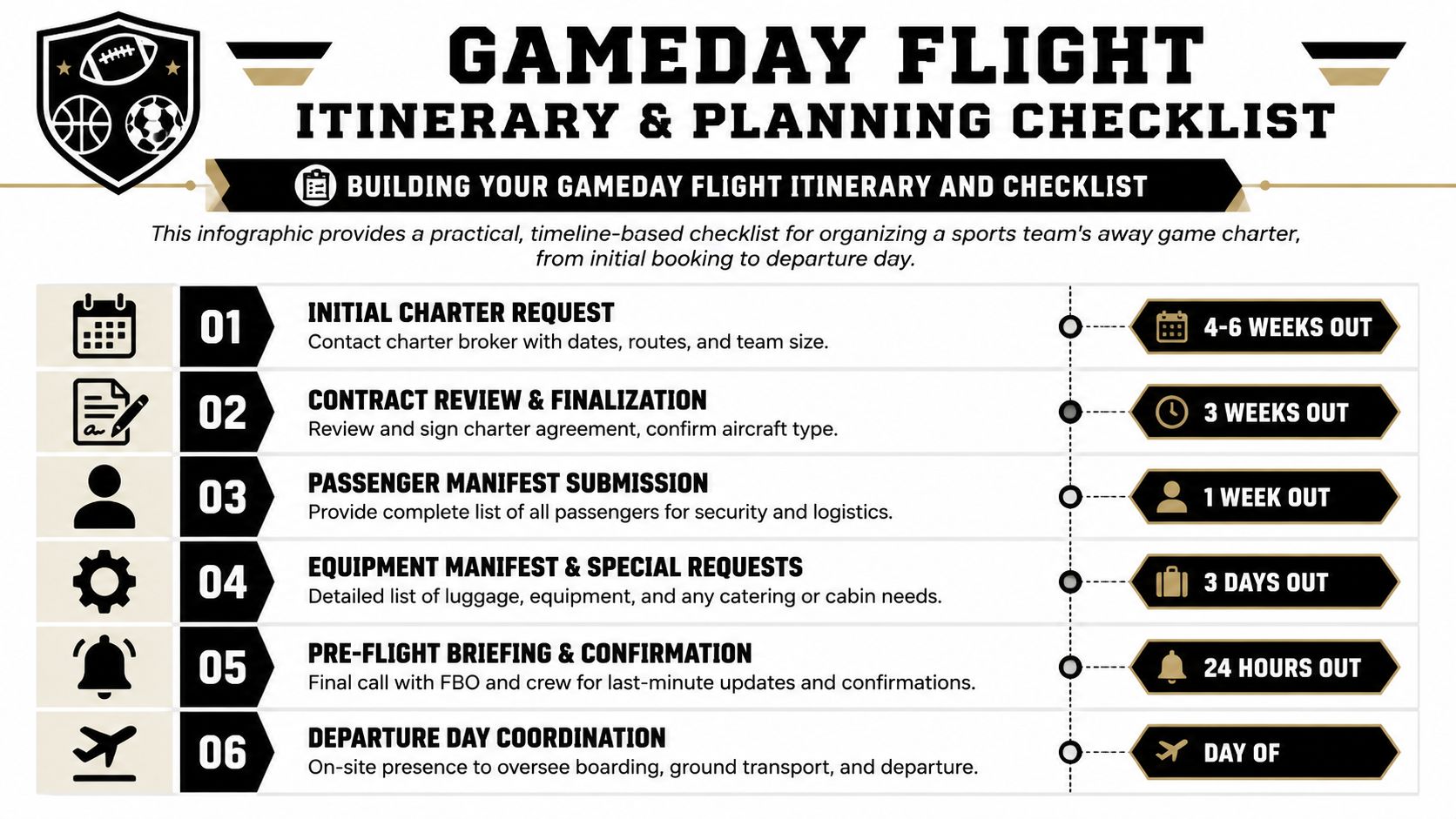
The visual sequence is useful. What matters more is assigning one owner to each checkpoint so nothing sits in a shared inbox waiting for someone else to act.
| Timing window | Owner | Must be locked |
|---|---|---|
| Initial booking phase | Travel manager | Route, travel party estimate, rough equipment profile |
| Contract phase | Travel lead and finance | Aircraft terms, cancellation language, operating assumptions |
| Final manifest phase | Team operations | Passenger list, staff changes, special cabin needs |
| Final preflight phase | Travel manager and operator | FBO timing, buses, catering, equipment handling, crew contacts |
The checklist that catches operational drift
The final checklist is not paperwork. It is a control document for changes that gradually build over a week.
Manifests drift. Equipment counts drift. Bus timing drifts. The danger is not one big failure. It is five small misses that collide at the FBO.
Use one live document with a time stamp and a named owner for every line item. Email threads are poor control tools because old versions keep circulating after the facts have changed. The travel manager should know which version is current without asking.
A working game-trip checklist should cover:
- Passenger manifest control: Confirm active roster, coaches, medical staff, executives, security, and any family or sponsor travelers approved for that leg.
- Equipment release status: Verify what is flying with the team, what is moving by truck, and what must stay cabin-accessible on arrival.
- Cabin priority setup: Note who needs work space, who needs treatment access, and which athletes should be seated for rest rather than conversation.
- FBO operating details: Confirm gate or ramp access, loading window, lav service if required, fueling plan, and the exact point of contact on site.
- Ground transport chain: Reconfirm bus count, truck positioning, driver numbers, police escort if used, and who has authority to release vehicles.
- Recovery and nutrition timing: Match catering, hydration, and hotel food timing to the team plan so arrival does not create a gap in recovery.
- Irregular-ops response: Identify who approves a departure shift, how the operator will communicate crew or airport constraints, and where the team stages if timing slips.
Field advice: Ask one question on the final call. “What changed since yesterday?” That gets better answers than “Are we all set?”
A sample away-game flow
For a standard away trip, source the aircraft early, then tighten the plan in stages as the roster and equipment picture stabilizes. Do not wait for a perfect final count before assigning buses, FBO times, and unloading responsibility. Good plans carry assumptions openly, then replace them with confirmed numbers as the trip gets closer.
On departure day, be at the terminal area before the first bus arrives. Watch the sequence in person. You want eyes on bus arrival order, baggage flow, equipment separation, and the moment the operator starts reconciling the passenger count against the manifest.
That is also where preventable mistakes show up fast. A mislabeled trunk goes to the wrong compartment. A medical case gets loaded out of reach. A bus parks where catering needs to stage. None of those issues look serious in isolation. All of them cost time, and time is usually the one thing the team cannot buy back that day.
Your Partner in Winning Logistics
The flight is never just the flight. It's recovery time, meeting time, treatment time, equipment security, schedule protection, and one less source of friction on a day that already carries enough pressure.
That's why the right charter partner matters as much as the aircraft itself. A capable partner screens operators properly, protects crew legality, verifies the details that affect departure reliability, and catches weak points before your staff sees them. They don't wait for the travel manager to ask the perfect question. They already know where teams get exposed.
The best relationships feel less like vendor management and more like adding a sharp operations specialist to your department. That partner understands that a small manifest error can force a larger aircraft, that an FBO timing miss can delay buses, and that a crew-rest issue discovered too late can derail the entire return plan. None of that shows up in the highlight reel, but all of it affects how a team arrives and how staff performs.
Sports team charter flights work best when everyone involved respects the chain. Coaches focus on competition. Medical staff focus on recovery. Equipment staff focus on readiness. The charter partner handles aviation complexity without creating more work for the team.
If you want athletes stepping off the aircraft rested, organized, and mentally quiet, logistics can't be improvised. They have to be built with intent, checked with discipline, and executed by people who understand that travel is part of performance.
If you need a charter solution built around team operations instead of generic brokerage, Haute Jets offers access to 3,500+ aircraft across 175 countries, sources locally to help avoid unnecessary repositioning costs, works only with Wyvern Wingman and Argus Gold/Platinum-rated operators, and provides 24-hour pre-flight confirmation with the exact aircraft, crew, and trip details your staff needs before departure.