
At 6:10 a.m., your phone lights up with three problems at once. A CFO needs to be in London by tomorrow after a board agenda changes overnight. The commercial route that made sense yesterday is now risky because of a sudden restriction. The executive assistant wants a smooth plan, finance wants the spend justified, and security wants a tighter review of the traveler's exposure from curb to cabin.
That's the true shape of modern travel manager responsibilities. The job still includes flights, hotels, and expense policy, but those are only the visible parts. Underneath sits a much harder mandate: protect people, control spend, support revenue-driving travel, interpret risk in real time, and keep the program aligned with procurement, finance, HR, legal, and sustainability requirements.
On Haute Jets Journal, that matters because the sharpest travel programs don't treat executive travel as a luxury exception. They treat it as a business-critical workflow with higher stakes, narrower margins for error, and a different operating model when private aviation enters the mix.
From Logistics Coordinator to Strategic Partner
The old stereotype of the travel manager was simple: book the trip, confirm the hotel, fix the missed connection. That version of the role is gone.
Take a routine executive movement that stops being routine. A CEO needs to visit two offices, meet an investor, and return in time for an earnings rehearsal. One visa detail changes. A connection becomes unreliable. The traveler's profile means long airport dwell times create unnecessary exposure. Now the decision isn't just where to book. It's whether to reroute, whether to split the party, whether to shift to private charter for control and security, and how to document the decision so finance and leadership understand why it was the right call. That's strategy, not administration.

What changed in the role
A useful benchmark comes from BCD Travel's survey of global travel buyers. It found that 68% of modern travel managers personally handle travel sourcing, and 51% oversee payment and expense management. That tells you where the role has moved. The travel manager now sits inside sourcing, policy, supplier governance, and financial controls.
In practice, that means the travel manager is often the person who can answer all of these at once:
- Program question: Which booking path fits policy and traveler needs?
- Finance question: Is this spend justified, coded correctly, and likely to repeat?
- Risk question: What's the exposure if this traveler gets stranded or rerouted?
- Leadership question: Does this itinerary protect time, confidentiality, and decision-making capacity?
That's why travel manager responsibilities now overlap with operational leadership. The job connects people who rarely see the full picture on their own.
Practical rule: If your travel manager only owns ticketing, your company has under-scoped the role.
Why executive travel changes the equation
Executive travel amplifies every weakness in a program. A poor handoff, an unclear policy exception, or a weak operator review becomes much more serious when the traveler is a board member, founder, or public-facing executive.
That's also why many companies reassess private aviation through a strategic lens rather than a prestige lens. The right use case isn't “private for everything.” It's selective deployment where time sensitivity, security, schedule control, or access make the trip materially better for the business. This is explored well in the strategic advantages of private charter for corporate travelers.
Designing Strategic Travel and Expense Policies
A weak travel policy creates friction everywhere. Travelers work around it, finance cleans up after it, and procurement loses its influence because behavior is inconsistent. A strong policy does the opposite. It gives people a clear operating framework, leaves room for justified exceptions, and makes enforcement easier because the rules match how the business functions.
Build a policy people can follow
The best policies answer practical questions before they become escalations. They define approved booking channels, air and hotel class rules, ground transport standards, expense categories, approval thresholds, and exception authority. They also spell out what changes for executives, critical client travel, and crisis situations.
A usable policy usually includes these elements:
- Booking path: State where travelers must book and when offline support is allowed.
- Approval logic: Match approvals to trip type, spend level, and traveler seniority.
- Expense boundaries: Define reimbursable items, non-reimbursable items, and documentation requirements.
- Exception handling: Give travelers and assistants a real process for urgent or justified deviations.
- Duty of care triggers: Clarify when the company can override a cheaper option because of risk, fatigue, routing complexity, or traveler profile.
When those rules are vague, people invent their own. That's where leakage starts.
Write for behavior, not for compliance theater
Policies fail when they read like legal disclaimers. They work when they reflect actual travel behavior. If your sales team books late because client schedules change, your policy needs a workable late-booking process. If your executives travel with security, medical, or confidentiality requirements, the policy needs a separate standard for those cases.
A travel policy should answer, “What should I do next?” It shouldn't force the traveler to guess who has authority in the middle of a disruption.
This is also where expense tooling matters. If your team is still reconciling domestic travel with email threads and spreadsheets, you're creating policy drift. For teams refining workflow and receipt capture, Snyp's domestic expense tracking is a useful reference point for how a cleaner process supports policy adherence.
Supplier management is part of policy design
A policy is only as strong as the suppliers behind it. Travel managers have to vet airlines, hotel programs, ground transport providers, and booking channels based on service reliability, flexibility, traveler support, data quality, and escalation paths.
Budget matters, but support quality matters too. A cheaper hotel rate loses value fast if the property can't handle late arrivals, executive privacy requests, or disruption support. The same principle applies to air.
According to GBTA guidance cited here, effective corporate travel management can reduce overall travel expenses by up to 30%. That's why policy and supplier negotiation belong together. The savings don't come from random cuts. They come from structured demand, preferred supplier use, and consistent enforcement.
Private aviation requires a separate policy standard
Executive and private aviation shouldn't be tucked into a footnote. It needs its own decision criteria.
Use a separate review framework for charter and other private air options:
| Decision area | What to define |
|---|---|
| Eligibility | Which travelers or trip types qualify for private aviation review |
| Business case | Time saved, routing efficiency, confidentiality, or operational necessity |
| Safety review | Operator must meet recognized third-party audit standards such as Wyvern Wingman or Argus Platinum |
| Approval authority | Who signs off, and what documentation is required |
| Service standards | Aircraft suitability, Wi-Fi, catering, manifest control, and ground transport coordination |
That last point gets overlooked. The aircraft category alone isn't enough. Travel managers need to check operator credentials, airport access, passenger handling, and whether the flight profile matches the mission. Short runway access, same-day turns, and multi-stop itineraries change the decision.
Mastering Budget Oversight and Cost Control
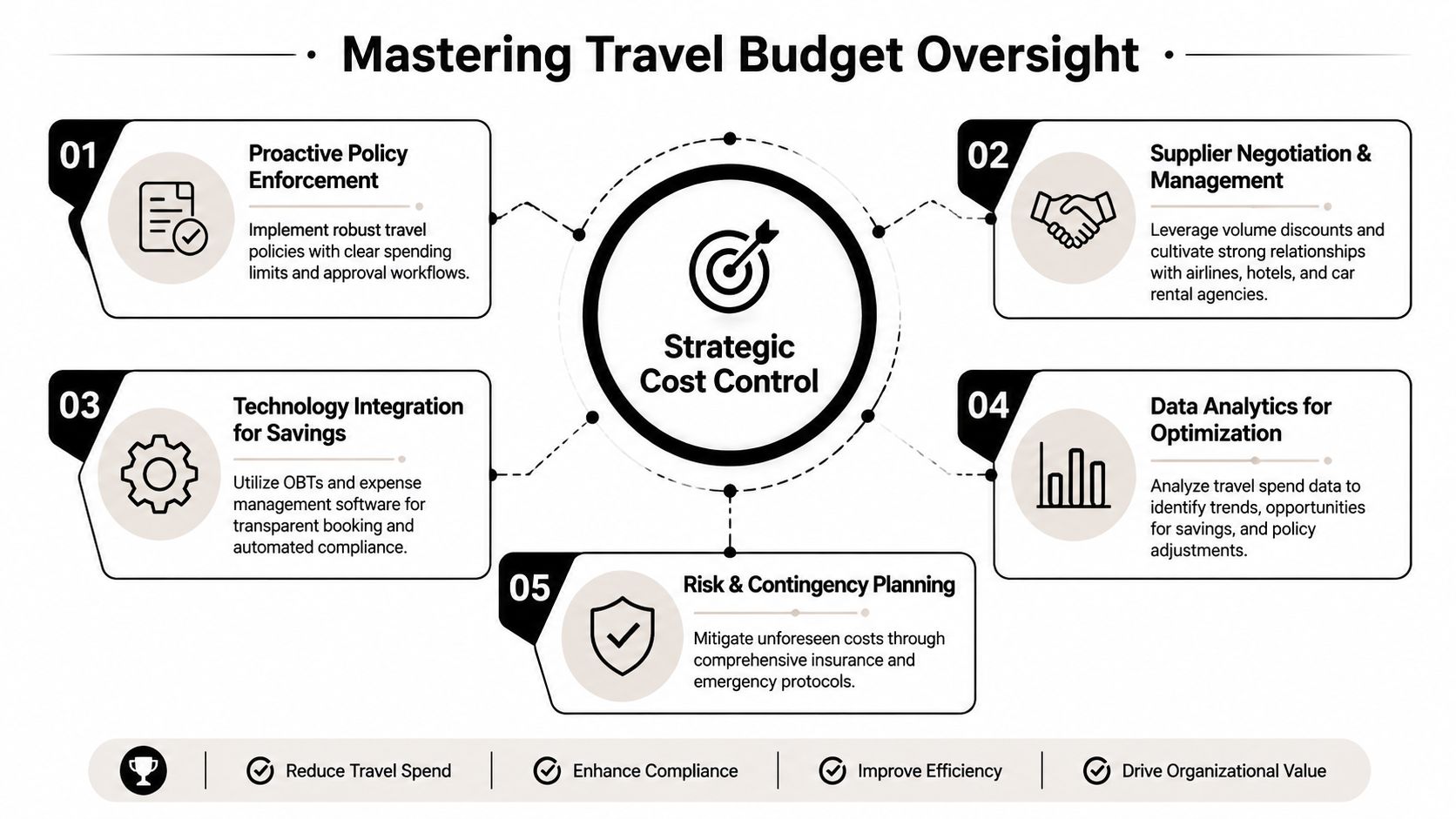
Cost control in corporate travel isn't just about buying cheaper tickets. It's about managing the total cost of movement. That includes fare, hotel rate, change exposure, lost executive time, disruption recovery, and the hidden cost of poor routing choices.
The fastest way to lose control is to focus only on visible line items.
Hard savings versus soft savings
Most travel programs track negotiated discounts and call that success. That's incomplete. Good travel managers separate hard savings from soft savings.
| Type | What it looks like |
|---|---|
| Hard savings | Lower contracted hotel rates, airline discounts, negotiated cancellation terms |
| Soft savings | Avoided last-minute rebooking costs, fewer out-of-policy bookings, less executive downtime, lower disruption fallout |
Both matter. One is easy to report. The other often has more business impact.
A common example is executive travel between cities with poor commercial timing. A charter option may look more expensive than a single published fare. But if the commercial itinerary requires an overnight stay, driver transfers, schedule padding, and a lost half day from a senior leadership team, the comparison changes. The smart move is to compare mission cost, not ticket cost.
What to watch in your spend data
Travel managers need spend visibility that goes beyond monthly totals. The data should show where behavior is drifting and where supplier terms no longer match reality.
Focus your review on patterns such as:
- Advance purchase erosion: Are teams booking later than the policy assumes?
- Route-level anomalies: Which city pairs keep producing exception requests?
- Hotel leakage: Are travelers selecting outside the preferred program because inventory, location, or service standards are misaligned?
- Change and cancellation patterns: Which departments create the most avoidable waste?
- Executive trip concentration: Which high-touch trips deserve a separate sourcing model?
The most useful travel data doesn't just explain what happened. It shows where your policy no longer matches the business.
Choose the right private aviation buying model
For executive travel, travel managers also need to compare on-demand charter, jet cards, and fractional structures with a clear head. In doing so, procurement discipline becomes vital.
On-demand charter works well when travel is variable, route patterns change, and the company wants flexibility without committing to prepaid hours. Jet cards can simplify access, but they may limit aircraft choice and pricing transparency. Fractional structures may suit predictable, heavy private flying, but they can be too rigid for companies with fluctuating demand.
That's why I prefer a use-case review before a program commitment. Ask:
- Is the flight pattern predictable or highly variable?
- Does the company need guaranteed access or aircraft flexibility?
- Are the travelers concentrated in one region or spread globally?
- Will the model still make sense when leadership travel shifts next quarter?
For a broader look at business aviation use cases, this guide to private jet charter for business and corporate teams in 2026 is a practical companion.
Control costs without damaging the traveler experience
Bad cost control creates rebellion. Good cost control creates trust.
That means enforcing policy where it should be firm and allowing flexibility where the business case is real. If travelers believe the program ignores productivity, safety, or trip purpose, they'll route around it. If they see that exceptions are documented and rational, compliance gets easier.
Upholding Duty of Care and Advanced Risk Management
Duty of care used to be treated like a checklist. Send the itinerary. Share the emergency number. Hope nothing goes wrong. That approach doesn't hold up anymore.
The job now is closer to live operations. The travel manager has to monitor traveler location, itinerary changes, country conditions, entry rules, and vendor response quality while deciding when to intervene. That's especially true when executives travel into volatile environments or work on compressed schedules where one missed segment can break the entire trip.
Risk management is a continuous process
One of the clearest signs of this shift is the amount of time travel managers spend communicating during disruptions. Recent survey data indicates 53% of travel managers' time is now spent on traveler communication during disruptions, a point noted in the earlier BCD Travel survey. The operational implication is bigger than the number itself. It means the role has moved from pre-trip setup to real-time orchestration.
That matters because modern risk tools don't just issue alerts. They produce streams of intelligence. AI-driven platforms can flag weather shifts, civil unrest, airport closures, health issues, and itinerary exposure faster than a manual process can. But the tool doesn't make the decision. The travel manager does.
What acting on AI risk signals actually looks like
When a platform flags rising risk, the travel manager has to judge three things quickly:
- Severity: Is this informational, disruptive, or dangerous?
- Exposure: Which travelers, executives, assistants, or crews are affected?
- Action path: Hold, reroute, extract, delay, or move the trip to a different operating model
That sounds straightforward until several hundred travelers are moving at once. Then communication discipline matters as much as the booking itself.
A workable operating rhythm looks like this:
- Confirm traveler location and trip criticality.
- Classify the event by safety impact, not just inconvenience.
- Create a response group that includes security, HR, executive support, and any local stakeholders needed.
- Issue one authoritative traveler message instead of multiple fragmented updates.
- Document every intervention in case legal or compliance teams review the response later.
If your risk process depends on someone noticing a news alert and forwarding it manually, you don't have a duty of care program. You have a hope-based process.
Executive travel raises the standard
Executive movements need tighter controls because the risks are broader. The traveler may have public visibility, earnings sensitivity, or a schedule where privacy and continuity matter as much as speed.
For executive travel, the travel manager's duty of care includes staying current on regulations, visa requirements, and health advisories, helping with travel documents, and maintaining support during disruptions or emergencies, as described in this executive travel overview. That's a very different responsibility from basic trip booking.
For private aviation, the standard rises again. The operator review has to cover recognized safety credentials, crew quality, aircraft suitability, manifest handling, and FBO coordination. A travel manager should also know who owns the communication chain if weather, maintenance, or security changes force a same-day pivot.
What doesn't work
Some companies still rely on static pre-trip memos, fragmented booking data, and a generic emergency contact line. That setup fails under pressure.
The weak points are usually predictable:
| Failure point | Why it causes trouble |
|---|---|
| Scattered bookings | You can't locate or support travelers quickly |
| Unclear escalation | Security, HR, and assistants duplicate effort |
| No executive protocol | High-profile travelers get handled like routine travelers |
| Late intervention | Small disruptions become exposure events |
A mature program treats duty of care as an operating discipline. It isn't a separate add-on. It shapes policy, technology, supplier choice, and approval logic across the whole travel program.
Implementing Technology and Measuring Performance
Travel programs break when the systems don't talk to each other. Booking sits in one place, card data in another, duty of care alerts in a third, and reporting arrives too late to change behavior. The result is manual patchwork and weak decision-making.
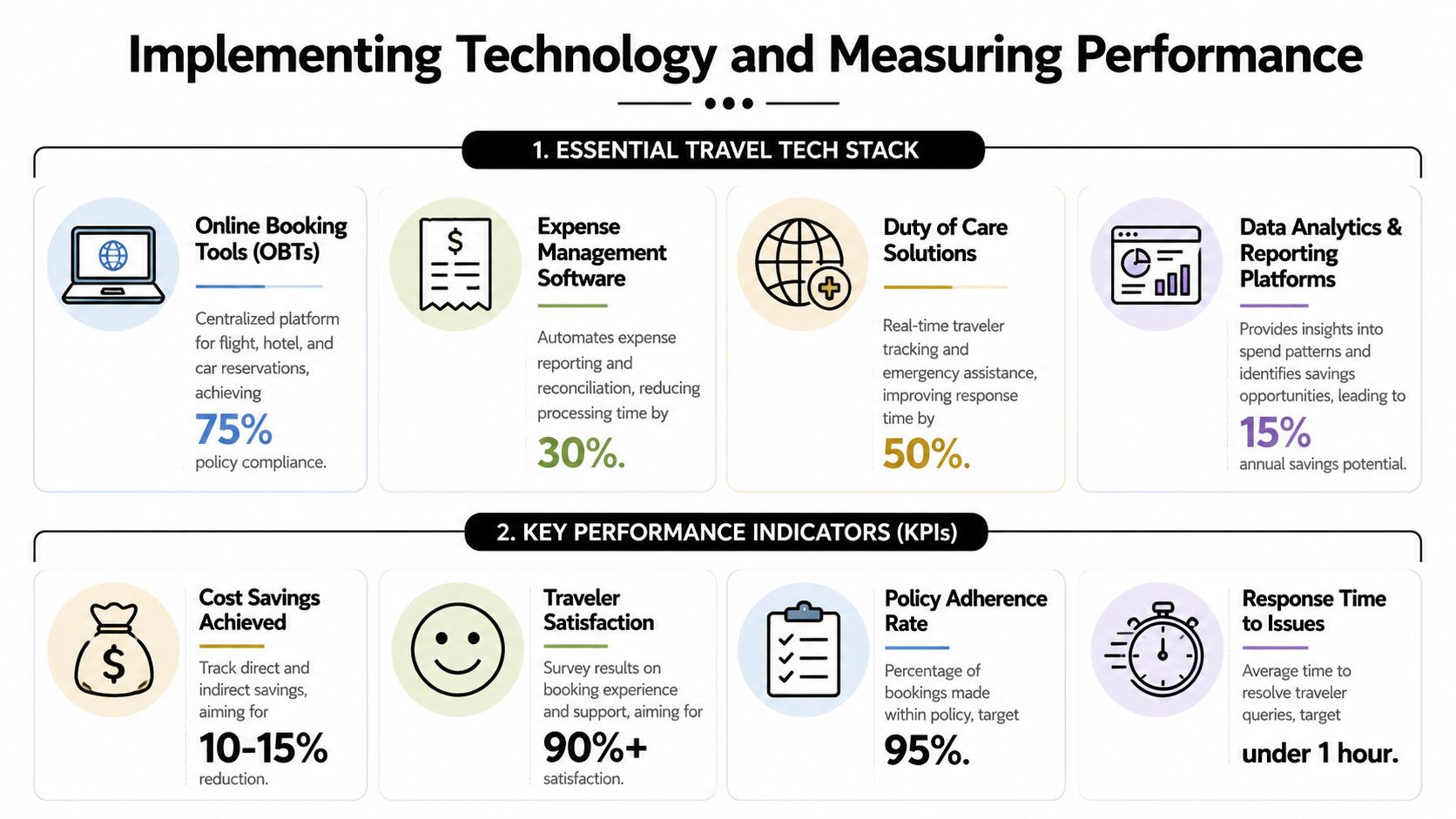
The strongest programs use a connected stack. Online booking tools, expense systems, traveler messaging, risk dashboards, and reporting workflows need to support one another, not compete for ownership.
Build the stack around workflow
Start with the traveler journey, not the vendor demo. A good stack should support request, approval, booking, payment, disruption handling, expense capture, and reporting with minimal rework.
The core layers usually include:
- Booking control: Online booking tool or managed booking path with policy logic
- Expense automation: Receipt capture, card reconciliation, and approval workflow
- Risk visibility: Traveler tracking, alerting, and emergency messaging
- Analytics: Spend, supplier, exception, and compliance reporting
- Mobile support: Easy traveler access to itinerary, changes, and support
If any one of those layers is weak, the travel manager spends too much time fixing preventable issues. For teams evaluating the category, this overview of corporate travel management software is a helpful starting point because it frames the tooling around real operating needs rather than feature overload.
Measure the program like a business function
A travel program needs KPIs, but not vanity KPIs. If all you report is average ticket price, leadership still won't know whether the program is effective.
Use a balanced scorecard instead.
Operational KPIs
These show whether the machine is running:
- Policy compliance rate
- Online adoption or approved-channel usage
- Average booking lead time
- Issue resolution speed
- Supplier service performance
Financial KPIs
These show whether the program is controlled:
- Spend by department and route
- Exception-driven cost exposure
- Unused ticket or credit recovery
- Hotel attachment and preferred supplier share
- Executive travel mission cost by trip type
Traveler-focused KPIs
These show whether the program is usable:
- Traveler satisfaction
- Support quality during disruptions
- Booking friction
- Executive assistant feedback
- Repeat exception themes
Field note: If a KPI can't trigger a decision, it's probably just dashboard decoration.
Use KPIs to improve policy, not just report up
A common pitfall for many travel managers is that they build reports for finance and never use them to redesign the program.
For example, if you see repeated policy exceptions on a single route, the answer may not be stricter enforcement. It may be that the preferred itinerary is unrealistic for the people taking the trip. If executive assistants keep bypassing the approved booking path, the issue may be workflow speed rather than noncompliance.
The point of measuring travel manager responsibilities isn't to create a prettier monthly report. It's to tighten policy, remove avoidable friction, and prove that travel is being managed as a business system.
Navigating the New ESG and Sustainability Mandate
A lot of companies still talk about sustainability in travel as if it's a nice extra. It isn't. It has become part of compliance, reporting, supplier strategy, and executive decision-making.
The hard part is that the mandate has moved faster than training. While 68% of organizations now require carbon reporting for travel, only 22% of travel professionals feel adequately trained on specific ESG metrics like negotiating for sustainable aviation fuel premiums, with the stakes rising under upcoming 2026 EU and US regulatory pressure. That gap is where travel managers now have to operate.
Sustainability is now a program design issue
This changes the job in very practical ways. The travel manager can't leave emissions questions to an annual CSR summary. Carbon reporting has to connect to booking behavior, supplier selection, and trip approvals.
That means folding sustainability into everyday decisions such as:
- Mode choice: When rail is a viable substitute for short-haul air, the program should say so
- Airline conversations: Ask what data the carrier can provide and how emissions reporting will flow
- Hotel sourcing: Prefer properties with credible environmental standards and reliable reporting
- Approval criteria: High-emission exceptions should have a documented business rationale
- Traveler communication: Make the sustainable choice visible and easy, not hidden and inconvenient
Private aviation needs a more disciplined ESG lens
Such discussions often begin with hand-waving. The right answer isn't to pretend private aviation has no sustainability implications. The right answer is to apply disciplined governance.
For executive and private flights, travel managers should document:
| ESG area | What to review |
|---|---|
| Trip necessity | Why this routing or timing requires private lift |
| Aircraft fit | Match aircraft size and range to the mission |
| Operator practices | Ask about fuel strategy, reporting, and operational efficiency |
| SAF access | Determine whether sustainable aviation fuel options are available and how they're handled |
| Disclosure trail | Ensure flight activity can be captured for reporting and internal review |
That's a stronger position than generic “green travel” language because it ties sustainability to procurement and recordkeeping.
For a more detailed look at this side of business aviation, green initiatives in private aviation offers useful context.
Sustainability stops being performative when it changes sourcing, approvals, and reporting.
What works in practice
The companies making progress usually do a few things consistently.
- They start with data quality. If travel data is fragmented, carbon reporting will be weak.
- They define ownership. Someone has to own travel emissions logic, supplier questions, and reporting quality.
- They align finance and procurement early. ESG travel decisions often affect contracts, budgets, and policy.
- They train for specifics. Travelers don't need a manifesto. Travel managers need operational guidance on SAF, reporting logic, and supplier documentation.
The biggest mistake is treating ESG as a communications exercise. For the travel manager, it's becoming a control function.
The Travel Manager Toolkit and Job Template
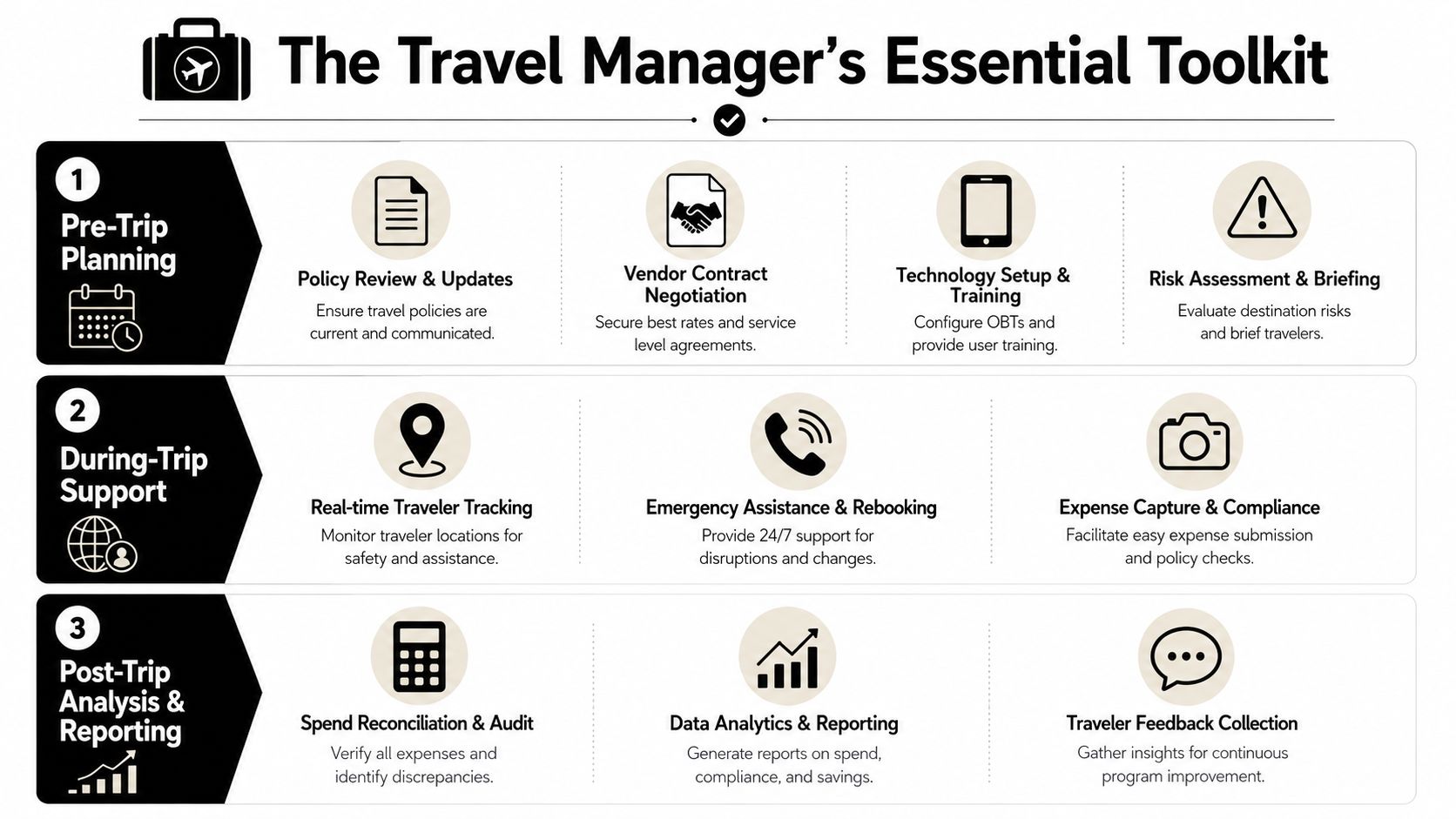
Most companies don't struggle because they lack intent. They struggle because the role has too many moving parts and no practical operating cadence. The fix is to make travel manager responsibilities visible in routines, templates, and accountability.
A working checklist by cadence
Daily
- Review active trips: Check disruptions, high-risk destinations, and executive movements.
- Monitor exceptions: Approve, reject, or escalate policy deviations quickly.
- Watch traveler support queues: Resolve rebooking, document, and payment problems before they compound.
- Track risk alerts: Verify whether any event requires traveler communication or itinerary intervention.
Weekly
- Meet with finance or procurement: Review spend anomalies, supplier issues, and payment exceptions.
- Audit executive travel workflows: Check whether assistant, security, and traveler handoffs are clean.
- Inspect booking channel performance: Identify leakage and workflow friction.
- Review traveler feedback: Spot recurring complaints before they turn into workarounds.
Monthly
- Reconcile spend and unused credits
- Review supplier performance
- Update policy FAQs and exception guidance
- Assess ESG data capture quality
- Test escalation procedures
Quarterly
- Renegotiate where needed
- Reassess preferred suppliers and route logic
- Review private aviation decision criteria
- Present KPI trends to leadership
- Refresh travel risk and incident protocols
A modern travel manager job template
Use this as a baseline for hiring.
Role title
Travel Manager
Role purpose
Own the company's travel program across policy, sourcing, booking governance, budget oversight, traveler support, risk management, supplier performance, executive travel, and sustainability reporting.
Core responsibilities
- Manage travel policy, approval workflows, and exception handling
- Oversee supplier selection, negotiations, and service performance
- Control travel and expense processes with finance alignment
- Lead duty of care operations, traveler communication, and disruption response
- Support executive travel with enhanced privacy, security, and service requirements
- Evaluate when private aviation is justified based on business need, safety, and total mission cost
- Maintain accurate travel data, reporting, and KPI dashboards
- Support travel-related ESG reporting and sustainability program execution
Required capabilities
- Strong commercial judgment
- Fluency in travel sourcing and T&E controls
- Comfort with crisis response and traveler communication
- Ability to work across finance, HR, procurement, legal, and executive support
- Understanding of private aviation safety review, operator vetting, and high-touch itinerary management
- High attention to detail under time pressure
What success looks like
The right person doesn't just book travel. They create a controlled, responsive, defensible travel program that protects travelers and supports the business.
If your team needs executive travel handled with tighter aircraft sourcing, stronger safety standards, and clearer cost control, Haute Jets is built for that operating reality. Their model gives companies access to Wyvern and Argus-rated operators, exact-aircraft sourcing, and on-demand charter without locking the program into memberships or jet cards.