
A client calls on a Thursday afternoon. He wants wheels up the next morning for Los Cabos, with a return held open because the house deal may close early. Another wants Mexico City for meetings, then a same-trip reposition to the coast. Both assume private aviation makes it simple. It does, but only because someone handles the details before the aircraft door closes.
This is the key aspect of travel restrictions in Mexico for private flyers. The trip itself can feel effortless. The planning cannot be casual.
Mexico is workable, accessible, and routine for experienced operators. It's also a market where entry formalities, regional security posture, airport handling, customs sequencing, and ground transport decisions matter more than most travelers realize. If you treat it like a domestic shuttle with a passport check, you create risk. If you treat it like a properly managed international movement, it runs cleanly.
Seamless Mexico Travel by Private Jet
A last-minute Mexico itinerary usually starts with urgency. The family wants to make dinner at the villa. The CEO wants to land, clear quickly, and be in the car without touching a crowded terminal. The aircraft can be arranged fast. The question is whether the rest of the chain is aligned.

Private aviation gives you control over departure time, airport access, cabin privacy, and on-arrival discretion. That advantage becomes obvious the moment you route through a proper private terminal environment. If you want a clear picture of that experience, this look at private FBO terminals for jet travelers captures why serious travelers rarely go back to the commercial process.
What serious travelers get wrong
The mistake isn't booking the aircraft. The mistake is assuming Mexico is operationally identical across every destination.
A beach arrival in a well-trafficked corridor, a business stop in a major city, and a landing in a more sensitive region require different handling logic. The aircraft, crew, handler, customs sequence, vehicle dispatch, and timing all need to line up with the destination, not with your assumptions.
Private travel feels spontaneous only when the administrative work is done early and done correctly.
That's why seasoned travelers rely on a logistics-first approach. Passports are checked before departure. Arrival documentation is reviewed before takeoff. Ground transport is arranged before the wheels touch down. Security posture is tied to the exact state and route, not to broad impressions about the country.
The right mindset
Mexico is not a place to be nervous about. It is a place to be precise about.
If your flight team plans the sequence properly, the trip is smooth: direct apron access, fast clearance, controlled baggage handling, and a car already waiting under a name the principal recognizes. That's the standard. Anything less is amateur hour.
Core Entry Requirements Visas and FMM
Your aircraft can be confirmed, the handler can be ready, and the car can be staged on the apron. Entry still slows down if your immigration file is sloppy. In Mexico, private aviation gives you speed on the ground, not a free pass on entry rules.
For many private travelers, Mexico does not require a visa for short tourism or business visits. The part that gets mishandled is duration. Canadian government guidance notes that visitors may be admitted for up to 180 days, but the immigration officer decides the authorized stay on arrival, and land arrivals generally must complete an FMM unless they qualify for a narrow northern border exception under 72 hours, within 21 km of the U.S. border, as outlined in the Government of Canada's Mexico entry guidance.
That decision point matters.
I tell clients to stop planning around the maximum and start planning around what they can support clearly at inspection. If you are arriving by private jet for meetings in Monterrey, then extending to Los Cabos for family time, your story, schedule, lodging details, and departure plan need to match. Private terminals are efficient, but immigration officers still look for consistency.
The cleanest approach is simple. Build an arrival file that answers questions before they are asked.
- Passport details must match the manifest exactly. Full legal name, number, and nationality should be identical across every flight and handling document.
- Trip purpose must be stated in plain language. Tourism, investor meetings, property visits, family travel, or a mixed itinerary should be described clearly and consistently.
- Lodging and host details should be ready before departure. Give your team the first-night address, local contact, and any residence or villa information in advance.
- Onward planning should be credible. A flexible departure date is fine. A vague explanation is not.
- Business travelers should separate visitor activity from work authorization issues. Meetings and site visits are one thing. Productive work in-country is another. Clear legal positioning avoids problems.
The FMM point deserves attention because it exposes a bigger rule. Mexico ties lawful stay to formal entry processing. For private aviation clients, that means the handler, crew, and principal should all be working from the same approved itinerary and passenger data before wheels up. Last-minute name corrections, undeclared schedule shifts, or casual answers at immigration create delays that should never happen on a well-managed trip.
If you are staying longer, relocating part-time, or structuring repeated entries, pair immigration planning with medical coverage planning early. This guide to expat health insurance in Mexico is a useful reference for travelers whose trips go beyond a short resort stay.
My recommendation is straightforward. Treat entry clearance like part of the flight operation, not an afterthought. The clients who clear quickly are not lucky. They arrive prepared, consistent, and easy to process.
Health Safety and Regional Security Advisories
Your aircraft can be cleared, your passengers can be documented, and your bags can be in order. A poorly timed road transfer can still turn the arrival into the weakest part of the trip. In Mexico, health planning and regional security planning belong inside the flight operation, not outside it.
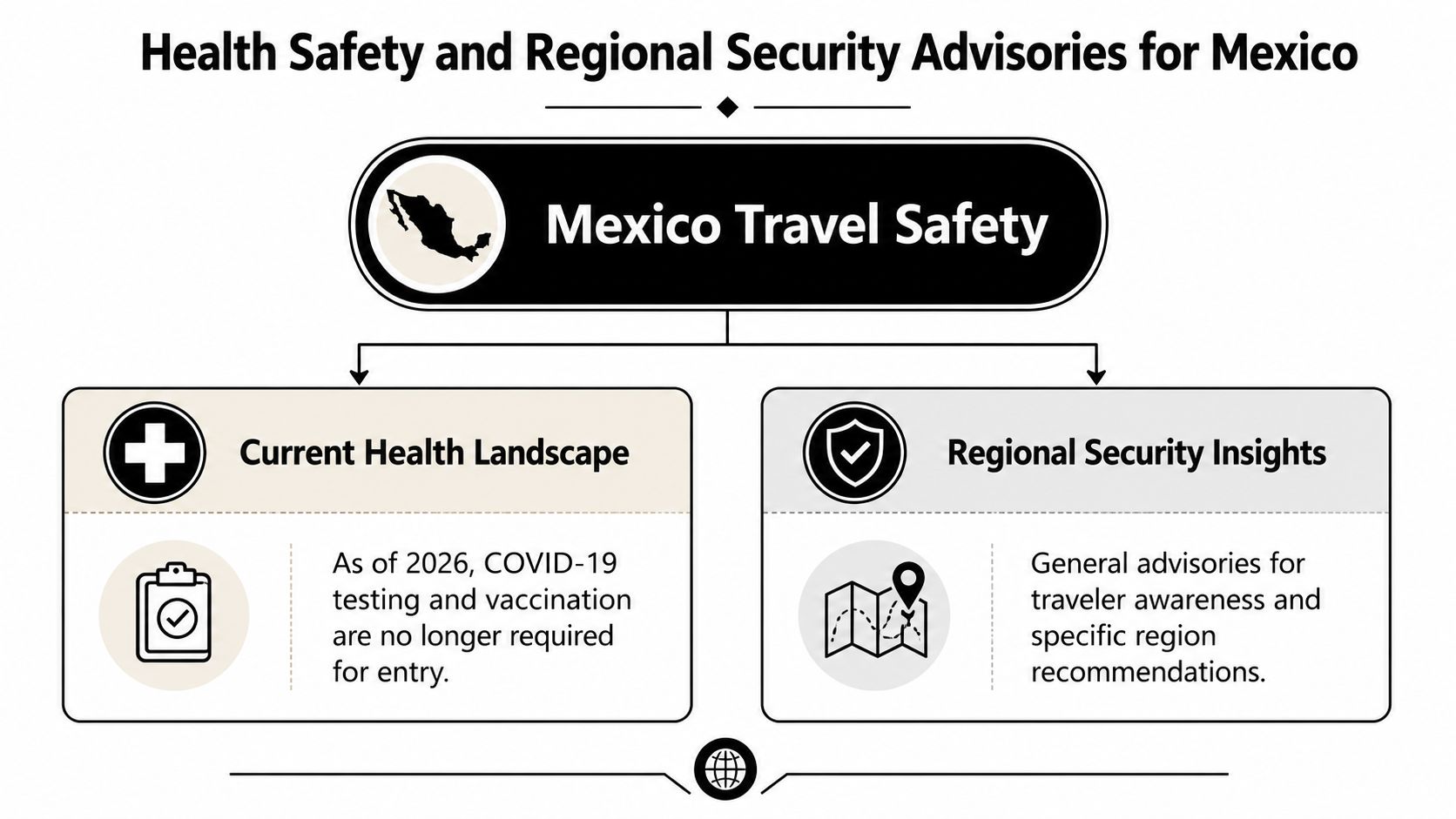
Mexico is not one operating environment. Risk changes by state, airport, and ground route. The current U.S. State Department Mexico advisory also makes clear that U.S. government personnel in certain areas follow concrete movement restrictions, including limits on intercity travel after dark and the use of controlled transportation. Private travelers should treat that as a practical benchmark, not background reading.
What that means for a private itinerary
The right question is not whether Mexico is “safe.” The right question is whether your exact movement plan is controlled.
For private aviation, that starts before landing. Choose airports that support orderly customs processing and coordinated handoff to vetted ground transport. If your route requires a long drive after arrival, adjust the wheels-down time or use a different airport. If the destination depends on unsecured road movement at night, change the plan.
I advise clients to evaluate three points with their flight department or broker:
| Operating concern | Recommended response |
|---|---|
| Regional conditions vary sharply | Build around the specific state, arrival airport, FBO, and road segment |
| Night transfers create avoidable exposure | Schedule arrival with daylight margin for customs, baggage, and onward transport |
| Uncontrolled pickups add unnecessary risk | Dispatch vetted vehicles through the handler, security team, or trusted local provider |
That is the private-jet standard. The aircraft only solves part of the problem. The handoff on the ground decides whether the trip stays controlled.
A disciplined arrival plan usually includes a named driver, vehicle details in advance, a direct route to the destination, and no improvised stops. If the principal is visiting multiple regions, review each leg separately. Cabo, Mexico City, Monterrey, and interior resort areas do not call for the same posture.
For a broader look at how private terminals, customs handling, and arrival procedures should be coordinated, review this guide to the customs and immigration process when flying overseas in a private jet.
Health planning for private travelers
Health restrictions no longer drive most Mexico entries, but medical preparation still matters, especially for longer stays, family travel, seasonal residence patterns, or staff accompanying the principal. Keep medications accessible in cabin baggage, confirm where private care is available near each stop, and make sure the lead traveler and support team know the response plan before departure.
If your travel extends beyond a short leisure stay, this guide to expat health insurance in Mexico is a useful reference.
My recommendation is straightforward. Control the ground segment as tightly as the flight segment, keep daylight on your side where practical, and treat medical access as part of itinerary design. That is how experienced operators keep Mexico trips smooth, discreet, and predictable.
Customs Declarations for Luxury Travelers
Customs problems in Mexico usually don't come from the aircraft. They come from what's inside the luggage.
Luxury travelers carry things that attract scrutiny without looking unusual to them. Watches, jewelry rolls, camera kits, prescription medication, sample products, business materials, cash, rare bottles, or gifts for hosts can all complicate arrival if they're packed casually and discussed vaguely.
What deserves extra attention
If you're arriving by private jet, assume customs officers expect a polished answer about anything valuable, unusual, or commercial-looking. That doesn't mean there's a problem. It means your explanation should be ready before anyone asks.
Focus on these categories:
- High-value personal items: Jewelry, watches, luxury handbags, cameras, and electronics should be packed in a way that makes ownership and personal use easy to explain.
- Medication and wellness items: Keep them in original packaging where possible, especially if they're specialized or prescription-based.
- Business materials: Product samples, branded materials, and technical equipment can look commercial if they aren't documented clearly.
- Cash and negotiable instruments: If you're traveling with substantial funds, treat declaration requirements seriously and handle them in advance with your advisor.
How to avoid the classic delay
The worst customs answer is a casual one. “It's just some personal stuff” invites more questions, not fewer.
A cleaner approach is to prepare a short internal inventory before departure. You don't need drama. You need order.
| Item type | Best practice |
|---|---|
| Jewelry and watches | Travel with a concise item list and keep pieces attributable to personal use |
| Electronics and camera gear | Separate personal devices from professional kits and label cases clearly |
| Gifts and specialty goods | Know what each item is, why you're carrying it, and who it's for |
For travelers managing a cross-border move, household shipment, or extended stay, this guide for international relocation offers a practical overview of how customs timing and process can affect planning. It's useful context even if you're arriving on a private aircraft rather than moving freight.
Why private aviation helps, but doesn't exempt you
Private terminals and FBO-driven arrivals are faster and more discreet, but they don't remove customs obligations. They allow those obligations to occur in a more controlled environment.
That's why experienced flyers value a structured overseas arrival process. This overview of the customs and immigration process when flying overseas in a private jet is worth reviewing if you want a better sense of how international private arrivals are sequenced.
The rule is simple. If an item would be painful to explain under pressure, prepare the explanation before departure.
Private Aviation Procedures and Permits
Behind the scenes, extensive effort is required. Clients see a departure board with one flight. Operators see permits, airport slots, handler coordination, passenger data, crew legality, customs timing, parking availability, fuel planning, and the ground segment waiting at the far end.
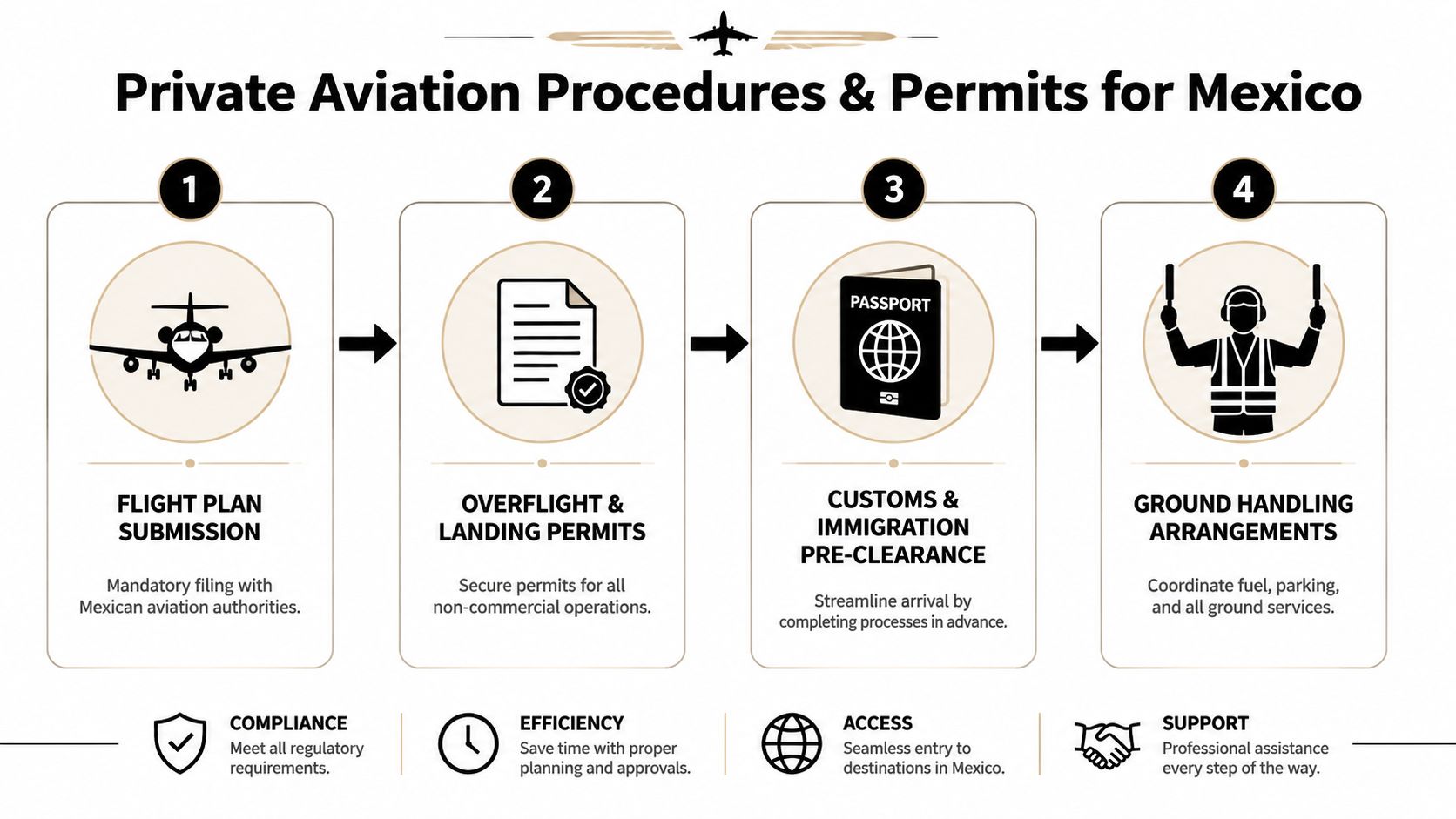
A Mexico private flight runs well when those elements are built as one operation rather than handed off piecemeal. That's the difference between “the jet is booked” and “the trip is covered.”
The four moving parts that matter most
A disciplined Mexico operation usually revolves around four control points.
Flight permissions
Private international flights into Mexico typically require proper operating approvals before departure. Depending on the aircraft, route, and destination, that can include overflight and landing permissions coordinated with the relevant authorities and local ground handlers.
This is not the place for loose timing. Last-minute changes can be possible, but only when the paperwork trail is clean and the handler is already in motion.
Passenger data and manifest accuracy
International private flights depend on accurate passenger information. Names, passport details, routing, and onboard changes must match what's been filed.
The glamorous version of private travel says you can swap passengers at the last second and sort it out on the ramp. Sometimes you can. Often you shouldn't. Manifest discipline is one of the easiest ways to avoid self-inflicted delays.
Customs and immigration sequencing
The best Mexico arrivals use airports and FBO arrangements that make customs and immigration efficient, discreet, and predictable. That doesn't mean every airport offers the same experience.
A strong operator chooses the airport and arrival window with the full process in mind:
- Customs flow: How quickly can passengers clear after shutdown?
- Ramp access: How close can ground transport stage to the aircraft or terminal?
- Parking and handling support: Can the aircraft remain, reposition, or depart on the needed schedule?
- Crew practicality: Are the crew's own handling and rest requirements manageable?
A quick operational visual helps frame the process:
Why the FBO matters more than clients think
The FBO is not just a nicer waiting room. In Mexico, it can be the difference between a polished arrival and a disjointed one.
An experienced team uses the FBO as a coordination hub for:
- Advance document review
- Customs interface
- Baggage handling
- Fuel and turnaround timing
- Vehicle dispatch to the correct access point
Good private aviation isn't fast because people rush. It's fast because every handoff is pre-arranged.
Crew and aircraft readiness
Passengers aren't the only people crossing a border. Crews need their own documents in order, and the aircraft itself must be current on the paperwork operators and handlers expect to produce on demand.
That's why I tell clients to judge providers by operational fluency, not marketing language. If the team can discuss permits, alternates, parking constraints, and customs choreography without sounding vague, you're probably in good hands. If they can't, keep looking.
Transporting Pets and Special Items
The easiest way to ruin a smooth Mexico trip is to assume your dog, artwork, or specialty cargo can be handled like carry-on luggage. It can't. It needs its own plan.
Pets are common on private aircraft, but cross-border pet movements depend on veterinary paperwork, timing, and airport handling discipline. If one document is wrong, the luxury cabin stops mattering very quickly.
Pets need their own travel file
For pet travel, I advise clients to assemble a dedicated packet rather than mixing documents into the main passenger folder. Keep health records, vaccination proof, identification details, and veterinarian contacts together in one place.
Your pre-departure pet routine should include:
- Confirm current entry requirements with your operator and veterinary team before the travel date.
- Schedule veterinary paperwork early so there's time to correct errors.
- Match the pet's documents to the traveler's itinerary including arrival airport and return timing.
- Review crate, cabin, and handling details with the aircraft operator, even if the pet will remain in-cabin.
If you want a service-focused overview of cabin pet flying, this page on flying with pets by private jet is a useful reference point for what should be coordinated before departure.
Special cargo needs the same discipline
High-net-worth travelers often carry items that aren't technically difficult, but are operationally sensitive. Think framed art, wine cases, golf clubs, surfboards, wardrobe trunks, production equipment, or medical devices.
Each of those items raises a different set of questions:
- Can it be secured safely in the aircraft?
- Does it need special packing or loading equipment?
- Will customs want a clearer declaration?
- Does the onward vehicle have the right space and handling protection?
The aircraft can carry a surprising amount. The real question is whether the item can move cleanly through every handoff on both sides of the border.
That's the right lens. Not whether it fits in the cabin or hold. Whether the whole chain is prepared for it.
Your Pre-Flight Checklist for Mexico
For private Mexico travel, the traveler's job should be short. The operations team's job should be long. If you're doing both, the setup is wrong.
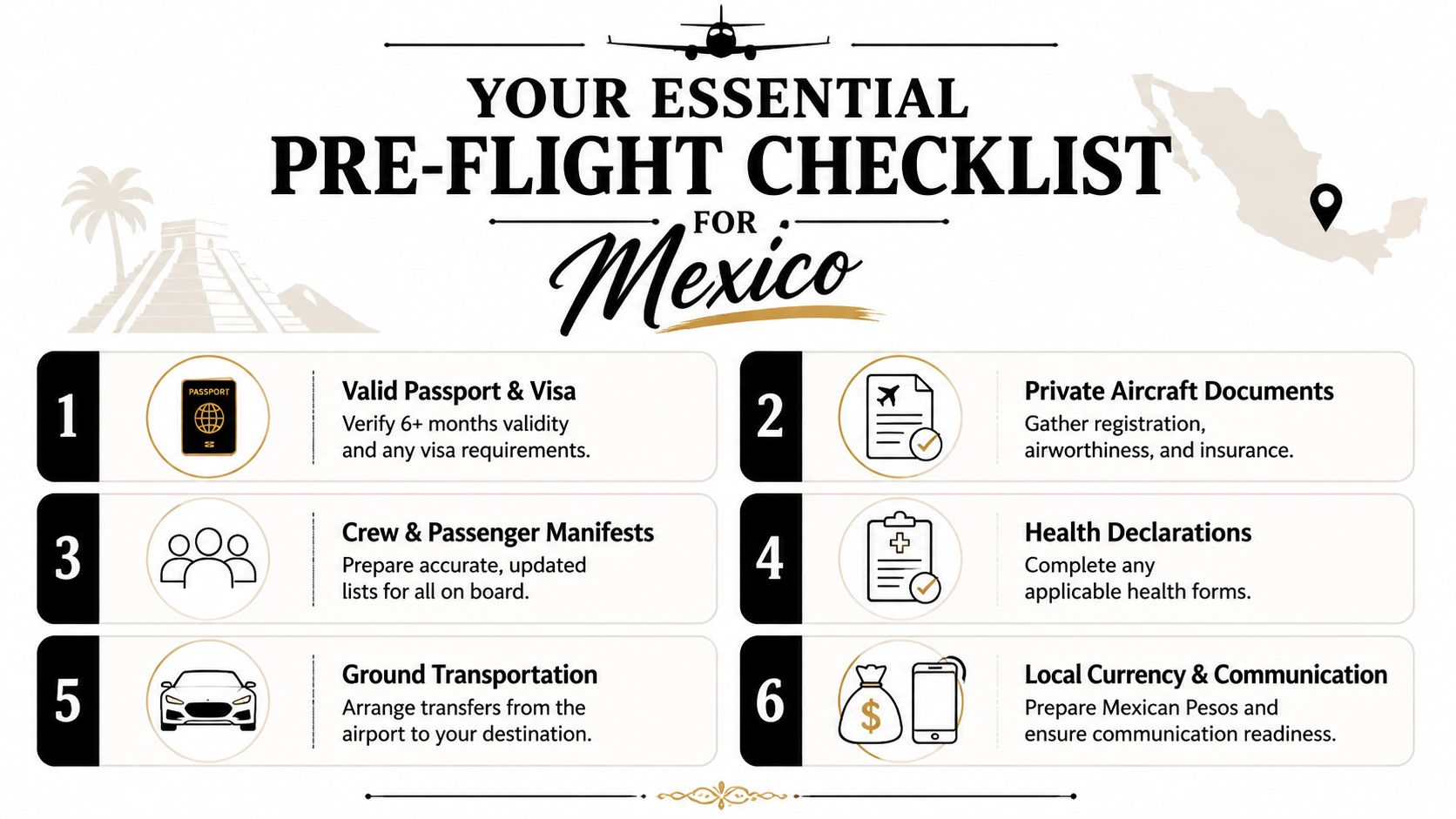
What you should handle personally
Keep your role focused on essentials:
- Provide passport copies early: Make sure names and document details are exact.
- State the trip purpose clearly: Tourism, business, or mixed-use travel should be described consistently.
- Flag valuables and unusual baggage: Jewelry, specialty equipment, pets, medication, and commercial-looking items should be disclosed before departure.
- Share lodging and contact details: Your first-night address and local host information shouldn't be guessed at on arrival.
What a proper private flight team should manage
A competent team should take over the rest:
| Client expectation | Operational work behind it |
|---|---|
| Fast international departure | Manifest review, flight planning, and document coordination |
| Smooth arrival in Mexico | Airport handling, customs sequencing, and ramp-side timing |
| Safe onward movement | Vetted vehicle dispatch and routing aligned to local conditions |
| Flexible return planning | Aircraft scheduling, crew coordination, and change management |
One final rule matters most. Don't book Mexico private travel based only on the aircraft. Book it based on who can control the whole chain.
The jet is only one part of the product. The real product is execution.
If you want Mexico handled the way experienced principals expect, with the right aircraft, vetted operators, precise logistics, and no wasted motion, Haute Jets is built for exactly that. Their team sources the specific aircraft you want from a global owner-operator network, coordinates the international details behind the scenes, and keeps the trip focused on your schedule instead of the operator's limitations.