
You’ve probably seen this happen. You ask for a private charter quote, and back comes a list of aircraft names that sound familiar but not helpful. Citation. Phenom. Challenger. Global. Maybe a turboprop appears in the mix, even though you asked for a jet. If you don’t book aircraft every week, it’s hard to know what any of that means for your trip.
That confusion is normal. The right type of jet isn’t the biggest aircraft someone can find. It’s the aircraft that fits your mission. A short flight with four passengers and light bags needs a very different solution than an overnight transcontinental itinerary with eight people, golf clubs, a dog, and a board meeting on arrival.
Your Guide to Choosing the Right Private Jet
A client is flying from Teterboro to Miami with four passengers for a quick two-day trip. Another is taking eight people from Los Angeles to New York with luggage, a pet, and meetings scheduled the moment they land. Both clients are asking for a private jet. They do not need the same aircraft, and choosing the larger one by default can add cost without improving the trip.
That is the first principle to keep in mind. Jet selection is a mission decision. Distance, passenger count, baggage, airport access, schedule, and comfort all matter. So does a cost many first-time charter clients miss at first glance: repositioning.
An aircraft may look attractively priced on an hourly basis, yet become expensive if it must fly empty from another airport to pick you up, then empty again after drop-off. That empty flying is often what turns a reasonable quote into an inefficient one. Haute Jets’ model speaks directly to that problem by focusing on aircraft access in a way that helps reduce unnecessary repositioning costs.
The best aircraft is mission specific
Aircraft categories are tools. A Very Light Jet works well for a short regional trip with a small group. A super-midsize jet fits many coast-to-coast business missions because it balances cabin comfort, speed, and range. A heavy jet earns its keep on longer flights where passengers need room to work, rest, dine, or arrive ready for a full day.
The practical question is not which jet is more impressive. It is which jet completes your trip with the fewest compromises and the least wasted spend.
A larger cabin can be worthwhile. It can also be expensive unused space.
Practical rule: If the aircraft gives you more cabin, range, or runway capability than your trip requires, you are often paying for capability you will not use.
What people often get wrong
New charter clients often start with the aircraft name. A charter advisor starts with the trip itself, because the same jet can be a great fit for one mission and a poor financial choice for another.
Use this order instead:
- Mission first: Your city pair, total flight time, airport choices, and how fixed the schedule is.
- Passengers second: Headcount, plus baggage volume, pets, sleeping needs, privacy expectations, and whether anyone needs to work en route.
- Cost structure third: Hourly rate is only part of the picture. Positioning costs, crew overnights, waiting time, airport fees, and whether the aircraft is already nearby can change the final number quickly.
That last point catches many first-time buyers off guard. Two quotes can list similar aircraft classes and still produce very different totals because one jet is local and the other is not. Choosing the right type of jet is not just about flying bigger or smaller. It is about matching the aircraft to the mission so you avoid paying for empty legs, excess cabin, or performance your trip never needed.
Understanding Key Aircraft Performance Metrics
Before you compare aircraft categories, you need a working feel for the numbers and terms that appear in charter proposals. Most of them sound technical. They’re straightforward when you tie them to the trip you’re trying to fly.

Range means how far the aircraft can go comfortably
Think of range like the distance your car can cover on a full tank, except with more variables. Passenger count, baggage, weather, routing, and reserve fuel all affect what the aircraft can realistically do.
A jet may be listed with enough range for your route on paper, but if the cabin is full and the weather is poor, the practical answer can change. That’s why aircraft selection should never rely on a brochure figure alone. In charter, the question isn’t only “Can it make the trip?” It’s “Can it make the trip with your actual passengers and bags, without compromising comfort or introducing an unnecessary fuel stop?”
Payload means people plus bags plus flexibility
Payload is the useful weight the aircraft can carry. In plain language, it’s who and what can come with you.
Clients frequently encounter surprises. Six passengers sounds simple until you add ski equipment, large suitcases, catering, and a pet crate. The aircraft category may still work, but a specific model within that category might become tight. A good charter advisor checks payload against the actual manifest, not the optimistic one.
Cabin dimensions affect more than comfort
Cabin size isn’t just about luxury. It changes how the flight feels, how people work, and how tired they are when they land.
For a quick hop, a smaller cabin may be perfectly fine. On a longer flight, the difference between “seated the whole time” and “able to stand, move around, hold a conversation, and use separate seating zones” becomes important. If passengers need to work, rest, or arrive presentation-ready, cabin dimensions stop being cosmetic and become operational.
A smaller jet can be the right aircraft. A too-small cabin for a long mission usually feels like the wrong one halfway through the flight.
Runway performance decides which airports you can use
Runway requirements tell you where the aircraft can realistically operate. This can matter as much as the jet itself.
Some aircraft can use shorter runways and reach smaller airports closer to your final destination. Others need longer runways and push you into larger fields, which may add a drive on either end. If your goal is time savings, airport access can outweigh a modest speed difference.
A simple way to compare aircraft
| Metric | What it means for you | Why it matters |
|---|---|---|
| Range | Whether the aircraft can fly your route without a stop | Fewer stops usually mean less travel time and fewer moving parts |
| Payload | How many people and bags it can carry comfortably | Prevents last-minute tradeoffs with luggage or seating |
| Cabin | Space to sit, work, rest, and move | Determines comfort on longer flights |
| Runway | Which airports the aircraft can use | Can save time by getting you closer to the destination |
When you know these four terms, the rest of the private aviation market becomes much easier to read. Every aircraft category is really just a different tradeoff among them.
Short-Haul Champions Turboprops and Light Jets
For regional flying, people often assume “jet” automatically means the better answer. Sometimes it does. Sometimes it doesn’t. On short sectors, the smartest aircraft is often the one that fits the route and airport pair most efficiently.

When a turboprop is the practical pick
A turboprop is often ideal for shorter regional missions, especially where airport access matters more than top-end speed. If you’re flying a quick route to an island, mountain town, or smaller regional field, a turboprop can do something many jets can’t do as efficiently. It can get in and out of shorter runways with less fuss.
For flights under 1,000 nautical miles, turboprops can offer 20% to 30% lower hourly rates than light jets, and they can use shorter runways. The tradeoff is safety performance, where light jets show a lower fatal accident rate of 0.22 per million departures versus 0.47 for turboprops, as summarized in this cost and safety comparison for short-haul private flying.
That doesn’t make turboprops “unsafe” in everyday language. It means clients should weigh mission economics against operating profile and choose carefully.
Very Light Jets for quick city pairs
A Very Light Jet, or VLJ, sits in a useful niche. It gives you the jet experience without jumping into a larger aircraft than the trip requires.
Very Light Jets have a maximum takeoff weight under 12,500 pounds. They can use runways under 3,000 feet, cruise at 405 knots, and burn up to 30% less fuel than traditional light jets. For short hops, that can translate into charter costs that are 25% to 35% lower, according to Essex Aviation’s overview of private jet categories.
That makes VLJs attractive for trips where the priorities are speed, privacy, and efficiency rather than a large cabin. If you’re moving a small group on a short route, a VLJ can be exactly the right type of jet.
Light jets when time and cabin feel matter
A traditional light jet usually becomes the better option when the flight is still regional, but the passengers want more cabin comfort, more baggage flexibility, and the quieter feel people associate with private jet travel.
This category tends to work well for:
- Business day trips: A team flying out and back the same day who wants speed and privacy.
- Leisure weekends: Couples or families carrying more luggage than a VLJ comfortably handles.
- Jet-first travelers: People who prefer the smoother cabin environment of a jet instead of a propeller aircraft.
If the trip is short and the destination airport is straightforward, a light jet often balances comfort and cost well. If the airport is constrained or the route is very short, the turboprop or VLJ may be the better economic answer.
For a deeper look at where prop aircraft make sense, this Haute Jets Journal piece on the advantages of a turboprop aircraft is useful background.
Here’s a quick visual explainer on how short-haul aircraft differ in practice.
Side by side decision guide
| Trip need | Usually the better fit | Why |
|---|---|---|
| Shortest runway access | Turboprop | Better for small or constrained airports |
| Lowest operating cost on a short route | Turboprop or VLJ | Better mission efficiency when cabin size isn’t the priority |
| Classic private jet feel | VLJ or light jet | Faster cruise and quieter jet cabin environment |
| Small group with minimal bags | VLJ | Efficient without paying for excess aircraft |
| More luggage or longer regional leg | Light jet | More comfort and flexibility |
Choose the aircraft for the actual mission, not for the label. “Jet” is a category. Efficiency is the goal.
The Transcontinental Workhorses Midsize and Super-Midsize Jets
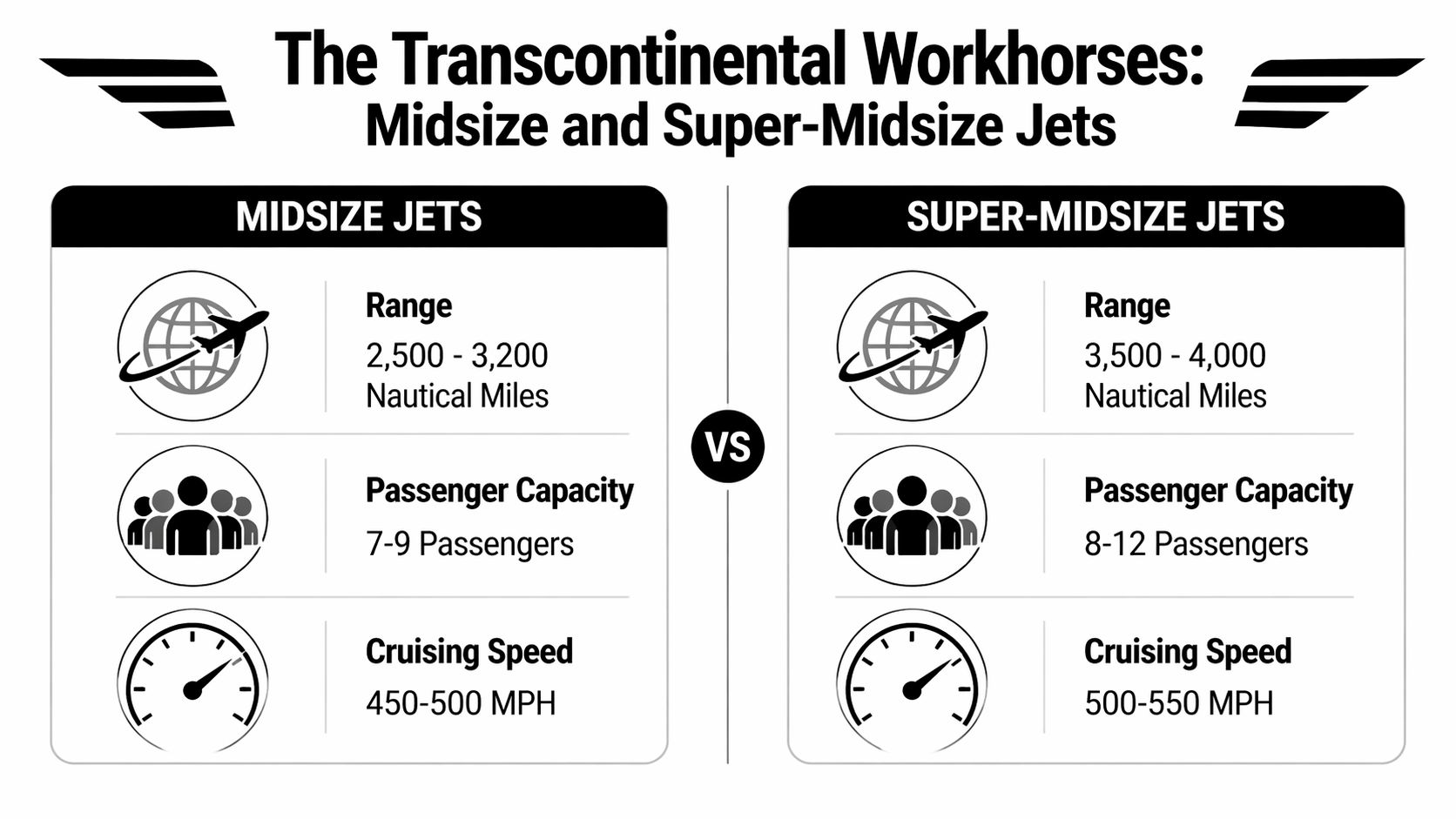
If short-haul flying is about agility, this part of the market is about balance. Midsize and super-midsize aircraft cover the trips many frequent charter clients fly most often. Cross-country meetings, multi-city business days, family travel between major metros, and flights that are too long for a light jet to feel easy.
For many travelers, this is the category where private aviation starts to feel effortless rather than merely convenient.
Why this category is the sweet spot
A midsize jet usually gives you enough cabin room to stretch out, enough baggage space for a normal business or leisure mission, and enough range to avoid awkward compromises on common domestic routes.
A super-midsize jet pushes that formula further. You get more range, a stronger climb, more cabin volume, and a better fit for longer sectors where passengers want to work, dine, and arrive less fatigued. It’s often the point where travelers stop thinking in terms of “Can we make this work?” and start thinking in terms of “This feels right.”
Super-midsize jets are built for serious domestic travel
Super-midsize jets typically have a maximum takeoff weight of 35,000 to 45,000 pounds. They cruise around Mach 0.80 to 0.85, and aircraft such as the Challenger 300 offer about 3,100 nautical miles of range, enough to fly New York to Los Angeles nonstop in under 5 hours, based on Jetcraft’s overview of private jet categories.
That combination is why this class has become such a practical answer for coast-to-coast travel. It doesn’t carry the operating footprint of a heavy jet, but it delivers enough performance to cover major domestic routes without feeling compromised.
What changes in real travel
The difference between midsize and super-midsize isn’t only technical. It shows up in how your day runs.
A super-midsize cabin usually gives you:
- More personal space: Better if the passenger count is high or the flight is long.
- More mission flexibility: Helpful when weather, routing, or baggage loads make a smaller jet less comfortable.
- A stronger time equation: Faster cruise and efficient nonstop performance on major domestic missions.
A midsize jet can still be the right choice. If the passenger load is moderate and the route fits neatly within its comfort zone, it often offers strong value. But when the trip edges toward coast-to-coast, super-midsize tends to feel more composed.
A practical way to choose between them
Use this logic when the charter options include both classes:
- If the trip is comfortably domestic with moderate passenger load, start with midsize.
- If the route is transcontinental, start with super-midsize.
- If passengers need to work or rest in a more spacious cabin, lean upward.
- If the quote difference is modest but the mission margin is much better, the larger class often saves stress later.
On many U.S. itineraries, super-midsize is where range, cabin comfort, and operating efficiency line up cleanly.
Travelers who want a deeper look at why this category has become so popular can read Haute Jets Journal’s take on understanding the super-midsize jet trend.
Global Reach Heavy Jets and Ultra-Long-Range Cabins
There’s a clear line between domestic private aviation and global private aviation. Heavy jets and ultra-long-range aircraft sit on the far side of that line. They are not just larger versions of midsize aircraft. They change what the trip can be.
Once you move into this class, the conversation shifts away from “Can we do it nonstop?” and toward “How do you want to live during the flight?”
What you gain beyond range
Heavy jets bring the cabin volume many travelers expect when they picture international private flying. You can stand up comfortably, move between seating areas, hold a meeting in one zone while someone else rests in another, and treat the aircraft as a private environment instead of a compact transport cabin.
Ultra-long-range aircraft extend that idea further. The value isn’t only distance. It’s continuity. Long sectors become more manageable when the aircraft has proper sleeping space, room for extended service, and the cabin width to avoid the cramped feeling that smaller aircraft can create late in a flight.
The market has clearly moved toward these larger cabins. Post-pandemic private flight hours surged, and top-selling models in 2020 included the Gulfstream G500/G600 and Bombardier Global series, reflecting rising demand for larger aircraft capable of connecting continents without fuel stops, according to Statista’s business jet market summary.
What ultra-long-range means in practice
At this level, aircraft capability changes routing options in a meaningful way. Some jets are built to link major global city pairs with fewer interruptions. That matters for travelers whose schedule, privacy, or security profile makes a fuel stop undesirable.
The experience on board also becomes more layered:
- Multiple living zones: Work, dining, and rest can happen separately.
- Overnight practicality: Beds or bed-like sleeping arrangements matter on longer sectors.
- Dedicated onboard service: Longer flights need a service model that feels organized, not improvised.
Where bizliners fit
Some clients eventually ask about aircraft that go beyond traditional business jets. That’s where bizliners come in. These are private conversions of larger commercial aircraft, used when the mission calls for unusual scale, highly customized interiors, or a group environment that a standard business jet can’t match.
They aren’t common answers for ordinary charter needs. They’re specialized tools for specialized missions, often when privacy, delegation size, or interior layout matters more than simple point-to-point convenience.
For long international flying, cabin livability matters almost as much as range. The aircraft becomes part of the trip, not just the way to start it.
Why Wyvern and ARGUS Safety Ratings Are Non-Negotiable
Clients often spend a lot of time comparing aircraft categories and very little time asking who operates the aircraft. That’s backward. A beautiful cabin and strong performance numbers don’t tell you enough about the operator’s procedures, training culture, maintenance discipline, or recordkeeping.
Safety in private aviation is operational before it is aesthetic.

What these ratings actually tell you
Wyvern and ARGUS are third-party safety audit systems used in private aviation to vet charter operators. For a client, their value is simple. They provide an external layer of verification.
That matters because charter buyers usually don’t inspect maintenance systems, pilot files, or operational manuals themselves. They rely on independent standards and on the charter advisor to enforce them.
In practical terms, these ratings help answer questions like:
- Is the operator audited to a recognized standard?
- Are crew qualifications and records being checked consistently?
- Is the company operating with disciplined processes, not just attractive marketing?
Why this should affect your booking decision
A lower quote can look appealing if all you compare is cabin category and departure time. But private aviation isn’t just aircraft selection. It’s operator selection.
If two similar aircraft are available and one comes from a thoroughly vetted operator while the other doesn’t, the quote comparison isn’t apples to apples. The missing piece is operational confidence.
Aircraft specs tell you what the plane can do. Safety ratings help tell you how the operator runs the flight.
For readers who want a fuller explanation of how these audit systems work in charter practice, Haute Jets Journal has a useful overview of Wyvern and ARGUS safety ratings.
A simple client checklist
Before you approve a charter, ask these questions:
- Operator verification: Is the flight operated by a company with recognized third-party safety credentials?
- Aircraft specifics: Are you seeing the exact aircraft and operator, not just a category label?
- Pre-flight clarity: Will you receive full aircraft and crew details before departure?
- Consistency: Is the same safety standard applied to every option in the quote set?
Clients rarely regret asking these questions. They often regret not asking them early enough.
How to Choose Your Jet and Avoid Hidden Charter Costs
A client flying from Chicago to Aspen with five passengers might ask for a super-midsize jet because it sounds like the safer upgrade. On paper, that feels sensible. In practice, the better question is whether that aircraft is the right tool for the trip, and whether it is already close enough to your departure airport to avoid expensive empty flying before you ever board.
That is the part many first-time charter clients miss.
Choosing a private aircraft works like choosing a car for a specific drive. You would not hire a long-haul coach bus for a short airport transfer, and you would not pick a compact car for a ski trip with six adults and gear. Private jets work the same way. The right choice depends on mission, passenger count, bags, runway access, and how far the airplane must travel just to reach you.
Start with the mission itself.
- Four passengers on a short regional trip: Begin with a turboprop, VLJ, or light jet, depending on baggage needs and airport constraints.
- A longer domestic business flight: Midsize and super-midsize jets are often the practical starting point.
- A larger group or a long international route: Heavy jets and ultra-long-range cabins enter the conversation.
For many short-haul trips, the smartest answer is not the largest cabin you can book. It is the smallest aircraft that handles the route comfortably, carries the people and bags you have, and operates from the airports you want to use. That is where mission efficiency saves money without making the trip feel compromised.
Then review aircraft positioning.
A quote can look attractive until you learn the airplane is based two states away. If it has to fly empty to pick you up, that repositioning time is often built into your price. Clients usually notice the hourly rate first. Experienced charter clients ask where the airplane is coming from.
That single detail can change the economics of the trip.
If two aircraft both fit the mission, the one already near your departure airport often delivers the better overall value. The cabin may be similar. The flight time may be similar. The invoice may not be. This practical guide on how to charter a private jet the smart way explains the same principle from a booking perspective: aircraft fit and sourcing matter as much as category.
Here is a simple way to pressure-test a quote:
| Question | Why it matters |
|---|---|
| Is the aircraft already near my departure airport? | Nearby aircraft can reduce or avoid empty repositioning charges |
| Am I paying for range or cabin size I will not use? | Extra capability often means extra cost |
| Does my airport require short-field performance? | Airport limits may point you toward a turboprop or smaller jet |
| Will baggage, pets, or special requests change the aircraft category? | Real-world trip details often narrow the practical options |
The goal is not to book the cheapest airplane. It is to book the most efficient airplane for the mission.
That is why seasoned buyers ask three questions in order:
- What mission am I flying?
- What onboard experience do I need for these passengers?
- Which aircraft can do that trip efficiently from a nearby base?
A sourcing model built around local aircraft access can make a meaningful difference here. Haute Jets works through a network of 3,500+ owner-operators in 175 countries and focuses on matching clients with aircraft that fit both the trip profile and the positioning economics.
The quote with the lowest headline price is not always the lowest-cost trip. Repositioning fees and oversized aircraft are two of the most common places where charter spend drifts upward.
Choose the mission first. Choose the aircraft second. Check positioning before you approve the trip.
That is how experienced clients avoid paying premium rates for the wrong type of jet.