
A client calls on a Thursday morning. He needs to leave the U.S., handle a board meeting in New York, be in London for signing, and get to Dubai for a family obligation before the weekend is over. Commercial schedules turn that into a fragmented, exhausting relay of connections, security lines, lounge waiting, and lost sleep. An ultra long range jet charter turns it into one controlled itinerary.
That's the primary use case. Not vanity. Not novelty. Control.
Published on Haute Jets Journal, this guide is for people who don't need another glossy aircraft brochure. You need to know which choices protect your time, which choices inflate your bill, and which safety standards separate a polished sales pitch from an operator you can trust. If you care about comfort, you should care even more about sourcing model and audit standards, because those two factors shape cost and risk more than the cabin photos ever will.
One more practical point. Long-haul private travel isn't just about the aircraft. It's also about arriving ready for the room you're walking into. If you're planning a multi-city itinerary and want a polished packing framework that travels well, these timeless Italian wardrobe tips are worth a read.
Your Globe-Spanning Itinerary Starts Here
The people who book ultra long range jet charter aren't trying to imitate airline travel with nicer seats. They're trying to avoid airline logic altogether.
A commercial carrier sells you a route. A serious charter solution sells you time back. That distinction matters when the trip involves more than one continent, more than one priority, and no tolerance for missed connections or schedule drift.
When commercial stops working
If your itinerary includes board meetings, negotiations, site visits, family commitments, or security-sensitive travel, commercial aviation starts failing in predictable ways:
- Rigid departure windows: You leave when the airline says, not when your schedule demands.
- Connection risk: One late inbound aircraft can wreck the entire chain.
- Airport inefficiency: Major terminals add friction before and after the flight.
- Public exposure: For executives, public figures, and family offices, that's often unacceptable.
An ultra long range jet charter solves a specific problem. It gives you one aircraft, one cabin, one crew plan, and one schedule built around your priorities.
You're not paying to sit in a better chair. You're paying to remove uncertainty from a high-value trip.
What matters more than the brochure
New clients usually ask the wrong first question. They ask, “Which jet is the nicest?” That's understandable, but it's not the best place to start.
Ask these instead:
- Can this aircraft complete the mission nonstop or with the right operational margin?
- Is the operator being sourced locally, or are you paying to move the aircraft to you?
- Does the operator hold meaningful third-party safety audits, or only baseline certification?
That's where smart charter decisions begin. The aircraft still matters. Cabin comfort still matters. But the hidden differentiators sit behind the booking, not in the photography.
What Defines an Ultra Long Range Jet
You are flying New York to Dubai, or Los Angeles to Tokyo, with a meeting on arrival and no room for a fuel stop, crew swap, or missed slot. That is the definitive test of an ultra long range jet. The label is not about prestige. It is about whether the aircraft can complete a demanding mission nonstop, with enough operating margin to protect the schedule when winds, payload, or airport constraints change.
Ultra long range jets typically sit at the top of the business aviation market because they are built for intercontinental missions that standard large-cabin jets cannot handle as reliably in real charter conditions. As Paramount Business Jets explains in its overview of ultra long range aircraft, this class is defined by true long-distance capability, high-altitude performance, and cabins designed for extended time onboard.
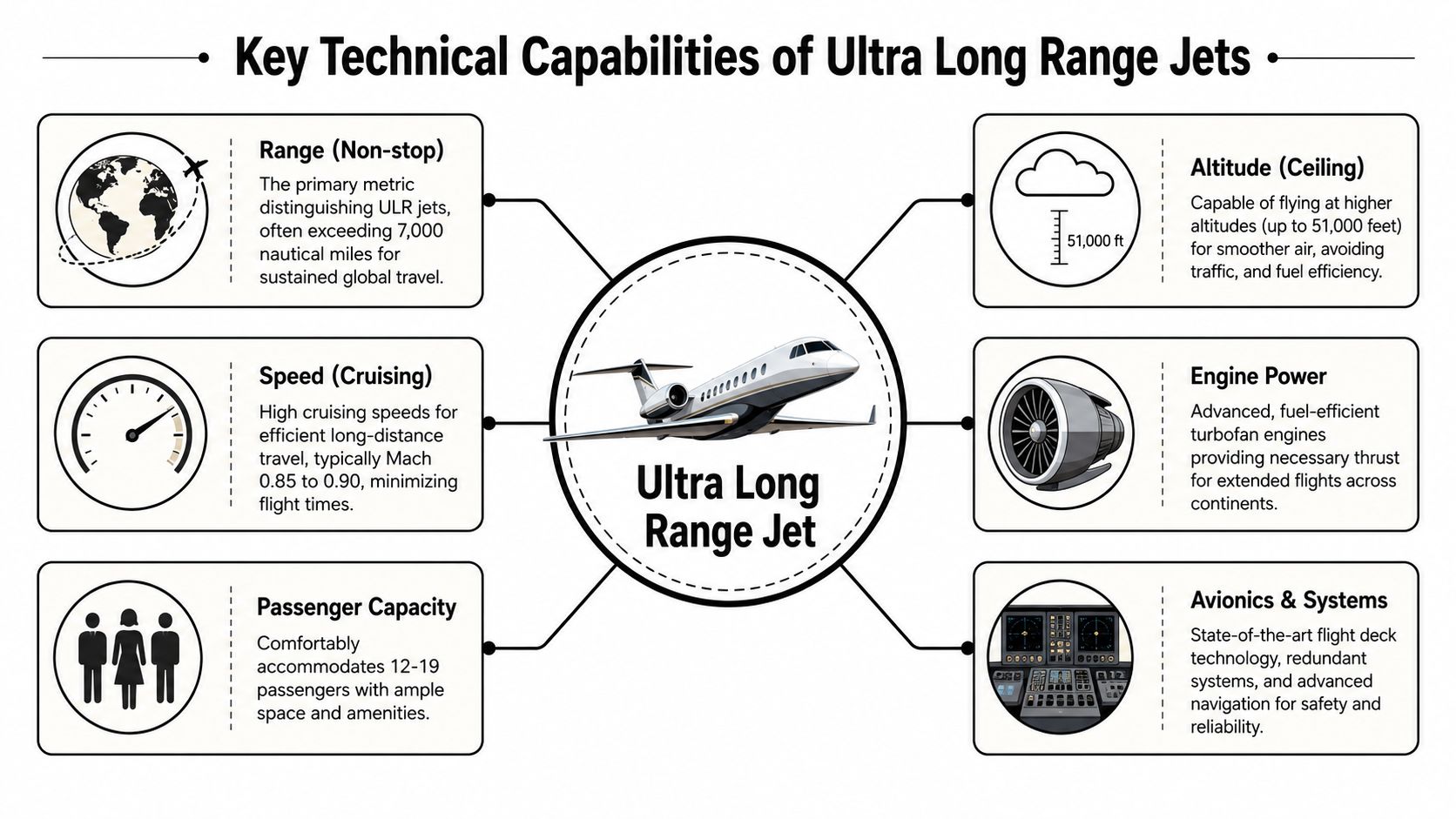
Range matters. Dispatch reliability matters more.
Clients fixate on brochure range. I care more about mission range. Those are not the same thing.
A manufacturer may publish an impressive maximum range under ideal conditions. Your trip is different. Passenger count, baggage, winter winds, runway length, and alternate airport requirements all cut into that number. That is why a true ULR jet is one that can cover intercontinental city pairs with practical margin, not one that barely makes the marketing chart.
The FAA describes nautical miles as the standard distance measure used in aviation, and that is the metric operators use when matching aircraft to route requirements in practice, not just on sales material. See the FAA Pilot's Handbook of Aeronautical Knowledge for the underlying definition.
Endurance, speed, and altitude are operating tools
These aircraft are built to stay productive for very long sectors. NBAA notes that long-range business jets are designed for high-speed cruise and high-altitude operation, which improves routing flexibility and helps crews avoid weather and congestion more effectively on international flights. That matters on charter because every operational advantage reduces the chance that your aircraft choice creates a delay later in the trip. See NBAA's business aircraft operations resources.
Altitude is not just a comfort point. It is a schedule tool. The ability to cruise high gives crews more options around traffic flows and weather systems. Speed plays the same role. Faster cruise trims block time, but the practical value is bigger than a shorter flight. It creates margin in the day, which protects meetings, onward helicopter transfers, and airport curfews.
If you want a quick sense of the aircraft that typically sit in this category, Haute Jets maintains a useful ultra long range jet fleet overview.
The practical definition I use with clients
An aircraft belongs in the ULR category if it meets these tests:
- It can fly the mission nonstop with realistic operating margin.
- It has a cabin layout that supports sleep, work, and meal service on a true long-haul sector.
- It gives the operator enough performance flexibility to protect the trip when conditions shift.
One more point matters, and brokers often bury it. A ULR aircraft on paper does not guarantee a strong charter option in practice. The sourcing model matters just as much. A locally based aircraft with a current third-party safety audit is usually a better charter decision than a more glamorous jet that must reposition across the country under baseline compliance only.
That is the difference between shopping for a brochure and booking for the mission.
Leading ULR Aircraft and Their Capabilities
The flagship names are familiar because they've earned their place. Gulfstream, Bombardier, and Dassault dominate this conversation for a reason. They build aircraft for long sectors, serious cabins, and executive mission profiles.
That demand isn't niche. The private jet charter services market was valued at USD 17.67 billion in 2026 and is projected to grow at a CAGR of 7.86% to reach USD 25.79 billion by 2031, with on-demand charters for long-haul trips holding a 51.62% revenue share in 2025, according to Mordor Intelligence's private jet charter services market report. That growth tells you something important. Clients want flexibility for specific long-haul missions, not locked-in programs that force them into one pricing structure.
The aircraft most clients ask about
The short list usually includes the Gulfstream G650ER, Gulfstream G700, Bombardier Global 7500, Bombardier Global 8000, Dassault Falcon 8X, and Dassault Falcon 10X.
Not all of those are equal in market availability, and not all missions require the newest airframe. In practice, I push clients to match the aircraft to the route, passenger count, sleep requirements, and baggage profile first. Prestige comes second.
If you want to review current category options, Haute Jets keeps a useful page on ultra long range jets in its fleet section.
Ultra Long Range Jet Comparison
| Aircraft Model | Max Range (NM) | Max Passengers | Typical Cruise Speed |
|---|---|---|---|
| Bombardier Global 7500 | 7,700 | 19 | Mach 0.80 to Mach 0.925 |
| Gulfstream G650ER | 7,500 | 16 | Mach 0.80 to Mach 0.925 |
| Dassault Falcon 8X | Qualitatively positioned in the ULR segment | 19 | Mach 0.80 to Mach 0.925 |
| Gulfstream G700 | Qualitatively positioned in the ULR segment | Up to 19 | Mach 0.80 to Mach 0.925 |
| Bombardier Global 8000 | Qualitatively positioned in the ULR segment | Qualitative, configuration-dependent | Mach 0.80 to Mach 0.925 |
| Dassault Falcon 10X | Qualitatively positioned in the ULR segment | Qualitative, configuration-dependent | Mach 0.80 to Mach 0.925 |
How to choose between them
Here's the blunt version.
- Choose the Global 7500 if nonstop reach is the priority and you want one of the benchmark aircraft in the category.
- Choose the G650ER if you value proven long-haul performance and speed.
- Choose the Falcon 8X when mission flexibility and a refined cabin matter, and the route fits comfortably inside its profile.
- Look at the newest flagships carefully, but don't pay a premium for novelty if an established aircraft already covers the trip cleanly.
The right aircraft is the one that flies your actual mission efficiently. Not the one with the loudest marketing.
Common Long Haul Routes and Global Access
Your principal finishes dinner in Manhattan and needs to be in Dubai ready for a morning meeting, not dragging through a connection in Europe. That is the primary use case for ultra long range charter. The route matters, but the better question is whether the aircraft is already positioned near your departure point and whether the operator running it has been audited beyond basic regulatory minimums.
City pairs such as New York to Dubai, Los Angeles to Sydney, New York to Singapore, and London to Buenos Aires sit squarely in the mission profile that drives demand for this category. On paper, those routes look like an aircraft selection exercise. In practice, they are often a sourcing exercise first. A locally available jet with the right payload and crew duty profile usually beats a theoretically perfect aircraft that has to reposition across the country before your trip even starts.
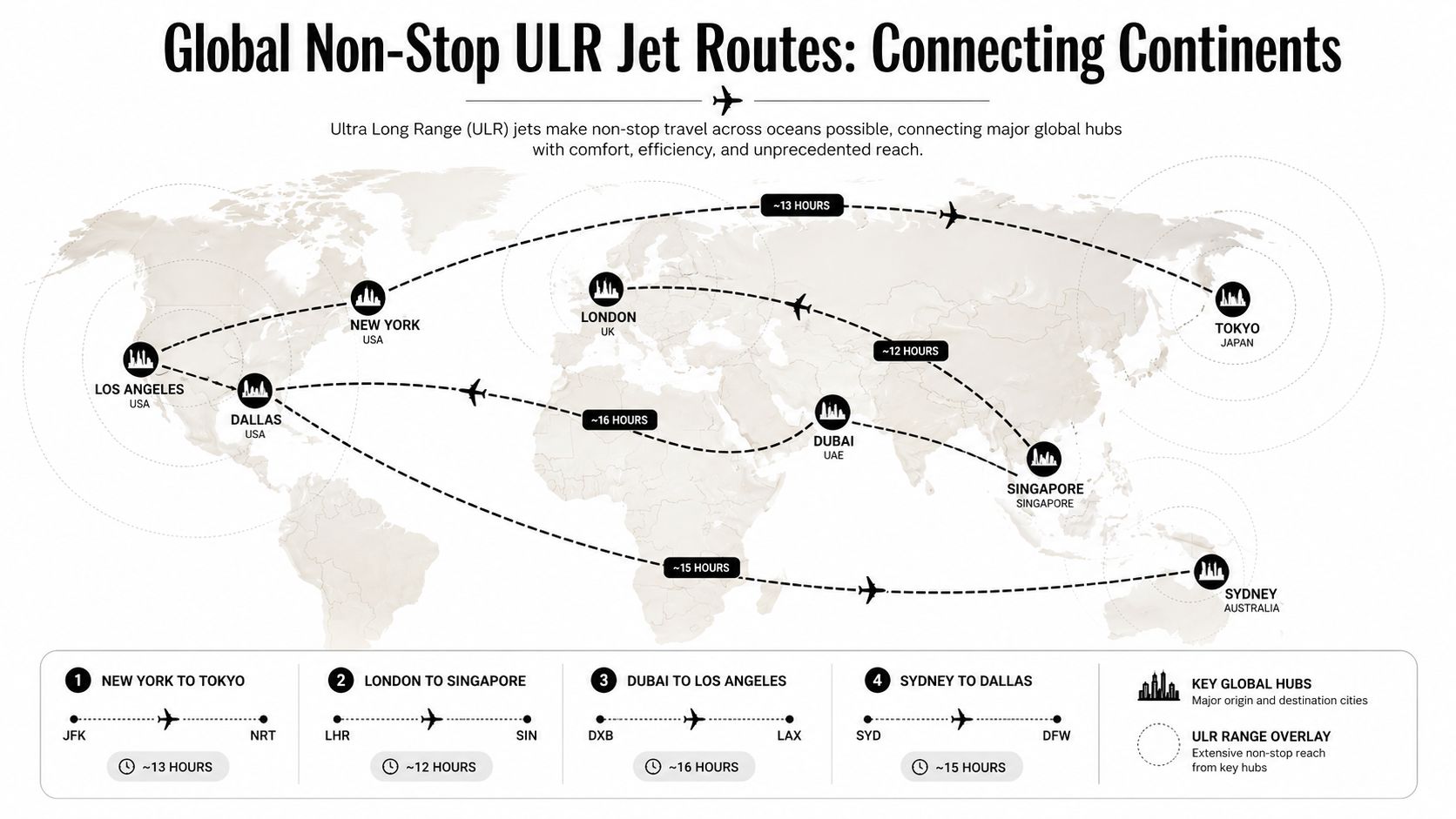
What nonstop access changes
Nonstop access protects time, privacy, and operational control.
It also reduces failure points. Every extra stop adds another airport, another ground handler, another fueling event, and another chance for delay. Clients usually focus on the cabin brochure. I advise them to focus on trip execution. The best ultra long range booking is the one that gets your group there on the cleanest operating chain with the fewest moving parts.
If you want a broader view of how private flyers move between major business and leisure markets, review these popular private jet routes in 2025.
Routes that justify the category
Ultra long range charter earns its keep on trips where connections create real business cost or unnecessary exposure:
- U.S. to Middle East: Strong fit for finance, government, investment, and family office travel with fixed arrival windows.
- West Coast to Australia: A serious mission where aircraft positioning, weather planning, and payload discipline matter as much as published range.
- Europe to Southeast Asia: Best for executives who need one secure cabin and a controlled itinerary instead of a fragmented airline schedule.
- North America to southern South America: An underrated route set where the right locally sourced aircraft can save meaningful repositioning cost.
One more point gets ignored too often. Global reach means little if the operator only meets baseline certification. Ask whether the flight provider can show current third-party audit credentials such as Wyvern or Argus, not just an air carrier certificate and insurance summary. On long-haul missions over oceans and multiple FIRs, that difference matters more than premium wood veneer or a prettier cabin rendering.
For true long-haul charter, the hidden differentiators are simple. Source the aircraft intelligently, favor local availability over expensive repositioning, and insist on audited operators instead of settling for minimum compliance.
Understanding ULR Charter Costs and Pricing
You receive two quotes for the same long-haul trip. One looks cheaper by enough to get your attention. Then the final invoice shows extra flying, extra crew time, and airport charges tied to an aircraft that had to come from somewhere else first. That is how first-time buyers overpay in ultra long range charter.
Start with the right question. Ask where the aircraft is based, not just what aircraft it is.
Published hourly rates only give you a rough starting point. Ultra long range charter usually prices higher than shorter-cabin categories because you are paying for intercontinental capability, larger cabins, heavier operating costs, and the crew and planning required for true long-haul missions. The brochure matters less than the sourcing model behind the quote.
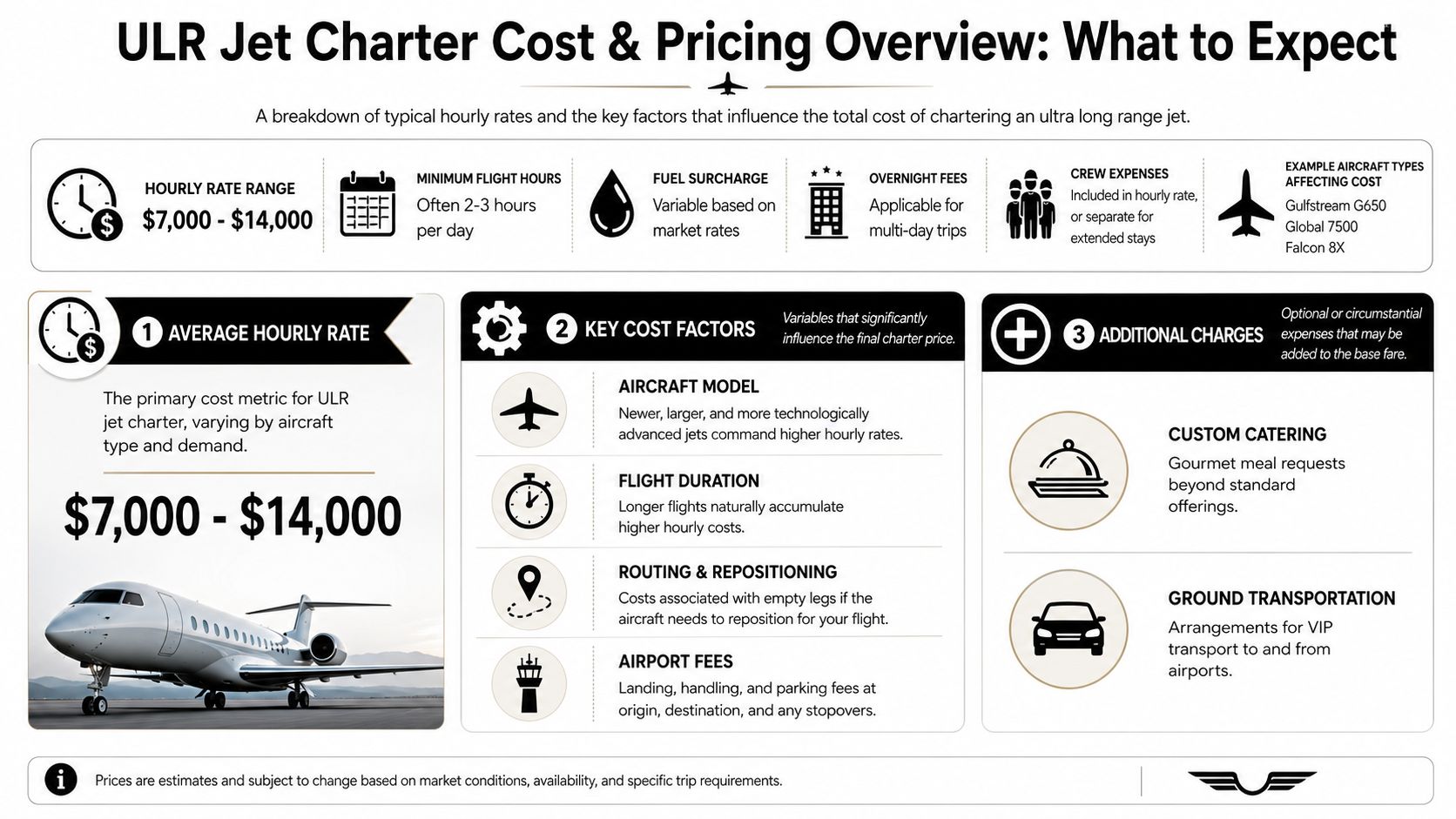
What the quote should actually show
A clean ULR quote should separate the base flight charge from the supporting costs that turn a paper rate into a real trip total. If it does not, treat that as a warning.
Here is what deserves scrutiny:
- Aircraft sourcing: A local aircraft usually prices better than one that must ferry in before pickup.
- Flight time and routing: Winds, technical restrictions, payload, and alternates can change billable time.
- Crew and duty planning: Long-haul missions often require augmented crew scheduling, rest logistics, and hotels.
- International trip support: Permits, handling, customs coordination, and airport fees vary widely by country.
- Cabin and baggage needs: Passenger count is only part of the equation. Luggage volume and onboard service requests also affect aircraft selection and trip cost.
The expensive mistake is focusing on the hourly number and ignoring where the airplane starts the mission.
Repositioning is where quotes stop being comparable
If the aircraft is not based near your departure city, you can end up paying for empty legs flown solely to reach you, plus related crew and handling expense. That can materially change the economics of the trip before your passengers even step onboard. Industry charter pricing guides from providers such as PrivateFly's private jet hire cost overview show how aircraft category, routing, and operating structure move total charter cost well beyond the advertised hourly rate.
This is why two quotes for the same route are often not true apples-to-apples comparisons. One may reflect a nearby aircraft with efficient positioning. The other may hide unnecessary ferry time inside a lower-looking headline rate.
Cost check: Ask this before approving any quote: “Is this aircraft based near my departure point, and does the price include any repositioning segments?”
A serious charter advisor should answer that clearly and in writing.
A quick visual breakdown helps before we go further:
My recommendation on pricing model
For most ULR clients, on-demand charter is the better buying method. It lets you price each mission on its own merits, compare local versus repositioned lift, and reject weak sourcing. Jet cards often smooth over these differences. That sounds convenient, but it can obscure where the margin sits and how the aircraft was procured.
Price and safety should be reviewed together. If a lower quote comes from a weaker operator standard, it is not a deal. Review the provider's operator safety review process for private jet charter alongside the sourcing logic before you sign anything.
My advice is simple. Buy the mission, not the membership. On ultra long range trips, the client who understands sourcing usually spends less and gets a better aircraft outcome.
The Booking Process and Critical Safety Standards
Booking a long-haul charter should feel simple from the client side. Behind the scenes, it should be rigorous.
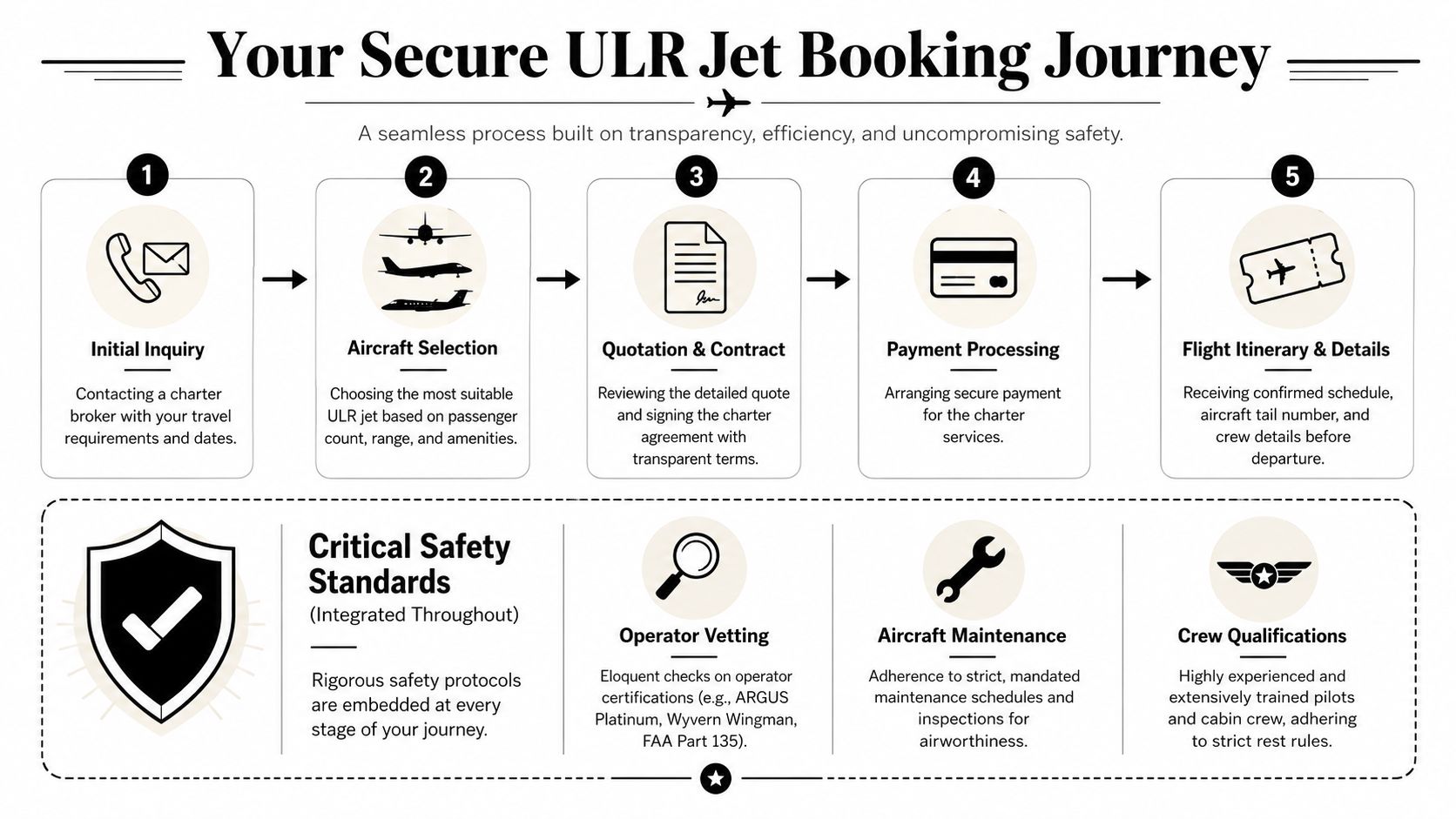
A proper process starts with your route, dates, passenger count, baggage profile, and cabin priorities. Then you review aircraft options, approve the quote, execute the contract, and receive final operational details including the tail number and crew information before departure. The transaction part is easy. The vetting part is where most of the actual work sits.
Certification is not the same as elite oversight
This is the mistake I see most often. Clients hear that an operator is certified and assume that means fully vetted at the highest level.
It doesn't.
The verified standard that matters here is the distinction between regulatory certification and third-party operational auditing. Top-tier audits such as Wyvern and Argus are essential for guaranteeing maintenance and crew standards on ULR jets beyond regulatory minimums, with 80% of ULR incidents in 2024 occurring with operators lacking these dual audits, according to RS Capital's guide to chartering a private jet.
That number should reset how you evaluate a flight.
What I tell new clients to demand
Don't ask vague safety questions. Ask specific ones.
- Ask for the audit status: Wyvern Wingman or Argus Gold/Platinum should be easy to confirm.
- Ask for the operator identity early: You need to know who is flying the aircraft.
- Ask for the tail number before departure: That allows proper final vetting.
- Ask for crew details: On long-haul sectors, pilot experience and rest planning matter.
If you want a general reference point on operator standards, Haute Jets provides a straightforward private jet safety page.
A hard line worth keeping
I don't treat third-party audits as a nice extra for ULR flying. I treat them as a minimum threshold for serious international missions.
If an operator can't show meaningful audit credentials beyond baseline certification, move on.
That's not paranoia. That's discipline.
Fly Smarter The Haute Jets Wholesale Model
You approve a London departure on a glossy aircraft profile. The quote looks competitive. Then the invoice picks up a ferry leg from another country, and you still do not know which operator is the one flying you. That is where charter buyers lose control.
For ultra long range flying, the brochure matters less than the sourcing model. I care about two questions first. Is the aircraft already positioned near your departure point? Is the operator independently audited beyond baseline certification? If you do not get clean answers on both, keep shopping.
Why sourcing model beats membership sales language
Jet cards and traditional broker programs often sell convenience. The hidden tradeoff is pricing opacity. If the provider fills your trip with an aircraft that must reposition from another market, you pay for that deadhead time whether it is itemized clearly or buried in the quote.
As noted earlier, repositioning can materially inflate charter cost. A local sourcing model cuts that waste by starting with aircraft already based near the mission. On long-haul trips, that difference is large enough to outweigh a lot of polished sales language about access, perks, or preferred fleets.
That is the practical case for a wholesale approach. It starts with operator availability in the right region, then matches the aircraft to the route, cabin needs, and airport constraints. Clients usually save money because the quote reflects the mission, not the cost of moving metal into place first.
Haute Jets presents its model in those terms. The company says it sources from 3,500 plus owner-operators across 175 countries, avoids memberships and jet cards, and limits sourcing to operators with Wyvern Wingman or Argus Gold or Platinum credentials. Those are useful filters because they address the two places buyers get hurt most often. Hidden positioning cost and weak operator screening.
What I tell a first-time ULR charter client to do
Keep the buying process strict.
- Ask where the aircraft is based before you discuss cabin photos. That answer affects the price faster than any amenity list.
- Ask who the operator is, not just who sold you the trip. The operating certificate holder matters more than the broker brand.
- Require named audit status in writing. Wyvern and Argus should be confirmed, not implied.
- Review the actual aircraft assigned to your trip. Tail number, interior configuration, Wi-Fi capability, baggage volume, and crew setup should all be clear.
- Compare sourcing logic, not just hourly rate. A lower headline rate can still be the more expensive trip if repositioning is built in.
Buyers who understand this usually make better decisions. They stop treating jet cards as a safety shortcut or a pricing advantage. In many cases, the smarter move is simpler. Source locally, verify the operator, and judge the quote on total trip economics.
If you want a live quote built around aircraft position and audited operators, Haute Jets is a reasonable place to start.