
You approve an international charter. The aircraft is right. The routing is right. The timing is right. Then the revised quote lands in your inbox and the number has moved, even though the trip hasn't.
That usually isn't random. It's foreign exchange.
For private jet clients, FX isn't a side issue simply processed by a bank or back office. It can alter what you pay, when you should pay, and how much certainty you have between quote and wire. If you book flights across the US, UK, Europe, the Middle East, or Africa, understanding currency exchange rates is part of cost control. It belongs in the same conversation as aircraft category, repositioning, crew duty limits, and airport access.
Exchange rates are often viewed merely as a headline on Bloomberg or a number on Google. That's too shallow. What matters is how that market rate flows through an operator, a broker, your bank, your payment rail, and ultimately your invoice.
The Hidden Variable in Your Charter Quote
A travel manager in New York receives a quote for a transatlantic charter. The aircraft works. The cabin works. The departure slot works. The client approves. A few days later, the same itinerary is still available, but the final amount due has changed.
Nothing visible changed. The route is the same. The aircraft is the same. The service level is the same. But the operator's cost base sits partly in another currency, and the payment chain converts that exposure back into the currency the client uses.
That's where affluent travelers get caught. They focus on flight time, airport pair, catering, Wi-Fi, and ground transport. They should. But currency exposure sits underneath all of it, especially on international missions where operator expenses, maintenance planning, crew logistics, airport charges, and handling can touch more than one market.
Practical rule: If you fly internationally and your quote changes without a change in mission profile, check currency exposure before you challenge the flight details.
This matters even more when you're comparing charter proposals. One quote may look cleaner because the provider has embedded a conversion spread inside the total. Another may show a lower flight price but leave the FX handling to your bank. Those are not the same quote.
If you want a better baseline for what sits inside a charter quote before FX even enters the picture, review what is included in private jet charter price. It helps separate aviation cost from payment friction.
Why high-net-worth travelers should care
Private aviation rewards precision. FX punishes vagueness.
When you're moving quickly between jurisdictions, a sloppy payment process can create avoidable noise. You don't need to become a currency trader. You do need to understand where exchange rates affect your charter cost, when the risk is material, and what decisions improve the outcome.
That's the useful version of financial sophistication. Not more complexity. More control.
What Are Currency Exchange Rates
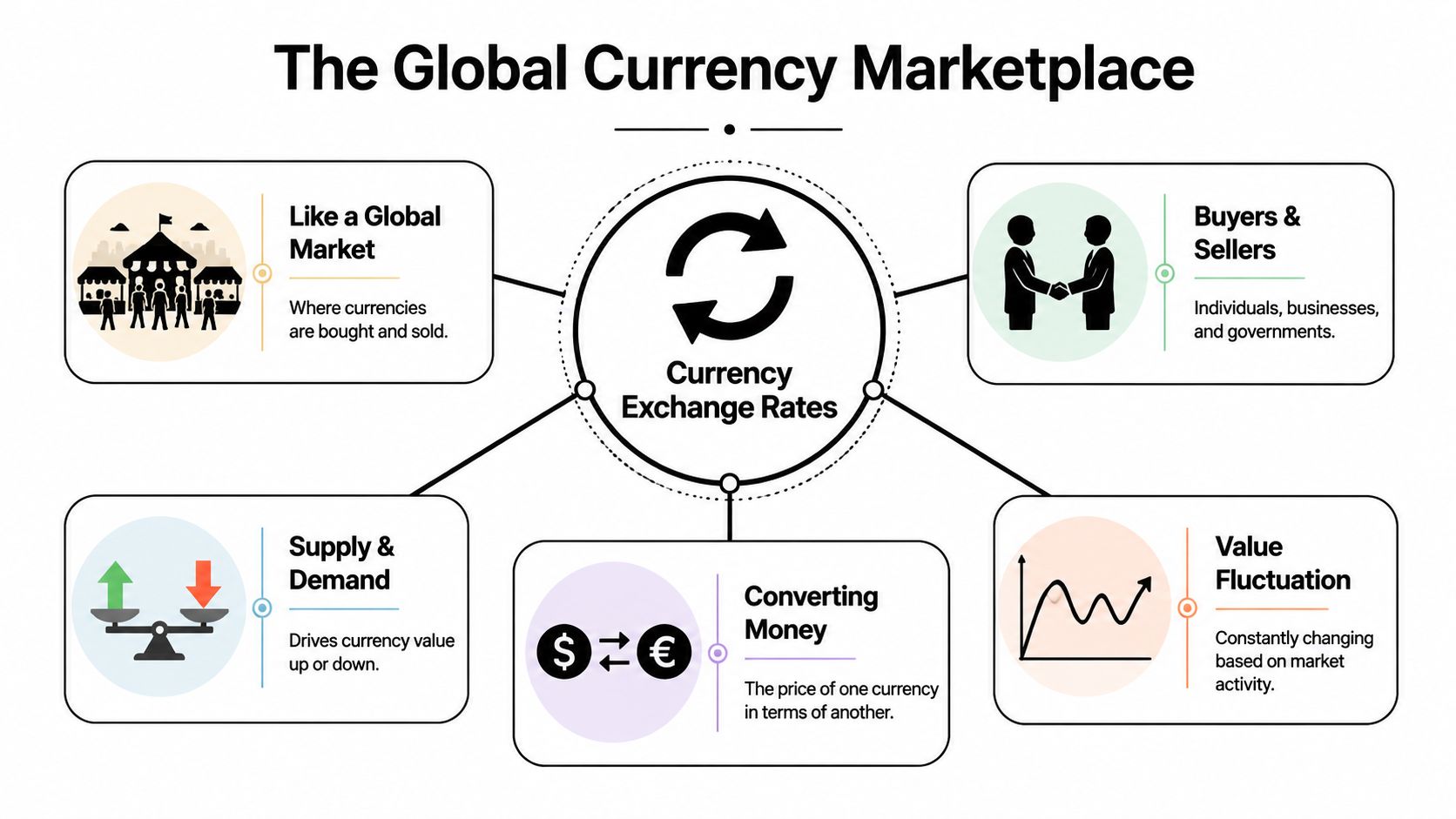
A currency exchange rate is the price of one currency expressed in another. Think of it as a global marketplace where currencies are the goods being bought and sold all day, by banks, companies, funds, governments, and travelers. The “price” changes because supply and demand change.
Spot rate and forward rate
The spot rate is the rate for an immediate exchange. If you approve a charter today and fund it now, the conversion usually references the spot market, plus whatever spread or fee your provider adds.
The forward rate is different. It applies when two parties agree today on a currency rate for a payment that will happen later. For clients planning a multi-leg summer schedule, a major event tour, or a repeated set of international charters, that distinction matters. Spot is about today's execution. Forward is about future certainty.
For private aviation, that difference is practical. If your trip is imminent, you care about execution quality. If your trip is planned well in advance, you may care more about locking the conversion terms than trying to “win” on timing.
Why rates move constantly now
Currency markets weren't always this fluid. A major historical anchor was the Bretton Woods system in 1944, which created a globally coordinated framework for fixed exchange rates pegged to the US dollar, with the dollar convertible to gold at $35 per ounce. That structure dominated until 1971, when President Richard Nixon suspended gold convertibility, beginning the move to the modern floating-rate regime. Since then, currencies have been driven far more by markets than by gold reserves.
That shift matters because today's market is huge and continuous. The transition to floating exchange rates began in 1971, and modern FX now trades at extraordinary scale. The average daily global foreign exchange turnover reached $7.5 trillion in 2025, according to IMF exchange rate data. In the same verified IMF material, the annual average volatility of EUR/USD reached about 8.5% in 2022, versus roughly 2% to 3% during the fixed-rate era of the 1960s. That's why an international charter quote can feel stable one week and less so the next.
Who sets the tone in this market
No single person “sets” exchange rates in normal conditions. Central banks influence them through policy. Commercial banks make markets. Companies transact for trade and payroll. Funds and institutions move capital based on return and risk.
If you want a practical primer from a business-payment angle, especially useful for teams handling cross-border invoices, this guide to understanding forex for South African businesses is a solid operational complement to the macro view.
Exchange rates are quoted in pairs because money only has a cross-border price relative to another currency.
For a charter client, that means your real question isn't “What's the dollar doing?” It's “What is my payment currency doing against the operator's currency, and how is my payment provider converting it?”
The Key Drivers That Move the Market
Exchange rates don't drift for no reason. They react to incentives, confidence, and expectations. If you follow only one rule, follow this one: currencies move when capital has a reason to move.

Interest rates and relative return
When one country offers meaningfully more attractive rates than another, that can support its currency because investors may want exposure to those returns. It's not mechanical in the short term, but it's one of the first things serious market participants watch.
For private aviation, the implication is simple. If policy shifts strengthen the operator's home currency against yours, your charter can become more expensive even if the flight itself hasn't changed.
Inflation and economic health
Currencies are also a judgment on purchasing power and credibility. If a country appears to be handling inflation poorly, or its growth outlook deteriorates, its currency can weaken. If investors think price stability and economic management are improving, the currency may strengthen.
Jet charter costs don't live in a vacuum. Airport services, crew expenses, maintenance inputs, and supplier invoices are tied to real local economies. The currency reflects those conditions imperfectly, but not irrelevantly.
Stability and political risk
Capital likes jurisdictions where legal systems, institutions, and policy direction look reliable. When that confidence erodes, money can move fast.
For a client booking internationally, this doesn't mean you should trade headlines. It means you should respect them. A country facing sudden political uncertainty can see currency volatility show up in quote timing, supplier caution, and payment preferences.
Speculation and positioning
Not every currency move comes from trade flows or policy. Traders constantly reprice expectations. If enough money is positioned one way and sentiment flips, rates can move hard and quickly.
Here's the private-jet takeaway:
- Don't assume a stable week means a stable invoice. FX can stay quiet, then adjust abruptly.
- Don't overreact to every daily move. One headline rarely matters as much as a sustained shift.
- Do ask what currency the operator is exposed to. That answer is often more useful than watching broad financial television.
A charter client doesn't need to forecast currencies. The client needs to know which market driver can realistically affect a payment due date.
That mindset keeps you out of noise and focused on what changes your cost.
From Market Rate to Your Final Invoice
The rate you see online is almost never the rate you pay. That gap is where many clients lose money without realizing it.
The headline rate is not your rate
The rate on Google, Bloomberg, or a financial app is usually a nominal market rate. It's useful as a reference. It is not a promise.
The IMF makes an important distinction that most consumer content skips. This distinction between the nominal exchange rate and the real exchange rate matters because the real rate accounts for relative prices, not just the headline quote. The IMF also notes that confusion between nominal, real, and real effective exchange rates is common in practice. Their explainer on real exchange rates and real effective exchange rates is the right source if you want the economics behind this.
For charter clients, the practical version is straightforward. The rate you “see” online often doesn't capture the full cost once fees, spreads, and purchasing-power differences work their way into the actual transaction.
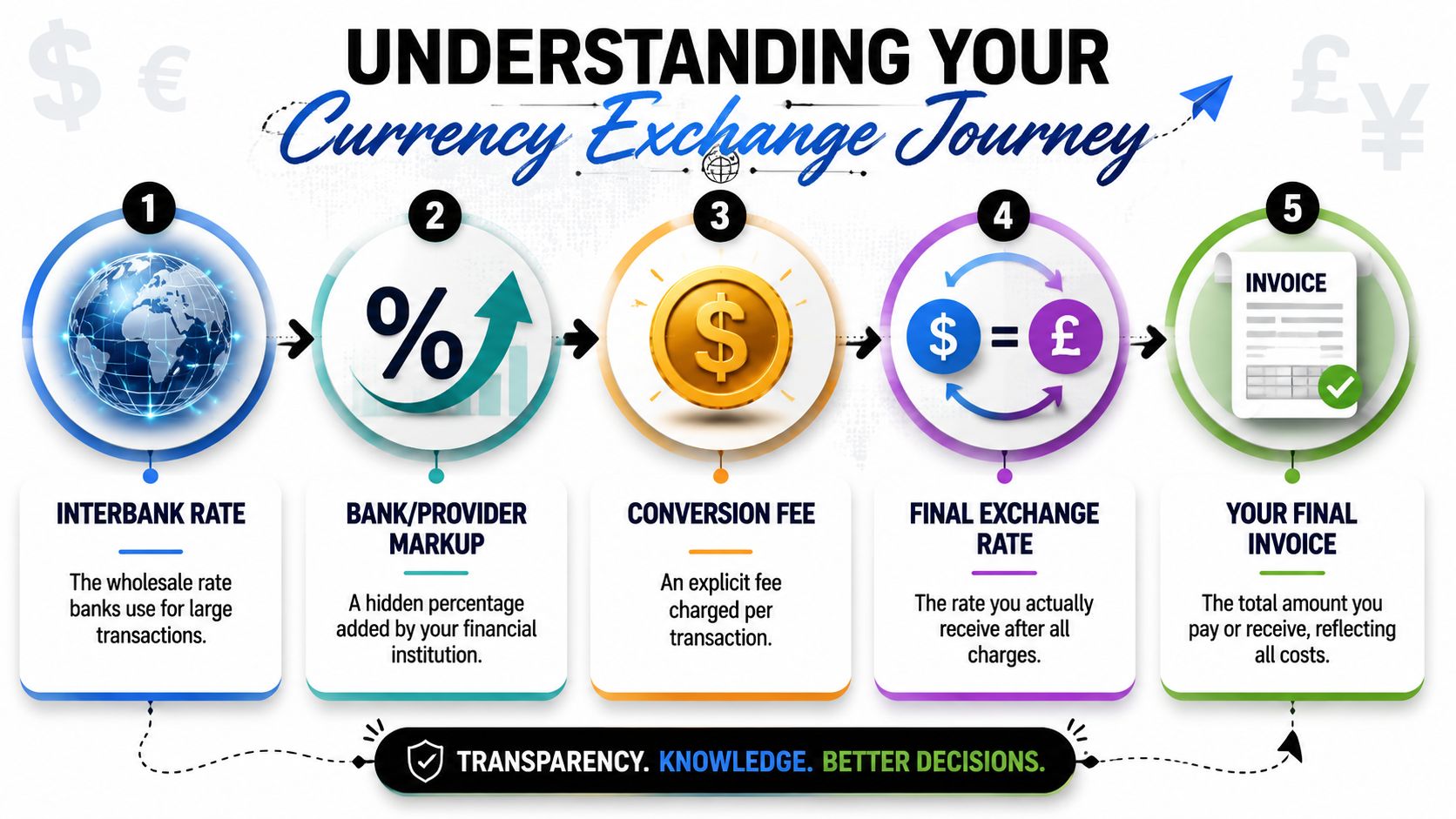
The waterfall from market to money moved
A private charter payment often passes through several layers before it becomes settled funds.
Interbank reference rate
This is the wholesale market level. It's the clean benchmark, not the client outcome.Provider spread
Your bank or payment provider may widen the rate in its favor. That spread is often less visible than an explicit fee.Transfer charges
Wires, correspondent-bank deductions, and payment-processing charges can further change the effective cost.Invoice timing risk
If the quote is in one currency and settlement happens later in another, the cost can move before the money lands.
Here's a useful way to think about it. A currency exchange kiosk shows one price to buy and another to sell. Institutional payment rails do the same thing with more polish.
To compare aviation pricing with the actual payment burden, it helps to review how much a private jet charter flight costs. Then isolate how much of your total is flight economics and how much is payment friction.
A short explainer can help anchor the basics before you negotiate with your bank or treasury team:
What to ask before you send the wire
Use these questions, not vague requests for “a better rate”:
- Which currency is the operator invoicing in? Ask for the native billing currency first.
- Is the quote fixed in my payment currency or only indicative? Those are very different commitments.
- What spread is being applied over the market rate? If nobody will answer, assume the spread favors the seller.
- Are there additional bank or processor deductions? Your treasury team should know before settlement day.
Online FX quotes are reference points. Final invoices are negotiated realities.
That distinction alone can save a client from paying for convenience dressed up as simplicity.
Case Study The Real FX Cost of a New York to London Charter
A practical example makes this easier.
Assume a New York to London charter is priced by the operator at GBP 120,000. The client ultimately needs to settle in US dollars. The aircraft hasn't changed. The route hasn't changed. The only moving parts are the exchange rate and the payment method.
What changes when the rate moves
Start with a base scenario. If the client converts at a given GBP/USD rate, the dollar cost is the sterling invoice multiplied by that rate. If sterling strengthens against the dollar before payment, the exact same flight costs more in dollars. If sterling weakens, it costs less.
The mechanics are simple. The consequences are not.
| Scenario | GBP/USD Rate | Cost in USD (Base) | Payment Fee | Total Cost in USD |
|---|---|---|---|---|
| Base quote | 1.25 | 150,000 | Traditional bank wire with 3% fee | 154,500 |
| Same flight, weaker USD | 1.275 | 153,000 | Traditional bank wire with 3% fee | 157,590 |
| Base quote, lower-fee payment rail | 1.25 | 150,000 | Fintech transfer with 0.5% fee | 150,750 |
| Same flight, weaker USD, lower-fee payment rail | 1.275 | 153,000 | Fintech transfer with 0.5% fee | 153,765 |
That second row reflects a 2% shift in GBP/USD from the base example. The flight hasn't changed, but the client's dollar outlay rises by thousands. That's exactly why international charter clients should stop treating FX as clerical noise.
What this example actually teaches
First, small percentage moves in currency markets can become meaningful on a six-figure invoice.
Second, the payment channel matters almost as much as the market move. A bank wire with a wider fee burden can turn a manageable conversion into an expensive one. A lower-cost specialist payment rail doesn't eliminate market risk, but it does reduce friction layered on top of that risk.
Third, timing matters. If a quote is indicative in sterling and your internal approval takes time, your exposure remains open until you lock the payment terms or settle the invoice.
The right takeaway for affluent travelers
Don't obsess over predicting currencies. Do insist on clarity.
If the trip is substantial, ask for the operator's billing currency, the timing window for quote validity, and whether the payment can be executed through a specialist FX provider rather than a default private-bank process. Clients who manage substantial arrangements often spend plenty of time negotiating aircraft and almost none negotiating the money movement. That's backwards.
The easiest FX savings usually don't come from calling the market correctly. They come from avoiding unnecessary spread and delay.
That's the discipline that turns a global flyer into a better buyer.
Actionable Strategies to Reduce Foreign Exchange Costs
Most international charter clients overpay on FX for one reason. They accept the payment path that's easiest for the seller, not the one that's smartest for the buyer.
The playbook that actually works
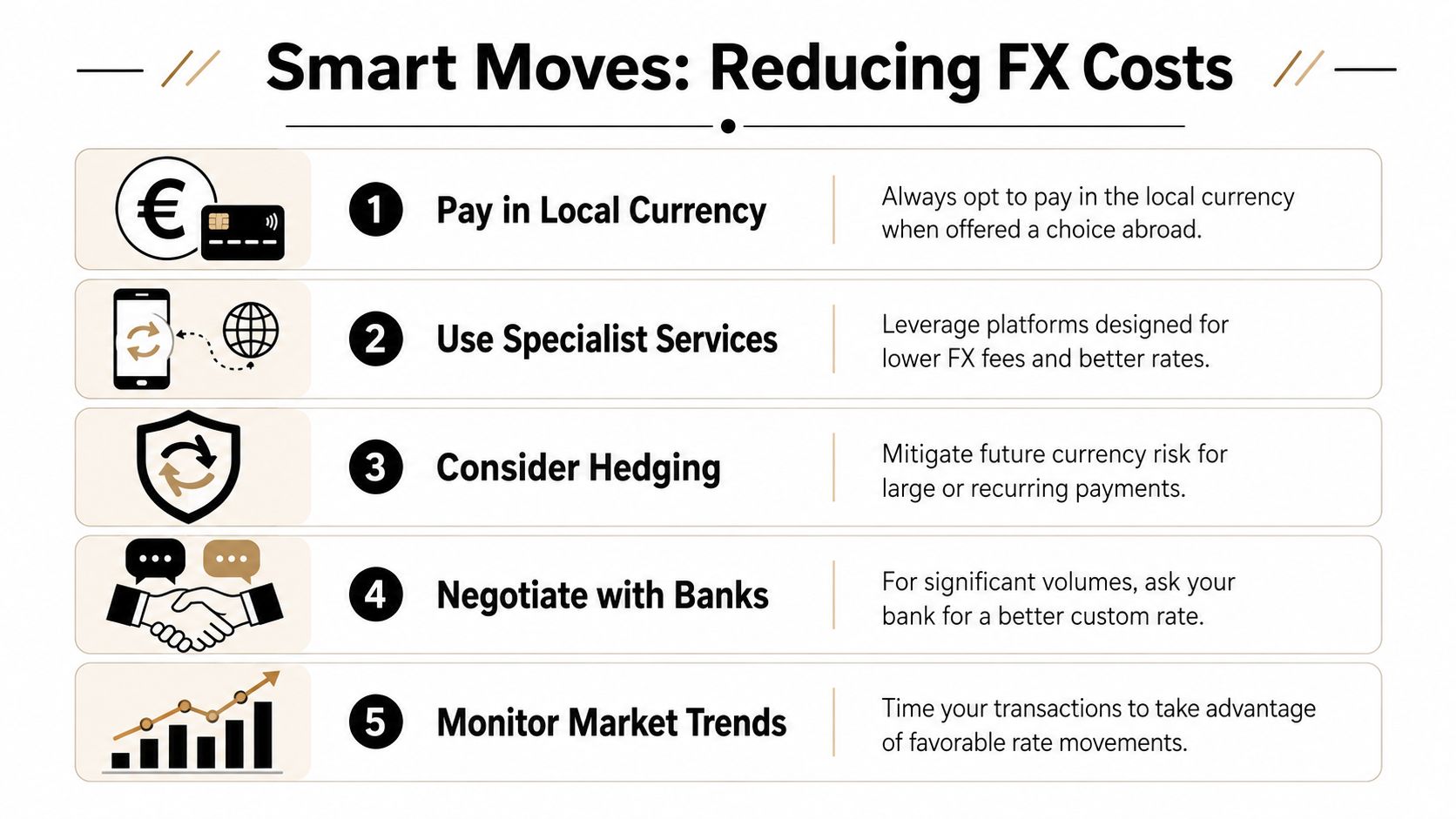
Ask to pay in the operator's local currency. If an intermediary offers to “help” by converting the invoice into your home currency, that convenience often includes a padded rate. Native-currency invoicing gives you transparency and lets you control the conversion separately.
Use a multi-currency account. Platforms such as Wise or Revolut Business can be useful for holding and converting funds with more visibility than a default bank wire. They aren't automatically best for every client, but they force cleaner comparisons.
Negotiate with your private bank or treasury desk. If you move meaningful volume internationally, don't accept retail-style FX treatment. Ask for the actual spread, the all-in landed rate, and any wire deductions.
Use forwards when the trip is planned and material. If you know you'll need to fund a major charter in the future, a forward contract can replace uncertainty with a defined rate. That's often more valuable than trying to guess where the market will be next week.
Know where pass-through really matters
Clients often assume a weaker home currency instantly raises every travel cost one-for-one. That's too simplistic. Research from the Federal Reserve Bank of San Francisco found evidence that exchange-rate pass-through to consumer prices declined after a structural break in the 1990s, in part because firms adjusted prices less frequently in a low-inflation environment. The underlying paper from the Federal Reserve Bank of San Francisco on exchange-rate pass-through is worth reading if you want the economic detail.
For private aviation, the practical lesson is clear. An operator may absorb small or short-lived currency moves rather than revise every quote immediately. But sustained moves don't disappear. They work their way into pricing, supplier costs, and margins over time.
Operating principle: Ignore tiny daily noise. Respect larger, persistent currency moves because they eventually show up somewhere in the travel budget.
Build a smarter payment stack
A good international traveler should have more than one way to settle a large invoice.
Consider this checklist:
Primary route
Your main banking relationship for standard wires and high-trust settlement.Secondary specialist route
A dedicated FX provider or multi-currency platform for better execution on cross-border invoices.Planning tool
A simple internal process for deciding when to convert now, when to hold, and when to hedge.
If you're already exploring alternative payment rails, it's also worth reviewing how crypto payments work for private jet charter to understand where digital assets fit, and where they add their own complexities.
The point isn't novelty. It's optionality. Wealthy travelers shouldn't be trapped in one expensive payment method out of habit.
Fly Smarter in a Global Market
Understanding currency exchange rates isn't about becoming a macro strategist. It's about removing a blind spot from international private aviation.
If you book global charters, three rules matter. Know which currency the operator wants. Know how your payment provider converts that exposure into your home currency. Know when certainty is worth more than trying to squeeze out a slightly better market level.
That mindset changes behavior. You stop treating exchange rates as background noise. You start treating them as a controllable part of total trip cost. You compare quotes more intelligently, approve payments with better timing, and avoid hidden spread that adds nothing to the flight experience.
For affluent travelers, that's the key value of understanding currency exchange rates. It sharpens decision-making without adding friction. You don't need to monitor every tick in GBP/USD or EUR/USD. You do need a system.
Use local-currency invoicing when it gives you transparency. Use specialist payment rails when they improve execution. Use hedging when the planned spend is large enough that unpredictability becomes the primary cost.
That's how savvy clients operate. They don't just charter well. They pay well.
Haute Jets helps clients book on-demand private aircraft with transparent sourcing and direct-to-owner pricing across a global network. If you want smarter control over international charter costs, from aircraft selection to payment planning, speak with Haute Jets.