

When you peel back the layers of aviation, the difference between a wet and dry lease is surprisingly simple. It all boils down to a single question: who’s handling the crew, maintenance, and insurance? With a wet lease, you get the aircraft plus all the operational support. A dry lease, on the other hand, gives you just the jet itself—the rest is up to you.
Understanding Wet and Dry Lease Fundamentals
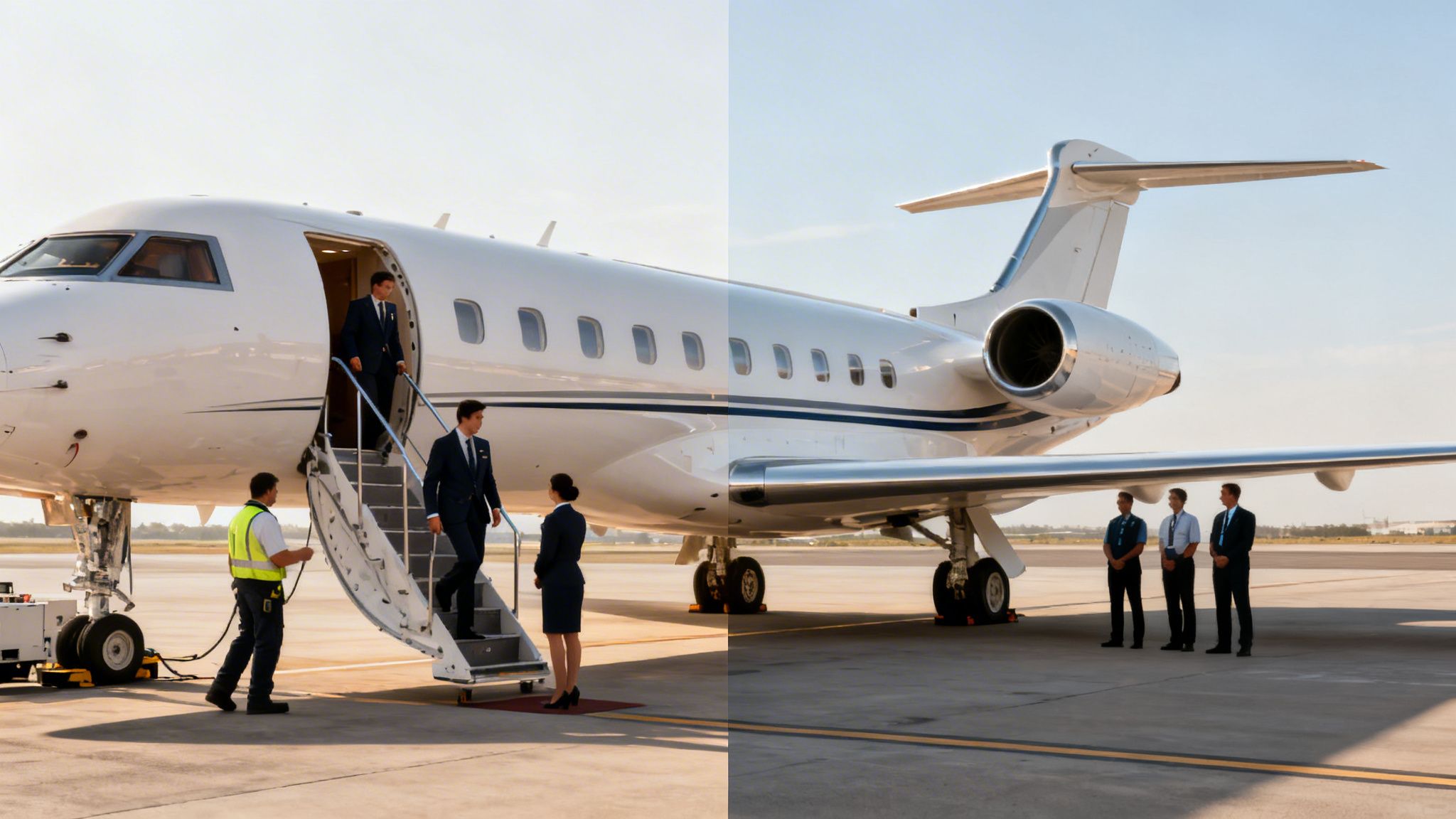
Aircraft leasing isn't just a niche strategy; it’s a cornerstone of the entire industry. Nearly 50% of the global commercial fleet is leased, and this practice has a huge influence on private aviation. For charter clients, the type of lease an operator holds—whether a wet and dry lease—directly shapes aircraft availability, flight costs, and the quality of your experience. These two agreements sit at opposite ends of the operational spectrum.
What Is a Wet Lease?
A wet lease is essentially a "jet-in-a-box" solution. It’s also known in the industry as an ACMI lease, a handy acronym that breaks down exactly what's included:
- Aircraft: The lessor provides the physical jet.
- Crew: The pilots and cabin attendants are employees of the lessor.
- Maintenance: All technical upkeep, from routine checks to major repairs, is the lessor's job.
- Insurance: The lessor is responsible for maintaining the necessary insurance policies.
This model lets an operator (the lessee) add a flight-ready aircraft to its fleet almost overnight, without taking on the immense overhead of staffing and managing it.
What Is a Dry Lease?
A dry lease is the complete opposite. It’s a bare-bones agreement where the lessor provides one thing and one thing only: the aircraft. All other responsibilities fall to the operator (the lessee), who must source their own pilots, manage maintenance schedules, secure proper insurance, and operate the jet under their own Air Operator Certificate (AOC).
Expert Insight: I always tell people to think of it this way: a wet lease is like hiring a chauffeured town car that comes fully serviced and insured. A dry lease is like taking over a long-term car rental—you get the keys, but the driver, gas, and upkeep are all on your dime.
To make these distinctions crystal clear, here’s a simple side-by-side comparison.
| Feature | Wet Lease (ACMI) | Dry Lease |
|---|---|---|
| What's Included | Aircraft, Crew, Maintenance, Insurance | Aircraft only |
| Operational Control | Held by the lessor (owner) | Held by the lessee (operator) |
| Typical Use Case | Short-term capacity, seasonal demand | Long-term fleet expansion |
| Responsibility | Lessor manages all operational aspects | Lessee manages all operational aspects |
Getting a firm grasp on these concepts is the first step to navigating the private charter market like an insider. The decision between a wet and dry lease fundamentally shapes how operators build their fleets, manage costs, and ultimately serve you. To see how these agreements fit into the bigger picture, you can dive deeper in our complete private jet lease guide.
Comparing Wet Lease vs Dry Lease Responsibilities
Knowing the basic difference between a wet and dry lease is one thing, but the real story is in the fine print—specifically, who is responsible for what. These agreements are about far more than just who hands over the keys to the jet. They define who manages the crew, who fixes a technical snag, who foots the insurance bill, and ultimately, who answers for the safety of every single flight.
At its core, the choice boils down to a trade-off between convenience and control. A wet lease is essentially a full-service, turnkey solution where the lessor handles nearly everything. On the other hand, a dry lease is more of an à la carte deal, giving the lessee complete operational command but also saddling them with all the duties that come with it.
Crew and Staffing Responsibilities
The most visible difference you'll notice is in the cockpit and cabin. With a wet lease, the pilots and flight attendants are employees of the lessor. They are already type-rated, fully integrated into the lessor's operational system, and show up ready to fly. It’s a massive shortcut for anyone needing to get a new service airborne without a drawn-out hiring and training cycle.
A dry lease is the exact opposite: the aircraft arrives as a blank slate. The lessee is entirely on the hook for sourcing, hiring, training, and managing their own flight and cabin crews. While this requires a robust HR and operational framework, it gives the lessee total control over their brand's feel, service standards, and crew culture.
Key Takeaway: The crew is the human face of your operation. In a wet lease, that face belongs to the lessor. In a dry lease, it’s yours to build, allowing you to create a completely consistent brand experience from the ground up.
This single point has huge ripple effects. An airline testing a new international route might grab a wet lease for an instant, experienced team. A corporate flight department that prizes discretion and consistency, however, will almost always prefer a dry lease to use their own trusted pilots across the fleet.
Maintenance and Technical Support
Aircraft are incredibly complex, and they require constant, painstaking maintenance to stay safe. How that work gets done is a fundamental split between a wet and dry lease.
Under a wet lease, the "M" in the common acronym ACMI stands for Maintenance, and that responsibility rests squarely with the lessor. They manage all scheduled inspections, handle any unexpected repairs, and ensure the aircraft is always airworthy per regulatory and manufacturer mandates. If something breaks, it's their problem to solve.
A dry lease flips that responsibility entirely. The lessee takes on all technical upkeep for the aircraft. This isn't just about topping up the oil; it means managing everything from routine daily checks to complex, multi-week inspections and engine overhauls. The lessee must have their own certified maintenance program and qualified people to keep the jet flying safely.
Insurance and Liability Coverage
Insurance is one of the most significant and non-negotiable costs in aviation. The lease structure dictates who holds the primary policies and bears the financial risk.
- Wet Lease: The "I" in ACMI stands for Insurance. The lessor provides the primary insurance policies covering the aircraft itself (hull) and third-party liability. The lessee is usually just named as an additional insured, shielding them from carrying the main policy burden.
- Dry Lease: The lessee is responsible for securing all their own insurance. This includes hull insurance to protect the aircraft's value and liability coverage for passengers, crew, and third parties on the ground. This provides control over the policy but adds a major administrative and financial task.
Regulatory and Safety Oversight
This is arguably the most critical distinction: who is legally considered the operator of the aircraft? The answer comes down to the Air Operator Certificate (AOC), the license granted by a national aviation authority (like the FAA in the US) that allows a company to fly aircraft for commercial purposes.
In a wet lease, the entire flight operates under the lessor's AOC. The lessor is the certified air carrier, making them legally responsible for flight safety, crew compliance, operational procedures, and everything in between.
With a dry lease, the lessee must add the aircraft to their own AOC. They become the legal operator, assuming full accountability for their safety management system (SMS), regulatory adherence, and proving to the authorities that they can run the aircraft to the highest safety standards.
For a simple side-by-side view, this table breaks down who is responsible for the key operational functions in both scenarios.
Wet Lease vs Dry Lease Responsibility Matrix
| Responsibility | Wet Lease (ACMI) | Dry Lease |
|---|---|---|
| Aircraft | Provided by Lessor | Provided by Lessor |
| Flight & Cabin Crew | Lessor provides and manages | Lessee provides and manages |
| Maintenance & Repairs | Lessor handles all technical support | Lessee handles all technical support |
| Insurance Policies | Lessor holds primary policies | Lessee holds primary policies |
| Air Operator Certificate (AOC) | Operates under Lessor's AOC | Operates under Lessee's AOC |
| Operational Control | Retained by the Lessor | Transferred to the Lessee |
Ultimately, the right choice is dictated by an operator's existing capabilities and long-term goals. A wet lease offers a fast and simple path by outsourcing these core functions, whereas a dry lease offers total control for those who have the expertise and infrastructure to manage it all in-house.
When Does a Wet Lease Make Strategic Sense?
When an airline needs an aircraft and crew now, without the long-term headaches of ownership, the wet lease is the go-to solution. Think of it as a complete, ready-to-fly package. A wet lease—often called an ACMI lease for Aircraft, Crew, Maintenance, and Insurance—is the industry’s ace in the hole for adapting to market demands with incredible speed.
The real power of a wet lease is that it's turnkey. An operator gets a fully operational aircraft, a qualified flight crew, and all the necessary technical and insurance coverage bundled together. It's an invaluable tool for navigating unexpected operational challenges and capitalizing on short-term opportunities.
Scaling Up for Peak Demand
Every airline operator knows the rhythm of seasonal demand. You have the summer holiday rush to Europe, the winter ski season traffic, or major annual events that cause bookings to spike. A wet lease lets you temporarily expand your fleet to meet that surge without buying planes that would just sit idle the rest of the year.
For instance, an airline might wet-lease a few extra Airbus A320s from June to August to handle the high demand for Mediterranean routes. Once the peak season is over, the lease ends, and the fleet returns to its normal, more cost-effective size. This avoids the heavy financial drain of underutilized assets during the slow months.
Launching New Routes with Lower Risk
Breaking into a new market is a big gamble. Is there enough demand to sustain a new route? Will it be profitable long-term? Instead of betting the farm, a wet lease offers a way to test the waters with minimal financial exposure.
An airline can use a wet-leased aircraft to launch a new route—say, a non-stop flight from New York to an up-and-coming destination—for a 6-to-12-month trial. This gives them time to build a presence and gauge real-world passenger numbers without the massive capital outlay for a new aircraft, crew base, and maintenance setup. If the route takes off, they can commit to a dry lease or purchase. If it doesn't, they can walk away without a major loss.
Expert Insight: A wet lease effectively converts a major capital risk into a predictable operational expense. It gives operators the agility to experiment with their network, react to market shifts, and innovate without putting the company's finances on the line.
Responding to AOGs and Unexpected Disruptions
In aviation, the one thing you can count on is the unexpected. An aircraft can be grounded for unscheduled maintenance (an AOG situation), a new delivery from the manufacturer can be delayed, or a fleet-wide technical issue can suddenly shrink your capacity. In these moments, a wet lease is an operational lifeline.
It all comes down to who is responsible for what. The infographic below breaks down the clear division of duties that makes a wet lease such a powerful short-term fix.
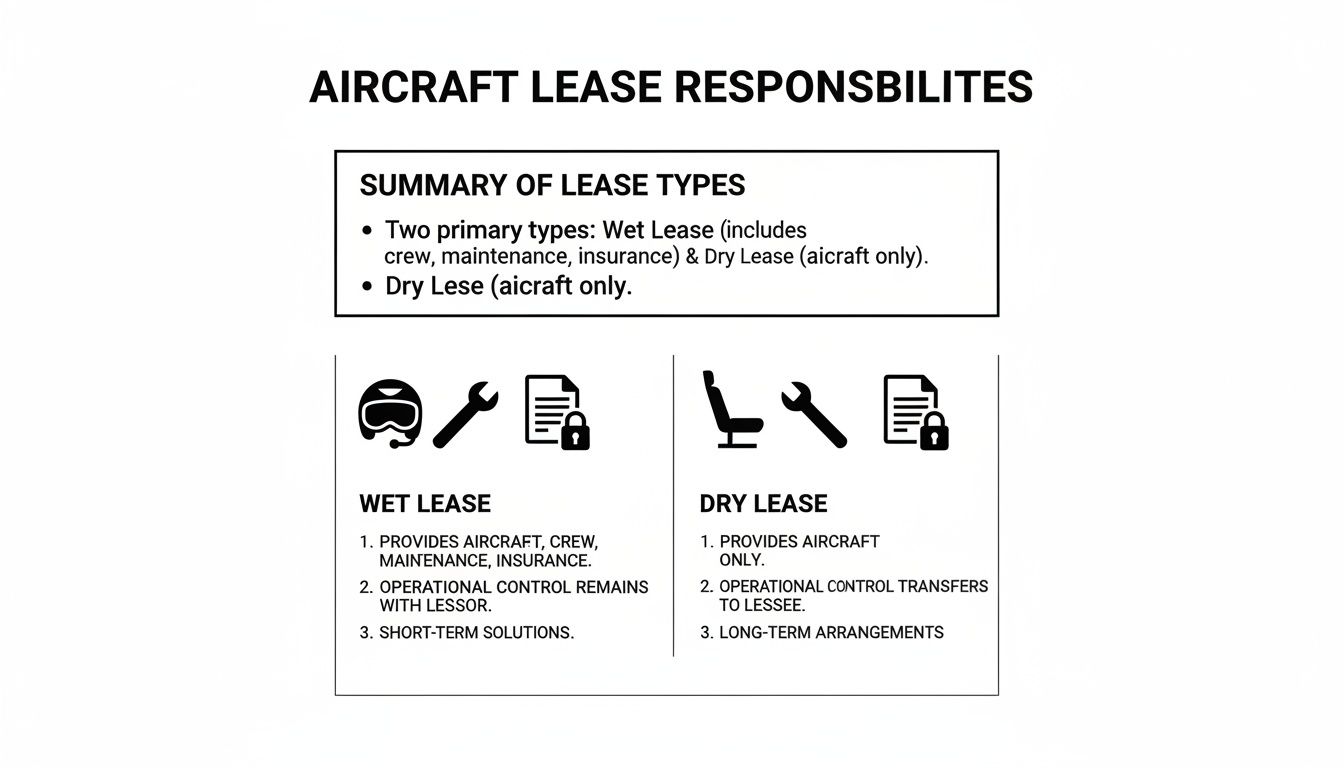
As you can see, the lessor handles all the core operational burdens. This allows the lessee to plug an operational gap almost instantly, keeping schedules intact and passengers happy during a crisis.
This ability to quickly find capacity has proven essential time and again. When the Eyjafjallajökull volcano erupted in 2010 and its ash cloud grounded over 100,000 flights, airlines scrambled to recover their networks, wet-leasing 15-20% more aircraft than usual.
More recently, as global passenger numbers bounced back to 4.5 billion in 2026—97% of pre-pandemic levels—production delays from Boeing and Airbus created a massive aircraft shortage. To meet soaring demand, airlines in Europe and North America turned to wet leasing, which grew to account for 28% of the market. You can find more data on these trends at OAG.com.
How Dry Leasing Powers Long-Term Fleet Strategy

If a wet lease is the industry's tactical solution for immediate needs, then the dry lease is its strategic counterpart. This is the model that fuels long-term fleet growth for major airlines, nimble low-cost carriers, and sophisticated corporate flight departments. A dry lease is simple in concept: it provides just the aircraft, nothing more.
By stripping away the bundled services, this "aircraft-only" model hands over all operational responsibilities—from crew and maintenance to insurance—squarely to you, the lessee. It’s a significant undertaking that requires a robust operational backbone, but the trade-off is immense: total control over your fleet, brand, and long-term costs. It’s a commitment, not a quick fix.
Mastering Operational Control and Brand Consistency
In aviation, your brand is built on consistency. A dry lease is the only way to ensure every passenger touchpoint, from the livery on the tail to the crew's service delivery, is 100% yours. You use your own pilots and flight attendants, which guarantees a familiar and uniform experience across the entire fleet.
This level of control goes far beyond just branding. When you operate the aircraft under your own Air Operator Certificate (AOC), you dictate the entire operational tempo. You manage the maintenance schedules, set the flight protocols, and integrate the jet seamlessly into your existing operations without any third-party bottlenecks.
Key Differentiator: A dry lease is fundamentally about building an identity. It empowers an operator to put their own stamp on every flight, making sure passengers know exactly what to expect, whether the aircraft is owned or leased.
For a corporate flight department, this translates to having a trusted, familiar crew flying an aircraft that functions as a true extension of the company. That kind of consistency is essential when executives depend on private aviation for mission-critical travel.
Achieving Long-Term Financial Efficiency
At its core, a dry lease is a powerful financial tool. By unbundling the aircraft from the crew, maintenance, and insurance, operators sidestep the hefty premiums baked into turnkey wet lease agreements. Over a typical lease term of five to ten years, those cost savings become enormous. It’s simply the most cost-effective method for fleet expansion without the massive capital outlay of a direct purchase.
This is exactly why dry leasing is the dominant force in the global market. Its commanding position is expected to propel the industry toward $377.90 billion by 2034, driven almost entirely by its financial logic. Just look at how low-cost giants like Ryanair and Southwest have historically used dry leases to rapidly scale their fleets with hundreds of jets, enabling aggressive growth while keeping a tight lid on costs. You can find more market data and analysis from Fortune Business Insights.
Building a Stable and Reliable Charter Fleet
The advantages of dry leasing also trickle down to the charter client. When a charter operator builds its core fleet on dry-leased aircraft, it establishes a bedrock of stability and reliability. These jets are fully absorbed into the operator's ecosystem—maintained by their technicians, flown by their crews, and consistently available.
This structure delivers clear benefits for anyone chartering a flight:
- Predictable Availability: Since the operator has long-term control of the asset, the aircraft is a dependable part of their charter offerings, perfect for frequent flyers or block-hour agreements.
- Cost-Effective Rates: By avoiding the higher overhead of a wet lease, operators using dry-leased aircraft can pass those savings on, resulting in more competitive charter pricing.
- Consistent Service: You fly with the operator’s team and experience their distinct service standards every time, ensuring a high-quality, predictable journey.
In the end, both a wet and dry lease have indispensable roles. A wet lease is your go-to for tactical, short-notice solutions. But a dry lease provides the strategic, long-term framework that lets operators build their fleet, define their brand, and offer dependable, cost-efficient service.
Understanding Hybrid Leases and Market Trends
The world of aviation leasing isn't just black and white. While wet and dry leases represent the two ends of the spectrum, there’s a flexible middle ground filled with hybrid agreements tailored to solve very specific operational problems.
The most common of these is the damp lease. Think of it as a modified wet lease. The lessor provides the Aircraft, flight Crew, and Maintenance (you'll often see this called an AMC lease), but the cabin crew is notably absent. That part is left to the lessee, giving them complete control over their brand identity and in-flight service standards.
When Hybrid Models Are the Smartest Choice
So, when does a damp lease make sense? It's the perfect fit for an airline that needs the technical heavy lifting handled but insists on owning the customer-facing experience.
Imagine a carrier launching a new international route. A damp lease lets them get planes in the air almost immediately, backed by the lessor's pilots and maintenance teams. At the same time, they can use their own cabin crew to deliver the exact service and brand consistency their passengers expect.
Other hybrid structures can get even more creative. Some agreements start as a full-service wet lease and gradually transition to a dry lease over months or years. This gives a new operator the runway to launch quickly with full support, then slowly take over all operational control as its own certifications and infrastructure fall into place.
Expert Insight: Hybrid leases show just how creative the market can be. They let operators cherry-pick what they need—blending the turnkey ease of a wet lease with the brand control of a dry lease—to build a solution that truly fits.
Current Market Trends Shaping Leasing Decisions
The leasing market is always in motion, but several key trends are really steering decisions right now. Persistent pilot shortages in some regions, coupled with major delivery delays from aircraft manufacturers, are forcing airlines to get creative to keep their schedules full.
This pressure is clearly shaping market growth. While the global aircraft leasing market is projected to hit $210.57 billion by 2026, the story is in the details. Dry leases still make up the bulk of the volume, but wet leasing is growing at a much faster clip. After recent fleet groundings, for example, European wet lease contracts shot up by 25% as airlines scrambled for rapid, flexible capacity. You can see more data on these shifts from industry analysts at SNS Insider.
Understanding these forces is key to making a smart leasing decision. It's also wise to keep an eye on technology, as breakthroughs like the impact of 3D printing in the aerospace industry could change maintenance logistics and long-term fleet strategies. The right lease isn't just about your immediate needs; it's about positioning yourself within a complex and fast-moving industry.
For a deeper dive into making these critical choices, our corporate jet leasing guide offers more context.
Choosing the Right Lease for Your Aviation Needs
So, when it comes to a wet and dry lease, what’s the right call? The truth is, there’s no single "best" option. It all boils down to the mission at hand. The best choice is always the one that strategically aligns with your immediate priorities: speed, cost, and control.
As a private flyer, you aren’t the one signing the lease agreement—that’s handled behind the scenes by your charter operator. But knowing how they build their fleet gives you valuable insight. The most capable operators use a smart mix of both lease types to make sure you always have the perfect aircraft ready for any given trip.
When to Prioritize Speed and Flexibility
A wet lease truly comes into its own when you need to move quickly or require a short-term solution. Think of it as the on-demand, all-inclusive option.
Here are a few scenarios where this approach is a clear winner:
- Urgent, Last-Minute Trips: An unexpected business meeting pops up across the country, or you decide on a spontaneous weekend escape. An operator with access to wet-leased jets can get you a flight-ready plane—crew, maintenance, and insurance included—almost immediately.
- One-Time Special Events: Flying a large group out for a destination wedding or getting the executive team to a conference doesn't justify a long-term aircraft commitment. A wet lease is the perfect ad-hoc solution to add capacity without any strings attached.
- Testing a Frequent Route: If you’re thinking about a more permanent travel arrangement but aren't quite ready to pull the trigger, chartering a wet-leased aircraft lets you test-drive the route and experience the convenience firsthand.
In these situations, you're paying for turnkey service and rapid deployment. That slightly higher cost is a direct exchange for getting in the air fast with zero operational headaches.
When to Focus on Cost and Consistency
For travelers with more predictable schedules or those keeping a close eye on the budget, an operator whose fleet is built on dry leases offers some serious perks. These aircraft are the backbone of a charter provider's core service.
Key Insight: Choosing an operator with a dry-leased fleet is like building a relationship with a trusted partner. You benefit from their long-term control over the aircraft, crew familiarity, and the cost efficiencies that come from their operational stability.
This model is the ideal fit when you’re looking for:
- Predictable Long-Term Relationships: Flying the same routes often? Working with an operator using dry-leased jets means consistency. You’ll likely see the same flight crew and fly on the same aircraft, which creates a comfortable, seamless experience.
- Cost-Effective Block Hours: Operators can pass on the savings from their efficient dry lease structures. This results in much better pricing on block-hour programs and other frequent-flyer arrangements. For many, this is what makes private aviation a practical alternative to full ownership. You can learn more by reading our guide on why you should charter a private jet vs ownership.
A truly great charter brokerage doesn't make you choose one over the other. They expertly navigate the market to find the right aircraft for the moment—whether that’s a wet lease for an urgent trip or a dry-leased jet for your routine travel—guaranteeing the perfect flight, every time.
Common Questions About Aircraft Leasing
When you start digging into how the private jet world works, terms like wet and dry lease pop up. It can seem complicated, but understanding the basics helps you appreciate what goes on behind the scenes of your charter flight. Let’s clear up a few common questions.
What Is an ACMI Lease? Is It Just Another Term for a Wet Lease?
Exactly. An ACMI lease is simply the industry term for a wet lease. The acronym itself tells you everything the aircraft owner (the lessor) provides: Aircraft, Crew, Maintenance, and Insurance. Think of it as the all-inclusive, ready-to-fly package for an operator who needs an extra jet, fast.
For you as the charter client, this is totally seamless. When your flight is arranged on an aircraft under a wet lease, the entire operation is handled by the lessor’s team. You just show up and fly.
As a Charter Client, Can I Pick Between a Wet or Dry Lease?
This is a great question, but the short answer is no, not directly. These leases are B2B agreements between operators. You aren't a party to the lease contract itself, but you absolutely feel the effects of it.
Your power comes from choosing the right charter provider. A good broker has access to a wide network of operators, some of whom use wet leases for flexibility and others who use dry leases to build out their core fleet. This behind-the-scenes management is what allows them to find you the right plane for your specific trip.
The Bottom Line: You don't sign the lease, but you experience the result. A wet lease might be why your operator can find you a last-minute jet, while a dry lease often contributes to the consistent aircraft options available for your regular routes.
Is a Wet Lease Safer Than a Dry Lease, or Vice Versa?
Neither lease type is inherently safer. Safety comes down to one thing: the quality and professionalism of the operator flying the plane. Both models are governed by strict aviation regulations.
- With a wet lease, the flight is conducted under the lessor's Air Operator Certificate (AOC). They are fully responsible for meeting all safety and maintenance standards.
- With a dry lease, the operator using the plane (the lessee) must put it on their own AOC and take on full responsibility for their safety program.
For any private flyer, the most critical question isn't about the lease type. It's about ensuring your flight is with an operator who holds top-tier safety credentials, like Wyvern Wingman or Argus Platinum ratings. That's the real measure of safety.
Ready to see how this flexibility translates into a better charter experience? Haute Jets works with a global network of over 3,500 safety-rated aircraft to find the perfect jet at the right price for your trip. Book your next flight today.