
When you book a private jet, you're not just buying a flight; you're placing your trust in an entire ecosystem of safety and operational standards. The backbone of that system is a set of rules known as the Federal Aviation Regulations, or FARs.
Think of the FARs as the master rulebook for everything that flies in the United States. Written and enforced by the Federal Aviation Administration (FAA), these laws dictate everything from how a jet is built and maintained to how many hours a pilot can fly in a day.
Your Essential Guide to Federal Aviation Regulations
For a private traveler, understanding a few key FARs is the difference between blindly trusting a provider and making an informed, safe choice. It's like hiring a licensed, bonded chauffeur versus just getting a ride from a stranger. Both might get you to your destination, but only one is held to a rigorous professional standard designed entirely for your protection.
These regulations are officially known as Title 14 of the Code of Federal Regulations (14 CFR). While it’s a massive body of law, you only need to know about a few specific "Parts" that directly impact your charter flight. Getting a handle on these is the first real step toward ensuring your safety and peace of mind.
The Regulations That Matter Most
Imagine the FARs as a library, with each "Part" being a book on a specific subject. You don't need to read the entire library—just the books that apply to your flight. For anyone chartering a jet, two Parts are absolutely essential to know:
- Part 91: This is the baseline. These are the general operating and flight rules that apply to all private aircraft not being operated for hire. Think of them as the basic traffic laws every driver on the road must follow.
- Part 135: This is the big one for charter clients. These are the strict regulations for "On-Demand Operations"—the legal term for charter flights. When you pay for a flight, the operator must hold a Part 135 certificate, which imposes much higher standards for crew training, maintenance, and operational oversight.
The single most important thing for any charter client to remember is this: A legal charter flight that you pay for must be conducted under FAR Part 135. This is not a suggestion; it's a hard-and-fast rule that separates legitimate, safe charter from a risky, illegal operation.
This knowledge instantly changes your role from a passive passenger to an empowered consumer. It gives you the vocabulary to ask the right questions, vet operators with confidence, and choose a service that meets the highest benchmarks for safety.
To make this even clearer, here’s a quick-reference table summarizing the FARs that have the biggest impact on the world of private aviation.
Key FAR Parts at a Glance
This table breaks down the most important regulations so you can quickly understand what they cover and why they're relevant to your flight choices.
| FAR Part | What It Governs | Why It Matters to You |
|---|---|---|
| Part 91 | General Aviation (Private, non-commercial flights) | Governs flights by aircraft owners for their own use. You should never be paying for a flight operated under Part 91. |
| Part 135 | On-Demand Charter Operations | These are the rules for legitimate charter flights. It ensures stricter crew rest, training, and maintenance standards for your safety. |
| Part 121 | Scheduled Airlines (e.g., Delta, American) | Governs major airlines. These are the highest standards, but they don't apply to on-demand charter. |
| Part 119 | Air Carrier & Commercial Operator Certification | This is the "gatekeeper" rule. It specifies what an operator must do to earn a Part 121 or Part 135 certificate from the FAA. |
Ultimately, having a basic grasp of what the FARs are and why they exist is your best tool for guaranteeing a secure and professionally managed flight every single time.
The History of FARs: Forged from Tragedy to Ensure Today's Safety
It’s easy to think of aviation regulations as just a thick book of bureaucratic rules. But the Federal Aviation Regulations, or FARs, weren't dreamt up in some quiet government office. They were written in the sky, a direct response to some of aviation's darkest days. To really grasp why these rules matter so much for your safety, we have to go back to a time when flying was a very different—and far more dangerous—proposition.
The 1950s saw an explosion in air travel. Propeller-driven airliners were giving way to faster, higher-flying jets, and the public was eager to fly. The problem? The system meant to manage all this new traffic was dangerously outdated. Military jets and commercial airliners crisscrossed the country, often invisible to each other and operating under entirely separate sets of rules. The sky was getting crowded, and no one was in charge.
The Collision That Changed Everything
The breaking point came on a clear morning over the Grand Canyon in 1956. A TWA Super Constellation and a United DC-7, having departed Los Angeles just minutes apart, both maneuvered to give their passengers a better view of the stunning landscape below. Tragically, they collided in mid-air. There were no survivors among the 128 people on board, making it the worst commercial air disaster in history at the time.
This wasn't just a freak accident; it was a symptom of a fundamentally broken system. A string of other mid-air collisions had already sounded the alarm. With no single authority overseeing all air traffic, civilian and military pilots were essentially flying blind.
The public was horrified and demanded action. It was painfully clear that the patchwork of old rules simply couldn't cope with the speed and complexity of the jet age.
In response, Congress passed the Federal Aviation Act of 1958. This wasn't just a minor update—it was a revolutionary overhaul of American aviation. The act created a single, powerful new authority, the Federal Aviation Agency (today's FAA), with the mandate to bring order to the skies.
From Chaos to Cohesion
The FAA's first and most critical task was to create and enforce one unified set of rules for all aircraft, from the smallest private plane to the largest airliner. This was the birth of the Federal Aviation Regulations as we know them.
These new regulations established strict, nationwide standards for everything: air traffic control procedures, how aircraft must be built and certified, and what it takes to earn and keep a pilot's license. For the first time, everyone was flying from the same playbook.
This framework, born from the 1958 act, is the direct ancestor of the rules that keep us safe today. And they work. The rigorous standards of FAR Part 135 for charter flights, for example, have helped drive a 75% reduction in fatal accidents per 100,000 flight hours since 1990. You can explore more about the evolution of private jet safety on our blog.
The FARs aren't static. They are constantly evolving, updated with lessons learned from every incident and every technological breakthrough. So when you hear about an operator's commitment to the FARs, remember it's not about checking boxes. It’s about honoring a decades-long commitment to safety that was paid for by the hard lessons of the past.
Decoding the Critical Difference Between Part 91 and Part 135
When you start digging into the world of private aviation, you’ll hear two terms tossed around constantly: Part 91 and Part 135. This isn't just industry jargon. Understanding the difference is single-handedly the most important piece of knowledge you can have to ensure you're flying safely and, just as importantly, legally.
Here’s a simple way to think about it. FAR Part 91 is essentially the rulebook for driving your own car. You own the vehicle, you're responsible for it, and you're not getting paid to drive anyone around. The rules cover the basics of safe operation but aren't built to protect paying customers.
FAR Part 135, however, is the heavy-duty legal framework that governs a professional limousine service. When you hire a limo, you're a commercial passenger, and a much higher set of standards kicks in to protect you. The company needs a commercial license, the drivers face stricter vetting, and the vehicles must pass rigorous inspections.
That analogy cuts right to the chase. When you book a private jet charter, you are paying for that flight. That makes you a commercial passenger, and the flight must legally be operated by an FAA-certificated Part 135 air carrier. No exceptions.
What Part 91 Actually Covers
So, what is Part 91 for? These regulations govern general aviation flights—flights where nobody is paying for a seat.
Think of it as the private-use category. It includes:
- An owner flying their own jet for personal trips or business.
- A corporate flight department that operates an aircraft exclusively for its own employees.
- Certain flight-sharing or fractional ownership models where members are only splitting costs, not creating a for-profit service.
The safety standards are solid for private use, but they lack the extra layers of oversight designed to protect the public. Pilot training schedules and rest requirements, for example, are much more flexible than in the commercial world.
The Part 135 Gold Standard for Charter
Part 135 was created specifically for the world of on-demand and commuter flights, which is the legal home for private jet charters. The second money changes hands for your trip, Part 135 rules must apply. This isn't a choice; it's a federal requirement. To do this, an operator has to earn and maintain a Part 135 Air Carrier Certificate—a difficult and costly process.
This certificate demands a much higher commitment to safety, which directly benefits you as the passenger. Key differences include:
- Stricter Pilot Requirements: Part 135 pilots need more flight hours to even qualify. They also face regular proficiency checks and must follow rigid duty time and rest rules to combat fatigue.
- Enhanced Maintenance: The aircraft must follow a stringent, FAA-approved inspection program that is far more demanding than standard Part 91 maintenance schedules.
- Operational Oversight: A certified operator is required to have a full management team, including a Director of Operations, Chief Pilot, and Director of Maintenance, who are all legally responsible for safety and compliance.
The bottom line is painfully simple: If a flight is sold as a "charter" but the operator is only following Part 91 rules, it's an illegal charter. It's a dangerous shortcut that sidesteps the very regulations designed to protect you. Always ask your provider: "Is this flight operated under a Part 135 certificate?"
This visual guide shows just how these safety regulations came to be, born from real-world events that shaped the framework we rely on today.
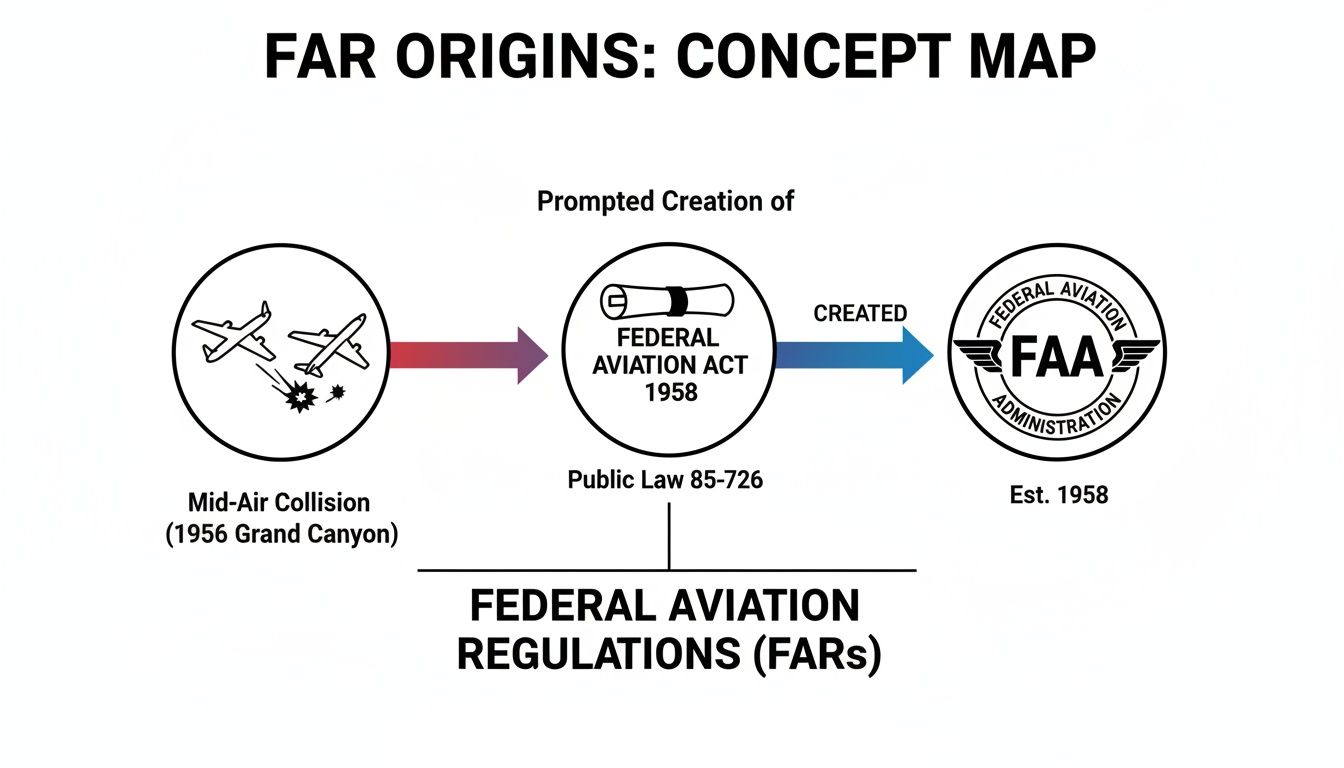
As you can see, a tragic mid-air collision directly led to the Federal Aviation Act of 1958 and the birth of the FAA. This established the foundation for the strict safety rules, like Part 135, that protect air travelers.
Why This Distinction Is So Critical
Choosing a Part 135 operator goes far beyond checking a legal box—it's about committing to a culture of safety. These operators live under constant FAA surveillance and have to prove their compliance every single day.
An illegal charter operator running flights under Part 91 bypasses all of this. They can offer a tempting price because they aren't investing in the expensive training, maintenance, and operational infrastructure that Part 135 demands. When you're chartering a flight, it's essential to understand exactly what a chartered jet really is and the high standards you should expect for your money.
By insisting on a legitimate Part 135 operator, you ensure you're protected by a system built from the ground up to deliver the highest level of safety and professionalism in private aviation.
How FARs Directly Enhance Your Private Flight Experience
It’s one thing to talk about Federal Aviation Regulations in the abstract, but what do they actually do for you when you step onto a private jet? When you hear that an operator adheres to the FARs, it isn't just about ticking a legal box. It’s a direct investment in your safety, your schedule, and your overall peace of mind.
These rules create a robust, behind-the-scenes framework that touches every single part of your flight. Let's look at three key areas—pilot qualifications, aircraft maintenance, and crew rest—to see how these regulations form the bedrock of a truly exceptional flight experience.

Ensuring Expert Pilots Are in the Cockpit
When you charter a Part 135 flight, you’re not just getting a pilot. You're getting a thoroughly vetted professional held to the same high standards as commercial airline pilots. The FARs set the minimum qualifications, and they are impressively stringent.
For instance, a captain must hold an Airline Transport Pilot (ATP) certificate, which is the highest level of pilot certification in the United States. To even qualify for an ATP, a pilot needs a minimum of 1,500 flight hours. This isn't just about time in the air; it's about accumulating the real-world experience and sound judgment needed to handle complex decisions under pressure.
Beyond that, Part 135 demands that pilots constantly prove their skills through rigorous, recurrent training. This includes:
- Regular simulator training to practice emergency procedures that you hope they never need but are glad they know.
- Annual or semi-annual check rides with an FAA examiner to validate their proficiency.
- Specific training on the exact make and model of the aircraft they are flying for you.
This system of continuous evaluation ensures your flight crew stays sharp and proficient, providing a level of expertise that goes far beyond what's required for basic private flying under Part 91.
Mandating Meticulous Aircraft Maintenance
A private jet is an incredibly sophisticated machine, and its reliability is non-negotiable. The FARs establish a strict framework for how Part 135 aircraft are inspected and maintained, dramatically cutting the risk of mechanical issues that can cause delays or safety incidents.
An aircraft used for charter must be enrolled in a stringent, FAA-approved inspection program. This is a huge distinction from a privately owned Part 91 aircraft, where maintenance schedules can be more flexible. For a charter operator, every inspection is mandatory and meticulously documented.
These programs often demand more frequent and detailed checks than even the manufacturer recommends. Furthermore, all significant maintenance must be done at an FAA-certified Part 145 repair station, which itself is held to exacting standards for its tools, technician training, and quality control.
This oversight means that when you board a Part 135 charter, you are flying on an aircraft maintained to a commercial standard, ensuring maximum reliability.
Preventing Pilot Fatigue with Strict Duty Limits
One of the most critical—and often invisible—factors in aviation safety is pilot fatigue. The FARs tackle this head-on with unambiguous rules governing how long a crew can fly, be on duty, and how much rest they must get between shifts.
These regulations are designed to ensure the pilots in the cockpit are always alert and at the top of their game. For example, pilots are limited in the number of flight hours they can log in a 24-hour period and are required to have a mandatory rest period between duty days. This prevents the dangerous cognitive decline that comes with exhaustion.
Regulations like those found in FAR Part 61 have set training benchmarks that have profoundly improved flight safety. This framework contributed to a 92% improvement in navigation accuracy on certain long-haul flights and helped slash global accident rates to just 0.5 per million departures in recent years. You can fuel the private jet market's growth and safety records on Airvoir.com to see how these standards impact the industry.
By enforcing these limits, the FARs provide a powerful safeguard against one of aviation's most subtle risks. It's a benefit you'll never see but one that has a massive impact on the safety of your journey.
Going Beyond the Rules with Wyvern and ARGUS Ratings
Think of the Federal Aviation Regulations as the absolute floor for safety in private aviation. Following these rules isn't optional; it's the price of entry for any operator to legally offer charter flights. This framework is what makes our aviation system so incredibly safe and reliable.
But for the best operators and the most discerning clients, that government-mandated baseline is just the starting point. It's not the finish line.
The top tier of private aviation chooses to undergo a much more intense level of scrutiny from independent, third-party auditors. The two most respected names you'll hear are Wyvern Ltd. and the Aviation Research Group/United States (ARGUS).
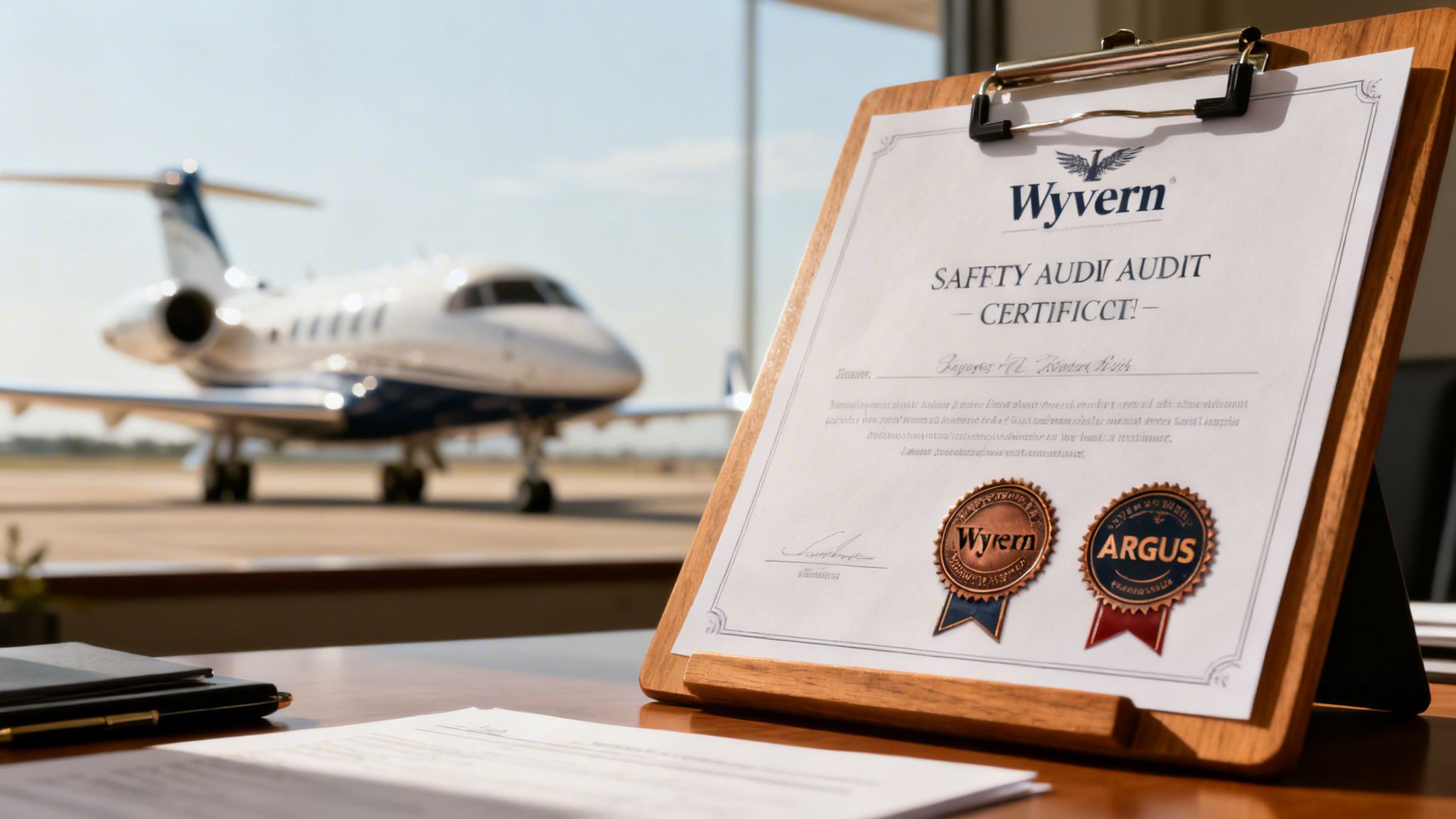
If the FAA ensures an operator is playing by the rules, Wyvern and ARGUS confirm that they're playing at a world-class level. They provide a vital, objective layer of assurance that goes far beyond what any government regulation demands.
What Do These Ratings Actually Mean?
When an operator earns a top-tier rating like Wyvern Wingman or ARGUS Platinum, it speaks volumes about their company-wide commitment to safety. This isn't a one-time award. It's the result of a continuous, rigorous audit process that examines every single facet of their business.
These audits are exhaustive deep-dives. Wyvern and ARGUS maintain massive databases on aircraft, operators, and pilots, which lets them cross-reference data and spot potential risks long before they could ever become a problem—a level of analysis the FAA simply isn't set up for.
To get a clearer picture of how these standards stack up, it helps to see them as layers of protection.
Understanding Aviation Safety Layers
This table breaks down the different standards you'll encounter in private aviation, from the mandatory minimums to the highest levels of voluntary oversight.
| Safety Layer | What It Is | Level of Assurance |
|---|---|---|
| FAR Part 135 | The mandatory FAA legal standard for all charter flights. | Good: Ensures a strong, government-mandated safety baseline. |
| ARGUS Gold/Platinum | A voluntary, third-party audit of an operator's safety history, pilot records, and maintenance programs. | Better: Verifies historical safety performance and a commitment beyond the legal minimums. |
| Wyvern Wingman | The highest level of voluntary audit, including on-site assessments of an operator's processes and safety culture. | Best: Confirms a proactive, deeply integrated safety management system is in place and actively practiced. |
Each layer builds upon the last, giving you a more complete understanding of an operator's dedication to keeping you safe.
The Power of Proactive Safety Audits
To earn these ratings, an operator has to open their books completely. Auditors scrutinize everything, holding them to a standard that often far exceeds FAR requirements in several key areas.
For instance, a Wyvern Wingman operator is required to have a fully implemented Safety Management System (SMS). This is a formal, top-down approach where the entire company systematically looks for hazards, assesses risks, and implements controls to neutralize them. While the FAA is moving toward making SMS mandatory for Part 135, the best operators—audited by Wyvern and ARGUS—have been doing this for years.
An operator with an ARGUS Platinum or Wyvern Wingman rating has proven they don't just react to safety issues—they actively hunt for potential risks and neutralize them. It's the difference between having a fire extinguisher (the reactive FAA requirement) and having a state-of-the-art fire prevention system (the proactive Wyvern/ARGUS standard).
These auditors also demand more from the flight crew. A pilot might meet the FAA's Airline Transport Pilot requirement of 1,500 hours, but a Wyvern-certified flight may require the captain for your specific trip to have 3,000 hours or more, with significant experience in that exact make and model of aircraft. For a deeper analysis of these standards, you can read more in our guide to private aviation safety ratings.
So when you choose an operator with a top-tier Wyvern or ARGUS rating, you're doing much more than just verifying their compliance with the FARs. You are selecting a partner who has invested heavily in a culture of excellence and proven to an independent body that your safety is, without question, their highest priority.
Your Pre-Flight Safety Checklist Before You Book
Knowing what the FARs are is one thing, but using that knowledge is what really matters. It's how you go from being just a passenger to an empowered client who can confidently choose a charter provider.
Before you lock in your next trip, run through this simple checklist. It's your way of making sure you're flying with an operator that puts safety where it belongs: first.
Think of it as your own personal pre-flight inspection. Any good broker or operator will have these answers ready—in fact, they'll be glad you asked. Their willingness to be transparent is one of the clearest signs you're in good hands.
The Essential Questions to Ask
Before you commit to a charter, you need clear, direct answers to a few non-negotiable questions. These cut right through the sales pitch and get to the core of what matters: safety and operational integrity.
"Is this flight operated under a FAR Part 135 certificate?" This is the most important question you can ask, and the only answer you should accept is "yes." This confirms the operator is held to the highest commercial standards for their pilots, aircraft maintenance, and company procedures.
"What is the operator's current Wyvern or ARGUS rating?" Top-tier operators are proud of their safety ratings and will share them without hesitation. You're looking for Wyvern Wingman or ARGUS Platinum status, which shows they've passed voluntary, in-depth audits that go far beyond standard FAA requirements.
"Can you provide the aircraft's tail number and crew details?" A reputable provider will send you this information at least 24 hours before your flight. This allows you to do your own final verification on the aircraft and pilots, giving you an extra layer of peace of mind.
Asking these questions isn't about being difficult; it's about being diligent. A premium charter experience is built on a foundation of trust and transparency. If a provider is hesitant or unable to answer these questions, consider it a major red flag.
These safety standards didn’t appear overnight. For example, FAR Part 145, which dictates modern maintenance rules, has helped slash private aviation downtime by 30% over the last two decades. It's a big reason why FAR-compliant jets see 60% fewer mechanical delays—a statistic that’s incredibly important when your schedule is tight. This relentless focus on safety has helped the industry grow into a projected $35-38 billion market, a topic explored further at Private Jet Card Comparisons.
This simple checklist empowers you to make smarter, safer decisions. For more expert advice, be sure to read our guide on other things to consider before booking a private jet. When you ask the right questions, you ensure your charter provider's commitment to safety is as serious as your own.
Frequently Asked Questions About FAR Regulations
As you get familiar with private aviation, a few common questions always seem to pop up about the rules. Let's tackle some of the most important ones so you can feel confident in your charter decisions.
Are FARs the Same in Every Country?
No, they aren’t. The FARs are the rulebook for aviation specifically within the United States. That said, they are widely respected as the global gold standard, and many countries model their own safety regulations after them.
For instance, the European Union has its own authority, EASA (European Union Aviation Safety Agency), with its own set of stringent rules. A truly global and reputable charter provider will always ensure the operator, no matter where they are based, meets or exceeds their local regulatory standards. This commitment ensures you receive a consistent, high level of safety on every flight.
Can I Legally Charter a Jet That Operates Under Part 91?
Absolutely not. This is a critical point for every private flyer to understand. The moment a flight is paid for, it legally becomes a commercial operation. By law, that flight must be conducted by an FAA-certified Part 135 operator.
Any attempt to charter a flight operating solely under Part 91 is an "illegal charter." Flying this way is a massive gamble with your safety, as it sidesteps all the stringent crew, maintenance, and operational standards put in place to protect paying passengers. Always insist on flying with a certified Part 135 operator.
When thinking about your comfort and safety on board, it helps to know the facts. For example, it's worth understanding the truth about FAA approved seat belt extenders and how they fit into regulations. While operators provide standard equipment, knowing the rules for personal items can make for a smoother trip.
Why Don't All Operators Have Wyvern or ARGUS Ratings?
Think of the FAA’s regulations as the mandatory floor for safety—the minimum legal requirement to operate. Achieving a top-tier rating from a third-party auditor like Wyvern or ARGUS is a completely voluntary step above that floor.
It's an expensive and ongoing commitment. Operators who pursue these ratings are investing in a rigorous, continuous audit of their entire operation. Many perfectly legal and safe operators simply choose not to make that extra investment. Opting for an operator with a Wyvern Wingman or ARGUS Platinum rating means you're choosing a partner who has embraced a proactive safety culture that goes far beyond just checking the boxes.
How Do FARs Affect the Cost of a Charter?
The strict compliance required by Part 135 directly impacts operational costs. These aren't just arbitrary expenses; they cover things like advanced pilot training, more frequent and detailed aircraft inspections, and systems to ensure crews are well-rested and properly scheduled.
This is why a legal, compliant charter costs more than a risky, illegal one. Those higher standards are a direct investment in your safety, the reliability of your flight, and ultimately, your peace of mind.
At Haute Jets, we charter exclusively from Wyvern Wingman and ARGUS Gold/Platinum-rated operators, ensuring every flight meets the highest third-party safety standards in private aviation. Book your on-demand flight today without membership fees or jet cards at https://www.hautejets.com.