
You're trying to book a private flight, and the first thing that becomes clear is that no single company owns every jet you might fly on. One broker may find the aircraft, another operator may fly it, and the main job is making sure those moving parts line up fast enough to keep your trip on schedule. That's why the role exists, and why what is a private jet broker is really a question about how private aviation works.
In practice, a broker sits between the traveler and the aircraft market, translating a trip request into real inventory, real pricing, and real logistics. The best ones do more than send quotes. They narrow aircraft choices, control avoidable cost, and coordinate the details that turn a floating “maybe” into a confirmed departure.
The Travel Moment That Reveals Why Brokers Exist
A traveler gets a call at 4 p.m., needs to be in Aspen the next morning, and doesn't want to spend hours comparing operators one by one. They know the city pair, the passenger count, the departure window, and the cabin expectation. What they usually don't know is which aircraft is available, where it sits, and which operator can execute the trip without drama.
That's the opening that reveals why brokers are more than salespeople. Private aviation is fragmented, and the market is large enough that no single operator owns the whole experience. A 2025 market report values the global private jet brokerage market at $32.4 billion, with charter brokerage representing 38.2% of that total, or about $12.4 billion (Marketintelo). That scale tells you brokerage isn't a side service, it's a major distribution layer.
Why the broker sits in the middle
The broker is the person who takes a request like “two passengers, overnight trip, morning departure, mid-size cabin” and turns it into an executable flight plan. They query operator networks, compare aircraft options, and help the client avoid wasting time on dead-end inventory. In a market with thousands of aircraft spread across operators, that filtering matters.
Practical rule: if the aircraft search feels slow, the charter process is probably working against the traveler, not for them.
The market context explains the need. Independent industry reporting says the global business aviation market ended 2025 at $34.0 billion and is forecast to reach $38.2 billion in 2026, while the active worldwide business jet fleet was 24,850 aircraft in Q1 2026 (EpicEdits). Those figures don't just signal growth, they signal complexity. The broker exists because a traveler rarely needs “a jet,” they need the right jet, in the right place, at the right time.
Defining the Private Jet Broker Role Step by Step
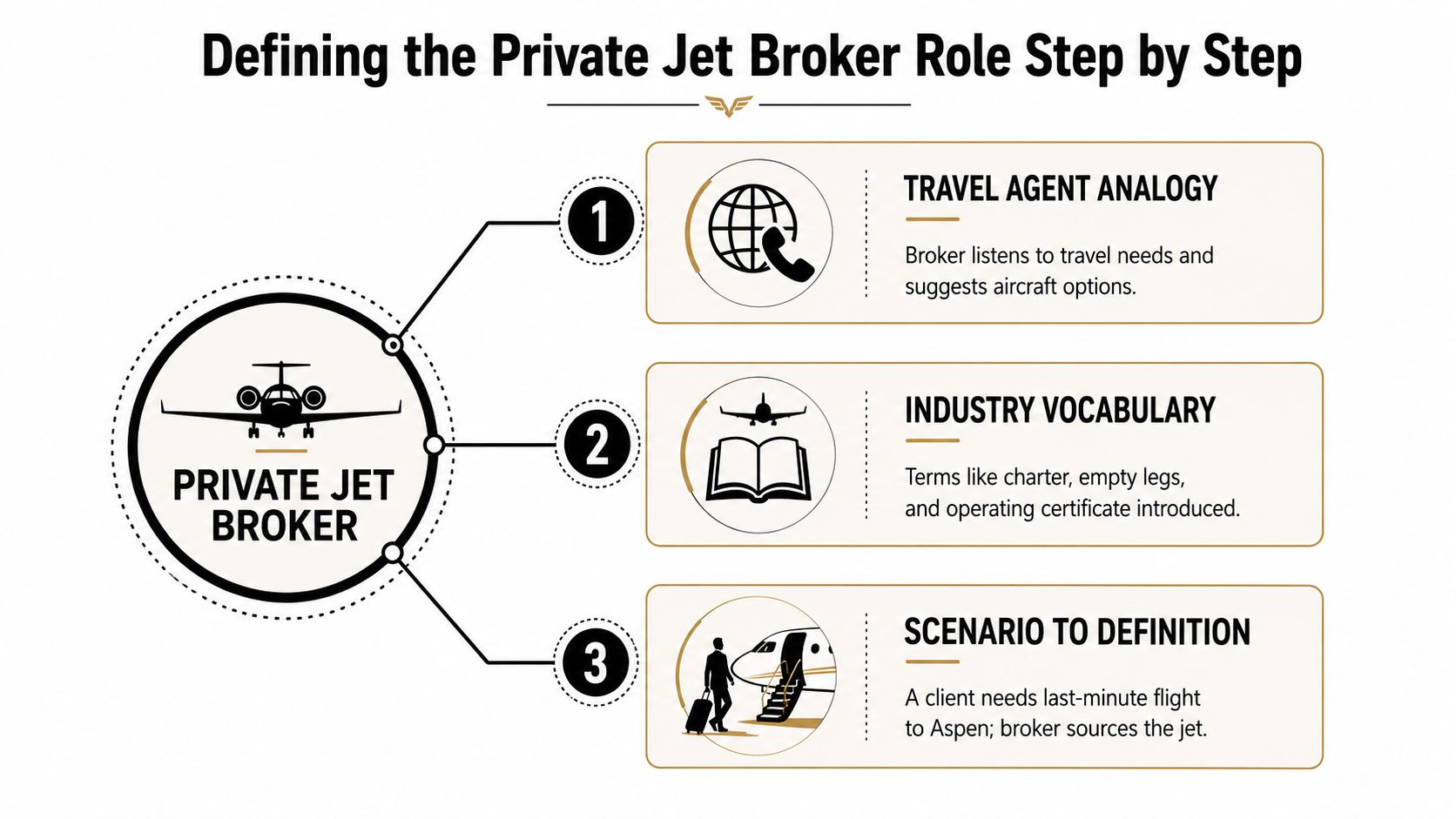
A broker's workflow follows three phases. First comes the trip request, then the search across available aircraft, then the booking process through departure. That sequence sounds simple, but each step carries trade-offs the client rarely sees at the start.
Travel needs become aircraft requirements
The broker begins with route, timing, passenger count, and preferences. If luggage, pets, runway length, or a tight meeting schedule are part of the trip, those details shape which aircraft can work. The request is not just being logged, it is being translated into an aircraft requirement that can be matched to real inventory.
That distinction matters because the broker does not own the airplane. The aircraft, crew, and operating certificate belong to the operator of record, often an FAA Part 135 operator in the U.S. The broker's role is to connect the trip to that operator's available aircraft and crew, while keeping the client's priorities in view.
A useful way to see the job is through the handoff. The traveler sets the destination and schedule, the broker turns that into a workable charter brief, and the operator supplies the aircraft that meets the brief.
The industry language makes more sense once the job is clear
Once the request is defined, the broker works with the terms private flyers hear often, charter, empty legs, and operating certificate. If you are also reading a broader luxury travel planning piece, Passport Premiere's luxury travel guide helps place brokered air travel inside the wider concierge process.
A broker adds value by combining access with coordination. One source describes the workflow as collecting client preferences, sourcing suitable aircraft, presenting pricing and aircraft options, and negotiating charter contracts before finalizing the booking (Stratos Jets). Another industry source says brokers source aircraft from operators around the world and manage booking, documentation, logistics, and follow-up (C&M Travel Recruitment).
That coordination also shapes price. For a closer look at how trip costs can be built, see private jet charter cost factors. A lower initial quote can still become the more expensive trip if the aircraft needs to reposition or if the operator's structure adds costs the client does not see at first glance.
The broader lesson is straightforward. The broker is the intermediary who turns a request into a flight, while the operator is the party that flies the aircraft.
How Brokers Source Aircraft and Build the Price
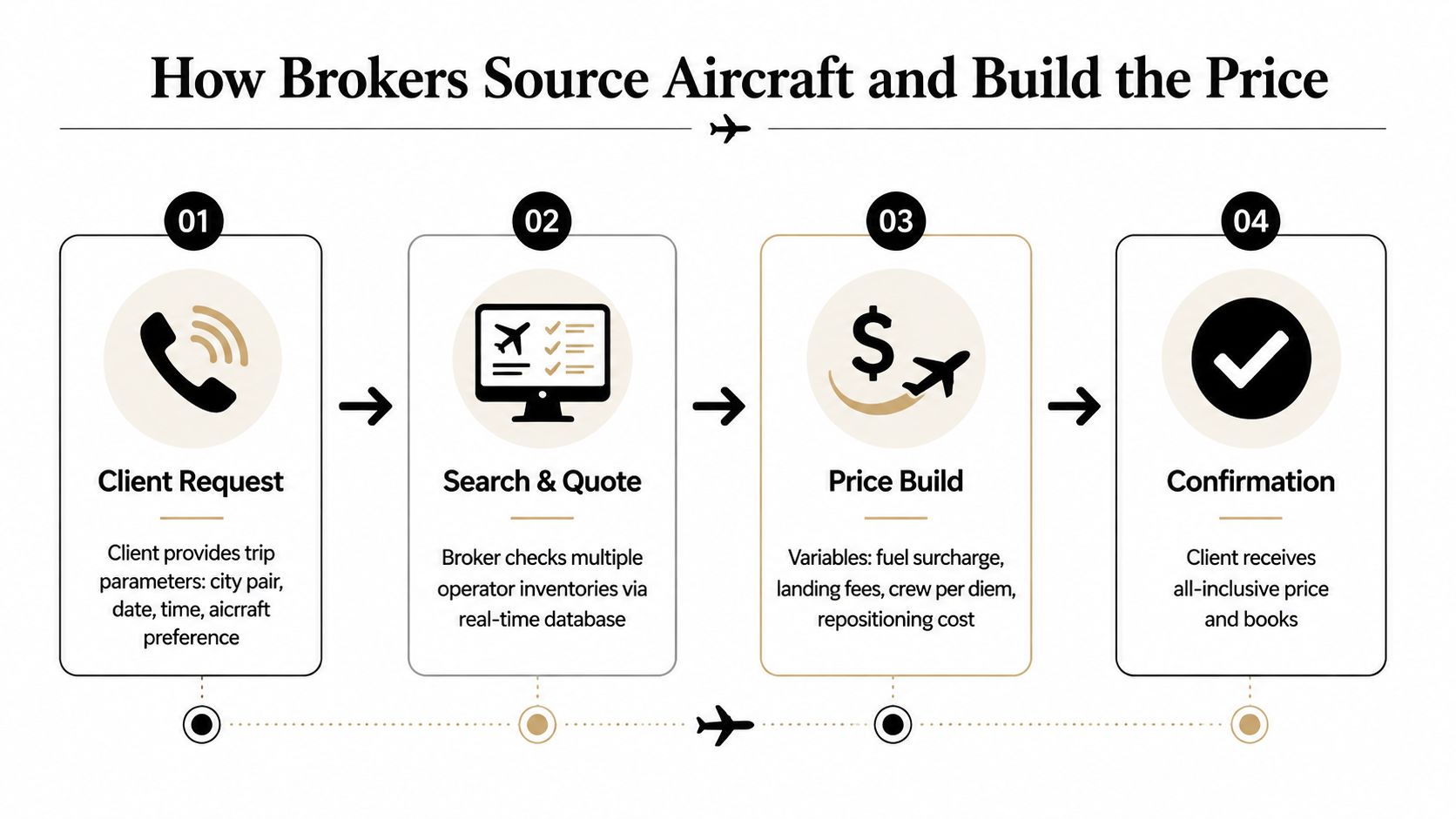
A private charter quote starts with the aircraft search, but it does not end there. The broker has to locate available jets, compare aircraft that may be sitting at different airports, and then add the trip costs tied to positioning, airport handling, and the operator's own pricing structure. Two jets that look almost identical on paper can still produce very different quotes if one is already close to the departure airport and the other has to fly in empty.
What changes the quote
The broker usually compares several operator proposals before presenting options to the client. That comparison is where the price starts to move, because aircraft category, location, and timing all shape the number you see. Industry guidance notes that repositioning can add about 20 to 40% to charter prices, which is why sourcing an aircraft closer to the departure airport can matter so much (EvoJets).
Important detail: a lower headline rate is not always the lower trip cost if the aircraft has to reposition first.
A charter quote can also break into several layers. One part is the aircraft rate itself, then there may be fuel-related adjustments, airport or handling costs, and any repositioning effect. A broker's job is to make those layers clear before the client confirms the trip, because the first number a client sees is rarely the full story.
For readers who want a practical view of how those pieces show up in a live itinerary, Haute Jets' private jet charter cost guide is a useful reference. The more useful question is not just, “what is the hourly rate,” but, “which aircraft is nearby, and how much am I paying to move it?”
The strongest brokers do not send the lowest quote. They try to hold the itinerary together while cutting unnecessary repositioning, since that is often where charter pricing gets pushed up. In a fragmented market, the sourcing process is also the pricing process.
Safety, Contracts, and Ground Logistics Behind Every Flight
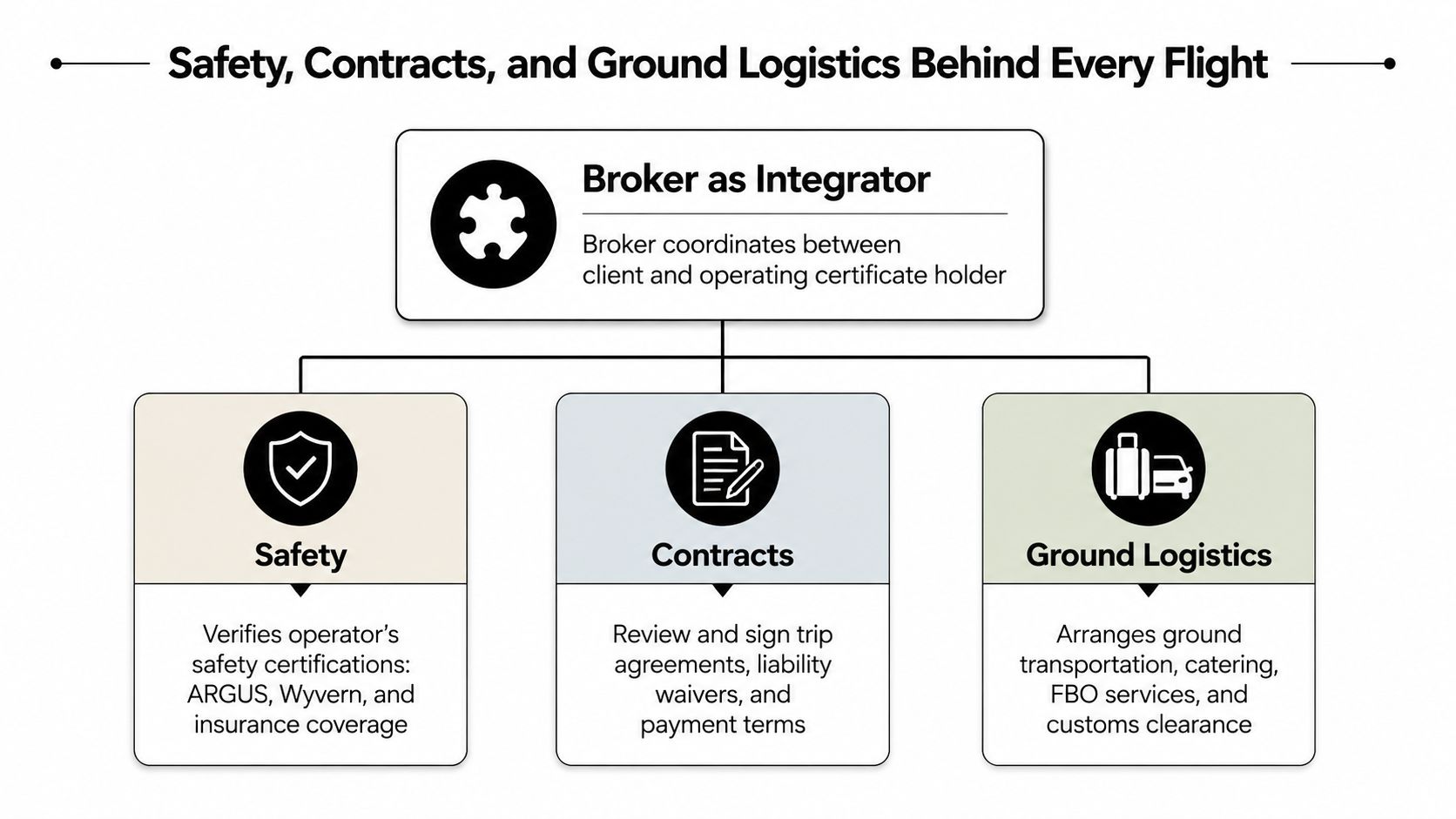
The broker's job gets more serious after the aircraft is selected. At that point, they're helping verify whether the operator, aircraft, and trip details are all consistent with the client's expectations. That means documents, certifications, timing, and all the moving parts on the ground.
What the broker can verify
The broker can ask for operator credentials, insurance certificates, and trip paperwork. They can also coordinate charter contracts, flight timing, catering, FBO preferences, and ground transport. In other words, they act as the integrator between the client and the operator.
Third-party safety audits matter here. Wyvern Wingman and ARGUS Gold or Platinum are widely recognized safety standards in private aviation, and they matter more than a broker's own marketing language because they come from external review. The broker may present the operator, but the operator's safety record and audit status are what really count.
What the operator still controls
The broker does not control the pilot roster, the aircraft maintenance program, or the operator's operational certificate. They also can't personally guarantee every last detail unless those details are confirmed with the operator before departure. That's why the strongest broker workflows include pre-flight confirmation rather than vague assurances.
The practical split looks like this:
- Safety checks: the broker verifies certifications, but the operator is responsible for maintaining them.
- Contracts: the broker coordinates the booking terms, but the operator is the party executing the flight.
- Ground logistics: the broker helps arrange the trip flow, but airport handling and crew execution still depend on third parties.
That division of labor is exactly why misunderstandings happen when a traveler assumes the broker “owns” the flight experience. They don't. They orchestrate it.
Brokers vs Operators, Jet Cards, and Fractional Ownership
| Model | How You Pay | Commitment | Flexibility | Best For |
|---|---|---|---|---|
| Broker | Per trip, through a quoted charter | Low | High | First-time charter clients, irregular flyers |
| Operator | Direct charter pricing | Low to moderate | High | Travelers who already know the aircraft or operator |
| Jet Card | Prepaid hours or flight deposits | Higher | Moderate | Frequent flyers who want a repeatable process |
| Fractional Ownership | Capital commitment plus ongoing costs | Highest | Moderate | Travelers with predictable flying needs |
A broker is the on-demand option. You don't pre-buy flight hours, and you don't own a share of the aircraft. You ask for a trip, the broker sources the aircraft, and you pay for that specific mission.
Jet cards and fractional ownership serve a different type of flyer. They work better when the travel pattern is steady enough to justify commitment, planning, and in some cases upfront capital. If your trips are irregular or route-dependent, on-demand charter through a broker often gives you more freedom than a prepaid structure.
The clearest distinction is between access and ownership. A broker gives you access to the market. A fractional program gives you structured use of an aircraft asset. An operator gives you direct access to that operator's fleet. This broker-versus-operator guide is useful if you want the operational difference stated plainly.
The right model depends on how often you fly, how much control you want, and how much commitment you're willing to take on. There isn't a universal winner. There's only a better fit for the way you travel.
How Brokers Make Money and Where Pricing Can Bend
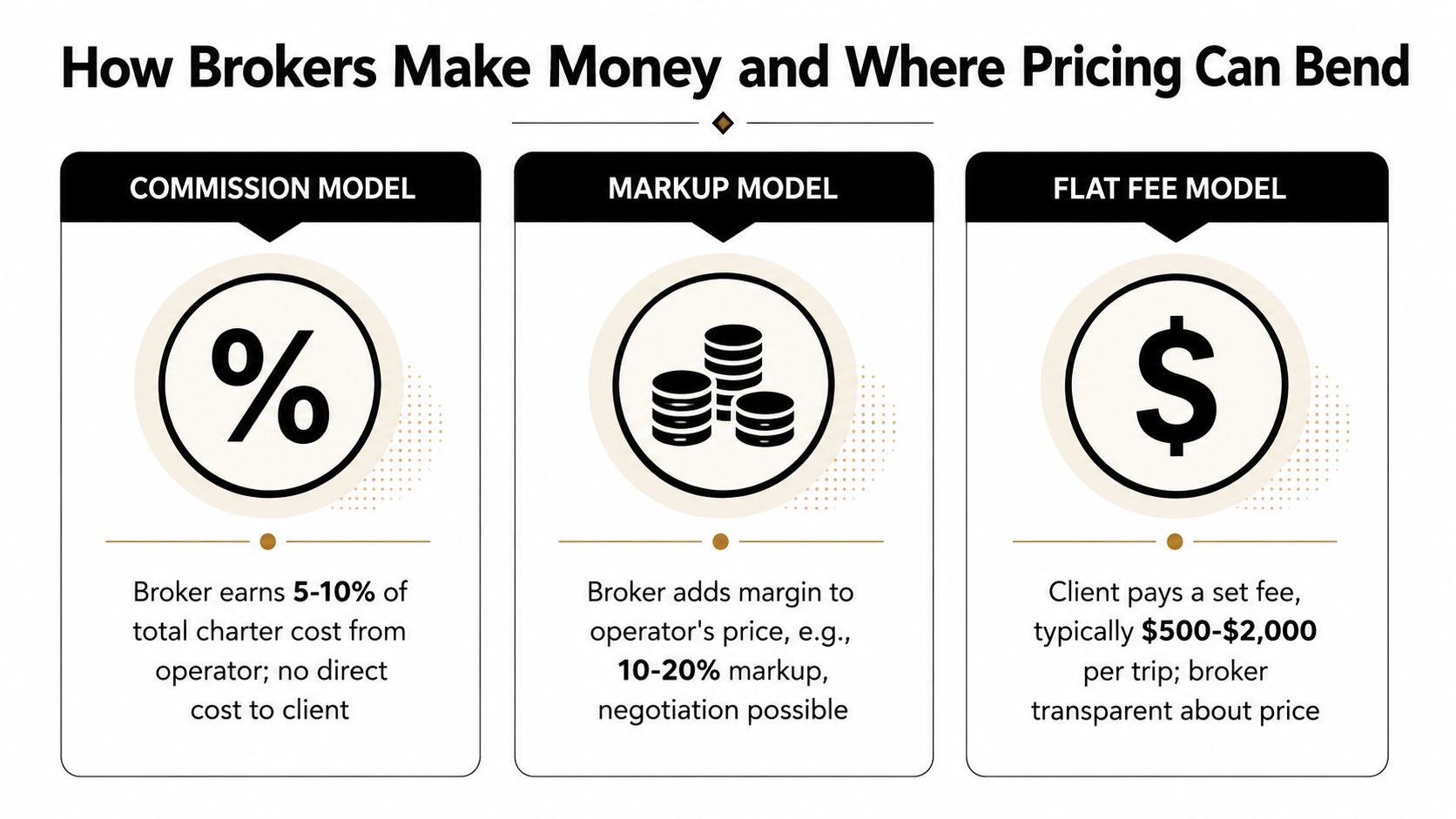
The money question is where many first-time clients get uneasy, and they should. A broker's compensation can be built in more than one way, and the structure affects how the quote is assembled. That's why two brokers can show the same route and still present different numbers.
The three common pay structures
Some brokers are paid by the operator through commission. Some charge the client directly. Others embed a markup inside the aircraft rate they present. Industry sources describe brokers as intermediaries who source aircraft and may be paid by commission or act as middlemen in negotiations (L'Voyage). NBAA likewise notes that brokers link customers with FAA Part 135 operators rather than operating the aircraft themselves (NBAA).
That means pricing can bend based on incentive. A commission-paid broker may not charge the client an obvious fee, while a fee-based broker may separate the advisory charge from the aircraft cost. A markup model can be less transparent if the client doesn't know how the underlying operator quote was changed.
A broker is not automatically cheaper than booking direct. The value comes from sourcing, access, and coordination, not from a guarantee of a lower number.
That's also why local sourcing matters so much. If the broker can find the right aircraft near your departure point, they may avoid the positioning cost that inflates the final quote. In traditional brokerage, that hidden movement can be one of the biggest drivers of price variability.
For a closer look at the economics of service fees, Haute Jets' private jet broker fee page is a straightforward reference. The better habit, though, is to ask the broker exactly how they're paid before you accept the quote.
Choosing the Right Broker and Red Flags to Avoid
The best charter conversations feel specific fast. A strong broker can tell you what aircraft category fits the mission, which operator is being sourced, and how they'll confirm the trip before departure. If the answers stay vague, that usually means the workflow is vague too.
Questions worth asking before you book
- Safety standards: Which third-party audits do you require, and do you verify them directly?
- Aircraft identity: Can you confirm the exact tail number and cabin layout before departure?
- Change handling: What happens if the assigned aircraft becomes unavailable?
- Pricing transparency: How do you disclose commission, markup, or client fees?
- Confirmation process: Do you provide final flight details before the day of travel?
A sourcing-driven broker will answer those questions without hesitation. They'll talk about operator selection, safety verification, and contingency planning instead of leaning on broad promises. A sales-led channel often focuses on membership language or generic convenience instead of the aircraft itself.
Red flags are usually easy to spot once you know what to look for. Category-only quotes without a real aircraft discussion are weak. Refusal to share operator information is weak. Pressure to prepay into a program you didn't ask for is weak. A lack of pre-flight confirmation is weak.
The best brokers behave like procurement specialists, not just order takers. They care about the exact aircraft, the operator behind it, and the logistics that keep the trip intact if something changes late.
FAQs and How Direct-to-Owner Sourcing Changes the Equation
A traveler often first notices the broker layer when an empty leg offer looks attractive but comes with a fixed schedule and a narrower set of choices. Those flights can make sense for the right itinerary, yet they depend on repositioning or on an aircraft that would otherwise sit unused, so the trade-off is flexibility, not certainty. Wyvern and ARGUS audits help verify operator standards and aircraft oversight, which is different from trusting a broker's presentation.
Memberships and jet cards are not required for every flyer. If travel is irregular, on-demand charter can be simpler because you pay for the trip you need instead of a standing program. Payment methods have also widened, and some travelers now ask about digital assets as part of the discussion.
The bigger structural change comes from direct-to-owner sourcing. Haute Living built Haute Jets to address the problem of clients paying too much for repositioned aircraft they did not choose, sourcing from 3,500+ owner-operators across 175 countries so clients get the right jet at wholesale rates (Haute Jets). That model matters because it brings the quote closer to the actual aircraft instead of padding the price with avoidable detours.
When a broker can source closer to the departure point and verify the operator carefully, the quote is easier to read and the trip is easier to trust. That's the answer to what a private jet broker does. They connect the traveler to the aircraft market, then reduce the friction that makes private flying confusing in the first place.