

You're about to board a private jet, and the flight matters for more than transportation. Maybe you need to review a contract before landing. Maybe your team expects you on a video call. Maybe your family wants a calm cabin with movies, messaging, and no debate over whose device gets priority.
That's usually when people ask a simple question with a surprisingly complicated answer: What is Gogo Inflight?
In plain terms, Gogo Inflight is an onboard connectivity system used on many private aircraft. It gives passengers internet access in the air, and depending on the aircraft and installed system, that can also include texting, voice, entertainment, and connected-aircraft services. In the business aviation market, Gogo's footprint is large. It has equipped more than 6,600 business aircraft with onboard Wi-Fi services, according to Wikipedia's Gogo Inflight Internet entry.
For charter passengers, the practical issue isn't the brand name alone. It's what that brand allows you to do on your specific flight. A jet may have Gogo, but the experience can still vary a lot based on whether it uses air-to-ground service, satellite service, or a newer platform configured for higher-bandwidth use.
Staying Connected at 40,000 Feet
A client flying from New York to South Florida usually doesn't ask for “connectivity architecture.” They ask, “Will I be able to join my meeting?” A family heading west for a ski trip asks a different version of the same thing. “Can the kids stream, and can I still work?”
That's why inflight internet has moved beyond a nice extra. On many private flights, it's part of the mission.

Why Gogo comes up so often
If you fly private often, you'll hear the name because Gogo has been extensively embedded in business aviation. Its installed base across private aircraft is broad enough that many passengers use “Gogo” almost as shorthand for inflight Wi-Fi. That familiarity didn't happen by accident. It happened because the company's systems have been installed on a large number of business jets over time.
Practical rule: On a charter flight, “Wi-Fi onboard” is not the same as “Wi-Fi that fits your day.”
That difference matters. A light browsing session and a stable video call are not the same use case. Neither is a short domestic hop compared with a longer route where the aircraft may rely on a different connectivity method.
The passenger view
From the seat, passengers don't care whether the signal comes from the ground or from space. They care about outcomes:
- Work continuity: Can you send large email attachments, use cloud apps, and message your office?
- Family comfort: Can passengers use entertainment without repeated interruptions?
- Communication confidence: Can you rely on the connection enough to plan around it?
If you're comparing inflight connectivity across travel categories, it can also help to look at how connectivity is discussed in other mobile environments. For example, the way marine operators think about Starlink satellite internet for boats highlights the same core issue: coverage, hardware, and route all shape the actual user experience.
For a charter passenger, that's the right frame. Don't start with the marketing label. Start with the flight you're taking, what you need to do onboard, and how the aircraft is equipped.
The Core Technology Behind Gogo Inflight Wifi
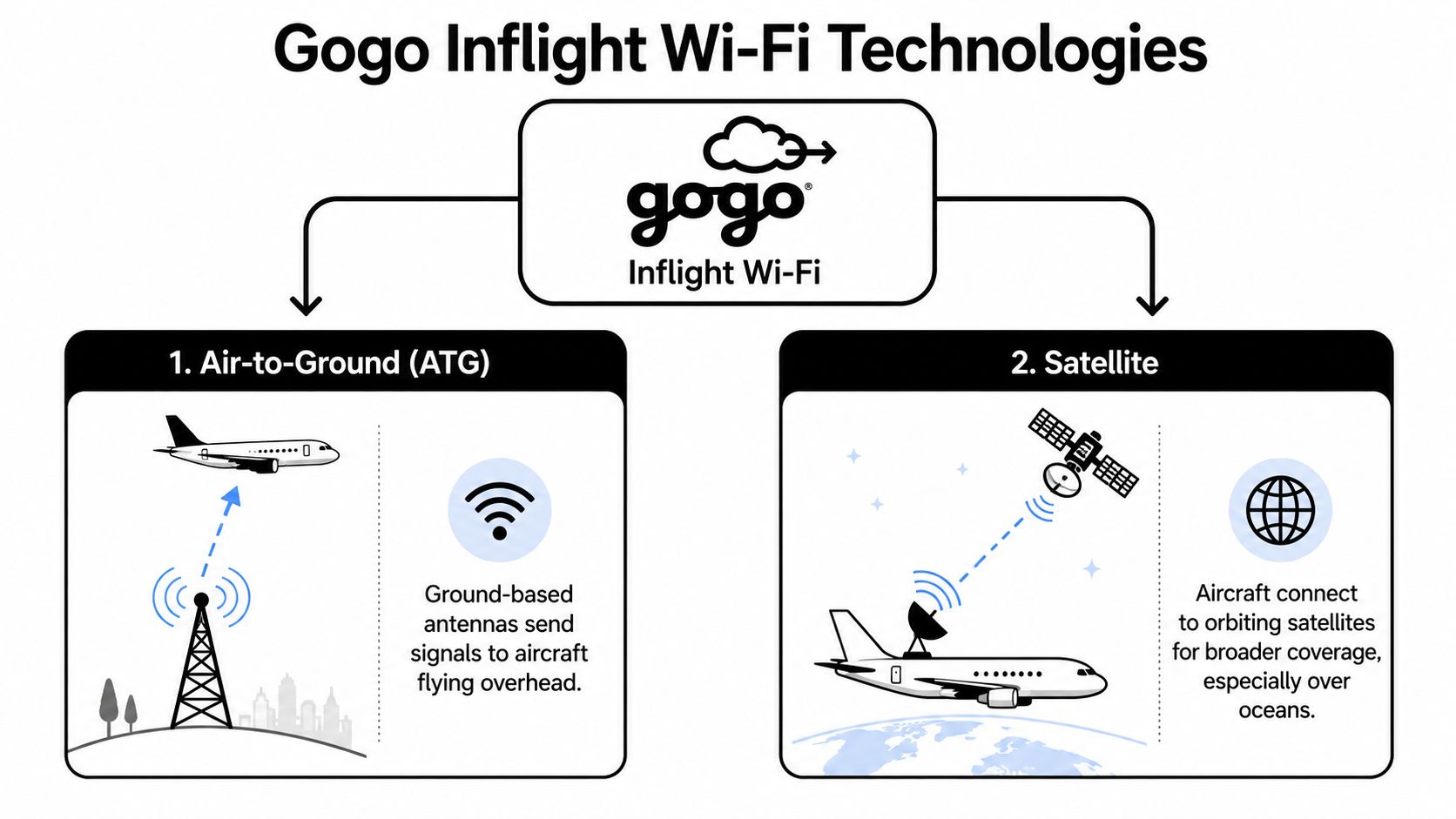
Gogo became a major business aviation brand because it didn't rely on one connectivity method. According to Gogo's company overview, it built a proprietary air-to-ground network across North America and also integrated global satellite solutions. That mix is the key to understanding what Gogo Inflight is.
Air-to-ground works like a specialized cell network
The easiest way to think about ATG, or air-to-ground, is as an aviation version of a mobile network. Instead of your phone connecting to a tower from the highway, the aircraft connects to a network designed to send signals upward to the plane.
That setup is especially useful for flights over the continental United States, including parts of Alaska and Canada as described on Gogo's company information page. For many domestic private jet missions, ATG has been the practical backbone of onboard internet.
Here's what that means in plain language:
- Best fit for North American overland flying: It's well suited to common domestic business routes.
- Hardware can be lighter and simpler for some aircraft: That can make it attractive on certain private jet types.
- Performance depends on the installed system: Some setups are built for basic productivity, others for more demanding use.
Satellite works more like space-based coverage
Satellite service is the better analogy to satellite TV or GPS. The aircraft communicates with satellites rather than relying only on ground infrastructure. That matters when the flight path moves beyond where ATG is practical, or when the aircraft needs broader global coverage.
For passengers, the operational takeaway is simple. Route matters. A jet flying a domestic U.S. city pair may perform differently from that same jet on a route where the connectivity profile changes.
A broader look at private aviation technology trends appears in Haute Jets' article on innovative technology redefining the exclusive private jet journey, which helps place onboard connectivity within the larger cabin experience.
Later in Gogo's product evolution, the company introduced higher-capacity systems, including its 2Ku satellite-based technology in 2015, marking a shift toward more capable inflight internet platforms according to the earlier cited Wikipedia entry.
A short overview can help if you want to see the concept in motion.
Why passengers get confused
Most confusion comes from one phrase: “This jet has Wi-Fi.”
That statement can be true and still incomplete. It doesn't tell you:
| Question | Why it matters |
|---|---|
| What network type is installed | It affects coverage and route suitability |
| Which Gogo platform is onboard | It shapes what applications are realistic |
| How many people will connect | Shared bandwidth changes the cabin experience |
| What your flight path looks like | Coverage and consistency can change with geography |
A passenger asking for “good Wi-Fi” usually means one of three things: email reliability, meeting stability, or streaming support. Those are not interchangeable.
Gogo's Main Systems for Private Jets
For a charter passenger, the useful question is not just whether the jet has Gogo. It is which Gogo system is installed, because that determines what your flight can realistically support once everyone opens a laptop or phone.
On many private jets, the name you will hear is AVANCE. That is Gogo's onboard platform family. The simplest way to understand it is to compare it to two different office setups. One is built for dependable daily work. The other is built for heavier traffic, with more headroom when several people want to do more at once.
What AVANCE L3 means onboard
The AVANCE L3 is a compact avionics unit that can be installed in different aircraft locations, according to the AVANCE L3 datasheet. For passengers, the engineering details matter less than the onboard result.
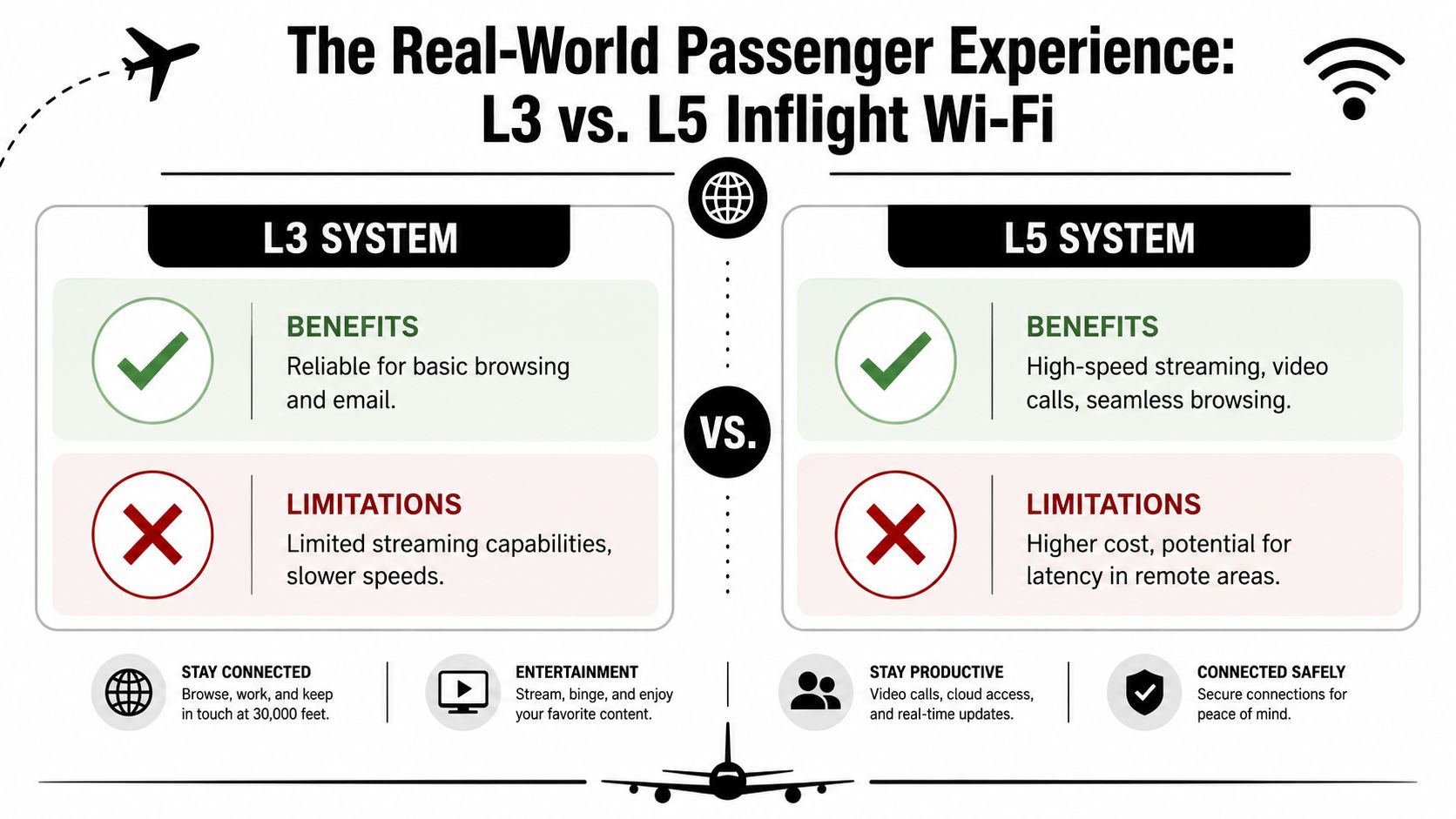
L3 is usually the better fit for practical, lower-demand use:
- Email and messaging
- Light web browsing
- Document review
- Routine business communication
If your plan is to stay reachable, clear an inbox, check travel updates, and handle normal work tasks, L3 can do that job well. It is the kind of setup that suits a passenger who wants productive time in the air rather than a home-style entertainment experience.
That distinction matters on charter. A light jet flying a short domestic leg with one or two connected passengers may feel perfectly well matched to L3.
What AVANCE L5 changes
AVANCE L5 is the version passengers usually care about when expectations rise. It is associated with a stronger onboard internet experience and is the system category people are often hoping for when they ask about video calls, media use, or several devices running at once.
In plain terms, L5 gives the cabin more breathing room.
That does not mean every flight will feel identical. Route, coverage, and how many people are online still matter. But if your party expects a connection that is better suited to heavier use, L5 is the more favorable answer than L3.
For clients comparing aircraft, this is one of the most practical specs to verify, much like reviewing cabin features on Haute Jets charters before you choose the right jet for the trip.
A passenger-focused comparison
| System | Best for | What passengers should expect |
|---|---|---|
| AVANCE L3 | Email, messaging, light browsing | A good fit for productivity basics and ordinary connected use |
| AVANCE L5 | Higher-demand use across more devices | Better support for video-heavy tasks, richer media use, and busier cabins |
A simple example helps. If you board with a phone, a laptop, and a work bag with laptop compartment, and your priority is answering messages and reviewing files, L3 may be fully adequate. If three or four passengers expect a more residential-style internet experience, the conversation usually shifts toward L5-level capability.
Don't assume the aircraft category tells you the answer
Passengers often expect a larger jet to have the better Wi-Fi setup. Sometimes it does. Sometimes it does not.
Two aircraft from the same model family can be equipped very differently. One may have a stronger connectivity package. Another may have a more limited installation, or a system that is fine for basic productivity but less suited to heavier cabin-wide use.
A charter advisor adds real value by checking the actual aircraft and installed connectivity, then matches that equipment to your planned use. If you tell your advisor, “I need reliable email for one passenger,” that points to one standard. If you say, “Our group wants to work, stream, and stay on calls,” that points to another. That verification is what turns “this jet has Wi-Fi” into a useful booking decision.
The Real-World Passenger Experience
The most useful way to judge Gogo isn't by product labels. It's by what you can do once the cabin door closes and the aircraft is in cruise.
Gogo positions its platform as more than basic internet. It includes internet, entertainment, text messaging, voice, and connected-aircraft services, and the actual experience varies depending on whether the aircraft is on a North American ATG network or a satellite link, according to Gogo's media room overview.
What a business traveler usually notices
Say you board with a laptop, phone, and a schedule full of moving parts. You're answering emails during climb, opening a cloud document in cruise, and trying to decide whether a video meeting is realistic.
The answer depends on the aircraft's system and how the cabin is using it at that moment.
- Email and messaging are usually the most forgiving tasks.
- Browser-based work can feel quite smooth or merely acceptable depending on bandwidth demand.
- Video calls depend on a stronger, more stable setup and lower contention among users.
- Streaming is where the gap between basic and streaming-class systems becomes obvious.
If you fly often, a few practical packing choices help too. Something as simple as an organized work bag with laptop compartment makes it easier to switch quickly between devices, chargers, printed documents, and headphones once you're airborne.
What families and multi-user cabins notice
A family usually tests the connection differently. One person starts a movie, another opens a tablet game, another checks messages, and someone else wants to upload photos or browse.
That's when system limits show up fast.
A cabin outfitted for basic productivity may still feel perfectly useful, but it may not deliver the same experience as a strong home broadband connection. That's not necessarily a flaw. It's a matter of matching expectations to equipment and route.
For more on how onboard amenities shape comfort beyond connectivity, Haute Jets has a useful overview of cabin features on charter flights.
How to set the right expectations
Here's the simplest way to think about onboard internet:
| If you need to do this | Treat this as realistic when the aircraft is equipped accordingly |
|---|---|
| Send messages, email, review documents | Usually reasonable on many Gogo-equipped business jets |
| Join a sensitive video meeting | Better when the system is configured for higher-bandwidth use |
| Let several passengers stream at once | Most realistic on stronger streaming-class installations |
Wi-Fi in a private jet can be excellent for aviation. It still isn't always the same thing as sitting beside your home router.
If your work absolutely depends on a smooth onboard session, ask in advance whether the aircraft is suited for that exact task. “Can I use Wi-Fi?” is too broad. “Can two passengers hold video calls while others browse?” is the right level of detail.
Cost and Availability on Charter Flights
Inflight Wi-Fi on charter aircraft is aircraft-specific, not category-specific. That's one of the biggest misunderstandings in private aviation booking.
A passenger may assume that booking a certain jet model guarantees a certain connectivity level. It doesn't. Equipment varies by tail number, operator choices, retrofit history, and route profile.
Why one aircraft may differ from another
Two aircraft of the same model can feel very different onboard. One may have a newer Gogo installation aimed at stronger passenger use. Another may have a more limited setup. A third may advertise Wi-Fi, but only in a way that suits lighter productivity rather than bandwidth-heavy tasks.
That's why serious charter planning treats connectivity the same way it treats cabin layout or baggage fit. It needs confirmation on the exact aircraft.
How charges are usually handled
There isn't one universal billing method for inflight internet on charter flights. Operators commonly handle it in one of several ways:
- Included as part of the trip on some aircraft and itineraries
- Included with practical limits depending on operator policy
- Billed separately when usage or service type justifies it
The right question is not “Does Gogo cost extra?” The right question is “How is internet use handled on this aircraft for this trip?”
If you're comparing overall trip economics, Haute Jets provides a broader pricing context in its private jet charter pricing overview.
What availability usually looks like
In practical terms, higher-performance connectivity is more commonly found on aircraft where owners and operators expect stronger business-use demand. Smaller jets may still offer very useful internet, but not always the same cabin-wide experience travelers expect on larger aircraft configured for more intensive use.
That's why the conversation should always include three items:
- The exact aircraft
- The installed system
- Your intended onboard use
Miss any one of those, and the booking can still be technically accurate while disappointing in practice.
How Haute Jets Guarantees Your Connectivity
For charter clients, the problem usually isn't finding an aircraft that lists Wi-Fi. The problem is confirming whether that Wi-Fi supports the flight you're about to take.
That's where a broker's process matters. Haute Jets works from a network of 3,500+ owner-operators across 175 countries, according to the company information provided above, and confirms details such as Wi-Fi, catering, pet policies, and ground transport for each booking. For connectivity, that means the discussion should go beyond a checkbox.
What gets verified
A careful charter review should confirm:
- Which system is installed so the passenger knows whether the aircraft has a basic or streaming-class setup
- What the route demands because network type affects coverage expectations
- How the client plans to use it whether for email, meetings, entertainment, or a mix
- Whether charges apply so there are no surprises after the flight
That process sounds simple, but it's where many booking errors happen. “Wi-Fi available” is easy to say. “Suitable for a multi-user business flight” requires checking.
If inflight internet matters to your trip, ask for the system details in writing before you confirm the aircraft.
Why that level of detail matters
Private aviation is full of assumptions that sound reasonable and turn out to be wrong. People assume larger means faster. They assume newer means fully connected. They assume any jet with Gogo will handle every online task the same way.
It doesn't work like that.
A strong charter process removes that uncertainty by verifying the actual onboard setup against the actual passenger need. That gives you a more predictable flight experience and a more useful booking conversation.
If connectivity is part of your mission, not just a nice extra, speak with Haute Jets before you book. Ask for the exact aircraft, the installed Wi-Fi system, and a plain-language assessment of what you can realistically do onboard for your route.