
Your aircraft lands early. The cabin door opens. The ramp is quiet, the FBO is expecting you, and your next meeting starts soon. If the car isn’t exactly where it should be, private aviation loses its edge fast.
That’s why what is ground transportation in private aviation isn’t a basic travel question. It’s an operational one. For high-net-worth travelers, family offices, executive assistants, and corporate travel managers, ground transport is the handoff that either protects the trip or weakens it. A polished sedan alone doesn’t solve the problem. The provider, the access protocol, the driver, the timing, the luggage plan, and the security standard matter just as much as the vehicle badge.
On Haute Jets Journal, I’d put it plainly. If you vet the aircraft but ignore the car, you’ve left the journey unfinished.
Beyond the Jet Why Ground Transportation Matters
Your flight can be perfectly executed and the trip can still break down the moment you step onto the ramp. In private aviation, ground transportation is the controlled road segment tied to the aircraft. It starts before departure, when pickup timing affects wheels-up, and it ends only when the principal reaches the residence, office, resort, or secure venue without delay, exposure, or confusion.

Generic travel articles frame a car service as a convenience. That misses the point. For private flyers, the vehicle is part of the itinerary, part of the security plan, and part of the client experience. The Global Business Travel Association forecast reflects the broader point. Ground spend remains a meaningful part of managed business travel, which is exactly why serious operators treat it as an operational standard rather than an afterthought.
Why this handoff carries so much weight
The weak points are predictable, and expensive clients should be intolerant of all of them.
- Wrong access point: the driver goes to the commercial terminal instead of the FBO or private gate.
- Loose communication: passenger names, tail details, or arrival updates are shared through unsecured channels.
- Poor baggage handling: luggage clearance is slow, disorganized, or left to line staff without a clear handoff.
- Bad vehicle assignment: a sedan is dispatched for a mountain itinerary, family movement, or security-sensitive transfer.
- Unvetted personnel: the chauffeur is professionally dressed but operationally unknown.
Recommendation: Hold the car provider to the same standard you apply to the aircraft charter. If they cannot confirm the driver, pickup protocol, vehicle spec, and contingency plan before the flight, replace them.
There is also a discipline behind all of this. Dispatch, maintenance scheduling, backup vehicle allocation, and chauffeur assignment decide whether luxury transport performs under pressure or falls apart. If you want context for that operating model, this explainer on what is fleet management is worth reading.
Defining ground transport in a private aviation context
Commercial travelers usually ask one simple question: how do I get from the airport to the hotel? Private aviation clients need a much tighter answer. Ground transport in this setting is a vetted, pre-coordinated transfer system designed around discretion, timing, security, and continuity with the flight operation.
| Priority | What it means on a private trip |
|---|---|
| Discretion | Pickup and arrival happen with minimal public exposure |
| Control | The driver, route, vehicle, and access point are confirmed in advance |
| Continuity | Air crew, FBO staff, dispatcher, and chauffeur work from the same live itinerary |
| Security | The road segment is assessed, assigned, and monitored instead of improvised |
| Efficiency | The traveler moves directly from aircraft to vehicle without waiting at a curb or lobby |
That is the correct standard. Luxury matters, but precision matters more.
The Spectrum of Private Ground Transportation Services
Not every premium vehicle solves the same problem. Some are built for discretion. Some for group movement. Some for protective transport. If you’re asking what is ground transportation in the world of private aviation, the useful answer is this: it’s a range of vehicle categories and service models matched to the mission.
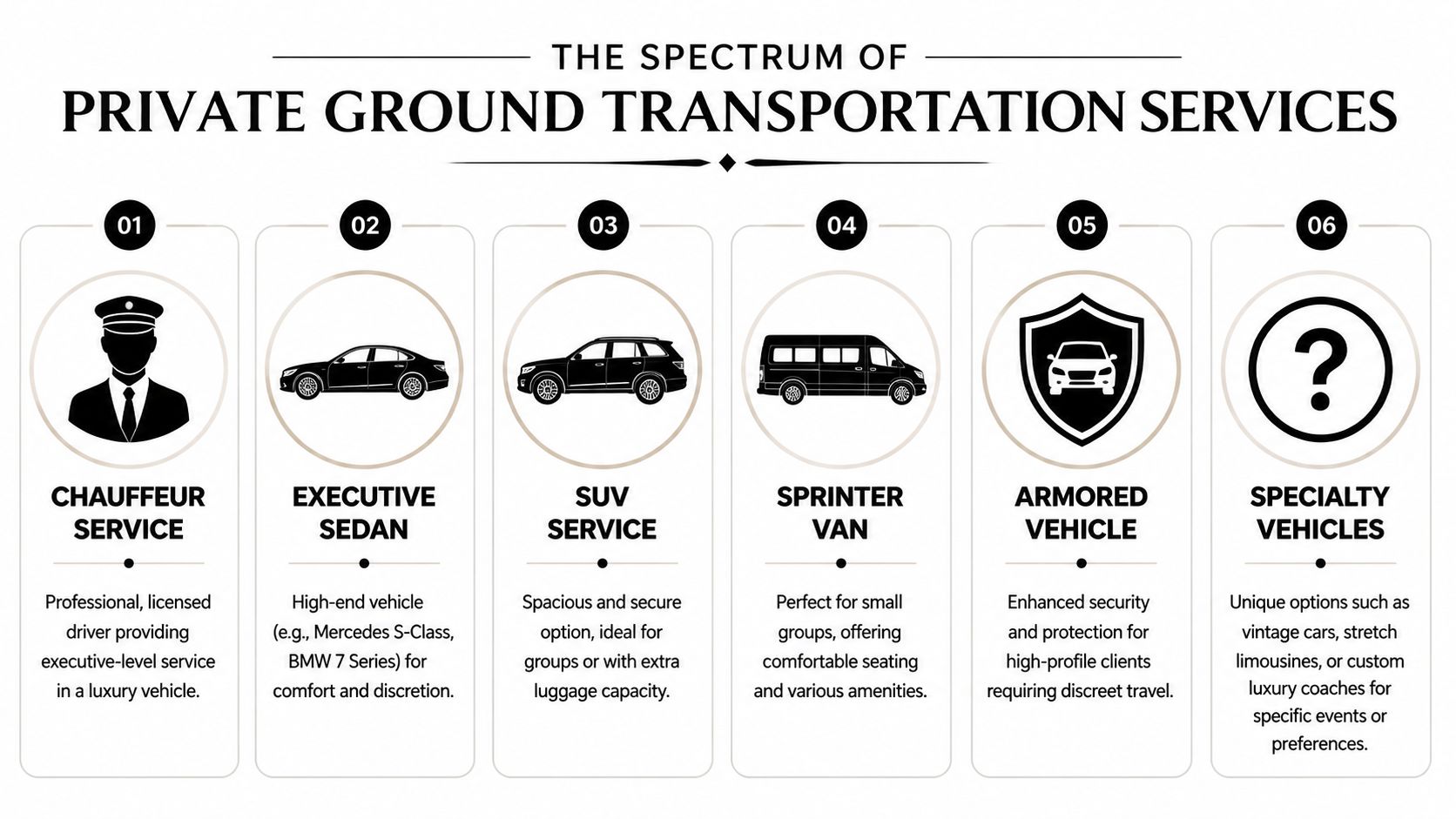
Private aviation operates within a more technical framework than might be apparent. Ground transportation includes Category I vehicles for VIP passenger movement such as sedans, SUVs, and limousines, Category II vehicles such as vans and minibuses for groups up to 20, and Category III vehicles for oversized luggage or equipment, per ground transportation classifications.
Category I for principal travelers
This is the core VIP class. Think Mercedes-Benz S-Class, BMW 7 Series, Cadillac Escalade, Range Rover Autobiography, or a discreet executive SUV with a trained chauffeur.
Best use cases include:
- Single executive transfers: office to FBO, FBO to meeting, residence to aircraft
- Couples and family principals: where comfort and privacy matter more than extra seating
- Low-profile arrivals: especially at urban FBOs or hotel entrances with visible public access
This category should feel calm, quiet, and predictable. The driver should already know whether you prefer rear-right seating, a silent cabin, temperature set before boarding, or a direct route without discussion.
Category II for groups and entourage movement
The moment you’re moving assistants, children, security staff, or business colleagues, a sedan stops making sense. Category II covers executive Sprinter vans, Mercedes V-Class vehicles in some markets, and minibuses when the group is larger.
Choose this when:
| Service type | Ideal use case | What to expect |
|---|---|---|
| Executive Sprinter | Small groups, roadshow teams, families with luggage | Comfortable seating, easier luggage handling, one coordinated arrival |
| Luxury minibus | Corporate groups, event transfers, multi-stop schedules | Better control than splitting passengers into several cars |
| Shuttle-style VIP van | FBO to hotel or venue for a team | Useful when synchronized arrival matters more than individual privacy |
A well-run van transfer often feels more refined than multiple sedans. It reduces confusion, keeps the party together, and simplifies security oversight.
The right vehicle is the one that removes decisions after landing. If your team has to start sorting bags, counting passengers, or calling drivers on arrival, the booking was wrong.
Category III for baggage, equipment, and special loads
This category gets overlooked until it becomes a problem. Oversized luggage, wardrobes, event materials, sports equipment, medical support gear, and production cases don’t belong in a principal’s cabin vehicle.
Use a separate support vehicle when the trip involves:
- Extended stays: trunks, garment bags, and multiple checked items
- Events and productions: staging materials, branded assets, technical cases
- Sport and leisure itineraries: golf clubs, skis, diving equipment, firearms where lawful and properly managed
- Family logistics: strollers, child seats, and nanny travel support
Separating people movement from equipment movement is often the cleaner decision. It preserves comfort and avoids a chaotic curbside unload at the destination.
Specialty vehicles and when they make sense
Some trips need more than a black SUV.
An armored vehicle is appropriate when privacy concerns overlap with personal security concerns. A specialty coach can work for campaign teams, artist management, or hospitality groups. Airside-to-helicopter transfers may require close coordination with airport procedures and specific access permissions.
Rideshare products such as premium black-car app options can work for low-risk urban segments, but they’re not the standard I’d use for principal movement tied to a private flight. The weak points are obvious. Driver substitution, inconsistent dispatch discipline, unpredictable airport pickup procedures, and poor alignment with FBO operations.
Accessibility also deserves more attention than the luxury sector usually gives it. If a trip involves a traveler with mobility or navigation needs, start planning earlier and insist on vehicle and pickup details in writing. This broader discussion on making paratransit more inclusive is worth reading because it reinforces a point luxury providers sometimes miss. Precision and dignity matter together.
Vetting for Safety and Quality The Ground Transport Duty of Care
The private flyer who accepts an unvetted car after demanding a highly rated aircraft is taking the wrong risk.

Road transport causes real exposure. Over 2.3 million Americans are injured in road crashes annually, and premium charter services carry liability when ground transportation isn’t properly vetted or coordinated, as discussed in ground transportation duty of care.
What duty of care actually means on the ground
For corporate travel managers, it’s a legal and reputational issue. For families and high-profile travelers, it’s personal. Duty of care means you don’t outsource safety just because the wheels are no longer in the air.
If the aircraft operator gets examined for third-party safety standards, your road provider should face scrutiny too. That’s why it helps to understand the logic behind Wyvern and ARGUS safety ratings. The same mindset belongs on the ground: verified operator quality, not guesswork.
Ask for proof, not promises
A luxury vehicle can hide a weak operator. Leather seats and bottled water prove nothing.
When I vet a ground provider for a sensitive itinerary, I want clear answers on these points:
- Driver screening: background checks, licensing, driving record review, and whether the assigned chauffeur can be identified before pickup
- Insurance: high-limit commercial liability coverage appropriate to the market and service type
- Maintenance discipline: documented vehicle service intervals, tire condition, and replacement standards
- Dispatch standards: live communication, driver tracking, and contingency handling if the flight shifts
- Confidentiality: no casual discussion of passenger identity, route, or destination
A proper chauffeur service should behave like a serious transport operator, not a dressed-up app booking.
Many travelers also need security-trained drivers, child-seat planning, bilingual support, or route discretion. None of that should be improvised while you’re taxiing in.
A short visual explainer can help frame the issue before you book:
Where premium rideshares fall short
I’m not anti-rideshare. I’m anti-mismatch.
For a routine dinner transfer in a familiar city, an app-based black car may be adequate. For airport curb pickup after a commercial flight, it can be acceptable. For a private terminal arrival involving a principal traveler, family office client, celebrity, senior executive, or anyone with security concerns, it usually falls short.
The biggest issues are operational, not cosmetic:
| Risk area | Vetted chauffeur provider | Premium rideshare |
|---|---|---|
| Driver identity | Confirmed in advance | May change close to pickup |
| Airport procedure | Works to FBO-specific instructions | Often optimized for public terminals |
| Luggage handling | Planned | Variable |
| Confidentiality | Expected and managed | Inconsistent |
| Contingencies | Dispatch-led | App-led |
If your standard in the air is verification, your standard on the road should match it.
The Art of Coordination Integrating Ground and Air Travel
The difference between a smooth arrival and an awkward one is usually communication. Not luck.
The strongest operators coordinate the handoff before departure day. Top-tier operators for Wyvern/Argus-rated charters benchmark 99.5% on-time ground handoffs by pre-positioning vehicles two hours before arrival, enabling sub-two-minute deplane-to-vehicle times for VIPs at 80% of the world’s top 50 FBOs. That benchmark appeared earlier in the technical guidance discussed in this article, and it’s the right model to follow qualitatively even when your trip is simpler.
The handoff starts before the flight
Ground planning should be locked in during pre-flight confirmation, not after the aircraft departs. At minimum, the air and ground teams need the same core facts:
Exact arrival facility
Not just the airport. The specific FBO matters.Principal traveler details
Who is in the lead car, who follows, and whether there are children, staff, or security personnel.Baggage profile
Standard luggage, oversized items, pets, wardrobes, golf clubs, ski equipment, production cases.Access method
Curbside pickup, FBO lobby meet-and-greet, or planeside access where permitted.Destination protocol
Residence, hotel, office tower, yacht marina, event venue, or helicopter transfer.
If any one of those is unclear, the trip isn’t fully coordinated.
Real-time tracking matters more than elegance
A polished chauffeur with the wrong arrival time is still the wrong chauffeur. Flight plans move. Wheels-up changes. Arrival can shift forward or back. Ground teams should track live flight status and adjust staging without asking the passenger to intervene.
That matters even more at private facilities, where timing and access are tighter than many travelers realize. If you want the context behind that environment, this guide to benefits of private FBO terminals for jet travelers is worth reading.
The traveler shouldn’t be the dispatcher. If you’re sending texts from the cabin to coordinate your own pickup, the system has already failed.
A clean coordination checklist
I recommend using a short operational checklist for every private flight:
- Confirm the named driver: full name, mobile contact, and vehicle description
- Verify pickup point: planeside only if authorized, otherwise the exact FBO meeting point
- Match the luggage plan: no guessing at the ramp
- Set contingency instructions: early arrival, diversion, weather hold, or destination change
- Protect the principal route: avoid unnecessary stops and public waiting areas
One provider that handles this as part of booking support is Haute Jets, which confirms ground transport details alongside aircraft, crew, and manifest information for each trip. That’s the right administrative model because the traveler gets one coordinated itinerary instead of separate moving parts.
Planeside access is not automatic
Many clients assume a car can always drive directly to the aircraft. Sometimes yes. Sometimes no. Airport rules, FBO procedures, security restrictions, vehicle credentials, and local operating conditions all affect access.
So the correct approach is simple. Request planeside when it’s useful, but always have a fallback that still protects privacy and speed. Good planning isn’t about insisting on one scenario. It’s about making sure the second scenario is equally controlled.
Cost Versus Value Understanding Pricing for Premium Ground Services
Price the road segment the way you price the aircraft. A low quote means nothing if the car is late, the driver is unknown, or the handoff exposes the principal at the terminal.
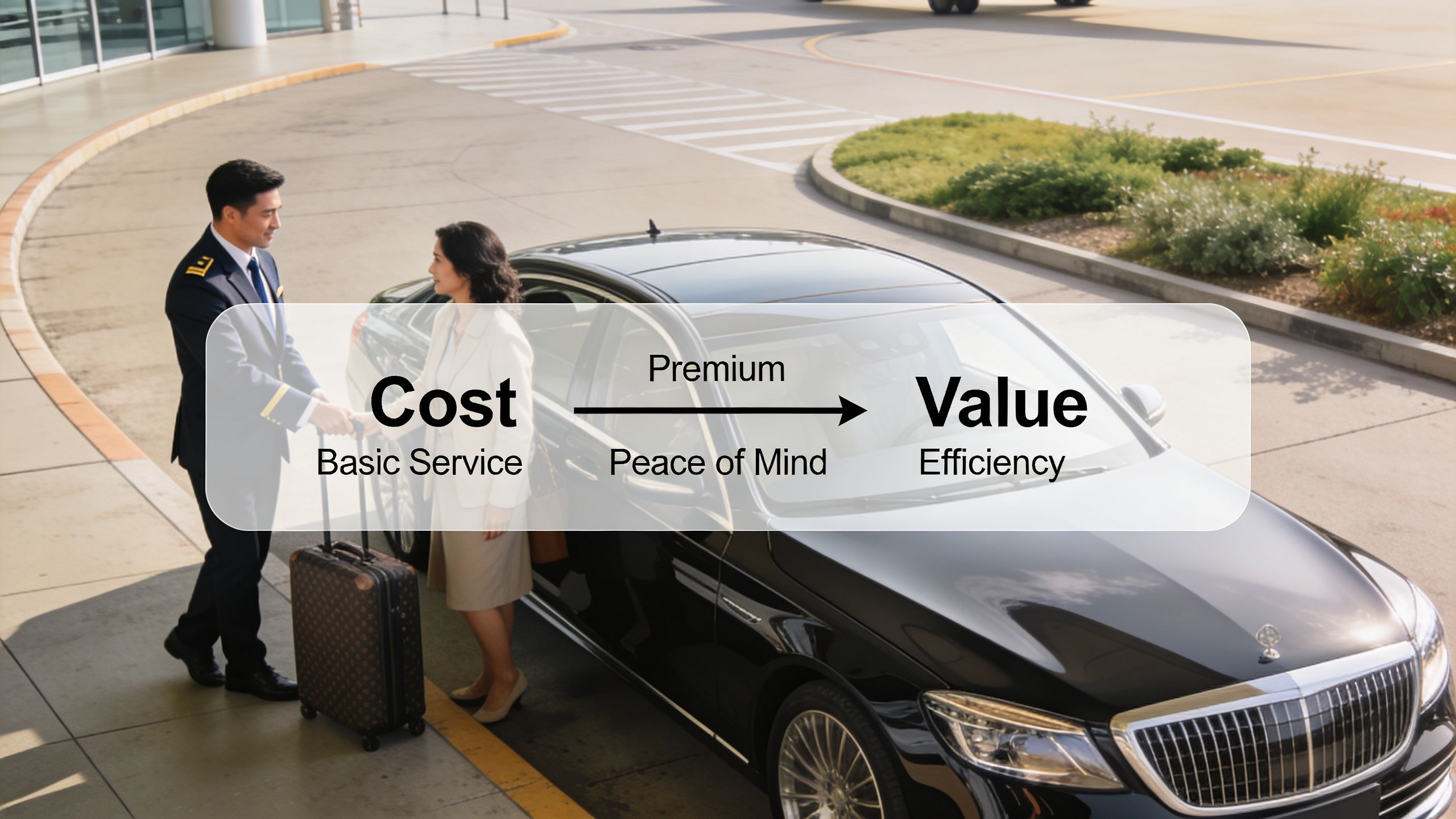
Premium ground transportation is not priced by distance alone. You are paying for standby discipline, airport access experience, flight tracking, vehicle quality, chauffeur screening, and the ability to absorb last-minute changes without turning the trip into a public exercise in improvisation.
That difference matters more in private aviation than in ordinary car service.
What you’re actually paying for
Premium ground transport is usually sold through three pricing models:
| Pricing model | Best for | Watch for |
|---|---|---|
| Point-to-point | Direct transfers between FBO, residence, hotel, office, or yacht marina | Wait-time charges, extra stops, airport access fees |
| Hourly | Meetings, events, shopping, flexible city movements | Minimum-hour rules, overtime, garage and toll billing |
| Day rate | Multi-stop itineraries, family movements, security-led schedules, all-day standby | Driver-hour limits, reset fees, route expansion |
The final number rises or falls based on the vehicle class, local market, timing, airport procedures, demand spikes, luggage volume, and any security requirement beyond a standard executive transfer.
An armored SUV, a bilingual chauffeur, or a second support vehicle changes the cost. So does a live flight arrival that requires the car and driver to be staged early and held in position until wheels down.
The value test that matters
Ask a better question. What risk does this booking remove?
A premium provider earns the fee when the traveler walks from aircraft to car without delay, without confusion, and without exposure. That is the benchmark. Leather seats and bottled water are irrelevant if the basics fail.
I judge value on five points:
- The chauffeur is identified in advance
- The vehicle fits the passenger group and luggage plan
- The provider handles schedule changes quietly
- The pickup process is controlled from touchdown to departure
- Billing is clear before the trip starts
That is what high-net-worth travelers are buying. Time protection, privacy protection, and operational control.
A missed handoff after a long-haul flight can cost more than the car booking itself. It can delay a closing, disrupt a family arrival, or put a recognizable traveler in the wrong place at the wrong time.
Premium pricing should buy certainty, discretion, and clean execution.
Where clients waste money
Overspending usually comes from poor specification, not from choosing a premium service.
The first mistake is booking the wrong vehicle. A sedan for four passengers with long-stay luggage creates delays and second-trip problems. An oversized Sprinter for one executive and one briefcase is just lazy planning. The second mistake is buying on headline price, then paying extra through wait time, access confusion, cancellation friction, and emergency replacement.
The right approach is simple. Match the vehicle to the actual movement. Confirm what is included. Get the wait-time policy, cancellation terms, airport pickup method, and any surcharges in writing before departure.
If you are arranging both air and ground, build them into one itinerary from the start. The booking process for private jet charter with coordinated trip details should cover the road segment with the same precision as the flight.
In this category, clarity has monetary value. So does discretion.
Your Next Steps Booking Seamless Ground Transportation with Haute Jets
If you’ve read this far, the takeaway is simple. Ground transportation isn’t an add-on after the flight. It’s part of the travel architecture.
That means your next booking should include a ground plan as early as your aircraft plan. If you’re arranging a charter through a flight advisor, give the road segment the same attention you’d give catering, tail number confirmation, Wi-Fi, or pet accommodation. If you’re coordinating your own trip, insist on one written itinerary that covers both air and ground.
What to specify before you travel
Send these details before departure, not while boarding:
- Passenger structure: principal traveler, family members, assistants, security, or staff
- Vehicle preference: sedan, SUV, Sprinter, armored vehicle, or support vehicle for luggage
- Pickup method: planeside request, FBO meet-and-greet, or curbside fallback
- Destination conditions: hotel loading bay, gated residence, yacht, event site, or multiple stops
- Special requirements: child seats, bilingual chauffeur, pet handling, extra luggage, privacy concerns
If you want a clean overview of the broader booking process, start with booking a private jet with Haute Jets. The important point is that ground transport details belong in that conversation from the start.
Frequently Asked Questions
| Question | Answer |
|---|---|
| Can I use my preferred car service? | Yes, if the provider can meet the operational requirements of the trip. Confirm driver identity, vehicle details, pickup procedure, and communication protocol in advance. |
| What happens if the flight is delayed or arrives early? | A proper provider tracks the flight and adjusts staging automatically. You should not have to land and start calling drivers. |
| Can a vehicle meet me planeside? | Sometimes. It depends on airport rules, FBO procedures, security permissions, and vehicle credentials. Always approve a backup pickup method too. |
| Should I book a sedan or an SUV? | Book based on passenger count, luggage volume, and security needs. Many clients default to a sedan when an SUV would handle the trip more cleanly. |
| When should I request an armored vehicle? | Request it early if the trip involves heightened personal security concerns, public visibility, or a need for protective transport protocols. |
| Can luggage travel in a separate vehicle? | Yes, and in many cases it should. That’s often the better choice for comfort, discretion, and cleaner arrival handling. |
The smart move is straightforward. Ask your advisor to treat the road segment as part of the charter, not as a separate errand. That’s how you protect timing, privacy, and peace of mind from departure to destination.
If you want one itinerary that covers both aircraft and arrival logistics, speak with Haute Jets. Share your route, passenger profile, luggage needs, and any privacy or security requirements, and have the ground plan confirmed before the flight is locked.