
You're probably looking at a trip that commercial aviation handles badly.
A morning board meeting in New York. Dinner in Miami. A family office review in Aspen after that. First class won't fix the fundamental problem. You still work around airline schedules, crowded terminals, missed connections, and airports chosen for the carrier's network instead of your agenda.
That's where private jet charter starts to make sense. Not as a status purchase. As a scheduling tool.
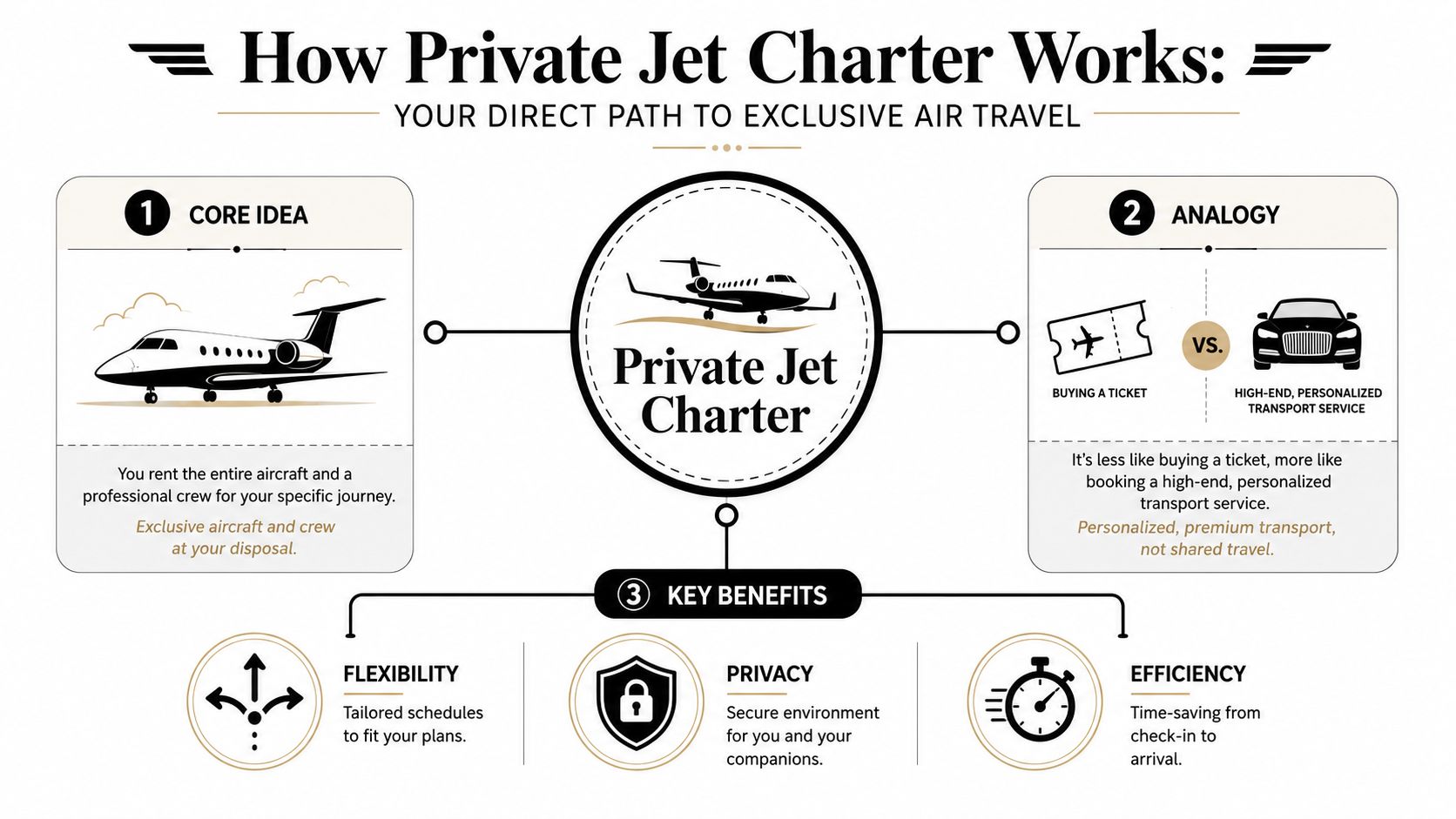
Private jet charter means you rent an aircraft and crew for a specific mission instead of owning the aircraft, managing it, or committing to a long-term program. You buy access when you need it. Nothing more. For most discerning travelers, that's the right model. It keeps capital free, keeps aircraft choice flexible, and lets you match the jet to the trip instead of forcing every trip into the same aircraft category.
Your Introduction to Private Aviation on Demand
If you're asking what is private jet charter, the practical answer is simple. It's aviation on demand.
You choose the departure point, the destination, the schedule, and the aircraft category that fits the trip. You don't buy a seat. You charter the whole aircraft. That changes everything. Departure times become negotiable, smaller airports become viable, and the trip starts to follow your life instead of the other way around.
This isn't a tiny corner of luxury travel. The market has real scale. One industry estimate values the global private jet charter services market at USD 17.67 billion in 2026 and projects it to reach USD 25.79 billion by 2031, with on-demand charter accounting for over 51% of revenue in 2025 according to Mordor Intelligence's private jet charter services market outlook. That matters because it confirms that on-demand charter isn't an exotic exception. It's the core access model.
Why clients choose charter instead of ownership
Ownership sounds efficient until you look at how people travel. Most clients don't fly the same mission every time. One trip is a short regional hop for a few passengers. The next requires a larger cabin and longer range. A fixed asset rarely fits every mission well.
Charter solves that mismatch.
- Route flexibility: You can choose a turboprop for a short regional flight or a long-range jet for an international itinerary.
- Schedule control: You depart when your meetings end, not when the airline decides to board.
- Operational simplicity: The operator handles crew, maintenance, and flight execution.
Private aviation delivers the most value when time matters more than uniformity.
There's another point new buyers often miss. Charter isn't just about luxury. It's about reducing friction. Fewer moving parts. Less dead time. More direct airport access. When your trip has consequences, that matters more than champagne and leather seats.
How Private Jet Charter Works
You need to be in Teterboro tomorrow morning, then Palm Beach the next day. Airline schedules waste half the trip. Ownership makes no economic sense for two flights. Charter solves that problem fast, but only if the aircraft is sourced correctly.
Private jet charter is simple. You request a specific trip. A properly licensed operator accepts the mission. You pay for that mission, not for year-round ownership, crew salaries, maintenance overhead, or hangar costs.
The operator and the broker
The operator is the company legally responsible for the flight. It controls the aircraft, employs or assigns the crew, maintains the jet, and runs the trip under its certificate.
The broker sources aircraft and coordinates the booking. A good broker saves you time, presents viable options, and explains the tradeoffs clearly. A weak broker adds margin, hides where the aircraft is coming from, and gives you a polished quote with very little pricing logic behind it.
That distinction drives cost.
Many first-time clients focus on cabin photos and hourly rates. A more pertinent question is where the aircraft is based relative to your trip. If the jet has to fly in empty to pick you up, you are often paying for that repositioning leg whether it is shown clearly or buried inside the quote.
Why local sourcing matters
At this point, clients overspend.
A locally based aircraft usually avoids the 20 to 40 percent repositioning premium that many brokers and jet card programs build into pricing. That premium shows up when the aircraft is not already near your departure airport and has to reposition before your wheels-up time. The farther the aircraft has to come, the worse the economics get.
The smart way to charter is to start with aircraft already positioned near your route, then choose the best operator and cabin fit from that local supply. That approach usually produces a better quote and a cleaner operational plan. It also reduces the risk of day-of-travel friction tied to ferry timing.
What the booking process usually looks like
- Trip request: You share the route, schedule, passenger count, baggage needs, and any cabin preferences.
- Market search: Available aircraft are screened by location first, then by capability, operator quality, and total trip cost.
- Quote review: You compare full-trip pricing, aircraft age and layout, operator credentials, and repositioning exposure.
- Operator confirmation: The operator approves the mission and issues the charter agreement and itinerary details.
- Flight execution: You arrive at the private terminal, clear directly through the FBO, board, and depart on your schedule.
Aircraft matching should be precise, not generic. The right jet for a short regional flight is not the right jet for a coast-to-coast itinerary, and paying for unnecessary range or cabin size is wasted money. For a breakdown of categories and mission fit, see this guide to understanding private jet types.
Ask three questions before you approve any quote. Who is operating the flight, where is the aircraft based, and how much of this price is repositioning? Those answers usually tell you whether the quote is efficient or padded.
Key Private Jet Charter Models Explained
Private aviation gives you several ways to buy the same outcome: a flight on your schedule. The smart choice comes down to economics. The wrong model adds ferry cost, standby time, or both. The right model keeps the aircraft close to your departure point and avoids the repositioning premium that often inflates quotes.

On-demand charter
On-demand charter is the cleanest starting point for most clients. You book a specific trip, select the aircraft for that mission, and pay for that flight rather than buying into a program.
It works because it lets you shop the live market instead of forcing every trip into a prepaid structure. If you travel irregularly, this is usually the most rational option. It also creates the best chance to source an aircraft locally, which is how you avoid the large repositioning markup that many broker quotes and jet card rates bury inside the total.
Empty leg flights
Empty legs exist because an aircraft needs to move without passengers. If your schedule matches that movement, the price can be attractive.
Treat them as opportunistic, not strategic. The aircraft is moving for another client's trip, not yours, so timing flexibility is limited and the flight can vanish if the primary itinerary changes. Empty legs are useful for discretionary travel, not for meetings, family events, or any trip where timing matters.
One-way charter
One-way charter is often the best-value format in private aviation. You use the aircraft for the trip you need and avoid paying for idle time at your destination.
This model rewards disciplined sourcing. A jet already near your departure airport will usually price far better than an identical jet that needs to ferry in first. That gap is where many clients overpay. Local sourcing can strip out a repositioning premium that would otherwise make a simple one-way trip look far more expensive than it should.
Round-trip charter
Round-trip charter makes sense when you need the same aircraft and crew held for your return, or when your destination has limited availability and you do not want to gamble on finding lift later.
You should choose it for control, not because it sounds efficient. If the aircraft waits, you are paying for that asset to sit. Sometimes that is the right decision. Often it is not. For a short stay, especially in a thin market, round-trip can be justified. For a longer stay, two separately sourced one-way flights are frequently the better buy.
Which model fits which traveler
- Choose on-demand charter for irregular travel and broad flexibility without prepaying for hours.
- Use empty legs only when your timing is flexible and the trip is discretionary.
- Book one-way charter when cost discipline matters and you do not need the aircraft waiting.
- Book round-trip charter when schedule control or limited return options matter more than minimizing total cost.
Aircraft category still matters, because the cheapest structure is not helpful if the jet is wrong for the mission. If you need help matching cabin size and range to the trip, review this guide to private jet types by mission and category.
Decoding Private Jet Charter Costs and Pricing
A client wants a one way flight from Teterboro to South Florida. Two quotes come back for what looks like the same trip. One is materially higher. The usual assumption is that the pricier quote includes a better aircraft or better service. In many cases, it includes an empty reposition flight you should never have been asked to fund.
That is the first pricing lesson in private charter. The hourly rate matters, but the quote is really a stack of cost drivers. If you only compare the headline rate, you will miss the reason one option is economically sound and another is inflated.
What you're actually paying for
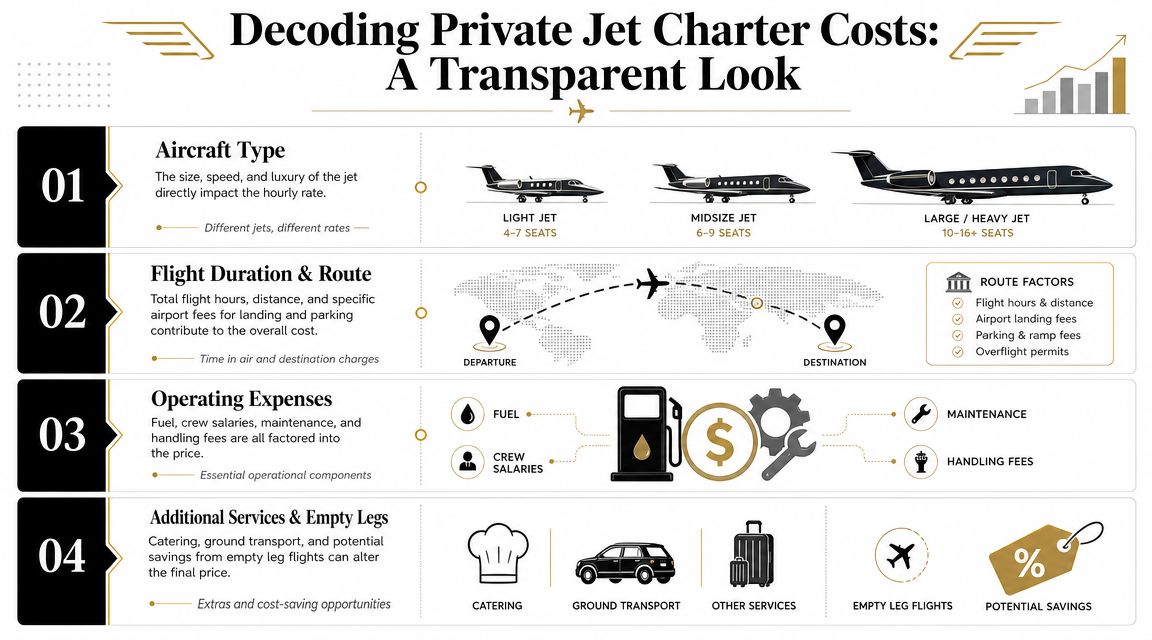
A charter quote usually starts with the aircraft's hourly charge, then adds trip-specific expenses such as landing fees, handling, fuel adjustments, federal taxes, catering, de-icing, overnight crew costs, and permits for international flying. That is why two quotes on the same city pair can differ sharply even within the same aircraft class.
Aircraft class still sets the baseline. According to BlackJet's explanation of private jet pricing mechanics, light jets are often quoted from about $3,000 per hour, while long-range aircraft can exceed $15,000 per hour. That range is normal. A larger cabin, longer legs, and higher operating costs push the number up fast.
Repositioning is where charter pricing gets distorted
The biggest pricing variable is not the cabin finish or the sales presentation. It is aircraft positioning.
If the jet is not already near your departure airport, someone has to pay to move it into place. That empty flight, often called repositioning or deadhead, gets baked into the quote. It can add a meaningful premium, and it often explains why a supposedly competitive offer is not competitive at all.
BlackJet also notes that repositioning can raise charter pricing by 20% to 40% in some cases. That is the margin disciplined buyers should focus on first.
Here is the smart question to ask before you compare quotes: Where is the aircraft coming from? If the answer is another state, or worse, another region, the quote deserves skepticism.
Why local sourcing usually wins
Local sourcing is the cleanest way to control charter cost because it attacks the most avoidable expense. A locally based aircraft can price the mission on the mission itself. A distant aircraft prices your trip plus the cost of getting ready for your trip.
That difference is not cosmetic. It is the economic divide between paying for transportation and subsidizing inefficiency.
This is also why many broker quotes and some jet card programs run high. They often quote from a broad network or fixed category model, then pass through the repositioning burden that comes with it. If you want better value, ask for the exact aircraft, its current base, and whether the quote includes any ferry time before pickup.
Why two quotes for the same route differ
Four factors usually explain the gap:
- Aircraft base location: Nearby aircraft avoid expensive empty positioning.
- Aircraft selection: A larger jet may complete the trip, but still be the wrong economic choice.
- Airport economics: Handling, parking, and operating fees vary by airport.
- Trip structure: A one way, same day return, and overnight itinerary do not price the same way.
For a more precise breakdown of how these inputs affect the bill, review this private jet cost per hour guide with the key pricing components.
My advice on controlling charter cost
Treat charter pricing like asset sourcing, not retail shopping.
Ask these questions every time:
- Is the aircraft already based near my departure airport?
- Am I paying for the right cabin and range, or just excess airplane?
- Does the quote separate flight cost from taxes, fees, and optional services?
- Is repositioning included, and if so, why was a local aircraft not sourced first?
Haute Jets is one example of a model built around local sourcing and aircraft-specific quoting rather than vague category pricing. That approach is the right one if your priority is transparency and avoiding the repositioning premium that drives up charter costs.
Ensuring Safety with Wyvern and ARGUS Ratings
If you remember only one operational point, remember this one. Charter safety is not an area for casual assumptions.
A legitimate U.S. charter flight operates under Part 135, not the looser framework used for owner-flown private operations. That matters because Part 135 places the flight under commercial-style operational control. Crew qualification, maintenance oversight, and dispatch responsibility are handled at the operator level.
According to Paramount Business Jets' charter aircraft guidance, charter flights operate under FAA Part 135, and clients should strongly prefer operators with third-party safety audits such as Wyvern or ARGUS. That's the right standard.
Why third-party audits matter
An operator can legally conduct charter and still not meet the standard a discerning client should demand. Third-party auditing adds another layer of review beyond the minimum legal threshold.
That's where Wyvern and ARGUS come in. These audits are used throughout private aviation as independent checks on operational standards. If an operator holds one of these credentials, you at least know someone outside the company has reviewed key elements of its safety program.
What to ask before you book
Don't ask vague questions like “Is this aircraft safe?” Ask precise questions.
- Operator identity: Who is the Part 135 operator on this flight?
- Audit status: Does that operator hold a current Wyvern or ARGUS audit?
- Operational control: Who is legally responsible for dispatching and operating the mission?
- Aircraft details: What exact tail will fly the trip?
For a fuller explanation of the audit framework, read this deep dive into Wyvern and ARGUS safety ratings.
If a seller dodges the operator question, stop there and move on.
Charter vs The Alternatives
Charter is flexible, but it isn't automatically the right answer for every traveler on every trip. That's where buyers waste money. They choose a model before they define the use case.
The better approach is simple. Match the access model to the frequency, route pattern, and level of commitment you want.
The practical comparison
On-demand charter works well when you want trip-by-trip flexibility. Jet cards appeal to buyers who want a prepackaged program and simpler budgeting. Fractional ownership suits travelers who want deeper commitment and don't mind the structure that comes with it.
The route matters too. Paramount Business Jets notes that charter value is highly use-case dependent, with a light jet suited to short hops and an ultra-long-range jet able to handle 8,000+ nautical mile trips in its discussion of the pros and cons of private jet charter. That's exactly why one-size-fits-all programs often disappoint. They standardize a product that should stay route-specific.
On-Demand Charter vs. Jet Cards vs. Fractional Ownership
| Attribute | On-Demand Charter | Jet Card | Fractional Ownership |
|---|---|---|---|
| Commitment | Pay per trip | Prepaid program | Long-term ownership structure |
| Aircraft choice | Broad, trip-specific | Usually category-based | Limited by owned share structure |
| Pricing style | Dynamic, route-specific | Program pricing | Capital plus ongoing operating obligations |
| Best for | Irregular or varied travel | Frequent flyers who want structure | Travelers with sustained, predictable demand |
| Main drawback | Quote variability | Less flexibility and potential program restrictions | Highest complexity and commitment |
Where first class still works
If you're flying a simple route between major hubs with no schedule sensitivity, first class can be perfectly rational. Don't charter out of habit. Charter when the mission justifies it.
Where private aviation wins is control. Direct departures. Smaller airports. Privacy for work or family. Better use of the day. And when the trip includes ground coordination at the destination, the same logic applies on the road. For travelers moving through the UAE, this guide to luxury chauffeur services Dubai is a useful reference for planning the transfer side with the same level of precision.
My recommendation
Choose on-demand charter if your travel pattern is varied and you care about matching the aircraft to the route. Consider a jet card only if you value program convenience more than aircraft flexibility. Look at fractional ownership only if you already know you want long-term aviation commitment and can support it operationally.
The Haute Jets Difference From Booking to Takeoff
A smart charter process does three things well. It finds an aircraft that fits the mission. It makes pricing legible. It removes surprises before departure.
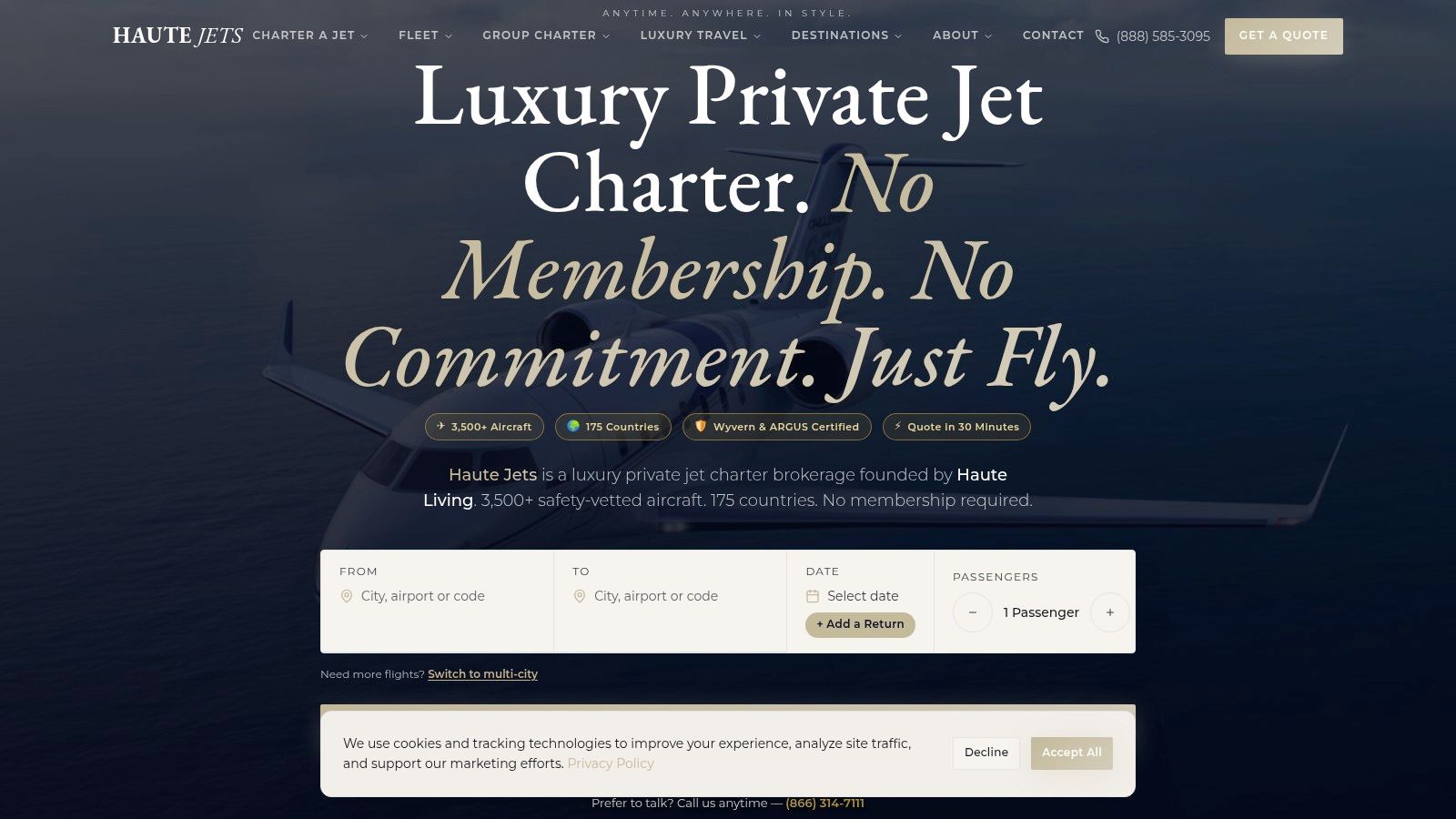
That's the practical appeal of the Haute Jets model as described by the publisher. It focuses on local sourcing, which is the right place to start if you want to avoid paying for unnecessary positioning. It also gives the client visibility into the exact year, make, and model instead of hiding behind a broad category label.
What a disciplined booking flow should include
A professional charter workflow should look like this:
- Local aircraft search: Start with jets based near your departure city.
- Specific aircraft review: Confirm the exact aircraft, not just “light jet” or “midsize jet.”
- Operational vetting: Verify operator credentials and third-party safety audit status.
- Pre-flight clarity: Confirm cabin features, passenger details, and crew information before departure.
What clients should insist on
Most charter frustration comes from ambiguity. Vague aircraft descriptions. Soft quotes. Unclear operator identity. Last-minute substitutions. Those are process failures, not unavoidable features of the market.
The publisher states that clients receive full flight details, including the tail number, crew bios, weather briefing, and passenger manifest before departure. That's the level of detail serious buyers should expect from any provider they use. It reduces confusion and gives you a clean line of sight into who is operating your flight and what you're boarding.
Good private aviation doesn't feel mysterious. It feels organized.
The answer to what is private jet charter isn't “luxury travel.” It's precision travel. When the provider builds around local sourcing, exact aircraft selection, and verified operator quality, charter becomes far more rational than outsiders assume.
If you want a trip-by-trip quote built around nearby aircraft, exact aircraft visibility, and verified operators, Haute Jets is the place to start.