
Private jet hourly charter rates in 2026 span from roughly $4,000 for a light jet to $22,000+ for a heavy jet, and a full transatlantic trip can exceed $100,000. The final bill depends on add-on fees that are often unseen in the headline quote.
You're probably looking at a quote that seemed manageable at first, then wondering why the number jumped once the operator added taxes, positioning, handling, and overnight costs. That's the part of private aviation pricing that blindsides first-time charter clients, and it's also where experienced travelers save the most when they know what to ask for.
A private jet quote should never be read as a single price. In 2026, private jet charter pricing commonly spans a broad hourly range, from light jets to large VIP airliners, and that spread reflects the aircraft class, mission length, and how the aircraft is sourced for your trip (TripFinders pricing guide).
Introduction to Private Jet Charter Costs
A client can open two quotes for the same route and think one broker is cheaper, then discover the so-called lower offer turns into the more expensive trip once the invoice is final. That's because the first number on the page is usually just the aircraft's hourly rate, not the whole cost of getting you airborne.
The practical question behind what is the cost to hire a private jet is never just the hourly number. It's whether the aircraft is already nearby, whether the route triggers repositioning, and whether the quote includes the operational charges that brokers often leave for later. A light jet may start around $4,000 to $6,500 per hour, while midsize and super-midsize jets usually sit around $5,500 to $10,500 per hour, heavy jets around $9,000 to $22,000 per hour, and large VIP airliners can reach $20,000 to $45,000 per hour (TripFinders pricing guide).
That range sounds wide because it is. The same aircraft type can look reasonable on paper and still end up expensive if it has to be moved to your departure airport, if you're flying at short notice, or if winter operations and overnight crew costs get added later.
Practical rule: treat the hourly rate as the opening bid, not the final answer.
The rest of the quote is where disciplined buyers win or lose. If you know the line items before you ask for a quote, you can compare offers on equal terms and avoid paying for noise instead of flight time.
How Private Jet Charter Pricing Works
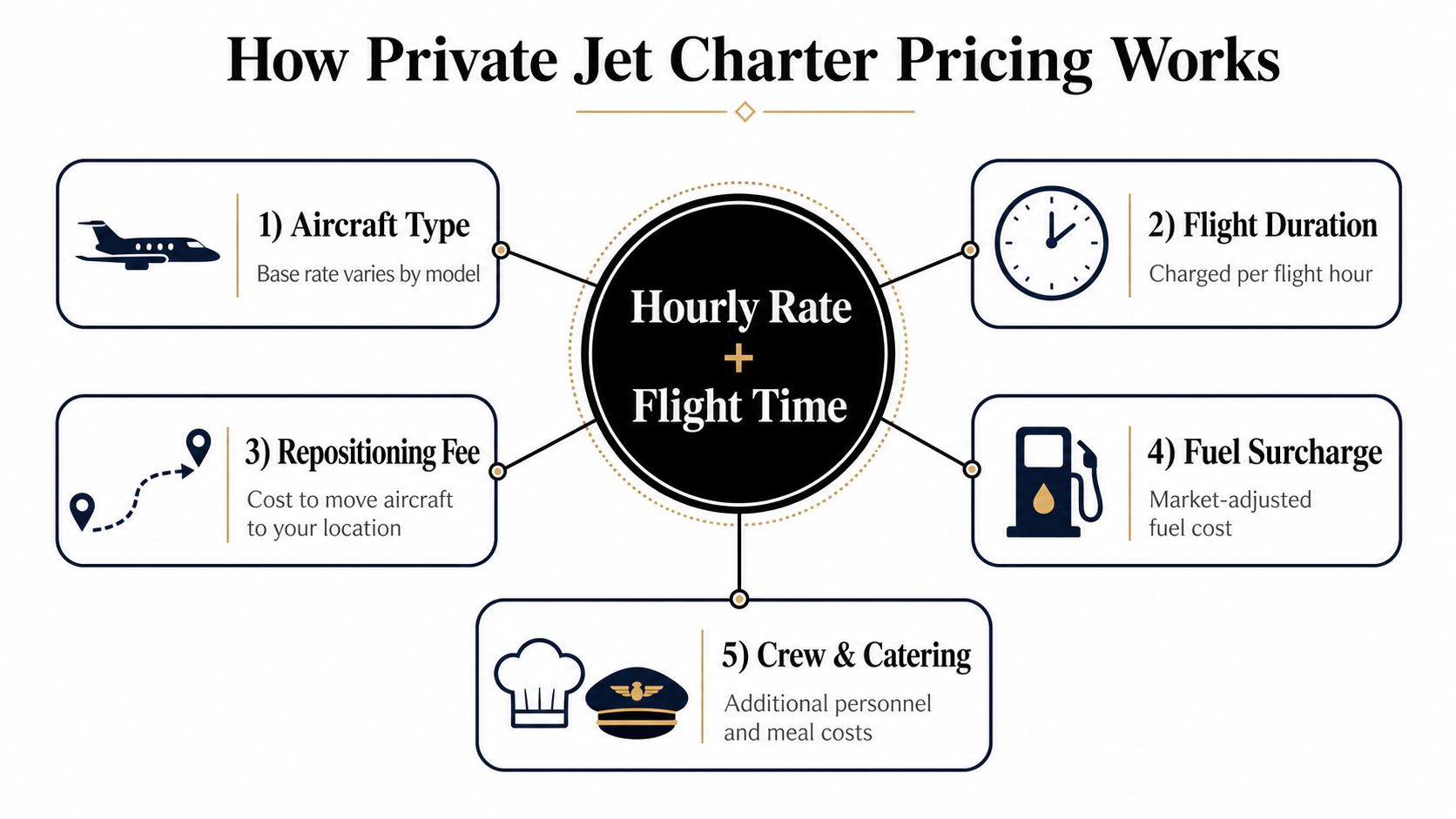
The base model is simple. You pay for billable flight time, and the hourly rate depends on the aircraft category, range, and operating complexity. That's why a charter quote for a light jet doesn't belong in the same mental bucket as a long-range heavy jet or a VIP airliner.
The part that trips people up is the empty aircraft time. If the jet isn't already based near your departure airport, the operator has to move it to you and then reposition it afterward. Industry pricing guides note that those positioning charges are typically billed at 75% to 100% of the occupied hourly rate (EVOJets pricing basics).
That's the private aviation equivalent of getting quoted for the car ride, then being charged for the driver's commute too. The hourly rate still matters, but it's only the starting layer. Taxes, airport handling, crew time, and routing all sit on top of it.
If an aircraft has to come to you, the empty leg is never free. Someone pays for it, and in most charter quotes, that someone is the client.
A useful way to evaluate any quote is to ask what's included and what's excluded. Base hourly cost, occupied flight time, and repositioning should be clearly separated. If they're not, the quote is designed to look cleaner than the actual invoice.
Private Jet Hourly Rates by Aircraft Category
Aircraft category sets the starting point for a charter quote. Light jets generally offer the lowest entry price, while midsize, heavy, and ultra-long-range aircraft charge more for added cabin space, range, and operating capability. The right comparison depends on the mission, whether it is a short regional flight, a coast-to-coast trip, or an international journey.
| Aircraft Category | Hourly Rate Range | Typical Aircraft Models |
|---|---|---|
| Light Jet | $2,800 to $4,500 per flight hour | Citation CJ3, Phenom 300 |
| Midsize Jet | $4,000 to $6,000 per flight hour | Citation Latitude, Learjet 60XR |
| Heavy Jet | $8,000 to $14,000 per flight hour | Gulfstream G550, Global 6000 |
| Ultra-Long-Range Jet | $13,000 to $20,000+ per hour | Gulfstream G650ER, Global 7500 |
Broader 2026 market guides show overlapping bands: light jets at roughly $4,000 to $6,500 per hour, midsize and super-midsize jets at about $5,500 to $10,500, heavy jets around $9,000 to $22,000, and large VIP airliners at $20,000 to $45,000 (The Jet Negotiator rates, TripFinders pricing guide).
These figures describe the aircraft's hourly rate, not necessarily the final invoice. Positioning, airport handling, taxes, and crew-related charges can raise the total, particularly when the selected aircraft is not locally based. A local-sourcing charter model can remove that positioning exposure, often the largest line item hidden behind an attractive hourly quote.
A four-person team on a short domestic route may pay more than necessary by choosing a heavy jet. A transatlantic group with several passengers and bags may need its range and capacity. Review the comparison of light, midsize, and heavy private jets before treating the lowest hourly rate as the cheapest option.
Hidden Fees That Inflate Your Private Jet Quote
A quote can look reasonable until the operator assigns an aircraft, confirms the airport, and builds the schedule. If that jet is based elsewhere, the empty flight to your departure airport may become the largest hidden charge on the trip. Ask about aircraft location before comparing hourly rates.
The charges that show up after the hourly rate
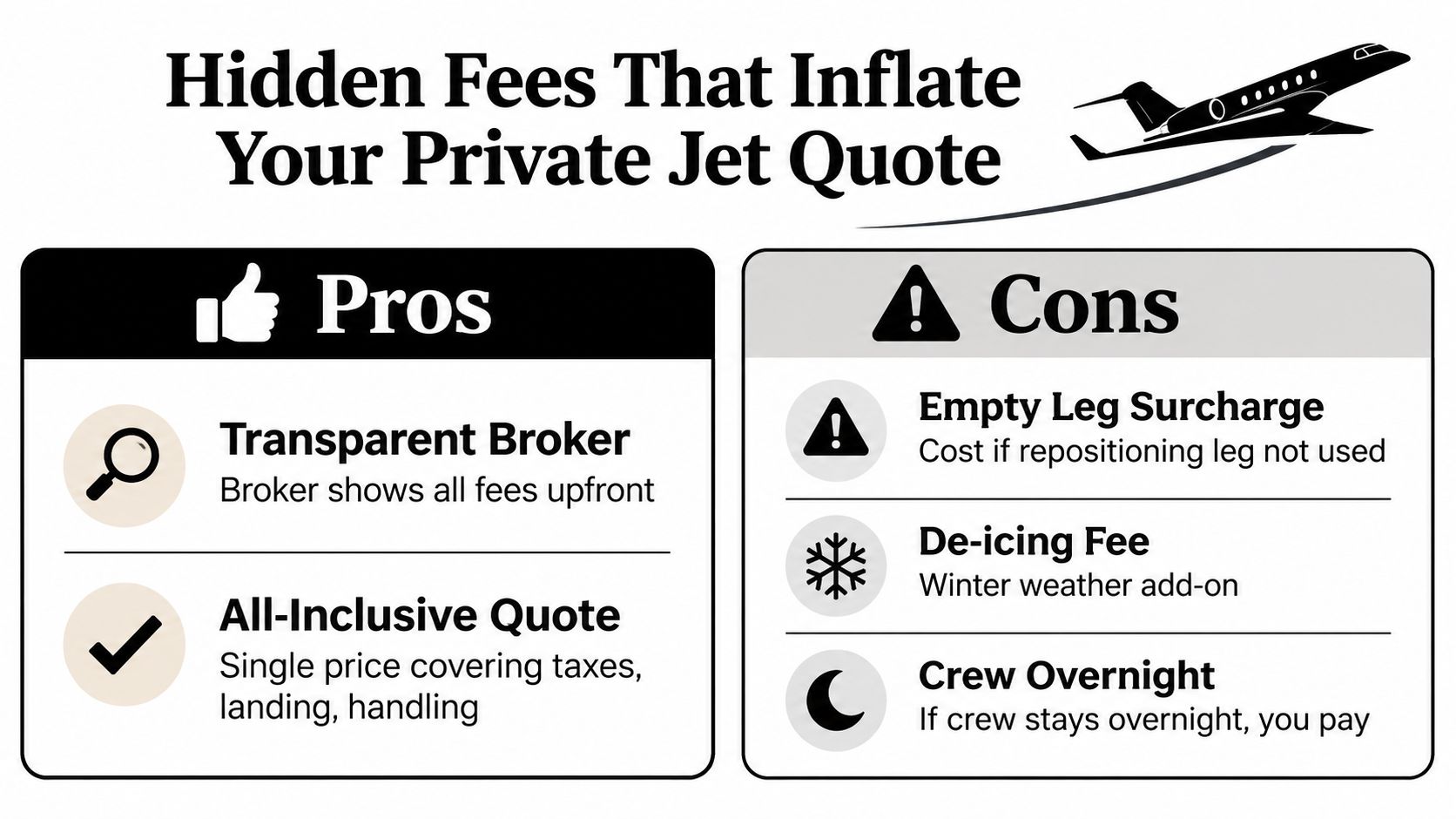
The base rate can sit alongside FBO and handling fees, ramp fees, crew overnight expenses, and winter deicing. One 2026 guide cites FBO ramp fees of $800 to $3,500 per landing, crew overnight costs of $400 to $900 per night, and deicing costs of $500 to $5,000 per departure (Elysium Jet hourly rates guide). Airport selection and winter operations can therefore change the invoice even when the aircraft and route stay the same.
Positioning requires the closest review. Deadhead or ferry legs may add roughly 30% to 100% to the trip, or at least the aircraft's full hourly cost for those empty segments (Uncompromised Travel repositioning explanation). A local-sourcing charter model can remove that exposure by using an aircraft already near your departure airport. For many quotes, that is the single largest cost difference brokers leave unclear.
Taxes add another layer. The U.S. Federal Excise Tax adds 7.5% to domestic flights. Base quotes may also exclude segment fees, fuel surcharges, repositioning, crew overnights, landing and handling, deicing, and international permits (Paramount Business Jets cost guide).
Before accepting a broker's proposal, request an all-in breakdown and the aircraft's current location. Also ask what triggers each variable fee, especially the private jet fuel surcharge explanation. A quote that cannot answer those questions is not transparent enough to compare.
Sample Route Pricing for Popular Private Jet Trips
Route context makes the pricing conversation far more useful. A short domestic hop can feel surprisingly affordable, while a long-haul international charter can jump into a different financial category altogether. The route itself changes the answer just as much as the cabin class does.
A light-jet trip on a short U.S. route can land around $10,000 to $20,000, a midsize jet around $18,000 to $35,000, and a heavy jet around $45,000 to $90,000, depending on distance and aircraft choice (FlyAC Jets pricing guide). That's why a simple mileage comparison doesn't tell the full story.
What that looks like on real corridors
A short flight from New York to Miami on a light jet can sit in that lower end of the market, while the same route in a midsize aircraft climbs because you're paying for more cabin, more range, and higher operating cost. For a route-specific example, Haute Jets publishes a New York to Miami midsize jet route page that helps anchor those expectations.
On the executive-travel side, a practical route planning reference is the executive business trip guide, which is useful because business flyers often care as much about schedule control as they do about the sticker price. That same mindset matters whether the trip is to Miami, Las Vegas, or a coastal weekend escape.
A transatlantic flight is a different category of spend because the trip can trigger positioning, crew overnights, and international permits. A heavy jet crossing to London can exceed $100,000 once those pieces are included, which is exactly why the final number can look nothing like a neat hourly multiplication.
Key Factors That Drive Private Jet Charter Costs
Aircraft availability near your departure point is the first thing I check. If the jet is already local, you avoid the repositioning problem entirely. If it isn't, the charter quote can absorb a meaningful empty-leg charge before you even board.
What buyers can control
A few variables matter more than others:
- Aircraft location. Local sourcing keeps the deadhead leg off your invoice.
- Aircraft size. A smaller jet is usually the cleaner fit when the group and bags are modest.
- Timing. Short-notice trips narrow your options and make favorable aircraft positioning harder to find.
- Route length. Longer missions tend to require more capable aircraft, more crew planning, and more operational complexity.
The impact of empty positioning is not minor. Industry explanations say ferry legs can add roughly 30% to 100% to the final invoice, which is why route sourcing matters as much as aircraft selection (Uncompromised Travel repositioning explanation).
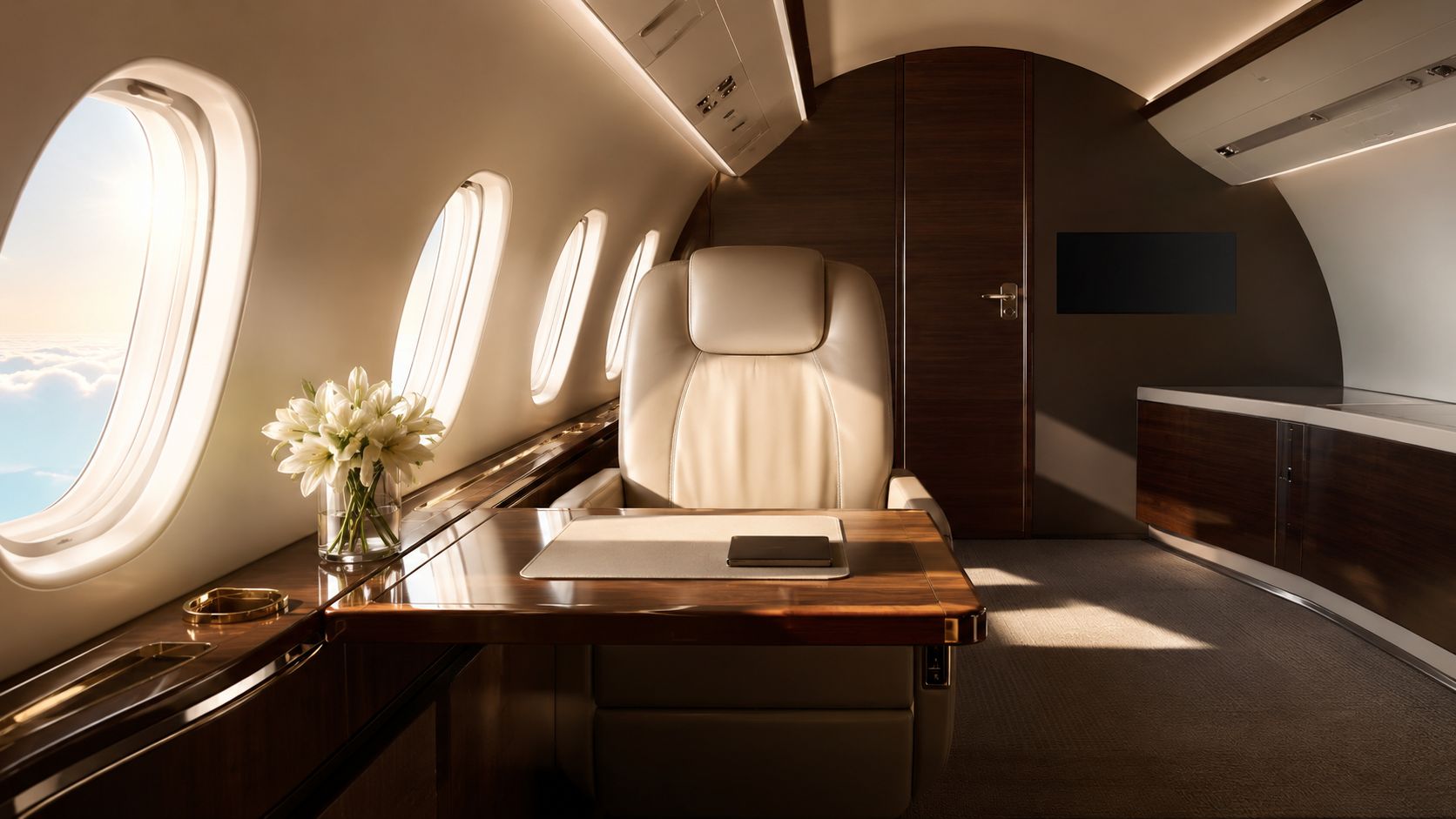
The image below shows the cabin side of that decision, because the right aircraft is as much about fit as it is about prestige.
The cheapest quote on paper is often the one with the worst aircraft positioning. The smarter quote is the one that starts with the jet already near you.
Smart Strategies to Lower Your Private Jet Charter Cost
The fastest way to save is to stop paying for unnecessary aircraft movement. Empty-leg flights exist because an operator already needs to move the jet, and that creates a real discount opportunity when your schedule is flexible. Pricing guides show empty-leg flights can start around $2,000 per hour for short VLJ hops and can reach $50,000+ for ultra-long-range international trips, depending on the mission (Amalfi Jets empty-leg guide).
Three choices that usually matter most
The first is aircraft class. A light jet is usually the right answer for a short executive mission or a small group, while upgrading to a heavier cabin just because it feels nicer can be an expensive habit. The second is timing. Flexibility gives you access to repositioned inventory and empty-leg pricing that fixed schedules shut out.
The third is sourcing. Local aircraft sourcing is where the biggest savings often live because the repositioning fee disappears when the jet is already based near your departure city. That's the single line item brokers tend to obscure, and it's the one that can turn a good hourly rate into a bad total.
Some operators, including Haute Jets, source from a large owner-operator network and focus on finding aircraft already positioned near the departure city, which reduces the chance of paying for a needless empty leg. That model matters because it aims at the cost driver most travelers never see until the invoice arrives.
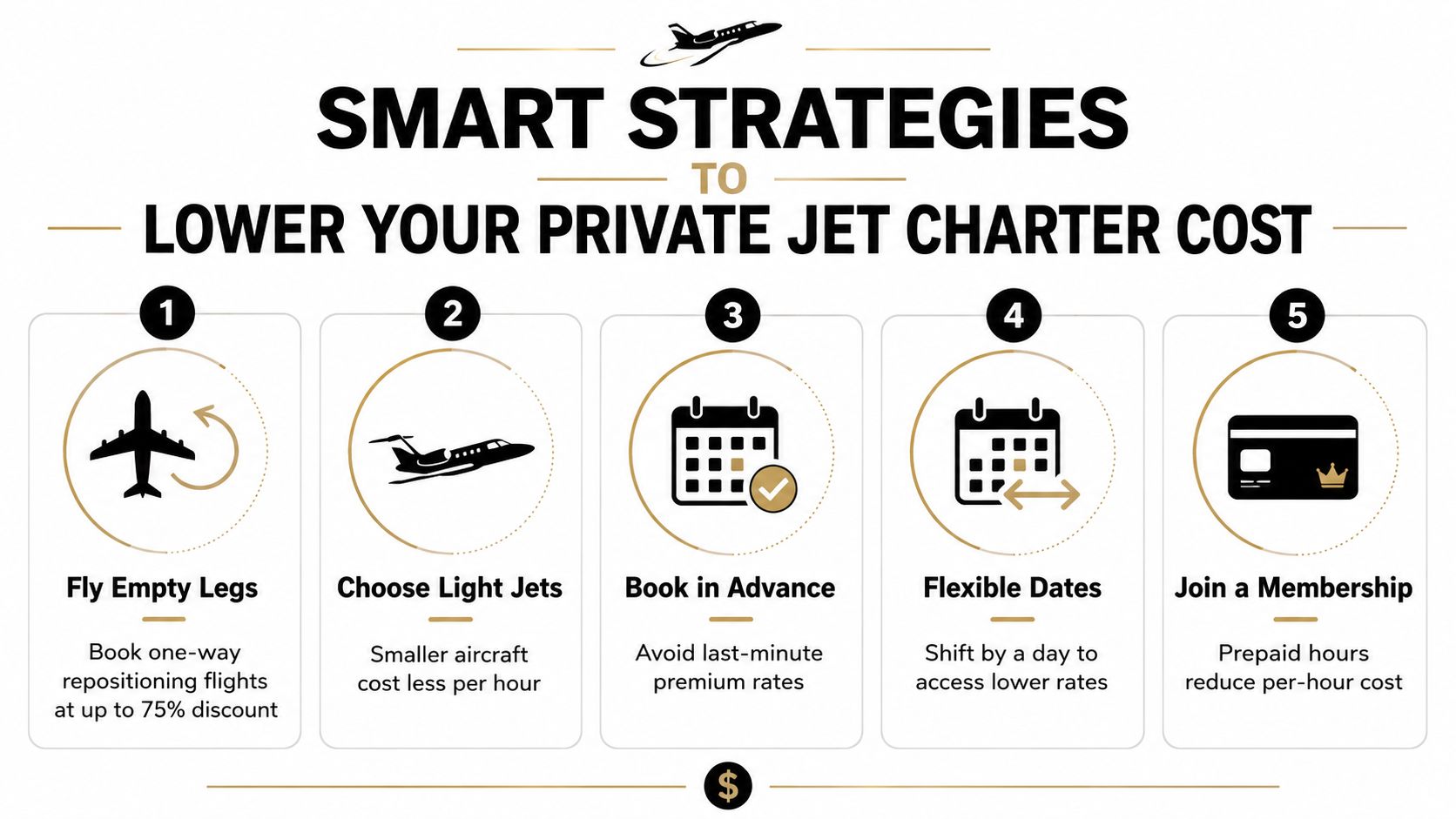
Flexibility creates leverage. Fixed dates, fixed aircraft type, and fixed departure airports all narrow the market and push the price up.
Frequently Asked Questions About Private Jet Charter Costs
Can you book a private jet for under $5,000? Yes, but only in narrow situations. A very short trip in a turboprop or light jet, especially on an empty-leg itinerary, can land under that number, but that's not the norm for most executive travel.
How far ahead should you book? If you want better selection and a better shot at avoiding repositioning costs, booking farther out helps. Same-day charters can still work, but last-minute demand usually leaves less room to optimize the route and aircraft location.
Do private jets always include Wi-Fi and catering? Not always. Wi-Fi is common on modern business jets, but catering is usually arranged separately and can range from simple refreshments to much more customized onboard service, depending on the operator and aircraft.
Is private jet travel safe? Safety depends on the operator and the aircraft maintenance culture, not just the cabin finish. Charter buyers should look for recognized third-party safety audits and ask for the operator's credentials before they book.
What's the single biggest mistake first-time buyers make? They compare hourly rates without checking where the aircraft is based. That's usually how the repositioning charge sneaks in and changes the economics of the trip.
Haute Jets helps clients compare charter options with an eye on the invoice, not just the headline hourly rate. If you want a quote that accounts for aircraft location, trip length, and the cost drivers that change the final number, visit Haute Jets and request a flight built around your route.