

A lot of luxury travelers only think about insurance before departure. That's a mistake.
The more expensive and layered your itinerary becomes, the more your real exposure starts after wheels up. A private charter to the Riviera, a villa paid in full, a series of dinner reservations, ground transfers, yacht connections, onward flights, and fixed experiences can unravel in one phone call. If you have to leave early, the financial damage isn't theoretical. It's immediate, and it's often spread across multiple suppliers who each apply their own cancellation rules.
For Haute Jets Journal readers, that's the right frame for this topic. What is trip interruption insurance? It's not a generic travel add-on. It's post-departure financial protection for the part of the trip you've already committed to, but can no longer use.
Your Journey Interrupted The Case for Post-Departure Protection
You're three days into a two-week European itinerary. The first charter leg went smoothly. Your family has checked into a prepaid villa. Drivers are booked. A beach club reservation is locked in. The next aircraft segment is already arranged. Then a family emergency back home changes everything.
At that point, the issue isn't whether you can absorb the loss. Many high-net-worth travelers can. The issue is whether you should. Good risk management exists to prevent unnecessary losses, especially when the trigger is outside your control.

Why this matters more in luxury travel
A simple airline vacation has fewer moving parts. A high-value itinerary is different. One interruption can leave you with:
- Unused charter segments that were prepaid and non-refundable
- Luxury lodging losses tied to strict terms
- Missed private experiences with no practical resale value
- Emergency repositioning costs to get home quickly
That's why I treat trip interruption coverage as a core planning issue, not a footnote.
The market itself reflects that shift. The global travel insurance market was estimated at USD 27.05 billion in 2024 and is projected to reach USD 63.87 billion by 2030, growing at a 15.4% CAGR from 2025 to 2030, according to the American Academy of Actuaries travel insurance monograph. That same source notes growing awareness of disruptions such as flight delays, lost luggage, and trip cancellations.
Advisor view: When sophisticated travelers spend heavily on flexibility, privacy, and time savings, they also need protection that recognizes how expensive disruption becomes once the trip has started.
The real question
Most travelers ask, “Do I need travel insurance?”
Affluent travelers should ask a better one: If I must cut this trip short halfway through, who pays for the unused value and the emergency return?
If you don't know the answer before departure, you're traveling with a blind spot.
Understanding the Trip Interruption Safety Net
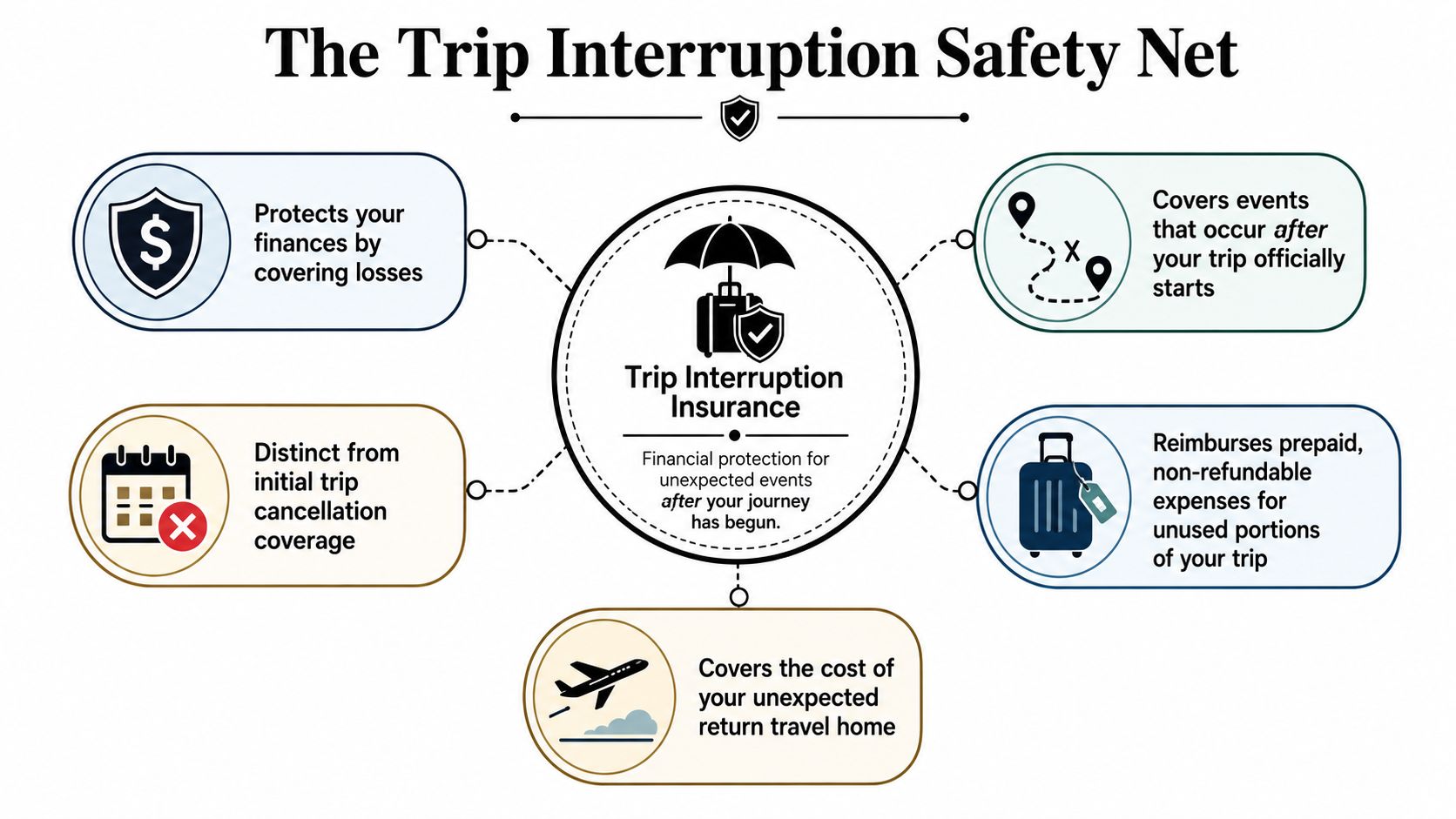
Trip interruption insurance is best understood as a post-departure reimbursement benefit. It doesn't protect the trip you never started. It protects the trip you did start, but couldn't finish because a covered event forced you to return home early or extend your stay unexpectedly.
That distinction matters because many travelers confuse interruption with cancellation. They're not interchangeable.
What it actually pays for
At its core, trip interruption coverage reimburses unused, prepaid, non-refundable trip costs. According to Squaremouth's explanation of trip interruption benefits, many plans reimburse at least 100% of those unused costs, and some extend to 125% to 200% of trip cost to help cover the added expense of rebooking return travel or other transportation after a covered disruption.
That extended limit is where strong policies separate themselves from weak ones.
If your return becomes urgent, you may need to replace a carefully planned itinerary with a far more expensive one. In commercial travel, that could mean a last-minute premium cabin seat. In private travel, it could mean securing a different aircraft, different routing, or a one-way solution on short notice. The reason some policies go above the original trip cost is simple. Emergency logistics often cost more than the travel plan they replace.
The right analogy for high-value travel
Think of trip interruption insurance as a financial airbag.
It doesn't stop the collision. It softens the financial impact after the disruption happens.
Here's how that usually works in practice:
- Your trip begins. You've already departed and started using the itinerary.
- A covered event occurs. Illness, family emergency, severe weather, or another qualifying reason forces a change.
- You incur losses. Prepaid services go unused, and new transport may become necessary.
- You submit for reimbursement. The insurer reviews the claim based on policy language and documentation.
The smartest buyers don't ask whether a policy includes trip interruption. They ask how much it reimburses, what counts as a covered reason, and whether the transport component is realistic for the kind of trip they actually take.
My recommendation
For expensive, multi-leg travel, don't buy on headline price. Buy on definition quality.
A cheap policy that reimburses basic unused hotel nights but handles replacement transport poorly can fail exactly where affluent travelers need it most. The policy should fit the trip you're taking, not the airline vacation the insurer seems to assume.
Interruption vs Cancellation vs Delay Clarifying Coverage
Most bad insurance decisions start with sloppy terminology. Travelers hear “trip protection” and assume they're covered for any disruption at any stage. They aren't.
These three benefits solve different problems. If you don't separate them clearly, you'll overestimate your protection.
The clean distinction
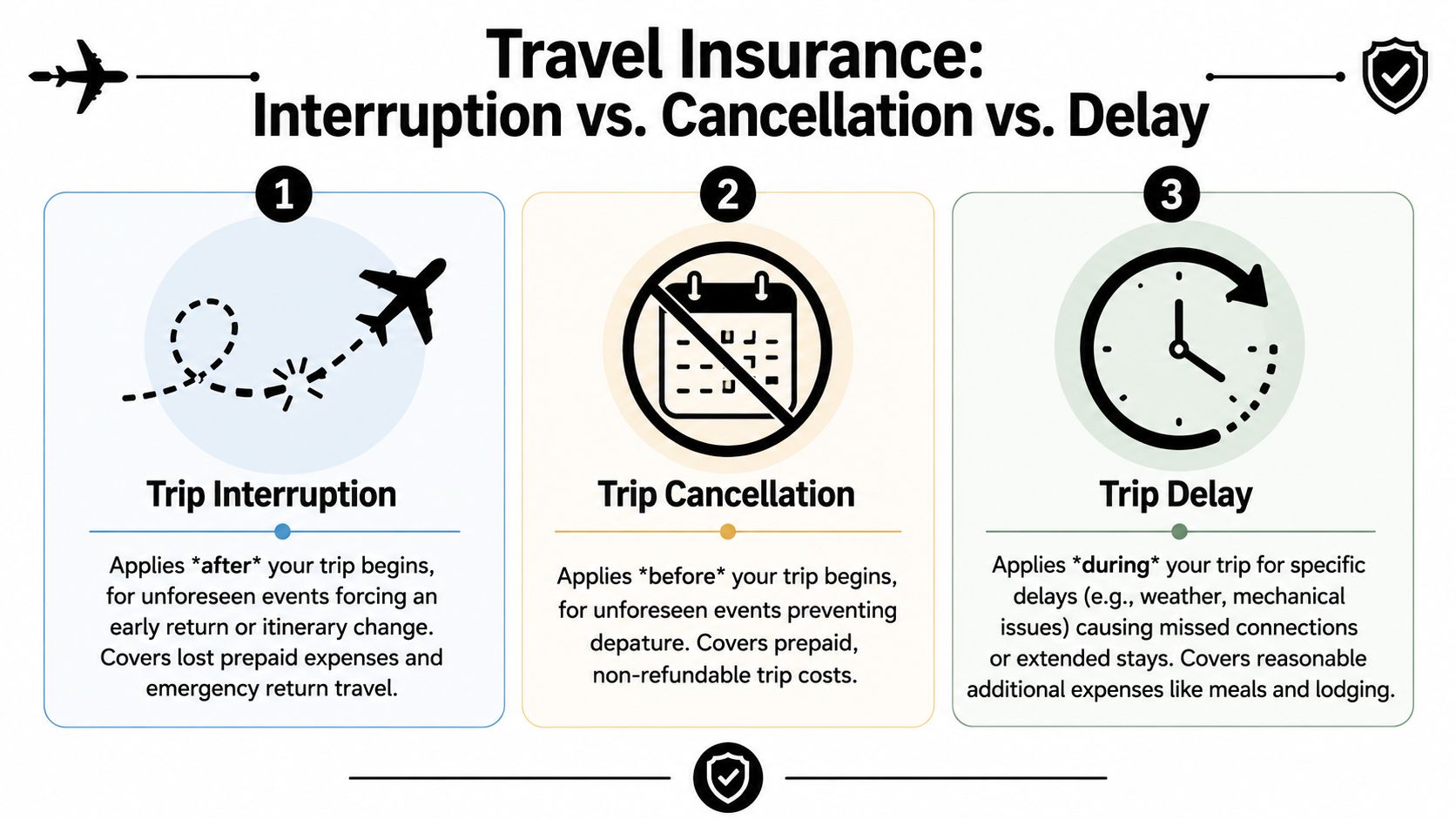
| Coverage type | When it applies | What it's for | Typical outcome |
|---|---|---|---|
| Trip cancellation | Before departure | You can't take the trip at all | Reimbursement for prepaid, non-refundable trip costs |
| Trip interruption | After departure | You must cut the trip short or materially change it due to a covered event | Reimbursement for unused prepaid costs and possibly replacement transport |
| Trip delay | During travel, but not necessarily ending the trip | A temporary disruption causes extra waiting time | Reimbursement for reasonable additional expenses such as meals or lodging |
That timing issue is everything.
If your charter never leaves because a qualifying event prevents you from traveling, you're in cancellation territory. If you're already in Sardinia and need to return home because of a family emergency, you're in interruption territory. If weather strands you overnight between segments but the trip continues, that's usually delay coverage.
Why travelers get this wrong
Luxury itineraries blur the lines because several losses can happen at once. A missed onward flight can look like delay. A forced early return can create interruption losses. A supplier's own cancellation terms can overlap with both.
That's why I tell clients to stop asking, “Am I covered?” and start asking two sharper questions:
- When did the problem occur, before or after departure?
- Did the event delay the trip, stop the trip, or prevent it entirely?
If you answer those correctly, you usually identify the right bucket.
Squaremouth's live data shows Trip Interruption ranks as a top traveler concern at 15.0%, and the same data roundup states that trip cancellation and disruption claims accounted for 40% of paid claims in the prior year. That makes disruption-related benefits some of the most frequently used parts of travel insurance, not obscure add-ons, as shown in Squaremouth live travel insurance data.
A second problem is contract confusion. Travelers often understand the insurance language less clearly than the transportation contract itself. If you book private aviation, it also helps to review how charter operators handle schedule changes and cancellations in the first place, because insurance and operator terms work together, not separately. Haute Jets has a useful explainer on private jet charter cancellation policy terms.
The practical rule
Buy with the assumption that your trip may suffer more than one type of disruption. Then verify whether the policy addresses all three categories or only one.
This is also worth a quick visual review before you compare policy wording:
My blunt recommendation
If you're booking a simple domestic weekend, basic protection may be enough.
If you're booking private air, multiple countries, villas, event access, or family logistics across several suppliers, don't settle for a plan that looks all-encompassing but is really thin on interruption language. That's where expensive mistakes hide.
What Events Trigger Trip Interruption Coverage
Trip interruption claims don't succeed because your situation feels urgent. They succeed because the event fits the policy's covered reasons.
That's why experienced travelers read this section of a policy more closely than the marketing summary.
Covered reasons that usually matter
According to Travel Guard's trip interruption overview, covered reasons typically include severe illness or injury, death, severe weather, natural disasters, or carrier failure. Claims are generally paid on a reimbursement basis and require significant documentation. Some providers also specify timing requirements, such as notifying suppliers within 72 hours of learning the trip will be interrupted.
For private and international travel, those triggers matter in very practical ways:
- Medical emergencies can force an immediate return for the traveler or a family member.
- Death in the family often triggers the clearest interruption claims, assuming documentation is complete.
- Severe weather or natural disaster can make a destination unusable or derail onward segments.
- Carrier failure can matter when a transportation provider can't perform as contracted.
What tends to fail
A lot of denied claims come from category mistakes, not insurer misconduct.
Watch for these common problems:
- Changing your mind: Regret isn't a covered reason.
- Poor documentation: If you can't prove both the expense and the cause, reimbursement gets difficult fast.
- Late notification: If a policy requires prompt notice and you wait, you may weaken the claim.
- Assumptions about broad wording: “Emergency” in plain English doesn't always equal a covered reason under policy language.
Read “covered reasons” as a contract list, not as a general promise of fairness.
A checklist I'd use before purchase
- Confirm the trigger language for illness, family emergency, weather, and supplier failure.
- Check notification obligations and save the insurer's assistance number before departure.
- Review international implications if your route involves customs complexity, remote airports, or multiple jurisdictions. Travelers on overseas private itineraries should also understand the customs and immigration process when flying overseas in a private jet, because disruption gets harder to manage when border procedures are involved.
- Scrutinize exclusions before you pay. Don't assume your planner, assistant, or card issuer has done that for you.
The strongest policy isn't the one with the broadest marketing language. It's the one whose triggers still hold up when your trip goes sideways in practice.
Navigating the Trip Interruption Claim Process
A valid claim can still turn into a frustrating one if you handle the paperwork poorly. Insurers pay trip interruption claims on a reimbursement basis. That means your file must tell a clean story from start to finish.
The worst time to become disorganized is during a family emergency or medical disruption. Yet that's exactly when recordkeeping usually breaks down.
The first moves matter
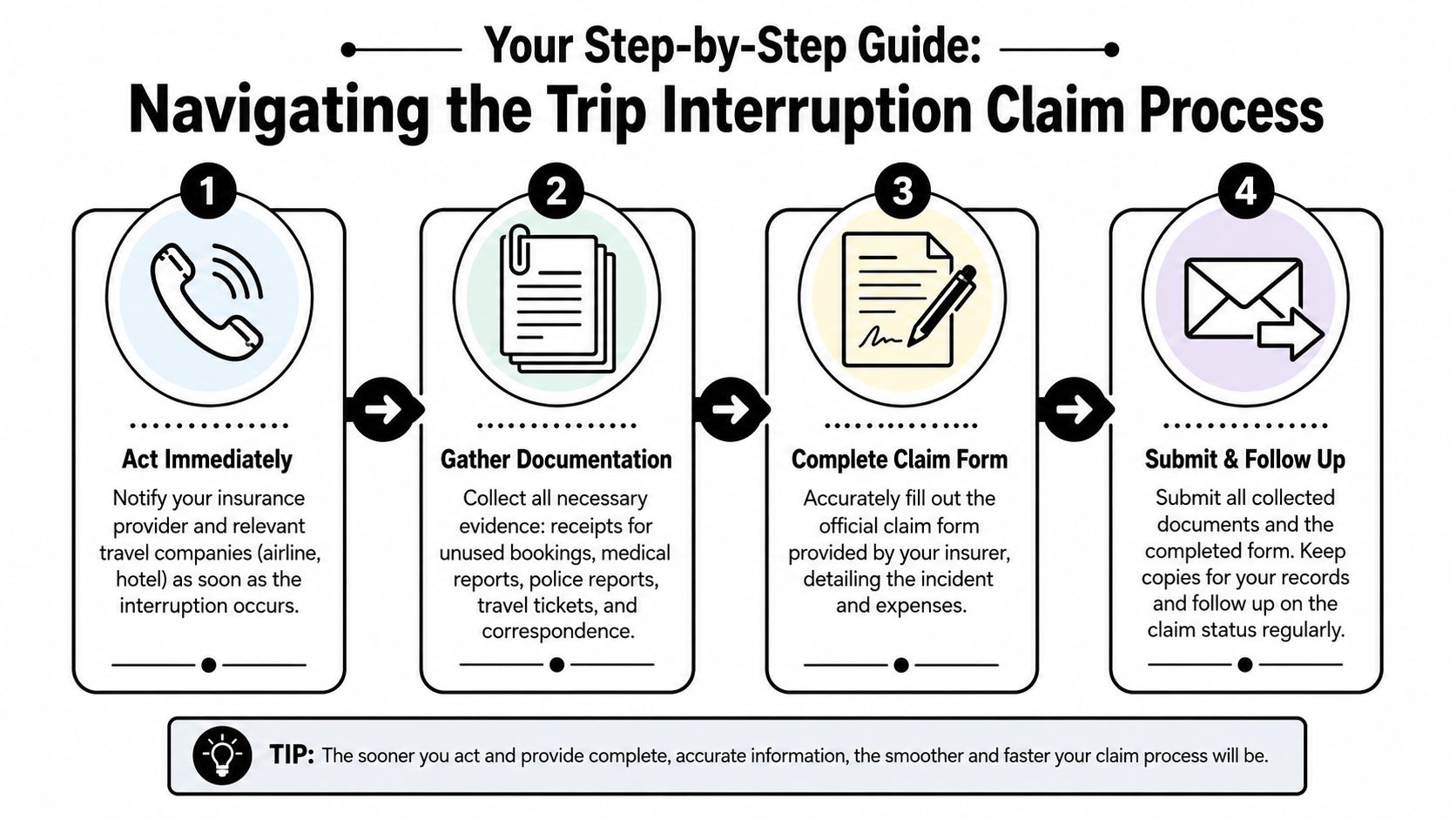
When the interruption happens, do these things in order:
- Notify travel providers immediately. Contact the airline, charter operator, hotel, villa manager, cruise line, or ground transport service.
- Call the insurer's assistance line. Don't wait until you're home.
- Ask what documentation they'll require. Requirements vary, and assumptions waste time.
- Preserve every receipt and message. Email confirmations, invoices, cancellation notices, and revised bookings all matter.
Build a claim file like an advisor would
Your file should usually include:
- Proof of original booking: itineraries, invoices, payment confirmations
- Proof of loss: what went unused and what was non-refundable
- Proof of cause: physician letter, hospital document, death-related record, weather notice, or supplier failure evidence
- Proof of replacement cost: new air tickets, ground transport, hotel extensions, change fees
Operational advice: If a family office or executive assistant manages travel, assign one person to own the claim file. Split responsibility creates missing records.
Medical paperwork is often the most chaotic part. Families who travel frequently should standardize how they store health documents before any trip starts. A practical resource on that front is this guide to streamline family medical records with Family Folder, which can make urgent documentation easier to retrieve when insurers request proof.
The mistake I see most often
Travelers focus on the dramatic event and ignore the boring evidence.
Insurers need both. They need proof that the interruption happened for a covered reason, and proof of exactly what financial loss resulted. If either side is thin, the claim weakens.
So keep duplicates. Save screenshots. Download supplier correspondence. If a charter broker, concierge, or assistant is involved, have them forward everything into one folder the same day.
A well-documented claim doesn't guarantee reimbursement. But a poorly documented one makes denial much easier.
Special Considerations for Private Jet Charters
Private aviation changes the economics of trip interruption. Standard travel insurance language often assumes commercial tickets, ordinary hotel stays, and simple round-trip structures. That assumption breaks down fast when a traveler has booked charter legs, multi-city routing, and high-value services around a fixed schedule.
Where standard coverage can fall short
The first issue is sunk cost concentration.
On a charter itinerary, a large share of value may sit inside prepaid flight segments rather than traditional airline tickets. If the trip is interrupted midway, the question isn't just whether the unused lodging is reimbursable. It's whether the policy recognizes the unused charter value and whether replacement transport limits are remotely adequate for how you travel.
The second issue is operational complexity. One disruption can trigger several downstream losses at once. A grounded aircraft, a family emergency, or an event requiring immediate return may force a traveler to abandon onward legs, scrap destination services, and source new transport under pressure.
How I'd evaluate a policy for charter travel
Use this lens:
- Unused charter treatment: Does the policy wording clearly support reimbursement for prepaid, non-refundable transportation already booked as part of the trip?
- Transport flexibility: If you must get home quickly, are the return-travel provisions broad enough to address realistic alternatives?
- Supplier coordination: Can your broker or travel manager produce the invoices and change records needed for a claim?
- Multi-leg itinerary logic: Does the policy make sense for open-jaw, international, or layered routing, or does it assume a simple round-trip?
If you're booking private aviation regularly, it also helps to understand the aviation-side coverage issues separate from travel insurance. Haute Jets has a useful primer on what insurance covers private jet charter, and it's worth reading alongside any trip interruption policy.
A sophisticated traveler shouldn't assume private aviation spend is automatically understood by a mass-market insurer. Verify it.
My recommendation for charter clients
Don't rely on generic summary language. Ask for the full certificate or policy wording and read the transportation provisions carefully.
If the itinerary is expensive, international, or time-sensitive, have your advisor, broker, or family office review it line by line. In private travel, the cost of misunderstanding a policy isn't minor. It can be the difference between a manageable disruption and a six-figure annoyance that no one can reverse after the fact.
Frequently Asked Questions for Sophisticated Travelers
Do I still need standalone coverage if my premium card includes trip protection
Usually, yes.
Premium cards can help, but the coverage may be narrower than a standalone policy. For example, American Express states that its trip cancellation and interruption insurance applies to round-trip purchases made entirely with the eligible card, which can create obvious gaps if a complex itinerary was split across cards, accounts, or suppliers. That issue is outlined in the American Express trip cancellation and interruption terms.
Is trip interruption insurance worth it for travelers who can self-insure
Financial capacity doesn't eliminate the need for discipline.
You can afford the loss and still reject the inefficiency. Insurance is most valuable when a low-frequency disruption can wipe out substantial prepaid value and force costly emergency logistics.
Should I buy based on the highest reimbursement percentage
No. Start with policy definitions, covered reasons, and transportation language. Higher limits help, but sloppy wording is worse than a lower limit with better structure.
What should families and security-conscious travelers organize before departure
Keep your medical, identity, and itinerary records accessible in one place. For travelers who prioritize digital safety while moving across borders and networks, tools like SafePing are worth reviewing as part of a broader travel-risk setup.
What's the single biggest mistake sophisticated travelers make
They assume expensive travel automatically comes with sophisticated protection.
It doesn't. The insurance market still contains plenty of products designed around ordinary trips. If your travel is extraordinary, your review process must be stricter than average.
If you're planning private air travel and want tighter control over the flight side of a complex itinerary, Haute Jets offers on-demand private jet charter with access to specific aircraft and operator details. Pair that kind of booking discipline with equally disciplined insurance review, and you reduce the odds that a disruption turns into an avoidable financial mess.