
Booking a private jet usually feels like a decision about schedule, cabin comfort, privacy, and service. What most passengers never see is the maintenance chain behind that aircraft. You're trusting that the jet, its engines, its avionics, and the components supporting every phase of flight were inspected and approved by people working under a serious standard, not a casual shop practice.
That's where 14 CFR Part 145 matters.
For clients reading Haute Jets Journal, this isn't a regulation to admire from a distance. It's one of the clearest ways to understand whether an aircraft's maintenance support comes from a vetted, controlled, FAA-recognized environment or from something less disciplined. In private aviation, that distinction affects more than compliance. It affects dispatch reliability, operational confidence, and the quiet peace of mind that should come with stepping onto a charter aircraft.
Introduction Why Aircraft Maintenance Standards Matter
If you're chartering a jet, you probably won't ask to review a stack of maintenance records before wheels up. You'll assume the aircraft is sound, the operator has done its job, and the systems behind the scenes are working as they should. That assumption has to be earned.
14 CFR Part 145 is the FAA framework that governs certificated repair stations in the United States and foreign repair stations approved to work on U.S.-registered aircraft. In practical terms, it exists so aircraft maintenance isn't treated like general mechanical work. It's controlled, documented, and limited to approved capabilities.
One of the most important protections is simple and direct. An FAA repair station certified under Part 145 is legally restricted to performing only the functions necessary to inspect, repair, replace, or overhaul the specific aviation articles for which it has received explicit approval, preventing unauthorized maintenance beyond its scope of approval (FAA repair station scope guidance). That matters because unauthorized work is where risk begins to creep in.
A knowledgeable charter client doesn't need to memorize regulations. But it helps to understand that aircraft support is layered. Operators rely on maintenance organizations, overhaul facilities, component specialists, and inspection programs that all have to fit together correctly. If you want a practical primer on that ecosystem, this overview of aviation MRO and its role in flight safety is a useful companion.
Practical rule: Maintenance isn't a commodity purchase. The question isn't only whether work was done. The question is who was authorized to do it, under what procedures, and with what controls.
For passengers, that's the primary value of Part 145. It draws a bright line between approved aviation maintenance and everything else.
What Exactly Is 14 CFR Part 145
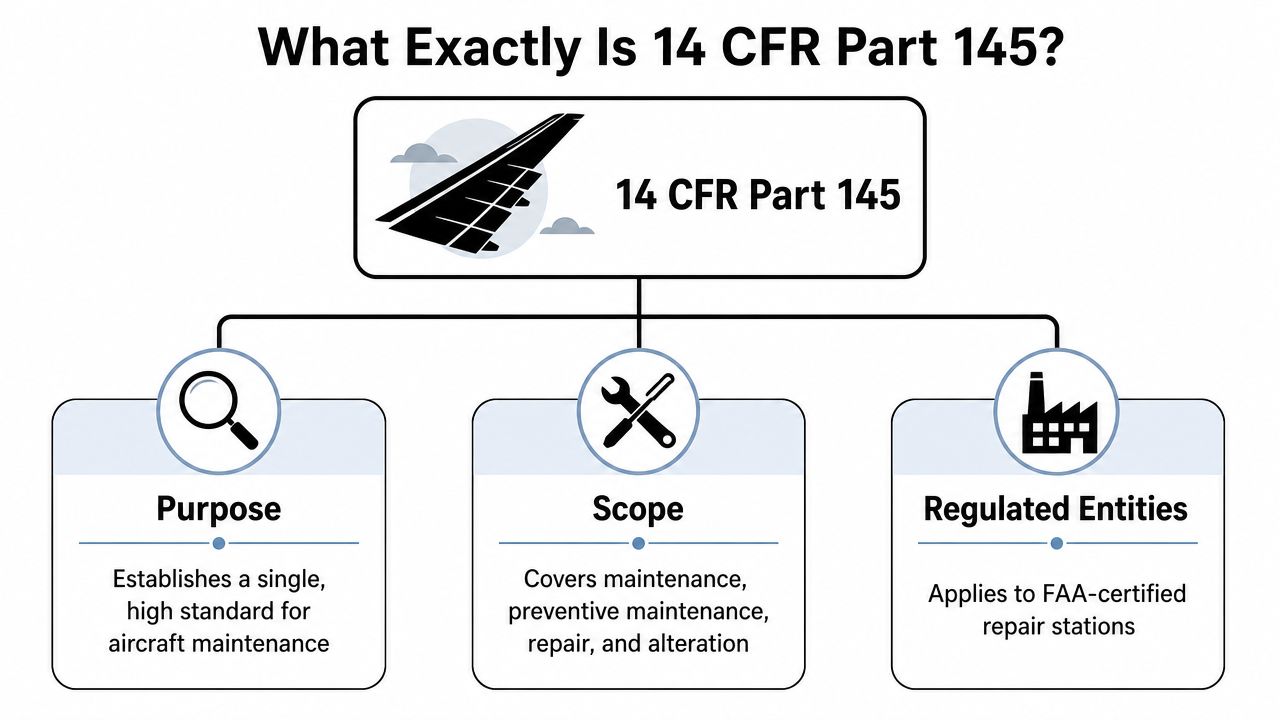
A charter client usually sees the result of maintenance long before seeing the paperwork. The cabin is ready, the departure stays on schedule, and no one is explaining a last-minute aircraft swap caused by a preventable discrepancy. Part 145 sits behind that reliability. It is the FAA rule that governs how certified repair stations are approved and how they must operate when they maintain aircraft, engines, propellers, and components.
If Part 135 tells an operator how to run charter flights, Part 145 tells an approved repair station what it must have in place before the FAA will trust it with aviation maintenance. That distinction matters for passengers because a polished aircraft means very little if the maintenance system behind it is weak.
Who the rule applies to
Part 145 applies to FAA-certificated repair stations in the United States and to foreign repair stations that hold FAA approval to work on U.S.-registered aircraft and articles. The FAA lays out that certification framework in its repair station regulations and guidance.
For owners, brokers, and charter clients, the practical point is simple. Approved maintenance can happen in more than one country, but it still has to fit an FAA-defined system if the aircraft or component falls under that approval.
What it requires in real life
A Part 145 certificate is proof of controlled capability. The repair station has to show that its facility, equipment, personnel, housing, manuals, training, and quality procedures match the work it wants authority to perform.
In day-to-day terms, that usually means:
- Facilities suited to the task: The shop environment has to support the inspection, repair, or overhaul being performed.
- Tools and equipment that match the approval: Having tools on hand is not enough. They must be appropriate for the specific work.
- Qualified people in defined roles: Personnel must be trained, assigned, and authorized for the functions they carry out.
- Manuals and procedures that govern the job: The work follows approved processes and documented controls.
- A capability tied to specific ratings and limitations: A repair station can only perform work within the scope the FAA has approved.
That last point is where the rule has real value. Good maintenance organizations know what they are approved to do, and just as important, what they are not approved to do. That discipline protects safety and usually improves dispatch reliability because the work is performed by shops built for that task, not by facilities stretching beyond their competence.
Strong repair stations do not market around their limits. They respect them.
Why passengers should care
Passengers do not need to read Part 145 to benefit from it. They feel its effect through fewer maintenance surprises, more consistent aircraft presentation, and greater confidence that the aircraft supporting the trip has been maintained under FAA-recognized controls.
That is also where premium charter service separates itself from a lower-trust operation. Serious operators and brokers pay attention to where maintenance is performed, who signs it off, and whether the underlying repair station has the approvals, staffing, and procedures to support the aircraft properly. Part 145 is not just a rule for mechanics. It is one of the systems that helps turn regulatory discipline into safety, reliability, and peace of mind for the passenger.
The Path to FAA Certification
A Part 145 certificate has value because the FAA doesn't hand it out casually. From the outside, a repair station plaque on the wall can look administrative. From the inside, earning that certificate takes structured preparation, documentation discipline, and the ability to prove that the organization can do what it claims.
A serious facility starts by deciding what ratings and capabilities it wants. That decision shapes everything that follows. If the shop wants approval to work on specific aircraft, engines, or components, it has to build its manuals, staffing, tooling, and processes around that scope. Overreach is one of the fastest ways to create trouble.
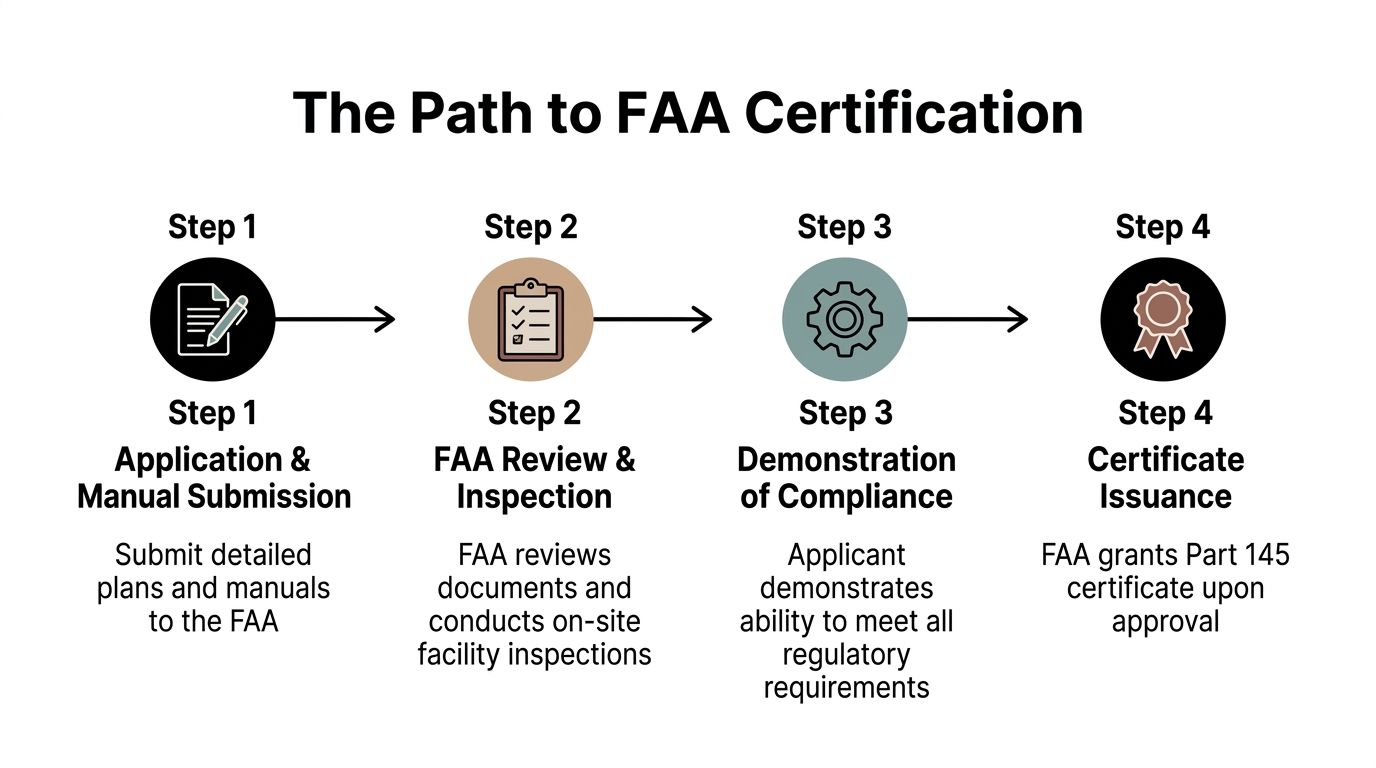
For readers who want a visual overview, this captures the typical certification journey:
The process is a demonstration, not a formality
The FAA expects more than paperwork. A facility has to submit documentation, present manuals, and show that the written program matches the actual operation. That usually includes evidence that personnel are qualified, tooling is appropriate, and the facility can support the maintenance environment it's requesting approval for.
What works is alignment. The manuals say one thing, the shop floor reflects the same thing, and the people in charge can explain how tasks are controlled from intake to final approval for return to service.
What doesn't work is cosmetic compliance. A polished manual that no one follows is a liability. So is a capable technician group operating inside a weak documentation structure.
What the FAA is really looking for
In practical consulting terms, inspectors want to see whether the organization can repeatedly produce compliant work, not whether it can stage a good visit. That means they're evaluating the system as much as the facility.
A credible applicant usually shows strength in four areas:
- Documentation control: Manuals are current, coherent, and usable.
- Personnel structure: Supervisory and inspection responsibilities are clearly assigned.
- Tooling and environment: Equipment supports the approved work.
- Operational discipline: The shop can demonstrate how it receives, inspects, performs, documents, and releases work.
This video gives additional context on the repair station certification environment:
Why that matters to someone booking a charter
When a charter client hears that an aircraft or its components are maintained through Part 145 repair stations, the point isn't that a certificate exists. The point is what the certificate represents. It reflects an organization that has already been required to define its authority, support its capabilities, and prove it can function under FAA oversight.
That's why experienced brokers and operators pay attention to maintenance pedigree. The aircraft might look immaculate on the ramp. The deeper question is whether the organizations touching that aircraft have earned the right to do so.
Core Operational and Recordkeeping Rules
Once a repair station is certificated, the practical work begins. The strongest Part 145 operations don't treat compliance as a binder on a shelf. They run the shop through three daily disciplines: staying within approved scope, controlling the work through a quality system, and documenting every meaningful maintenance action in a way that can withstand scrutiny.
That sounds procedural. It is. But procedure is exactly what keeps maintenance quality from depending on memory, mood, or individual habit.
Scope control and quality control
The center of gravity is authorization. 14 CFR Part 145 mandates that FAA-certificated repair stations operate strictly within their approved ratings and scope, and must maintain a functional Quality Control System (QCS) that oversees the entire maintenance lifecycle to ensure all work aligns with the FAA-reviewed Repair Station Manual (RSM) and Quality Control Manual (QCM) (Part 145 operational control and QCS overview).
For jet owners, operators, and brokers, this is one of the most useful practical tests. A disciplined repair station knows exactly what it is approved to handle and exactly how that work flows through inspection, execution, verification, and release. A weak station tends to blur edges. It improvises authority, relies on tribal knowledge, and treats manuals as background noise.
That's why premium private aviation puts so much weight on maintenance consistency. This broader look at private jet safety and reliability standards fits neatly into the same conversation.
Personnel, tools, and current data
A quality system only works if the people and inputs are controlled.
Repair stations need qualified personnel in supervisory and inspection functions. They also need the correct tooling, calibration discipline, and access to current maintenance data. In day-to-day operations, many maintenance errors don't start with bad intentions. They start with outdated instructions, informal signoffs, or a technician using a workaround because the approved process wasn't properly enforced.
Here's where experienced operators separate themselves from marginal ones. They don't just ask whether work was completed. They ask whether the station had the approved capability, the right manuals, and the proper signoff structure to complete it correctly.
Records are not paperwork for paperwork's sake. They are the aircraft's memory.
Why records matter so much
In aviation, undocumented work has a credibility problem. If a maintenance action can't be traced clearly, reviewed clearly, and linked to the appropriate authority and procedure, confidence drops fast. That affects resale reviews, pre-purchase evaluations, regulatory inspections, and operational trust.
A good maintenance record does several jobs at once:
- It shows what was done
- It identifies who performed or inspected the work
- It connects the task to approved procedures
- It supports return-to-service decisions
- It preserves continuity for the next inspection or event
What works and what fails in practice
A quick comparison makes the trade-offs clear:
| Maintenance habit | What works | What causes trouble |
|---|---|---|
| Manual use | Technicians follow current approved manuals | Staff rely on old revisions or memory |
| Work scope | The station accepts only approved tasks | The station stretches beyond its ratings |
| Inspection flow | Inspection points are defined and enforced | Inspection becomes informal or rushed |
| Recordkeeping | Entries are complete, clear, and traceable | Notes are vague, delayed, or inconsistent |
Clients rarely see any of this. But they feel the downstream effect when an aircraft dispatches smoothly, when discrepancies are addressed methodically, and when the operator can answer maintenance questions without hesitation.
FAA Oversight and Staying Compliant
A Part 145 certificate isn't a lifetime award. It's a living approval that has to be sustained. That's one of the most important things discerning charter clients should understand. Certification tells you a repair station met the bar. Oversight tells you the station must keep meeting it.
Readiness is part of the system
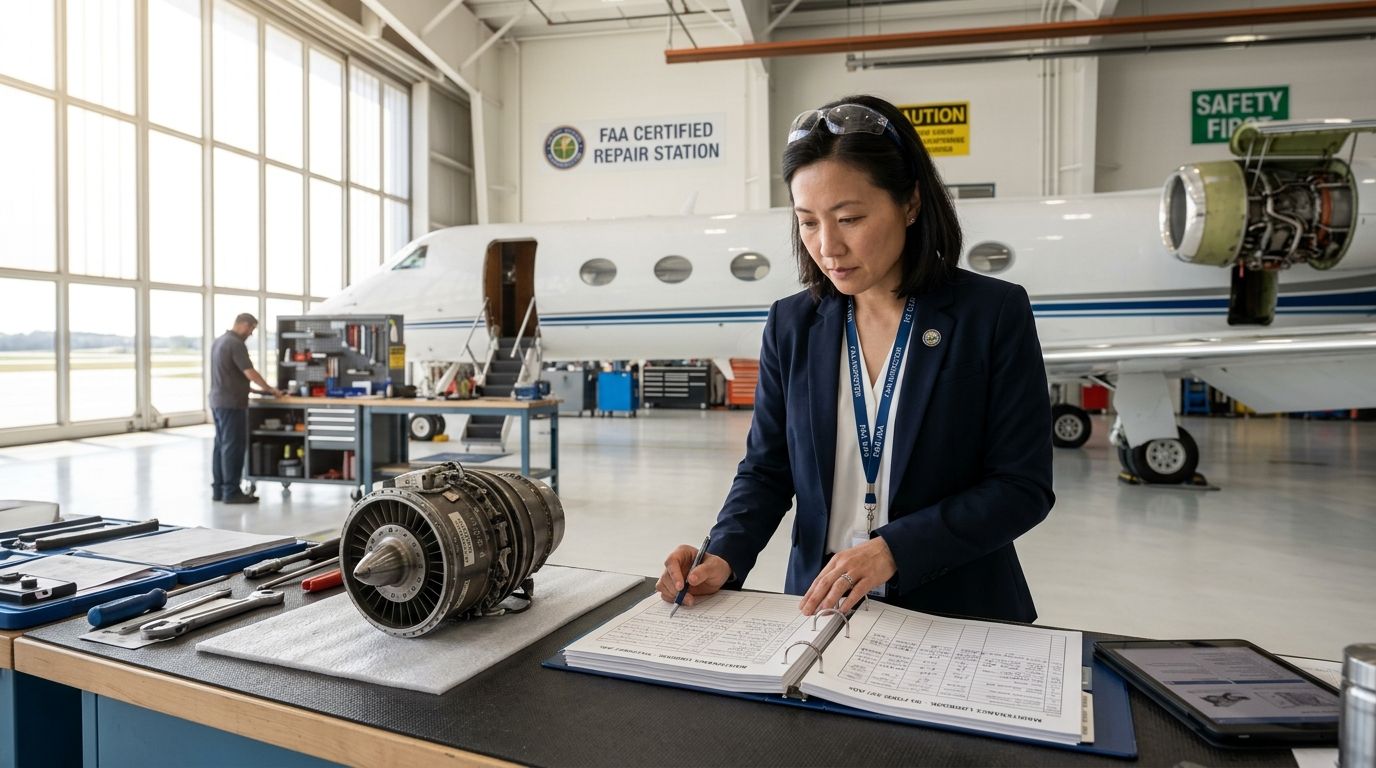
FAA oversight works because it pushes repair stations to operate in a constant state of accountability. Manuals have to remain current. Procedures have to be followed consistently. Records have to support the work performed. If the operation only looks compliant on presentation day, the weakness eventually shows.
In practical terms, the best repair stations build internal discipline around the same pressure points the regulator cares about. That's where thoughtful operational planning and practical compliance risk strategies become useful. The strongest organizations identify where process drift can occur, then close those gaps before an audit or an event exposes them.
Domestic and foreign repair stations
For charter clients, one subtle but important point is that FAA expectations don't disappear when maintenance support occurs outside the United States. If a foreign repair station is approved to work on U.S.-registered aircraft, the FAA's certification logic still follows the work. That matters in international business aviation, where parts, inspections, and specialized maintenance frequently cross borders.
The operational lesson is simple. Geography doesn't excuse inconsistency. Good operators know which repair stations are approved, how their manuals and controls operate, and whether the work fits the station's actual authority.
A compliant shop doesn't scramble when someone asks for records. It already knows where everything is and why it supports the release.
Why ongoing oversight matters to passengers
The passenger benefit is indirect but powerful. Continuing oversight discourages drift. It pushes maintenance organizations to keep standards current, not just historically valid. In a premium charter environment, that supports a more dependable operation overall.
You may never meet the inspector or see the audit trail. But when the oversight system works, you're stepping onto an aircraft supported by organizations that know they must prove their standards again and again.
What This Means for Jet Operators and Brokers
For operators and brokers, Part 145 isn't abstract regulation. It's a quality filter. It helps separate maintenance support that is structured, monitored, and competence-based from maintenance support that may be legal in some limited context but doesn't offer the same confidence profile for premium charter flying.
If you're arranging flights for executives, family travel, entertainment clients, or high-visibility passengers, that distinction matters. The passenger may judge the trip by the cabin and catering. The professional arranging the flight should judge it by the safety infrastructure underneath.
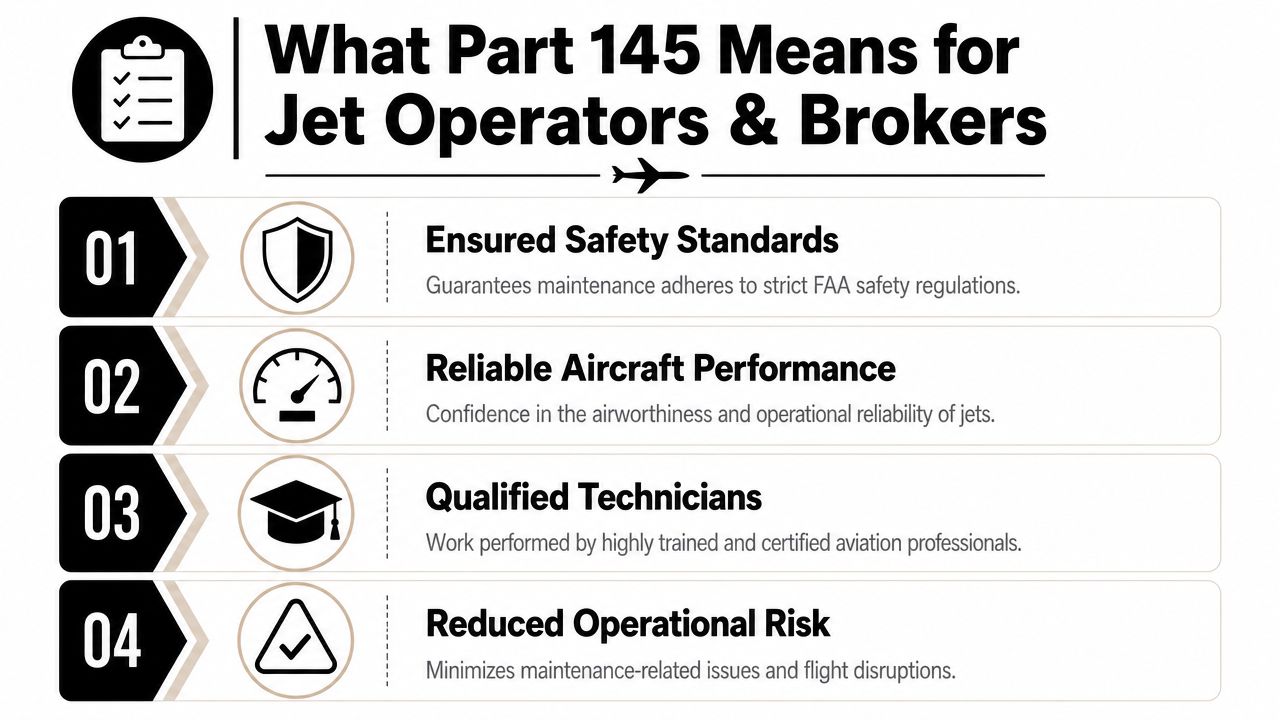
The direct benefits behind the regulation
One major advantage is technician competency. Part 145 training is a mandatory, extensive competency requirement for maintenance personnel, including Initial, Recurrent, Type-Specific, Advanced, and Regulatory training to ensure they possess the necessary expertise to perform duties effectively according to the latest FAA procedures (Part 145 training requirements for maintenance personnel).
That matters because modern business aircraft are complex machines. Airframes, engines, avionics suites, cabin systems, and digital diagnostics all require more than generic mechanical skill. They require current, role-specific competency.
For brokers, this translates into a more useful question set when evaluating charter options. You're not only checking operator certificates and insurance posture. You're also asking where the aircraft is maintained, how major maintenance is handled, and whether the support network reflects the seriousness of the trip.
A related point for charter buyers is operational structure. If you want to understand the flight side of the equation, this guide to FAA Part 135 and charter operations pairs naturally with maintenance due diligence.
Questions worth asking before you book
You don't need to interrogate an operator like an auditor. But you should ask sharper questions than “Is the aircraft safe?”
Better questions include:
- Where is the aircraft maintained? Ask whether maintenance is performed through FAA-certificated Part 145 repair stations where applicable.
- How are major inspections and component work handled? Listen for clear, direct answers rather than broad reassurances.
- What happens when a discrepancy appears close to departure? Good operators have process. Weak ones have improvisation.
- Who controls maintenance release decisions? You want evidence of structure, not personality-based oversight.
- How transparent is the operator about maintenance pedigree? Confidence usually sounds organized, not defensive.
What premium providers do differently
The best operators and brokers understand that luxury service doesn't offset weak maintenance governance. They know that real premium value comes from combining customer experience with disciplined safety systems.
In practice, that means they tend to favor:
- Approved maintenance channels: Work goes through organizations with defined authority.
- Traceable records: Documentation supports decisions and follow-up maintenance.
- Training discipline: Technical staff remain current, not merely experienced.
- Operational honesty: If an issue affects dispatch, they address it directly rather than minimizing it.
For a discerning client, that's the value proposition. Part 145 helps turn maintenance quality from an invisible promise into something you can evaluate through the questions you ask and the standards your provider relies on.
Conclusion The Gold Standard in Aircraft Maintenance
Private aviation runs on trust, but trust in this environment should never be blind. 14 CFR Part 145 gives structure to that trust by defining what an approved repair station must be, how it earns certification, how it controls daily work, and how it stays under oversight after the certificate is issued.
For passengers, the regulation matters because it reaches far beyond legal text. It influences who can touch the aircraft, what work they may perform, how that work is checked, and whether the resulting records support continued airworthiness. For operators and brokers, it provides a meaningful way to evaluate maintenance pedigree rather than relying on vague safety language.
The strongest charter experiences usually feel effortless in the cabin. That effortless feeling is often supported by rigorous work on the ground. Qualified personnel, controlled procedures, approved scope, and disciplined records are what make high-end private aviation dependable, not just polished.
That's why Part 145 remains the gold standard in aircraft maintenance. It gives charter clients, brokers, and operators a common benchmark for judging whether maintenance support is merely available or worthy of confidence. When an aircraft is maintained within that framework, peace of mind rests on something stronger than appearances. It rests on an established safety system.
If you want charter options backed by serious operator standards, Haute Jets connects clients with Wyvern and ARGUS-rated aircraft worldwide, with transparent aircraft selection, direct-to-owner pricing, and a flight experience designed around confidence as much as comfort.