
Most advice on private aviation starts from the wrong premise. It assumes the serious buyer needs a membership, a jet card, or some form of annual commitment to get reliable access. That's backward.
The actual question isn't how to join. It's how to book the right aircraft, for the right mission, without paying for someone else's positioning problem. That's where most travelers overspend.
On Haute Jets Journal, this topic comes up constantly because clients often arrive after looking at jet cards and branded membership programs first. They assume those products create access. In practice, 23. private jet no membership required is not a loophole. It's how on-demand charter has always worked when the trip is sourced correctly, the operator is vetted properly, and the quote is built around the actual mission instead of a prepaid program.
The Myth of Membership The Reality of On-Demand Flying
The cleanest way to understand private aviation is this. On-demand charter is the native model. You request a trip, the market matches an aircraft to that trip, and you pay for that mission only.
That matters because many travelers still think private flying begins with a buy-in. It doesn't. The core operating model for flying private with no membership is on-demand charter, where you book and pay for each trip individually. It's especially well suited to occasional flyers and travelers whose needs change trip by trip, because pricing is mission-specific rather than locked into a subscription, as outlined in this private jet membership guide.

What membership products actually solve
Memberships, jet cards, and fractional structures can make sense for flyers who value standardized terms and who fly often enough to justify the commitment. They can simplify buying. They don't eliminate the underlying economics of aircraft availability, crew scheduling, airport constraints, and fleet location.
That's the part glossy marketing usually skips.
A membership may package access neatly, but the aircraft still has to come from somewhere. If the jet isn't already near your departure airport, somebody pays to move it. If demand spikes on a holiday weekend, someone absorbs the pricing pressure. The structure changes who pays first. It doesn't change the operating reality.
Practical rule: If you don't fly on a fixed, heavy schedule, flexibility usually matters more than formal access.
Why pay per flight often fits better
For irregular travelers, on-demand charter avoids annual dues, prepaid flight-hour blocks, and ownership-style obligations. You're not paying to stay in a system between trips. You're paying for the actual aircraft and itinerary in front of you.
That's why many travelers who begin by researching programs end up comparing them against direct pay-per-flight access instead. The logic is straightforward. If your travel patterns vary, a variable buying model often fits better than a fixed one.
For readers weighing both approaches, Haute Jets lays out the difference between pay-per-flight access and program-based access on its membership options page.
The mindset shift that saves money
The smart private flyer doesn't ask, “Which membership should I join first?” The better question is, “Who can source the right aircraft near my departure point, with transparent terms, every time I need to fly?”
That shift changes everything. It moves the conversation away from access fees and toward aircraft quality, airport convenience, operator vetting, and trip-specific pricing. Those are the variables that decide whether no-membership flying feels efficient or expensive.
Decoding the True Cost of Your Private Flight
The advertised hourly rate is rarely the number that decides whether a charter is fairly priced. Aircraft location does.
A no-membership charter can be the better buy, but only when the aircraft is sourced intelligently near your departure point. If the jet has to fly in empty from another market, the trip starts costing you before you ever board. That is the hidden economic gap many buyers miss when they compare charter against cards or ownership programs.
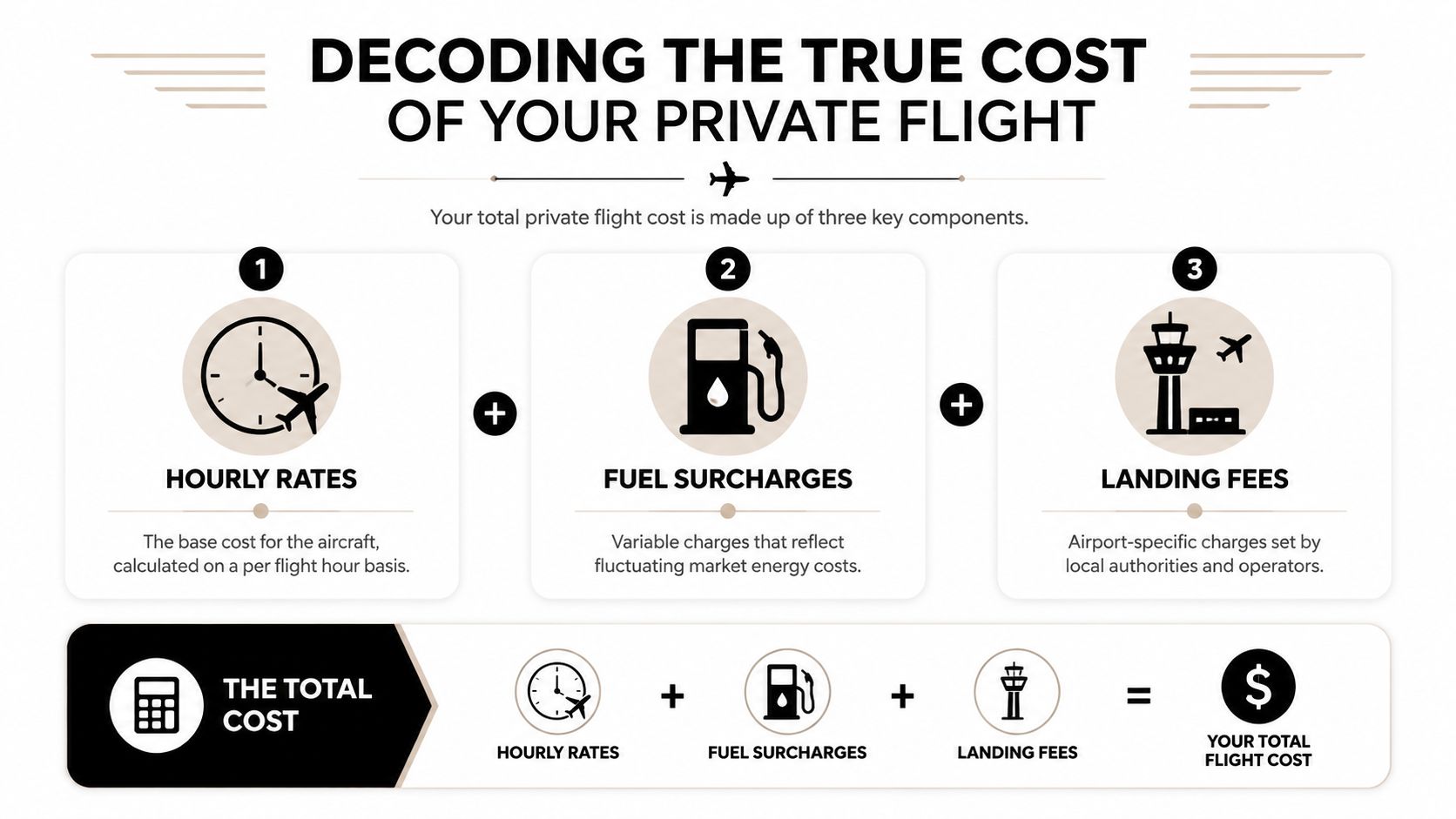
The three cost buckets that matter
A usable quote breaks into three parts:
- Aircraft time: The flight hours for the specific aircraft and route.
- Trip expenses: Items such as landing fees, ramp handling, crew overnights, catering, and other routing-specific charges.
- Positioning: The cost to move the aircraft to your departure airport, then sometimes onward after drop-off.
Aircraft time gets the attention because it looks familiar. Positioning is usually what separates a sharp quote from an overpriced one.
Repositioning is the primary swing factor
Repositioning is the empty-leg flying required to get the aircraft into place for your trip. If a broker sources a jet based two states away, you may be paying for that ferry segment whether it is shown clearly or buried in the total.
That is why two quotes for the same route and cabin class can differ so much. The aircraft are not equally located, and location drives cost.
Local sourcing is what makes on-demand charter financially workable without a membership. Brokers who know where lift sits, not just what is technically available on a screen, can often cut out a large portion of unnecessary repositioning. That is the practical advantage behind trip-by-trip buying. You are not locked into one network's inventory economics.
Ask one direct question before comparing quotes: Where is this aircraft coming from?
If the answer is vague, the price probably is too.
A better way to compare buying models
Buyers often compare access models at the program level and miss the operating detail that changes the invoice. A jet card may give rate predictability. Fractional ownership may suit very heavy usage. But neither removes the physical need to place an aircraft where your trip begins.
Here is the cleaner comparison:
| Cost Factor | On-Demand Charter (Haute Jets) | Jet Card Program | Fractional Ownership |
|---|---|---|---|
| Upfront commitment | Pay per trip | Prepaid program or deposit | Ownership-style capital commitment |
| Pricing basis | Mission-specific market pricing | Program terms and card rules | Long-term asset and operating structure |
| Aircraft choice | Trip-by-trip selection | Usually category-based access | Limited to owned share structure |
| Repositioning exposure | Often reduced if aircraft is sourced locally | May still be built into program economics | Still exists operationally, even if less visible |
| Best fit | Irregular or varied travel | Frequent flyers who want fixed program terms | Very high utilization travelers |
The useful comparison is not just access versus no access. It is whether the provider can source the right aircraft close to your trip, on terms you can verify.
For a clearer view of how trip pricing is built, Haute Jets outlines the main components on its private jet pricing page.
What a fair quote should make clear
A charter quote should answer five questions without follow-up:
- Where is the aircraft based?
- How much of the total is repositioning?
- Is the quote all-in, or can fees still be added later?
- Which operator and tail are being offered?
- What changes if your departure time or airport shifts?
Those details matter more than polished formatting. In practice, disputes usually come from unclear terms, unclear sourcing, or both.
Ground logistics matter too. Clients who plan the full trip, not just the flying segment, usually avoid last-minute friction. If you also need stress-free airport travel options, line that up early so the savings you got on aircraft sourcing are not wasted on avoidable day-of delays.
Your On-Demand Booking Checklist From Itinerary to Wheels Up
A smooth charter booking starts long before the contract is signed. Buyers who get the best results usually present a clear mission, narrow the aircraft type quickly, and ask for a quote that reflects how they will travel.
That sounds obvious, but it's where a lot of wasted money begins.
Start with the mission, not the aircraft
Don't begin by saying you want a heavy jet or a light jet unless you already know why. Start with the operating facts:
- Passenger count: Final number, not an estimate.
- Route and dates: Include preferred departure windows, not just cities.
- Airport preference: Some airports work better than others for privacy, runway access, or local drive time.
- Luggage profile: Golf clubs, skis, garment bags, production gear, and pet equipment change the aircraft recommendation fast.
- Cabin priorities: Wi-Fi, enclosed lavatory, sleeping setup, and pet policy should be decided early.
A good broker can only match the mission you describe. If the details are fuzzy, the quote will either be inflated to cover risk or built on assumptions that later trigger changes.
Then match the aircraft category to the trip
Short regional hops may work better on a turboprop or light jet than on a larger cabin aircraft. Longer domestic sectors or coast-to-coast flying often push the mission toward midsize, super-midsize, or heavy cabin options. International flying adds another layer, especially when baggage, cabin comfort, and range all matter at once.
The mistake I see most often is travelers paying for cabin size they don't need or accepting an aircraft that technically works but leaves no room for luggage or schedule flexibility.
The right aircraft isn't the biggest one available. It's the one that handles your route, payload, airport constraints, and passenger expectations without waste.
Read the quote like an operator would
Once the quote arrives, review it line by line. You want to confirm the exact aircraft offered, the operator, departure airport, cancellation terms, and whether the pricing is all-inclusive or exposed to later adjustments.
A common concern with no-membership charter is availability, especially for same-day trips. Broker network depth matters here because access to locally available operators is what prevents pricing spikes and dead-head costs, making spontaneous travel possible without being penalized financially, as noted by FlyVaunt's discussion of private charter availability and standby constraints.
For clients pairing air charter with ground logistics, it also helps to line up stress-free airport travel options in advance, especially when a trip starts at a private terminal and timing is tight.
Here's a quick visual overview of the booking flow and what to expect during the process:
The last checks before wheels up
Before departure, confirm these items in writing:
- Tail and operator: You should know exactly which aircraft is flying the mission.
- Passenger manifest: Names should match identification exactly.
- Special handling notes: Pets, catering, car seats, security details, and oversized baggage need to be listed.
- Terminal instructions: FBO location, arrival timing, and crew contact procedures should be clear.
Same-day charter is possible in major markets, but only when a locally available aircraft can be sourced in real time. That's why booking speed matters less than booking accuracy. The fastest bad match still becomes a delay.
Insisting on Safety Vetting Your Operator and Aircraft
Private aviation gives you more control than commercial travel, but only if you use that control. Safety isn't automatic just because the cabin is beautiful and the service feels polished.
The buyer has to insist on independent vetting. That should happen on every trip, not just the first one.

Why standards matter in a large charter market
The global private jet fleet grew by 133 percent between 2000 and 2022, reaching over 23,000 aircraft, according to the VistaJet Jet Traveler Report. A market that large can support broad on-demand access, but scale cuts both ways. It gives travelers more choice, and it also means not every operator will meet the same standard.
That's why third-party safety audits matter so much. They give clients a common language for evaluating operators across a wide market.
What to ask by name
Ask whether the operator holds Wyvern Wingman or ARGUS Gold or Platinum status. Don't settle for broad reassurance or sales language that sounds close enough.
Then ask follow-up questions that force clarity:
- Which rating does this operator currently hold
- Is the offered aircraft on that operator certificate
- Has there been any aircraft substitution since the quote
- Who are the scheduled crew members
- Can you confirm the operator and tail before departure
Those questions are direct because they need to be. A strong broker won't resist them.
Ask for the operator identity early, not after payment. Safety review done late is safety review done under pressure.
Safety is trip specific
One mistake new buyers make is assuming a trusted brand guarantees every aircraft in every situation. It doesn't. The relevant question is whether the exact operator and exact aircraft assigned to your mission meet the standard you require.
That's especially important when schedules move, weather changes, or a substitution is proposed. A replacement aircraft may be perfectly acceptable, but it still needs to be vetted on its own merits.
For travelers who want to see how these standards are handled in practice, Haute Jets describes its operator requirements on its private jet safety page.
Securing Your Flight Finalizing Payments and Contracts
Once the aircraft is selected and the operator checks out, the final stage is contract discipline. During this step, a well-booked trip becomes a properly documented one.
Clients often move too fast here because they're eager to lock in the aircraft. That's understandable, but this is the moment to slow down and verify the details.
What the agreement must match
The charter agreement should mirror the quote you approved. Check the routing, dates, departure windows, passenger list, operator identity, and aircraft details. If a tail number is available at signing, it should appear. If it will be assigned later, the agreement should state when confirmation will be provided.
Also review whether the quoted amount is all-inclusive for the planned mission or whether specific variables could still change the final total. If there are conditions that trigger added charges, they should be explicit.
Use this short review standard before payment:
- Aircraft details: Confirm make, model, and offered cabin configuration if that mattered to your decision.
- Commercial terms: Read cancellation language, timing rules, and any repositioning assumptions carefully.
- Service extras: Catering, pet handling, ground transfers, and special requests should appear somewhere in the file, not just in text messages.
Where clients can still negotiate
Private charter isn't a retail checkout cart. Some items are fixed, especially if supply is tight. Others are worth clarifying before funds move.
You can often clean up service details by asking practical questions. Is catering included or separate. Is de-icing, if needed, treated as pass-through. Is ground transport coordinated by the broker, the FBO, or your assistant. None of that is dramatic, but missed details create friction on departure day.
A charter contract shouldn't leave you guessing what happens if the schedule shifts by an hour or if baggage expands the night before departure.
Paying by wire, card, or crypto
Most charter payments still move by wire transfer, and many operators or intermediaries can also accept credit card payment subject to their terms. The key is speed and proof of cleared funds, because aircraft won't be held indefinitely without financial confirmation.
For crypto-forward travelers, digital asset payments can also fit private charter well when the booking channel supports them. The practical appeal is usually transaction speed, discretion, and convenience for clients who already manage liquidity that way. The important part is process control. Before sending any digital payment, confirm the settlement steps, wallet verification procedure, and the point at which the flight is treated as fully funded.
Payment flexibility is useful. It doesn't replace contract accuracy.
The Haute Jets Advantage Fly On-Demand Without Compromise
Membership is often sold as the cure for private aviation pricing. In practice, a large share of avoidable cost comes from one place. The airplane starts the day somewhere else.
That is why no-membership charter works so well when it is sourced properly. If the aircraft is already near your departure airport, the trip can price cleanly. If it has to ferry in from another city, the quote absorbs that positioning time, crew duty impact, and sometimes overnight logistics. Clients who skip that distinction often assume charter pricing is inconsistent, when the bigger issue is poor sourcing.
Why local sourcing changes the economics
Aircraft proximity shapes the economics of every on-demand trip. A local jet usually means lower repositioning exposure, faster dispatch, and fewer surprise line items if plans shift. A distant jet can still be the right answer, but the quote needs to justify it with aircraft quality, cabin fit, or schedule availability.
Haute Jets works through a network of 3,500+ owner-operators across 175 countries, with a sourcing model built to find aircraft close to the mission whenever possible. That matters because no-membership charter becomes far more competitive when you are not paying to drag lift in from another region just to start your trip.
This is the point experienced buyers focus on. Annual fees do not remove repositioning. Prepaid cards do not erase it either. They may package it differently.
What discerning buyers should actually prioritize
A serious charter buyer should compare providers on operating discipline, not branding.
| Priority | What to verify |
|---|---|
| Aircraft proximity | Is the offered jet already near the departure airport |
| Operator quality | Are third-party safety standards confirmed |
| Quote clarity | Are repositioning and variable charges explained |
| Aircraft specificity | Can you approve the exact aircraft, not just a category |
| Dispatch realism | Can the network source locally when plans change |
That framework is more useful than debating whether the product is called a membership, a card, or an on-demand charter.
Why this market keeps growing
The pay-as-you-fly model now sits firmly in the mainstream private aviation market. Analysts cited by Jet Finder's market summary project continued charter market growth, with North America remaining the largest region.
That matters for one reason. On-demand flying is not a fallback option for people who cannot access private aviation the "proper" way. It is a standard buying model for travelers who want to assess each trip on its own economics.
Good on-demand charter feels controlled because the aircraft, operator, and positioning logic all make sense before funds move.
If you remember one thing about 23. private jet no membership required, make it this. The absence of a membership fee is helpful, but it is not the main advantage. The stronger advantage is buying each mission on its own merits, and rejecting aircraft that carry unnecessary repositioning cost, vague pricing, or weak operational fit.
If you want private jet access without annual fees, prepaid hours, or forced fleet programs, Haute Jets offers a pay-per-flight charter model built around exact aircraft selection, third-party-rated operators, and trip-specific sourcing. It is a practical fit for travelers who want control over cost, safety, and scheduling on every mission.