You're usually not thinking about an aircraft cleaning agent when you book or manage a flight. You notice the result. The leather looks conditioned, the cabin air smells neutral, the brightwork is spotless, and nothing feels sticky, cloudy, or rushed. For most passengers, that reads as luxury.
For a maintenance team, it reads as process.
A clean aircraft is never just a visual standard. It's evidence that someone chose the right chemical for the right surface, applied it correctly, documented it, and protected the aircraft while keeping the operation moving. On a charter aircraft, those choices affect dispatch reliability, audit readiness, material condition, and the confidence a client has before the cabin door closes.
Why Cleaning Agents Are a Critical Safety Component
A passenger boards a well-kept jet and sees polished wood veneer, clear windows, and seats that look ready for a long sector. What they're really seeing is a maintenance culture that doesn't separate appearance from airworthiness.
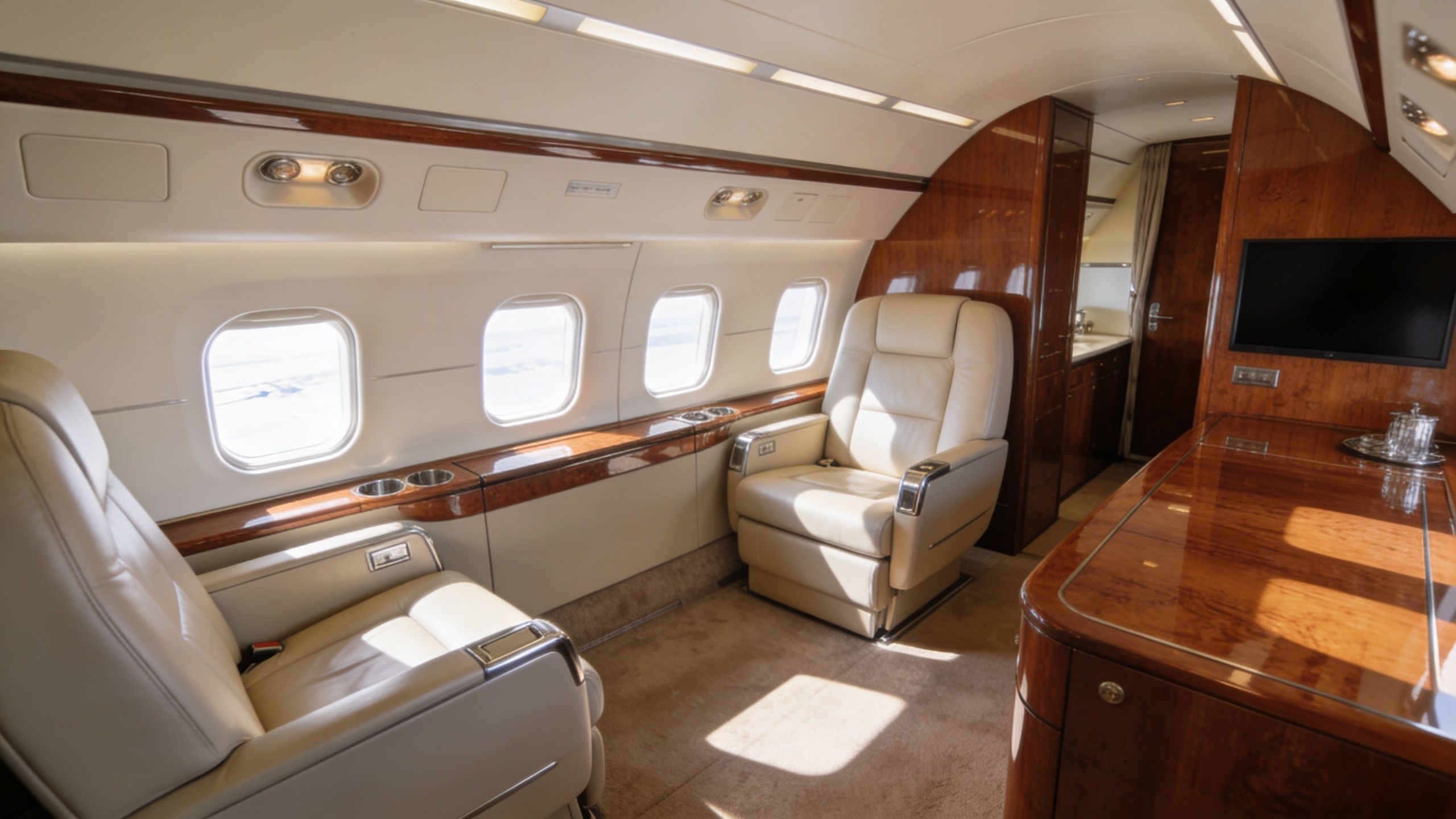
The wrong product can do more harm than visible dirt ever will. A harsh degreaser can attack finishes. An unsuitable interior cleaner can leave residue on touch surfaces and sensitive trim. An unapproved product used around seals, transparencies, or avionics can create problems that won't show up until the next inspection, or worse, the next flight.
What the cabin tells you about the operator
In charter operations, cleaning sits inside the larger safety system. It affects how fast a crew can turn an aircraft, how confidently maintenance can inspect surfaces, and whether standards are followed the same way every time. Turnaround cleaning between flights typically takes 1 to 2 hours, and certified cleaning protocols are tied to aircraft availability and the safety standards associated with Wyvern and ARGUS-rated operations across networks of 3,500+ aircraft according to this industry discussion on charter cleaning standards.
That matters because a rushed clean often hides one of two failures. Either the crew skipped steps, or they used a product that made the aircraft look good fast but created risk later.
Practical rule: If a product isn't approved for the material and the task, it's not a shortcut. It's a future discrepancy.
Owners and flight departments that review broader guidance on infection control and surface hygiene often find useful context in resources such as VirusFAQ cleaning and sanitation, but aircraft still require aviation-specific product approval and handling discipline.
A serious operator treats cleaning records the same way it treats any controlled maintenance practice. That's part of why discerning buyers look beyond cabin shine and ask about the underlying private jet safety standards.
What doesn't work
A few habits repeatedly create trouble:
- Using household or automotive cleaners because they're available on the truck
- Letting line staff improvise on luxury interiors with mixed materials
- Choosing one “万能” product for everything when cabin, cockpit, gear, and fuselage all have different requirements
- Skipping documentation because cleaning feels operational instead of technical
The best operators don't make those mistakes. They treat cleaning agents as controlled maintenance consumables.
Decoding the Types of Aircraft Cleaning Agents
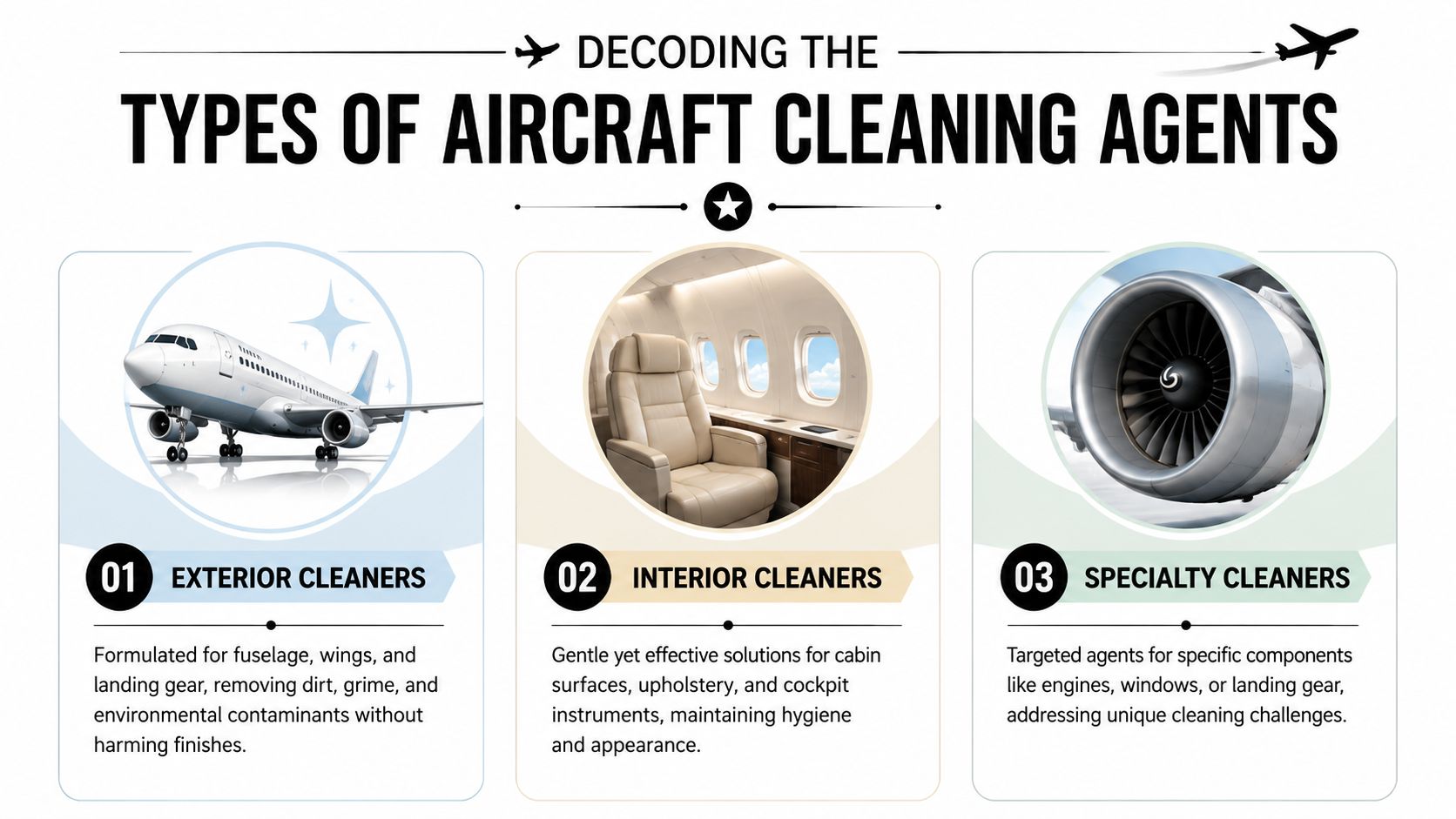
Not every aircraft cleaning agent does the same job. Thinking otherwise is how operators end up with stained sidewalls, hazed windows, softened sealants, or exterior residue that keeps coming back.
The market itself reflects that specialization. The global aircraft cleaning chemicals market is projected at USD 0.95 billion in 2026, and interior cleaning chemicals are expected to hold 57.0% market share that year, while regulatory pressure continues to push adoption of water-based formulations according to Fact.MR's aircraft cleaning chemical market analysis.
Exterior agents
Exterior products are built for contamination the cabin never sees. Oil film, exhaust residue, ramp dirt, bug impact, carbon deposits, and hydraulic staining all require stronger chemistry than an armrest or sideledge.
You'll generally see exterior products selected by task:
| Task | Typical agent type | What matters most |
|---|---|---|
| Fuselage wash | General exterior cleaner | Finish protection and rinse behavior |
| Belly wash | Stronger degreasing chemistry | Removal of oil and carbon without attacking coatings |
| Landing gear area | Targeted heavy soil cleaner | Compatibility with metals, finishes, and nearby components |
| Spot cleaning | Controlled specialty product | Minimal overspray and precise application |
A common mistake is assuming “stronger” means “better.” On aircraft, stronger often means less margin for error.
Interior agents
Interior cleaning is less forgiving because the surfaces are closer to passengers and more varied. A cabin may combine leather, plated hardware, veneer, laminate, acrylic, touchscreen surfaces, carpet, galley worktops, and lavatory panels in a very small space.
Products such as Aero-Sense Cabin Cleaner are designed for washable cabin surfaces. For heavier contamination, gel-based products such as PENAIR C5575 are used because the formulation stays where it's applied instead of running into unwanted areas. That type of adhesion matters in vertical lavatory and galley surfaces and in locations where dripping is unacceptable.
Cabin cleaning chemistry has to do two jobs at once. Remove contamination and leave the material unharmed.
Water-based and solvent-based choices
This decision is usually less about preference than environment, approval, and drainage control.
- Water-based formulations are increasingly favored where environmental restrictions are tighter and where operators want safer handling and easier rinse management.
- Solvent-based products may still have a place for specific tasks, but they bring more scrutiny and less room for casual use.
- Neutral pH interior products are often the right answer inside the cabin because passengers and crew make direct contact with those surfaces.
- Task-specific degreasers belong outside, where residues are different and material exposure has to be managed with more precision.
The best fleets build a cleaning kit the way a technician builds a toolbox. One product for each defined use, no overlap that creates ambiguity, and no unlabeled bottles on the cart.
The Critical Science of Material Compatibility
Material compatibility is where cleaning stops being cosmetic and becomes technical. Modern aircraft aren't made of one forgiving material. They combine painted metals, anodized aluminum, composite structures, acrylics, laminates, leather, rubber seals, and sensitive electronic interfaces. One bad product choice can affect several of them at once.
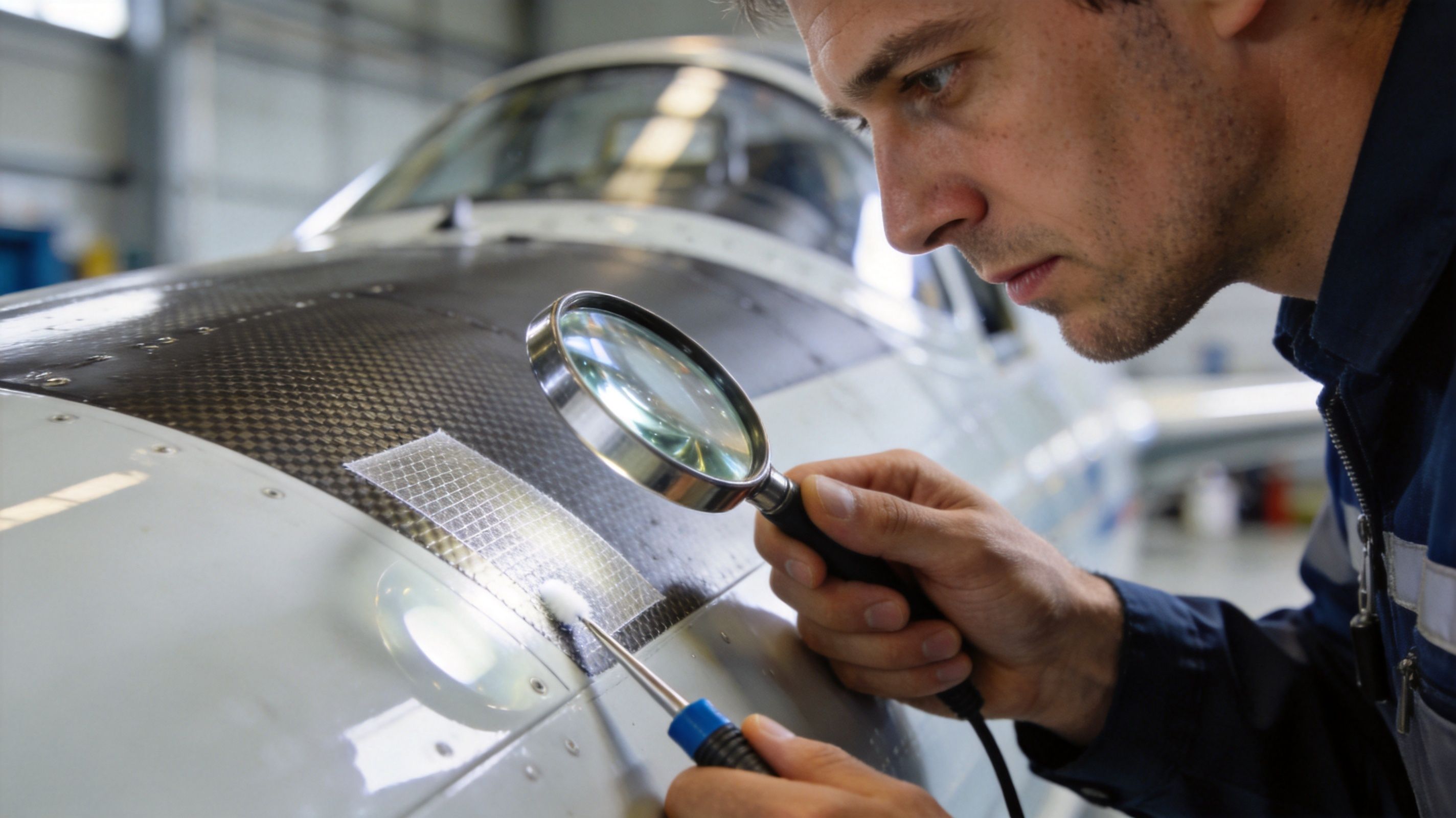
The chemistry split is straightforward in principle and demanding in practice. Exterior cleaners are often alkaline degreasers intended to remove fuel and oil without damaging structural metals, while interior cleaners are typically neutral pH multipurpose agents selected for passenger safety and cabin material compatibility under FAA-related guidance, as described in the Aero-Sense cabin cleaner technical sheet.
Where operators get into trouble
Most cleaning damage comes from one of four errors:
- Wrong chemical family used on the right area
- Right product at the wrong concentration
- Poor dwell control, which leaves a product on too long
- Cross-contamination from reused towels, bottles, or applicators
The phrase “it looked fine after we wiped it down” doesn't mean much. Damage often starts below the threshold of immediate visibility. Window crazing, finish dulling, adhesive weakening, and seal degradation can begin long before the crew notices a visual defect.
OEM approval is the real line
If the Aircraft Maintenance Manual or OEM guidance calls for approved compounds, that isn't administrative padding. It's how the manufacturer protects the aircraft from preventable chemical damage. New fleet managers sometimes focus on price first and approval second. That order should be reversed.
If a cleaner doesn't appear in the approved process, maintenance shouldn't be experimenting with it on a multimillion-dollar asset.
The same rule applies to luxury interiors. Premium wood and leather don't tolerate “close enough.” Neither do display surfaces in modern cockpits.
A short technical overview helps show why this discipline matters in practice:
What works in the field
Good operators don't rely on memory. They use controlled product lists, dedicated application tools, and training that ties the product to the substrate. The towel for polished metal isn't the towel for acrylic. The spray bottle for lavatory surfaces isn't the one used near the cockpit. That level of separation prevents many expensive mistakes before they happen.
Navigating Aviation Certification and Regulations
Aviation cleaning products live inside a compliance framework, not a housekeeping budget. If you're buying or approving an aircraft cleaning agent, the question isn't just whether it cleans well. The question is whether it meets the applicable spec, fits the approved maintenance process, and can be defended during an audit.
What MIL-PRF-85570 means in practical terms
For exterior cleaning compounds, MIL-PRF-85570 is one of the specifications that matters. Products compliant with that standard are formulated to remove oil and grime from aircraft surfaces, and their use is managed through dilution ratios. For example, 1:1 dilution is used for heavy soil, which lets maintenance teams match cleaning strength to contamination while staying inside a controlled standard, as outlined in the MIL-PRF-85570 specification reference.
That does two things for an operation:
- It standardizes performance.
- It limits freelance chemistry on the ramp.
A product with a controlled dilution range gives the DOM or maintenance manager a repeatable process. It also reduces the chance that one technician mixes a cleaner far too hot while another barely gets any effect from it.
How this touches Wyvern and ARGUS expectations
Wyvern and ARGUS audits aren't limited to pilot qualifications and manuals. They also reflect whether the operator has disciplined systems. Cleaning falls into that larger picture because it affects condition, readiness, documentation, and consistency.
An auditor may not start with a bottle of cleaner, but an operator's handling of chemicals says a lot about the health of the operation. Approved products, labeled containers, staff training, issue tracking, and usage records all point in the same direction. Either the operator follows controlled processes, or it doesn't.
For readers who want a broader look at what those elite audits represent, this deep dive into Wyvern and ARGUS safety ratings is useful context.
Documentation matters as much as the bottle
The simplest way to lose control of a cleaning program is to treat consumables as informal supplies. Every serious operation needs:
- Approved product lists tied to aircraft type or material class
- Mixing instructions that crews can follow without guesswork
- Container labeling that survives ramp and hangar use
- Application records when the task intersects with maintenance control
If your team also handles cabin wipes, disinfectant products, or mixed-use industrial supplies, guidance on verifying industrial cleaning wipe certifications can help sharpen the habit of checking claims before products enter service.
Best Practices for Private Aircraft Application
The application method matters as much as the product itself. I've seen approved chemicals create poor results because the crew rushed the wipe pattern, used the wrong cloth, or applied product directly to a sensitive surface instead of to the applicator.
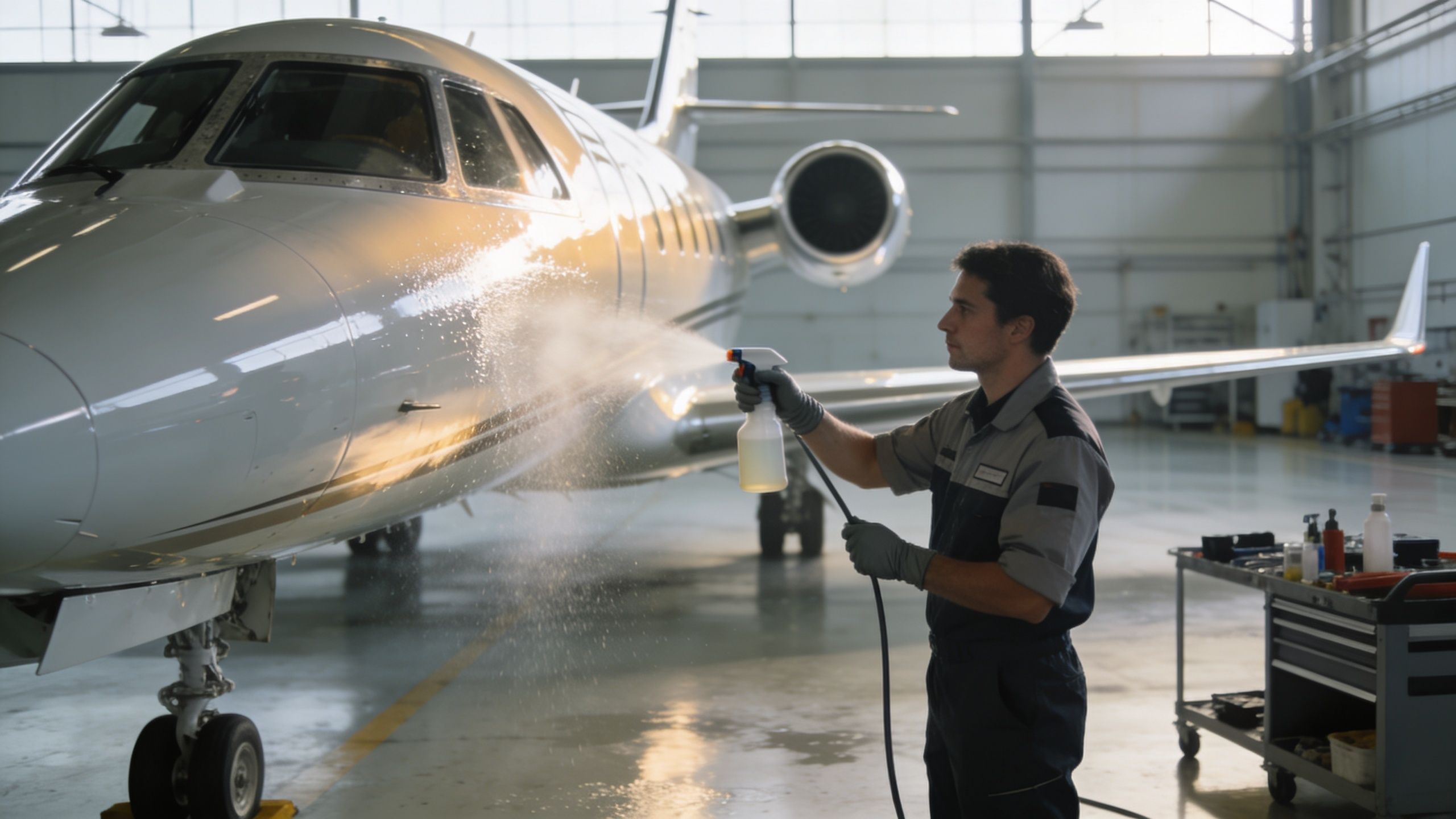
That's one reason this work should never be treated as unskilled. The aircraft cleaning services market is projected at USD 6.30 billion in 2026, and in the United States the median wage for aircraft cleaners is $17.45 per hour, reflecting that proper aircraft cleaning is professional labor with real technique behind it, according to Fortune Business Insights on the aircraft cleaning service market.
Exterior application discipline
Exterior washing on private aircraft is mostly about control.
- Start with contamination mapping. Belly residue, leading-edge buildup, and lower fuselage film don't need the same approach.
- Use the least aggressive approved method first. If a general wash works, there's no reason to escalate immediately.
- Protect openings and sensitive areas. Antennas, seals, ports, and certain seams don't forgive sloppy application.
- Watch rinse behavior. Streaking, beading, and residue trails often tell you more about technique than product.
Wet wash, dry wash, and spot-treatment methods each have their place. The wrong choice usually shows up as extra labor, not extra cleanliness.
Interior standards that separate premium operators
Inside the cabin, the best teams work by surface class, not by aisle section. That means one protocol for leather, another for hard trim, another for high-touch sanitization, and separate handling for screens and cockpit-adjacent surfaces.
A strong private aircraft program usually includes:
| Cabin area | Application standard | Common failure |
|---|---|---|
| Seats and armrests | Material-safe cleaner and controlled wipe-down | Overwetting leather or leaving shine residue |
| Galley surfaces | Neutral product with complete residue removal | Using harsh chemistry near food-contact areas |
| Lavatory | Targeted cleaner with dwell control | Product runoff into seams and hardware |
| Displays and glossy trim | Indirect application to cloth, not direct spray | Overspray, streaking, or edge intrusion |
Clean cabins aren't built with one bottle and a fast wipe. They're built with sequence, separation, and restraint.
That same attention to surface condition supports the broader passenger environment, including concerns around private jet cabin air and cabin cleanliness.
The record is part of the work
The final step is documentation. Record the product, date, task, and any observed condition issue. If a finish changes, a stain resists removal, or a panel reacts unexpectedly, that note may save hours of troubleshooting later.
A clean airplane should also be an inspectable airplane. If the product leaves residue, fragrance, haze, or uncertainty, it wasn't a professional result.
Procurement Strategy and Operational Cost Analysis
Most operators make the wrong comparison when they buy cleaning products. They compare purchase price instead of operational cost.
A cheaper aircraft cleaning agent can become the expensive option very quickly if it takes longer to apply, requires more agitation, creates rework, or introduces compliance risk. The bottle price is only one line item. Labor, training, dilution control, storage, consistency, and audit defensibility matter more over time.
What should be included in the cost decision
A maintenance manager should review at least five factors before approving a product:
- Dilution efficiency. A product that performs at the right ratio may reduce waste and simplify stock control.
- Application time. If technicians spend extra time scrubbing or correcting residue, labor cost rises.
- Surface risk. Any chance of finish damage or compatibility trouble changes the economics immediately.
- Training burden. Products that are hard to mix or easy to misuse create avoidable variability.
- Documentation fit. If you can't control and record usage cleanly, the product doesn't belong in a serious fleet.
The business side of maintenance becomes visible to charter clients here, even if they never see the spreadsheet. Cleaning labor and specialized materials are legitimate operational expenses. In a market where some brokers obscure fees, understanding how those expenses are managed across 3,500 operators helps explain the value of transparent pricing models, as noted in this discussion of aircraft cleaning labor and pricing context.
Why standardization protects margins
Standardization does more than improve quality. It limits variance.
If every operator, station, or vendor uses a different method, you get inconsistent cabin presentation, different turnaround behavior, and uneven material wear. Those inconsistencies eventually show up in schedule pressure, owner dissatisfaction, or corrective maintenance.
A disciplined procurement strategy asks different questions than a bargain buyer would:
| Procurement question | Weak approach | Strong approach |
|---|---|---|
| What does it cost? | Price per container | Total labor and compliance impact |
| Is it approved? | Vendor says yes | Operator verifies documentation |
| Will crews use it correctly? | Assumed | Trained and controlled |
| Does it scale? | Works at one base | Works across the network |
The most expensive cleaner in charter aviation is the one that causes downtime, rework, or audit friction.
Clients care about charter pricing transparency. Maintenance teams care about cost control. The two meet in operational discipline.
The Ultimate Mark of a Superior Charter Operation
A superior charter operation doesn't prove itself only in the cockpit. It proves itself in small technical decisions that most passengers never see.
The aircraft cleaning agent is one of those decisions.
When an operator chooses approved chemicals, matches them to the correct surfaces, trains the staff, controls dilution, documents application, and builds enough turnaround time to do the job properly, that operator is showing you how it thinks. It doesn't separate luxury from discipline. It understands that the polished cabin, the preserved finishes, the clean inspection surfaces, and the audit-ready paperwork all come from the same culture.
What discerning owners and flight departments should look for
The right questions are practical:
- Are cleaning products controlled and approved for aircraft use?
- Do crews follow a standard process instead of improvising?
- Can the operator show consistency across aircraft and locations?
- Does the presentation of the cabin reflect care rather than cover-up?
Those questions matter because quality in aviation is cumulative. A team that is casual with chemicals is often casual in other places too. A team that is meticulous with cleaning usually carries that same discipline into maintenance control, records, dispatch readiness, and passenger preparation.
The visible standard and the invisible one
Passengers see the visible standard first. Clean leather. Clear windows. No residue on trim. No chemical odor. No signs of a rushed turn.
What they don't see is the invisible standard underneath it. Approved compounds. Material compatibility. trained technicians. Controlled procedures. Compliance habits that support the kind of safety culture high-end charter clients should demand.
That is the significance of aircraft cleaning. It is not a finishing touch. It is a maintenance decision with operational consequences.
When you want a charter experience built around that level of discipline, Haute Jets connects you with Wyvern and ARGUS-rated operators across a global network of 3,500+ aircraft in 175 countries, with transparent on-demand pricing and access to the exact aircraft that fits your trip.