A maintenance issue rarely shows up when the airplane is sitting idle with nowhere to be. It appears the afternoon before a client trip, during preflight, or after a pilot writes up a snag that can't be deferred. That's when most owners start searching for aircraft maintenance near me and realize that proximity alone doesn't solve the problem.
The question isn't who's closest. It's who can answer the phone, diagnose correctly, get parts moving, document the work cleanly, and return the aircraft to service without creating a second problem in the logbooks. In private aviation, that difference separates a manageable delay from a blown schedule, an unhappy passenger, and a much larger invoice.
A second factor has made this search harder. The labor pool is tight. The qualified aviation mechanic shortage isn't an abstract industry talking point. It directly affects who's available this week, how long your airplane waits in queue, and whether a local shop can support an urgent trip without overpromising.
The Search for Local Aircraft Maintenance
Your pilot finds a discrepancy during preflight. The airplane is supposed to depart in the morning. The issue may be minor, or it may ground the aircraft until a technician inspects it. At that moment, most owners do what anyone would do. They start calling nearby shops, FBOs, and mobile AOG contacts.
That search gets expensive fast if you treat it like a last-minute directory lookup. Local access matters because moving the airplane elsewhere for service can trigger unnecessary repositioning and operational friction. In practice, the best local maintenance option is often the one that prevents a second flight, a second crew movement, and a second round of scheduling chaos.

Why nearby isn't enough
A local provider can still be the wrong provider. Some shops are strong on routine inspections but weak on troubleshooting. Some mobile teams are excellent for line issues and minor AOG response but can't support deeper structural, avionics, or OEM-specific work. Some facilities have the talent but no open slot.
The labor side is the hidden constraint. The shortage is already affecting service availability. The severe and growing shortage of qualified aviation maintenance technicians directly impacts aircraft availability and charter pricing. Data shows a projected shortfall of 12,000–18,000 mechanics now, escalating to over 48,000 (a 27% deficit) by 2027, the worst year for the shortage, according to Oliver Wyman's analysis of the aviation mechanic gap.
Practical rule: When a shop says, “We can probably squeeze it in,” ask who exactly is doing the work, when they'll touch the aircraft, and whether parts support is already lined up.
What smart owners do first
Owners who manage maintenance well don't wait for the airplane to go AOG before building a local support list. They identify nearby options in advance, sort them by capability, and keep current contact information for after-hours response.
A simple pre-vetted list should include:
- Routine support shops for inspections, tire and brake work, common discrepancies, and logbook follow-up.
- Mobile AOG contacts that can travel to the aircraft and handle urgent troubleshooting on site.
- Type-experienced providers for your specific make and model when the issue goes beyond generic line maintenance.
- Parts-aware coordinators who know which vendors can move inventory quickly when the fault turns into a supply problem.
That approach reduces panic decisions. It also helps you separate real local capability from marketing language. On Haute Jets Journal, this matters because aircraft access, dispatch reliability, and cost control all begin long before wheels-up.
Mapping Your Local Maintenance Options
A new owner usually starts with proximity. The closest shop is rarely the full answer. In a mechanic shortage, local coverage gets thin fast, and the provider with the shortest drive may still be weeks out, short on type experience, or unable to support an AOG after hours.
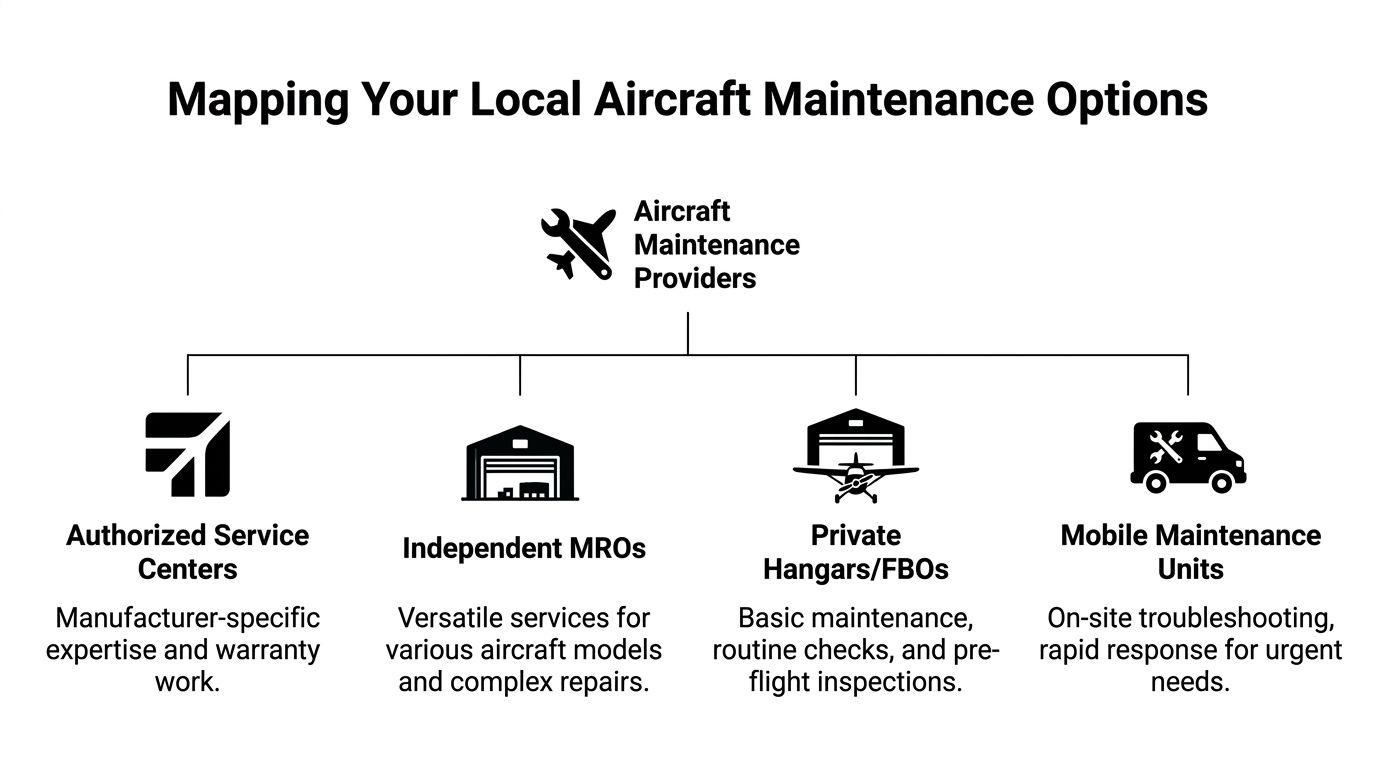
Map your options by capability, response time, and staffing depth. That last point gets missed. A shop may have the certificate and hangar space, but if two senior technicians just left and the remaining crew is buried in scheduled work, your airplane is still waiting.
Authorized service centers
Use authorized service centers for warranty work, manufacturer-driven inspections, software updates, and recurring discrepancies tied to proprietary systems. On newer aircraft, that access can save rework and protect resale value because the documentation path is cleaner and the shop has direct OEM support.
The trade-off is schedule pressure and cost. These facilities often carry the heaviest backlog during labor shortages, especially on popular turbine models. If the aircraft is flyable and the issue is not warranty-sensitive, it may make more sense to reserve OEM involvement for the items only they should handle.
Independent MROs
Independent maintenance, repair, and overhaul providers usually give owners the best balance of access and flexibility. A strong independent shop can handle inspections, troubleshooting, component replacement, and discrepancy follow-up without the queue you see at some factory networks.
Owners should look past the sales sheet. Ask how many technicians are on staff, which airframes they touch every month, and whether your model has to wait behind fleet accounts. In the current labor market, a critical differentiator is not just capability. It is whether qualified people are available to work your airplane this week.
A provider with a mature quality system, such as one aligned with an aerospace quality standard, often runs cleaner documentation and better process control. That does not replace FAA approval or type experience, but it helps separate disciplined operators from shops that are stretched too thin.
Private hangars and FBO line maintenance
Private hangars and FBO line teams are useful for quick-turn support near the airplane. They are often the fastest option for servicing, batteries, tires, brake checks, common write-ups, and basic troubleshooting at the point of departure.
Set the expectation early. Ask what they can sign off in-house, what must be deferred to a repair station, and who they call when the discrepancy moves beyond line maintenance. Good local line support saves time because they know when to escalate instead of letting your aircraft sit on the ramp while everyone hopes the problem stays small.
Mobile maintenance units
Mobile AOG teams earn their value when moving the aircraft creates more cost and delay than sending the mechanic. They can inspect on site, clear straightforward discrepancies, and tell you quickly whether the aircraft needs parts, a ferry permit, or a reposition to a larger facility.
That speed matters when the local labor pool is tight. A mobile provider may cover several airports with one team, so availability can change by the hour. Confirm callout area, typical response window, and whether they stock common consumables and high-failure items for your make and model.
Which provider fits which situation
| Need | Best first call | Why |
|---|---|---|
| Routine inspection or scheduled check | Independent MRO | Better odds of scheduling flexibility and broad in-house capability |
| Warranty or manufacturer-specific issue | Authorized service center | Direct OEM procedures, tooling, and model-specific support |
| Minor preflight discrepancy | FBO or private hangar support | Fast access near the aircraft for basic diagnostics and simple corrective work |
| Urgent AOG event | Mobile maintenance unit | On-site response can cut towing, repositioning, and idle time |
If you operate through several cities, build a maintenance map around where the airplane goes, not just where it is based. A practical starting point is the Haute Jets airport directory for common operating points, then layer in one primary shop, one mobile contact, and one backup provider at each airport you use often.
Verifying Certifications and Safety Records
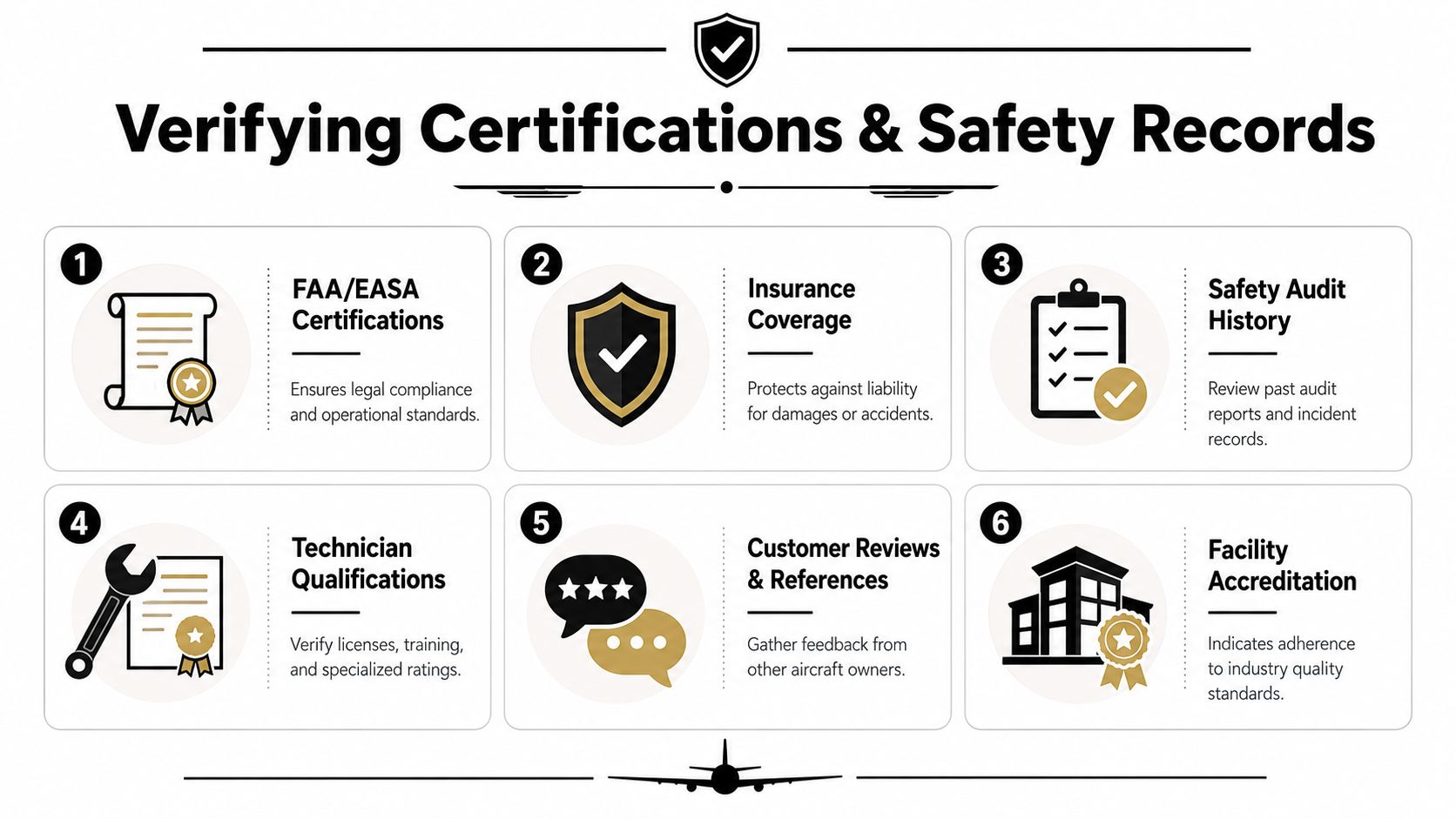
A nearby shop with an open slot isn't automatically a good fit. Before you authorize work, verify whether the provider's approvals, quality systems, and technician experience match the aircraft and the task. Owners who skip this step often don't see the risk until the invoice arrives, the logs come back incomplete, or a follow-on discrepancy appears after return to service.
What baseline compliance actually tells you
Start with the provider's formal operating authority and capabilities. If a repair station says it can support your aircraft, ask what approval basis they're operating under and whether that capability is in writing. You're not looking for vague confidence. You're looking for documented authority, current scope, and people who know how to explain both clearly.
Then move to insurance, experience, and quality controls. Any serious provider should be able to show proof of coverage and explain who signs off work, who inspects critical tasks, and how they manage records. If the answers are evasive, move on.
A helpful cross-check is whether the organization follows a recognized aerospace quality standard. That doesn't replace regulatory approval, but it does tell you the shop thinks in terms of controlled processes, traceability, and repeatability.
Safety culture shows up in details
The best providers don't just mention safety. They show it in how they brief work, control parts, handle tooling, and document return-to-service decisions. In charter and managed aircraft operations, third-party audit culture matters because it reflects how a company behaves when nobody is watching.
That's one reason discerning flight departments pay attention to operators that maintain strong outside scrutiny, including programs such as Wyvern and ARGUS on the operational side. Maintenance partners should show the same discipline in documentation, training, and accountability.
Ask a simple question: “If I review this event six months from now, will the paperwork tell a clean story?” A good shop answers yes without hesitation.
A practical verification sequence
Use a short review sequence before approving work:
Confirm capability
Ask whether the provider regularly works on your aircraft type, not just “similar models.” Specific model familiarity matters.Review documents
Request current approvals, insurance confirmation, and a sample of how they present work documentation.Check technician depth
One strong lead technician helps. A supported team is better. You need to know who backs up the work if the primary person is unavailable.Evaluate record discipline
Sloppy estimates usually predict sloppy paperwork. Watch how they track squawks, labor, parts, and signoffs.Look at maintenance philosophy
Shops that only react to break-fix events tend to create repeat visits. Shops that think ahead look for root cause and next due items.
If you want a broader primer on how maintenance organizations function inside aviation operations, this overview of what MRO means in aviation and why it matters for flight safety is a useful companion.
The Pre-Engagement Checklist for Maintenance Providers
Most maintenance problems don't become expensive because the original fault was severe. They become expensive because the owner engaged a provider without defining scope, communication rules, documentation requirements, or parts authority. That's preventable.
A shop should earn your approval before it earns your work order. The fastest way to expose weakness is to ask operational questions that force clear answers.
Questions that reveal how the shop really operates
Start with capacity. Ask when the aircraft will be opened, not when the provider hopes to start. Then ask who is assigned, whether that person has current experience on your aircraft, and what happens if the assigned technician gets pulled to another job.
Move next to parts. Ask how they source parts, whether they use owner-supplied inventory, how they handle trace documentation, and who approves substitutes. Many delays aren't caused by diagnosis; they're caused by waiting for the right component or sorting out whether the wrong one was ordered.
Then ask about communication. You want one accountable point of contact and a defined update rhythm. Daily updates for an active event are reasonable. Silence isn't.
If a provider can't explain how they track open discrepancies, pending parts, and labor status, they're asking you to trust a system they can't describe.
Documents worth requesting before the first job
Don't rely on verbal assurances. Ask for documents that show how the provider works.
- Insurance evidence that matches the kind of work being performed and the aircraft environment involved.
- A sample estimate or invoice so you can see how labor, consumables, outside services, and parts are presented.
- Work authorization language that states who can approve additional work and spending.
- Recordkeeping examples that show how discrepancies, corrective actions, and return-to-service entries are documented.
If you've never reviewed maintenance paperwork closely, this guide on seeing aircraft maintenance records before booking or operating gives useful context for what should be transparent.
Why integrated processes matter
Effective management often distinguishes maintenance providers. A shop that handles documentation in one place, parts in another, and communication through informal calls will eventually drop something. The risk isn't theoretical. A fragmented approach where documentation, inventory, and communication systems fail to integrate leads to a 25–30% increase in operational delays due to poor record-keeping and missed preventive tasks, according to SOMA Software's review of maintenance management mistakes.
The practical lesson is simple. Ask how they connect the squawk list, parts status, labor tracking, and final records. If the answer sounds improvised, expect delay.
What a strong answer sounds like
A strong provider says who will inspect the aircraft, what the first diagnostic step is, how updates will be delivered, what parts channels will be used, and when you'll get the next decision point. A weak provider talks in generalities and leans on reassurance.
Good maintenance support feels organized before the aircraft enters the shop. If it feels disorganized during the estimate phase, it won't get better once the panels come off.
Managing Timelines Costs and AOG Events
A new owner usually learns this lesson on a bad day. The airplane goes in for what looked like routine work, the estimate expands after inspection, and the return-to-service date slips because the shop is short on technicians. That problem is getting harder to avoid. The mechanic shortage is tightening local capacity, which means longer queues, less schedule flexibility, and higher labor pressure even at otherwise good shops.
What actually controls the timeline
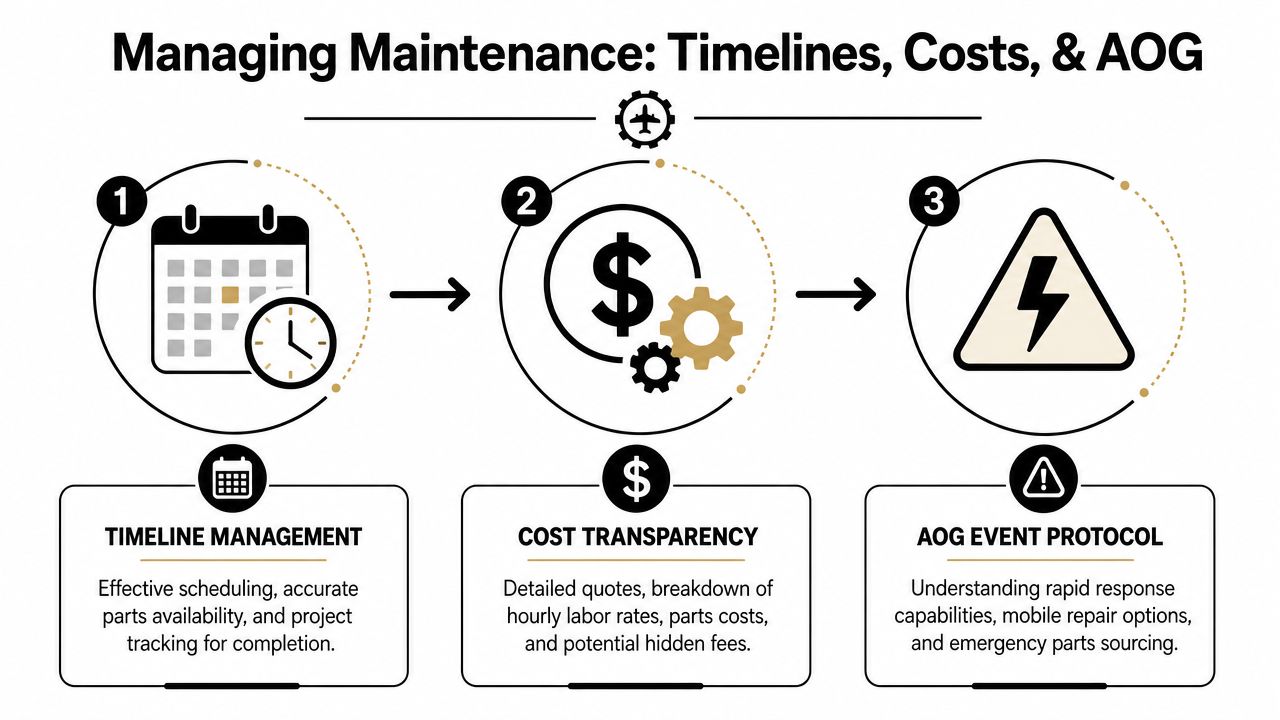
The calendar is usually driven by labor availability first, technical complexity second. A shop can have hangar space and still be weeks out if its experienced A&P and avionics people are already committed. That is why local search results can be misleading. Proximity does not equal capacity.
The common delay points are predictable. Troubleshooting takes longer than the squawk suggested. Parts are not in stock. Inspection reveals follow-on discrepancies. The aircraft gets opened up, then sits because the assigned technicians are pulled onto a higher-priority job.
Good providers reduce that risk by packaging related work while the aircraft is already down and by building enough field capability to solve more problems without relocating the airplane. BCG's analysis of maintenance execution strategies notes that better task packaging improves completion rates and that stronger tooling increases how much work can be handled on-site. For an owner, the practical question is simple: can this shop bundle the inspection, known squawks, likely follow-on items, and any recurring discrepancies into one event with the right people and tools already lined up?
That question matters more in a tight labor market.
How to read the cost structure
Short staffing affects cost as much as schedule. If a shop is overloaded, work gets interrupted, handed off, or pushed into overtime. None of that helps the invoice. Ask how the estimate is built and where it can change before authorizing anything.
A usable estimate separates the controllable items from the unknowns:
| Cost area | What to ask |
|---|---|
| Labor | Is troubleshooting included, capped, or billed as-found? |
| Parts | Are trace, documentation, and core charges included? |
| Outside services | Will avionics, NDT, paint, or machining be sent out? |
| Logistics | Who approves freight speed, road service, or special handling? |
One more question saves owners a lot of grief. Ask who is assigned to the aircraft, and whether that labor is reserved or just planned. In a mechanic shortage, those are not the same thing.
A provider cannot predict every discrepancy. A good one can tell you when it will stop, call, and ask for approval before the scope grows.
Handling AOG events without wasting hours
AOG decisions get expensive fast, especially away from base where local support may be thin and the nearest qualified technician is already covering several airports. The first objective is to get to a credible diagnosis and decide whether the aircraft can be repaired in place, deferred legally, or repositioned.
Use a disciplined AOG sequence:
- Centralize the facts with the pilot write-up, CAS messages or fault indications, recent maintenance history, and photos if available.
- Call the provider with mobile capability and type familiarity instead of starting with the nearest general shop.
- Set the approval limit and decision triggers early so everyone knows when on-site repair stops and relocation or parts escalation begins.
- Confirm parts access before dispatch because technician travel without parts support often burns a day with little to show for it.
I have seen owners lose more time chasing the cheapest first response than they would have spent paying for the right mobile team at the start. In the current labor market, speed comes from getting the right technician, not just the nearest one.
In an AOG event, a fast wrong answer costs more than a slower correct one.
Field capability changes the math here. If the local provider can troubleshoot properly, has the tooling to complete the repair, and can get parts moving without delay, you avoid ferry costs, extra handling, and another position in another shop's queue. That is often the difference between a contained disruption and a multi-day outage.
Building a Proactive Maintenance Partnership
The best answer to aircraft maintenance near me isn't a search result. It's a relationship. Owners who operate smoothly usually have a primary shop, a backup shop, a mobile AOG contact, and a clear understanding of who handles type-specific issues. They don't build that network during an urgent trip. They build it before one.
A strong maintenance partnership is built on three things. First, the provider knows your aircraft and your operating pattern. Second, you know how that provider communicates, documents, and escalates issues. Third, both sides understand that preventing downtime is cheaper than reacting to it.
What a long-term setup looks like
Keep your preferred providers current on aircraft status, upcoming inspections, recurring discrepancies, and travel patterns. If the airplane spends time in more than one region, identify local support in those cities before you need it. That turns a scattered vendor list into a working maintenance network.
Review performance after each event. Did the shop hit the timeline it gave you? Were records clean? Did the discrepancy stay fixed? Those are better indicators than a friendly sales call or a polished website.
Why the outlook is still workable
The labor market is under pressure, but it isn't static. There is a pipeline forming. The overall employment of aircraft and avionics equipment mechanics and technicians is projected to grow 5 percent from 2024 to 2034, faster than the average for all occupations, with approximately 13,100 new openings projected each year, according to the U.S. Bureau of Labor Statistics outlook for aircraft and avionics mechanics and technicians.
That projection doesn't solve today's scheduling crunch. It does support a practical conclusion. The owners who will manage the next few years best are the ones who choose carefully, document expectations, and invest in stable local relationships now.
The right maintenance network lowers risk long before the airplane breaks. That's its real value.
If you want flight options built around local sourcing, transparent aircraft selection, and audited operator standards, Haute Jets offers on-demand private jet charter without memberships or jet cards. You can review exact aircraft options, avoid unnecessary repositioning exposure, and book with a team focused on practical dispatch reliability.