
You’re usually focused on the visible parts of a charter flight. The aircraft type. Cabin layout. Wi-Fi. Catering. Departure time. Whether the jet can get you from New York to London nonstop without compromise.
What most clients don’t see is the discipline that makes that experience possible. Before you step onto the ramp, a chain of inspections, logbook reviews, sign-offs, parts tracking, and regulatory checks has already taken place. That quiet work is what turns a beautiful aircraft into an airworthy one.
On Haute Jets Journal, that’s the part worth understanding. Not because you need to become a mechanic, but because maintenance status directly affects the two things that matter most in private aviation: safety and reliability.
The Unseen Element of Every Perfect Flight
A flawless charter day feels effortless.
Your car arrives on time. The crew is ready. The cabin is set up the way you requested. The aircraft departs smoothly, lands when expected, and nothing about the trip feels uncertain. For many travelers, that ease is the product they’re really buying.
But in private aviation, ease is built on rigor.
An aircraft can look immaculate and still be a poor charter choice if its records are sloppy, its inspections are nearing due, or its operator treats maintenance as a box-checking exercise. The opposite is also true. A jet’s true quality is often revealed not by the leather or the galley, but by the discipline behind its maintenance program.

What maintenance really protects
In practical terms, aviation maintenance services cover the inspections, repairs, component tracking, documentation, and compliance work that keep an aircraft legal to fly and safe to dispatch. For a charter client, that translates into very real outcomes:
- Dependable departure: The aircraft is ready when you need it.
- Fewer surprises: A small unresolved issue doesn’t become a last-minute delay.
- Regulatory compliance: The operator can prove the aircraft meets required standards.
- Confidence in sourcing: You’re not relying on appearance or sales language alone.
Practical rule: If you can’t verify how an operator manages maintenance, you can’t really judge the risk of the flight.
This is why experienced charter professionals start with safety records, maintenance status, and third-party audit standards before discussing amenities. The polished experience comes last. Airworthiness comes first.
Why this matters to a charter client
Private aviation runs on availability. If a maintenance item grounds one aircraft, the consequences move quickly. Routing changes. Crews reshuffle. Replacement options narrow. Costs can shift. Your schedule becomes vulnerable.
That’s why serious buyers ask a better question than “Is the jet nice?” They ask whether the operator’s systems are disciplined enough to keep that jet available without cutting corners.
If you’re curious how safety systems behind the scenes support high-consequence aviation environments, Sheridan Technologies has a useful overview of embedded systems for defense. It’s a different segment of aerospace, but it helps illustrate how much reliability depends on strong technical infrastructure long before anyone sees the finished product.
For private charter, the closest client-facing shortcut is to review an operator’s audit standing and safety process. Haute Jets outlines that approach in its guide to private jet safety standards. It’s one of the clearest ways to separate genuine operational discipline from marketing language.
Understanding Aircraft Maintenance Checks and Types
Most confusion around aircraft maintenance comes from one simple issue. People hear terms like “line maintenance,” “A-check,” or “overhaul” and assume they all mean roughly the same thing.
They don’t.
A good way to think about it is car ownership. Some work is routine and frequent, like checking fluids or tires before a long drive. Other work is deeper and less frequent, like a major service where parts are inspected, replaced, and documented in detail. Aircraft follow the same basic logic, but with much stricter rules and far more documentation.
Line maintenance and base maintenance
Line maintenance is the day-to-day work that helps keep an aircraft dispatch-ready between flights. It includes routine inspections, troubleshooting, and servicing. This category matters more than many clients realize. The global aircraft line maintenance market was valued at USD 24.18 billion in 2026 according to Fortune Business Insights on aircraft line maintenance, which shows how central this routine work is to aviation reliability.
Base maintenance is deeper work performed in a hangar environment. It often takes more time, involves more disassembly, and addresses the aircraft more thoroughly.
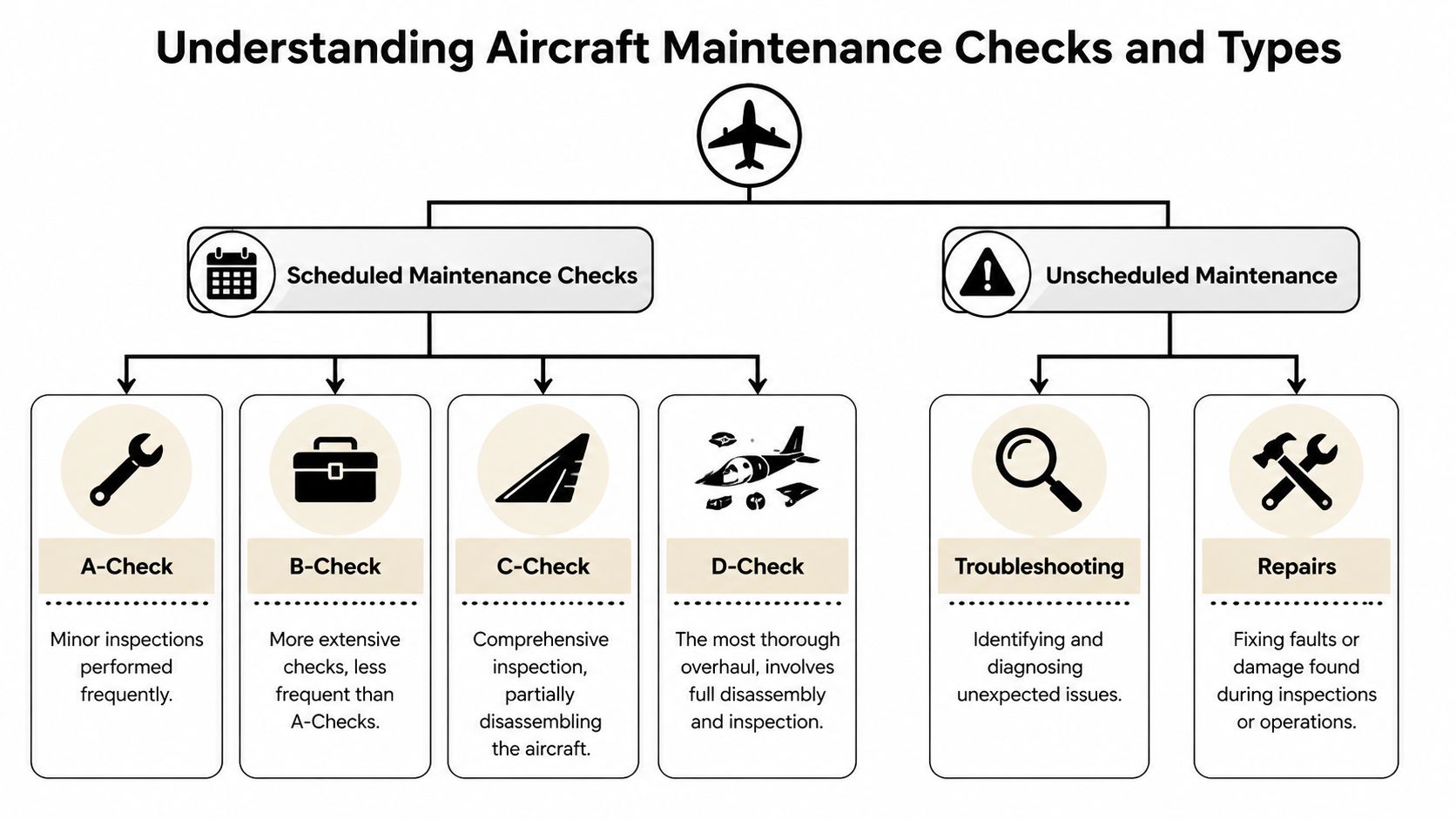
The common check types
Here’s the language you’ll hear most often:
| Check type | What it means for you |
|---|---|
| A-Check | A lighter, recurring inspection. Usually planned to keep the aircraft in regular service with minimal downtime. |
| B-Check | More involved than an A-Check. Less commonly discussed by clients, but part of the structured maintenance rhythm. |
| C-Check | A substantial inspection requiring more downtime and more detailed review of aircraft systems and structure. |
| D-Check | The deepest form of scheduled overhaul. This is major work, often associated with extensive disassembly and long planning windows. |
| Troubleshooting | Diagnostic work when something unexpected needs investigation. |
| Repairs | Corrective action once a fault, wear issue, or damage is identified. |
Why availability changes even when nothing is “wrong”
Clients sometimes hear that an aircraft is unavailable for maintenance and assume there must be a problem. Not necessarily.
Scheduled maintenance is part of responsible aircraft ownership. A jet that goes offline for a check may be following its required inspection program on time, which is exactly what you want. The concern is not that maintenance happens. It’s whether the operator plans for it properly.
For readers who want a broader reliability framework, UptimeAI’s explainer on optimizing asset reliability with RCM is a helpful way to understand how structured maintenance thinking reduces failure risk across complex equipment.
Well-run operators don’t wait for something to break. They manage inspection intervals, component life, and records so the aircraft remains both compliant and predictable.
That predictability is what protects your itinerary.
The Global Rulebook Governing Aviation Safety
Luxury travel can feel personal and bespoke. Maintenance compliance is not. It is formal, documented, and governed by law.
That distinction matters. When you board a charter aircraft, you aren’t relying on an operator’s good intentions. You’re relying on a regulatory framework that defines who may perform maintenance, how it must be documented, and what standards must be met before the aircraft returns to service.
The regulators behind the scenes
In the United States, the key authority is the FAA, the Federal Aviation Administration. In Europe, it’s EASA, the European Union Aviation Safety Agency. Other jurisdictions have their own authorities, but these two shape much of the global operating environment for business aviation.
For a client, the important point is simple. Maintenance standards are not casual recommendations. Operators, technicians, and repair organizations work inside a strict rulebook.
That rulebook covers areas such as:
- Who can sign off work
- How inspections are recorded
- Which components must be tracked
- When an aircraft may be released back to service
- How facilities are approved and audited
What an approved maintenance organization means
You may hear terms like AMO or Part 145 repair station. Those labels matter because they indicate that a maintenance facility has been approved to perform specific work under regulated standards.
A well-qualified facility should have the right tooling, trained personnel, controlled procedures, and documentation systems. In plain language, it means the aircraft isn’t being maintained in an informal or improvised environment. There is a recognized structure behind the work.
What to listen for: Not “we know a good shop,” but “this work is performed by an approved facility under the correct authority and documented accordingly.”
Why international consistency matters
Private jets often move across borders, and charter clients often fly internationally. That makes consistency important. An aircraft may be based in one place, maintained in another, and dispatched for a mission somewhere else entirely.
The maintenance record has to travel with it in a meaningful way. Inspection history, airworthiness directives, service bulletins, and component status need to be understandable, current, and properly controlled.
For the traveler, this is reassuring. The aircraft isn’t considered safe because someone says it is. It is considered airworthy only when its records, inspections, and maintenance releases support that conclusion under the applicable rules.
That’s one reason experienced charter professionals place so much weight on compliance culture. The regulations create the floor. Strong operators build systems that treat that floor as a starting point, not the finish line.
Meet the Experts Who Keep Private Jets Airworthy
Aircraft maintenance is never the work of one person. It’s a network.
A private jet may be serviced by a line technician at the airport, inspected at an MRO facility, reviewed by a maintenance controller, and returned to service only after a properly authorized mechanic signs the work off. If you want to understand aviation maintenance services, it helps to know who these people are and what role each one plays.

The main players
MRO facilities are where deeper maintenance, repair, and overhaul work gets done. Think of them as specialized clinics for aircraft. They handle heavier inspections, complex repairs, and major scheduled events.
FBOs are best known to clients as the private terminals where charter trips begin and end, but many also support line maintenance. That can include servicing and light technical support that helps keep aircraft moving on schedule.
A&P mechanics are central to the system. These licensed technicians have the authority to perform and sign off specific maintenance work. Their judgment and documentation are part of what makes an aircraft legally return to service.
The shortage clients should know about
One of the industry’s biggest pressures isn’t hidden inside the aircraft. It’s in the labor market.
The aviation industry faces a severe challenge with a projected shortage of qualified technicians. By 2027, the U.S. alone could face a deficit of up to 48,000 maintenance workers, a 27% shortfall, according to Oliver Wyman’s analysis of the aviation mechanic shortage. For charter operators, that threatens maintenance timelines, availability, and operating costs.
This also helps explain why some operators handle disruption better than others. When skilled labor is tight, the operators with stronger recruiting, training, and retention practices usually manage maintenance planning more smoothly.
Here’s a useful primer on the people and workflow behind that work:
What this means for your booking
A client rarely sees the staffing side directly, but you can feel it in outcomes.
- Longer maintenance queues can reduce aircraft availability.
- Parts and labor coordination can delay return-to-service timing.
- Strong maintenance teams give operators more control during disruptions.
The same aircraft model can produce two very different charter experiences depending on the quality and depth of the team maintaining it.
That’s why seasoned charter advisors pay attention not just to the jet, but to the operator behind it. Airworthiness lives in people, process, and paperwork just as much as it lives in the machine.
How Maintenance Impacts Charter Costs and Reliability
Maintenance affects your charter in two ways. First, it shapes whether the aircraft is available. Second, it shapes what it costs to keep that aircraft dependable enough for on-demand travel.
That connection is easy to miss because most maintenance work happens before a quote is ever sent. But every operator prices around inspection schedules, parts replacement, labor, downtime, and the possibility that something unexpected could interrupt a trip.
Scheduled work versus AOG events
Scheduled maintenance is the predictable side of the equation. Operators know inspections are coming. They budget for them, plan aircraft downtime, and try to keep those events from disrupting client itineraries.
The expensive problems are usually on the unscheduled side. In charter, one of the most disruptive scenarios is an AOG, or aircraft on ground event. That means a technical issue keeps the aircraft from flying until it’s resolved.
When that happens, the ripple effects can be immediate:
- Trip timing shifts
- Replacement aircraft may need to be sourced
- Positioning logistics become more complex
- Costs can rise quickly if alternatives are limited
Why predictive maintenance matters
The most forward-looking operators try to reduce those surprises through predictive maintenance. Instead of waiting for a fault to appear during a scheduled check or on the day of departure, they use real-time data and machine learning to identify patterns that suggest a component may be trending toward failure.
According to Striim’s overview of predictive aircraft maintenance, predictive maintenance can reduce unscheduled aircraft downtime by up to 50% and cut maintenance costs by 20% to 30%. The same source notes that AOG events can cost $10,000 to $50,000 per hour for an ultra-long-range jet.
That matters to the client even if you never see the dashboard. Better maintenance forecasting can mean fewer disruptions, cleaner dispatch planning, and less chance that your trip turns into a scramble for a substitute aircraft.
How this shows up in your quote
A low headline price isn’t always a sign of efficiency. Sometimes it reflects an operator making aggressive assumptions about availability, maintenance timing, or fleet resilience.
A more useful question is whether the operator has the systems to support the quote they’re offering. For clients comparing options, Haute Jets has a clear breakdown of the bigger pricing picture in its guide to private jet charter pricing and cost breakdowns.
Client takeaway: The most economical flight is often the one that avoids a last-minute maintenance disruption, not the one with the lowest initial quote.
In private aviation, reliability has a cost. Poor reliability usually costs more.
Verifying Maintenance Excellence with Wyvern and ARGUS
Most charter clients don’t want a lesson in maintenance records, component tracking, or inspection intervals. They want a credible way to know whether an operator takes those things seriously.
That’s where Wyvern and ARGUS become so valuable.
These aren’t decorative labels. They are third-party audit standards that review an operator’s safety systems in depth, including maintenance procedures, operational controls, training, and documentation discipline. For a non-technical client, they function as one of the clearest trust filters in private aviation.
Why third-party audits matter more than self-reported claims
Any operator can say safety is important. A meaningful audit asks them to prove it.
That distinction is important in maintenance because the strongest operators often exceed bare minimum compliance. They maintain records carefully, track open items closely, and follow manufacturer guidance with real consistency. An outside audit helps verify that culture rather than leaving you to rely on a brochure or a verbal assurance.
According to Aviation Technical Advisor’s explanation of maintenance program management, Wyvern Wingman and Argus Gold audits mandate 100% compliance with OEM Service Bulletins, and that standard correlates to 99.9% dispatch reliability. The same source notes that rigorous technical assessments can identify 80% to 90% of latent defects, which helps prevent more serious in-flight issues.
What a client should ask
You don’t need to request raw maintenance logs to be an informed buyer. But you should expect clear answers to a few practical questions.
- Audit status: Is the operator current on Wyvern Wingman or ARGUS Gold/Platinum?
- Maintenance oversight: Who manages ongoing maintenance compliance for the aircraft?
- Approved providers: Where is major maintenance performed?
- Operational transparency: Can the charter provider confirm the operator’s standing before departure?
If you want a deeper explanation of how these ratings work, Haute Jets has a useful primer on Wyvern and ARGUS safety ratings.
The practical value of verification
For high-net-worth travelers, the benefit is peace of mind without needing to become technical.
You’re not trying to audit a turbine engine. You’re trying to confirm that the people responsible for the aircraft submit to meaningful oversight, maintain disciplined procedures, and operate with a safety culture that can be independently checked.
Ask for proof of the operator’s audit standing, not just reassurance that everything is “fully compliant.”
That single step does more to verify maintenance seriousness than almost any other question a charter client can ask.
Answering Your Key Questions on Jet Maintenance
Clients usually ask about maintenance only after something goes wrong. A better time is before the booking is finalized.
The right questions are straightforward. They help you understand whether the aircraft and operator are likely to support the mission you have in mind, especially if your trip is time-sensitive or involves a challenging routing.
Does a newer jet require less maintenance
A newer aircraft may benefit from updated systems, fresher components, and fewer age-related issues. But that doesn’t mean maintenance stops being a major factor.
An older Gulfstream G550 and a newer Phenom 300 can both be excellent charter choices if they’re maintained properly. The question isn’t age alone. It’s how well the operator manages inspections, records, parts planning, and recurring compliance items.
If a mechanical issue causes a delay, who pays
That depends on the charter agreement, the timing of the issue, and whether replacement lift is available. In practice, strong charter providers focus first on solving the disruption safely and clearly. That may mean sourcing another aircraft, adjusting departure timing, or revising the itinerary.
From a client standpoint, the key is to understand in advance how the provider handles operational interruptions and what alternatives can be offered if the original aircraft becomes unavailable.
Why are maintenance costs affecting charter pricing more visibly
Because the pressure is broad, not isolated.
A recent survey found that 65% of general aviation providers cite escalating costs and supply chain issues as their top challenges, according to AvWeb’s report on general aviation maintenance pressure. That affects parts access, labor planning, turnaround time, and ultimately charter pricing.
A short booking checklist
Before confirming a trip, ask for these details:
Operator audit status
Verify that the aircraft is operated by a current Wyvern or ARGUS-rated operator.Aircraft-specific confirmation
Ask for the exact aircraft, not just a category estimate.Pre-flight clarity
Confirm when you’ll receive tail number, crew details, and final trip information.Maintenance transparency
Ask how the provider verifies the aircraft’s maintenance standing before dispatch.Disruption plan
Find out what happens if a maintenance issue affects the assigned jet.
Safety and reliability are the real luxuries in private aviation. Everything else sits on top of them.
A charter client doesn’t need to speak like a mechanic. You just need to know how to verify the standards behind the aircraft you’re stepping onto.
If you’d like help sourcing an aircraft from operators that meet strict third-party safety standards, Haute Jets can help you review options, confirm operator audit status, and book the exact aircraft that fits your mission.