
You're arranging a group flight into a city airport with strict noise limits, a short runway, and passengers who expect something more comfortable than a turboprop. The broker offers a BAe 146 aircraft, or perhaps an Avro RJ, and the first reaction is often understandable: isn't this an old regional airliner?
That question misses the reason the type remains relevant. The BAe 146 was designed around a particular operational problem, combining quiet operation, short-field capability, and a useful regional cabin. Those qualities can matter more than age when a charter needs access to airports that limit noise or runway length.

Introduction to the BAe 146 and Why It Still Matters Today
A group charter is headed for a city airport with strict noise limits and a runway that leaves little room for error. The broker offers a BAe 146 aircraft, perhaps listed as an Avro RJ, and the immediate question is familiar: why choose an older regional airliner?
Its age is only one part of the decision. The BAe 146 first flew on 3 September 1981 and entered service in May 1983, beginning a British regional jet program that produced the 146-100, 146-200, and 146-300 before developing into the Avro RJ family, as documented in the BAe 146 aircraft history. The original 146 series continued through the early 1990s.
That lineage explains the different names appearing in charter listings. One aircraft may be identified as a BAe 146-200, another as an Avro RJ85 or RJ100. They are not identical in every detail, yet they share a design approach aimed at specialized regional operations.
Why the aircraft can suit a difficult airport
A private charter comparison should look beyond fuel burn, age, and range. The airport pair often matters more. At a noise-sensitive or runway-constrained destination near a city center, the BAe 146's quiet operating profile and high-lift wing may provide access that a newer, more efficient aircraft cannot offer under the same conditions.
The type has been associated with airports such as London City, Salzburg, Innsbruck, and former Berlin Tempelhof. Public material also describes certification below Stage 3 noise limits within the aircraft's operating history, as outlined in the BAe 146 general data brochure. These characteristics help explain why charter clients may still encounter it for group movements, medical flights, government assignments, cargo work, and other missions where airport access outweighs intercontinental range.
The aircraft is not a universal private-travel solution. A small party may be better served by a light jet, while a long-range itinerary may favor a newer twin-engine aircraft with lower operating costs. The BAe 146 makes more sense when a larger group needs a quiet, short-field specialist for a constrained airport.
Practical rule: Judge a BAe 146 charter by the airport pair and mission requirements first, then compare age and operating economics.
What Makes the BAe 146 Aircraft Concept So Distinctive
A charter group arriving at a noise-sensitive airport may value access more than top cruise speed. The BAe 146's layout reflects that kind of assignment. It combines a high wing, four turbofan engines, and a regional cabin to support operations where runway length, approach profile, or noise can limit other aircraft.
Four engines as a mission choice
Four engines do not automatically make an aircraft cheaper or better. They distribute thrust and system capability across more installations. The arrangement works like all-wheel drive: spreading power across multiple points can provide useful control and traction characteristics, while adding hardware that requires maintenance.
On the BAe 146, this configuration allowed designers to use relatively compact engines beneath a high wing. Those engines could provide the required thrust without the larger nacelles associated with some higher-thrust layouts. Passengers therefore see four smaller engine installations rather than two larger ones, a visual signature that also reflects the aircraft's intended role.
High wing and short-field behavior
The high wing raises the engines and related structure above the immediate runway environment. That positioning can help at airports where surface conditions, loose debris, or nearby infrastructure place demands on the aircraft's layout.
Its relatively large wing supports lift at lower speeds. Lower approach speeds can reduce the landing distance required, while the flap system helps generate lift during takeoff and landing. The result is greater operating flexibility, rather than a promise that every BAe 146 can use every short runway. For charter planners, that flexibility may matter near a resort, city center, or destination with limited infrastructure.
The high-wing arrangement also keeps the engines farther from the ground than a low-wing design, which can reduce exposure to typical ramp debris during ground operations.
Quiet operation changes airport access
Noise is one of the aircraft's most relevant charter characteristics. The BAe 146 became known for a low noise profile, and that quality can matter more than a modest cruise-performance difference when a schedule depends on a noise-sensitive airport.
Quiet operation does not remove airport restrictions. Operators still need the correct permissions, runway analysis, crew qualifications, aircraft status, and local approvals. The design does give charter planners a reason to investigate airports that may be impractical for a louder regional jet.
The BAe 146's value comes from how its systems work together. Four engines provide the required thrust, the high wing supports the airfield concept, and the quiet profile can widen the set of airports worth reviewing for a specialized charter mission.
History and Evolution From BAe 146 to Avro RJ
A charter client may encounter the BAe 146 decades after its airline debut, serving a group movement, cargo assignment, research mission, or government operation. Its history explains why. The program refined one aircraft concept across several sizes instead of replacing it with an unrelated design.
British Aerospace introduced three principal lengths, the 146-100, 146-200, and 146-300. Operators could choose a shorter or longer fuselage while keeping the same basic approach to airport access and quiet regional service.
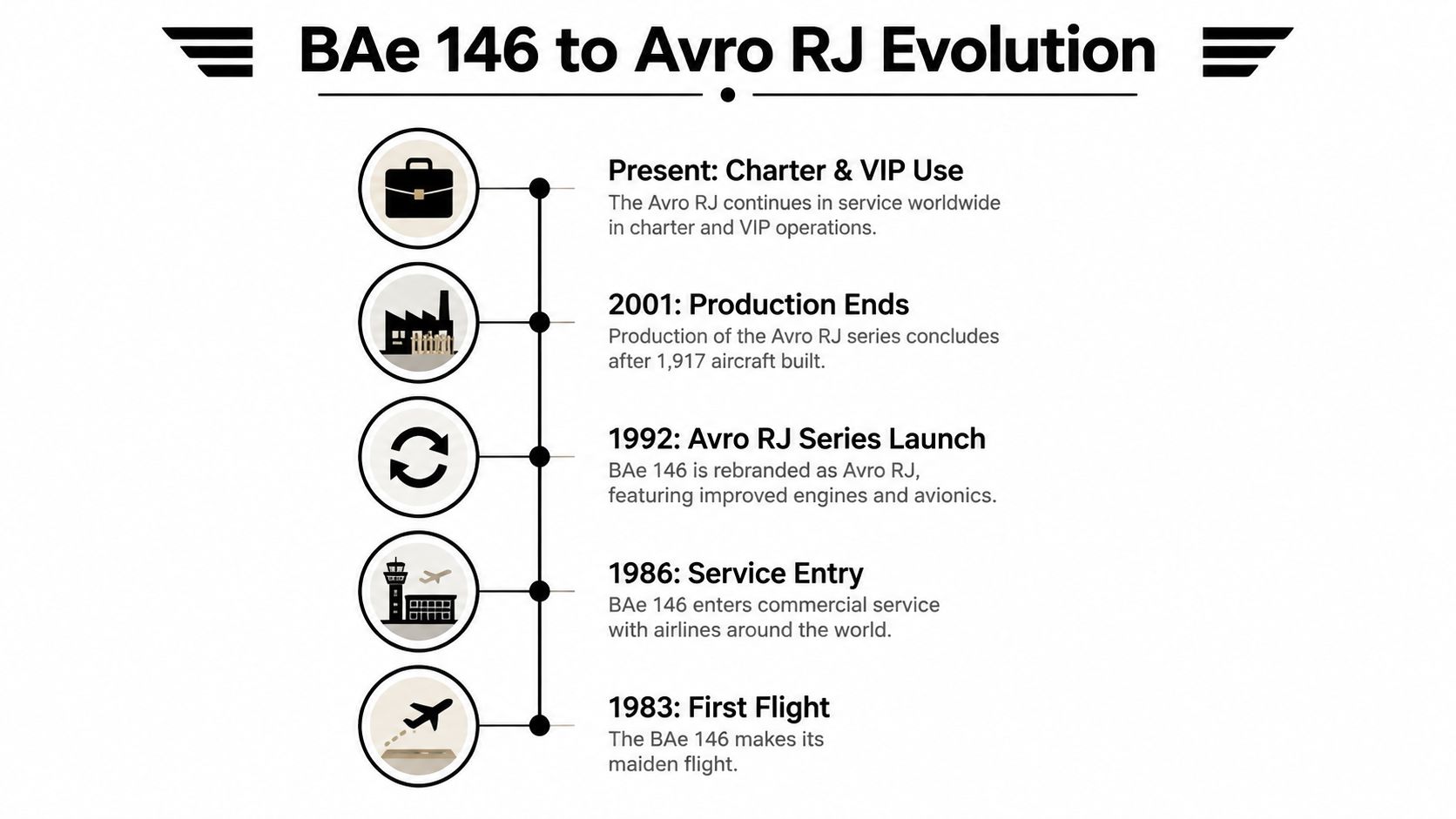
The original aircraft first flew on 3 September 1981 and entered service in May 1983. Production of the original BAe 146 series continued into the early 1990s before the family developed into the Avro RJ series.
How the variant names relate
The naming pattern helps a charter client compare listings:
| BAe 146 family | Avro RJ successor |
|---|---|
| 146-100 | RJ70 |
| 146-200 | RJ85 |
| 146-300 | RJ100 |
The Avro RJ versions were an improved continuation of the family. A broker offering an Avro RJ should identify the exact model, cabin, refurbishment, and operating approvals. The name alone does not confirm the interior, payload, or performance of a particular aircraft.
Production scale and present-day availability
The BAe 146 and Avro RJ line ran from 1983 to 2002, with 387 aircraft built across the family, according to the BAe 146 production overview. Production ended as airlines shifted toward newer regional aircraft and different operating economics. The change did not erase the BAe 146's usefulness for specialized charter work.
For clients, fleet age is only one part of the decision. An individual aircraft may offer a refreshed cabin and strong maintenance support, while another may be configured for cargo, research, or government service. That difference is similar to comparing two properties with the same floor plan, but different renovations and operating permissions.
Read the listing carefully: “BAe 146” identifies a family. It doesn't tell you the aircraft's exact cabin condition, maintenance status, or charter suitability.
The practical question is whether the specific aircraft has the configuration, approvals, and support required for the proposed trip.
Technical Specifications Performance and Cabin Layout Explained
The BAe 146-300 shows how the design translates into practical capability. It uses four Honeywell/Textron Lycoming ALF 502R-5 turbofans, each rated at about 6,970 lbf, or 31 kN, with a 77.3 m² wing area and a 44,225 kg maximum takeoff weight, according to the BAe 146-300 specifications.
Those figures are easier to understand when treated as a system. The engines provide distributed thrust, while the large wing supplies lift over a substantial surface. Together, they support the aircraft's short-field role and help produce lower approach speeds than many jets with a similar cabin size.
Turning the numbers into charter meaning
The maximum takeoff weight is the aircraft's certified upper operating boundary for departure. It includes the aircraft, fuel, passengers, baggage, and any cargo. A broker therefore can't treat the published seating capacity as the only constraint. On a short route, the aircraft may carry a large group comfortably, but on a longer sector, fuel requirements can affect payload.
Range also depends on configuration, payload, weather, and reserves. Published figures for the BAe 146-100 commonly include about 880 nautical miles of normal range and 1,620 nautical miles of maximum range, while some family sources list approximately 2,075 km depending on configuration and payload, as shown in the BAe 146-100 aircraft data. These figures should guide an initial conversation, not replace an operator's flight planning.
The key lesson is simple. The BAe 146 trades some long-range efficiency for airport flexibility and a useful cabin, so it can make sense on a short or medium regional mission even when another aircraft has a better headline range.
Cabin arrangements
The family was built for regional passenger work, with seating references commonly ranging from 70 to 112 seats across configurations. A standard economy arrangement is often described as 3+3, but charter interiors can be adapted around the operator's approved layout and the mission.
A sports group may value seat count and baggage organization. A corporate roadshow may need a more flexible cabin arrangement, while a government or medical mission may require specialized equipment. The aircraft's value comes partly from this adaptability, but clients must verify the actual cabin rather than relying on a generic model description.
BAe 146 variant specifications at a glance
| Variant | Length | Typical Seats | Range |
|---|---|---|---|
| BAe 146-100 | Shortest family variant | About 70 to 82, depending on configuration | About 880 nm normal, up to 1,620 nm maximum |
| BAe 146-200 | Intermediate family variant | About 85 to 100, depending on configuration | Configuration and payload dependent |
| BAe 146-300 | Longest original family variant | About 100 to 112, depending on configuration | Configuration and payload dependent |
The table is a planning aid, not a quote. Ask for the exact tail number, usable cabin configuration, baggage limits, fuel assumptions, and runway analysis before accepting a proposal.
Typical Charter Use Cases and How the BAe 146 Compares
The BAe 146 fits missions where airport access and group capacity outweigh the appeal of a newer, more fuel-efficient aircraft. A tour manager moving performers, a sports organization positioning a full traveling party, or a company visiting several regional destinations may value a cabin that keeps the group together.
Where the aircraft makes practical sense
- Group shuttles: A larger regional cabin can simplify scheduling when passengers need to travel together rather than split across smaller aircraft.
- Sports and entertainment charters: Teams and productions often need a combination of seating, baggage space, schedule control, and access to airports near venues. A sports team charter can involve equipment, staff, and changing itineraries, so the aircraft's actual loading plan matters as much as its seat count.
- Corporate roadshows: The type can work when an itinerary includes several regional airports and the group wants a dedicated aircraft rather than multiple scheduled connections.
- Ski and resort transfers: Airports such as Salzburg and Innsbruck illustrate why short-field performance and noise considerations can matter when a destination is close to a resort community.
Comparing the alternatives
A modern regional jet will often be more attractive on fuel burn, emissions, avionics, and long-term maintenance support. A turboprop may offer strong economics on shorter sectors and can suit smaller airports, but some clients prefer the speed and cabin feel of a jet. A newer twin-engine aircraft may provide a more contemporary passenger experience and simpler operating economics, yet it may not offer the same combination of quietness, runway behavior, and available group capacity.
The BAe 146 can therefore be understood as a specialist tool, not a default choice. Its four engines create additional maintenance and fuel considerations, but the aircraft may justify those tradeoffs when a quieter operation or a difficult runway changes the itinerary.
Charter comparison: The right aircraft isn't the newest one in the category. It's the one that can carry the group, meet the airport rules, and complete the schedule without forcing an inconvenient reposition or split itinerary.
Service quality varies by owner-operator. Some aircraft are maintained for passenger charter, while others are configured for government, cargo, research, or utility missions. Ask for photographs of the actual cabin and confirm catering, baggage handling, ground transport, and onboard amenities before comparing prices.
Operating Costs Limitations Safety and Regulatory Realities
A charter client may find the BAe 146 useful for a short runway, a noise-sensitive airport, or a group that should travel together. The same aircraft can be a poor fit for a routine passenger route where fuel burn, maintenance, and long-term support matter more than access or capacity.
Four engines mean more engine hardware and more maintenance planning than a comparable modern twin-engine regional jet. Fuel consumption can also compare unfavorably on ordinary passenger sectors. Evaluate the entire mission, including ground transfers, airport access, group size, and schedule, rather than judging the aircraft by hourly cost alone.
Regulation can be part of the value
Noise certification remains one of the BAe 146's strongest differentiators. Public material describes the type as operating below Stage 3 noise limits and links it with airports where noise restrictions affect scheduling, as noted earlier. Current airport rules and the individual aircraft's approvals still require confirmation. Historical certification does not automatically permit every operation.
The fleet's age makes records and continuing airworthiness especially important. In 2025, the FAA moved to remove an older airworthiness directive affecting BAe 146 and Avro 146-RJ aircraft. That regulatory change does not replace the operator's maintenance program, inspections, or review of the specific aircraft's status. A charter client should ask who holds operational control and what approvals apply to the proposed flight.
Why conversions matter
Some BAe 146 aircraft have been considered for QT/QC freighter conversions and simpler E-Class cargo conversions, with options such as a rear cargo door and roller floor, according to FlightGlobal's conversion coverage. This conversion history explains why the aircraft still appears in specialist freight, government transport, research, and utility work. Its value may come from mission flexibility rather than ordinary airline economics.
The UK RAF has been retiring BAe 146 aircraft, while the UK Ministry of Defence has been replacing its command-support fleet with smaller Dassault 900LX business jets. Separately, the first flying BAe 146 research aircraft faced retirement after funding cuts. A planned mid-life upgrade had already used about GBP38 million of a GBP49 million budget, as reported in earlier material.
For passenger charter, review private aviation safety guidance and verify the operator, aircraft, crew, maintenance status, and oversight. The model name alone cannot establish whether a particular aircraft is suitable for the trip.
Booking Guidance for Charter Clients on Haute Jets
A BAe 146 or Avro RJ quote deserves the same disciplined review as any other charter proposal. Start with the exact aircraft, not the family label. Ask for the model, tail number when available, aircraft year, cabin photographs, seating plan, baggage capacity, and the maintenance or refurbishment status that affects the passenger experience.
Questions to ask before accepting
- Airport fit: Can the operator confirm runway performance, noise approval, operating hours, and any local restrictions for both airports?
- Mission fit: Does the aircraft have the payload, range, fuel reserves, and cabin arrangement for the proposed itinerary?
- Operator oversight: Is the operator rated through Wyvern Wingman or Argus Gold or Platinum, and can the charter provider explain who holds operational control?
- Passenger details: Are Wi-Fi, catering, pets, ground transport, and special equipment confirmed for the actual aircraft?
- Pricing structure: Is the aircraft sourced locally, or does the quote include repositioning, ferry time, or additional overnight costs?
A reliable broker should confirm the aircraft and operational details before departure, then provide the final flight information close to travel. The broader guide to booking a private jet with Haute Jets describes the kind of detail clients should expect during that process.
Choose the BAe 146 when your group needs a larger regional cabin, quiet access, or short-field utility and the operator can document the aircraft's condition. Choose a lighter jet when the party is small, or a newer larger aircraft when range, efficiency, and contemporary amenities matter more than specialized airport performance.
Haute Jets can source BAe 146 and Avro RJ solutions alongside newer regional and private aircraft, matching the aircraft to your group size, airport requirements, cabin expectations, and schedule. Visit Haute Jets to request current availability and receive a charter comparison built around the actual mission.