
Most advice on a book private jet app starts with speed. That's the wrong starting point.
If you're booking private aviation for the first time, don't chase the slickest interface or the fastest quote. Chase certainty. A polished app can still show you an aircraft that hasn't been assigned, a price that isn't fully settled, and an operator you haven't properly vetted. In private aviation, convenience matters, but confirmation, safety, and cost discipline matter more.
That matters even more in a market that keeps expanding. The global private jet charter market reached approximately $48.1 billion in 2026, with a 13.5% year-on-year increase from roughly $24.1 billion in 2025, while business-jet flight activity hit about 2.75 million flights in 2025, up 4.7% year-on-year, according to this industry analysis of the 2025 to 2026 private jet market. More demand brings more apps, more platforms, and more marketing noise. It doesn't automatically bring better booking discipline.
On Haute Jets Journal, I'll give you the advice I'd give a first-time charter client with a meaningful budget and no patience for avoidable mistakes. Use the app if you want. Just don't let the app do your thinking for you.
Beyond the Hype of Instant Jet Booking
The “Uber for jets” pitch sounds modern. It also leaves out the part that matters most: private aviation isn't a rideshare business.
A car swap is annoying. An aircraft swap on the morning of departure is a completely different problem. You're dealing with crew legality, maintenance status, airport handling, luggage fit, catering, pets, and sometimes international paperwork. When a platform reduces all of that to a few taps, it often hides the operational reality behind a clean screen.
Research highlighted by Robb Report's look at private aviation apps and broker-led booking points to a contrarian trend: affluent flyers are turning back to human brokers, prioritizing specialist advice over pure speed. That's not nostalgia. It's pattern recognition. Experienced travelers know that the true test of a booking platform isn't how fast it can display a jet. It's how well it handles friction when weather shifts, an aircraft goes offline, or the original quote starts changing.
Why the instant-booking promise is overrated
Many first-time clients assume that if an app shows availability, the aircraft is ready to go. That assumption causes trouble.
Apps are good at presenting options. They're often much weaker at proving what's locked in. Some platforms market convenience aggressively, but they don't make it obvious whether you're seeing a live operator confirmation or a provisional estimate built from inventory logic. Those are not the same thing.
Convenience without verification is a luxury-looking version of uncertainty.
The better mindset is simple. Treat the app as a search tool first, not as the final authority on your trip.
What savvy travelers do instead
They still use technology. They just use it with discipline.
A smart client will compare aircraft, narrow routing options, and review cabin fit through digital tools. Then they'll press for the operational details a screen tends to blur: exact operator, exact aircraft, exact terms, exact confirmation timing. That's the difference between browsing and booking.
If you want a broader view of how digital tools are changing the private travel experience without replacing judgment, this perspective on innovative technology redefining the exclusive private jet journey is worth reading.
Your Pre-Flight Checklist Before Opening the App
Most bad charter quotes start with vague requests. “Miami to New York next Friday” is not a serious booking brief. It's a rough idea.
Before you open any app, organize the trip like a professional. That doesn't make the process slower. It makes the quote sharper, the aircraft match better, and the follow-up cleaner.
Gather the details that actually drive the quote
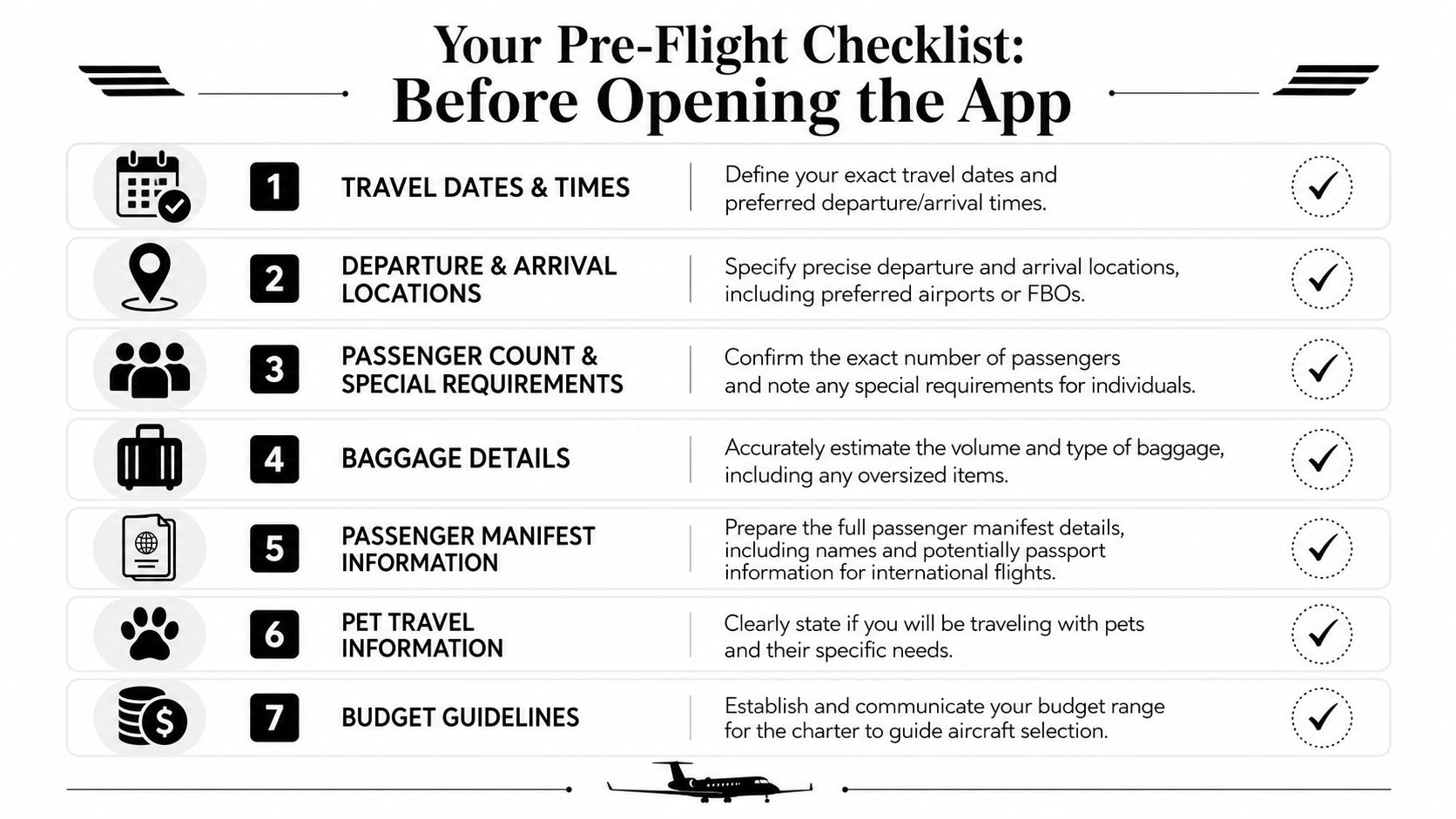
Start with these essentials:
- Exact airports. Don't give cities if you already know the airport or FBO you prefer. Teterboro and JFK are not interchangeable. Opa-locka and Miami International are not interchangeable either.
- Departure window. Give a preferred departure time and the amount of flexibility around it.
- Passenger count. Use the exact number, not an estimate. One added passenger can change the aircraft category.
- Baggage profile. Standard roller bags are one thing. Garment bags, golf clubs, skis, medical equipment, and strollers are another.
- Pet details. Size, breed, carrier needs, and whether the pet will remain in cabin all matter.
- Catering expectations. Don't just say “light catering.” Specify if you want full meals, particular brands, children's items, or dietary restrictions.
- Manifest readiness. Full legal names should be ready. International trips may require passport details early in the process.
- Budget range. Give one. If you don't, the app may show you aircraft that fit the route but not your appetite for spend.
Why specificity saves time
A precise request prevents two common problems. First, it reduces false matches. Second, it keeps the operator from repricing once actual trip details emerge.
If you're flying internationally, customs and passenger documentation can affect timing and handling requirements in ways first-time travelers often underestimate. This practical private jet customs guide helps frame what you should have ready before you start requesting quotes.
Practical rule: The more specific your trip brief is before search, the less likely you are to get a glossy quote that falls apart under real operating details.
A short example of a strong request
Use this kind of structure in the app's notes field or in follow-up communication:
- Route and timing. “Westchester County to Palm Beach, wheels up around 10:30 a.m., flexible by one hour.”
- Passengers. “Four adults, one child, one small dog.”
- Baggage and service. “Six carry-ons, two golf bags, lunch catering, car service on arrival.”
That level of clarity gets you much closer to a usable quote than a one-line search ever will.
How to Vet Aircraft Safety and Operator Quality
Safety isn't a box to tick after you like the cabin photos. It's the first filter.
A first-time client often thinks the app has already handled that part. Sometimes it has. Sometimes it hasn't. You need to know the difference. In practical terms, I want to know whether the platform is filtering operators through meaningful third-party safety standards or showing all operators that can technically service the route.
The only shortcut that matters
Ask one direct question early: Is the operator Wyvern Wingman or ARGUS rated?
That question cuts through a lot of empty marketing. It tells you whether the operator has gone beyond basic regulatory permission and submitted to respected outside scrutiny. The technical guidance behind private jet booking apps is blunt on this point. Success rates for apps integrating Wyvern/Argus-rated operator filters exceed 92% in safety compliance audits, while apps lacking third-party safety validation suffer 35% higher operator rejection rates during booking confirmation, according to this aviation app methodology video reference.
That's why I don't treat third-party audits as a nice extra. I treat them as the minimum standard for any serious booking workflow.
What to verify before you approve anything
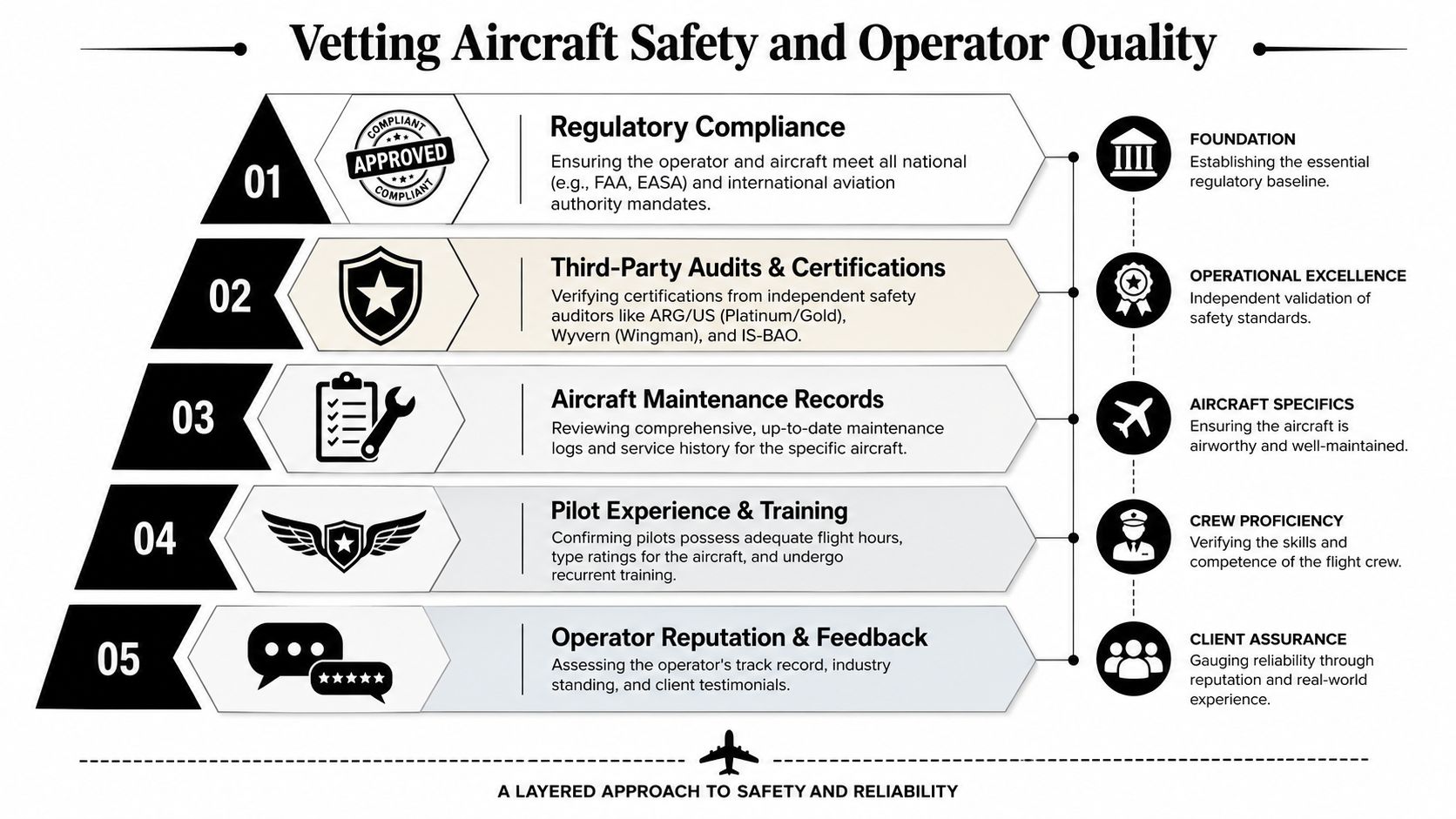
A strong operator review should cover several layers:
- Regulatory standing. The operator must be properly authorized for charter operations in the applicable jurisdiction.
- Third-party audit status. Wyvern Wingman and ARGUS Gold or Platinum are the names to look for.
- Aircraft-specific maintenance posture. Not a generic fleet promise. The actual aircraft matters.
- Pilot qualification depth. Type familiarity and recurrent training are not trivial details.
- Operational reputation. Reliability, communication, and issue handling matter once the trip gets complicated.
Here's a useful visual breakdown before we go deeper:
Why the tail number matters more than the category
Don't stop at “light jet,” “midsize jet,” or “super midsize.” Those are browsing labels, not booking guarantees.
If you approve only a category, you leave room for substitution. If you approve a specific tail number, you can verify the exact year, make, model, cabin layout, luggage profile, and onboard amenities tied to your trip. That makes the booking more rigid in the best way.
If an app can't tell you the real aircraft, you don't have a real booking yet.
A serious client doesn't buy vague capacity. A serious client books a specific aircraft operated by a specific company under known safety standards.
Decoding the True Cost of Your Charter Flight
Private jet pricing feels opaque because many quotes bundle core costs with avoidable waste. The biggest offender is usually not the hourly rate. It's aircraft positioning.
If you only compare the top-line quote in an app, you can miss where the money is going. That's how first-time clients overpay and still feel uncertain about what they bought.
The charge that inflates more quotes than clients realize
Repositioning fees are the first thing I look for when reviewing a charter price. They apply when the aircraft must fly empty to reach your departure point. According to Fortune Business Insights' private jet charter services market analysis, repositioning fees can inflate charter prices by 20–40% when aircraft are sourced from distant locations rather than near the departure city. The same analysis notes that North America reached $12.29 billion in 2025, reinforcing how important dense local sourcing is in major charter corridors.
That means your cheapest-looking app result may be expensive for one simple reason: the plane isn't near you.
What a quote usually includes
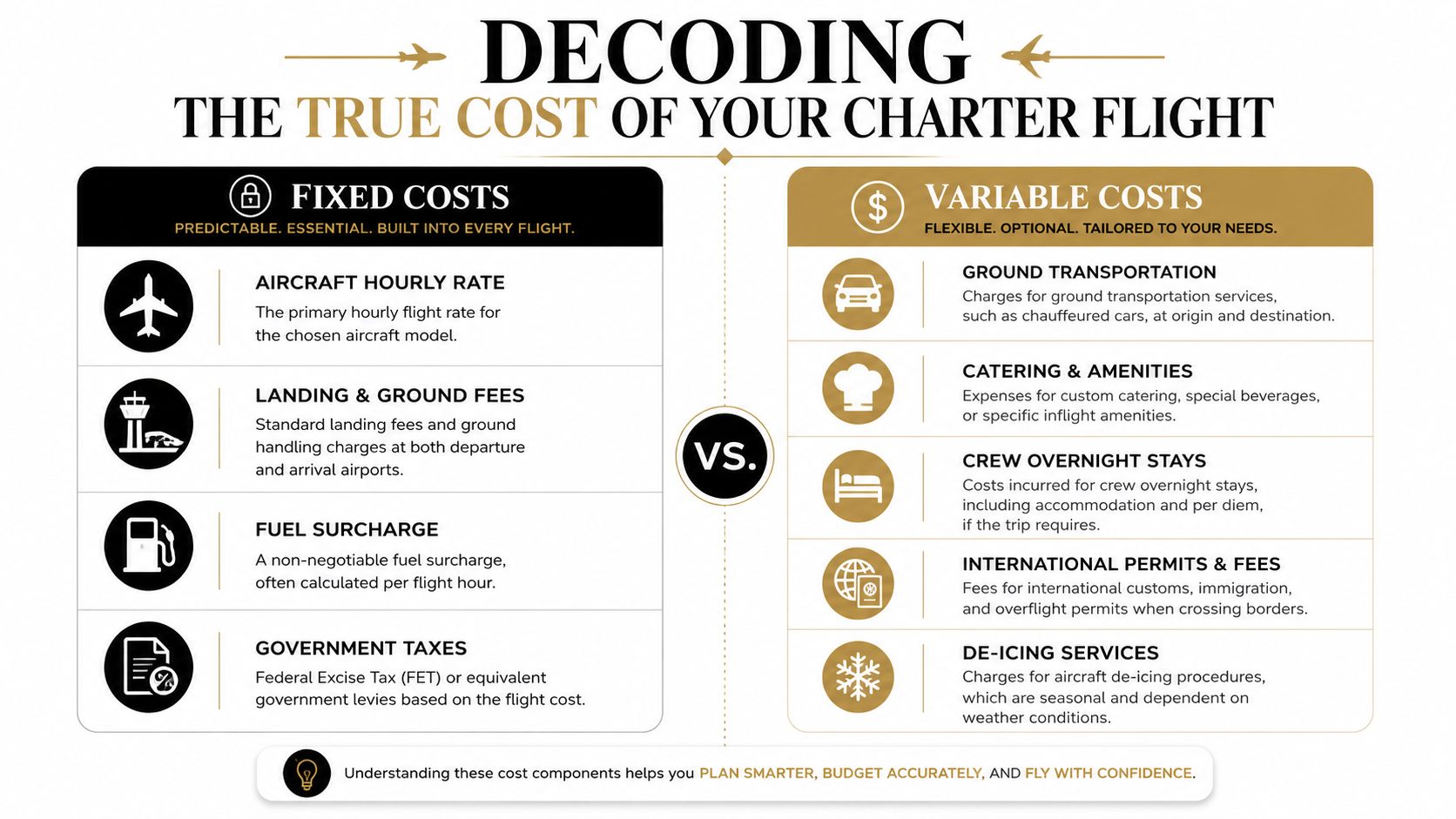
A charter quote typically combines a few predictable buckets and a few trip-specific variables.
| Cost area | What to look for |
|---|---|
| Aircraft charge | The flight rate tied to the aircraft and routing |
| Airport handling | Landing and ground handling charges |
| Fuel-related line items | Sometimes bundled, sometimes shown separately |
| Government taxes and levies | These depend on jurisdiction and trip structure |
| Trip extras | Catering, ground transport, de-icing, permits, crew overnight costs |
The issue isn't that these items exist. The issue is that some apps hide them until late in the process, or make it hard to tell which charges are fixed and which are avoidable.
How to judge whether the quote is fair
Use this decision framework instead of chasing the lowest screen price:
- Ask where the aircraft is based. If it's not close to your departure point, expect deadhead costs.
- Ask whether the quote reflects direct operator sourcing or layered brokerage. More intermediaries often mean more markup.
- Ask whether the aircraft shown is the exact aircraft intended for your trip. A placeholder quote can change quickly.
- Check whether trip extras are itemized. If they aren't, the quote may not be mature enough to trust.
For clients who charter yachts as well as aircraft, the same pricing discipline applies across luxury transport. A useful example is this boat charter Dubai guide, which shows how route, vessel location, and onboard service choices shape the actual cost far more than a headline rate alone.
Local sourcing changes the economics
The best-priced charter is often not the cheapest category. It's the aircraft that's already where you need it.
That's especially true in major metro markets where local availability is stronger. A well-sourced quote can remove much of the empty repositioning waste that makes first-time bookings unnecessarily expensive. If you want a broader primer on pricing logic and line items, this guide on private jet charter cost is a helpful reference.
Don't ask only, “What does this jet cost?” Ask, “Why is this jet priced this way?”
That question usually tells you whether you're looking at a clean charter or a padded one.
From Quote to Confirmation The Final Steps
A quote is not a booking. A screen that says “book now” is not the same thing as an operator-confirmed charter. As a result, many first-time clients get misled.
The weak point in app-based booking is the gap between digital presentation and legal commitment. The quote may look polished, the aircraft may look available, and the payment button may be live. None of that matters if the operator hasn't confirmed the trip in a binding way.
What real confirmation looks like
The core issue is aircraft assignment. Paramount Business Jets' analysis of instant booking claims notes that the specific aircraft assigned is frequently not determined until the day prior, and that some apps present “floating fleets” where the exact tail number is an AI-generated estimate rather than a confirmed operator booking. That's the line you need to draw clearly. An estimate is not a commitment.
A real booking includes:
- A formal charter agreement with the operating party and trip terms.
- The aircraft details, not just a cabin category.
- The price you are approving, with material terms clear enough to enforce.
- Cancellation language you've read.
- Payment confirmation through an accepted, documented channel.
What to review before sending funds
Read the agreement like someone who expects plans to change, because sometimes they do.
Look for the passenger names, route, date, departure timing, baggage assumptions, pet approval if relevant, and cancellation terms. If anything material is missing, it's not ready for approval. If the aircraft can still be substituted broadly without your review, tighten that language or reconsider the booking.
The final click in an app should follow operator confirmation. It should never replace it.
Payment should follow clarity, not precede it
Apps may support cards, wires, or other payment methods. That's fine. The method matters less than the sequence.
Pay once the flight is documented properly. If privacy is important to you, ask what payment channels are accepted and how the records are handled. But don't let payment convenience distract you from the main issue, which is whether the trip is confirmed.
Your Pre-Flight Briefing The Day Before Departure
The day before departure tells you whether you booked well or merely hoped for the best.
A high-quality charter experience becomes obvious in the final 24 hours. You should not be guessing where to go, who your crew is, or whether your catering and ground transport made it into the file. At this stage, professional providers tighten details. Weak ones start improvising.
What you should receive before wheels up
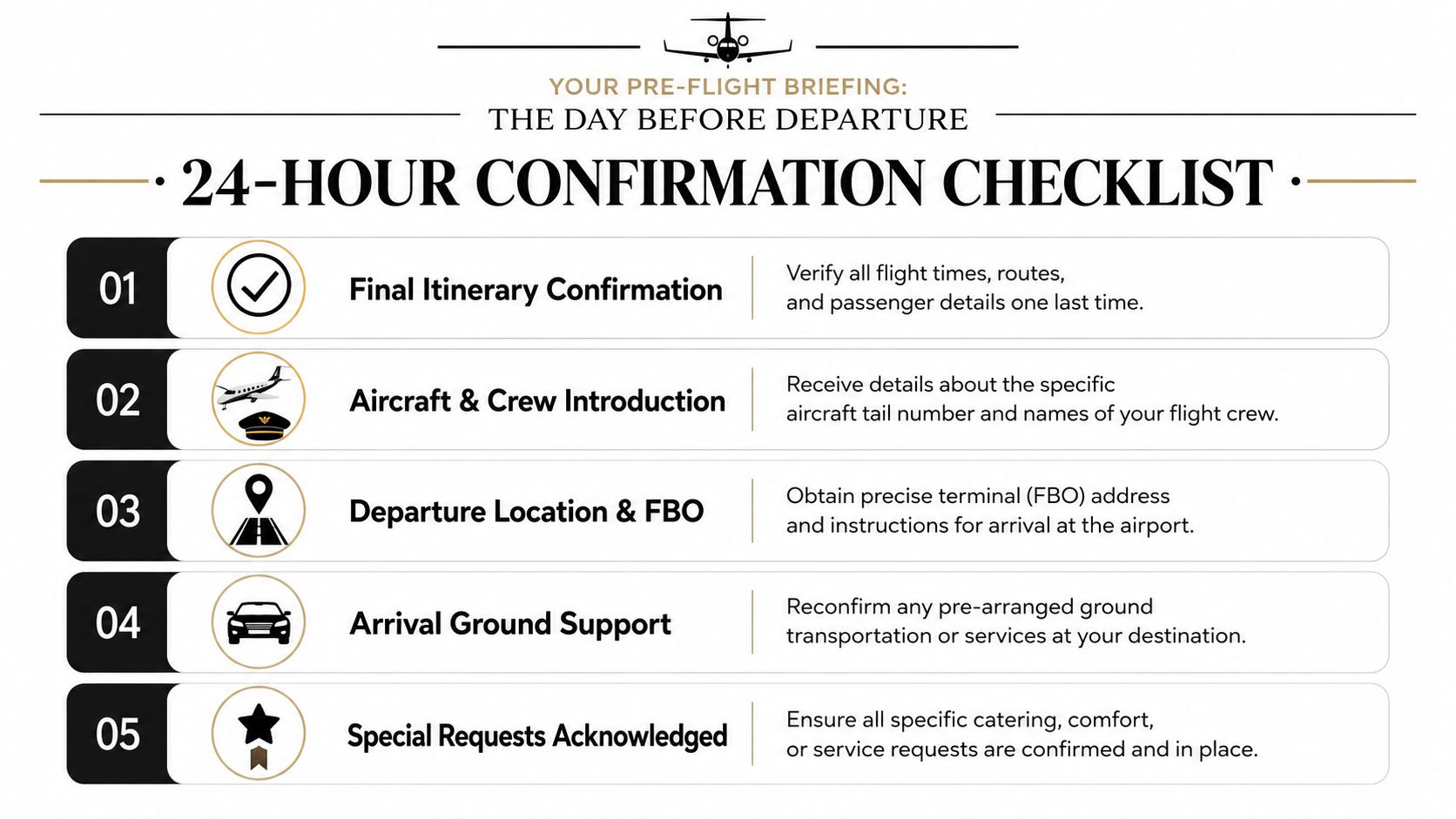
The benchmark is simple. You should have a complete, practical briefing that removes ambiguity from departure day.
That typically includes:
- Final itinerary with confirmed times, airports, and passenger details
- Specific tail number for the aircraft you will fly
- Crew information so you know who's operating the flight
- FBO details including address, arrival instructions, and contact numbers
- Ground transport status at destination if arranged
- Special-request confirmation for catering, pets, accessibility, or security preferences
According to this Haute Jets Journal overview of private jet charter booking, Haute Jets sources aircraft from 3,500+ owner-operators across 175 countries and provides same-day availability along with a detailed 24-hour pre-flight confirmation with full flight details. Regardless of provider, that's the standard you should expect: the specific jet you selected, with the details confirmed before departure, not improvised on the morning of travel.
What the last 24 hours should feel like
You shouldn't be chasing updates. The provider should be delivering them.
If the trip is domestic, the message should be straightforward and complete. If the trip is international, you should also see that manifest, customs, and timing details were handled cleanly. Either way, your day-before communication should leave you with logistics, not questions.
Here's the practical sequence I like to see:
| Timing | What should happen |
|---|---|
| Day before | Final itinerary and aircraft confirmation arrive |
| Later that day | Crew, FBO, and service requests are reconfirmed |
| Morning of departure | Any operational update is minor, not fundamental |
The signs of a well-managed flight
A good pre-flight briefing has a calm quality to it. The details line up. The names match. The route makes sense. The ground team knows you're coming.
A weak briefing feels vague. It leans on “we'll update you shortly” language, keeps the aircraft details soft, or treats the FBO instructions like an afterthought. If you see that pattern, ask direct questions immediately.
The day-before confirmation is your final proof that the booking moved from app interface to actual aircraft operation.
That's the standard. Anything less is unfinished work dressed as convenience.
If you want app-level convenience without the usual ambiguity, Haute Jets is built for travelers who care about exact aircraft selection, Wyvern and ARGUS-rated operators, wholesale rates, and a real 24-hour pre-flight confirmation. If you'd rather skip memberships, jet cards, and inflated repositioning costs, start there.