

You're probably staring at three quotes right now, one for a Phenom 300, one for a Citation Latitude, and one for a Challenger 350, and the hard part isn't reading the numbers. It's deciding which jet fits the trip, the baggage, the runway, and the people on board.
For a New York to Miami run, most travelers don't need the flashiest cabin. They need a jet that shows up reliably, carries the group without drama, and doesn't force awkward compromises on range or airport access. That's where the Challenger 350 jet keeps winning charter decisions.
Why the Challenger 350 Dominates Charter Bookings
A corporate travel manager booking New York to Miami has a simple job, at least on paper. The team needs a smooth departure, enough cabin room for executives and bags, and a return plan that won't spiral into a second aircraft search if the schedule changes. The Challenger 350 wins that comparison because it sits in the sweet spot between light-jet efficiency and large-cabin practicality.
A Phenom 300 can make sense when the trip is shorter and the passenger count is modest. A Citation Latitude can be a decent middle option when cost matters more than cabin size. But once the mission moves into coast-to-coast planning, or a day that might stretch beyond a single domestic hop, the Challenger 350 starts looking less like a premium choice and more like the sensible one.
What it does well
The aircraft's reputation is built on being useful first. It is a super-midsize jet, the smallest aircraft in Bombardier's Challenger lineup, and that matters because charter buyers usually want access, range, and flexibility more than a prestige badge. The jet's 3,200 nautical mile range with four passengers and IFR reserves, along with a high-speed cruise of Mach 0.82, gives it a practical transcontinental mission profile according to Bombardier's brochure and operating references (Bombardier brochure, AOPA aircraft guide).
That's why charter brokers keep quoting it. It fits the middle ground that many clients fly, not just the idealized brochure route. It also helps that the aircraft first flew on March 2, 2013, and received approval on June 11, 2014, so it's a relatively recent derivative of the Challenger 300 family rather than a clean-sheet concept (Aviator Insider).
Practical rule: if the trip is long enough to matter but not long enough to justify a heavy jet, the Challenger 350 is usually the right place to start.
For charter shoppers, that's the main reason it keeps showing up on quotes. It solves a wide band of missions without forcing the buyer to overspend on empty cabin volume or undershoot on range.
Performance, Range, and Runway Capability Explained
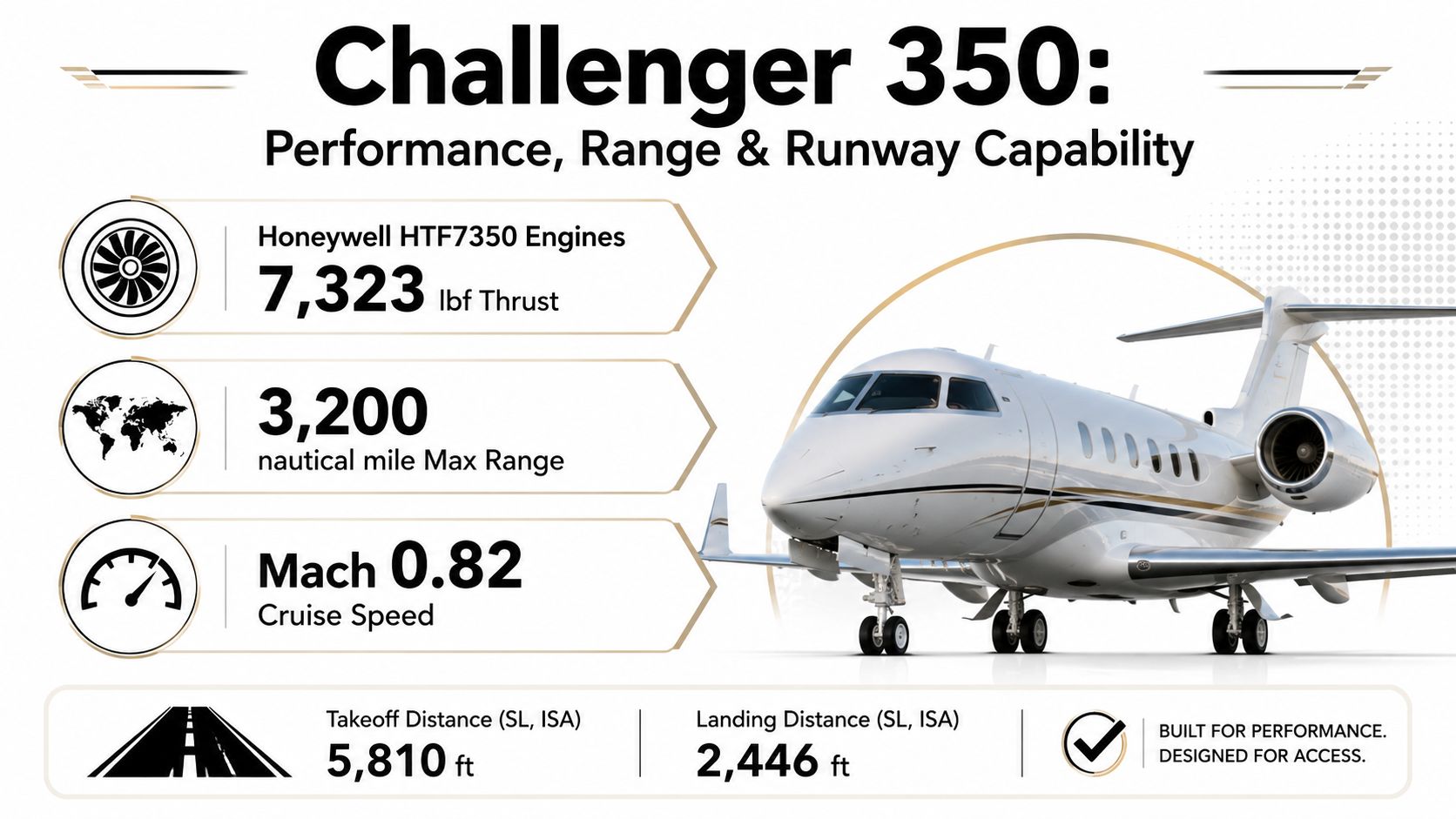
A Challenger 350 quote only makes sense if the aircraft can work for the trip you want to fly. The performance profile starts with two Honeywell HTF7350 turbofans, each rated at 7,323 lbf of thrust, which gives the jet the climb and cruise behavior charter buyers expect from a true super-midsize aircraft (Bombardier brochure). That engine setup is not just a brochure talking point, it affects whether the jet can get in, get out, and keep the schedule intact.
I look at the numbers in three parts. Range tells you whether the route can be done without a stop. Cruise speed tells you how long passengers sit onboard. Runway performance tells you which airports are realistic, which matters just as much as the cabin size on a charter trip.
How the numbers translate into planning
According to the Bombardier brochure, the Challenger 350 reaches a maximum range of 3,200 nautical miles (5,926 km) at a high-speed cruise of Mach 0.82, with a top speed of Mach 0.83 and capacity for up to 10 passengers. That puts many standard business and leisure routes within reach without forcing a fuel stop, which is the primary test charter clients care about.
The ceiling matters too. A 45,000-foot service ceiling lets the aircraft cruise above much of the weather and airline traffic, which helps smooth out the ride and often gives dispatchers more routing flexibility (AOPA aircraft guide). On paper, that sounds technical. In practice, it gives operators more room to work around congestion and weather layers without pushing the trip into a less convenient aircraft category.
Runway performance is where the Challenger 350 earns its place on charter shortlists. Bombardier and Aviation Week note a takeoff distance of about 4,835 ft at MTOW under sea-level ISA conditions and a landing distance around 2,364 ft at typical landing weight (Aviation Week aircraft overview). That opens up shorter business airports and FBOs that larger jets cannot use as reliably, which is one of the few ways to save real time on the ground.
A short runway does not make the trip glamorous. It gets you closer to the meeting, the resort, or the home base.
Practical range is different from marketing range. Independent flight-analysis discussion puts real-world endurance closer to about 6 hours with reserves, and notes that some long sectors, including London to New York with a full load, can exceed the jet's comfortable envelope (Infinite Flight community analysis). That is the right way to judge it. The Challenger 350 is a strong transcontinental charter jet, but if you need a full-cabin, no-compromise Atlantic crossing, another aircraft class is the better choice.
Cabin Experience and Passenger Comfort
The Challenger 350 cabin works because it feels usable, not ornamental. Adults can move around naturally, conversations stay easy, and the layout supports business travel without making the flight feel cramped. For charter clients, that matters more than polished marketing language.
The practical cabin picture is straightforward. The aircraft is commonly configured for up to 9 or 10 passengers, and charter listings often include Wi-Fi, a refreshment center or full galley, an enclosed lavatory, and baggage space suited to business and leisure trips. Cabin layouts differ by tail number, so the exact interior you get depends on the specific aircraft you book, not just the model name.
What passengers actually notice
The most underrated comfort feature is cabin altitude. At cruise, the Challenger 350's stand-up cabin design and controlled pressure environment help make longer legs feel less punishing than they would in a tighter jet. That does not make it a living room in the sky, but it does make working, eating, and resting easier.
Noise matters too. The Challenger 350 is known in charter circles for being quiet enough that people can talk without feeling like they're shouting across the cabin. That becomes a real advantage on work trips, when the cabin needs to function as a moving conference room rather than a luxury showroom.
Because charter inventories vary, smart buyers ask for the details before they commit. Confirm the cabin layout, the seat count, and whether the aircraft has the amenity set your group needs. If you're traveling with pets, request the policy in writing. If you need catering, ask whether it's sourced locally or loaded from the departure airport.
A few booking checks pay off every time:
- Cabin layout: verify the seat arrangement, not just the maximum passenger count.
- Connectivity: confirm Wi-Fi availability before you assume it's installed.
- Pet handling: get the policy and any restrictions in advance.
- Ground transport: line up vehicles early if you're using a smaller FBO.
- Bags and sports gear: ask how the specific tail handles irregular luggage.
The runway figures matter here too. The Challenger 350 and 3500 require about 4,835 ft of takeoff distance at MTOW under sea-level ISA conditions and a landing distance around 2,364 ft, which expands access to shorter business airports many larger jets can't use as reliably (Aviation Week aircraft overview). That's comfort in a different form. It means less ground transfer time and more predictable door-to-door scheduling.
Challenger 350 Compared to Citation Latitude and Phenom 300
The Challenger 350 does not win every charter. Anyone who tells you it does is selling, not advising. You should compare it directly against the Citation Latitude and Phenom 300, because those are the aircraft that usually compete for the same trip.
The Citation Latitude can be attractive when a buyer wants a similar mission profile with a slightly leaner cabin and a lower hourly number. The Phenom 300 makes sense when the route is shorter, the group is smaller, and the price sensitivity is real. The mistake is choosing a jet by habit instead of by mission.
| Specification | Challenger 350 | Citation Latitude | Phenom 300 |
|---|---|---|---|
| Best fit | Transcontinental business and leisure missions | Balanced midsize trips | Shorter regional hops |
| Cabin size | Larger super-midsize cabin | Smaller cabin than the Challenger 350 | Smaller cabin than the Challenger 350 |
| Range | 3,200 nautical miles (Bombardier brochure) | Similar range in charter comparisons | Not suitable for nonstop transcontinental missions |
| Typical charter logic | Choose for more room and fewer compromises | Choose when cabin size can be trimmed | Choose when cost and speed on short legs matter |
| Route fit | Coast-to-coast and many long domestic sectors | Good for many domestic missions | Better for shorter nonstop trips |
How to make the right call
If the trip is New York to Miami, both the Challenger 350 and Latitude deserve a look. If the group includes more people, more bags, or a higher expectation of cabin comfort, the Challenger usually earns the booking. If the mission is a quick regional business loop, the Phenom 300 can be the smarter aircraft because you're not paying for unused range and cabin volume.
The Phenom 300 is the one to beat on short missions, and if that's your profile, the numbers should be checked against a dedicated aircraft page like the one at Haute Jets' Phenom 300 listing. The point is not to sell up. The point is to stop overbuying aircraft when a lighter jet will do.
If you don't need the extra cabin and you're flying under three hours, don't pay for the Challenger 350 just because it sounds more serious.
For a charter buyer, the decision criteria are simple. Count the passengers. Measure the baggage. Look at the airport pair. Then ask whether the mission needs the Challenger 350's combination of cabin size, runway flexibility, and long-range capability.
Typical Charter Pricing and Popular Routes
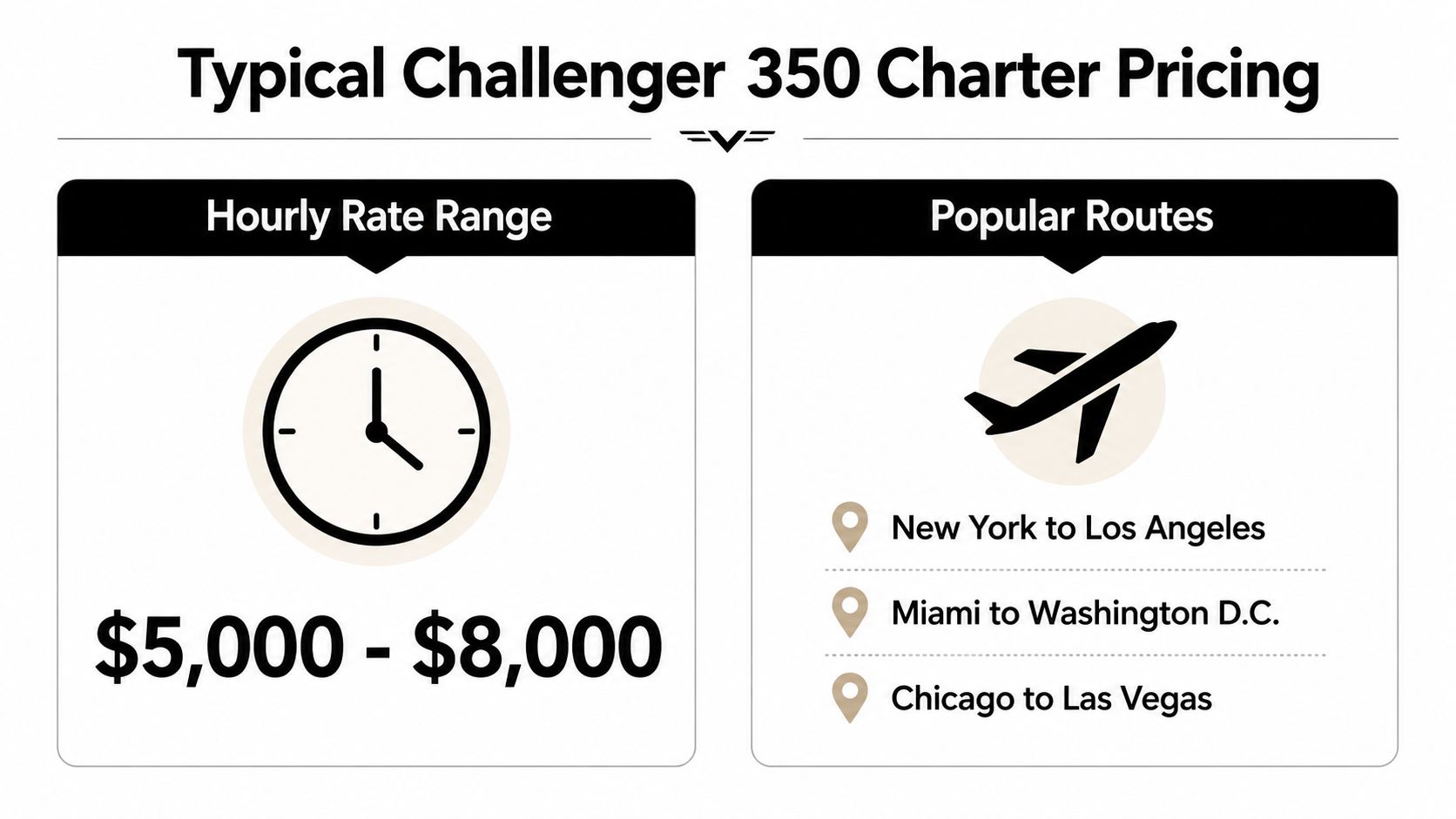
A Challenger 350 quote starts with one question, where is the aircraft sitting right now. If the jet is already based near your departure airport, pricing stays tighter. If it has to be ferried in from another city, the bill climbs fast because you are paying for positioning, crew time, and scheduling friction.
That is why two identical trips can produce very different numbers. Miami often has stronger local inventory than a smaller airport, so the same aircraft type can come back at a cleaner price in one market and a heavier quote in another. Charter buyers who ignore local sourcing usually overpay.
The market also gets pushed up by repositioning. Traditional brokers and jet card programs can add empty-leg movement to the bill, and that is where the hidden cost shows up. Haute Jets says repositioning fees can inflate charter prices by 20 to 40 percent when the aircraft has to fly empty to the departure city (Haute Jets).
What drives the quote in practice
A Challenger 350 quote is usually a mix of the aircraft, the route, and the trip logistics. A busy metro with several locally based aircraft is often cheaper than a smaller city that needs repositioning. Add overnight crew time, special catering, or a tight schedule, and the number moves quickly.
Fleet depth matters too. The Challenger 350 is widely available in charter networks, with one industry source saying Bombardier has delivered more than 700 units and another noting over 450 in service, which helps explain why it is often available on short notice in major regions (Villiers article). In practical terms, a deeper fleet gives charter buyers more room to avoid repositioning and reduce waste in the quote.
When I review a Challenger 350 price, I ask three things immediately:
- Where is the aircraft based? Local sourcing can save real money.
- What is the exact tail number? The interior and amenities matter.
- What is included? Fuel, crew, catering, and ground handling can all shift the final number.
The routes people ask about are predictable for a reason. New York to Miami is a standard business run. Los Angeles to Aspen requires runway awareness and sensible payload planning. Miami to London pushes the aircraft toward the outer edge of its practical comfort zone, so that trip deserves a hard look before anyone calls it a clean nonstop.
The smart move is simple. Do not accept the first quote without checking where the aircraft is coming from. If the jet is already near your departure airport, you are in a better position to avoid unnecessary empty positioning and keep the pricing cleaner.
Safety Standards and Operator Vetting
A Challenger 350 is only as good as the operator flying it. Aircraft model matters, but operator quality matters more. If the charter company can't show solid third-party safety audits, I would walk away without debating the cabin.
Two names matter most here, Wyvern Wingman and Argus Gold/Platinum. Those are the highest third-party safety standards most charter buyers will hear about, and they're the ones I want to see before anyone talks about catering or seat color. Haute Jets states that every operator in its network holds one of those ratings, and it describes them as the two highest third-party safety audits in private aviation (Haute Jets safety, Haute Jets).
What to verify before you book
You don't need to be an aviation insider to vet a charter operator. You just need a process.
- Ask for the operator name. Don't settle for a vague broker promise.
- Check the safety rating. Look for Wyvern Wingman or Argus Gold/Platinum.
- Confirm the actual aircraft. The tail number should match the proposed trip.
- Review crew and maintenance standards. If the provider won't share basic information, that's a problem.
- Use the operator's own documents. Don't rely on marketing copy.
The reason this matters is simple. The safest-looking aircraft on a quote sheet can still be a bad booking if the operator cuts corners. The reverse is also true. A normal-looking Challenger 350 flight can be extremely well run if the operator has strong audit results and disciplined procedures.
Non-negotiable: if the operator can't clear a top-tier third-party safety audit, keep shopping.
I'd rather take a slightly less convenient departure time with a vetted operator than accept a nicer itinerary from an unknown one. The flight is the product. The operator is the brand.
How to Book a Challenger 350 Through Haute Jets
Most charter buyers don't need more aircraft jargon. They need a clean way to get the right jet, from the right city, at a price that doesn't include avoidable repositioning. That's where the booking process should be judged, not on glossy promises but on how many decisions it makes easier.
Haute Jets says it sources from 3,500+ owner-operators across 175 countries, with no membership fees, no jet cards, and direct-to-owner pricing on the exact aircraft chosen (Haute Jets). That matters because it changes the quote from a packaged product into a mission-specific search, which is how Challenger 350 charters should be handled.
The best bookings start with the aircraft details, not the city name. Ask for the exact year, make, model, and cabin layout. Then confirm the practical extras that affect the flight, including Wi-Fi, catering, pet policy, and ground transportation.
The sequence should be tight:
- Submit the mission: city pair, passenger count, timing, and baggage.
- Specify the aircraft: Challenger 350, exact tail if you care about cabin fit.
- Confirm the service items: catering, pets, Wi-Fi, and ground transport.
- Review the flight file: tail number, crew bios, weather briefing, and passenger manifest.
- Lock it in early: same-day availability is common in major metros when the network has nearby aircraft.
A video briefing can help when a client wants to see the process before they book.
Direct-to-owner sourcing matters most when the departure city isn't a major jet base. If the aircraft is already near you, the math gets cleaner because you're less likely to pay for empty repositioning. If the jet has to come from far away, the quote should reflect that transparently, not hide it inside a bigger package.
If you want the Challenger 350 booked the way it should be booked, use a provider that lets you choose the exact aircraft instead of forcing you into a category. Request a quote when you're ready to compare local availability, cabin layout, and mission pricing without wasting time on generic broker inventory.
If you're planning a Challenger 350 trip, book the aircraft around your route, not the other way around. Haute Jets can source the exact jet, confirm the cabin and operator details, and keep the quote tied to the city pair you need.