
You're probably looking at a trip from Cheyenne and running into the same problem most travelers hit. Commercial schedules don't line up, connections waste half a day, and driving to a larger airport defeats the point of moving fast. Private charter fixes that, but only if you book it the right way.
Regional airports are where first-time charter clients often overpay. Not because the flight itself is unusually complex, but because the quote can hide aircraft positioning costs, weak aircraft matching, and vague safety standards. If you want a smart Charter Cheyenne WY booking, you need to know what drives the price and which details matter before you sign anything.
Private aviation is also no longer some niche corner of travel. The global private jet charter market was projected at approximately $48.1 billion in 2026, up 13.5% year over year from $24.1 billion in 2025, with around 2.75 million business-jet flights conducted globally in 2025. Demand is real. That makes strategy more important, not less.
This article appears on Haute Jets Journal because this is exactly the kind of market where generic booking sites leave out the details that matter.
Chartering Your Flight from Cheyenne Wyoming
A flight out of Cheyenne usually starts with a practical need, not a fantasy. You need to get to a meeting, a ranch, a ski destination, a family property, or a connecting long-haul trip without burning time on airline schedules that don't serve your plan.
That's where private charter earns its keep. You choose the departure time, skip the standard terminal process, and fly closer to your actual destination. But if you're leaving from a regional airport like Cheyenne, you can't treat the booking the same way you'd treat a departure from a major metro.
What makes Cheyenne different
Cheyenne gives you flexibility. It also demands precision.
A regional airport often has fewer aircraft physically based on the field at any given moment. That means the aircraft in your quote may need to fly in before your trip even starts. If your broker doesn't spell that out, you're paying for movement you didn't ask for.
Practical rule: At a regional airport, the first quote is rarely the best quote. Ask where the aircraft is coming from before you ask whether the hourly rate looks fair.
That's the first mindset shift. Don't shop Charter Cheyenne WY options by category name alone. Shop by mission, aircraft location, and operator quality.
The right way to approach your first booking
Start with three decisions:
Define the mission clearly.
Is this a short regional hop, a same-day business out-and-back, or a cross-country itinerary with bags, pets, and multiple passengers?Give a real departure window.
Flexibility helps. Even a modest time window can open up better aircraft placement and cleaner routing.Ask for a fully itemized quote. You want to see whether the aircraft is local, whether crew overnights are involved, and whether the quoted airplane fits the trip.
If you skip those basics, you'll likely get a glossy quote that looks simple and costs more than it should.
Why this matters for new charter clients
First-time clients usually assume private charter is expensive because the aircraft is luxurious. Sometimes it is. More often, the waste comes from logistics.
Cheyenne can be a very efficient departure point. But only if someone builds the trip around the airport's reality instead of forcing a generic national pricing model onto a regional mission.
Selecting the Right Airport and Aircraft
Cheyenne Regional Airport, identified by CYS, is the logical departure point for most local private charters. If you haven't chartered before, you'll also hear the term FBO, or Fixed-Base Operator. That's the private terminal where you check in, meet your crew, and board without going through the standard commercial terminal routine.

If you want a broader primer on how private terminals work, this private jet airport guide is useful before your first departure.
Use CYS unless the mission says otherwise
Most travelers instinctively ask whether they should reposition to Denver first. Usually, that's the wrong move.
Departing directly from CYS keeps the day simple. You reduce ground transfer time, keep your itinerary tighter, and avoid turning a private flight into a half-private, half-car-service workaround. The exception is when the aircraft you need for a specific mission isn't practical from Cheyenne at the time you want to depart.
Match the aircraft to the route
The biggest mistake I see is overbooking airplane and underthinking mission.
For markets like Cheyenne, success rates for aligning aircraft mission profiles with regional demand exceed 85%, especially when operators keep light jets on routes under 1,500 miles to maximize fuel efficiency. That rule matters because it affects both price and performance.
A simple way to think about it:
| Trip type | Better fit | Why it works |
|---|---|---|
| Short regional hop | Turboprop or efficient light jet | Lower operating burden and better economics |
| Mid-range business trip | Phenom 300 or similar light jet | Strong speed-to-cost balance |
| Cross-country mission | Challenger 350 or larger cabin | Better range, comfort, and baggage flexibility |
A Phenom 300 makes sense when you want a fast regional or mid-range trip with a small group. A Challenger 350 is the better answer when you're flying farther, carrying more bags, or want a cabin that doesn't feel tight halfway through the day.
Don't ignore the turboprop option
A lot of first-time clients ask for a jet because they assume “private” means “jet.” That's not always smart.
For certain shorter trips, a turboprop can be the cleaner decision. The goal isn't to impress yourself with a category label. The goal is to get the right aircraft for the distance, passengers, luggage, runway conditions, and total trip cost.
If your route is short and your party is small, asking for a jet by default can be the fastest way to overspend.
Here's a useful overview before you compare categories:
Questions you should ask before approving an aircraft
- Where is the aircraft based? If it isn't near Cheyenne, your quote may already be carrying avoidable cost.
- How many passengers and how much baggage fit comfortably? Not technically. Comfortably.
- Is the route short enough for a lighter aircraft to make sense? That's where strong value usually lives.
- Do you need stand-up cabin space or a larger enclosed lav? For some travelers, that's not a luxury issue. It's a practical one.
Pick the airplane for the trip you are taking, not the one you imagine private aviation is supposed to look like.
How to Avoid Hidden Charter Costs from Cheyenne
The most common pricing mistake in Charter Cheyenne WY bookings is assuming the quoted flight starts when you board. It often doesn't.
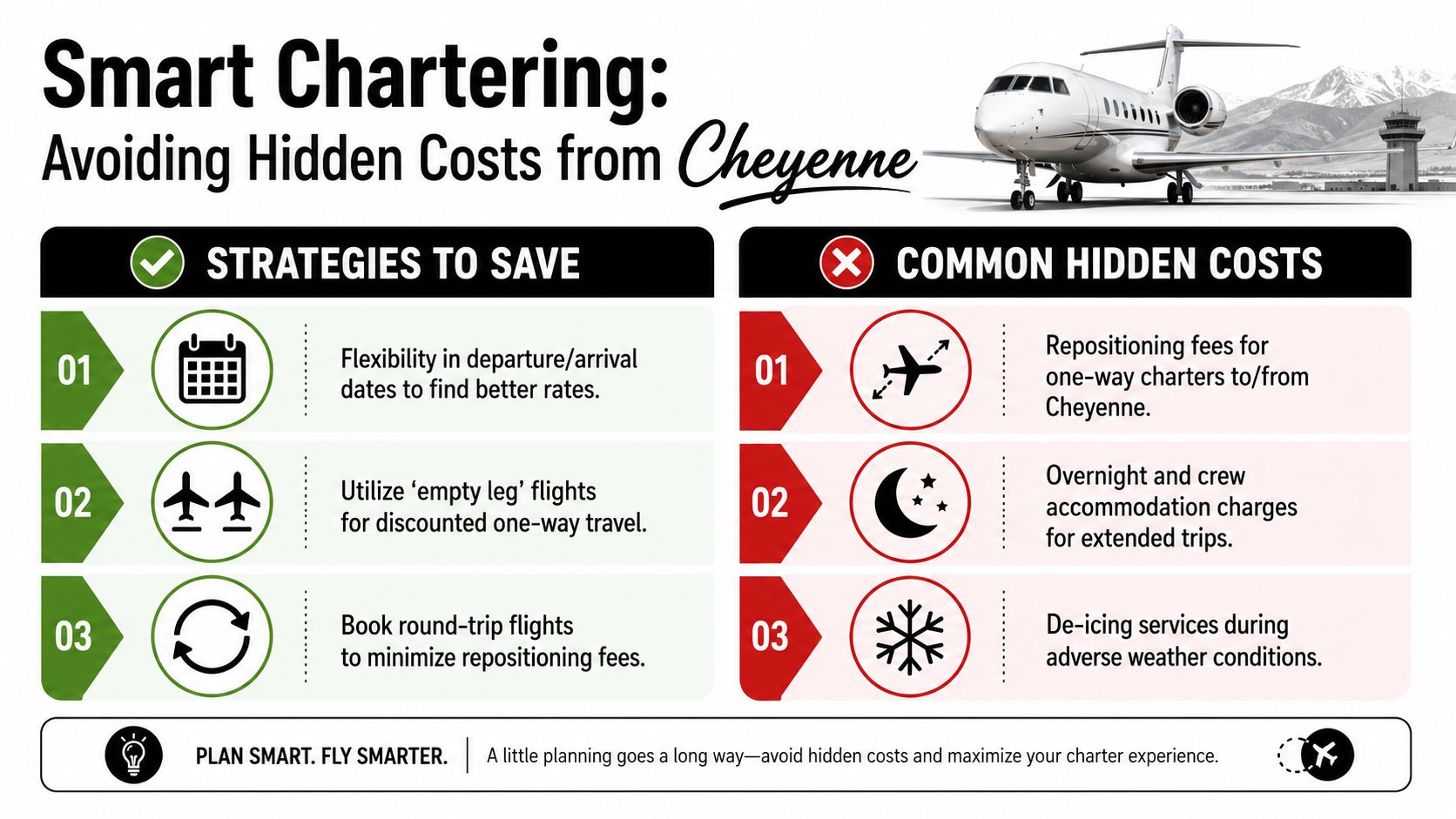
If the aircraft isn't already near Cheyenne, someone has to move it into position. That repositioning leg costs money, and many clients don't realize they're paying for it until the quote is already on the table.
What repositioning fees actually are
A repositioning fee is the cost of getting the aircraft to your departure airport, and sometimes returning it afterward if your trip is one-way. At major hubs, that cost can be less noticeable because more charter aircraft are already nearby. At regional airports, it's often the main reason one quote is dramatically higher than another.
The problem isn't theoretical. Industry data confirms traditional brokers inflate charter prices by 20 to 40 percent due to repositioning fees for flights to non-major hubs like Cheyenne, and that cost can be eliminated by sourcing a locally based jet.
That's why a generic hourly quote tells you almost nothing.
The fix is local sourcing
If you want to cut waste, source the aircraft as close to Cheyenne as possible. That can mean an aircraft already at CYS, or one positioned in a nearby market such as Denver or Colorado Springs if it creates a cleaner total route.
This is the part generic booking sites usually miss. They'll show aircraft type and broad pricing language, but they won't explain how aircraft location changes the economics of your trip.
For a better sense of how charter pricing works beyond the surface number, review this breakdown of private jet charter cost.
What else can move the quote
Repositioning is the big one, but not the only one. Watch these line items:
- Crew overnights: If the aircraft and crew must wait for you, your quote may reflect hotel and duty-related logistics.
- Weather-related services: In Wyoming, winter operations can introduce de-icing or weather handling complexity.
- One-way inefficiency: One-way flights can be excellent, but only if the aircraft's next movement makes sense.
- Date rigidity: If you're locked into one narrow departure point with no flexibility, you reduce your broker's ability to find a better-positioned aircraft.
The cheapest-looking quote is often the one with the least explanation. That should make you cautious, not comfortable.
Smart ways to reduce cost without lowering standards
Try this checklist before you book:
Ask where the aircraft is based.
If the answer is vague, keep asking.Check nearby sourcing markets.
A plane close to Cheyenne is usually better than a plane that merely looks attractive on paper.Consider an empty leg if your schedule is flexible.
These can work well for one-way travelers, though they require tolerance for specific timing and routing.Price the round-trip structure carefully.
Sometimes keeping the aircraft with you is more efficient than releasing it and paying for awkward repositioning later.
The hidden-cost problem in Cheyenne isn't private aviation itself. It's lazy trip construction.
Ensuring Top-Tier Safety for Your Flight
A legal charter operator isn't automatically the operator you should fly with. FAA certification is the floor. It is not the finish line.
If you're booking a private flight from Cheyenne, insist on third-party safety screening that goes beyond the regulatory minimum. In practice, that means looking for Wyvern Wingman or Argus Gold/Platinum standards.
Why those ratings matter
These audits examine the operator in a deeper way than a casual client can. They're built to evaluate operating discipline, pilot standards, maintenance oversight, and the broader safety culture behind the flight.
If you're comparing options and one operator has that level of review while another states it's compliant, that's not an even comparison.
Haute Jets limits its charter network exclusively to operators holding a Wyvern Wingman or Argus Gold/Platinum rating, recognized as the two highest third-party safety audits in private aviation. If you want a practical benchmark for what strong standards look like, their private jet safety standards are worth reviewing.
What to ask before you board
Don't ask vague questions like “Is this safe?” Ask specific ones.
- What third-party audit rating does the operator hold?
- Is the flight operated under Part 135 charter authority?
- Are the pilots ATP-certified, and what experience profile does the operator require?
- Will I receive aircraft and crew details before departure?
Those questions force clarity.
Non-negotiable: If a broker can't give you a direct answer on operator rating and flight authority, stop the booking process.
Safety should remove uncertainty
Good charter planning makes the flight feel effortless. Good safety standards make the effortlessness possible.
You shouldn't have to do detective work on the operator the night before departure. You should know who is flying you, under what standards, and why that operator made the cut in the first place.
From Booking to Takeoff The Seamless Process
A well-run private charter doesn't feel complicated from the client side. It feels organized. That only happens when the broker does the hard work early.
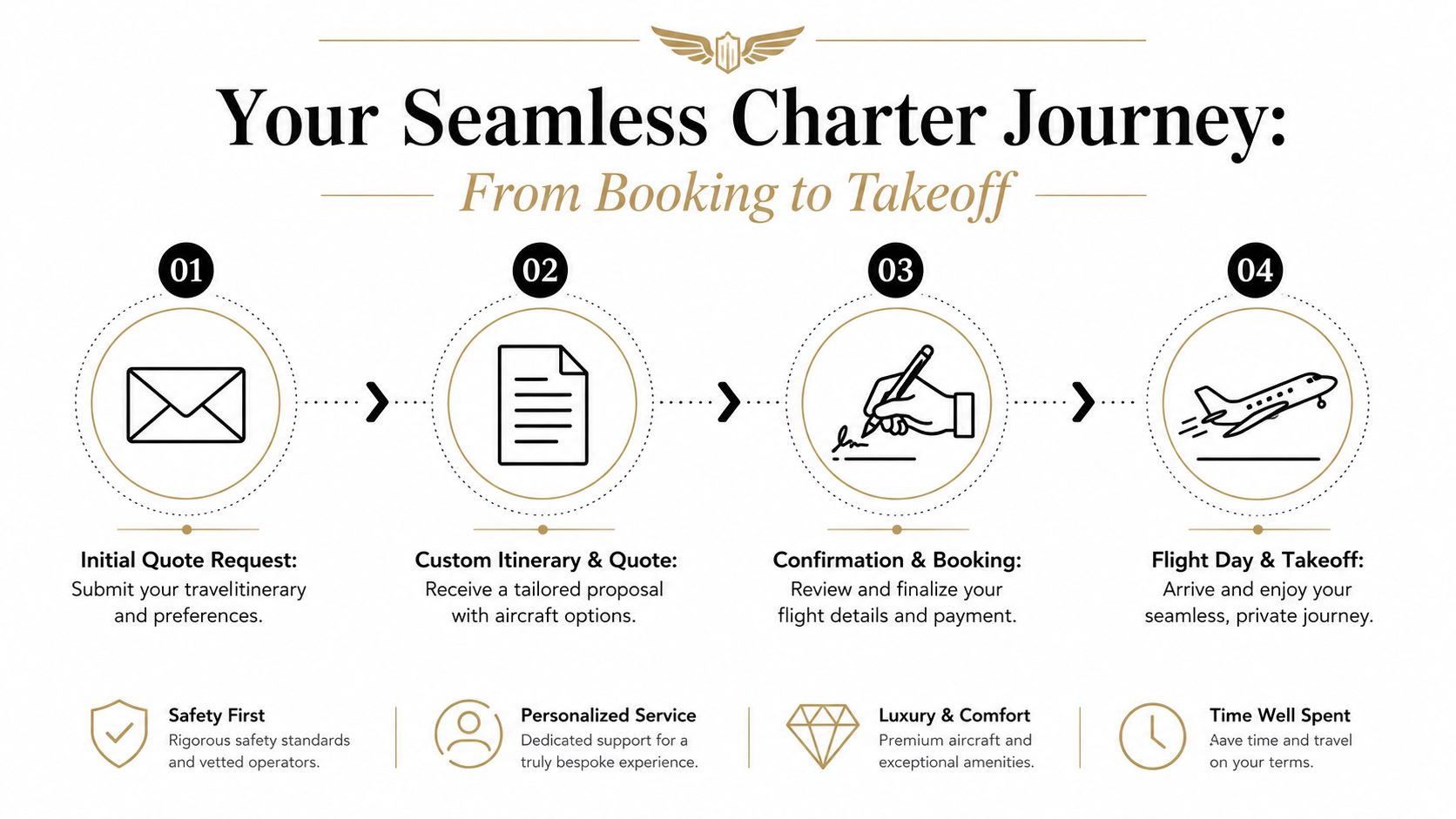
The best way to understand the process is to follow a typical booking from first inquiry to wheels up.
Step one starts with a real itinerary
A client calls from Cheyenne. They need an early departure, want to bring a pet, need return flexibility, and don't want a generic “light jet” quote. That last part matters.
The brokerage should ask for the actual mission details, not just city pairs. Passenger count, luggage profile, preferred departure window, ground transportation, catering requests, and whether this is a same-day turn or a multi-day itinerary all affect which aircraft is suitable.
Then the aircraft options get specific
Serious brokerage separates itself from category shopping.
The Haute Jets brokerage sources aircraft from a verified network of 3,500+ owner-operators across 175 countries, allowing clients to select the exact aircraft by year, make, and model, not just a generic category. That matters because “midsize jet” can mean very different cabin conditions, baggage access, and onboard amenities depending on the actual tail.
A proper proposal should tell you:
| Booking detail | What you should receive |
|---|---|
| Aircraft option | Exact year, make, and model |
| Cabin details | Layout, baggage suitability, amenities |
| Operating terms | Departure window, routing logic, key restrictions |
| Client logistics | Catering, pets, ground transfer notes |
Confirmation should remove surprises
Once you choose the aircraft, the booking moves into execution. Documents are finalized, payment is handled, and the operations team starts locking down every practical detail.
First-time clients usually appreciate charter the most, as you're not bouncing between an airline app, a car service, and an airport desk. One process handles the trip.
A strong pre-flight workflow includes:
- Ground transportation coordination: Car service to the FBO, with the address and timing confirmed.
- Cabin preferences: Specific catering, beverage requests, and any accessibility or privacy needs.
- Pet handling: Breed, crate requirements if any, and any operator-specific rules.
- Passenger manifest review: Names and travel details checked in advance.
The smoother the flight day feels, the more work was done before flight day.
The final twenty-four hours matter most
It is here that confidence gets built. You should receive the final operating details before departure so there's no ambiguity at the terminal.
That typically includes the tail number, the crew information, the final itinerary, and practical notes tied to the departure. If weather is relevant, you want that surfaced early. If the FBO has a specific arrival procedure, you want that in writing.
On flight day, you arrive at the private terminal, check in quickly, meet the crew, and board. No long security line. No gate change. No guessing.
That's what clients are buying when they book private charter from a regional airport. Not just an airplane. A controlled day.
Key Takeaways for Smart Cheyenne Charters
The smartest Charter Cheyenne WY booking isn't the one with the flashiest aircraft or the fastest quote. It's the one built around the realities of a regional departure.
If you remember only four things, remember these.
First, protect the economics
At Cheyenne, aircraft location matters as much as aircraft type. A beautiful airplane positioned badly is still the wrong airplane. Local sourcing is the cleanest way to avoid wasted spend and keep the quote tied to your trip instead of someone else's aircraft movement problem.
Second, match the cabin to the mission
A short hop doesn't automatically need a jet. A long day with several passengers and meaningful baggage doesn't belong on an aircraft chosen only because the hourly number looked attractive.
Use distance, passenger count, comfort expectations, and baggage needs to make the decision. Smart charter clients don't buy category labels. They buy fit.
Third, treat safety standards as a filter
Don't debate this point with yourself. If the operator doesn't meet elite third-party safety benchmarks, move on.
That decision simplifies everything else. It narrows the field to operators worth considering and removes the false economy of cutting corners where you should never cut corners.
Fourth, get the logistics right before the flight day
Private charter works best when the details are settled early. Ground transfers, catering, pet approvals, exact aircraft details, and final flight paperwork should be handled before you head to the FBO.
Here's the smart traveler's playbook in one quick list:
- Demand aircraft-location transparency: Ask where the plane is based before evaluating the quote.
- Choose the mission-fit aircraft: Don't overspend on range or cabin you don't need.
- Require elite safety screening: Wyvern Wingman or Argus Gold/Platinum should be your baseline.
- Confirm the entire day: Car service, manifest, catering, and terminal instructions should all be locked in.
Cheyenne can be a highly efficient private charter market if you know what to watch. If you don't, it's easy to approve a quote that looks polished and performs poorly.
If you want expert help booking the right aircraft without paying for unnecessary repositioning, Haute Jets is built for exactly that. Their team sources from a large global network, focuses on locally positioned aircraft when possible, and gives clients clear visibility into the exact jet, operator standards, and pre-flight details before departure.