

Charter flights in Miami start from about $3,500 per hour, with sample Bahamas trips running $3,500–$7,000 and Miami to Aspen around $18,000. The airport you choose and the operator network behind the quote often drive the final number more than the advertised hourly rate.
That distinction matters in Miami. A quote from a private airport can be operationally cleaner than one built around Miami International, while a locally positioned aircraft can avoid the repositioning charges that turn a reasonable estimate into an expensive one. For a first booking, don't ask only which jet is available. Ask where it will depart, who operates it, whether customs is handled on site, and how many ferry hours are included.
This is the practical briefing for charter flights in Miami in 2026, written for travelers who want the right aircraft, the right airport, and a clear explanation of the trade-offs before committing funds. It also appears on Haute Jets Journal, alongside the publication's Miami private jet travel guide.
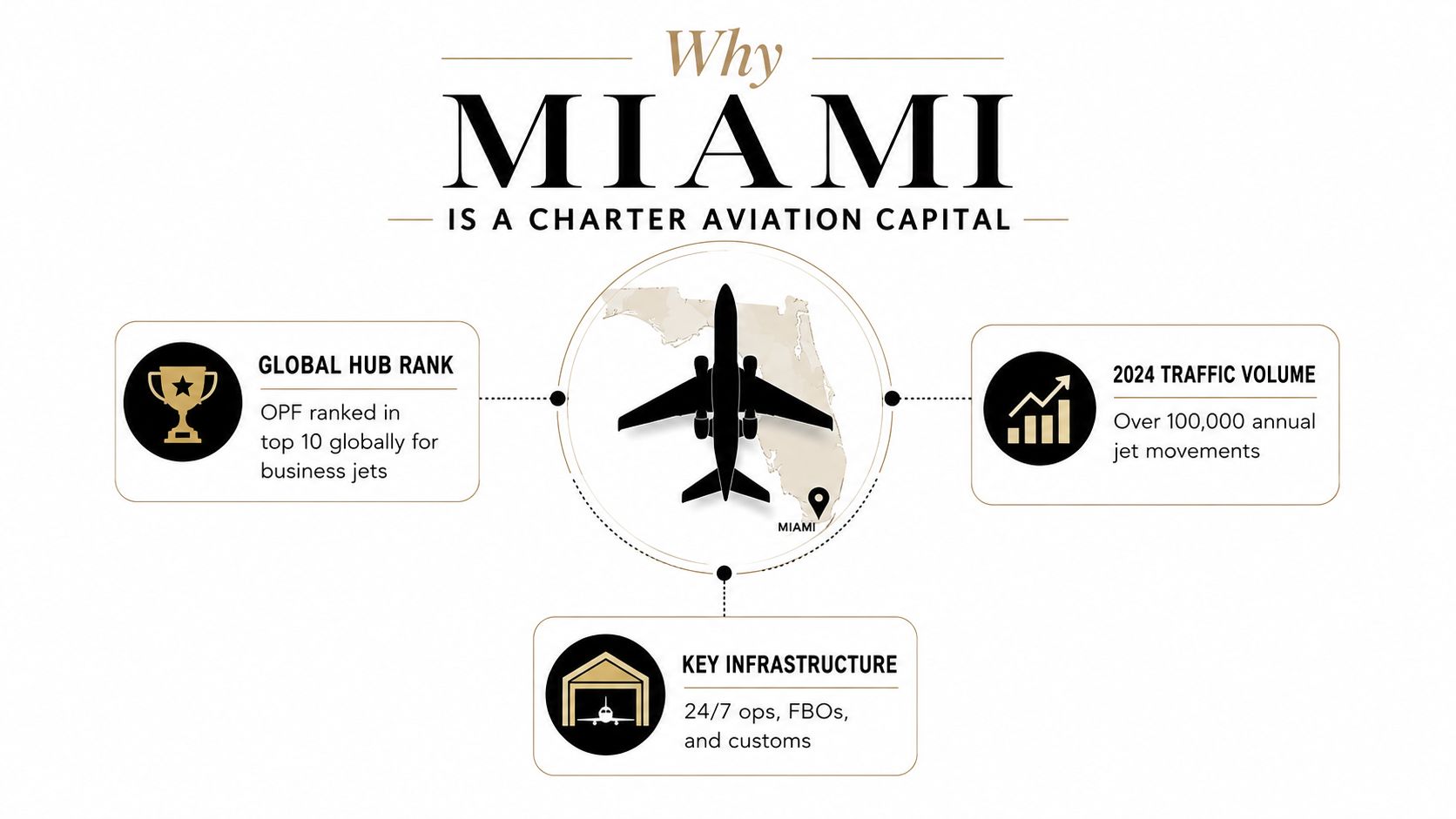
Why Miami Is a Charter Aviation Capital
Miami's aviation importance isn't a recent luxury-travel development. The city's original airport site began operations in 1928, when Pan American Airways moved operations from Key West to Miami and opened Pan American Field, according to the Miami International Airport historical record. Pan American Field was built on 116 acres, and scheduled connections to cities including St. Petersburg, Chicago, Newark, and later Europe helped establish Miami as a gateway between the United States, the Caribbean, and Latin America.
The airport's passenger-first design is especially relevant to charter aviation. Miami developed around high-touch, point-to-point travel before private aviation became a mainstream commercial product. That legacy still shows up in the region's airport mix, customs capability, FBO network, maintenance support, and experienced flight crews.
Scale creates options, not automatic value
Miami International Airport handled 55,702,982 passengers in fiscal year 2024, an 8.0% increase from fiscal year 2023, and reported that it passed 55 million passengers for the first time in its history, according to the airport's 2024 Annual Comprehensive Financial Report. Domestic traffic reached 30.8 million passengers, while international traffic rose to 2.1 million, with the airport reporting increases of 7.3% and 9.0%, respectively, over the prior year.
Those figures don't mean a private client should automatically depart from MIA. They show why the wider Miami market supports deep aviation infrastructure. A large commercial ecosystem usually brings more maintenance providers, crew resources, ground handlers, catering companies, customs expertise, and FBO choices. Miami also has a long general aviation history. A published airport history source recorded 12,000 general aviation aircraft operations in the year ending July 10, 2008, an average of 32 per day.
For a premium traveler, density creates opportunity. A broker with access to nearby aircraft can compare departure airports instead of accepting the first available tail from a distant base. That can improve scheduling and reduce unnecessary repositioning, but only if the broker searches the local market.
Miami rule: Volume guarantees options. It doesn't guarantee that your first quote uses them.
Luxury travelers also compare the cost of the full travel experience, not only the aircraft. For a useful perspective on what commercial carriers charge for onboard extras, you can compare airline wine pricing. That comparison won't replace a charter quote, but it reinforces the difference between a headline fare and the complete cost of a journey.
The smart approach is simple. Start with the mission, identify the most suitable airport, then request aircraft and operator options from that location. Miami's history and scale give you choices. Good planning turns those choices into value.
Choosing the Right Miami Airport for Your Mission
Airport choice can affect customs, runway margin, ground time, and the aircraft available for your trip. Set the departure field around the mission, not habit or name recognition. OPF, TMB, MIA, and FLL each solve a different problem.
Opa-locka Executive Airport, OPF or KOPF, is the strongest starting point for many international private charters. Its 8,002-foot longest runway, on-site customs, and port-of-entry capability support heavy and long-range business jets, according to this Opa-locka Executive Airport overview. For the Bahamas, Caribbean, and Latin America, OPF usually offers the best balance of international capability and private-terminal convenience. Review the Opa-locka Executive Airport charter details before choosing an FBO.
Miami Executive Airport, TMB or KTMB, suits regional missions and travelers who want a quieter private-aviation setting. Its longest runway is 6,000 feet, with on-site port-of-entry services, as detailed in this Miami Executive Airport guide. TMB fits light and midsize aircraft, domestic trips, and itineraries where a calmer ramp experience matters more than maximum runway margin.
Miami International Airport, MIA or KMIA, offers the greatest runway length but also the most airline activity. Its runway reaches 13,016 feet, giving larger-cabin aircraft useful operating margin. Shared airspace, airline traffic, commercial ground infrastructure, and longer taxi or coordination times are the trade-offs. Choose MIA when the aircraft, destination, or connecting itinerary requires it, not just because it is familiar.
Fort Lauderdale, FLL, is the practical alternative when Miami-area availability tightens. It can suit heavy aircraft or clients whose final destination lies north of Miami. Ground time remains the deciding cost. A lower aircraft quote can lose its value when the transfer into Miami adds waiting and coordination.
| Airport | Primary Advantage | Customs/Immigration | Ideal Mission Profile |
|---|---|---|---|
| OPF | Private-aviation focus and runway suitable for heavy and long-range jets | On-site customs and port-of-entry capability | International leisure, Caribbean, Latin America, and larger-cabin missions |
| TMB | Lower-friction regional private aviation | On-site port-of-entry services | Domestic and regional flights on light or midsize aircraft |
| MIA | Long runway and broad commercial connectivity | International airport infrastructure | Larger aircraft, commercial connections, or itineraries requiring MIA |
| FLL | Useful South Florida alternative when Miami fields are constrained | Confirm the specific customs arrangement for the itinerary | North Miami destinations, alternate departures, and availability-driven planning |
Airport selection should come before comparing hourly rates. Seasonal demand and aircraft location can change the quote, while Wyvern and ARGUS-only sourcing across 3,500+ owner-operators can reduce the 20–40% repositioning premium traditional brokers may charge.
Practical rule: Choose the airport that minimizes total trip friction, not the airport with the lowest quoted aircraft rate.
Popular Charter Routes from Miami in 2026
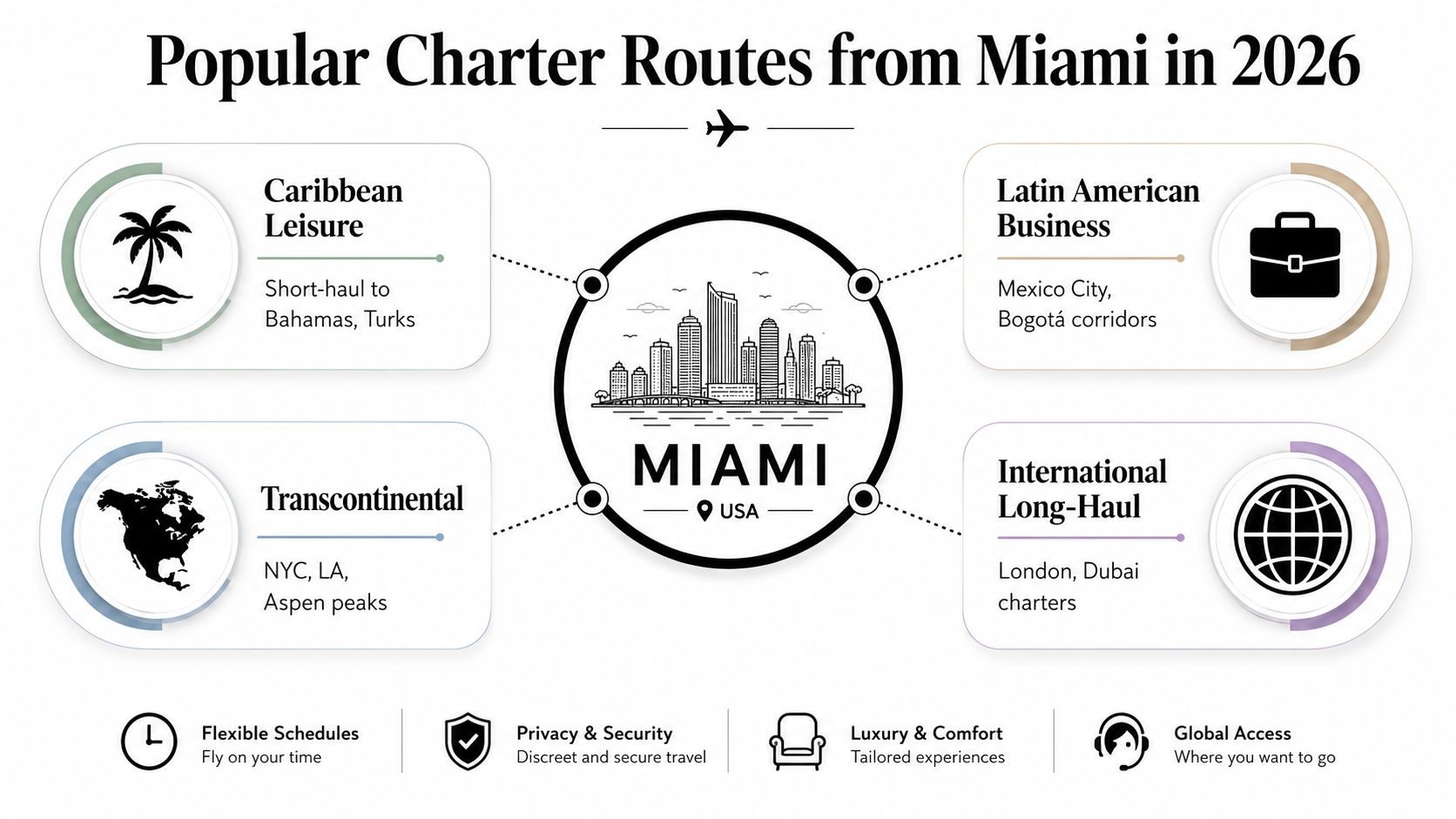
Miami's geography creates distinct charter corridors, and each corridor rewards a different aircraft decision. The mistake I see most often is treating every regional trip as a light-jet mission. For short overwater flights, a turboprop can be the more rational premium product.
The island corridor
The Bahamas and Turks and Caicos remain natural Miami charter markets because the route structure favors point-to-point travel and flexible departure times. A turboprop can be an excellent fit for Nassau, Exuma, Harbour Island, or Eleuthera when the itinerary values practical access and sensible pricing over jet speed. Smaller island airports and baggage requirements need to be checked before booking, particularly when passengers are carrying sports equipment, beach gear, or more luggage than the cabin can comfortably accept.
Current route estimates illustrate the spread. One Miami charter estimate places a light jet to Nassau around $6,650, while another Miami pricing guide lists turboprop Bahamas trips from approximately $3,500–$7,000 and light-jet Miami to Nassau or Exuma trips around $7,500, as shown in this Miami private jet route pricing guide. These are benchmarks, not guaranteed quotes. Aircraft availability, airport selection, passenger count, and trip structure still control the final figure.
Longer domestic and international missions
Aspen is a different mission. It demands more range, cabin capacity, baggage planning, and operational judgment than a short island hop. A midsize aircraft is usually the sensible starting point for a ski itinerary, while a heavy jet becomes appropriate when passenger count, luggage, or comfort requirements increase.
New York routes, including Teterboro and other New York-area airports, favor light or midsize jets for travelers who want efficient point-to-point access. London and Rio de Janeiro require long-range aircraft and more careful planning around crew, customs, weather, and payload.
The pricing contrast is clear from Haute Jets' published benchmarks. Private charter pricing starts from $3,500 per hour, with Miami to the Bahamas listed at $3,500–$7,000 and Miami to Aspen at $18,000 on its private jet pricing page. Don't pay for heavy-jet capacity when a turboprop or light jet meets the mission. Do pay for the range, runway performance, baggage space, and cabin features your route requires.
Seasonal Demand and Pricing Windows
Miami charter pricing changes with demand, but the most important variable isn't a single calendar date. It's the combination of event pressure, aircraft availability, airport capacity, and how much flexibility you give the operator.
Winter demand concentrates around leisure travel, ski destinations, the Bahamas, and other warm-weather escapes. Aspen becomes especially sensitive because aircraft suitable for the route are also in demand from other affluent markets. If your dates are fixed, request options before the same-week market tightens. If your dates are flexible, tell the charter team that flexibility at the start, because it can open aircraft and airport combinations that a rigid request won't reveal.
Spring Break places particular pressure on Bahamas-bound flying. Travelers who focus only on the hourly rate often miss the return-leg problem. A one-way aircraft may be available at an attractive figure, but the operator still has to position it for the next assignment. Ask whether the quote includes ferry time, and compare OPF, TMB, and Fort Lauderdale rather than assuming Miami's most convenient airport is the only option.
Formula 1 Miami creates a different constraint. Event demand can reduce ramp availability and tighten departure options, making airport choice more important than a small difference in the aircraft's hourly rate. A client who waits until the market is compressed may need to pivot to OPF or FLL, accept a less convenient departure time, or select a different aircraft category.
Art Basel also puts pressure on Miami and Northeast travel patterns. Transcontinental aircraft and airport slots can become harder to secure, particularly when travelers are moving between Miami and the New York area. Book the route before the event becomes the organizing principle of the market.
| Season | Peak Dates | Miami to Nassau, Light Jet | Miami to Aspen, Midsize | Miami to Teterboro, Heavy Jet | Smart Booking Window |
|---|---|---|---|---|---|
| Winter | Ski and holiday demand | Request turboprop and light-jet alternatives | Reserve suitable midsize capacity early | Compare heavy-jet availability across OPF and FLL | Book before same-week demand dominates |
| Spring Break | Island-leisure surge | Compare turboprop, light jet, and one-way positioning | Review aircraft availability before committing | Confirm whether a heavy jet is operationally necessary | Lock dates before the peak period |
| Formula 1 Miami | Event-driven Miami demand | Prioritize airport and ramp availability | Match the aircraft to the event schedule | Keep OPF and FLL as practical alternatives | Plan well ahead of event week |
| Art Basel | Miami and Northeast travel pressure | Use airport flexibility where possible | Protect the departure window | Expect tighter transcontinental availability | Secure the aircraft before event demand compresses supply |
Seasonal strategy is straightforward. Book early when dates are fixed, offer airport flexibility when they aren't, and treat repositioning disclosure as a required part of the quote.
How Wyvern and ARGUS Operators Lower Your Bill
Safety vetting and pricing discipline belong in the same conversation. A low quote isn't useful if the operator is unclear, the aircraft isn't confirmed, or the broker won't disclose how the aircraft reaches Miami.
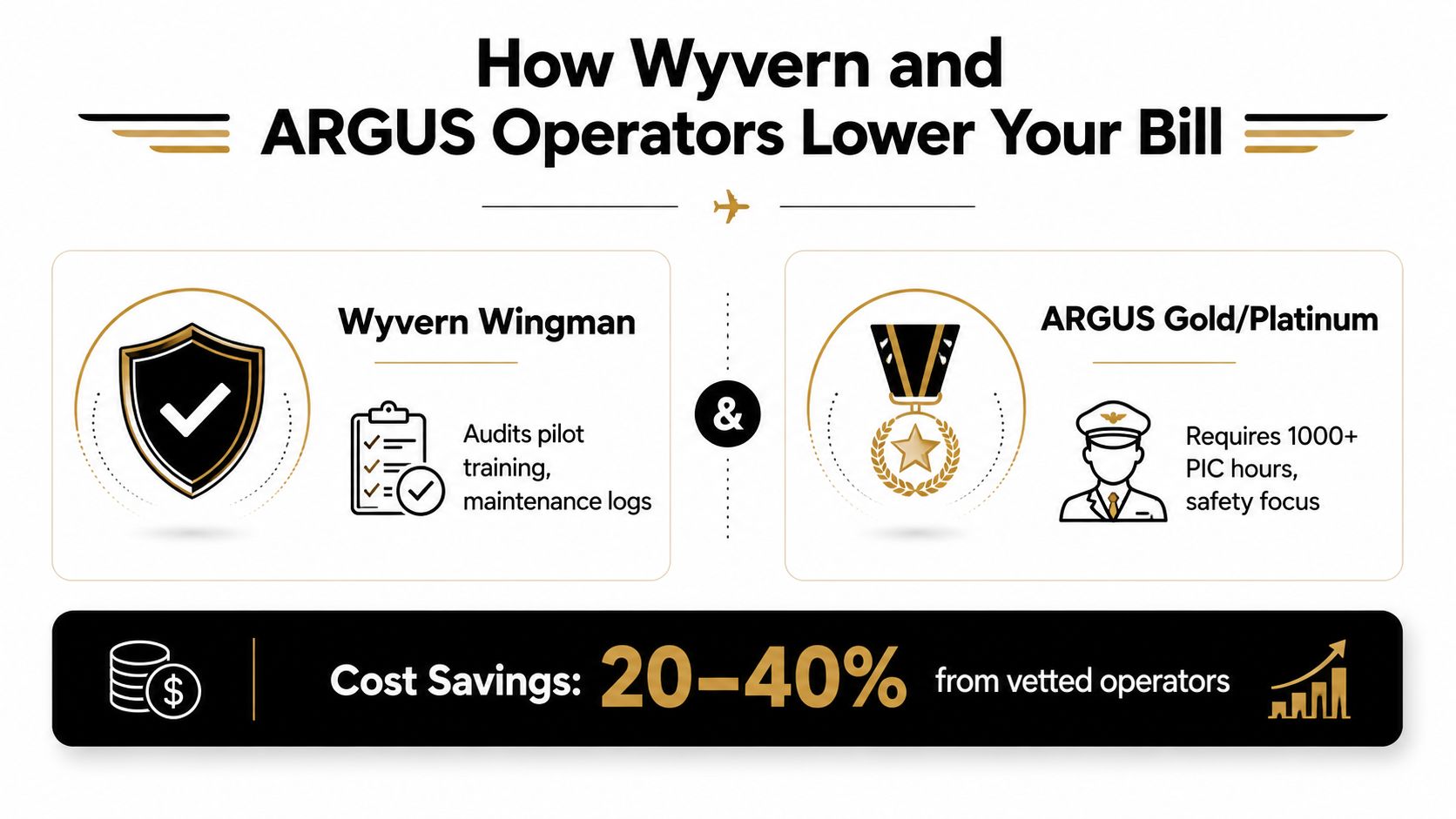
Wyvern Wingman and ARGUS Gold or Platinum ratings provide structured third-party scrutiny of charter operators. A buyer should ask which rating applies to the proposed operator and whether the quoted aircraft is operated by that company. The rating belongs to the operator, not to a generic aircraft category or a broker's marketing page.
A network sourcing from 3,500+ owner-operators can also search for aircraft already near Miami instead of accepting a jet repositioned from another market. Haute Jets describes its model as sourcing from owner-operators across 175 countries, with the aim of reducing repositioning costs that traditional broker and jet-card structures can add. The relevant point for a buyer is not the size of the directory by itself. It is whether the broker can show you a realistic local option and disclose every ferry segment in the trip sheet.
Read the quote behind the headline
The requested savings angle is important, but it needs a disciplined interpretation. Haute Jets' published positioning says that local sourcing can eliminate a 20–40% repositioning premium associated with traditional brokers and jet-card programs, and its Miami Journal coverage discusses the same range in the context of charter pricing. Treat that as a pricing model claim to test against your specific itinerary, not as a guaranteed reduction on every flight.
Ask for four things in writing:
- Operator identity: Name the certificate-holding operator, not only the broker.
- Safety status: Confirm current Wyvern Wingman or ARGUS Gold/Platinum standing.
- Ferry disclosure: Separate passenger flight time from repositioning time.
- Aircraft confirmation: Review the actual tail number, crew details, and cabin specifications.
A serious quote makes the economics visible. If the broker can't explain where the aircraft is coming from, you can't judge whether the price is efficient.
For a deeper explanation of the audit frameworks, consult this Wyvern and ARGUS safety ratings guide. The best price isn't the lowest number on the first email. It's the quote that matches a vetted local operator to the mission without hiding the cost of getting the aircraft into position.
Matching Aircraft to Your Miami Itinerary
Aircraft selection starts with the airport and destination, then accounts for passenger count, baggage, runway requirements, and cabin expectations. Choosing by badge or cabin class before checking those constraints creates avoidable cost and discomfort.
A Bahamas family trip often favors practical island access over maximum cruise speed. A turboprop can suit destinations with runway limitations and may offer more usable baggage space for beach equipment. Before approving a King Air or comparable aircraft, confirm baggage volume, passenger weights, pets, and the destination airport's operating limits. Seat count alone does not show whether the aircraft fits the mission.
Baggage allowances can differ sharply within the same route. Turboprops may offer flexible loading for bulky leisure gear, light jets can impose tighter compartment limits, and midsize jets usually provide more room for skis and winter clothing. Ask for the usable baggage capacity, not only the number of seats.
An Aspen ski trip deserves a midsize-aircraft review. Ski bags and cold-weather clothing consume space quickly, while the route may require more performance margin than a short regional flight. Ask whether the proposed aircraft has the cabin, baggage capacity, and operating capability suited to your date and destination. If the operator is positioning the aircraft from the Northeast, request a second option with an aircraft already near Miami. That sourcing decision can shift the final price by several thousand dollars.
A transatlantic board meeting calls for a heavy, long-range aircraft when the group needs a working cabin, rest capability, galley service, and reliable connectivity. A smaller aircraft may technically cover the route in some circumstances, but technical range does not make it a sensible executive itinerary.
| Mission | Recommended Aircraft | Cabin and Range | Pricing Request | Why This Class |
|---|---|---|---|---|
| Bahamas family trip | King Air or comparable turboprop | Regional cabin with practical island access | Request a route-specific quote | Efficient for short overwater missions and baggage-sensitive leisure travel |
| Miami to Aspen | Midsize jet | More cabin and baggage capacity for a longer domestic mission | Request a route-specific quote | Better fit for skis, winter clothing, and comfort over a longer flight |
| Transatlantic board meeting | Heavy long-range jet | Large cabin, galley, rest capability, and intercontinental range | Request an all-in quote | Supports work, rest, baggage, and long-haul operating requirements |
Haute Jets presents Miami charter pricing as a starting reference, not a substitute for an aircraft-specific proposal. Ask whether the aircraft is locally positioned, then require the quote to identify the aircraft, certificate-holding operator, airports, ferry segments, catering, ground transport, and cancellation terms. Safety standing should also be clear, including current Wyvern or ARGUS status.
Booking Charter Flights Miami With Confidence
At 9 a.m., send a complete request rather than a vague message asking what is available. Include departure airport preferences, destination, date, passenger count, luggage, pets, catering, ground transport, and whether you can use OPF, TMB, MIA, or FLL.
By the next stage, the charter team should match the mission against its vetted operator roster. You should receive aircraft choices that identify the operator and explain why each aircraft fits the route. A credible proposal won't hide behind “light jet” or “heavy jet” alone. It will give you the make, model, cabin details, and meaningful operating assumptions.
What to confirm before payment
Review the trip sheet before signing. Check the departure FBO address, customs arrangements, passenger manifest, catering, ground transportation, cancellation language, and all repositioning segments. The aircraft should be confirmed with a tail number before departure, subject to normal operational changes and the contract terms.
A proper pre-flight brief arrives 24 hours before departure and includes the FBO, customs timing, weather briefing, alternates, crew information, and passenger details. If a broker sends only a price and a departure time, you don't yet have a flight plan you can responsibly approve.
Watch for these red flags:
- Unexplained hourly pricing: The quote lists flight hours but doesn't identify ferry or repositioning hours.
- Missing operator name: The intermediary won't disclose who holds operational control.
- Vague service details: Catering, Wi-Fi, pets, baggage, and ground transport remain “to be arranged.”
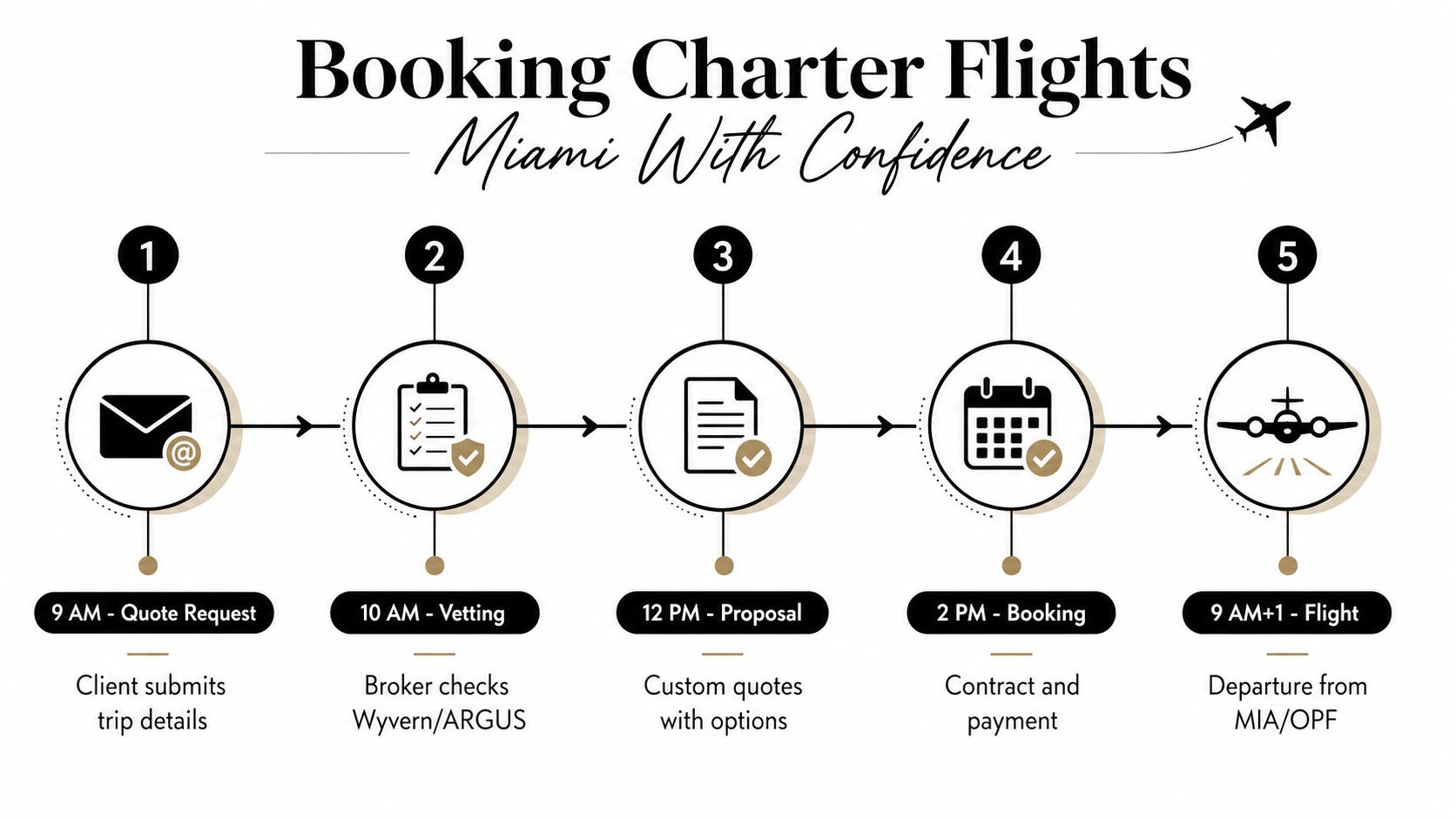
The process should feel organized, not mysterious. Define the mission, choose the airport, request comparable quotes, verify the operator's Wyvern or ARGUS status, confirm the aircraft, and complete the pre-flight brief.
Save this checklist:
- Define the mission: Passengers, baggage, destination, timing, and service needs.
- Choose the airport: Compare OPF, TMB, MIA, and FLL by friction and proximity.
- Request three quotes: Require the same scope and fee disclosure in each.
- Verify the operator: Confirm Wyvern Wingman or ARGUS Gold/Platinum status.
- Confirm the tail number: Review aircraft, crew, FBO, catering, and ground transport.
Haute Jets arranges on-demand private charter options from Miami-area airports and matches missions with aircraft sourced from Wyvern Wingman and ARGUS Gold/Platinum-rated operators. Visit Haute Jets to request a route-specific quote, compare the right airport and aircraft, and speak with a charter team before your first booking.