

You've got four executives who need to leave on Friday, reach London for a Monday meeting, and continue to Milan for a site visit before returning home. The aircraft matters, but it isn't the only decision that determines whether the trip runs smoothly or whether the final invoice surprises everyone.
A successful charter private jet to Europe depends on aircraft positioning, departure geography, passenger documentation, permits, airport choice, taxes, and crew planning. Hourly pricing is only one part of that equation. The practical method is to build the itinerary around the mission, then test the aircraft and operator against the actual route.
Europe is a mature cross-border charter market with concentrated hubs, experienced operators, and a wide choice of airports. That makes it possible to control schedule and cost, provided you look beyond the headline rate.
Why Charter Private Jet to Europe Is Easier Than You Think
A London meeting, a same-day reposition to Milan, and a return from Geneva can look complicated on paper. In practice, the route becomes manageable once the operator checks airport access, permit requirements, customs, and the aircraft's starting location together. Europe has established business aviation networks around London, Paris, Geneva, Milan, and Nice, with several routing options when one airport has limited availability.
The market is large enough to support that flexibility. Europe recorded about 1,491,971 business aviation departures and arrivals in 2024, supported around 449,000 jobs, and generated roughly €100 billion in business aviation economic output. Business aviation represented 7% of European air traffic, according to the European Business Aviation Association's market data. For charter clients, that scale means access to established operators, handling providers, maintenance support, and alternative airports.
A large network creates practical choice
Aircraft and crews tend to concentrate around the busiest hubs. That concentration can improve availability, but it does not automatically produce the lowest quote. A jet based near the departure airport may avoid a repositioning charge, while a cheaper hourly rate from another country can become more expensive after ferry time, local taxes, and permit work.
Europe-related movements reached 1,401,135 in 2024. For London to Milan, Paris to Nice, or Geneva to Barcelona, that cross-border connectivity gives the charter team room to build around the traveler's schedule instead of a fixed airline timetable.
Send the complete mission before reviewing aircraft:
- Passenger count: Include adults, children, pets, and assistance requirements.
- Route sequence: List every stop, including positioning or planned return legs.
- Timing: Separate fixed meetings from flexible departure windows.
- Airport preference: Identify the destination, then ask the operator to compare nearby business aviation airports.
- Baggage and equipment: Declare presentation materials, sports equipment, samples, or unusually heavy luggage.
For a practical overview of the passenger experience, read a guide to the passenger experience on European private jet travel. The operator can then test local sourcing, permit geography, airport restrictions, and tax treatment before recommending an aircraft.
Practical rule: Compare aircraft only after the complete route, repositioning, permits, airport restrictions, and return plan have been mapped.
Choose the Right Aircraft for Your Europe Route
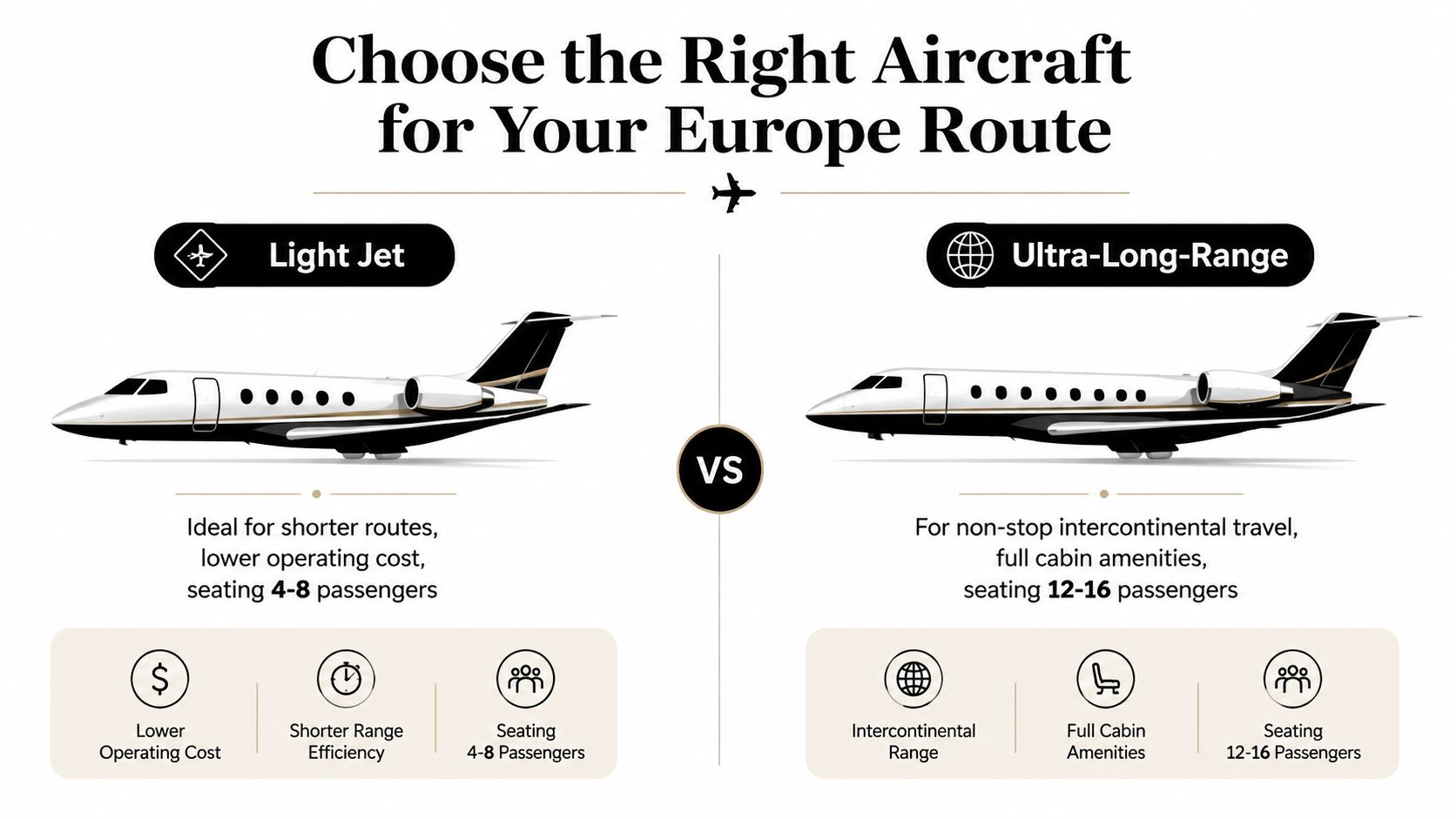
Aircraft class should follow the route, not the other way around. A light jet can be an efficient choice for a short intra-European sector, while an ultra-long-range aircraft may be necessary for a nonstop transatlantic crossing. Choosing a larger cabin than the mission requires can add cost, but choosing an aircraft with insufficient range or payload can create a fuel stop, luggage compromise, or operational substitution.
A 2026 European charter market index places light jets at €4,700 to €7,500 per block hour, while ultra-long-range aircraft range from €14,300 to €22,500 per block hour. The figures come from the European charter price index, and they should be treated as market bands rather than a guaranteed quote.
Match cabin, range, and passenger load
| Aircraft Class | Hourly Band | Best Use |
|---|---|---|
| Light jet | €4,700–€7,500 per block hour | Short intra-European routes and smaller groups |
| Ultra-long-range jet | €14,300–€22,500 per block hour | Nonstop intercontinental missions and larger groups |
A London to Paris itinerary may suit a light jet when the passenger group is small and the airport choice supports the schedule. A New York to Paris mission demands a different analysis, including nonstop range, payload, baggage, weather, and crew planning. A larger aircraft can provide more cabin space and transatlantic capability, but it shouldn't be selected just because the cabin looks more impressive.
Haute Jets' Europe pricing information lists $4,000 to $6,000 per hour for one aircraft category, $13,000 to $20,000 per hour for a larger category, and transatlantic flights from $65,000. These bands appear on the Haute Jets Europe destination page. The same page highlights a cost factor that many charter comparisons omit: sourcing an aircraft close to departure can eliminate repositioning fees that add 20–40% to typical charter costs.
That makes aircraft location as important as aircraft size. Two jets with similar cabins may produce very different quotes if one must travel empty to collect the passengers.
For a more detailed cabin and mission comparison, use this guide to private aircraft for long-distance travel. Ask for the exact year, make, model, cabin layout, current base, and estimated positioning before accepting a category-level quote.
Estimate True All-In Cost After 2025 Fees
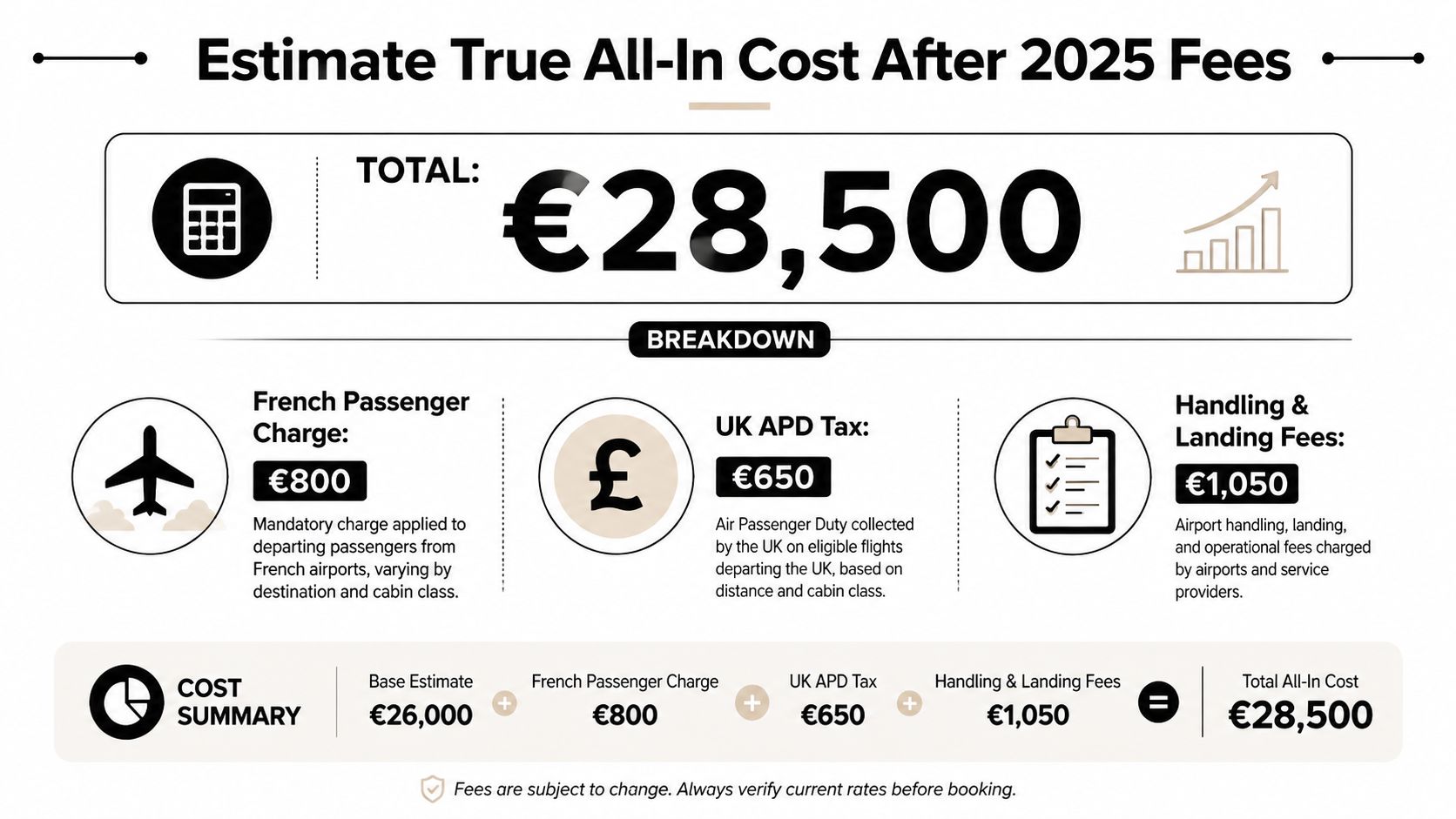
The hourly rate is a starting point, not the trip price. A proper estimate includes aircraft time, positioning, landing and handling charges, permits, customs support, catering, ground transport, crew expenses, and country-specific passenger taxes. These items can change the ranking between two apparently similar aircraft.
France introduced steep per-passenger charges for business jets with 19 seats or fewer, effective March 1, 2025. The charges range from €420 per passenger for EU and EEA destinations to €2,100 per passenger for destinations over 5,500 km, as reported in European charter market coverage. Denmark also introduced a new air passenger tax effective January 1, 2025, so the departure and arrival countries deserve attention before you compare quotes.
Why geography can outweigh the hourly rate
Consider two missions with broadly similar flight time, such as London to Nice and New York to Paris. Their true prices can diverge because they may trigger different passenger charges, handling structures, permit requirements, and aircraft positioning patterns. The quoted aircraft with the lower hourly rate may be based farther from departure, use a more expensive airport, or create a tax exposure that overwhelms the apparent saving.
The quote should separate each cost category clearly:
- Aircraft time: Confirm whether the quote uses block time, flight time, or a guaranteed minimum.
- Positioning: Ask where the aircraft starts and where it must go after the trip.
- Taxes and fees: Require France, Denmark, and other country-specific charges to appear explicitly.
- Airport services: Identify landing, parking, handling, customs, and security charges.
- Crew costs: Confirm whether hotels, transportation, and additional rest periods are included.
- Changes: Review the treatment of passenger changes, schedule shifts, cancellation, and aircraft substitution.
Short European sectors deserve particular scrutiny. The same index places most one-to-two-hour European sectors between €8,300 and €18,500 all-in, while a London to Paris light-jet trip starts at about €8,300 all-in. It also reports that hops under one hour can cost roughly €2,300 to €2,400 per 100 km flown. These are not interchangeable quotes, but they illustrate why short distance doesn't automatically mean low total cost.
Before approving the itinerary, request an all-in private jet charter cost breakdown tied to the exact departure airport, passenger list, aircraft, and routing.
Plan Range Fuel Stops and Crew Overnight
Range planning begins with payload, not the brochure's maximum distance. Passenger count, baggage, fuel reserves, weather, routing restrictions, and the chosen airport all affect whether an aircraft can complete a sector nonstop. A route that looks straightforward on a map may require a technical fuel stop once the operator accounts for the actual load and operating conditions.
Ask the charter team to provide route-specific planning for the proposed aircraft. The useful question isn't just, “Can this jet fly from New York to London?” Ask whether it can do so with the confirmed passenger count, baggage, required fuel reserves, expected winds, and the selected departure and arrival airports.
Fuel stops are operational choices
A fuel stop adds more than airborne time. It can involve landing charges, handling, security coordination, passenger disembarkation procedures, and a new departure slot. On a time-critical itinerary, a nonstop aircraft may justify its higher rate because it protects the meeting schedule and reduces exposure to disruption.
A light jet used for an intra-European hop may not need a fuel stop, but that doesn't mean every small aircraft is interchangeable. Airport runway limits, payload restrictions, and weather can change the operating plan. The operator should explain the assumptions behind the proposed range rather than quoting only a catalog figure.
Crew duty also shapes the schedule. A long mission, late arrival, early departure, or multi-city itinerary may require a crew overnight or additional crew planning. Confirm the following before payment:
- Crew rest location: Ask where the crew will stay and whether the hotel and transfers are included.
- Duty-time impact: Confirm whether the planned return or next sector fits the crew's legal rest requirements.
- Fuel strategy: Identify the primary fuel stop and a practical alternate.
- Payload assumptions: Make sure baggage and special equipment are included in the calculation.
- Schedule protection: Ask what happens if weather or air traffic forces a delay.
A reliable quote explains the operating plan. If the proposal doesn't identify the range assumptions, fuel strategy, and crew-rest implications, it isn't yet a complete itinerary.
Secure Permits Slots Overflight and Customs
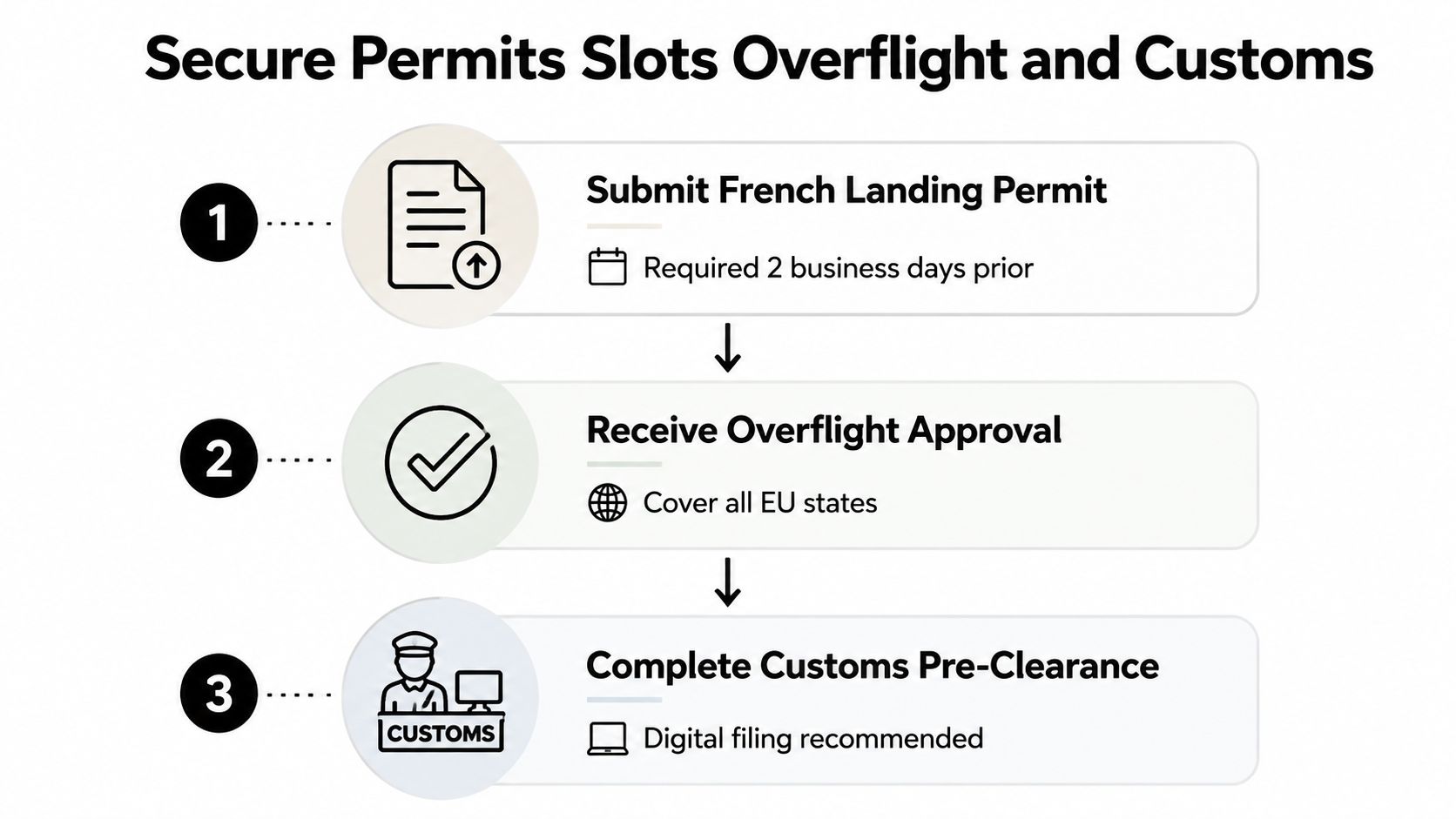
The most expensive operational mistake is often discovered after the aircraft has been selected. A country may require a landing permit, an overflight approval, a slot, advance customs information, or a specific passenger manifest. These requirements interact, so changing the aircraft registration or passenger list late in the process can invalidate work that appeared complete.
France provides a useful example. Charter flights require landing permits with an official lead time of two business days, excluding weekends and holidays. Non-EU charter operators must obtain the relevant permits or risk grounding or impounding, and the submission must include GENDEC, a full passenger manifest with place of birth, and proof of an approved Safety Management System. The permit's validity is plus or minus 72 hours, so a departure outside that window requires re-confirmation, according to the France business aviation destination guide.
Keep the permit file internally consistent
The permit team needs a stable set of facts. That includes the aircraft registration, operator identity, operator status, route, dates, and passenger information. A last-minute name change may sound minor to a traveler, but it can require a revised manifest and permit submission.
Build the compliance timeline around the least flexible country on the route. For a France operation, submit early enough to avoid weekends and holidays, then keep the departure time inside the permitted window. If the schedule moves materially, ask the operator to reconfirm rather than assuming the existing approval remains valid.
The practical workflow should cover:
- Landing permits: Confirm which countries require them and who submits the applications.
- Overflight approvals: Check every state crossed, including any route changes caused by weather or air traffic.
- Airport slots: Verify that the preferred arrival and departure times are accepted by the airport.
- Customs: Confirm passenger data, filing deadlines, and whether the selected airport can process the arrival.
- Manifest control: Freeze the passenger list as early as possible and report every change immediately.
Avoid booking around a generic aircraft category. The permit belongs to the actual operation, and the actual operation includes the operator and aircraft registry.
Select FBO Ground Logistics and Safety Credentials
The FBO is where an efficient flight either stays efficient or loses time. The right facility supports customs, passenger processing, aircraft handling, ground transportation, catering, and security without forcing the traveler through unnecessary airport congestion. A convenient runway is not automatically the right terminal if the ground operation can't support the itinerary.
Start with the destination meeting, not the airport name. Ask which FBO is closest to the final appointment, whether customs can process the arrival, how the vehicle transfer will be coordinated, and whether the aircraft can park as planned. For multi-city trips, use the same discipline at every stop. A few minutes saved on the ground can matter more than a small difference in airborne time.
Build the terminal experience into the quote
Confirm Wi-Fi, catering, pet handling, special baggage, and vehicle transfers before departure. These details should be attached to the booking rather than handled through informal messages on travel day. If the group has a tight schedule, request a single ground coordinator who can manage the aircraft arrival and the onward vehicle movement.
Safety screening is a separate responsibility. Haute Jets states that every operator in its network holds Wyvern Wingman or Argus Gold/Platinum status, described in its private aviation journal as the two highest third-party safety audits in private aviation. The screening doesn't replace route planning, but it removes an avoidable category of uncertainty before the aircraft is presented.
Europe destinations highlighted by the same journal include London, Paris, Milan, Mykonos, Ibiza, Barcelona, Rome, Geneva, and Nice. For each proposal, request the operating carrier, aircraft registration, safety credential, FBO, and ground plan. Those details connect the safety check with the passenger experience.
Use Empty Legs Crypto and Haute Jets Benefits
Empty legs can be useful when the route and timing happen to align. An empty leg exists because an aircraft must reposition for another confirmed mission, so the traveler may access a flight that would otherwise move without passengers. The trade-off is flexibility. The departure time, route, aircraft, and cancellation terms may be less adaptable than a dedicated charter.
That makes empty legs a poor foundation for a fixed board meeting, but a reasonable option for a leisure itinerary with flexible timing. Ask whether the quoted price includes handling, taxes, catering, ground transport, and any schedule conditions. A low empty-leg figure that excludes major trip costs isn't a meaningful comparison.

Crypto payment can also suit travelers who prefer digital assets, but the payment method shouldn't distract from the operating details. Confirm the payment currency, conversion terms, settlement timing, refund process, and whether the booking becomes confirmed only after funds clear. Travelers who want broader context on decentralized payment infrastructure can review why supports aviation finance, while keeping the charter decision grounded in aircraft, compliance, and total cost.
Compare the sourcing model, not just the aircraft
Traditional broker quotes may include aircraft repositioning that isn't obvious in the first rate. Haute Jets states that it sources from 3,500+ owner-operators across 175 countries, with the aim of eliminating repositioning fees of 20–40% associated with traditional brokers. Its journal also states that every operator is Wyvern or Argus rated, that clients receive 24-hour pre-flight confirmation, and that bookings require no memberships. These are operating and commercial terms to verify against the specific proposal, not reasons to skip due diligence.
The useful comparison process is straightforward:
- Route fit: Confirm the aircraft can perform the full mission with the passenger and baggage load.
- Local positioning: Ask where the aircraft is based before pickup and what happens after drop-off.
- Exact aircraft: Request the year, make, model, registration, cabin layout, and available amenities.
- Compliance file: Verify permits, slots, overflight approvals, customs, and passenger data.
- Safety credential: Confirm the operating carrier's current Wyvern or Argus status.
- Final confirmation: Obtain the tail number, crew information, weather briefing, and manifest before departure.
A dedicated charter can be the better choice when the meeting time, passenger list, and airport requirements are fixed. An empty leg can work when flexibility is more valuable than control. Neither option should be approved from an hourly number alone.
The article is published on the Haute Jets Journal, where the journal's Europe coverage includes practical guidance for destinations such as London, Paris, Milan, Mykonos, Ibiza, Barcelona, Rome, Geneva, and Nice. The final booking check should be completed before the payment deadline, while changes are still manageable.
Haute Jets can source aircraft near your departure point, compare route-suitable cabins, and coordinate the permits, operator documentation, and all-in pricing that determine the true cost of a Europe charter. Review the available options and request a route-specific proposal through Haute Jets.