

Empty leg flights from Los Angeles are typically priced 25% to 75% below comparable full-charter rates, with example listings into Los Angeles starting from $726. The catch is timing, because most inventory appears only 48 to 72 hours before departure.
That makes Los Angeles one of the most attractive, and most misunderstood, empty-leg markets in private aviation. The discount is real, but it isn't a normal fare you can select whenever you like. An empty leg exists because an aircraft already has somewhere else to be, so the useful question isn't, “How cheap is this flight?” It's whether the route, departure window, airport, and aircraft match your trip closely enough to justify booking.
The advice below is straightforward. Use empty legs when your schedule can move and your route follows a busy repositioning corridor. Choose a direct on-demand charter when certainty matters more than the discount.
Why Los Angeles Is an Empty Leg Goldmine
The Los Angeles basin creates a steady supply of repositioning flights because it generates more private-jet movements than any market outside the Northeast. Operators constantly move aircraft between Southern California, leisure destinations, business centers, and the next booked mission. That activity is why empty leg flights Los Angeles searches produce genuine inventory rather than occasional leftover listings. Los Angeles empty-leg availability is a market condition, not a marketing trick.
Published marketplace data illustrates the range. Empty legs generally sell for 25% to 75% below an equivalent full-charter rate, while one marketplace has listed 62 live empty-leg flights to Los Angeles starting from $726. SkyAccess explains the discount mechanics and live Los Angeles inventory, including why operators would rather collect partial revenue than move an aircraft without passengers.
The timing problem
The cheapest listing won't necessarily help if you need a firm departure date. Empty legs commonly appear 48 to 72 hours before departure, although some can surface as late as two hours before takeoff. Industry guidance on empty-leg timing makes the trade-off clear: flexibility creates access, while advance certainty limits your choices.
Start by defining three acceptable variables:
- Departure window: Decide how much you can move the time, not just the date.
- Airport range: Include Van Nuys, Burbank, Long Beach, or another practical Southern California field.
- Destination range: Watch nearby airports and related corridors instead of one exact city pair.
The rest of the decision comes down to matching those variables against aircraft movement. Los Angeles offers volume, but volume doesn't guarantee a usable match. A jet heading to Las Vegas may be plentiful while a flight to your exact destination at your required time remains unavailable.
What an Empty Leg Flight Actually Is
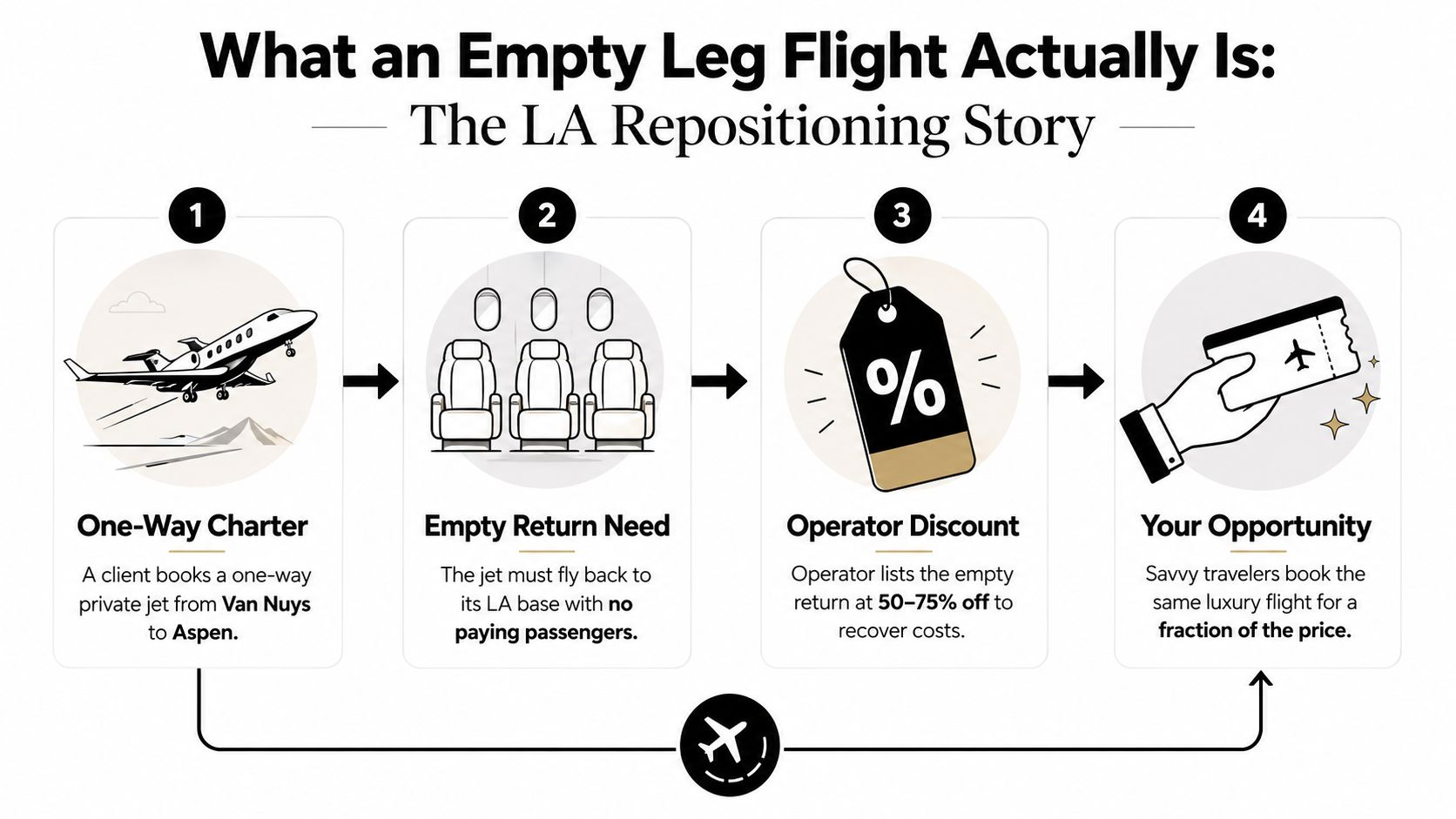
An empty leg is the repositioning segment an aircraft must fly without its original charter passengers. Consider a common Los Angeles scenario. A client books a one-way flight from Van Nuys to Aspen. After dropping off that client, the aircraft may need to return to its Los Angeles base or continue to another city for the next booking.
The operator already committed the aircraft, crew, fuel planning, and primary mission to the Aspen trip. Flying the return without passengers produces no passenger revenue, so the operator lists that segment at a reduced price to recover part of the cost already tied to the aircraft's movement. You're not getting a different kind of jet. You're buying a seatless repositioning mission as a whole-aircraft charter.
The practical definition: an empty leg is a scheduled aircraft movement looking for passengers, not a flight created around your preferred itinerary.
The safety question
Empty-leg flying isn't a separate, lower-standard category of aviation service in the United States. Legitimate empty legs operate under FAA Part 135, the same commercial framework used for on-demand charter. The aircraft, crew, maintenance program, and operational controls follow the same framework as a standard charter. The difference is the unused routing and the price, not a reduced safety standard. This guide to empty legs and standard charter provides useful terminology for comparing the two.
Before you accept a quote, ask which certified operator will perform the flight, what aircraft is assigned, and whether the aircraft can legally operate from your chosen airport. A broker should be able to explain the operator, aircraft, departure field, and contingency plan without vague answers.
The economics also explain the scale of the market. Repositioning flights account for roughly 30% to 40% of private-jet flight hours, according to NBAA-referenced industry coverage summarized by SkyAccess's comparison of empty legs and standard charters. Los Angeles benefits from that broader operating pattern because one-way missions naturally create return and onward movements.
How the LA Empty Leg Market Works
Los Angeles works as a high-velocity repositioning market because the basin produces more private-jet movements than any other market outside the Northeast. The result is a recurring stream of aircraft moving into and out of the region, especially through Van Nuys. Repositioning flights represent roughly 30% to 40% of private-jet flight hours, which gives major hubs a structural supply of potential empty legs rather than a sporadic source of discounts. The LA empty-leg market overview connects that movement volume with listings starting near $726 and discounts of about 25% to 75% below comparable retail charter.
Four airports, four different roles
Van Nuys, KVNY, is the workhorse. It is the first airport I check for most Los Angeles empty-leg searches because business-aviation operators use it heavily and one-way charter activity creates frequent repositioning opportunities. If you live on the Westside, in the Valley, or near a destination served by Van Nuys, start here.
Los Angeles International, LAX, matters more for longer-range and international positioning. It can be less convenient for a local private traveler, but it shouldn't be excluded when the aircraft's mission involves a major domestic or international movement.
Burbank, BUR, can be the smarter option for travelers in the San Fernando Valley, Hollywood, or central Los Angeles. It often makes sense on shorter corridors where ground access is more important than insisting on Van Nuys.
Long Beach, LGB, is a useful Southern California alternative. It can open a match for travelers based in the South Bay, Orange County, or coastal communities, particularly when the aircraft is already positioned there.

Why inventory refreshes quickly
Los Angeles generates empty legs from one-way missions to destinations such as Las Vegas, Aspen, New York, Cabo San Lucas, and the Bay Area. The aircraft may need to return to base, pick up another client, or reach its next booked city. That creates a market where the supply looks broad but remains highly specific to the aircraft's schedule.
Search the airport pair, not just the city name. “Los Angeles” can mean several practical departure fields, and accepting one nearby airport may turn an unusable search into a genuine option. Haute Jets' empty-leg platform is one channel travelers can use to monitor this type of one-way repositioning inventory.
Typical LA Routes and Realistic Prices
Price comparisons make empty legs easier to judge. The busy corridors include Los Angeles to Las Vegas, Los Angeles to San Francisco, Los Angeles to Oakland, Aspen, New York, and Cabo San Lucas. Short West Coast routes usually offer the lowest total entry price, while longer missions can produce larger absolute savings even when the final quote remains substantial.
Published examples put Van Nuys to Las Vegas around $4,500 on light or midsize aircraft and Van Nuys to New York around $22,000 on heavy jets. Published Los Angeles empty-leg route examples show how aircraft category and distance shape the quote. These aren't fixed rates. They are useful benchmarks for spotting whether a listing is directionally sensible.
A practical comparison
| Route | Aircraft Class | Typical One-Way Price | Best For |
|---|---|---|---|
| Van Nuys to Las Vegas | Light or midsize jet | Around $4,500 | Flexible short leisure trips |
| Los Angeles to San Francisco | Light jet | Route-specific quote | Business travel and Bay Area connections |
| Los Angeles to Oakland | Light jet | Route-specific quote | East Bay access and short-haul flexibility |
| Los Angeles to Aspen | Light, midsize, or super midsize jet | Seasonal, aircraft-dependent quote | Leisure travel when the aircraft is already moving toward Colorado |
| Van Nuys to New York | Heavy jet | Around $22,000 | Long-range travel with a flexible departure window |
| Los Angeles to Cabo San Lucas | Light, midsize, or super midsize jet | Seasonal, aircraft-dependent quote | Leisure travel tied to existing West Coast demand |
The table's key lesson is simple. A $4,500 Las Vegas listing and a $22,000 New York listing shouldn't be judged by the same percentage or passenger expectation. A heavy jet costs more to operate, carries a different cabin, and may be solving a longer repositioning requirement.
The best route-level opportunities tend to follow imbalance. Las Vegas and the Bay Area generate frequent movement because clients regularly travel between Los Angeles and those markets. Aspen and Cabo can become especially active when leisure demand drives one-way charters. New York offers longer-range opportunities, but the aircraft class and total price move sharply upward.
Treat every quote as a whole-aircraft price. Your group size changes the effective cost per passenger, but it doesn't turn the booking into a seat sale.
How to Find and Book an Empty Leg in LA
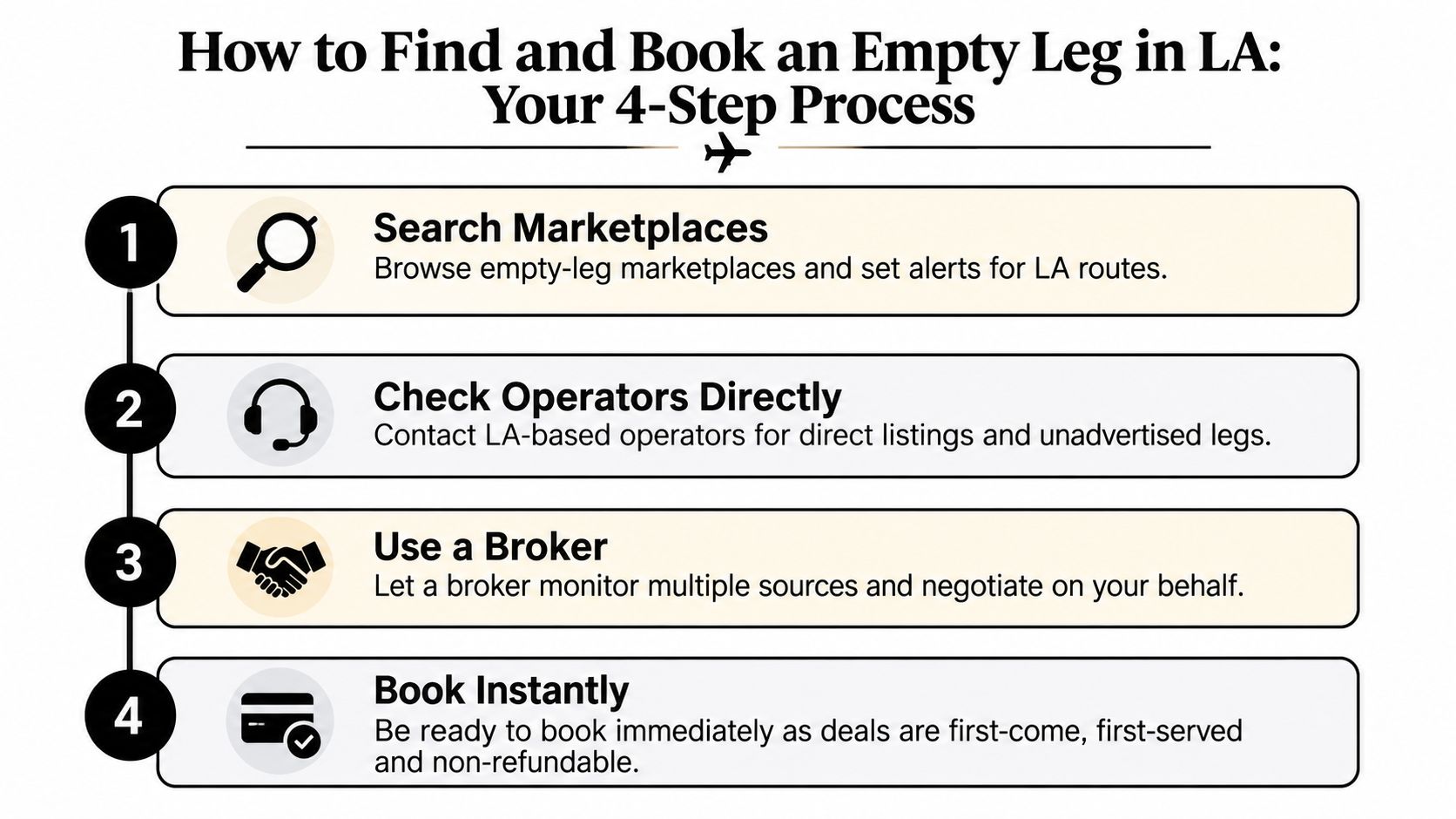
You need speed, broad search criteria, and a willingness to make a decision. Empty-leg inventory usually appears close to departure, with the strongest booking window concentrated around 48 to 72 hours and occasional opportunities appearing as late as two hours before takeoff. SkyAccess's market guidance also identifies heavy activity on short-haul corridors, but an exact match still depends on timing, destination, and aircraft class.
Use three search channels
Search marketplaces first. Browse live Los Angeles routes and create alerts for Las Vegas, San Francisco, Oakland, Aspen, New York, and Cabo San Lucas. Don't limit the alert to one airport if ground travel to an alternate field is manageable.
Call operators directly. Operators may know about repositioning sectors that haven't reached a public marketplace. Ask specifically for aircraft already positioned in Southern California or scheduled to arrive for another charter.
Use a broker for cross-market monitoring. A broker can compare operator listings, airport options, aircraft categories, and a standard on-demand alternative. That comparison matters when an empty leg looks cheap but requires an inconvenient airport or an uncertain departure.
Confirm the conditions before paying
You buy the entire aircraft, not an individual seat. The total price can therefore be divided among your passengers, but the aircraft's capacity and cabin layout remain fixed by the repositioning mission. WeloJets explains how empty-leg pricing depends on aircraft, route, timing, and whole-aircraft booking.
Ask for these details in writing:
- Assigned aircraft: Confirm the make, model, tail number when available, and cabin configuration.
- Operator and crew: Verify the operating company, crew arrangements, and applicable certification.
- Departure window: Establish the exact window and whether a small change is possible.
- Primary mission dependency: Ask what happens if the original charter changes or cancels.
- Cancellation terms: Confirm whether your payment is refundable, transferable, or fully at risk.
- Airport logistics: Check FBO location, ground access, baggage limits, pets, and catering.
A broker should also compare the empty leg with a direct charter before you commit. If the difference is modest and your schedule is valuable, the standard option may be the more economical decision in practice.
The Trade-Offs Nobody Mentions
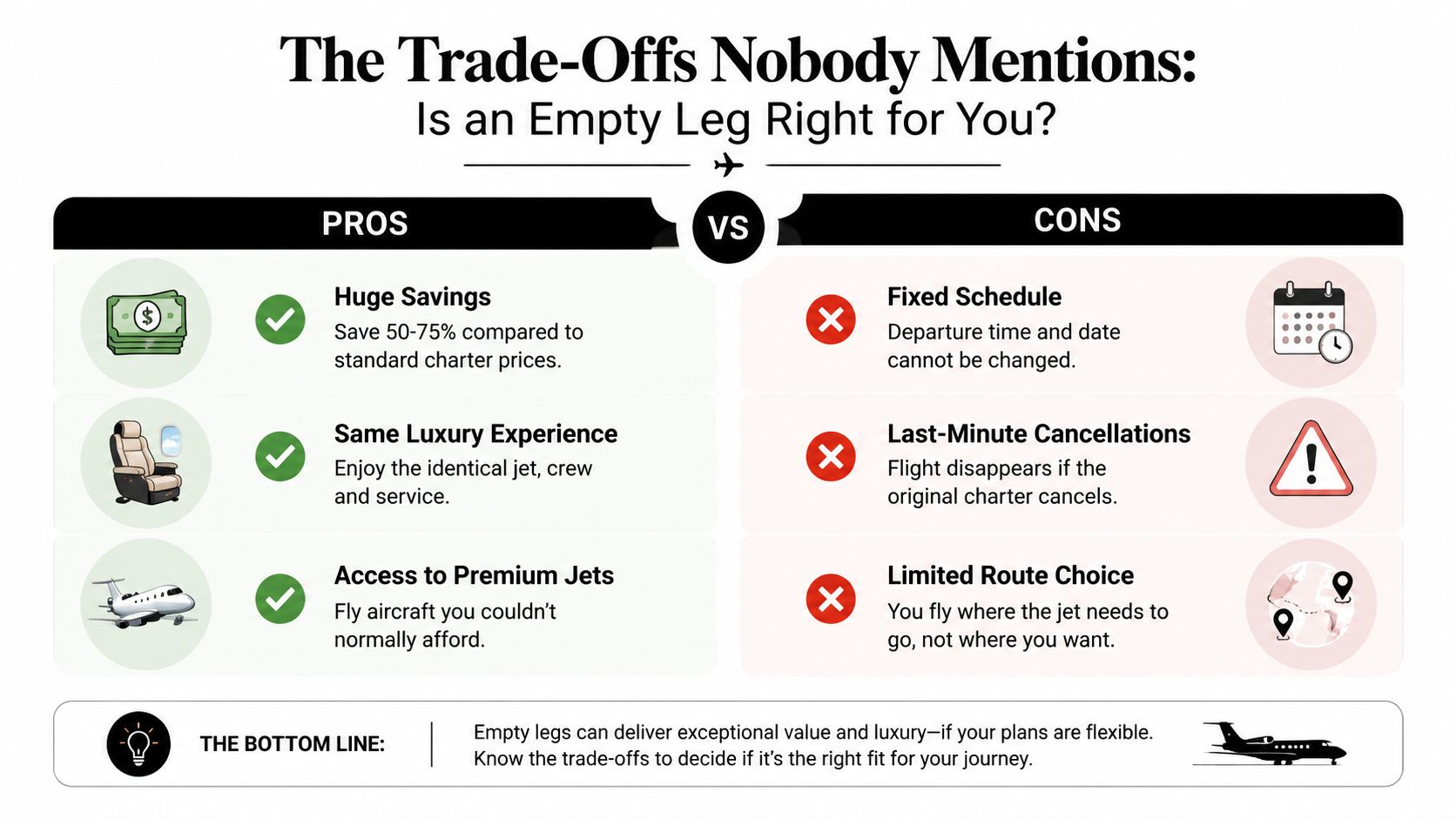
An empty leg isn't automatically the best-value flight. Los Angeles may show plentiful inventory, yet the specific listing can fail your trip because it departs at the wrong time, ends in the wrong city, or offers an aircraft too small for your party. A discount only has value if the flight solves the travel problem.
The primary charter creates the empty leg, which means changes to that original mission can move or eliminate your flight. You should treat the booking as operationally dependent, not as an entirely independent charter with full schedule control.
When the discount stops working
The most common failure is schedule mismatch. If you need to attend a meeting at a fixed hour, arrive for a production call, or connect with a nonflexible itinerary, an empty leg's departure window can create more cost than it saves. Ground transport to an inconvenient airport can create the same problem.
Route mismatch is just as serious. A flight into Los Angeles doesn't help if you need to reach Orange County and the aircraft lands at Van Nuys, while a flight from Long Beach may be preferable even if its advertised price looks less dramatic.
Seasonal demand also changes the value equation. Recent coverage of the 2026 empty-leg market notes that savings vary by aircraft category and season, with West Coast demand concentrating around Las Vegas, Aspen, Scottsdale, and event-driven travel. Light-jet empty legs commonly remain in the low thousands, so a discounted flight can still cost more than an alternative arrangement for a smaller group.
Broker's rule: If your meeting, event, or onward connection can't move, price the direct charter first.
Choose an empty leg when your schedule is flexible, your destination matches the aircraft's route, and the savings justify the cancellation exposure. Choose an on-demand charter when you need to select the departure time, aircraft class, airport, or return plan. The more constraints you have, the less likely an opportunistic repositioning flight will fit.
Smart Booking Tips for LA Travelers
The best Los Angeles strategy is to widen the search before chasing the lowest quote. Empty legs reward travelers who can accept the aircraft and routing already created by someone else's itinerary.
Work the airport network
If you live near Santa Monica, start with Van Nuys but keep Burbank in play. A traveler in the South Bay or Orange County should include Long Beach and other practical Southern California airports. The right airport can turn a missed match into a workable trip without changing the destination.
Set alerts by corridor
Don't alert only for “Los Angeles to Las Vegas.” Add the Bay Area, Aspen, New York, and Cabo San Lucas, then decide which options are acceptable when an alert arrives. The busiest corridors often produce more useful matches than a narrow destination search.
Accept the aircraft the mission created
You won't choose the aircraft category with the same freedom as a standard charter. If a light jet is repositioning to Las Vegas, don't reject it because you hoped for a larger cabin unless space, baggage, range, or onboard requirements make it unsuitable.
Split the whole-aircraft cost intelligently
The booking covers the aircraft, not seats. A group traveling together can divide the total cost among passengers, provided everyone accepts the fixed route and schedule. This works best when the group already shares the same destination and can respond quickly to an alert.
Compare local sourcing against the empty leg
A wholesale-rate on-demand charter can beat a mismatched empty leg when the latter requires an awkward airport, poor timing, or a cabin that doesn't suit the group. Haute Jets sources from 3,500+ owner-operators across 175 countries and looks for aircraft based near the departure city, a model intended to avoid repositioning charges that traditional charter pricing can add. Haute Jets' charter network is one option to compare alongside marketplace and operator listings.
Your Next Move on Empty Legs From Los Angeles
The Los Angeles discount is real, but flexibility is the currency that earns it. Focus on three levers: the 48-to-72-hour timing window, the major corridors such as Las Vegas and the Bay Area, and the aircraft class already assigned to the repositioning mission. If those three variables line up, an empty leg can deliver exceptional value.
If your schedule can move and your route follows an active corridor, set alerts and be prepared to book quickly. If you need a guaranteed departure time, a particular airport, a specific aircraft, or a dependable return plan, request a direct on-demand quote at the same time. The right comparison isn't empty leg versus nothing. It's empty leg versus a charter that works.
Ask for both options before you make the decision. A qualified broker should show the empty-leg terms, the aircraft and operator details, the airport logistics, and the direct-charter alternative in one conversation. That gives you a price comparison based on the complete trip rather than the headline discount.
Haute Jets can help you compare Los Angeles empty-leg opportunities with on-demand charter options sourced from owner-operators near your departure city. Visit Haute Jets to request a quote, monitor matching routes, and choose the option that fits your schedule and aircraft requirements.