
You're trying to book a flight that feels simple on the surface. The airplane looks polished, the itinerary is tight, and the promise is easy. What matters is less visible, the operator behind the flight, the certificate it holds, and the rules that decide whether your trip is in fact commercial charter or just dressed up that way.
That's where FAA Part 135 comes in. For a charter client, it's not paperwork trivia, it's the operating standard that shapes who can fly you, how they can fly you, and what kind of oversight sits behind the flight. Haute Jets Journal treats that distinction as essential because in critical situations, the right answer is never just “the jet looks nice.”
Beyond the Tail Number Why Part 135 Matters for Your Flight
A client calls on a Friday afternoon and needs to be in another city that night. The aircraft is available, the cabin looks perfect, and the broker says the trip can go immediately. That's the moment one stops asking questions, even though it's the exact moment they should start.
FAA Part 135 is the rulebook that tells you whether the flight is a legitimate on-demand commercial operation in the U.S. The FAA says it covers on-demand air carrier and commuter operations, including airplanes with 30 or fewer passenger seats or a maximum payload capacity of 7,500 pounds, plus rotorcraft of any size, and it ties each certificate to specific Operations Specifications, or OpSpecs, that define the exact aircraft, airports, and procedures the operator may use. FAA Part 135 certification overview

What that means for your seat
Part 135 isn't a generic “approved to fly” label. It's a specific operating envelope. If the aircraft, airport, procedure, or weather condition falls outside the operator's OpSpecs, the flight shouldn't move forward under that certificate.
That's why two trips that look identical to a passenger can have very different compliance realities behind them. One operator may be approved for a certain aircraft and airport combination, while another isn't. For you, that affects dispatch flexibility, backup aircraft options, and whether a last-minute change is legal.
Practical rule: if a provider can't clearly name the certificate holder and explain the operating authority behind the trip, you're not comparing charter options, you're evaluating uncertainty.
The reason this matters is simple. Part 135 is the dividing line between a professionally regulated charter flight and an operation that's trying to behave like charter without carrying the same burden of proof. On a high-value trip, that's not a small distinction. It's the difference between trusting a formal system and trusting a sales pitch.
What Is FAA Part 135 Certification
A charter flight under Part 135 is not the same thing as private flying. It is the FAA's commercial operating framework for carrying passengers for hire, and that difference matters every time you board.
The FAA describes Part 135 as the regulatory framework for on-demand air carrier operations in the United States. It applies to charter-style service, air taxi flying, and rotorcraft operations, and it is built around FAA-approved Operations Specifications that spell out exactly what the operator may do.
Why the certificate matters
A certificate is more than a permission slip. It shows the operator has a defined compliance structure for aircraft use, airports, procedures, and weather minima. The same airframe can be allowed on one mission and not on another, depending on how it is authorized under the certificate holder's authority.
For passengers, that structure creates predictability. You are not just buying a ride, you are booking a flight inside an auditable framework. The aircraft, the crew, and the mission all need to fit the operator's approved profile.
Part 135 also separates commercial charter from private flying in practical terms. If a flight is being sold to you for compensation, the operator needs the right commercial authority. That is the core point. It is not about luxury branding or cabin style, it is about the legal status of the operation.
The aircraft size line
The FAA's Part 135 framework commonly covers smaller aircraft, but the key determinant is regulatory, not marketing-driven. The certificate holder's approved operations, aircraft authorizations, and procedures govern the trip. That means a client should always ask whether the exact aircraft assigned to the trip is on the operator's authority, not just whether the cabin looks charter-ready.
A useful way to think about it is this. The aircraft may look ready for charter, but the paperwork decides whether it is approved for that specific flight. If an operator cannot explain that clearly, you do not have enough information to judge the trip with confidence.
The safest charter conversations are specific conversations. Ask what the operator is approved to do, not just what the broker hopes to sell.
Comparing Part 91 Part 121 and Part 135
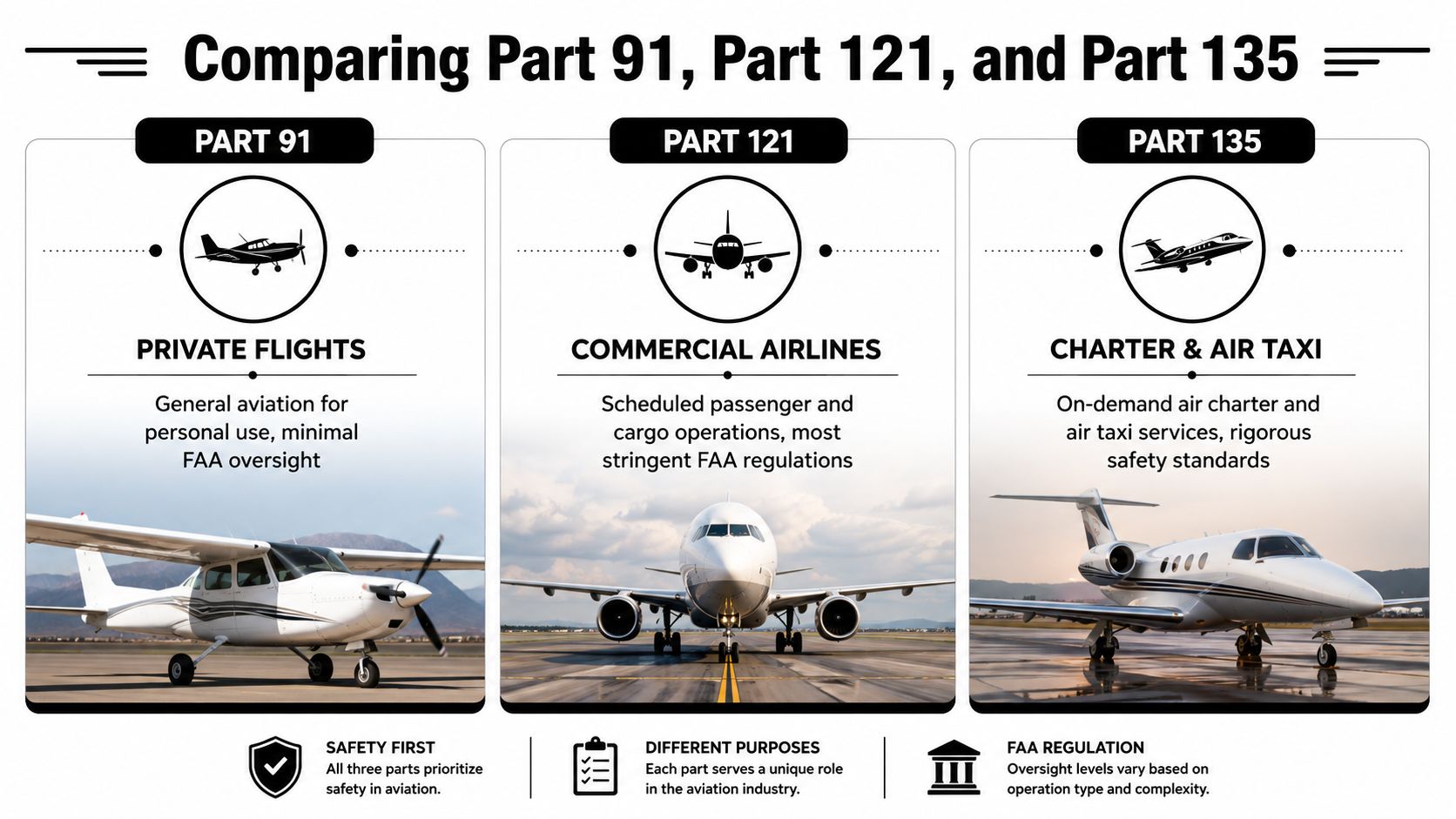
A charter client usually starts with one simple question, who is responsible for the flight? The answer changes the whole safety picture. Part 91, Part 135, and Part 121 are three different regulatory systems, and each one sets a different level of oversight, commercial control, and accountability for the people on board.
Part 91 covers private, noncommercial flying. Part 135 covers charter and air taxi operations. Part 121 covers scheduled airline service for large commercial carriers. The difference matters because the FAA's safety study shows that Part 135 on-demand operations improved from 2.67 accidents per 100,000 flight hours in 1992–2001 to 1.5 per 100,000 flight hours in 2002–2011, while annual fatalities fell from 54 to 36. FAA Part 135 safety study
The practical difference
The difference is easier to understand if you separate private use, commercial charter, and airline service. Part 91 is built for private flying. Part 135 is built for transportation for compensation. Part 121 is built for large-scale scheduled airline operations. For a traveler, that means the closer you get to commercial carriage, the tighter the rules around dispatch, crew oversight, and operational control.
That control shows up in the way the aircraft is used, maintained, and approved for the mission. A flight under Part 135 is not just a plane with seats and a pilot. It is a commercial operation that has to fit inside the operator's certificate, procedures, and approvals. If you want to understand how that approval structure affects maintenance control behind the scenes, see how MRO supports charter safety.
The FAA also reported that the average Part 135 aircraft was flown 377 hours per year, which helps show how heavily used these aircraft can be, and it estimated Part 135 operating costs at $6.3 billion in 2010. FAA Part 135 safety study
FAA Operating Rules at a Glance
| Aspect | Part 91 (Private) | Part 135 (Charter) | Part 121 (Airline) |
|---|---|---|---|
| Business model | Personal or noncommercial use | On-demand passenger or cargo transport | Scheduled airline service |
| Regulatory feel | More flexible | Highly structured and auditable | Most standardized |
| Aircraft use | Private flying | Commercial charter flights | Large-scale airline fleets |
| Operational envelope | Operator discretion within private rules | Defined by OpSpecs and certificate authority | Fixed network operations |
| Passenger expectation | Informal private use | Commercial carriage for hire | Airline-style service |
Why clients should care
If you are booking a charter under Part 135, you should expect more control than you would see in private flying under Part 91. The aircraft cannot just look ready. It has to be authorized, configured, and dispatched within the operator's approved framework, because that is what ties the flight to the certificate holder's safety system.
That is a significant value of Part 135 for passengers. It gives private aviation a commercial safety standard without turning every trip into a scheduled airline operation. For a client, the practical takeaway is straightforward, ask whether the flight, the aircraft, and the crew are all covered by the operator's authority before you book.
Strict Standards for Pilots Aircraft and Maintenance
Part 135 protects passengers through a simple idea, no single part of the operation gets to run loose. The pilot, the airplane, and the maintenance program all need to hold up under commercial scrutiny. If one weakens, the whole operation becomes less reliable.
The FAA's equipment rules show how serious that standard is. Flight recorder specifications in Appendix B require a 25-hour minimum recording duration, and the regulations call for surveillance tools such as Mode S transponders and ADS-B Out in most controlled airspace after the relevant compliance dates. 14 CFR Part 135 equipment and recorder requirements
Pilots and fatigue control
Pilot scheduling under Part 135 is not casual. The FAA-derived summary used in industry references notes 10 consecutive hours of rest before a flight-time period, with 500 hours in any 100 consecutive days for on-demand operations and 1,200 hours in any 12-calendar-month period for scheduled operations. Those limits exist to keep fatigue from creeping into last-minute missions. Part 135 operating limits summary
That matters on the flight you're taking, not just on paper. A late-night reposition, a weather delay, or an early-morning departure all puts more pressure on crew readiness. The rules are there to create a hard ceiling on that pressure.
Aircraft that can be inspected and tracked
Part 135 aircraft are built to be easier to inspect after the fact. The required recorder and surveillance equipment supports higher-fidelity monitoring, incident reconstruction, and controlled-airspace compliance. If an aircraft doesn't carry the needed equipment, it may be legally unusable for your charter even if it looks perfectly fine from the ramp.
Maintenance as a commercial discipline
Maintenance under Part 135 is not just about fixing problems when they appear. It's about keeping the aircraft inside a managed inspection system. For deeper context on why maintenance control matters, Haute Jets Journal readers can also look at this overview of MRO in aviation and flight safety.
Client rule: ask whether the assigned aircraft is legal for the mission, not merely airworthy in a general sense.
That question matters because a charter flight is only as strong as the weakest compliance link. A polished cabin doesn't mean much if the equipment, logs, or crew rules don't match the mission.
The FAA's Role and Evolving Safety Oversight
A Part 135 certificate is not a one-time pass. It sits inside an ongoing relationship with the FAA, and that relationship is where real discipline shows up. The certificate holder has to keep proving that its operation still matches the approved scope.
The FAA is also pushing the industry toward more formalized risk management. Under FAR Part 5, the agency is expanding Safety Management Systems, or SMS, to include more Part 135 operators, which means more carriers must formalize hazard reporting and risk controls. FAA SMS rules for Part 135 operators
Why OpSpecs change the conversation
OpSpecs are where the certificate gets practical. They define the aircraft, airports, approaches, and weather minimums an operator can use. Two operators can fly the same jet model and still have different permissions, different dispatch flexibility, and different operational reach.
That's the practical reason Part 135 feels more restrictive than a casual private arrangement. The FAA isn't just approving a company name, it's approving a specific operating envelope. If the mission falls outside that envelope, the answer is no.
Proactive safety instead of reactive cleanup
SMS pushes operators to look for risks before they become events. That includes hazard reporting, internal review, and tighter oversight of scheduling and operational decisions. For a client, that matters because the operator's culture shows up in small decisions long before it shows up in a serious problem.
A good charter flight starts long before the engines do. It starts with how the operator tracks risk, documents it, and responds to it.
You can see how that culture matters on the ground, too. A provider that tracks the mission carefully and keeps its operational records tight is more likely to treat a weather change, a crew issue, or an aircraft swap as a safety question, not just a sales problem. If you want a separate reading point on the topic, Haute Jets Journal has a broader page on private aviation safety.
How to Verify an Operator and Ensure Compliance
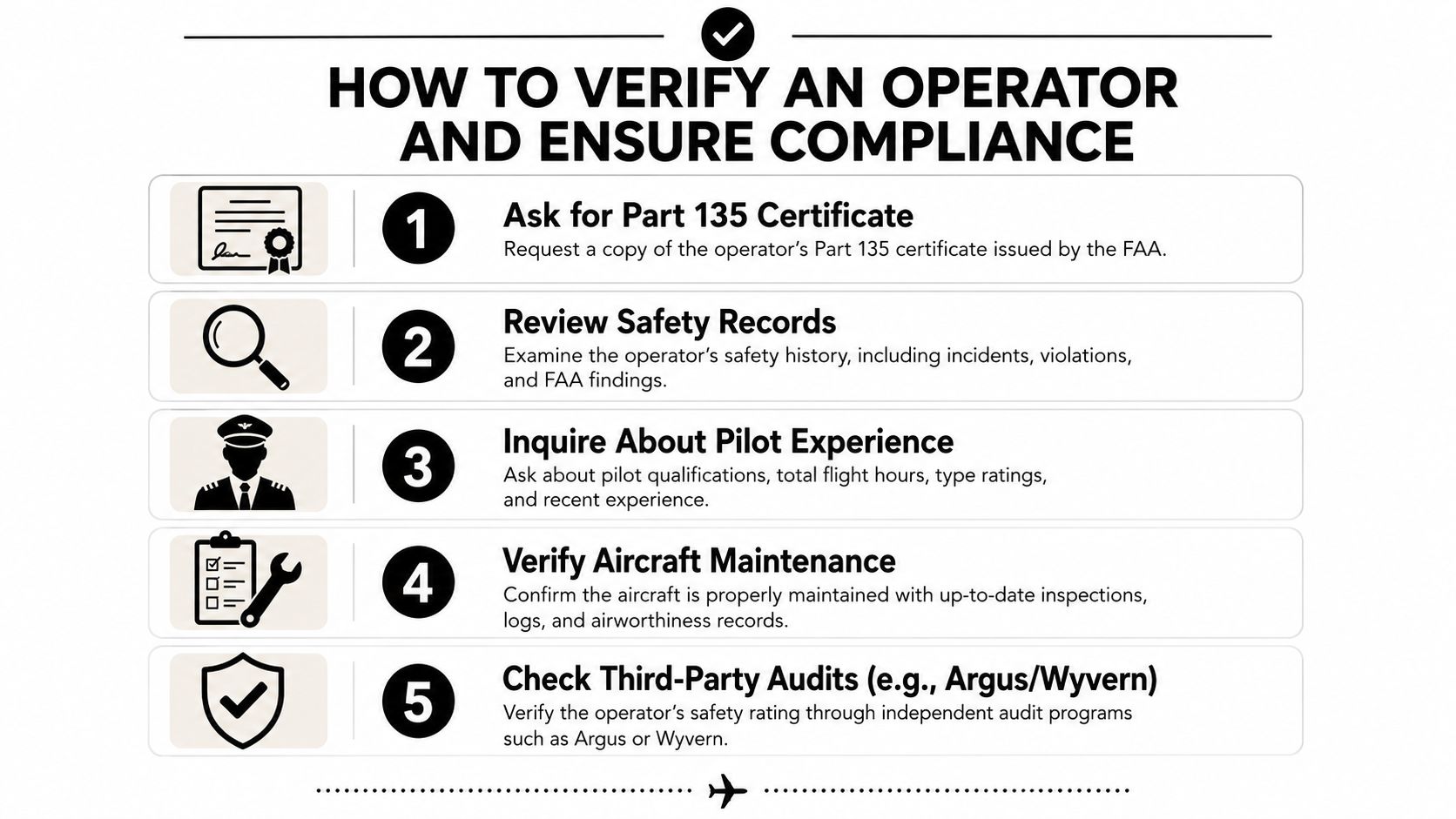
The safest charter buyers don't rely on confidence. They rely on verification. If you're spending real money on a charter flight, you should expect to know who the certificate holder is, what aircraft is assigned, and whether a third party has validated the operator's standards.
That's where independent audit programs matter. In private aviation, Wyvern and ARGUS are widely used as outside checks on safety culture, maintenance discipline, and pilot quality. Haute Jets, for example, states that it sources from Wyvern Wingman or Argus Gold and Platinum rated operators, but the bigger point for any client is the same, don't stop at minimum FAA compliance when a higher standard is available.
What to ask before you pay
Start with the certificate holder. Ask who is operating the flight, not who is quoting it. Then ask for the aircraft tail number, the certificate authority, and the aircraft approval under the operator's OpSpecs.
- Ask for the Part 135 certificate holder. The name should be specific and verifiable.
- Review the safety record. You want a provider that can discuss how it manages compliance, not just how it sells access.
- Ask about pilot qualification. A serious operator should be able to explain crew standards clearly.
- Verify maintenance control. The aircraft should be tied to a real inspection and records process.
- Check for third-party audits. Wyvern and ARGUS ratings help you gauge whether an operator has been independently evaluated.
Why independent ratings matter
FAA compliance is the floor, not the ceiling. Third-party audits help reveal whether an operator has built a real safety culture or just met the minimum. That's especially useful when the trip is time-sensitive, because pressure can hide weak procedures.
For a deeper look at the audit side of private aviation, Haute Jets Journal has a dedicated article on Wyvern and ARGUS safety ratings. Use that kind of independent check whenever the provider's answer sounds polished but vague.
Your Pre-Flight Checklist for Booking a Safe Charter
Before you confirm a flight, ask one direct question, who is the Part 135 certificate holder for this mission? If the answer comes with hesitation, or if the company can't explain the aircraft's status clearly, treat that as a warning sign. The FAA expects the operator to have exclusive use of at least one aircraft, and the applicant must either own the aircraft or hold a lease for 6 continuous months to meet that requirement, which is part of how the agency ensures stable operational control. FAA Part 135 general requirements
That requirement matters because it shows you the operator isn't supposed to be improvising access to aircraft at the last second. It should have stable control, documented authority, and a legal basis for the flight.
Questions worth asking every time
- Who is the actual certificate holder? Get the legal company name, not just the brand name.
- Is this flight being flown under Part 135? Don't assume the answer.
- What aircraft tail number is assigned? The assigned aircraft should match the operator's authority.
- What is the operator's Wyvern or ARGUS rating? Ask whether the flight source has independent audit coverage.
- Can you provide the DBA name of the carrier? The doing-business-as name should line up with the certificate holder.
- Who confirms maintenance and crew readiness? You want a direct answer, not marketing language.
If a quote sounds unusually low, ask what's being omitted. If a broker won't identify the operating company, walk away. Safety and transparency usually travel together, and when they don't, the gap tends to show up in the details.
Haute Jets arranges charter flights through Part 135 operators and keeps the booking conversation focused on aircraft identity, operator quality, and mission fit. If you want a charter partner that treats verification as part of the booking process, visit Haute Jets and start with the operator, not just the itinerary.