
You're trying to book a charter, the broker is pushing a tail number, and the price looks fine. The problem is that none of that tells you whether the aircraft is authorized, whether the crew is current, or whether the operator is built for real commercial work. That's where FAA Part 135 operators matter, because the certificate is the line between a legal charter and a flight that only looks legit on a sales sheet.
The confusion usually starts with marketing. A slick website can make any aircraft look available, but the core questions are simpler and tougher. Who holds the certificate, is that exact tail number authorized, and is the operator running with the safety discipline that premium charter should demand?
What Part 135 Operators Are
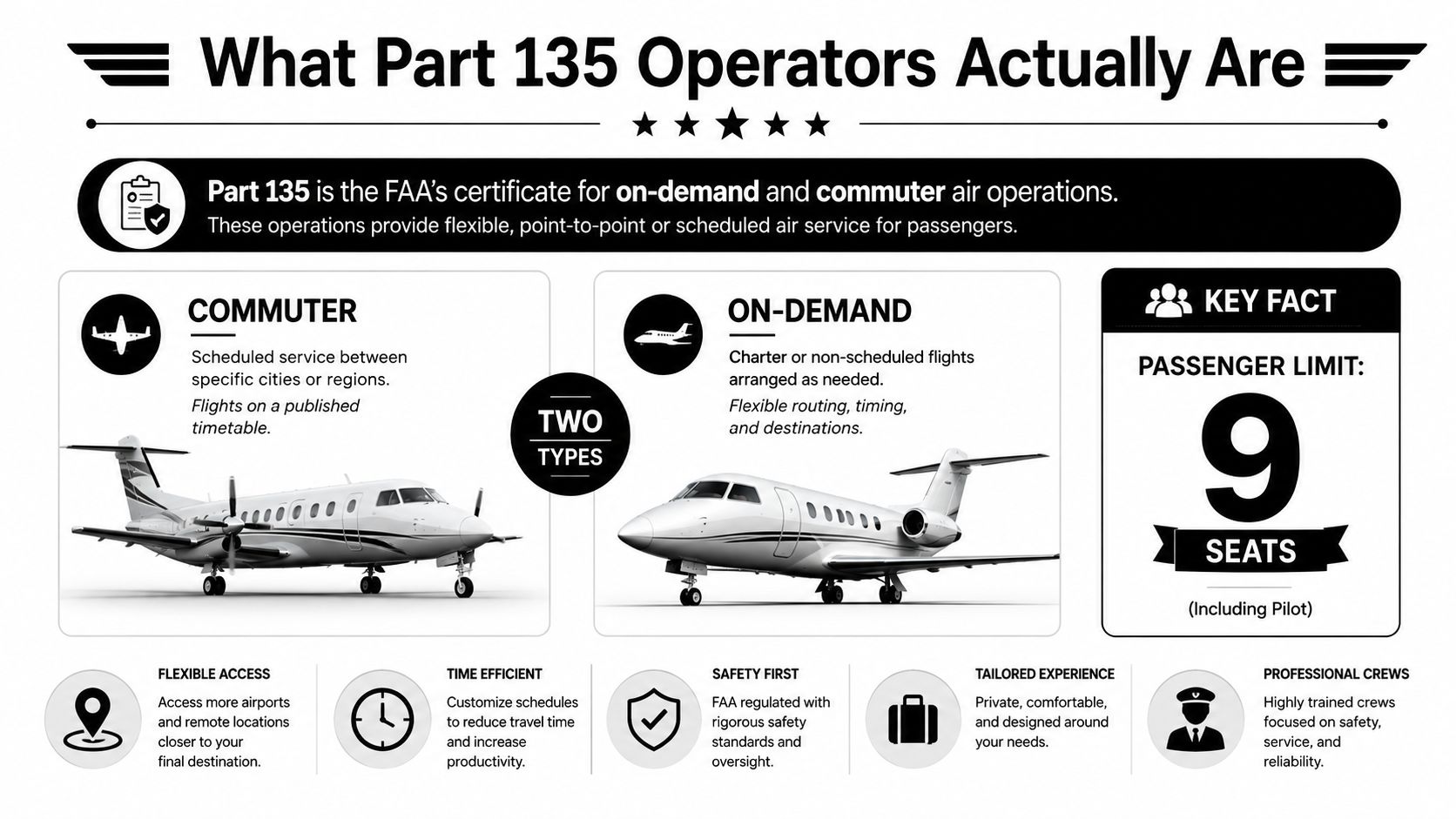
A Part 135 operator is the FAA certificate used for paid, on-demand flying. It covers charter and commuter operations, and it is the regulatory base for most legitimate private jet flights clients buy. A standard Part 135 operator is limited to aircraft type-certificated with 9 passenger seats or fewer, and the operation scope is the United States, Canada, Mexico, and the Caribbean.
That matters because a charter client is not buying an aircraft in the abstract, they are buying a legally controlled operation. Under Part 135, each mission type has to be separately authorized through OpSpecs, so the certificate alone does not tell you everything. The aircraft, route, weather approvals, manuals, and dispatch limits all sit behind it.
The FAA's own study shows how large and uneven this market is. As of February 2016, the FAA reported 2,030 Part 135 operators and 10,668 aircraft authorized on Part 135 certificates, with about 72% fixed-wing airplanes and 28% rotorcraft FAA Part 135 operator study. That is a huge certificate base, but it does not mean every operator is equally active or equally capable.
Practical rule: if the broker cannot quickly tell you who the certificate holder is and which aircraft is authorized, you are not looking at a clean charter sale.
A quick client-facing explainer is still useful before you start asking harder questions. What is FAA Part 135 gives the plain-English version of the category without the regulatory clutter.
| Metric | Value |
|---|---|
| FAA-reported Part 135 operators, February 2016 | 2,030 |
| FAA-reported Part 135 aircraft, February 2016 | 10,668 |
| Fixed-wing share | About 72% |
| Rotorcraft share | About 28% |
Part 135 vs Part 91 vs Part 121
The cleanest way to understand charter is to place it between the two other big civil aviation categories. Part 91 is private, noncommercial flying. Part 121 is the scheduled airline system. Part 135 sits in the middle, with commercial oversight that's much closer to airline discipline than to owner-flown private use.
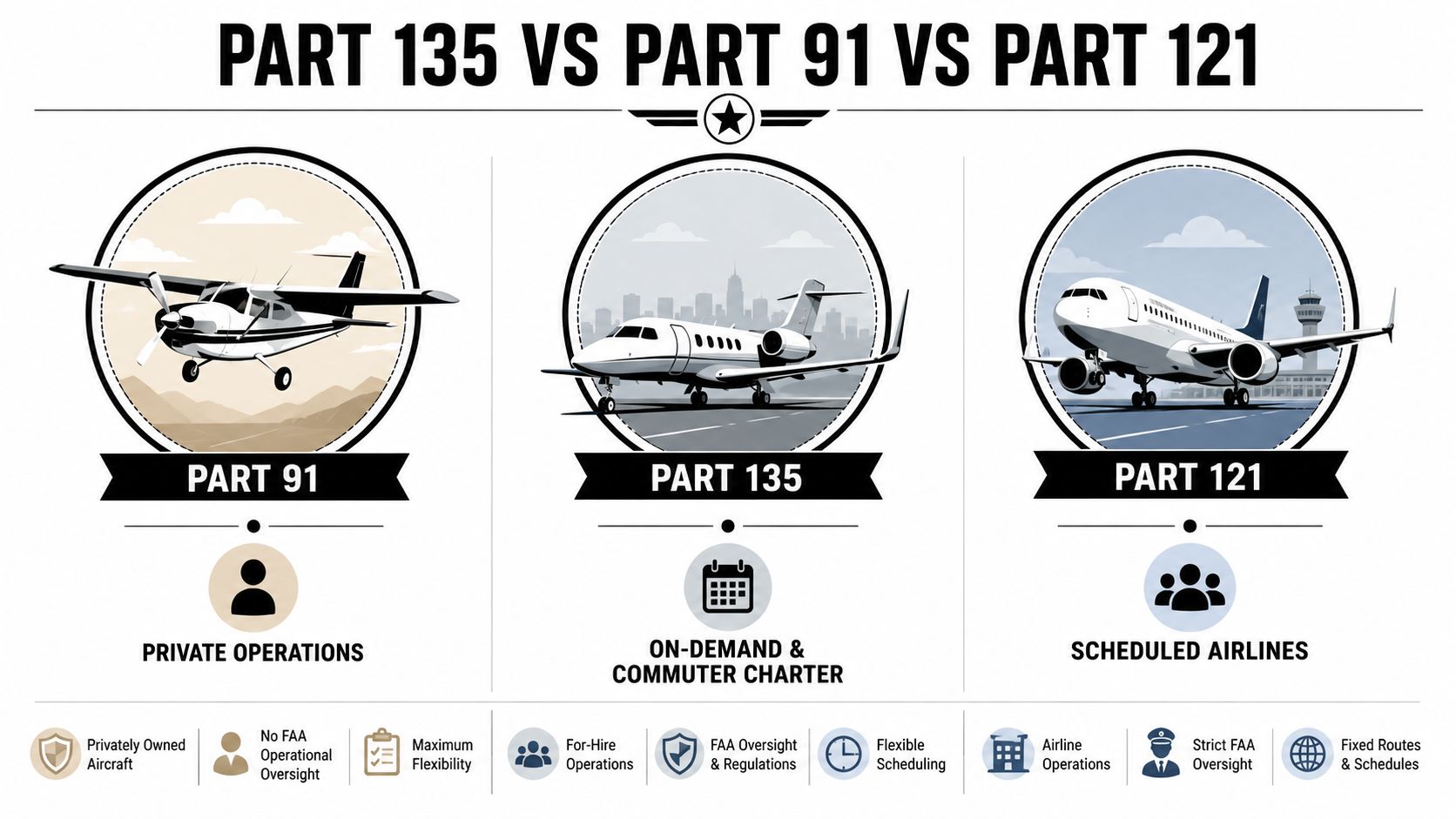
A Citation Latitude charter falls under Part 135 because you're paying for carriage and the operator is holding out the aircraft for hire. That's different from a private owner using the same jet under Part 91 for personal travel. It's also different from a scheduled airline under Part 121, where the system is built around published routes, larger aircraft, and a very different operating model.
Why the category changes everything
The certification tier drives who controls the flight, how much training the crew must complete, how maintenance is documented, and how the operator can dispatch the aircraft. That's why two flights that look similar from the passenger seat can sit under different legal structures. One might be a private repositioning leg, another a revenue charter, and a third a scheduled airline segment.
The FAA's Part 135 framework also has tighter operating boundaries than most casual buyers realize. A standard operator's geographic scope and aircraft seat limit are not just paperwork details, they shape what kind of flying the certificate can legally support FAA general info on Part 135. If you're booking a jet because it “looks like charter,” that's not enough. The legal category has to fit the mission.
| Tier | What it is | What it means for a charter client |
|---|---|---|
| Part 91 | Private operations | No commercial charter sale |
| Part 135 | On-demand and commuter charter | Legal paid charter with FAA oversight |
| Part 121 | Scheduled airlines | Airline-style operation, not bespoke charter |
How Operators Earn and Keep a Part 135 Certificate
A Part 135 certificate is not a rubber stamp. The FAA says that, effective January 24, 2024, Flight Standards began using a new process meant to improve applicant readiness for initial certifications across parts 135, 91K, 125, 133, 137, 141, 142, 145, and 147 FAA certification process update. That matters because the agency wants proof of readiness before it treats the application as a serious operating proposal.
A credible Part 135 applicant has to show more than access to an aircraft. The FAA requires exclusive use of at least one aircraft, usually through ownership or a lease of at least 6 continuous months, plus complete maintenance records with no gaps FAA general requirements for Part 135. If a time- or cycle-limited component is missing its records, it has to be returned to zero-time status before the aircraft can be used under Part 135. That is a hard operational gate, not a paperwork preference.
What gets checked
The operator also needs approved manuals, a training program, and the right management roles in place. Even single-pilot operators still need designated operational control and HazMat training, so the “small operator” label does not erase the compliance burden Aviatize Part 135 glossary. The FAA is checking whether the company can run commercial flying with discipline, not whether it owns an airplane and has a sales deck.
If records are incomplete, dispatch stops. The aircraft does not care that the sales team is ready.
That is the buyer lesson. A Part 135 certificate is earned through systems, and it is kept through continuous compliance. If maintenance records slip, if manuals are not current, or if training falls out of cadence, the operator's ability to fly revenue charters gets strained fast. Experienced charter buyers do not stop at, “Are they certificated?” They ask, “Are they organized enough to stay certificated?”
Crew Qualification and Safety Maturity Beyond the Certificate
A Part 135 certificate gets an operator into the charter market. It does not tell you whether the cockpit culture is disciplined, whether training is current, or whether the aircraft being sold is the one that will show up. That is where buyers get burned, because legal compliance and real operational maturity are not the same thing.
For IFR Part 135 flying, PICs must meet higher experience thresholds, including at least 1,200 total flight hours, 500 cross-country hours, and 100 night hours. Operators also have to run annual recurrent ground and flight checks, an annual instrument proficiency check, and a line check at least every 12 calendar months Aviatize Part 135 glossary. That cadence forces more oversight than private flying, and it should.
The harder question is what happens when the weather turns, the schedule slips, or maintenance turns up a problem. The NTSB reported about 1,850 Part 135 certificate holders in 2024, with roughly 30% being single-pilot or single-PIC operators. It also recorded 116 fatal accidents and 460 nonfatal accidents involving Part 135 flights from 2010 to 2022 NTSB Part 135 advocacy report. That is why safety maturity matters so much in this category.
What separates the good operators
Strong operators do more than clear the FAA minimums. They put extra time into training, keep procedures written and current, and use voluntary safety programs that expose weak spots before passengers feel them. Operators with Wyvern Wingman ratings are a clear example, because they are being checked for more than a certificate on the wall. The NTSB has also pushed for wider use of SMS, flight data monitoring, and CFIT-avoidance programs, because the certificate alone does not create those layers NTSB Part 135 advocacy report.
Buyer diligence has to go beyond the brochure. The NTSB has also said that training remains a major concern for Part 135 operators, that many are trying to keep up with changing regulation, and that an SMS does not mean much if the company is not using its safety tools. That is the point of ARGUS Gold/Platinum and Wyvern Wingman ratings, they are buyer-side filters for training culture, oversight, and day-to-day discipline NTSB Part 135 advocacy report.
Buyer rule: a certificate proves legality. A third-party audit shows whether the operator chose to go further.
Look for the difference in practice. The operators worth trusting keep extra training current, brief crews hard on abnormal scenarios, and verify that the aircraft, crew, and dispatch setup match the trip they sold. That is what separates a compliant charter shop from one that is built for passenger protection.
Your Pre-Booking Verification Workflow
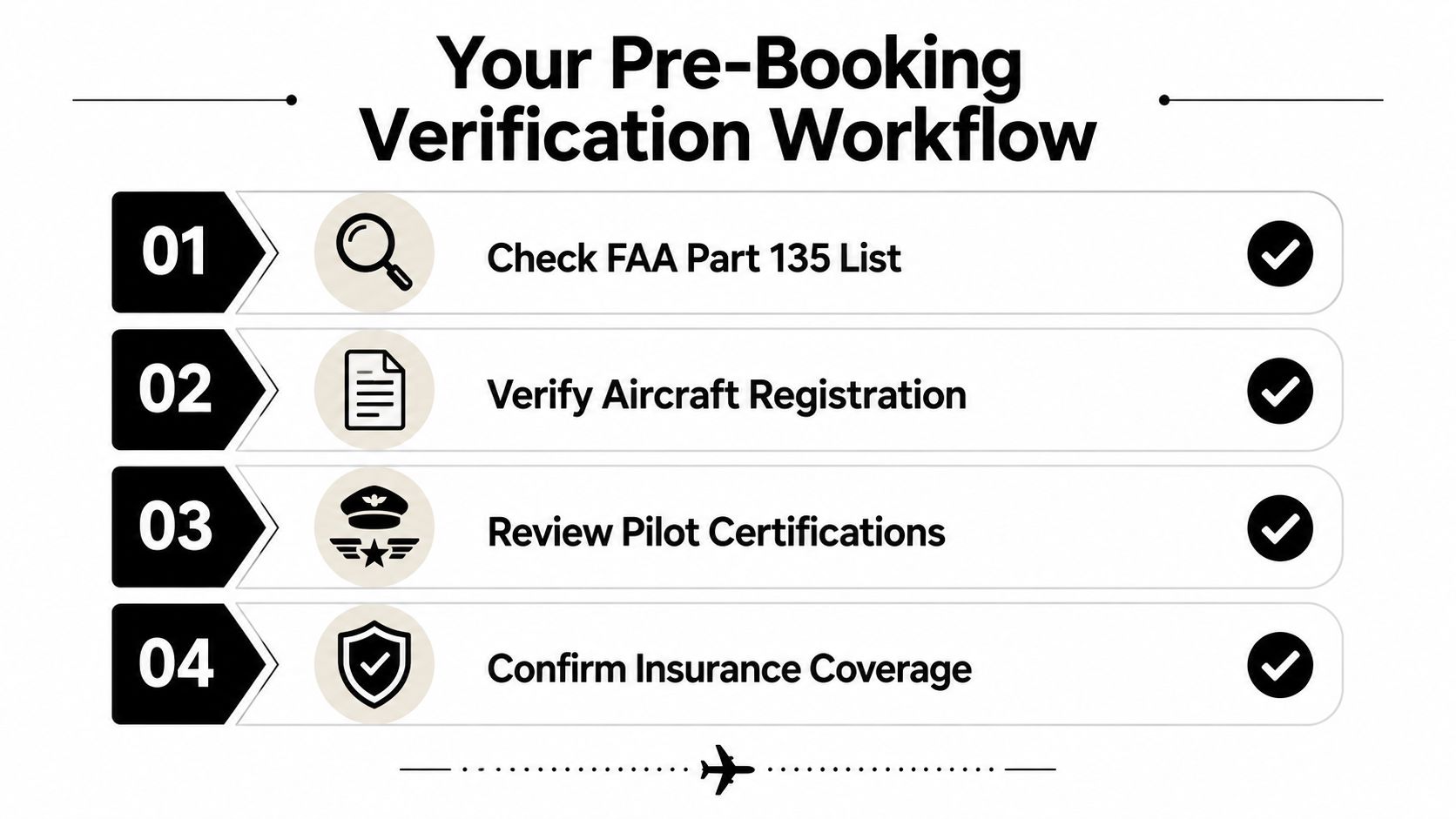
A broker can sound polished and still be selling you the wrong airplane, the wrong certificate holder, or both. Start with the operator's paperwork, then verify the aircraft behind it. The FAA's official Part 135 operators and aircraft list is there for charter authorization checks, and the FAA has also had to correct data-integrity problems and temporarily deactivate the public list while fixing them FAA Part 135 operator list. Use it as a starting point, not as the final word.
The sequence that works
- Check the FAA Part 135 list. Confirm the operator is listed and that the tail number you're being sold appears on the authorization record.
- Cross-check the aircraft details. If the aircraft name, registration, or operator identity is unclear, stop there.
- Ask for third-party safety proof. Wyvern and ARGUS databases show whether the operator carries voluntary safety credibility, not just the legal minimum.
- Press the broker with direct questions. Who holds the certificate, who controls dispatch, what aircraft and crew are reserved, and what insurance applies?
Use a vendor-due-diligence mindset here. The PeopleFinder tips on vendor verification are a useful reminder that serious checking means comparing names, roles, and claims before any money moves.
What to listen for
If the broker falls back on vague language like “our network” or “our preferred partners,” keep pressing. You want the legal entity, the aircraft tail number, and the dispatch authority stated plainly. If those answers stay fuzzy, you are not looking at a verified flight, just a sales conversation.
A Part 135 certificate is the floor, not the finish line. It proves the operator is legal to run charter flights, but it says nothing by itself about safety maturity, training culture, or whether the aircraft on the quote is the aircraft that shows up. That is why buyer-side checks matter, and why third-party ratings are useful as a second filter after the FAA record.
Insurance, Liability, and Passenger Protection
Insurance is where the buyer finds out whether the operator is carrying commercial risk or just talking about it. Do not assume the broker's coverage protects you. The operator's policy is what matters, because that policy follows the flight you are boarding.
Before you book, ask for a copy of the operator's Certificate of Authorization and the insurance certificate showing at least $100 million in hull and liability coverage. Get the certificate holder name, the aircraft tail number, the safety rating, and the policy details in writing. If the operator will not put those documents in front of you, stop there. A charter sale that cannot survive basic documentation is a weak sale.
If you want a practical explainer on how coverage is structured, keep this internal guide handy: What insurance covers private jet charter. For a wider insurance context outside aviation, the Miami boat and airplane insurance broker example is a useful reminder that specialty brokers treat hull, liability, and passenger risk as separate issues.
Most Part 135 carriers also have to carry an FAA-approved hazardous materials program covering the entire acceptance and transportation process, plus training for all employees, tied to 49 CFR Parts 100-185 and the ICAO Technical Instructions. That is not background noise. It tells you the operator is managing a commercial system, not just moving passengers from one airport to another.
A clean pre-flight workflow looks like this:
- FAA holder list: verify the certificate holder.
- Tail number lookup: confirm the exact aircraft is authorized.
- ARGUS or Wyvern check: confirm the operator's voluntary safety standing.
- Broker questions: who operates, who dispatches, what coverage applies, and what the cancellation terms are.
That last point matters. Contract language can change the client experience fast, especially when weather or maintenance shifts the schedule. Read the cancellation terms before you sign, not after the aircraft is late.
Why Haute Jets Sources Only From Wyvern and ARGUS Rated Operators
The point of all this diligence is simple, buyers don't just want legal charter, they want fewer surprises. Haute Jets works from a sourcing model built around Wyvern Wingman and ARGUS Gold/Platinum rated operators, which adds a voluntary safety filter on top of the FAA certificate. That matters because the certificate tells you an operator can fly, while the rating tells you the operator chose to submit to a tougher review.
That safety filter pairs with a cost filter. Haute Jets sources from 3,500+ owner-operators across 175 countries, which lets it look for aircraft based near departure cities and reduce repositioning waste that traditional broker quotes often bury in the price. The practical effect is less deadhead logic and more direct aircraft matching, which is what serious buyers want.
Wyvern and ARGUS safety ratings deep dive explains why those third-party audits matter in more detail. The key point here is that a Part 135 certificate is necessary, but it isn't the finish line. Ratings, local sourcing, and pre-flight confirmation are what turn a legal charter into a cleaner client experience.
Haute Jets also uses an on-demand, no-membership model, so you're not buying blocks of hours or paying for a card structure you may not use. Before departure, you get a 24-hour confirmation with the tail number, crew bios, weather, and manifest, which is exactly the level of detail a charter client should expect when the flight is real.
If you want a charter that's checked at the operator level, not just sold at the broker level, Haute Jets can help you compare aircraft, verify the certificate holder, and source only from vetted operators built for the trip you're taking. Visit Haute Jets to request a flight and get a real pre-flight verification process instead of a sales pitch.