
A flight request often looks simple on the surface. Wheels up tomorrow morning. Tight meeting window. Family joining on the return. No tolerance for a crew timing issue, a maintenance surprise, or an operator that suddenly needs to reposition an aircraft from somewhere else.
That's where savvy charter clients usually ask the wrong first question. They ask whether the operator is “safe rated.” That matters, but the deeper question is how the operator manages risk when the schedule changes, weather moves, the aircraft is out of position, or the trip turns into a same-day operational puzzle.
On Haute Jets Journal, FAA safety management systems deserve a closer look. A modern Safety Management System, or SMS, is the framework that shows whether a charter operator is merely meeting a rule or running a disciplined, repeatable safety operation. For clients, that distinction affects more than safety. It affects dispatch reliability, hidden costs, and whether the trip feels controlled from booking to touchdown.
Beyond the Safety Rating
A corporate travel manager booking a last-minute charter doesn't see the whole machine. They see an aircraft, a departure time, and a quote. Behind that quote, the operator is making real decisions about crew legality, aircraft positioning, maintenance status, weather risk, airport constraints, and passenger handling.
An operator with a mature SMS treats those decisions as part of one system. An operator stuck in a compliance mindset often handles them as isolated tasks. That difference becomes visible when the itinerary gets complicated.
Many charter buyers already understand third-party ratings, and this deep dive into Wyvern and ARGUS safety ratings is a useful starting point. But a rating alone doesn't tell you whether the operator uses risk data well, whether front-line staff report hazards early, or whether management corrects recurring problems before they become passenger-facing delays.
Practical rule: The best operators don't just avoid accidents. They prevent repeatable operational mistakes that lead to unstable schedules, rushed crews, and last-minute substitutions.
That matters because many Part 135 operators may treat SMS as a compliance burden, failing to utilize its risk management tools to address issues like crew fatigue or repositioning errors, which can inflate charter costs by 20–40% and introduce operational risks that a mature SMS is designed to prevent, as discussed by Global Aero's review of the FAA's 2024 SMS expansion.
What clients should hear in that
- Crew fatigue isn't abstract: It affects whether the original trip plan is realistic.
- Repositioning errors aren't just a logistics issue: They can create delays, aircraft swaps, and unnecessary cost.
- A strong SMS shows up in execution: You'll usually feel it as smoother planning, cleaner communication, and fewer surprises.
What Are FAA Safety Management Systems
An SMS is the aviation equivalent of an internal control system for risk. It is comparable to a company's financial discipline, but for safety. Instead of waiting for something to go wrong and then reacting, the organization gathers information, identifies hazards, assigns responsibility, tracks whether controls are working, and improves the process over time.
That shift matters because the old model was mostly reactive. An event happened, management investigated it, and everyone moved on. A modern SMS asks a harder question earlier. What conditions exist today that could create tomorrow's incident?
The regulatory shift
The FAA formalized that approach in a major way when the SMS Final Rule of December 16, 2015, legally mandated this proactive, data-driven framework for over 500 certified U.S. airports, aligning with international standards set by the International Civil Aviation Organization (ICAO), as stated in the FAA's SMS Final Rule publication.
That's why SMS isn't a buzzword. It's the operating logic behind modern aviation safety oversight. ICAO set the international direction. The FAA translated that into an enforceable U.S. framework. The result is a system built around finding hazards before they become accidents.
What it looks like in practice
A real SMS doesn't live in a binder. It shows up in daily behavior:
- Reporting systems: Staff can flag hazards and irregularities.
- Structured review: Management evaluates what happened and what could happen next.
- Risk controls: The operator documents how it will reduce a hazard.
- Follow-through: Someone checks whether the fix worked.
If you work in another risk-sensitive field, the logic will feel familiar. A useful comparison is GM GROUP Services on risk management, which explains the broader discipline of identifying, assessing, and controlling operational risk. Aviation applies that mindset with much tighter procedural rigor because consequences can escalate quickly.
A strong SMS changes the question from “Were we compliant yesterday?” to “What are we learning today?”
Why smart charter clients should care
For passengers, FAA safety management systems matter because they make an operator less dependent on luck. A well-run operator doesn't assume the trip will go exactly as filed. It plans for variation and manages it deliberately. That's what you want when your departure airport changes, your meeting runs late, or the original aircraft assignment becomes operationally inconvenient.
The Four Core Components of an SMS
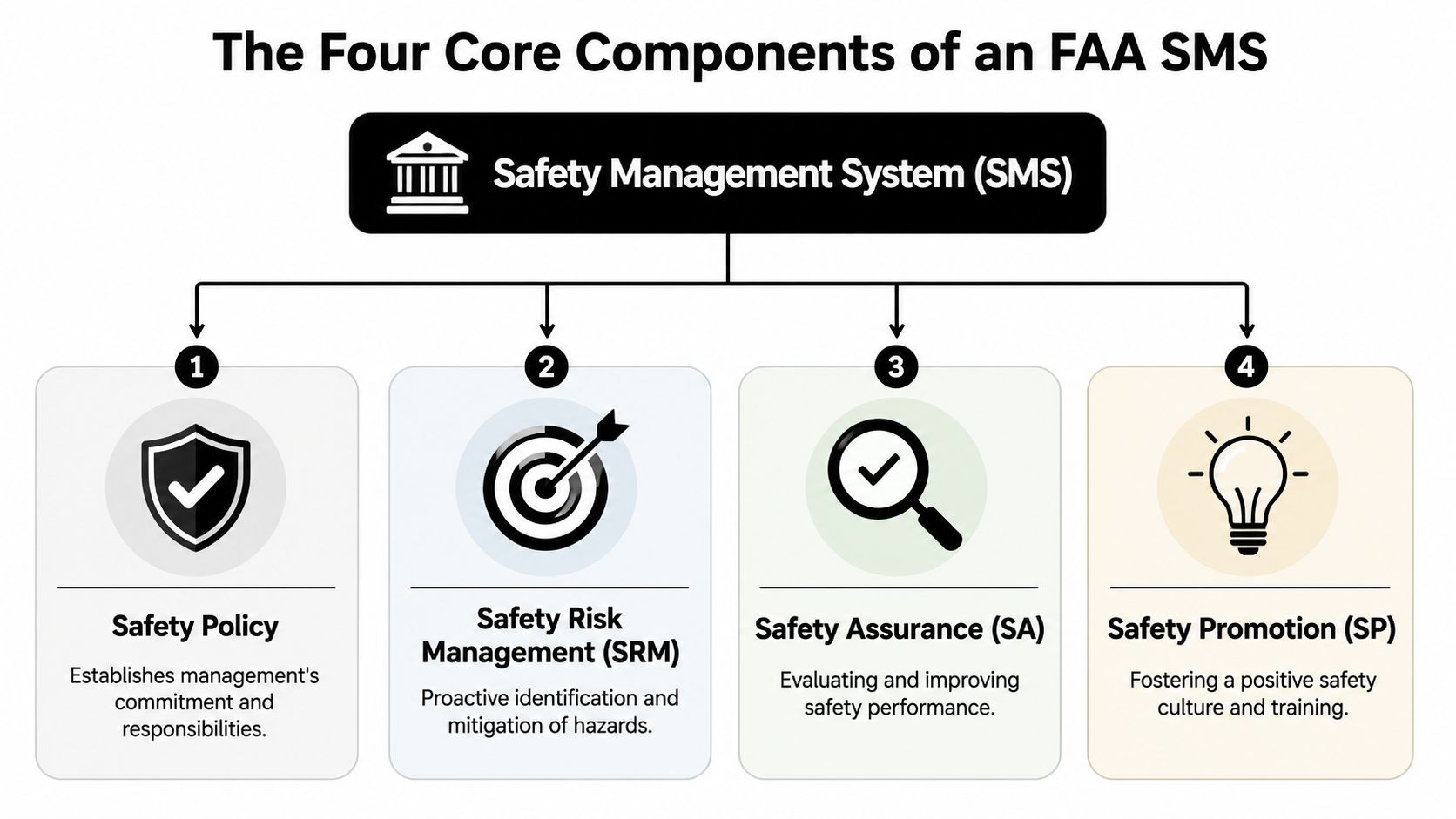
The FAA framework isn't vague. It requires four core functions that work together. For Part 135 on-demand operators, the FAA's expanded SMS mandate requires four core components, with Safety Risk Management (SRM) explicitly mandating a systematic hazard analysis process to reduce risks to an acceptable level, as outlined on the FAA's Safety Management System overview.
Safety Policy
This is management's written commitment to how safety decisions get made. It defines roles, authority, accountability, and the standard the organization expects from pilots, maintenance teams, dispatch, and leadership.
In charter operations, policy becomes real when a scheduler knows they can't pressure a crew into accepting a marginal duty situation just to protect a departure slot. If leadership says safety comes first but rewards only utilization and speed, the policy is weak no matter how polished the manual looks.
A solid Safety Policy does three things well:
- Sets authority clearly: People know who can accept, reject, or escalate risk.
- Defines expectations: Crews and staff understand what “good judgment” means operationally.
- Protects reporting: Employees can surface concerns without fearing retaliation.
Safety Risk Management
SRM is where the operator identifies hazards, analyzes them, and decides what controls are needed. This is the heart of proactive safety.
Take a charter into a high-altitude airport with changing afternoon weather and a passenger request for a tight turnaround. A mature operator won't just ask whether the flight is legal. It will assess aircraft performance, runway conditions, crew familiarity, alternates, schedule pressure, and whether the return leg creates compounded risk.
That's what makes SRM powerful. It helps operators tailor decisions to the mission rather than forcing every flight into the same template.
Field view: In charter, the hazard usually isn't one dramatic event. It's a chain of ordinary pressures that line up at the wrong time.
Safety Assurance
Safety Assurance is how the operator checks whether the system is working. Controls are documented, audits are performed, trends are monitored, and management verifies whether the risk level has improved.
In practical terms, an operator asks:
| Assurance question | What it means in charter |
|---|---|
| Did the mitigation happen? | The crew brief, equipment check, or dispatch control was actually completed |
| Did it work? | The same issue didn't recur under similar conditions |
| Is the risk still acceptable? | Conditions haven't changed enough to require a new assessment |
Without Assurance, operators collect forms instead of learning.
Safety Promotion
This is the cultural piece. Training matters. Communication matters. So does whether people believe management wants the truth.
The best operators use Safety Promotion to make reporting normal. A line pilot reports an unstable process. Maintenance notes a recurring discrepancy trend. Scheduling shares a pattern of trip requests that create avoidable pressure points. Leadership then feeds lessons back into the operation.
Promotion is what turns SMS from a management system into an operating culture.
SMS for Private Charters and The Part 135 Mandate
For private charter clients, the key issue isn't whether SMS exists in theory. It's whether Part 135 operators are built to implement it without straining the rest of the operation.
That's where the FAA mandate matters. A serious operator has to invest time, money, management attention, documentation discipline, and training resources before SMS becomes useful. This isn't a light administrative update.
The business reality for Part 135 operators
For smaller charter companies, that commitment is material. Small Part 135 operators face initial SMS implementation costs up to $41,180 and must declare compliance within 36 months, while new applicants need a functional SMS from day one, linking regulatory timing directly to an operator's readiness, according to AvicAir's breakdown of FAA SMS requirements for small Part 135 operators.
That single fact tells clients a lot. Operators that invest early usually build stronger internal processes. Operators that scramble late often treat SMS as paperwork layered on top of an unchanged culture.
A quick refresher on the operating certificate itself is useful here. This explanation of FAA Part 135 covers why on-demand charter providers operate under a different regulatory structure than private owners flying under Part 91.
Part 135 SMS implementation timelines
| Operator Status | Compliance Deadline |
|---|---|
| Existing small Part 135 operator | Declaration of compliance within 36 months of the regulation's effective date |
| New Part 135 applicant | Functional SMS required from day one |
What that means for passengers
Clients rarely see the hidden trade-offs inside a smaller operator's business. Management may be balancing software costs, training requirements, documentation standards, and oversight workload while also trying to keep aircraft flying.
That can produce two very different outcomes:
- Operators that integrate SMS into operations: They use the mandate to improve decision quality, reporting, and consistency.
- Operators that bolt SMS onto the side: They produce documents for the regulator but leave dispatch, scheduling, and operational judgment mostly unchanged.
The second model is where trouble starts. Not necessarily catastrophic trouble. More often, it's the kind clients feel as poor communication, late aircraft swaps, or a trip that becomes more expensive and less predictable than it looked on the initial quote.
A useful filter
When I assess charter quality, I pay attention to whether the operator's SMS appears to shape decisions before the day of flight. If the operation only becomes “careful” once an issue appears, it's usually behind the curve already. The mandate forces operators to have the framework. It doesn't guarantee maturity.
Measurable Benefits of a Mature SMS
A mature SMS pays off because it reduces recurrence. In aviation, repeat hazards are a warning sign that the organization is seeing problems without fixing the conditions behind them.
The FAA's own policy focus reflects that. The FAA's emphasis on data analytics and performance-based standards has shown that operators adopting SMS see a reduction in repeat hazards by up to 30% in early post-implementation evaluations, according to FAA Order 8040.4C.
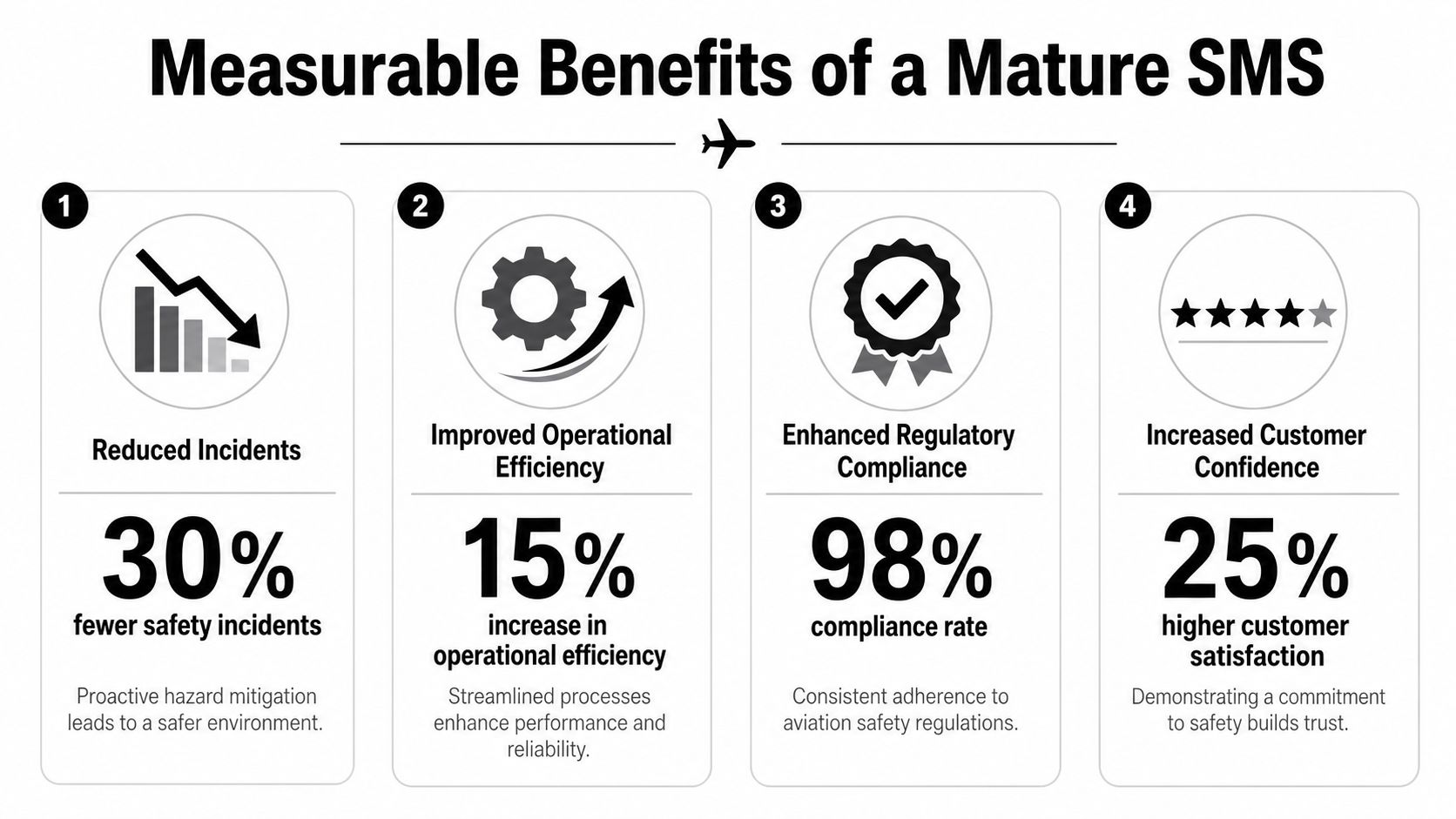
That statistic matters because repeat hazards are exactly what create unstable service. A scheduling conflict that keeps reappearing. A reporting gap between maintenance and operations. A crew planning weakness that turns into avoidable friction for passengers.
Where passengers feel the difference
A mature SMS improves the client experience in ways most passengers won't label as “safety,” even though that's what's driving them.
- Fewer repeat disruptions: The same preventable issue is less likely to appear trip after trip.
- Better crew readiness: Fatigue, duty risk, and trip complexity are treated as planning variables, not afterthoughts.
- Cleaner communication: Operators with disciplined reporting usually brief changes earlier and more clearly.
- Stronger reliability culture: Teams are accustomed to documenting, escalating, and closing the loop.
For a broader view of what reliable charter execution looks like from the passenger side, this guide to maintaining private jet safety and reliability is worth reading.
Mature SMS doesn't make operations perfect. It makes them teachable. The organization learns faster than the risk can repeat itself.
Compliance versus performance
This is the dividing line that informed buyers should care about most.
A compliance-only operator asks, “Do we have the required process?”
A mature operator asks, “Did the process change the outcome?”
Only one of those mindsets improves reliability over time.
How Haute Jets Sourcing Aligns with SMS Principles
A broker doesn't operate the aircraft, but sourcing standards still shape the safety and reliability profile a client gets. That's the practical connection to SMS thinking. If your selection process filters out weak operators, you reduce exposure before the trip is ever booked.
That matters in the charter market because operator quality isn't uniform. Some providers have the paperwork. Others have a culture that shows up in crew standards, maintenance discipline, scheduling realism, and operational communication. Third-party audit programs help distinguish between them.
Why third-party audit quality matters
Wyvern Wingman and ARGUS Gold or Platinum aren't random labels. In practice, they function as useful proxies for whether an operator has built disciplined systems instead of relying on bare-minimum compliance. They don't replace direct FAA oversight, but they do add another layer of scrutiny around how the operation is run.
For a charter client, that's valuable because SMS maturity is difficult to evaluate from the outside. You usually can't inspect the reporting culture, review internal hazard tracking, or sit in on management safety meetings. Audit-backed operator screening narrows the field to providers that have accepted deeper operational accountability.
A short visual overview helps make that sourcing logic concrete.
The sourcing advantage clients actually notice
The most important client benefit isn't an abstract safety label. It's reduced exposure to weak execution.
When sourcing prioritizes stronger operators, several practical advantages tend to follow:
- Better trip stability: The provider is less likely to unravel when the mission changes.
- Lower hidden-friction risk: Dispatch and scheduling tend to be more realistic from the start.
- Stronger accountability: Operators with mature systems usually document and communicate deviations more cleanly.
- More confidence in the quote: When repositioning and operational planning are handled intelligently, clients are less likely to discover the true cost later.
That last point is easy to miss. An operator with poor internal risk management may quote attractively and then struggle operationally because the aircraft, crew, or timing assumptions were thin from the beginning. Strong sourcing helps protect clients from exactly that kind of avoidable exposure.
Frequently Asked Questions About FAA SMS
Is SMS just a newer name for safety paperwork
No. Traditional programs often reacted after an event. SMS is designed to identify hazards earlier, assign controls, verify whether those controls work, and keep improving the system. The difference is proactive management, not just documentation.
Does SMS guarantee that nothing will go wrong
No safety framework can eliminate all risk. What an effective SMS does is reduce risk systematically and make the operator better at identifying threats before they become incidents, delays, or unstable operating conditions.
Ask whether the operator only satisfies the regulation, or whether safety reporting, training, and follow-up clearly shape day-to-day decisions.
What should a charter client actually look for
Start with operator quality signals that are visible from the outside. Wyvern Wingman and ARGUS Gold or Platinum are useful indicators because they reflect deeper operational scrutiny than a marketing claim about being “safe.”
Then ask practical questions:
- How is the aircraft sourced for this trip?
- Is the operator experienced in this route profile and airport set?
- How are crew, maintenance, and scheduling risks managed when the itinerary changes?
Why does training matter so much in SMS
Because reporting systems and risk controls only work if people know how to use them. Front-line judgment is where SMS either becomes real or stays theoretical. For readers who want a broader plain-English resource on how aviation training questions are approached, Aviation training FAQs offers useful context.
Why should a charter client care if an operator's SMS is mature
Because maturity usually shows up in reliability. You may never see the safety meeting, the hazard report, or the assurance audit. But you'll notice when the trip is planned intelligently, the crew is prepared, and the operator doesn't create avoidable surprises.
When your schedule is time-critical, operator quality matters as much as aircraft category. Haute Jets sources from Wyvern Wingman and ARGUS Gold or Platinum-rated operators, helps clients avoid unnecessary repositioning costs, and gives you visibility into the exact aircraft you're booking so your charter is safer, cleaner, and more predictable from the start.