

A call like this usually comes at the worst moment. Bags are packed, the car is booked, your meeting is fixed, and then your charter coordinator says your departure may be delayed because of IMC.
If you don't work in aviation, that phrase can sound more serious than it is, or worse, more routine than it should. In practice, instrument meteorological condition means the weather has dropped below the level where a pilot can safely and legally fly by looking outside. At that point, the flight has to be managed by instruments, procedures, and air traffic control.
For private travelers, that distinction matters because it affects more than the view out the window. It changes how the crew plans the route, whether an alternate airport is required, how much flexibility exists at departure and arrival, and whether a delay is the safest choice. On Haute Jets Journal's guide to flying in any weather, you'll see the broader idea. Here, the goal is narrower and more useful: to translate IMC into plain English so you know what's happening when weather starts shaping your itinerary.
Understanding Your Flight Weather Briefing
You're scheduled for a morning departure. The aircraft is ready, the crew is legal, the destination airport is open, and yet your flight team says they're watching IMC at either the departure field, the arrival field, or somewhere along the route. That isn't a vague excuse. It's a precise operational flag.
In day-to-day terms, instrument meteorological condition means the outside visual cues a pilot would normally use are limited or gone. Low cloud, fog, haze, precipitation, or a combination of them can hide the horizon and reduce the pilot's ability to maintain attitude, direction, and spacing by sight alone. When that happens, the flight shifts into a more structured mode of operation.
Practical rule: A weather delay tied to IMC usually means the crew is protecting legal margins, not improvising.
That's the reassuring part clients should know. Professional operators don't “try and see.” They verify weather, check the approach and airport limits, confirm crew and aircraft qualifications, and decide whether the flight can proceed under the rules that apply.
What clients often hear wrong
Many travelers hear “bad weather” and assume the flight is unsafe. Others hear “the aircraft is certified” and assume weather won't matter. Neither view is accurate.
A properly planned IMC flight can be routine. A poorly managed weather situation can become unstable quickly, especially if a provider treats low visibility as a sales obstacle instead of a safety condition. The difference usually comes down to planning discipline and pilot proficiency.
What your coordinator is really telling you
When your team says IMC may affect your trip, they're usually talking about one or more of these realities:
- Departure constraints: The crew may need the visibility to improve before takeoff can happen legally.
- Arrival constraints: The destination may require an instrument approach, and the weather could sit close to or below that airport's usable minimums.
- Flow management: Air traffic control may space aircraft more conservatively in low visibility, which can slow departures and arrivals.
- Backup planning: The crew may carry an alternate destination and extra fuel if the primary airport becomes unavailable on arrival.
That's how a disciplined operation turns uncertainty into a controlled decision.
IMC vs VMC Explained
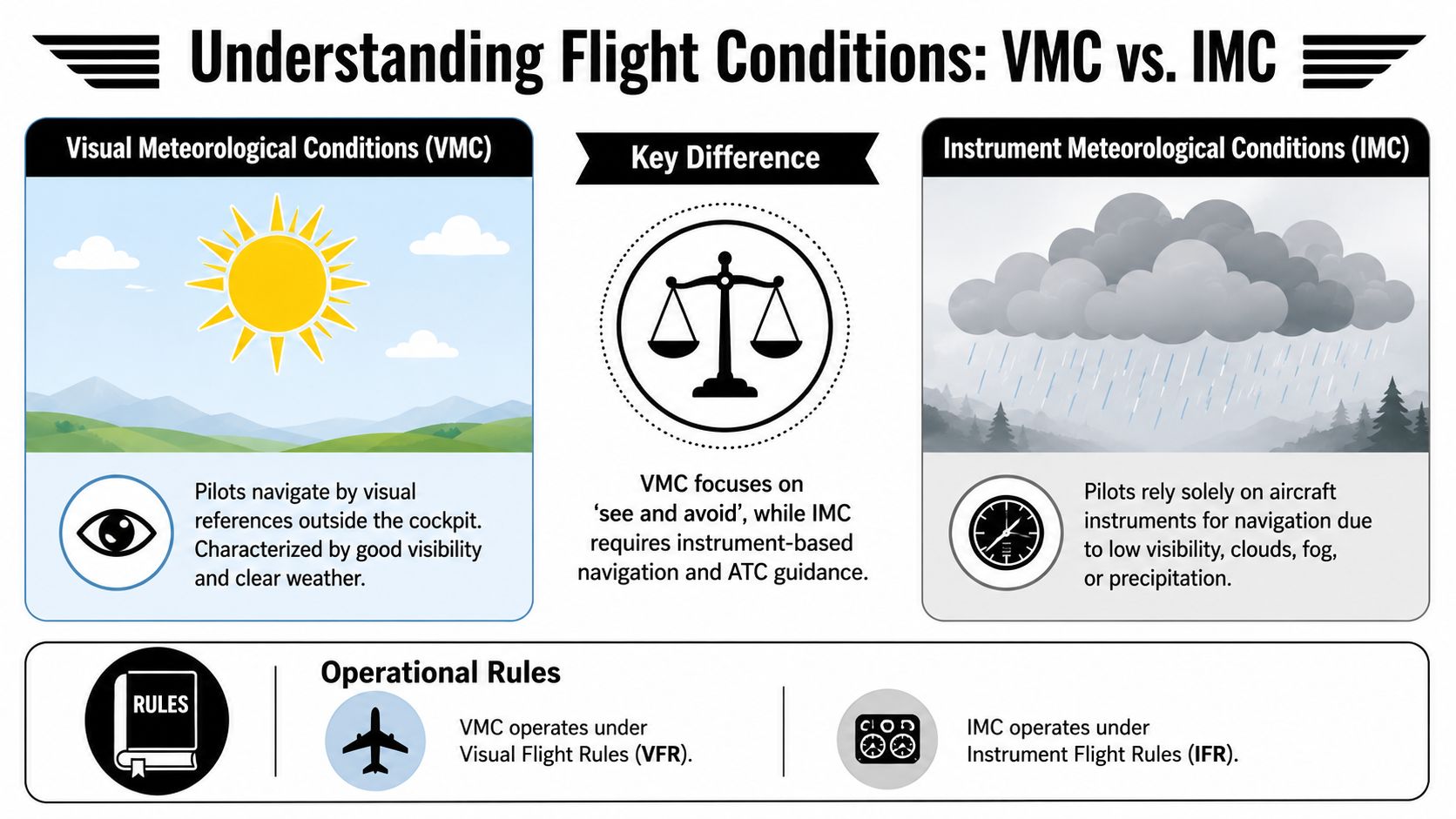
The easiest way to understand this is to compare flying on a clear day with driving on a clear highway. You can see your lane, the vehicles around you, the road signs, and the horizon. In aviation, that's the world of VMC, or Visual Meteorological Conditions. The pilot operates under VFR, or Visual Flight Rules, and uses outside references as the primary guide.
Now compare that with driving in dense fog. You can't trust the horizon because you can't see it. You rely on your instruments, lane discipline, route guidance, and a much more structured pace. In aviation, that's IMC, and the flight must be handled under IFR, or Instrument Flight Rules.
Where the line is drawn
At an airport in the United States and Canada, standard VFR weather minimums require at least 3 statute miles of horizontal visibility and a ceiling of 1,000 feet above the airport. If the cloud base drops below 1,000 ft AGL or visibility falls below 3 SM, the environment is treated as IFR/IMC, and VFR flight isn't permitted unless both the aircraft and pilot are instrument-certified, as explained in this UBC aviation weather overview.
That's the basic airport-level line many clients need to know.
A related FAA framework also varies VMC minimums by airspace. Under FAR 91.155, Class B generally requires 3 SM visibility and clear of clouds, while Classes C and D require 3 SM visibility plus cloud clearance of 500 feet below, 1,000 feet above, and 2,000 feet horizontally. Once the weather drops below those minima, the pilot is no longer in visual conditions.
Why the distinction matters
This isn't aviation jargon for its own sake. The entire operating model changes.
| Condition | Pilot's main reference | Operating rule set | Practical effect |
|---|---|---|---|
| VMC | Outside visual cues | VFR | More flexibility if weather is clear |
| IMC | Cockpit instruments and procedures | IFR | More structure, more coordination, tighter legal limits |
In VMC, a pilot can maintain orientation by looking outside and visually separating from terrain and traffic in the way the rules allow. In IMC, that visual safety net is gone. The crew must trust instruments, published procedures, and ATC instructions.
Dense cloud or poor visibility doesn't just make the trip less comfortable. It changes the legal and operational framework of the flight.
Why clients get confused
The confusion usually comes from the phrase “the aircraft can fly in any weather.” Jets are highly capable, but the trip still depends on weather minima, airport procedures, crew qualifications, and regulatory limits. Capability isn't a blanket permission slip.
That's why a well-managed charter operation talks about conditions, minimums, and approaches, not just the aircraft model.
The Rules of the Sky in Instrument Conditions
Once weather drops below VFR minimums, the flight can't continue as a visual operation. Under 14 CFR § 170.3, Instrument Meteorological Conditions are legally defined as weather conditions below the minimums prescribed for flight under VFR. That threshold prohibits VFR operations and requires an IFR clearance from air traffic control, as stated in the Cornell Law School text of 14 CFR § 170.3.
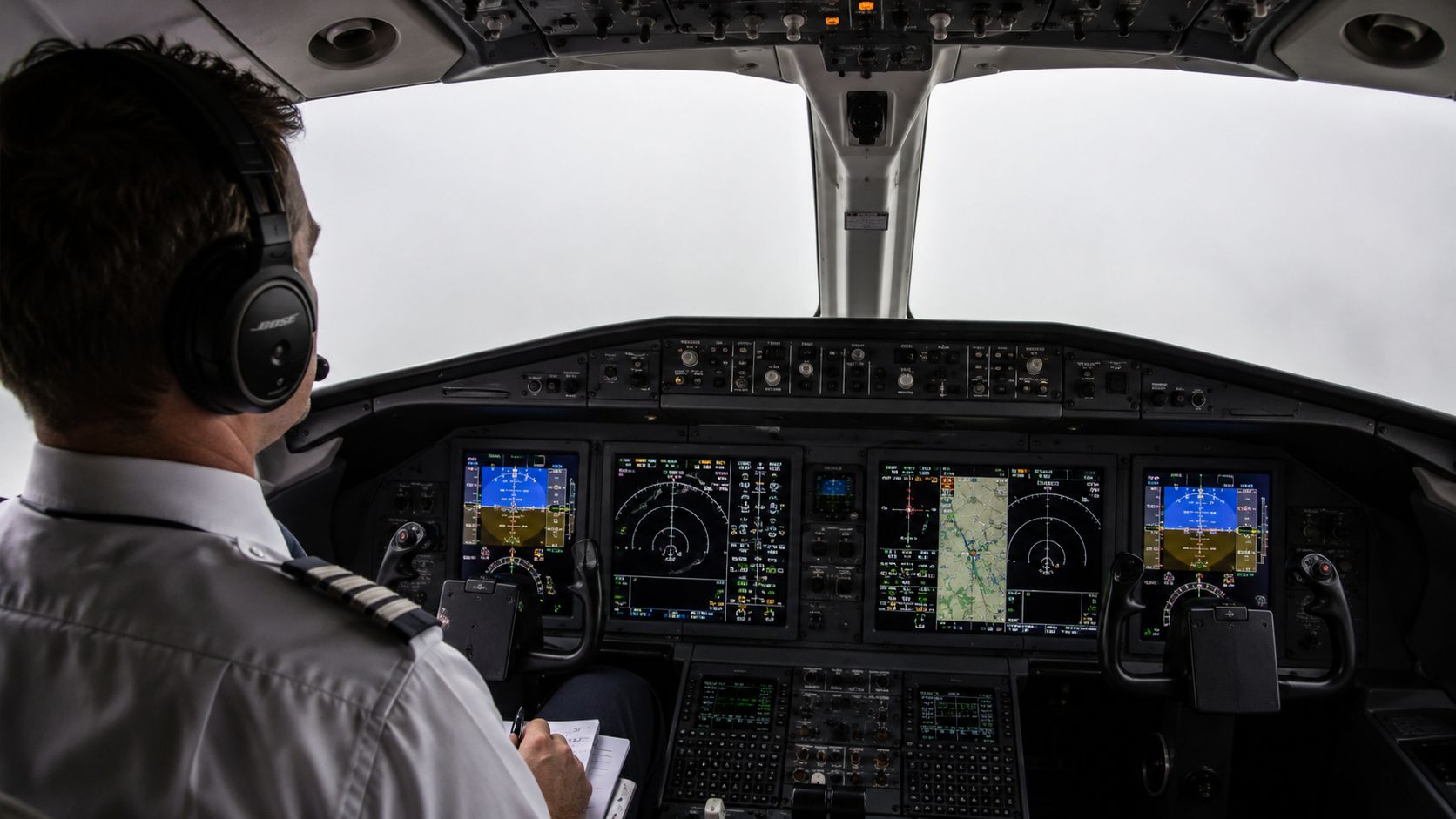
That legal shift is what separates a casual explanation of weather from an actual operational decision. A pilot must do more than choose to be more careful. The entire flight has to move into the IFR system.
IFR works like a managed route network
A useful way to think about IFR is as a highway system in the sky. Aircraft are assigned routes, altitudes, and clearances. Air traffic control keeps separation between aircraft and manages the flow into and out of airports.
That matters most when pilots can't rely on outside visual cues. In low cloud or poor visibility, the crew flies by reference to the aircraft's instruments and follows published procedures designed for that airport and runway.
If you've ever wondered why a flight that “should only be an hour” sits for a release time or takes a slightly longer routing, this is often the reason. Order and predictability are part of the safety system.
What the crew actually uses
Pilots operating in IMC depend on several layers working together, including:
- Flight instruments: These show attitude, heading, altitude, airspeed, and vertical path.
- Navigation systems: RNAV and other certified systems help crews follow precise routes and approaches.
- Published procedures: Standard departures, arrivals, and instrument approaches are built to keep aircraft clear of terrain and aligned for landing.
- ATC clearance: Controllers provide route approval, spacing, altitude assignments, and sequencing.
For clients chartering under FAA Part 135 standards, this isn't optional. It's the operating framework that governs how commercial charter flights are conducted in instrument conditions.
Approaches are where discipline shows
The arrival phase is where clients most often feel IMC operationally. The aircraft may descend through cloud layers with no outside view until late in the approach, or not continue at all if the required visual references never appear.
A strong crew doesn't force the issue. If the runway environment isn't visible at the required point, they execute the missed approach and either try again if conditions support it or divert according to plan.
A short briefing helps show how the system works in practice:
The safest IFR crews are often the least dramatic. They follow procedure, respect minima, and make conservative decisions early.
That's why an IMC delay can be evidence of a healthy operation, not a weak one.
How IMC Impacts Your Private Jet Charter
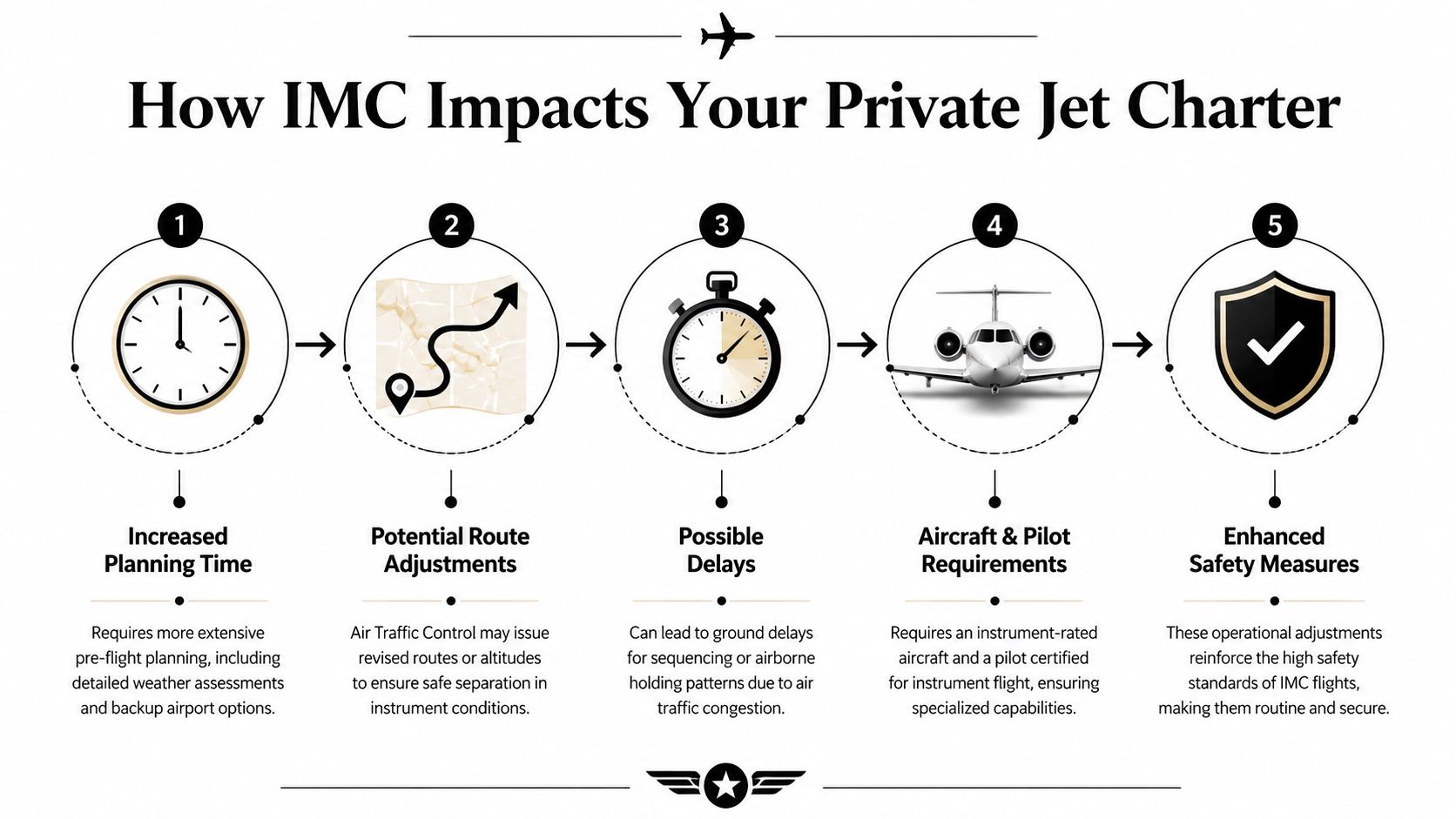
For passengers, IMC rarely feels dangerous inside the cabin. The effects are logistical. The pressure shows up in timing, routing, alternates, and dispatch decisions rather than in visible drama.
The key point is that instrument meteorological condition narrows the operating envelope. As Skybrary's IMC overview notes, IMC is associated with visibility less than 1 mile, cloud ceiling below 2,000 feet, or distance from cloud less than VMC minima, forcing the flight to operate under IFR. The same source notes that when visibility drops below 1/2 mile, standard instrument approaches are legally prohibited for most Part 135 operators, which can require holding or rerouting instead of continuing to land.
Why a delay can happen before the weather looks terrible
Clients often look outside, see light mist or a low gray layer, and wonder why dispatch is hesitant. That's because crews don't make the call based on casual appearance. They're checking the actual reported and forecast visibility, runway approach availability, airport-specific procedures, and whether the conditions support both departure and arrival legally.
A flight may wait because the weather is close to the minimum, not because it is catastrophic.
The operational chain reaction
When IMC is in the forecast, several things usually happen behind the scenes:
- Alternate planning: The dispatcher and crew may need a practical backup airport if the destination goes below landing conditions.
- Fuel strategy: More margin may be carried for holding, a missed approach, or diversion.
- Routing changes: ATC may issue a different path or altitude to manage traffic flow safely in instrument conditions.
- Ground timing: A delayed push can be smarter than launching into an arrival bank that's already stacking aircraft into holds.
What this means for your day
A low-visibility morning can create different outcomes depending on where the bottleneck sits.
| Situation | Likely effect on your trip |
|---|---|
| Departure airport below usable limits | Delayed takeoff or revised departure time |
| Destination near approach minimums | Additional fuel, alternate planning, possible diversion |
| ATC congestion in low visibility | Flow delays, slot times, airborne holding |
| Weather below legal landing threshold | Missed approach, diversion, or cancellation |
Client takeaway: In IMC, the cleanest schedule isn't always the safest one. The best operators protect the landing outcome, not just the departure time.
That's also why two providers can quote the same trip and give very different confidence levels. One may be pricing a flight. The other is managing a weather-dependent operation properly.
Pilot and Aircraft Requirements for Safe IMC Operations
A common client assumption is that once an aircraft has modern avionics, the weather problem is mostly solved. That's incomplete. Equipment matters, but pilot proficiency is the deciding layer.
According to UCAR's weather requirements material, operational safety in IMC requires strict adherence to certified instrument approach procedures, and IMC brings a 20–40% increase in flight complexity compared with VMC. The same material notes that these conditions demand higher training standards, including Category II/III certification, and advanced avionics such as RNAV/RNP systems for precise navigation in low visibility.

Instrument-rated isn't the whole story
An instrument rating is the baseline. It allows a pilot to operate under IFR, but advanced charter flying often asks for more than baseline legality.
The crew may need recent experience in the specific aircraft, familiarity with the destination environment, and training for advanced approach categories where applicable. A pilot who is legal on paper can still be weaker than another pilot who flies frequent low-visibility operations in the same tail and airport network.
The aircraft matters, but only as part of a system
A capable jet supports safe IMC operations when it has the right certified equipment and the crew knows how to use it correctly. That usually includes navigation capability that supports precise instrument procedures and automation that reduces workload at the right moments.
Still, avionics don't replace judgment. They support it.
Three things discerning clients should care about
Crew recency and proficiency
Ask whether the assigned crew regularly flies IFR trips and remains current on the procedures that match the mission profile.Aircraft-specific capability
A modern panel is useful only if the aircraft is properly equipped and approved for the procedures the destination may require.Approach authorization
Some low-visibility operations require additional approvals and training beyond general IFR competence.
The strongest IMC operation is never just “good airplane, good luck.” It's trained crew, approved procedures, disciplined dispatch, and aircraft capability working together.
Why elite operators stand apart
A clear difference manifests between a premium operator and a less-vetted one. In marketing, many aircraft look interchangeable. In actual weather, they aren't.
The difference shows up in how calmly the crew handles a reroute, how precisely they brief a missed approach, how conservatively dispatch interprets changing conditions, and whether everyone involved treats IMC as a professional procedure rather than an inconvenience.
Clients don't need to master instrument flying. They do need to understand that weather capability is earned by training and standards, not claimed by brochure language.
Fly with Confidence The Haute Jets Safety Standard
The most important distinction in charter weather risk goes beyond VMC versus IMC. It's planned IMC versus inadvertent IMC.
Planned IMC is what disciplined operators prepare for. The flight is filed properly, the crew is qualified, the aircraft is approved, the approach and alternate are evaluated, and dispatch builds the trip around the weather that exists, not the weather everyone wishes existed. In that environment, instrument conditions are managed professionally.
Inadvertent IMC is different. That's when a pilot or provider ends up in instrument conditions without the right preparation, proficiency, or margins. That scenario is where the polished charter promise of “any weather capability” starts to break down.
Why less-vetted providers create hidden risk
The charter buyer often sees the aircraft first. The actual risk usually sits elsewhere.
As GlobeAir's discussion of IMC and inadvertent IMC notes, 40% of helicopter accidents occur during inadvertent entry into IMC. The same source highlights that many of these incidents involve pilots who lack proper instrument training for the specific aircraft, and states that true safety in IMC relies 90% on pilot instrument proficiency, not just avionics.
That is the nuance many clients never hear. A weather-capable aircraft doesn't automatically create a weather-capable operation.
What strong vetting changes
Haute Jets addresses that gap through operator selection and transparency. The company sources from a broad global network while limiting choices to operators that hold Wyvern Wingman or ARGUS Gold/Platinum safety credentials, which are described in its safety standards overview. That matters because IMC safety is built long before the cabin door closes.
A rigorous process helps answer the questions clients rarely know to ask:
- Who is flying this tail number today?
- Are those pilots trained and current for instrument operations in this aircraft?
- Is the dispatch culture conservative when weather compresses?
- Will someone explain the delay clearly, or just tell me the trip is “weather pending”?
The practical benefit to the traveler
For a client, good IMC management feels like clarity. You get honest timing, realistic options, and fewer surprises. If the answer is delay, you hear why. If the answer is divert, you know where and what happens next. If the flight proceeds, it does so because the operation supports it.
That's the ultimate premium in private aviation. Not pretending weather doesn't matter. Knowing your provider respects it, plans for it, and communicates it without drama.
When travelers understand the difference between a properly planned instrument operation and an accidental encounter with conditions a crew shouldn't have accepted, they ask better questions and make better charter decisions.
If you want a private charter team that explains weather clearly, confirms operator quality in advance, and sources from vetted aircraft worldwide without membership commitments, Haute Jets offers on-demand access to Wyvern and ARGUS-rated operators with transparent trip planning from quote to wheels up.