
A pilot can legally start private training in the United States with 40 flight hours, yet typical students finish closer to 72 hours, and airline-bound pilots must build 1,500 hours, a path that typically takes two to three years and costs $70,000 to $110,000 according to PilotBound's training data. That single gap tells you almost everything that matters about pilot training requirements. Regulatory minimums are entry gates. They are not a proxy for mastery.
If you're chartering a jet, the right question isn't whether your pilots meet the minimum. The right question is whether the operator treats minimums as irrelevant to passenger safety. In private aviation, expertise is the luxury that matters most. Leather seats, cabin altitude, and catering are easy to buy. Judgment in deteriorating weather, systems discipline at high altitude, and calm crew coordination under abnormal conditions take years to build.
That's the standard Haute Jets Journal readers should care about. Not paperwork alone. Proven capability.
The Three Tiers of Pilot Certification
For a private aviation client, pilot certificates are not academic milestones. They are a fast way to separate a recreational aviator from a professional who belongs in the left seat of your aircraft. If you are paying for charter service, you should expect credentials that match the risk of turbine operations, weather exposure, passenger duty, and complex aircraft systems.
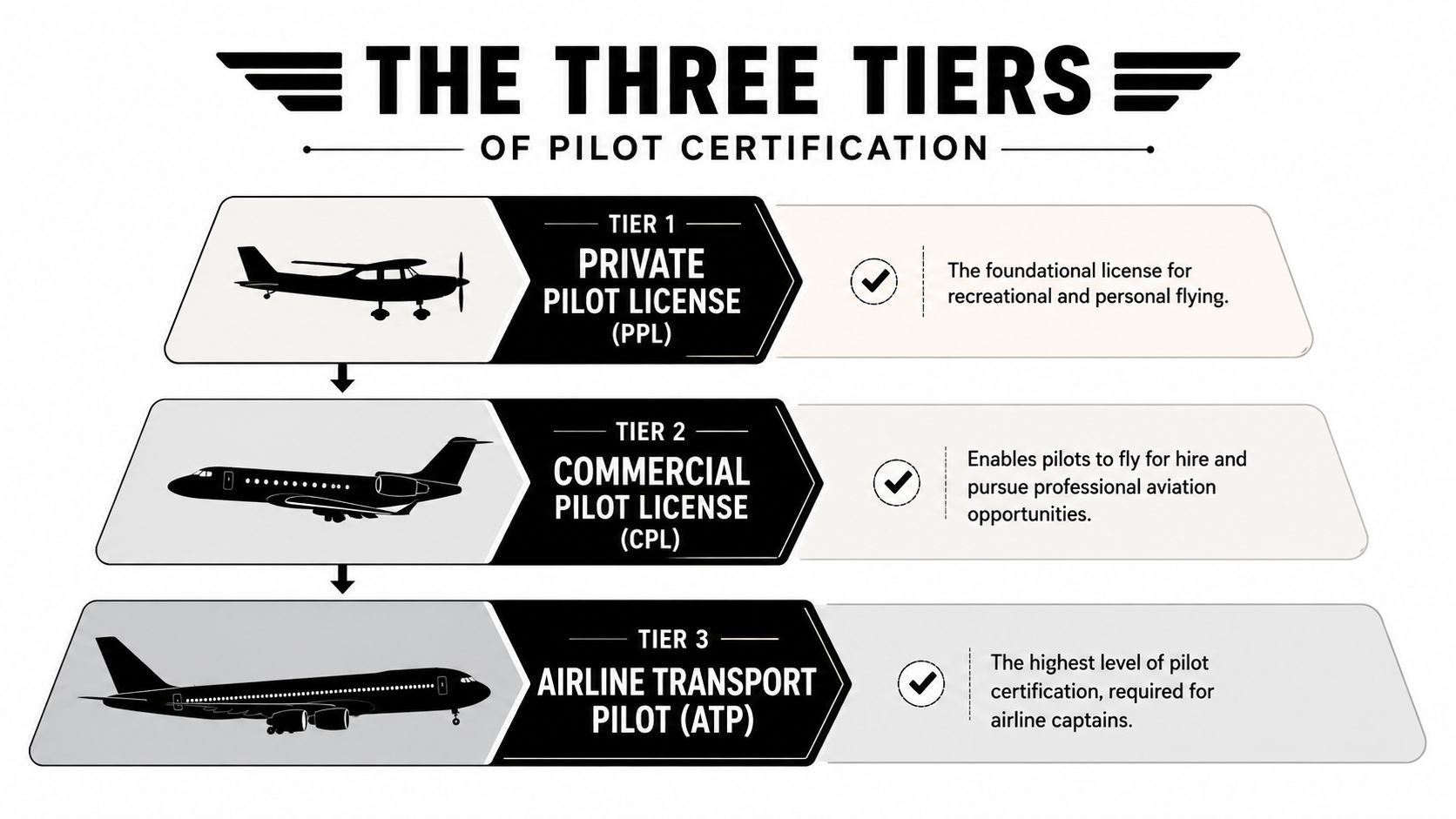
Private Pilot License
A Private Pilot License, or PPL, is the entry point. It allows a pilot to act as pilot in command for personal flying, but not for compensation or hire. That limitation matters because the training objective is personal transportation and basic airmanship, not commercial passenger service.
A PPL can be perfectly respectable for owner-flown piston aircraft. It is not the credential you should associate with a charter cockpit.
Commercial Pilot License
A Commercial Pilot License, or CPL, marks the move from personal flying to professional flying. It authorizes a pilot to be paid for approved operations and reflects a higher standard of precision, aircraft control, and operational discipline than a private certificate.
Clients still should not stop their review here. A commercial certificate shows a pilot has entered professional aviation. It does not prove readiness for high-end charter in turbine aircraft, busy airspace, demanding weather, or executive duty of care. A critical safety question is whether that pilot also has the judgment, aircraft-specific training, and operating environment to perform consistently under pressure.
Practical rule: If “commercial pilot” is the headline qualification, keep asking. For serious charter flying, that is a midpoint.
Airline Transport Pilot Certificate
The Airline Transport Pilot, or ATP, certificate is the highest level of pilot certification. It is the clearest signal that the pilot has reached command-level professional standing. For clients booking a jet, this is the credential that should carry the most weight because it aligns with the reality of carrying passengers in complex aircraft where mistakes have little margin for recovery.
The FAA outlines the ATP as the top certificate level for pilots, with eligibility standards that go well beyond private and commercial certification in age, aeronautical knowledge, flight experience, and operational competency under FAA airline transport pilot requirements. That gap is the point. The industry does not treat entry-level certification as enough for command responsibility in serious passenger operations, and neither should you.
If you want context on how professionals build from early certificates into charter and business aviation roles, see this overview of private jet pilot careers.
Here is the hierarchy that matters to a charter client:
- PPL: Personal flying authority
- CPL: Professional earning authority
- ATP: Command-level authority for the most demanding passenger operations
For your flight, the right answer is simple. The pilot in command should be operating at the ATP level, and the operator should treat anything less as a compromise, not a cost saving.
Essential Ratings and Endorsements
A license tells you the broad category of what a pilot may do. Ratings and endorsements tell you what that pilot is trained to do in the aircraft and environment that matter to you.
That distinction is where many clients get misled. A pilot can hold a respected certificate and still be unqualified for your specific flight.
Instrument and multi-engine capability
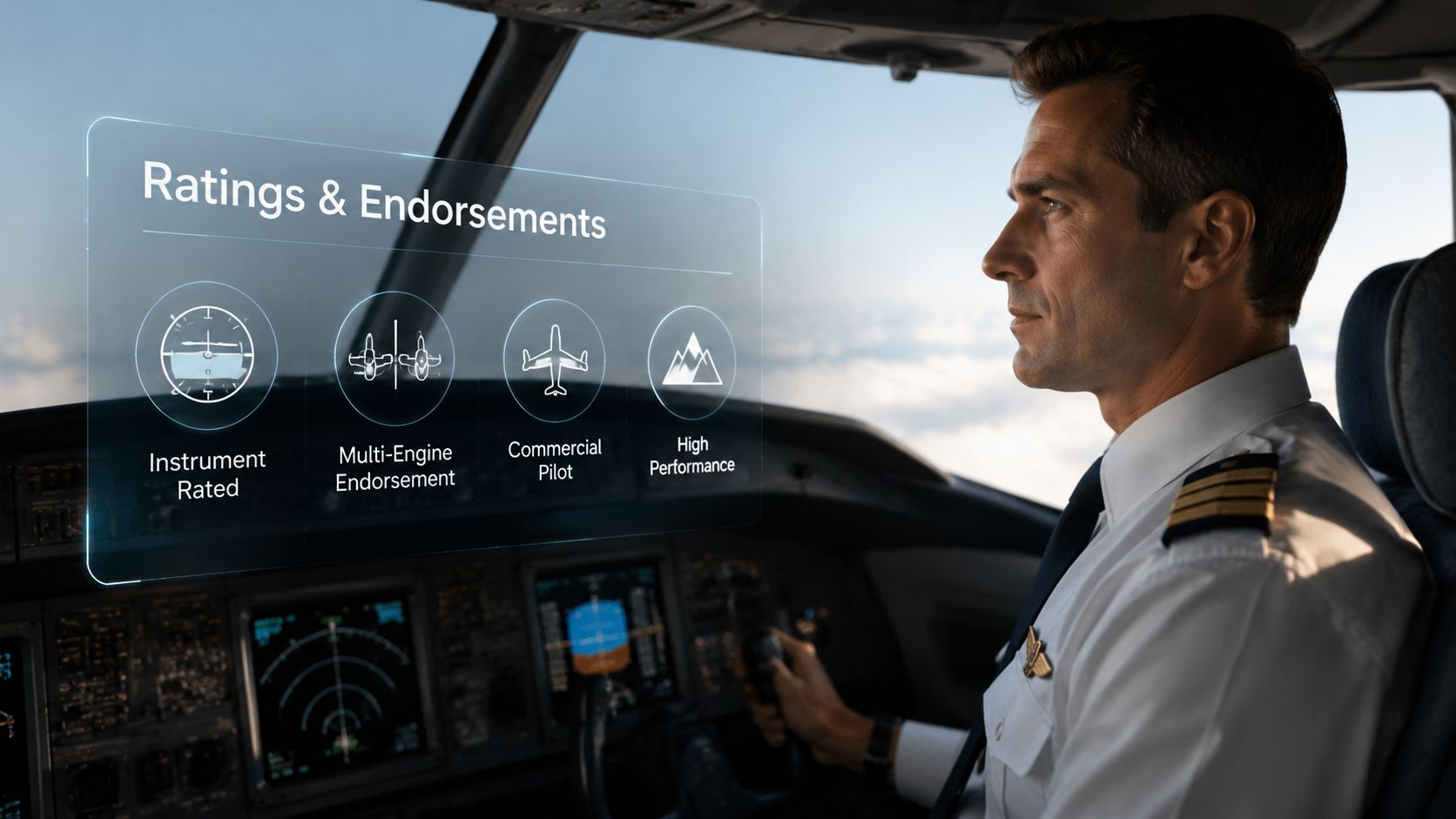
For professional jet operations, an Instrument Rating isn't a bonus. It's the baseline for operating safely when visibility drops, cloud layers build, or routing changes force instrument procedures. Without instrument competence, a pilot's utility and safety margin collapse the moment conditions stop being ideal.
A Multi-Engine Rating is just as important for most business aviation flying. Jets and many turbine aircraft aren't forgiving platforms for someone whose background is limited to single-engine operations. Engine-out handling, performance planning, and systems management change materially once the aircraft is more powerful and more complex.
Type ratings separate pilots from aircraft-specific experts
The rating that charter clients should care about most is the type rating. This is the aircraft-specific authorization required to operate many complex, high-performance aircraft. A pilot doesn't jump from a training airplane into a Gulfstream, Challenger, or Citation because they “have enough hours.” They must complete dedicated training and checking for that model.
That point becomes even sharper in Europe. For an initial turbo-jet type rating under EASA rules, a Pilot-in-Command must have at least 1,000 total flying hours with a Multi-Engine Rating and Instrument Rating, while a Co-Pilot must have at least 200 hours total experience and 70 hours as PIC, plus specific training requirements, according to EASA guidance for high-performance aircraft operations. That's a reminder that aircraft qualification is never generic.
The safest charter flight isn't flown by the pilot with the most impressive résumé headline. It's flown by the pilot whose qualifications match the exact aircraft, mission profile, and operating environment.
High-altitude endorsement matters in jet operations
Jet clients should also understand one less glamorous credential: the High Altitude Pressurization Endorsement. Pilots operating pressurized airplanes with a service ceiling above 25,000 feet MSL (FL250) must obtain that endorsement under FAR 61.31(g), ensuring competence in high-altitude physiology and systems management, as outlined by PilotPulse's summary of the FAA requirement.
That matters because the luxury cabin experience depends on invisible technical competence. Pressurization management, oxygen system understanding, and physiological awareness aren't academic topics. At altitude, small errors become serious problems quickly.
A useful video overview of ratings and training progression helps make these layers more concrete:
Ask the operator three direct questions:
- Aircraft-specific authority: Is each pilot type-rated for the exact aircraft?
- Weather authority: Do both pilots have strong instrument backgrounds?
- Altitude authority: Do their endorsements and recent training fit the aircraft's operating envelope?
That's how you separate legal compliance from operational competence.
FAA vs EASA A Tale of Two Standards
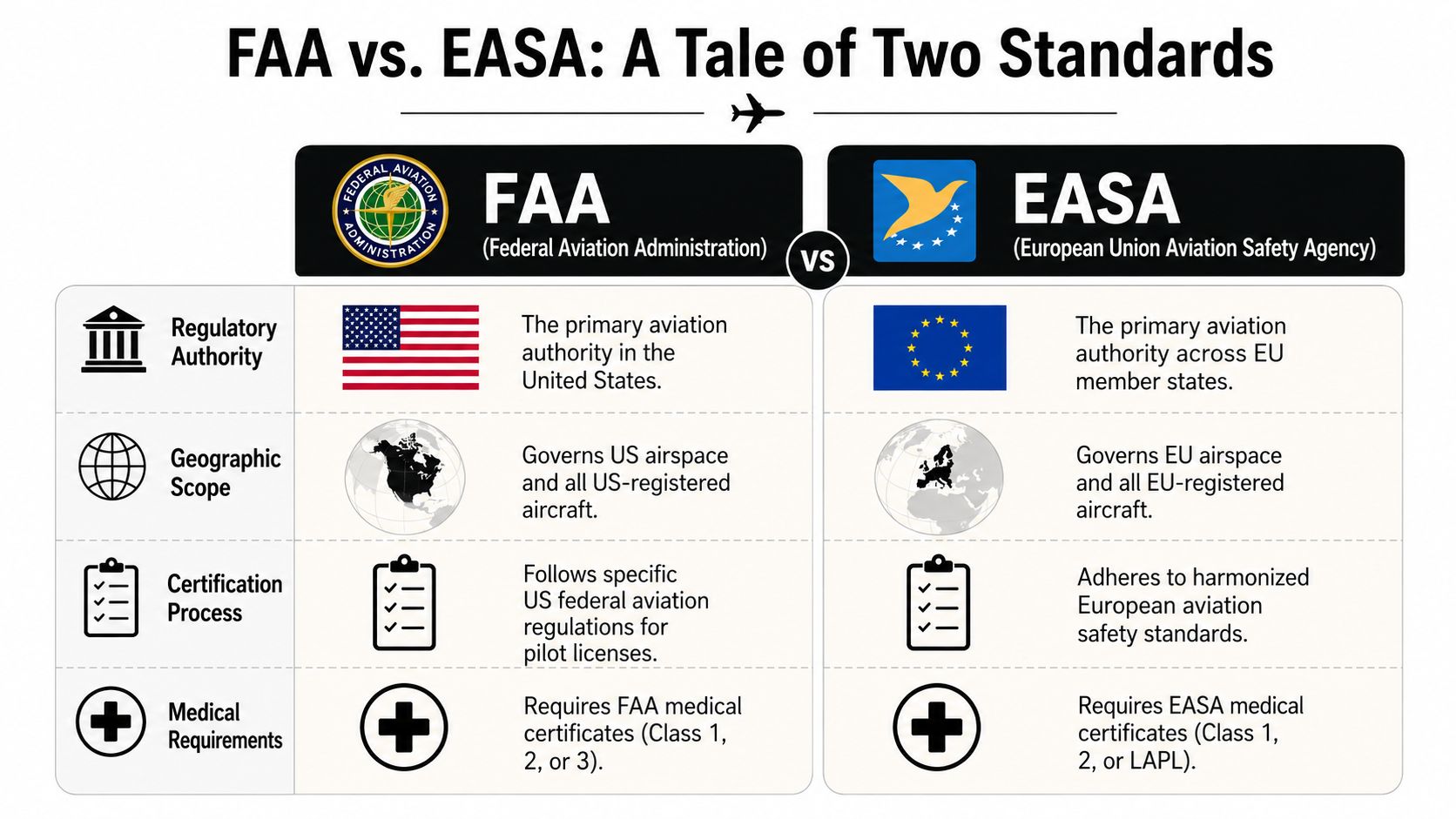
The two dominant training cultures in global aviation are the FAA system in the United States and the EASA system in Europe. Both can produce excellent pilots. They do it differently.
For clients using global charter networks, that difference matters because training philosophy shapes pilot behavior. One system leans harder on accumulated real-world flying. The other leans harder on standardized theory and structured progression.
The FAA model values accumulated flight time
The FAA approach generally favors broader hands-on experience before granting higher privileges. For a Commercial Pilot License, the FAA requires a minimum of 250 total flight hours, while EASA requires 200 hours for an integrated course. That extra time isn't trivial. More flight hours usually mean more exposure to weather variation, traffic density, airspace complexity, and imperfect real-world decision-making.
That can produce pilots who are more practiced at adapting when operations don't unfold exactly as planned.
EASA drives standardized theory and structured progression
EASA asks for fewer commercial hours in the integrated pathway, but it demands more formal theory. EASA requires 14 written exams versus the FAA's single exam for the commercial pathway comparison cited by Airmappr's FAA versus EASA licensing analysis. That creates a different type of rigor.
EASA-trained pilots often arrive with stronger standardized classroom preparation and a tighter multi-crew training framework. The benefit is consistency. The possible limitation is that standardization doesn't automatically equal broad operational seasoning.
A polished training file is valuable. A polished training file plus deep real-world exposure is better.
What private jet clients should conclude
This isn't an argument that one regulator is “safe” and the other isn't. That's too simplistic. The better conclusion is that credentials need context. A pilot from an FAA path may bring more accumulated flight time. A pilot from an EASA path may bring more formalized theoretical and simulator discipline.
For charter oversight, ask how the operator closes the gaps that each system can leave behind. If the crew trained under an experience-heavy system, what recurrent standardization keeps procedures sharp? If they trained under a theory-heavy system, what line experience and aircraft-specific depth strengthen judgment under pressure?
If you want the operating framework behind U.S. charter oversight, review FAA Part 135 standards in private aviation.
A simple comparison helps:
| Standard | FAA | EASA |
|---|---|---|
| Commercial hour minimum | 250 hours | 200 hours integrated |
| Exam emphasis | Single exam | 14 written exams |
| Training bias | More accumulated flight exposure | More structured theoretical standardization |
The best operators don't treat FAA or EASA credentials as self-sufficient. They build additional screening on top.
Flight Hours and Medical Fitness
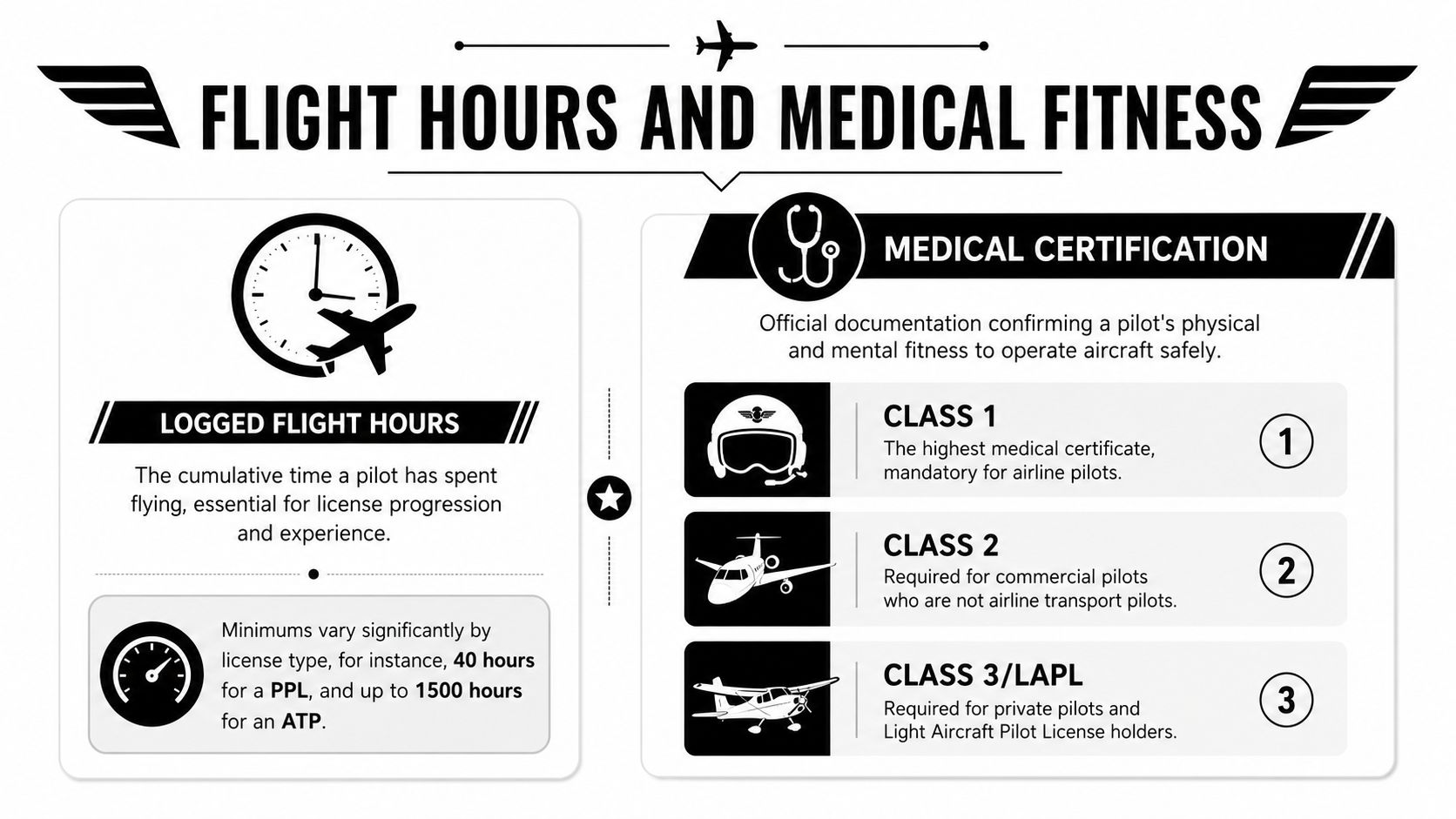
Boards like numbers because numbers feel objective. In pilot hiring, that instinct is useful, but only if you understand what the numbers really mean. Logged time is not a vanity metric. It's evidence of exposure. Medical certification is not routine paperwork. It's the continuing gatekeeper for whether a pilot is fit to exercise that experience safely.
The first trap is assuming the legal minimum tells you anything meaningful about proficiency.
The hidden gap between legal and practical competence
For private pilot training, FAA minimums are 40 hours, but the national average is 75 hours, according to Charter College's overview of common pilot training questions. That same source notes this hidden gap often leads to budget shortfalls of $15,000 to $25,000 because many students plan around the minimum instead of the realistic average.
For a passenger, the lesson is straightforward. Minimums are legal thresholds, not evidence that a pilot has absorbed enough repetition to respond smoothly under pressure. The pilot who barely crosses a line and the pilot who has worked well beyond it are not equivalent, even if the certificate looks the same.
What flight hours should mean to a client
Hours should be read in layers, not as a single total.
- Total time: Broad exposure across the pilot's career.
- Pilot-in-command time: Evidence that the pilot has carried decision responsibility.
- Night and cross-country time: Useful proxies for operational variety.
- Time in type: Often the most important category for private jet passengers.
A client doesn't need to become an auditor. But the client should understand that a pilot with strong total time and weak aircraft-specific time may still represent avoidable risk.
Board-level standard: Don't ask only “How many hours?” Ask “How many hours in this aircraft, in this role, under this operator's procedures?”
Medical fitness is a live safety issue
Medical qualification deserves the same seriousness as flight time. In practical terms, pilots operate under different classes of medical certification depending on the privileges they exercise. The point isn't memorizing labels. The point is recognizing that professional pilots are subject to continuing oversight for physical and mental fitness.
A polished résumé doesn't matter if fatigue, untreated health issues, medication complications, or degraded cognitive performance undermine judgment in the cockpit. That's why disciplined operators treat medical fitness as current operational risk management, not administrative housekeeping.
A strong logbook gets a pilot in the door. Ongoing medical fitness keeps that pilot safe to dispatch.
Maintaining Proficiency with Recurrent Training
Initial qualification proves a pilot once met a standard. Recurrent training proves the pilot still can.
That distinction is decisive in private aviation. A jet crew may go months without seeing a specific emergency in the aircraft, and that's a good thing for passengers. But rare events are precisely the ones that punish weak preparation. The operators worth trusting force their pilots to practice abnormal and emergency scenarios before actual circumstances demand it.
Why recurrent training matters more than impressive résumés
The best crews are not casual about memory items, callouts, systems failures, unstable approach criteria, or high-altitude decision-making. They rehearse them. Full-motion simulators allow pilots to train engine failures, depressurization events, rejected takeoffs, and system malfunctions that would be unsafe to replicate in live flight.
That repeated exposure does something résumés cannot. It keeps responses fast, procedural, and coordinated under stress.
A client should view recurrent training as a window into safety culture. Operators that invest heavily in it tend to be disciplined in other areas too, including standard operating procedures, crew pairing, and dispatch judgment.
Sharp crews train in small doses, not just big events
Traditional recurrent programs matter, but they shouldn't be the only learning touchpoint. Between simulator cycles, smart operators use shorter refreshers to reinforce memory items, systems knowledge, and scenario-based judgment. That's why VideoLearningAI's microlearning insights are relevant here. The core idea is simple and useful: shorter, focused training moments help people retain operational knowledge more effectively than relying only on infrequent, heavy training blocks.
That approach fits aviation well. Crews don't need more theory for theory's sake. They need constant sharpening of the decisions and procedures that protect passengers.
A current pilot isn't automatically a sharp pilot. Sharpness comes from repetition, review, and disciplined standards between major training events.
When evaluating a charter provider, don't settle for “the crew is qualified.” Ask how often the pilots train, where they train, and whether the operator treats recurrent training as compliance or as culture. Those are not the same thing.
How to Assess Pilot Qualifications for Your Flight
A charter flight can satisfy the legal minimum and still fall short of the standard a private client should accept. Your job is not to audit logbooks. Your job is to choose an operator that treats cockpit quality as a risk-control system, not a paperwork exercise.
Skip the broad question, “Are your pilots qualified?” Every operator will say yes. Ask questions that force specifics and expose discipline.
What to verify before you book
A serious operator should answer these without hesitation:
- Who is flying this trip? Ask for the captain and second-in-command qualifications, including total time, time in type, and recent time in the exact aircraft model.
- How current is the crew on this aircraft? You want recent, relevant experience, not a strong résumé from five years ago.
- Where do they complete recurrent training? Top operators will name the training provider, the simulator standard, and the training interval.
- How does the company vet pilots internally? Ask about line checks, standard operating procedures, and how they pair captains with second-in-command pilots.
- What outside oversight does the operator accept? Independent audits matter because they test whether the company's safety claims survive inspection. Review this analysis of Wyvern and ARGUS safety ratings to understand what those designations mean.
One sharp question often reveals more than a long brochure: “What would make you replace this crew before departure?” Good operators have a clear answer. Weak ones fall back on generic assurances.
What strong answers sound like
Use this filter.
| Question | Weak answer | Strong answer |
|---|---|---|
| How experienced is the crew on this aircraft? | “They fly this type a lot.” | Specific hours in type, recent legs flown, and role on aircraft |
| How do you keep crews sharp between major training events? | “They're current and fully qualified.” | Defined recurrent schedule, simulator provider, and interim proficiency checks |
| How do you supervise pilot standards? | “We hire very experienced people.” | Documented SOPs, line checks, crew pairing standards, and chief pilot oversight |
| What independent review do you accept? | “We meet all requirements.” | Current third-party audit status and willingness to share details |
Specificity matters. Vague answers usually mean weak systems, weak supervision, or both.
The standard worth paying for
The right question isn't whether your pilots meet the minimum. It is whether the operator has built a cockpit standard you would trust with your family in bad weather, at night, into a demanding airport.
That is the private aviation difference that matters. Cabin finish, catering, and schedule flexibility are luxuries. Experienced crews, disciplined training, and outside oversight are what protect passengers.
Top-tier charter providers understand that. They do not sell access to an airplane. They sell judgment before takeoff, during the flight, and when conditions deteriorate. That is the qualification standard worth paying for.
Haute Jets applies that standard where it counts. If you want on-demand private jet charter sourced from Wyvern Wingman and ARGUS-rated operators, with exact-aircraft selection and full pre-flight visibility, explore Haute Jets.