
You're probably doing what most first-time charter clients do. You're comparing cabins, checking luggage capacity, asking about Wi-Fi, and making sure the aircraft looks worthy of the trip. That's normal. It's also incomplete.
The aircraft matters. The people in the cockpit matter more.
If you're hiring private aviation for business, family travel, or sensitive personal movement, your standard shouldn't stop at “nice jet” or even “reputable operator.” You should want to know exactly who is flying you, how they were selected, and whether anyone verified the story behind the résumé. That's where experienced clients separate themselves from casual buyers.
This guide is written for that moment. Not to teach you how to become an aviation expert, but to show you how smart clients evaluate pilots for private jets without getting buried in jargon.
The Most Important Asset on Your Flight
A client books a midsize jet for a same-day trip. The cabin is refreshed, catering is confirmed, the Wi-Fi is working, and the car is waiting on arrival. On paper, everything looks perfect.
Then weather shifts, the destination gets congested, and the crew has to make fast, disciplined decisions. At that point, the leather seats and espresso machine are irrelevant. Your experience and your safety now depend on judgment in the cockpit.
That's why I tell new clients the same thing. The most important feature on any private flight is the flight crew. Not the aircraft paint. Not the cabin layout. Not the branding on the quote.
Private aviation runs at real scale. The global private aviation fleet operated 4,301,561 individual flight legs in 2023 and logged 6,474,710 flight hours, according to this climate and operations study in Nature Communications Earth & Environment. That volume tells you something important. This isn't a tiny fringe market where informal standards are acceptable. It's a busy, global operating environment where consistency matters on millions of movements.
Why clients miss the real issue
Most buyers assume the operator has already handled crew quality. Sometimes they have. Sometimes they've only satisfied minimum compliance.
Those are not the same thing.
A polished charter quote can hide weak crew depth, last-minute substitutions, or a pilot pairing that is legal but not impressive. If you want a smooth flight into a busy airport, in changing weather, on a tight schedule, you should care about experience in a very practical way.
- Decision speed: Experienced crews process abnormal situations faster.
- Aircraft familiarity: Pilots who know the exact aircraft react with less hesitation.
- Operational calm: Strong crews make the trip feel effortless because they've seen more and prepare better.
- Client confidence: Transparency around crew selection reduces uncertainty before departure.
Practical rule: If a broker spends more time selling the cabin than explaining the crew, ask harder questions.
You don't need to become a check airman to charter well. You do need to treat pilot quality as a core buying criterion. If private aviation safety is part of your decision process, start with a serious private jet safety overview from Haute Jets and then ask who, specifically, is flying your trip.
What Makes an Elite Private Jet Pilot
Legal qualification is the floor. Elite qualification is the standard you should buy.
A lot of confusion starts because people hear “licensed pilot” and assume that means “ready for my jet, my route, my family, and my risk profile.” It doesn't. A basic driving license doesn't qualify someone to race professionally. Aviation works the same way.
The credential stack that matters
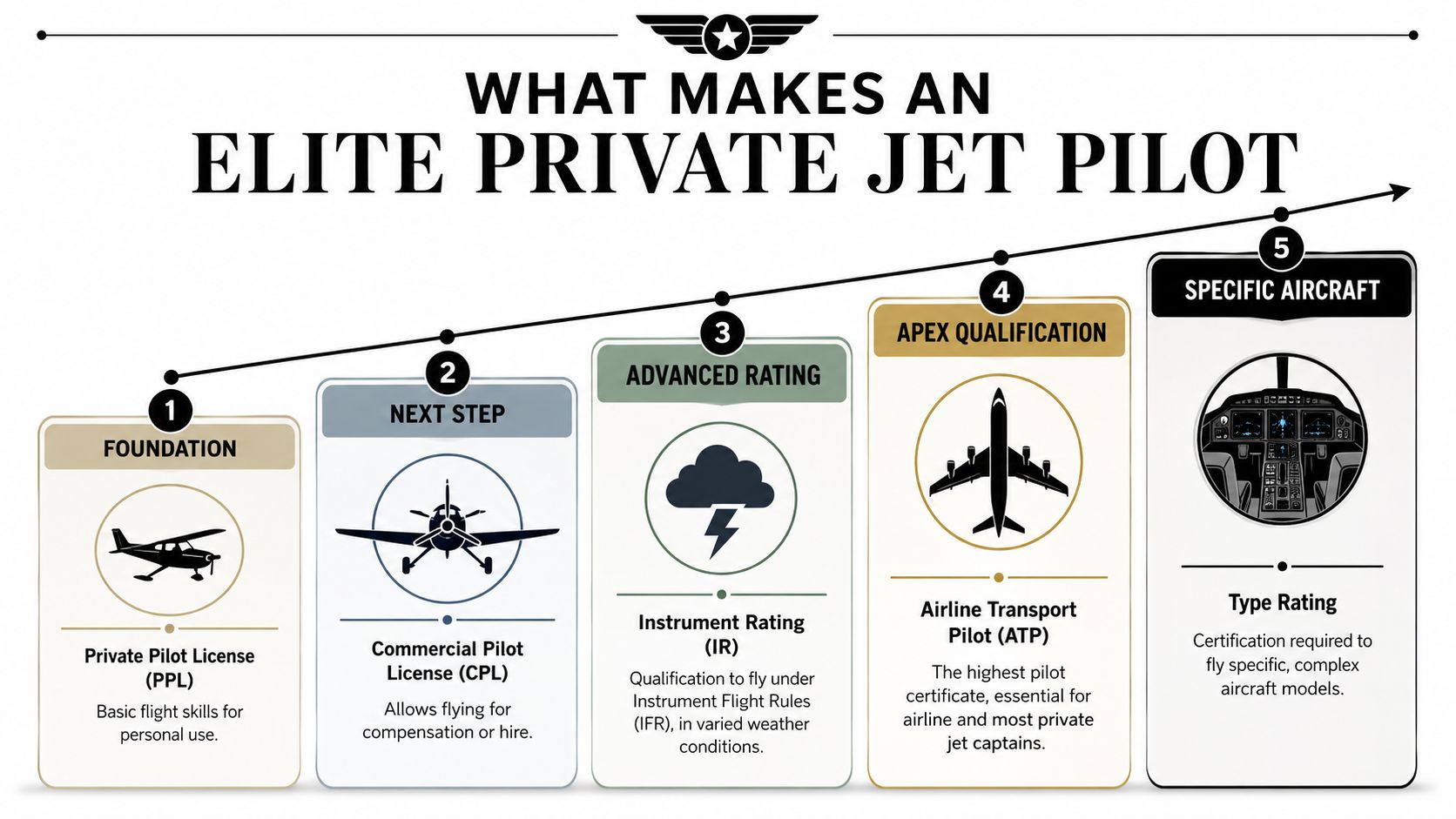
At the foundation, a pilot may hold a Private Pilot License, then a Commercial Pilot License, then an Instrument Rating that allows operation under instrument flight rules. For serious jet command, the credential clients should expect to hear about is the ATP, or Airline Transport Pilot certificate. That's the top pilot certificate in the standard progression.
Then comes the part many clients overlook. Type rating.
A type rating means the pilot is certified for the exact aircraft model being flown. Not “something similar.” Not “another jet in the family.” The exact aircraft type.
Good, better, best
Here's the clean way to think about pilots for private jets.
| Standard | What it means | What I'd advise |
|---|---|---|
| Good | Legally qualified to fly commercially | Necessary, but not enough on its own |
| Better | Significant multi-engine, turbine, and command experience | Appropriate for serious charter evaluation |
| Best | Deep time in the exact aircraft type and strong operator standards | What discerning clients should request |
One industry guide notes that elite charter operators often require captains to have roughly 3,500 to 4,000 total flight hours, 1,500 to 2,000 hours as pilot-in-command, and 1,000+ hours in the specific aircraft type. The same guide explains that this level of time matters because the pilot has internalized the aircraft's systems and performance for non-standard situations, as outlined in Ventura Air Services' discussion of pilot qualifications in private aviation.
That last point matters more than clients realize. You are not buying hours for vanity. You are buying familiarity under pressure.
What to listen for when a broker answers
If I ask about a crew and hear only “they're fully licensed,” I keep digging.
Strong answers usually include:
- Exact type qualification: The crew is current and type-rated on the aircraft assigned.
- Command time: The captain has substantial pilot-in-command experience, not just total time.
- Time in type: The captain knows this aircraft specifically, not just business jets in general.
- Recent recurrent training: The operator can confirm that training is current and documented.
An elite pilot doesn't just know how to fly. He or she knows how this aircraft behaves when the day stops going according to plan.
That's the distinction clients should pay for.
Full-Time Crew vs Contract Pilots
Not every charter flight is staffed the same way. Some aircraft fly with a dedicated, full-time crew attached to the owner or operator. Others rely partly on contract pilots brought in to cover schedule gaps, repositioning needs, vacation periods, or demand spikes.
Neither model is automatically unsafe. But they are not equal in consistency.
Where full-time crews usually win
A dedicated full-time crew tends to know the aircraft better, know the operator's procedures better, and work more predictably as a team. From a client perspective, that usually translates into fewer surprises.
If the flight profile is straightforward, a well-vetted contract pilot can be perfectly acceptable. But the burden shifts to the operator and broker to prove that “acceptable” still means strong.
Pilot Employment Models Comparison
| Factor | Full-Time Crew | Contract Pilot |
|---|---|---|
| Aircraft familiarity | Usually stronger on the assigned aircraft | Can vary widely by assignment |
| Crew coordination | Often more consistent because the team flies together | Depends on prior pairing and operator oversight |
| Scheduling | More stable if crew availability is managed well | Useful when demand changes quickly |
| Client experience | Often smoother and more predictable | Can still be strong, but less uniform |
| Vetting burden | Lower if the operator has a disciplined crew program | Higher because substitution risk is greater |
| Best use case | Repeat owner flying, premium charter consistency | Overflow coverage, short-notice staffing, niche availability |
The question clients should ask directly
Don't ask, “Are your pilots good?” That invites a marketing answer.
Ask this instead:
- Is this a dedicated crew or a contract crew?
- If contract, how often does that pilot fly this aircraft type for your operation?
- Who verified currency, training, and experience for this specific trip?
- Will there be any crew substitution before departure?
Those questions cut through sales language immediately.
My view on contract pilots
Contract pilots are part of private aviation. That won't change. Many are excellent, disciplined professionals with serious backgrounds. I'd use one without hesitation if the operator can show current qualifications, strong time in type, and proper oversight.
What I won't accept is lazy staffing.
If a broker acts as though all pilots are interchangeable, move on. They aren't. A full-time captain thoroughly familiar with the aircraft and operation is usually the cleaner choice. A contract pilot can still be a sound option, but only after real verification.
If the crew model changes at the last minute, your standard should go up, not down.
That's the trust-but-verify mindset in practice.
The Vetting Process Demystified
A pilot profile on a quote sheet is not vetting. It's marketing until someone proves otherwise.
Real crew vetting means checking the credential, the history behind it, the operator's oversight, and the fit for the actual mission. That matters even more in a strained labor market. One source cited in the brief states that an ongoing 25,000+ pilot shortage has increased charter availability delays by 30-45% and pressured some operators to use less-experienced pilots, which is why rigorous broker vetting is described as more important than ever in this industry piece. Treat that as a warning sign, not trivia.
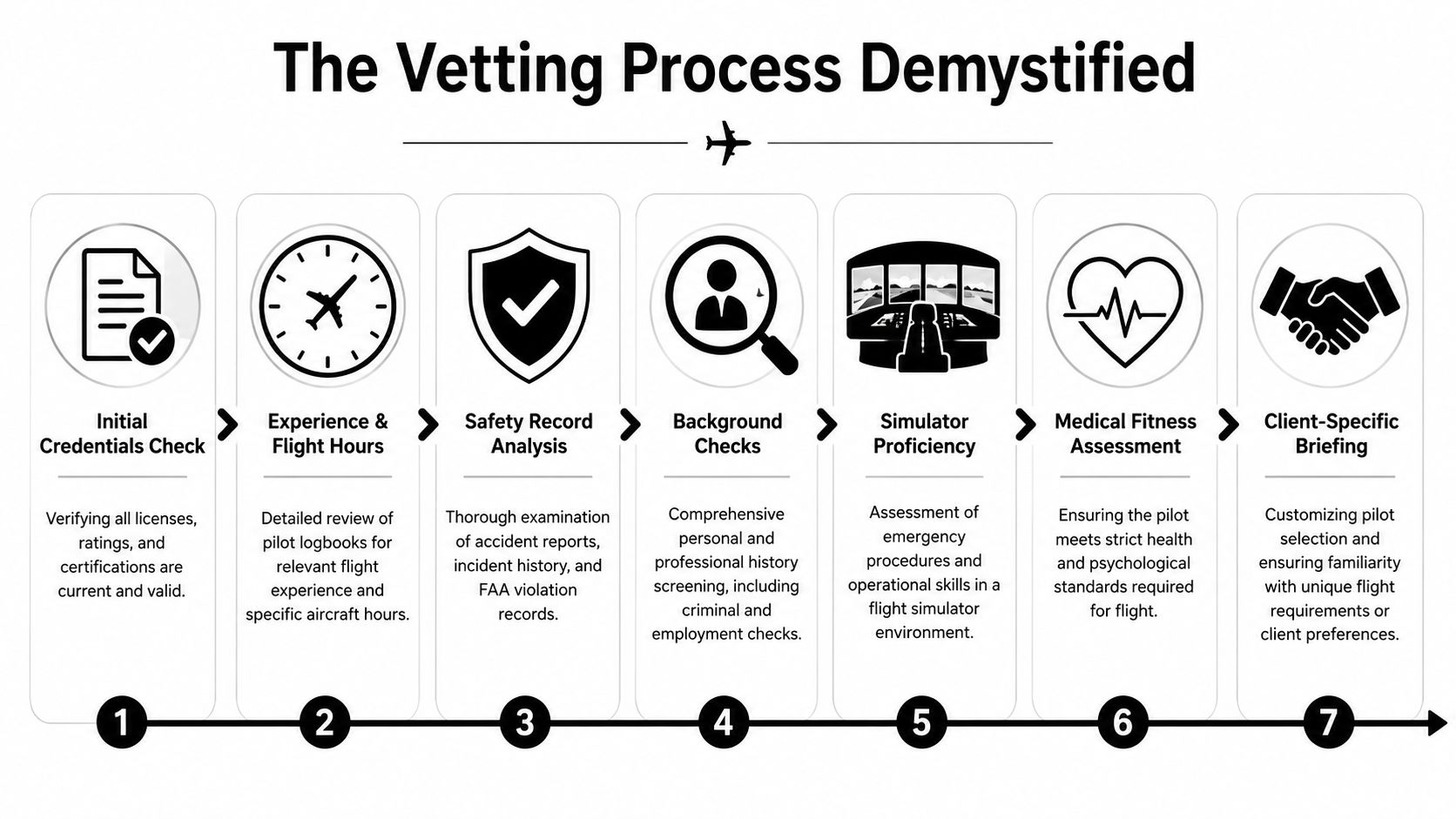
What real vetting includes
A serious process looks layered, not casual.
License and rating review
Someone confirms that certificates, type ratings, and required qualifications are current for the assigned trip.Experience review
Total time matters less than relevant time. I care about command time, aircraft-specific time, recent activity, and operational fit.Training review
Recurrent simulator training is where crews prove they can handle abnormal events, not just normal departures and arrivals.Safety record review
Incident history, enforcement history, and operator-level patterns should be checked, not assumed away.Background and employment review
This isn't unique to aviation. It follows the same logic as assessing vendor risk in any high-trust service relationship. You don't outsource due diligence when the consequences of a bad choice are serious.
Why third-party audits matter
When evaluating charter operators, independent audit frameworks matter because they force consistency. They don't replace judgment, but they do create a disciplined screening baseline for aircraft, crews, and operating practices.
If you want a cleaner understanding of what those audit systems mean, read this deep dive on Wyvern and ARGUS safety ratings from Haute Jets Journal.
Red flags I'd never ignore
These are the warning signs that should slow any booking down:
- Vague crew answers: “Our crews are all highly experienced” without specifics.
- Last-minute opacity: The broker won't confirm crew details until just before departure.
- Substitution shrug: A different captain appears and nobody explains why.
- Minimum-compliance language: The seller leans on legality rather than quality.
- No audit context: The operator's safety oversight is described loosely or defensively.
Trust is earned in private aviation through documentation, transparency, and consistency. Not through polished reassurance.
That's why strong clients don't ask whether a pilot is qualified. They ask how qualification was verified for this flight.
Essential Questions to Ask Your Charter Broker
A good broker won't be offended by detailed questions. A weak one will.
If you want to know whether you're dealing with a real professional, ask the kind of questions that force specific answers. The same logic applies in other high-risk service industries. A buyer hiring close protection or event security should ask structured, practical questions before engagement, which is why this checklist on essential security company questions from GM GROUP Services is a useful parallel. Private aviation deserves the same discipline.
Start with this visual checklist.
The seven questions that matter
Are both pilots ATP-certified where applicable, and are they type-rated for this exact aircraft?
This tells you whether the broker is speaking in specifics or hiding behind generalities.What are the captain's and first officer's total hours, command hours, and time in this aircraft type?
Ask for all three categories. A single total-time figure can mislead.Is this a dedicated crew or are either of the pilots contract crew for this trip?
You want to know how familiar the pilots are with the aircraft and with each other.When did each pilot last complete recurrent training?
Current simulator-based training says more than a polished bio.
Before you finish your checklist, this short clip helps frame why broker questions matter in the first place.
Can you confirm the operator's third-party safety audit status and whether the assigned crew meets those standards?
Don't settle for “the company is safe.” Ask what standard is being used.Will I receive final crew names and flight details before departure, and when?
If the answer is evasive, assume the process is loose.What happens if there is a crew substitution?
This question reveals whether the broker has a controlled process or fills seats indiscriminately in the cockpit.
What strong answers sound like
A serious broker will answer with names, dates, aircraft type references, and a clear explanation of who validated the information. A weak broker will answer with adjectives.
If you need a quick reference on audit language before that call, review what ARGUS certification means in private aviation. It helps you separate meaningful safety language from sales copy.
Ask questions that require evidence, not comfort.
That single shift changes the quality of the charter conversation immediately.
The Haute Jets Difference in Crew Confirmation
Process is what matters more than promises.
In the United States, only about 0.14% of Americans, or roughly 1 in 700 people, hold a pilot's license, according to the cited reference in the brief from The Ninety-Nines video source. That small talent pool is one reason crew sourcing and verification isn't clerical work. It's a specialist function.
For a charter client, that means the broker's role shouldn't stop at finding an aircraft. The broker should also control how crew information is gathered, checked, and confirmed before the trip.
What disciplined confirmation looks like
From the publisher information provided for Haute Jets, the operating model includes sourcing from Wyvern Wingman and ARGUS Gold/Platinum operators and providing 24-hour pre-flight confirmation that includes the tail number, crew bios, weather briefing, and passenger manifest.
That matters because it answers the exact concerns discerning clients should raise:
- Who is flying my trip
- What are their qualifications
- Has the assigned crew changed
- Do I have final confirmation before I arrive at the terminal
Why that level of transparency changes the client experience
Most charter friction comes from uncertainty. Clients don't like surprises, and they especially don't like surprises involving crew assignment.
A disciplined confirmation process reduces that uncertainty by moving key details forward in time. Instead of trusting broad assurances, the client gets concrete trip information in advance. That's how a premium broker should handle pilots for private jets. Not with vague confidence, but with documented confirmation.
If your broker can't or won't provide that level of clarity, the issue isn't luxury. It's control.
Flying with Unmatched Confidence
Private aviation buyers often start with the wrong question. They ask, “What jet should I book?” The sharper question is, “Who is flying it, and who verified them?”
That's where true peace of mind comes from.
The aircraft sets the environment. The pilots set the standard. Their judgment affects safety, punctuality, workload management, communication, and how calmly the whole trip unfolds when conditions change. If you care about your family, your executive team, your schedule, or your privacy, crew quality isn't a secondary detail. It is the decision.
The good news is you don't need to guess anymore. You now know what strong answers sound like, what weak answers avoid, and which red flags deserve immediate attention. You know the difference between legal minimums and elite standards. You know why dedicated crews often provide more consistency. You know why third-party audits and active verification matter. Above all, you know which questions force a broker to show their work.
That's the standard I'd recommend to any high-net-worth client entering this market for the first time. Trust the process, but verify the people.
Luxury in private aviation isn't only about access. It's about confidence before the wheels leave the ground.
If you want that level of transparency on your next charter, explore Haute Jets and review how the trip details, aircraft sourcing, and crew confirmation process are handled before you book.