

The price of challenger 350 only looks simple if you stop at the sticker. A new aircraft averages $26.7 million, but that number tells you almost nothing about what it costs to access, operate, or charter the jet intelligently.
That’s where buyers and charter clients get burned. One side of the market talks about acquisition price. The other talks about hourly charter rates. Most never connect the two, and that gap is where hidden costs live. If you want the truth, you need to look at total cost of access, not just ownership price or a quoted hourly rate.
Challenger 350 Purchase Prices New vs Used
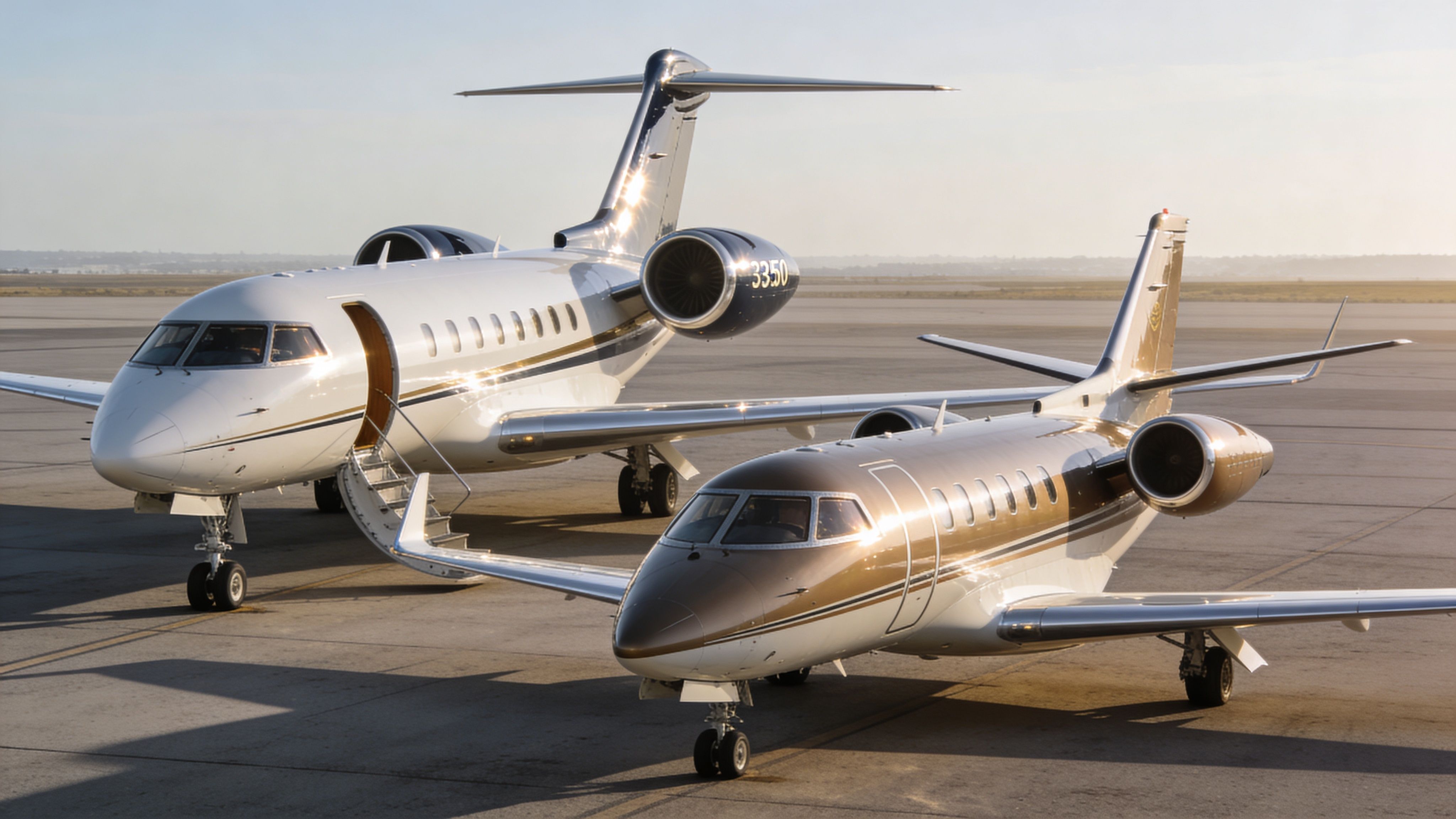
The Challenger 350 earned its place in the market because clients and operators kept choosing it. It captured over 25% of the super-midsize segment, and more than 380 units had been delivered worldwide by 2025, which tells you this isn’t a niche aircraft with thin market acceptance. A new Bombardier Challenger 350 averages $26.7 million as of 2026, while pre-owned aircraft from 2015 to 2020 range from $15.5 million to $22 million, according to the verified market data cited in this private jet purchase guide.
What drives the purchase price
A used Challenger 350 doesn’t trade on age alone. Key price drivers are:
- Model year and airframe time: Lower-time aircraft usually command stronger pricing.
- Maintenance status: Clean records and current programs matter more than glossy cosmetics.
- Cabin and connectivity upgrades: Buyers pay for relevant equipment, not random add-ons.
- Overall condition: Paint, interior wear, and avionics spec all shape value.
If you’re shopping pre-owned, don’t obsess over the lowest ask. The cheapest airframe can become the most expensive one you evaluate once deferred maintenance, engine program exposure, and refurbishment needs show up.
New versus used is really a capital allocation decision
A factory-new jet gives you maximum control over spec, warranty positioning, and entry into service. It also locks up far more capital. For most individuals and many companies, that’s an inefficient use of money unless they fly enough to justify full ownership and want a dedicated asset on their balance sheet.
Practical rule: Buy only if you need control of the asset. Don’t buy because you assume chartering is “wasted money.”
A pre-owned Challenger 350 can be the more rational ownership play if you insist on owning. But even then, the purchase price is only the first invoice. You still have crew, hangar, insurance, fuel, maintenance reserves, and downtime risk. That’s why I tell clients to treat the acquisition number as the admission ticket, not the full bill.
Typical Challenger 350 Charter Rates Per Hour
If you don’t need year-round access to the same tail, chartering is usually the cleaner move. Verified 2026 pricing puts Challenger 350 charter at an average of $8,000 per hour, with typical domestic trips such as Miami to Aspen pricing around $40,000 to $55,000. The same verified data notes that operators used for this model are Wyvern/ARGUS-rated, with 24-hour pre-flight confirmations standard.
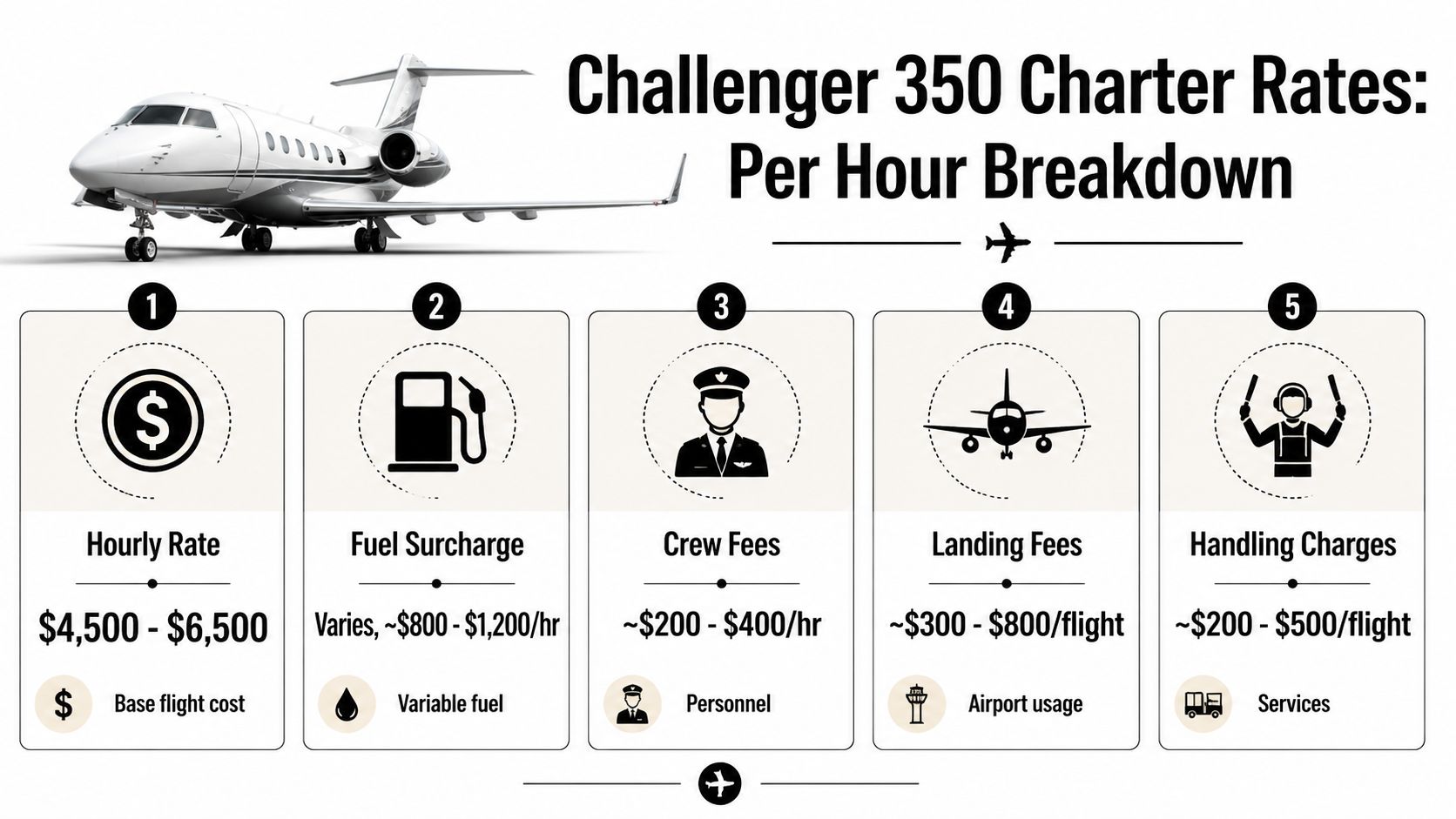
Those numbers matter because they reset expectations. Many people hear “super-midsize” and assume the quote will be wildly out of reach. In practice, the aircraft often sits in the sweet spot between cabin comfort and long enough legs for serious domestic travel.
What that hourly rate actually means
Hourly pricing is a starting point, not a final contract number. A charter quote usually reflects the aircraft, route, airport mix, crew planning, and how efficiently the operator can position the jet.
A good starting framework is:
- Shorter domestic sectors: Often efficient if the aircraft is already nearby.
- Multi-leg trips: Can price well when the routing keeps the airplane productive.
- One-way missions: Often where bad pricing hides, especially if the jet must reposition.
If you want a practical primer on quote math, this guide to calculating private jet cost per hour is worth reading.
Route logic matters more than category labels
The Challenger 350 works well because it combines range with a real cabin. It can handle trips that would stretch a light jet and make passengers feel it. That doesn’t mean every route is a bargain. It means the aircraft is often the right fit when your priority is nonstop capability, proper seating, and a cabin clients or executives can spend time in without regretting the choice.
A cheap hourly rate on the wrong aircraft usually turns into a worse trip and a messier invoice.
When clients ask me for the price of challenger 350 charter, I don’t answer with one number and stop there. I ask where the plane is coming from, whether the trip is one-way or roundtrip, how long the aircraft sits, and whether there’s a local operator available. Those questions determine whether your quote is fair or inflated.
Annual Operating Costs for a Challenger 350 Owner
Ownership economics are where the glossy sales pitch falls apart. Verified operating costs for the Challenger 350 range from $2,625 to $4,574 per flight hour, with fuel and maintenance acting as major drivers, according to Air Charter Advisors’ Challenger 350 operating cost data. The same verified dataset notes that fixed costs such as crew salaries of $300,000+ and hangar fees of $50,000+ get spread more efficiently across more annual hours.
That’s the right way to think about ownership. Not “what does it cost per hour?” but “how much am I committing every year before I even fly?”
Fixed costs don’t care whether you travel
These are the bills that show up regardless of usage:
- Crew salaries: You’re paying for availability, not just flying time.
- Hangar: The aircraft needs a home whether it flies tomorrow or next month.
- Insurance: Non-negotiable and ongoing.
- Training and compliance: Required if you want the operation run properly.
Then come the variable expenses, which rise with use. Fuel is obvious. Maintenance reserves, engine program costs, handling, and trip-related items add up fast.
A sample owner budget at 400 hours
Below is a simple planning view using only verified data points and qualitative categories where exact figures weren’t assigned.
| Cost Category | Expense Item | Estimated Annual Cost |
|---|---|---|
| Fixed | Crew salaries | $300,000+ |
| Fixed | Hangar fees | $50,000-$100,000 |
| Fixed | Insurance | $50,000 |
| Fixed | Other fixed ownership expenses | Included in annual ownership budget |
| Variable | Flight hour operating cost | $2,625-$4,574 per hour |
| Variable | Fuel component within hourly cost | Major driver |
| Variable | Maintenance and engine reserves | Major driver |
| Total planning view | Fixed annual costs for 400-hour operation | Verified datasets also cite $650,000 in fixed annual costs for 400 hours |
| Total planning view | All-in annual ownership budget | Depends on utilization and cost discipline |
That table should change your thinking. If you fly lightly, ownership punishes you because the fixed structure stays heavy. If you fly more, your economics improve on a per-mile basis, but your total outlay is still serious.
Utilization decides whether ownership makes sense
A Challenger 350 owner flying occasionally usually pays for the privilege of saying they own the airplane. A heavier user may justify the structure if schedule control is critical. Most clients aren’t in that category.
If your travel pattern is uneven, seasonal, or route-specific, charter usually wins because it converts aviation from fixed overhead into trip-based spend. That matters more than bragging rights.
For a broader ownership reality check, this breakdown of what a private jet costs to own is useful.
Key Factors That Influence Challenger 350 Pricing
The Challenger 350 commands solid pricing because people want to fly on it. Its cabin is 6'1" high, offers 15% more volume than rivals, and combines that comfort with a 3,200 nm range and 99.9% dispatch reliability, according to the verified data summarized by Aviacost’s Challenger 350 specifications.
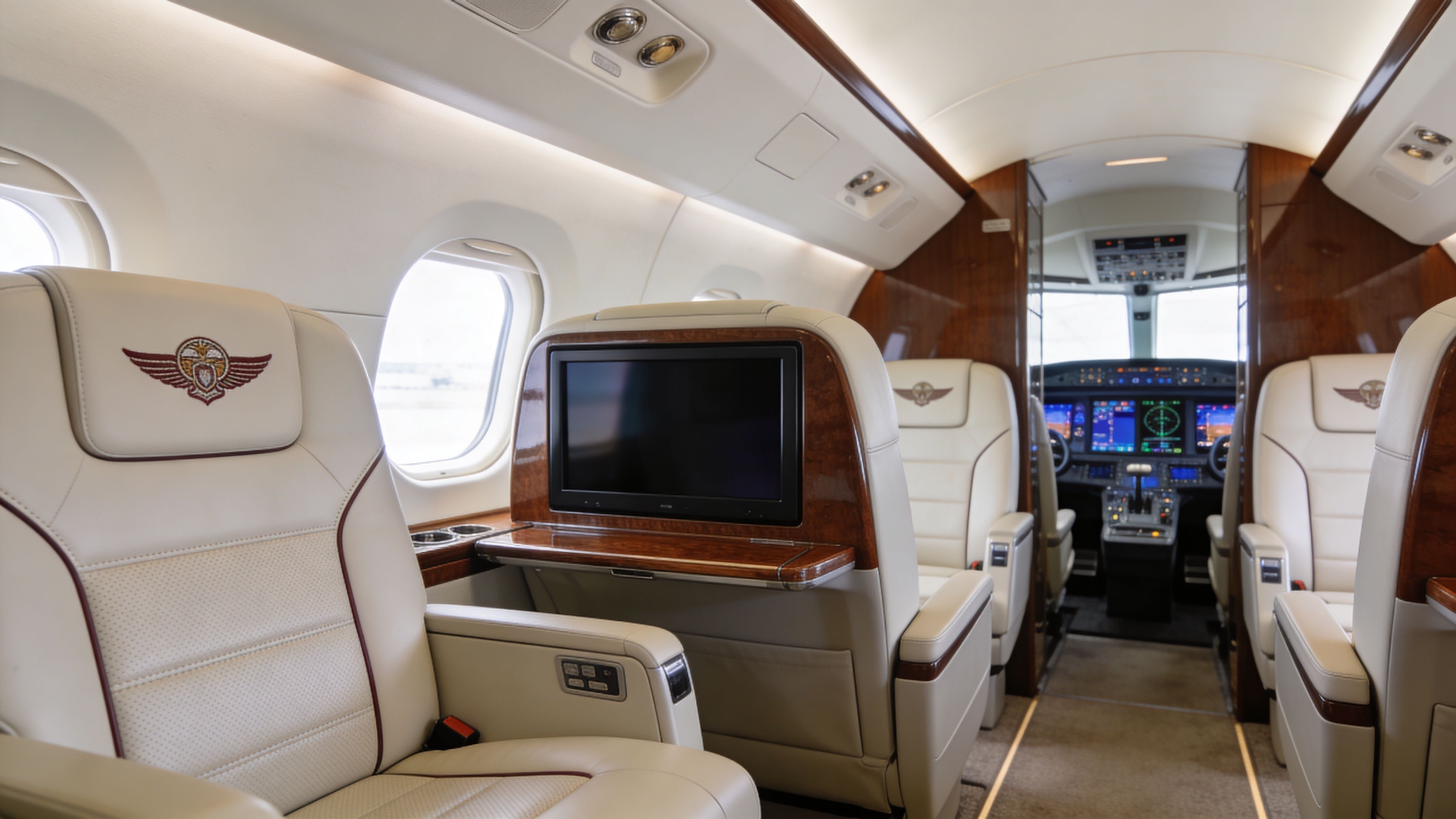
That’s the legitimate reason the aircraft prices well. It’s not hype. It’s a cabin and mission profile people prefer.
Purchase pricing shifts with asset quality
On the ownership side, pricing moves on asset specifics. A lower-time airframe with strong maintenance pedigree, current connectivity, and a desirable interior will attract more interest than a tired example that looks cheap on paper.
What matters most in practice:
- Airframe history: Clean records and disciplined maintenance support value.
- Cabin relevance: Buyers care about practical upgrades that improve usability.
- Downtime risk: A cheaper aircraft with looming maintenance is not cheaper.
Charter pricing moves on logistics
Here’s the part most clients miss. The quoted hourly rate is only one layer. The primary swing factor is often repositioning.
Traditional brokers and many program structures pass the cost of moving an empty jet to your departure airport directly into your quote. That’s why two “same aircraft” quotes can look wildly different. One plane is local. The other has to travel empty before your trip even starts.
If the aircraft isn’t based near your departure city, you may be paying for someone else’s empty flight before your own.
That’s not a small detail. It’s one of the biggest pricing distortions in private aviation.
A quick look at the aircraft helps explain why demand stays firm:
The price of challenger 350 charter rises or falls based on more than prestige. The aircraft itself supports the rate. The routing determines whether the quote is honest.
Smart Ways to Reduce Your Charter Costs
Most charter savings advice is shallow. People repeat the same points about “shopping around” without explaining what lowers the invoice. The biggest savings usually come from how the aircraft is sourced, not from haggling over a headline rate.
Verified market data highlights a core disconnect: pre-owned Challenger 350 values sit around $17M to $19M, while charter starts at $5,500+ per hour, and locally sourced on-demand booking can avoid 20-40% repositioning fees, according to AvBuyer’s Challenger 350 price guide. That’s the economic clue most flyers overlook.
Focus on avoidable costs first
A smart client tries to remove waste before negotiating service details.
Here’s where to look:
- Local aircraft first: If the jet is already near your departure airport, you cut out the most common source of inflated pricing.
- Empty legs selectively: They can work, but only if your schedule is flexible and the route matches your trip.
- Avoid prepaid programs unless you’ll use them heavily: Jet cards can add structure, but they can also lock you into pricing that doesn’t reflect local market availability.
- Book the right cabin, not the biggest one you can afford: A super-midsize jet should solve a mission requirement, not serve as a vanity upgrade.
The right question to ask a broker
Don’t ask, “What’s your hourly rate?” Ask, “Where is the aircraft based, and what empty positioning am I paying for?”
That question changes the conversation immediately. A transparent charter provider should be able to explain whether the jet is local, whether the quote includes ferry time, and whether there are nearby alternatives.
Booking advice: The cleanest quote is often the one tied to the aircraft that’s already in your market, not the one with the prettiest PDF.
For most flyers, ownership isn’t the economical answer. Efficient, on-demand access is. The mistake is choosing a booking model whose design recreates ownership inefficiency through unnecessary ferry costs.
How Haute Jets Delivers Better Challenger 350 Prices
The private aviation industry has a pricing problem, and it isn’t hard to identify. Too many clients get quoted for the wrong aircraft in the wrong place, then pay extra to move that aircraft into position. That’s how an acceptable charter rate turns into an expensive trip.
The more rational model is simple. Source the right Challenger 350 from a local owner-operator when possible, confirm the exact aircraft details before departure, and avoid locking clients into memberships or prepaid structures they may not need.
What the access model should look like
A serious charter solution should do four things well:
- Find aircraft close to the point of departure so the quote reflects the actual trip, not unnecessary repositioning.
- Verify safety standards through recognized third-party audits.
- Show the exact aircraft details instead of hiding behind a vague jet category.
- Keep pricing transactional so clients pay for flights, not for program overhead they may never fully use.
That’s where Haute Jets fits. It sources from 3,500+ aircraft across 175 countries and uses locally based owner-operators to avoid the 20-40% broker markup that can come from repositioning-heavy quoting, while working only with operators holding Wyvern Wingman or ARGUS-rated credentials and providing 24-hour pre-flight confirmations. Those are useful facts because they tie directly to cost control and booking clarity, not marketing fluff.
Why this matters for Challenger 350 clients
The Challenger 350 sits in a sweet spot. It’s large enough to feel substantial and capable enough for demanding domestic missions. That also means it’s exactly the kind of aircraft that gets overpriced when a broker assumes you won’t ask where the plane is coming from.
If you’re comparing quotes, use this filter:
- Is the aircraft local or repositioning from somewhere else?
- Can you see the exact tail and operator details before departure?
- Are you paying for membership structure you don’t need?
- Does the quote reflect your route, or someone else’s logistics problem?
Clients who ask those questions usually make better decisions quickly. They stop chasing the lowest apparent hourly rate and start looking for the cleanest all-in number.
My recommendation
If you’re considering buying, be honest about utilization. If your flight schedule is irregular, ownership is often an expensive way to create fixed overhead.
If you’re chartering, prioritize local sourcing and operator transparency. That’s where savings are found. The price of challenger 350 access isn’t just about what the aircraft costs. It’s about whether the booking model removes waste or reintroduces it.
Ownership of this jet is not a necessity for many. They require reliable access to it, on the right routes, at pricing that reflects actual aircraft availability instead of industry padding.
If you want a Challenger 350 quote built around local availability, exact aircraft selection, and transparent trip economics, contact Haute Jets for an on-demand charter review. A clean quote starts with the right aircraft in the right market, not a generic hourly rate.