
A light jet from Atlanta to New York typically costs about $12,450, while a midsize jet from Atlanta to Charlotte runs about $7,500. A meaningful part of either quote may be the cost of moving the aircraft to Atlanta first, which local sourcing is designed to avoid.
You may be booking a flight because a board meeting in Midtown Manhattan starts tomorrow morning, a production schedule changed overnight, or a family trip can't fit a commercial timetable. The headline price matters, but the aircraft's location often matters more. A jet already sitting near PDK or FTY can produce a materially cleaner quote than an aircraft that has to ferry into Atlanta, carry you north, and then return empty.
That distinction drives the practical advice in this guide. Atlanta private aviation is built around reliever airports, operator availability, and fast ground handling. Choose the airport first, match the aircraft to the mission, demand an all-in quote, and make the broker prove where the aircraft will be before you sign.
Why Atlanta Is a Major Private Jet Market
A Buckhead executive has a 9 a.m. board meeting in Midtown Manhattan tomorrow. Driving to the commercial terminal, standing in a security line, and accepting an airline schedule wastes time. A car to an executive airport, a short FBO process, and a departure timed to the meeting fit the mission better.
That demand is routine because Atlanta's private aviation market runs on corporate travel, alongside entertainment, sports, and production work. DeKalb–Peachtree Airport, or PDK, sits about 12 miles northeast of downtown Atlanta, has three runways, and offers a maximum runway length of 1,829 meters, according to Atlanta's private airport guide. Multiple FBOs make it a major executive gateway.
Atlanta's business economy creates recurring travel between offices, client sites, and regional meetings. Artists, athletes, production crews, and corporate teams also work to schedules that airlines cannot always match. Travelers planning film, music, or entertainment logistics can review affordable private jet set options while comparing transport requirements.
The demand picture
Hartsfield-Jackson Atlanta International Airport handles more than 450,000 annual flight operations across all traffic types at ATL, according to the Atlanta airport comparison. That volume explains why charter passengers often choose PDK, FTY, or RYY instead of adding commercial-terminal congestion to a private itinerary.
| Driver | Detail |
|---|---|
| Executive access | PDK provides a direct business-aviation gateway northeast of downtown Atlanta. |
| Corporate demand | Atlanta's charter market centers on business travel and recurring corporate missions. |
| Airport choice | PDK, FTY, and RYY can reduce ground friction compared with the commercial terminal. |
| Aircraft variety | Availability ranges from regional turboprops to long-range jets, with pricing shaped by aircraft location and mission length. |
| High-frequency use | NetJets has reported approximately 4,000 flights in and out of PDK annually, according to coverage of NetJets activity at the airport. |
The airport is only part of the quote. On short-hop routes and one-way trips, repositioning can add a ferry leg before or after the passenger flight. Ask where the aircraft is based, whether it must reposition, and whether the quote includes that movement. Local owner-operators near PDK and FTY can cut 20–40% from traditional broker pricing when the aircraft is already nearby.
Atlanta private aviation is logistics first. Select the airport near the passenger, verify the aircraft's location, and demand an all-in price before booking. Safety audits and operator certification still matter, but a convenient departure is not a bargain if repositioning costs erase the saving.
Atlanta Airports and FBOs for Private Aviation
Most private charter passengers shouldn't default to ATL. Hartsfield-Jackson remains essential for airline travel and certain private operations, but the commercial terminal brings congestion, security processing, and more ground friction than a dedicated FBO. From Buckhead, the drive can also become unpredictable during peak traffic.
PDK is the default choice for many Atlanta charter departures. DeKalb–Peachtree has three runways and a strong business-aviation ecosystem with multiple FBOs. Signature Aviation's listing shows 24-hour operation and ramp-side vehicle access, details confirmed by the Signature Aviation PDK listing. That setup lets a passenger move from car to aircraft without navigating an airline terminal.
Choose the airport by geography
Use the airport that reduces total door-to-door time, not the one that looks most familiar on a map.
- PDK for Buckhead, Midtown, and northeast Atlanta: This is the practical first check for corporate departures and many domestic charters.
- FTY for west-side travelers: Fulton County Airport supports business aviation with dedicated FBO infrastructure and can be more convenient for passengers west of downtown.
- RYY for Cobb and northwest suburbs: Cobb County Airport adds another reliever option, particularly when an aircraft or crew is positioned there.
- ATL for specific operational needs: A private-use facility operates at Hartsfield-Jackson. The PS / Signature private terminal opened in September 2023 and offers paid access options, including annual membership and per-visit suite or salon access, according to Airport Improvement's report on the facility.
Runway and FBO fit also matter. PDK is listed with a 6,001-foot longest runway, FTY with approximately 5,796 to 5,801 feet, and RYY with a 6,305-foot runway, as outlined in Atlanta aircraft and airport guidance. Those lengths generally suit light and midsize jets, but dispatchers still need to check aircraft performance, passenger load, temperature, and runway elevation.
Practical rule: Ask for the exact FBO before you accept the quote. Airport selection changes the drive, handling process, parking arrangements, and sometimes the aircraft available.
International arrivals require additional planning. Confirm customs handling, passenger documentation, and FBO instructions before departure. For the private-terminal option at ATL, review the Hartsfield-Jackson private terminal details rather than assuming the commercial terminal process applies.
Aircraft Options for Atlanta Departures
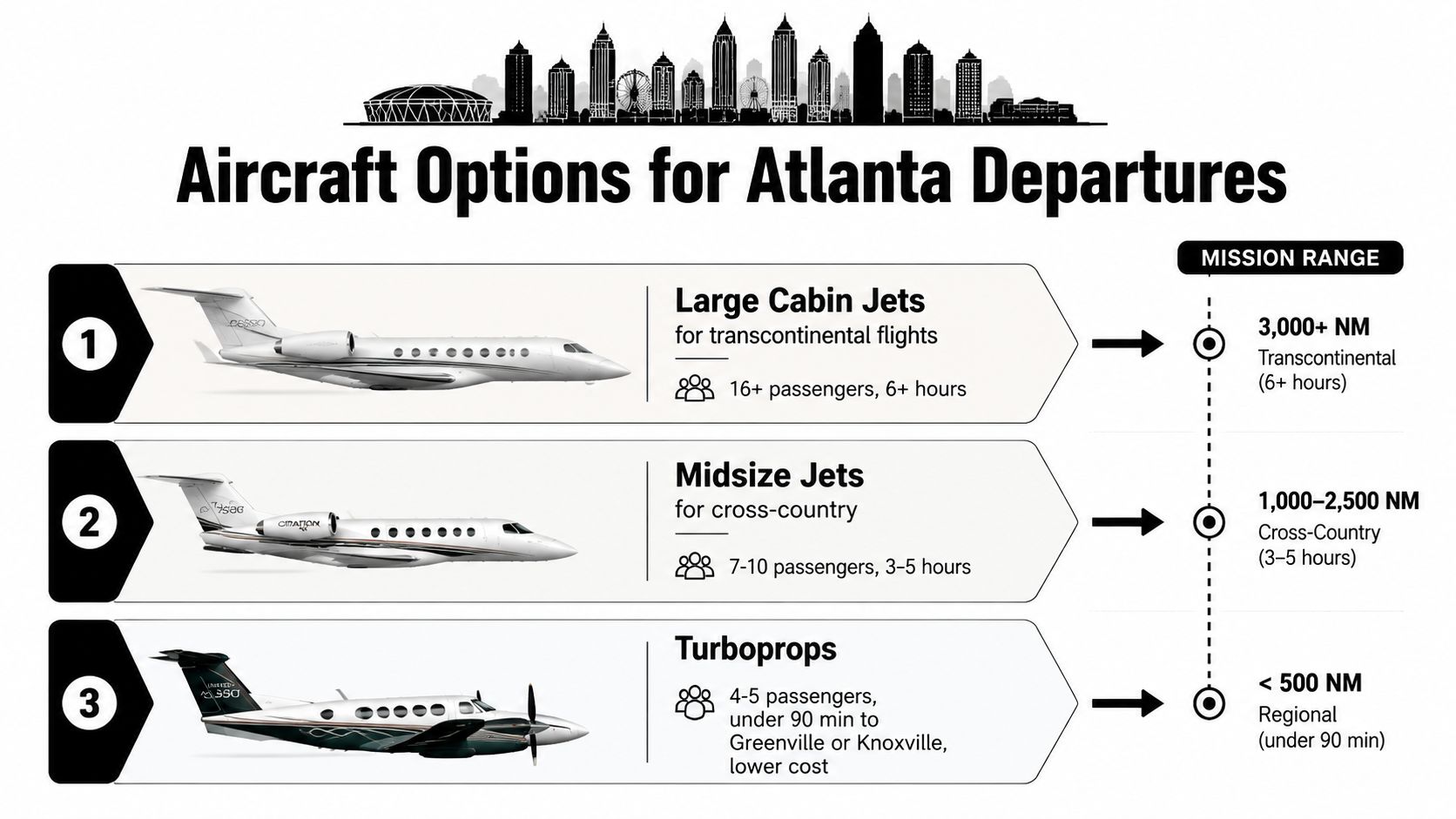
The right aircraft is the smallest one that comfortably handles your passengers, luggage, range, and arrival requirement. Treating aircraft as a marketing catalog leads to unnecessary cost. Treating them as mission tools produces a more disciplined quote.
Regional missions
A turboprop, such as a King Air 350, is a strong option for short regional flights. Atlanta to Greenville or Knoxville can fit this category for four to five passengers in under 90 minutes. Turboprops start around $2,000 per hour, according to Atlanta charter pricing guidance, although the final quote depends on aircraft availability, positioning, fees, and schedule.
A light jet, such as a Phenom 300 or Citation CJ3, handles longer domestic missions with a faster cruise profile and a pressurized cabin. Atlanta to New York, Miami, or Houston can suit this class when passenger count and baggage remain within the aircraft's performance limits. Independent Atlanta pricing references place light-jet rates in a broad range, including approximately $3,500 to $4,800 per hour, as shown in Atlanta private charter market pricing.
Cross-country and long-range missions
A midsize jet, such as a Citation Latitude or Hawker 4000, is often the workhorse for Atlanta to Chicago, Denver, or Los Angeles. The larger cabin and luggage capacity can matter more than raw speed, especially when the flight includes several passengers or business equipment. Midsize pricing starts around $7,000 per hour in Atlanta market references, with the final amount shaped by the complete itinerary.
Super-midsize and large-cabin aircraft, including a Challenger 350 or Gulfstream G450, make sense for transcontinental or international-style missions where cabin comfort, range, and baggage capacity justify the larger platform. Long-range rates can reach $10,000 per hour or more, while broader Atlanta tables list approximately $12,000 to $15,000 per hour for long-range aircraft, according to the Atlanta charter pricing reference.
For a clearer explanation of cabin classes and mission fit, use this guide to private jet types. My operating rule is simple: every unnecessary seat burns fuel on every leg. Start with the group and bags, then choose the smallest aircraft that meets the mission safely.
How Charter Pricing Works on Atlanta Routes
A charter quote is not an hourly rate multiplied by flight time. Compare occupied aircraft time, repositioning, and every added fee before choosing a bid. Short Atlanta routes often expose the biggest pricing gaps because an aircraft may cost more to reach the passenger than to fly the passenger.
Aircraft category sets the initial range. Atlanta references put turboprops near $2,000 per hour, light jets near $5,000, midsize jets near $7,000, and long-range jets at $10,000 per hour or more. Other Atlanta pricing tables show light jets around $3,500 to $4,800 per hour and long-range aircraft at approximately $12,000 to $15,000 per hour. Those differences reflect the aircraft, operator, availability, and quote method. Use private jet charter cost guidance to understand how these components fit together.
The hidden line is positioning
Repositioning pays for moving an aircraft without passengers. A jet may fly into Atlanta from another city, complete your trip, then reposition for its next assignment. On a short hop, those empty legs can form a large share of the invoice.
Require the quote to identify:
- Aircraft time: Block time tied to your passenger itinerary.
- Positioning: Empty legs bringing the aircraft to Atlanta or moving it afterward.
- Airport charges: Landing, handling, parking, and FBO fees.
- Trip conditions: Catering, crew expenses, international handling, and schedule requirements.
A Boston to Atlanta one-way charter can cost approximately $21,000 to $32,000, according to Atlanta route pricing examples. The same reference estimates about $7,500 for Atlanta to Charlotte and $12,450 for Atlanta to New York. These figures show why the hourly rate alone is a poor comparison.
| Route | Aircraft | Block Time | Hourly Rate | Repositioning | All-In Estimate |
|---|---|---|---|---|---|
| Atlanta to Charlotte | Midsize or light jet | Route-dependent | Category-dependent | Must be disclosed | About $7,500 |
| Atlanta to New York | Light jet | Route-dependent | Category-dependent | Must be disclosed | About $12,450 |
| Boston to Atlanta | Midsize or larger aircraft | Route-dependent | Category-dependent | Can materially affect total | $21,000 to $32,000 one way |
Ask, “Where is the aircraft on departure day, and which empty legs are included?” Do not accept a vague positioning line. An aircraft already near PDK or FTY can remove a major cost, while a traditional broker sourcing from farther away may build that ferry flight into your price. Local owner-operator sourcing can cut 20–40% from broker quotes when availability and certification align. Have the operator document the aircraft location, operating authority, and complete all-in price before paying.
Booking a Private Jet from Atlanta Step by Step
Book the mission, not the aircraft category. A broker can't source intelligently if you only say, “I need a jet from Atlanta tomorrow.” Give the passenger count, baggage details, preferred airport, hard arrival time, pets, golf clubs, skis, production equipment, and any other item that affects capacity.
Start with a complete brief
Ask at least two operators and one independent broker for bids. Each party should disclose the tail number, operating certificate, aircraft location, and whether the jet is based at PDK, FTY, RYY, or another airport that requires positioning.
Then compare the all-in number. Don't rank quotes by the first figure in an email. Request the aircraft rate, positioning, taxes, segment charges, catering, crew costs, and any overnight or airport fees in writing.
Confirm the operator before sending funds
Once you select the aircraft and operator, sign the charter agreement and send the deposit through the agreed payment channel. Provide the passenger manifest and identification promptly, particularly for international travel.
A proper pre-flight process should include a 24-hour confirmation naming the crew, tail number, fuel plan, weather briefing, passenger manifest, and exact FBO address. If the broker can't provide those details by the agreed confirmation point, call immediately rather than waiting at the airport.
At PDK, verify whether you're using Signature Flight Support, Atlantic Aviation, or another field facility. Their entry instructions, vehicle access, parking, and passenger meeting points can differ. Arrive with enough time for a calm handoff, but don't recreate the airline experience by arriving excessively early. For a straightforward domestic departure, the FBO process is designed to move you from car to aircraft efficiently.
Ask this before booking: “Is the aircraft already in Atlanta, and what happens to my price if the tail number changes?”
Safety and Certification Standards That Matter
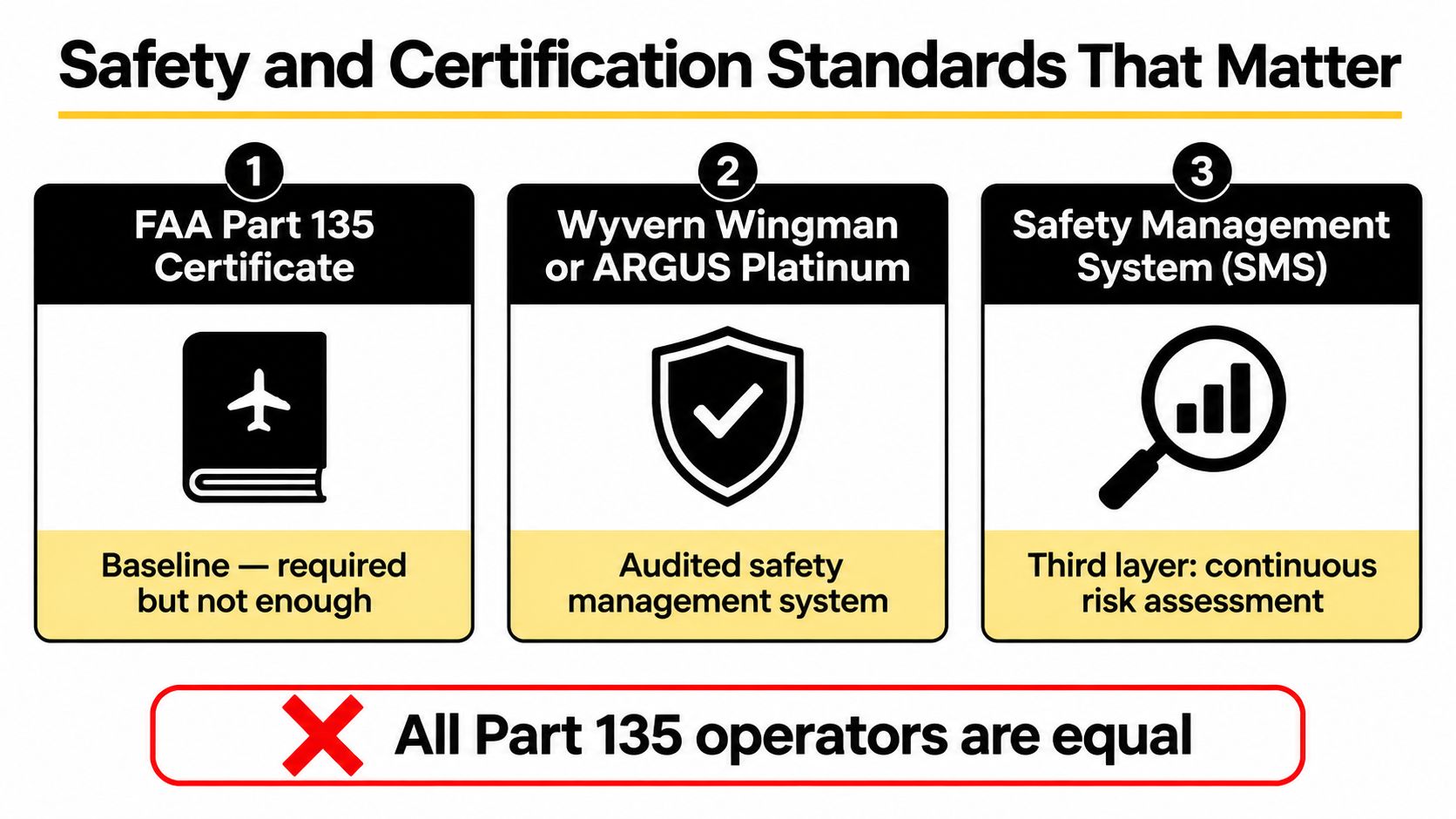
A Part 135 certificate is the floor, not the complete safety profile. Operators holding the same regulatory certificate can still differ in training depth, maintenance controls, safety-management maturity, crew experience, and the transparency of their records.
A serious Atlanta buyer should request three layers of evidence. First, confirm the operator holds an FAA Part 135 air carrier certificate for charter operations. Second, ask for a current third-party audit, such as Wyvern Wingman or ARGUS Gold or Platinum. Third, verify that the operator uses a functioning Safety Management System, not merely a document stored for compliance purposes.
What the audit labels mean
Wyvern Wingman evaluates operational areas including SMS, training records, maintenance, and pilot qualifications. ARGUS Gold reflects a qualifying historical safety record, while Platinum adds an on-site operational audit. For charter, Platinum is the tier I want to see when it is available.
Broker-side ratings and safety organizations don't always evaluate the same thing. An ARGUS or Air Charter Safety Foundation review may assess the broker or company relationship, while an operational audit focuses more directly on the carrier's systems and aircraft operations. Ask exactly what was audited and when.
Before signing, request answers to these questions:
- Pilot experience: What are the pilots' total flight hours and type-specific hours?
- Recent training: When did each pilot complete recurrent training?
- Maintenance program: Is the aircraft maintained under a Part 135 program, rather than only receiving annual inspections?
- Insurance: What passenger liability coverage does the operator carry?
- Audit evidence: Can the broker provide the current audit letter before contract execution?
PDK-based and Tennessee-based operators serving Atlanta can vary widely across these tiers. The broker's job is to show the audit documentation before the contract is signed, not after the passenger has committed funds.
Saving Money with Empty Legs and Local Sourcing
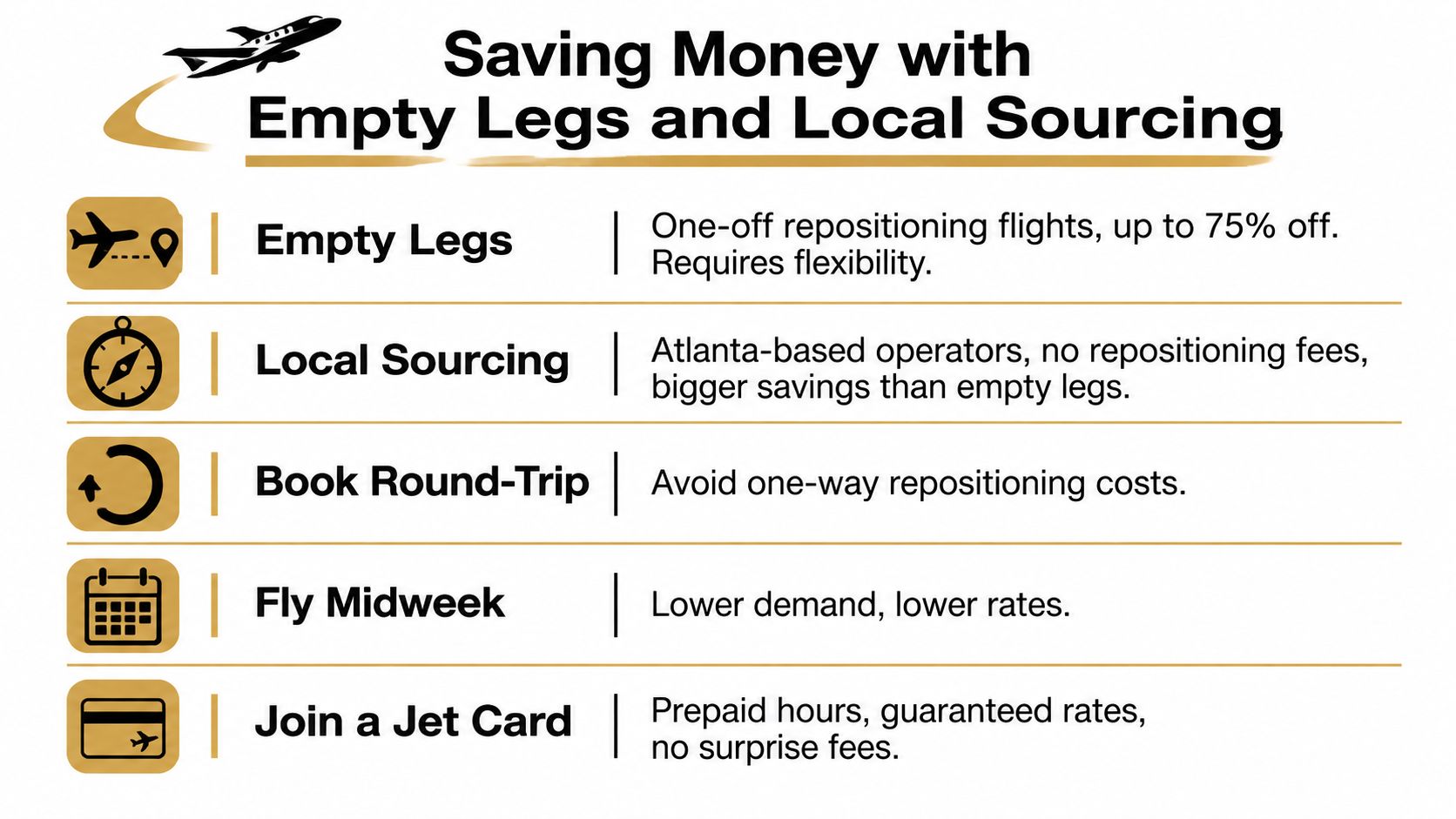
Empty legs attract attention because they can offer steep discounts, but they aren't automatically the best saving mechanism for Atlanta travelers. An empty leg is a one-off repositioning flight sold when an operator needs to move an aircraft without its original passengers. The discount can be substantial, but the schedule and routing are fixed.
That makes empty legs useful for flexible leisure travel and poor for a hard meeting in Manhattan. Miss the departure and you may forfeit the arrangement. You also can't assume the aircraft will be available at the airport or time you want.
Local sourcing is the stronger first move
National broker quotes often include positioning because the selected aircraft isn't near Atlanta. On short hops, those empty legs can add 20 to 40 percent to the charter price, according to Haute Jets' local-sourcing explanation. The better first question is whether an owner-operator near PDK, FTY, or RYY has an appropriate aircraft already available.
A locally based aircraft can reduce the quote by removing the ferry requirement rather than by downgrading the cabin or compromising the schedule. That distinction matters. You want the right aircraft at a better operational starting point, not a cheap aircraft that creates baggage, range, or comfort problems.
Use this sourcing playbook:
- Request competing bids: Get at least three quotes and require each provider to identify the aircraft's overnight location.
- Ask about the tail: Confirm whether the aircraft sits at PDK, FTY, RYY, or must reposition.
- Flex the schedule: A departure window shifted by two to four hours can expose aircraft that otherwise can't fit the trip.
- Consider a round trip: Returning the aircraft with the passengers may avoid a separate one-way positioning problem.
- Use empty legs selectively: Choose them when the fixed timing works, not because the discount looks attractive.
Broker's rule: Find the nearby aircraft first. Look for an empty leg second.
Local sourcing can cut 20 to 40 percent from what traditional brokers charge when repositioning drives the original quote, but the exact result depends on the aircraft, date, route, and operator availability. Safety audits and aircraft condition remain essential.
Logistics and FAQs for Atlanta Charter Travelers
Atlanta charter trips often go wrong at the ground level. Have your driver meet you at the FBO entrance, not the commercial terminal, and confirm the exact pickup point, vehicle access, parking rules, and whether the facility allows direct driver access.
Catering needs the same precision. PDK-based FBOs and operators can arrange meals, yet a Buckhead or West Midtown caterer familiar with the facility may suit the trip better. Provide dietary requirements, hot-meal requests, drinks, and galley limitations before departure so the operator can confirm what the aircraft can handle.
Common questions from Atlanta passengers
Do you need a passport for an international charter from Atlanta? Yes. Confirm passport requirements and customs procedures before departure. International handling through an FBO may require 60 to 90 minutes of CBP processing, as outlined in Atlanta private charter route guidance.
How early should you arrive? For a domestic PDK departure, 20 to 30 minutes is a practical arrival window. ATL private-terminal procedures can demand more preparation, so follow the selected facility's instructions instead of applying PDK timing automatically.
Can you bring pets, golf bags, or skis? Dogs and cats commonly travel in the cabin, but confirm the operator's pet policy before payment. Golf bags and skis can travel too. On light jets, limited cargo space may require a different aircraft.
What happens if the aircraft changes? The handling team should transfer luggage between operators. Tag every bag and keep your contact number visible. Your broker should notify you immediately if the tail number, FBO, crew, or aircraft model changes.
Before paying, identify who is flying, where they need to go, when they must arrive, and which trade-offs they accept. Choose the nearest suitable aircraft, review the operator's safety documentation, and compare transparent all-in quotes. Repositioning can inflate a short-hop price, so require that cost in writing rather than judging offers by hourly rates alone.
Haute Jets can source Atlanta departures from owner-operators near PDK, FTY, and RYY, with aircraft details, operator safety credentials, and positioning costs addressed before you commit. Visit Haute Jets to request an on-demand charter quote built around your actual passengers, baggage, airport, and schedule.