
A private jet charter broker is an intermediary, not an operator, and the broker's value comes from which aircraft it can reach and how transparently it quotes. That matters because the private jet charter services market reached USD 16.38 billion in 2025 and is projected to hit USD 25.79 billion by 2031 at a 7.86% CAGR, so the money is in access, not hype. Source
Most clients overpay because they buy a category, not an aircraft. They accept a “light jet” or “midsize” pitch, then find out the final invoice reflects repositioning, owner approval delays, or a worse cabin than they expected.
What a Private Jet Charter Broker Does
Travelers often assume a broker owns the jet. That assumption causes bad bookings. A private jet charter broker is a legal intermediary, not an operator. The broker sources aircraft, builds the quote, coordinates the trip, and manages communication. The operator keeps control of the aircraft, dispatch, crew, and safety responsibility. FAA regulations on indirect air carriers and broker roles
The clean way to tell the difference
If a company owns and flies the aircraft, it is an operator. If it sells access to aircraft it does not operate, it is a broker. If it sells prepaid flying time or structured access, it is a jet card program. Those models may all sit under private aviation, but they are not the same product, and the difference shows up the moment a trip changes, a tail is swapped, or an invoice arrives with extra charges.
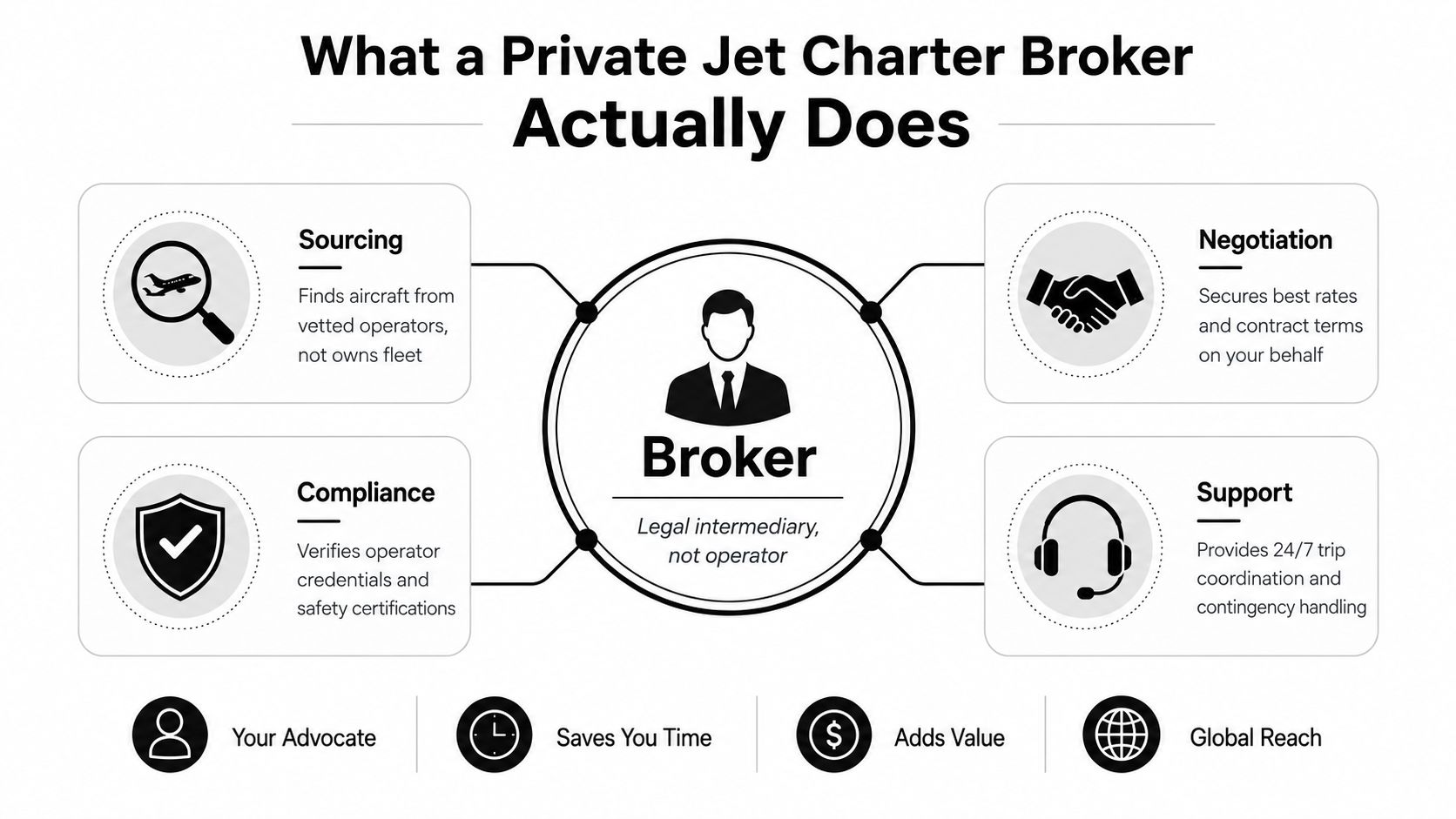
Under U.S. rules, a private jet charter broker operates as an indirect air carrier and cannot exercise operational control of the aircraft. That control stays with the FAA-authorized operator, which is why a broker can improve access, pricing, and logistics, but cannot take over the role of the people responsible for the aircraft, crew, and dispatch. broker versus operator definitions
Practical rule: if the company cannot tell you whether it is brokering or operating the flight, walk away.
A useful broker does four things well. It sources aircraft, compares operator options, negotiates terms, and stays on top of contingencies. A weak broker resells category labels and hopes you will not ask for the actual tail, the actual operator, or the backup plan if the first aircraft falls through.
Ask one question on the first call: “Do you operate the aircraft, broker it, or both?” A serious answer comes fast and precise. A vague answer usually means the quote will be vague too.
How Brokers Source Aircraft and Set Your Price
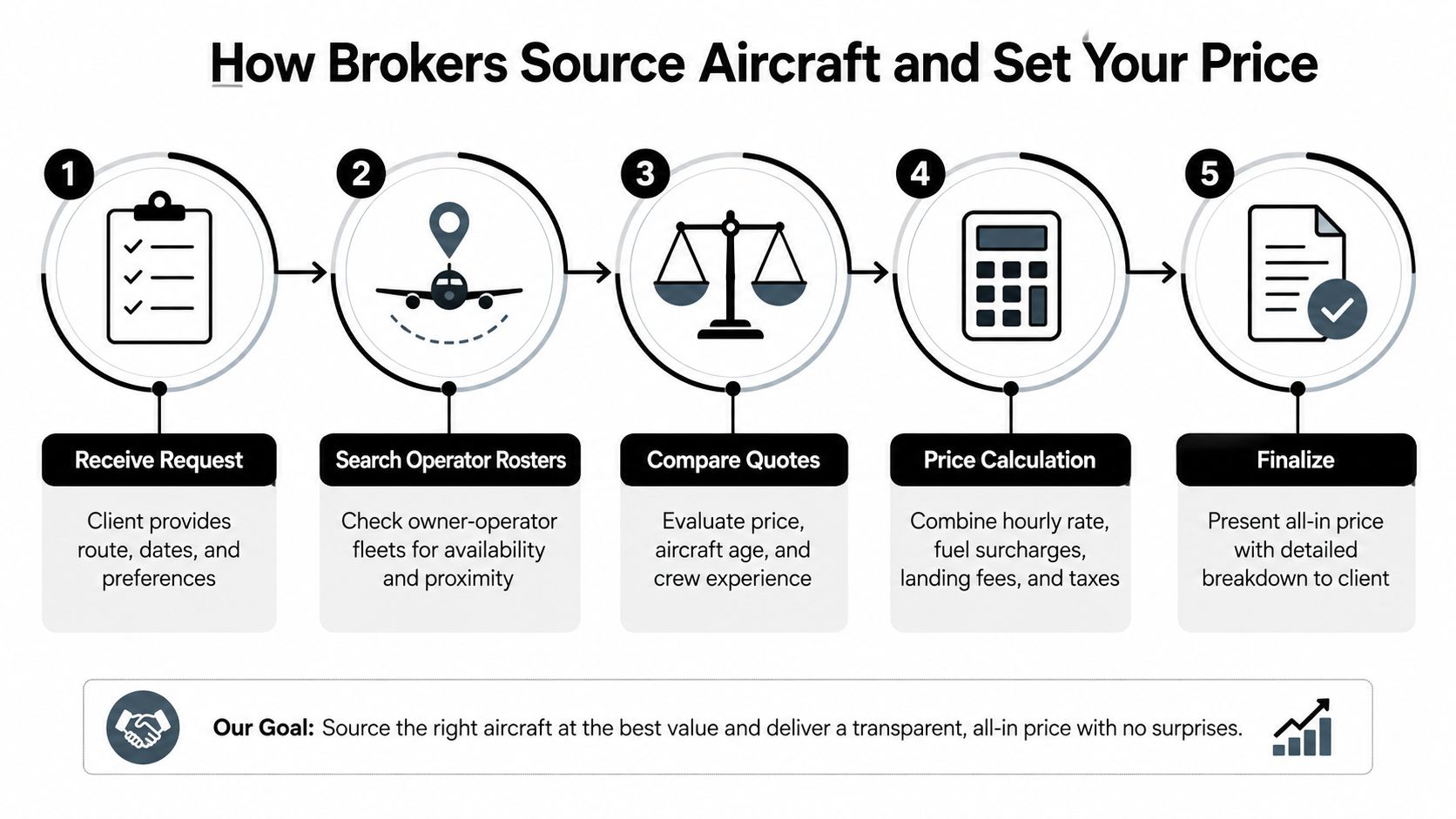
A broker's quote is only as strong as the aircraft it can place near your departure point. If the nearest suitable jet is not already positioned where you need it, the broker has to build the price around empty ferry legs before and after the trip, and that is where invoices start to swell.
Why local sourcing beats category quoting
A serious broker starts with local availability, not a cabin label. The goal is to match the route, the aircraft base, and the exact tail, because that is what keeps the quote grounded in real lift instead of padded assumptions. Haute Jets says it sources from 3,500+ owner-operators across 175 countries, with local aircraft and no membership or jet card fees, which is the right structure if you care about exact aircraft access rather than a generic promise. Haute Jets charter sourcing overview
That distinction matters because a quote built on nearby lift is usually tighter than one built on repositioned lift. If the aircraft is not already close enough, the broker has to account for the deadhead segment, and that often pushes the final price up by 20–40% versus locally sourced lift. Private jet broker pricing and repositioning impact
Read every quote line by line. First, ask whether you are being quoted a category or a specific aircraft. Then check whether the departure airport works for the aircraft's location, not only for your schedule. After that, ask if the price already includes repositioning, handling, and any owner approval timing that could affect departure.
Good brokers sell proximity, not adjectives. If the aircraft is already based near your trip, the quote should show that advantage immediately.
Source quality also matters. Independent research shows 65% of charter bookings are coordinated through brokers while 35% are made via online platforms, which tells you the market still runs on intermediary expertise rather than one-click booking. Air charter broker market share research
Haute Jets' public pricing pages make the structure visible. It lists charter pricing starting from $3,500 per hour. Haute Jets charter pricing
Broker vs Direct Operator vs Jet Card vs Fractional
The wrong comparison starts with price alone. A broker, a direct operator, a jet card, and a fractional share can all move you from A to B, but they are built around different levels of control, inventory access, and cost exposure. If you care about exact aircraft, local sourcing, and avoiding surprise repositioning fees, the model matters more than the brochure.
| Model | How You Pay | Flexibility | Best For |
|---|---|---|---|
| Brokered charter | Per trip, quoted flight by flight | High | Occasional trips, changing routes, exact aircraft selection |
| Direct operator | Per trip, usually tied to operator inventory | Medium | Travelers loyal to one fleet or one operating base |
| Jet card | Prepaid hours or access commitment | Medium to low | Predictable flying patterns and repeat scheduling |
| Fractional share | Ownership-style entry plus ongoing program costs | Lowest day-to-day flexibility | Heavy annual utilization and consistent mission needs |
When a broker wins
A broker wins on irregular trips, airport pairs that change from one call to the next, and cabin requirements that do not fit a standard program. Good brokers source locally, compare the actual aircraft available, and explain why one tail is better positioned than another. That matters because a category quote hides the cost until the aircraft assignment is clear.
When the other models make sense
A direct operator works well if you already trust the fleet and want to stay inside one operating base. A jet card makes more sense if you fly similar routes on a routine schedule and value predictable access over wide shopping. Fractional ownership only makes sense when your utilization is high enough that ownership-style economics matter more than flexibility on short notice.
The market still leans heavily on brokers because buyers want access across operators, not just one captive fleet. Analysts at air charter broker market size and growth data have pointed to sustained growth in broker-facilitated charter activity, which matches how most clients buy. They are not shopping for membership perks. They are trying to avoid paying for the wrong aircraft, the wrong base, or a deadhead segment they never asked for.
The clean rule is simple. Use a broker if your trips are occasional, your aircraft needs are specific, and you want someone to source locally and disclose the exact aircraft. Look at a jet card or fractional product if your flying pattern is repetitive and you care more about repeat access than tailoring each trip. Do not buy a structure that forces you to pay for inventory you will never use.
Safety Standards and Vetting That Matter
Safety language gets abused in private aviation. Anyone can say “safety first.” That means nothing unless the broker can show the operator's actual audit status and the date on the certificate.
What to ask for
Ask for the operator's Wyvern Wingman or ARGUS Gold/Platinum documentation by name. A broker who cannot produce that paperwork is asking you to trust a sales pitch instead of an operation. These ratings matter because they review maintenance programs, crew records, flight operations standards, and the way the operator handles risk.
If you want a closer look at what those ratings cover, Haute Jets has a clear breakdown in its journal at Wyvern and ARGUS safety ratings explained.
What the broker should verify
A serious broker checks the operator, not just the aircraft type. That means confirming the certificate, checking the aircraft's condition, and matching the crew and operation to the trip instead of relying on a plane that merely looks available on paper.
Two brokers can sell the same city pair and still expose you to different risk levels. One broker works only with audited operators. Another shops until a cheap plane appears, then hopes the trip holds together. Clients usually see the difference only after a delay, a maintenance issue, or a crew problem.
Ask for the certificate, then verify it directly with the operator. If the broker resists, that tells you enough.
Good brokers treat vetting as a gate, not a slogan. If the operator cannot clear that gate, the aircraft should not be sold, no matter how attractive the quote looks.
Real Pricing Examples by Route and Aircraft
Cheap quotes are usually the expensive ones. If the number looks too clean for the aircraft, route, and timing, the broker has either smoothed over repositioning, shifted you into a different cabin category, or left fees to surface later.
Use the infographic as a pricing check, not a sales prop. It shows how the same market can produce very different numbers once aircraft type, routing, and trip length change. That variation is normal. What is not normal is a quote that hides the reason for the gap.
The test is line-item clarity. A serious broker should show the base charter, fuel, repositioning if it applies, de-icing if weather forces it, catering if it is included, taxes, and any airport or handling charges. If those pieces are missing, the quote is incomplete. If they appear only after you press for details, the broker was not quoting the trip, just the headline.
The private jet charter cost page at Haute Jets is useful for sanity-checking the structure of an estimate before you commit. Use it as a reference point, then compare the broker's offer against the route, aircraft category, and aircraft availability you were promised.
Reading the quote like an adult
Start with the aircraft, not the category. A light jet quoted for a short regional sector should not look like a super midsize transcontinental trip, because the mission profile is completely different. If the broker will not name the aircraft, it is easy to pad the figure with assumptions the customer never approved.
Positioning is where many brokers inflate the invoice. If the aircraft has to reposition from another airport, that cost should be stated plainly. Some quotes bury it inside a broader total, then make the client think the flight itself was more expensive than expected. It was not. The aircraft was not local, and that difference should have been visible from the start.
You also need to watch the line between aircraft time and trip cost. Hourly pricing helps, but it does not tell the full story unless you know whether taxes, landing fees, overnight crew costs, and wait time are folded into the quote. A low hourly rate can still produce a high invoice if the broker adds those pieces late.
As a rule, ask the broker to separate the quote into base charter, aircraft positioning, operational extras, and third-party charges. That is where padded estimates get exposed. If the answer comes back as a single lump sum with no explanation, you are not looking at transparency, you are looking at margin protection.
Rule of thumb: if the broker cannot explain why the estimate changed by line item, the final invoice will favor the broker, not the client.
Questions to Ask Before You Sign Anything
Don't sign a charter agreement until the broker answers the questions that expose whether it knows the exact aircraft or just the category. The difference shows up in the first five minutes of the call.
- Exact aircraft details: ask for the make, model, year, and tail number. If the broker won't name the tail, it's quoting inventory, not a specific jet.
- Operator proof: request the operator's Wyvern or ARGUS certificate and confirm it hasn't been hand-waved away by sales language.
- Crew experience: ask how much time on type the crew has and whether the proposed crew is assigned, not just “available.”
- Weather and cancellation terms: make the broker explain what happens if weather changes, the aircraft goes mechanical, or the operator loses the slot.
- Cabin confirmations: get written answers on catering, pets, Wi-Fi, baggage, and any special passenger needs.
- Ground logistics: confirm pickup and drop-off details at both ends, not just the flight itself.
- Payment mechanics: ask how payment is handled, whether the broker accepts wire transfer, and if alternative methods are available on that booking.
- Backup plan: ask what aircraft replaces the first choice if the original option drops out.
The best brokers answer these questions without defensiveness. The weak ones sound annoyed because the questions interrupt a sales script.
If the broker keeps speaking in cabin categories instead of exact aircraft, stop there. A serious charter quote should be specific enough to survive scrutiny, contract review, and a last-minute swap without turning into a different trip.
Booking a Trusted Broker From Inquiry to Wheels Up
Good charter work feels uneventful. You send the mission, the broker comes back with an exact aircraft, the contract names the operator and terms, and the flight packet clears away surprises before you reach the FBO.
The wrong broker hides behind category quotes and prepaid programs. The right broker shows you the tail, the operator, and routing before you commit, because empty legs, repositioning, and vague cabin classes are where invoices get distorted.
The sequence that should happen
Start with the basics. Send the route, timing, passenger count, and any cabin requirements. The broker should answer with a named aircraft and operator, not a broad category that could mean several different jets.
Then read the contract line by line. It should match the mission, the aircraft, and the service terms before any payment leaves your account. If the broker wants money first and specifics later, walk away.
The flight packet should arrive before departure, not after you are already at the terminal. It should include the tail number, crew information, weather briefing, and passenger manifest, so the trip still makes sense if the schedule shifts.
For a practical walkthrough of the booking process, use Haute Jets' charter guide for 2026.
Local sourcing matters more than slick sales language. A broker with real access to nearby aircraft can cut repositioning fees and keep the proposal tied to the jet you get, instead of padding the quote with a category that looks cheaper than it is.
If the broker stays vague after the packet is issued, treat that as the answer. A competent charter advisor makes the airport feel simple because the hard work was done early, with the right aircraft, the right operator, and the right ground plan.
If you want a charter experience built around exact aircraft transparency, local sourcing, and operator vetting, visit Haute Jets and request a quote. The broker should show you the aircraft before it shows you the invoice.