You're standing at a Fort Lauderdale hotel with a meeting in Manhattan tomorrow morning, or perhaps a yacht waiting in Nassau this afternoon. The aircraft is available, but the airport decision isn't obvious. FXE may offer a faster executive departure, FLL may simplify customs or accommodate a larger aircraft, and an alternative field may reduce the drive to your actual destination. The wrong choice can turn a short private flight into a long ground transfer.
That's why a private jet charter in Fort Lauderdale should be planned around the complete journey, not only the airborne segment. Airport pairing, aircraft positioning, customs, roadway congestion, baggage, and schedule flexibility can influence both convenience and the final quote. This guide gives you a practical framework for choosing among FXE, FLL, and nearby airports, matching aircraft to the mission, understanding charter economics, and coordinating the FBO experience. Haute Jets Journal is built for travelers who want that level of operational clarity.
Introduction to Private Jet Charter in Fort Lauderdale
A Bahamas departure, a Miami business meeting, and a yacht transfer each create a different charter problem. The best airport depends on the final ground destination, not only the shortest flight time. A traveler heading to a beach hotel may favor a different field than someone bound for a cruise terminal, office tower, or yacht basin.
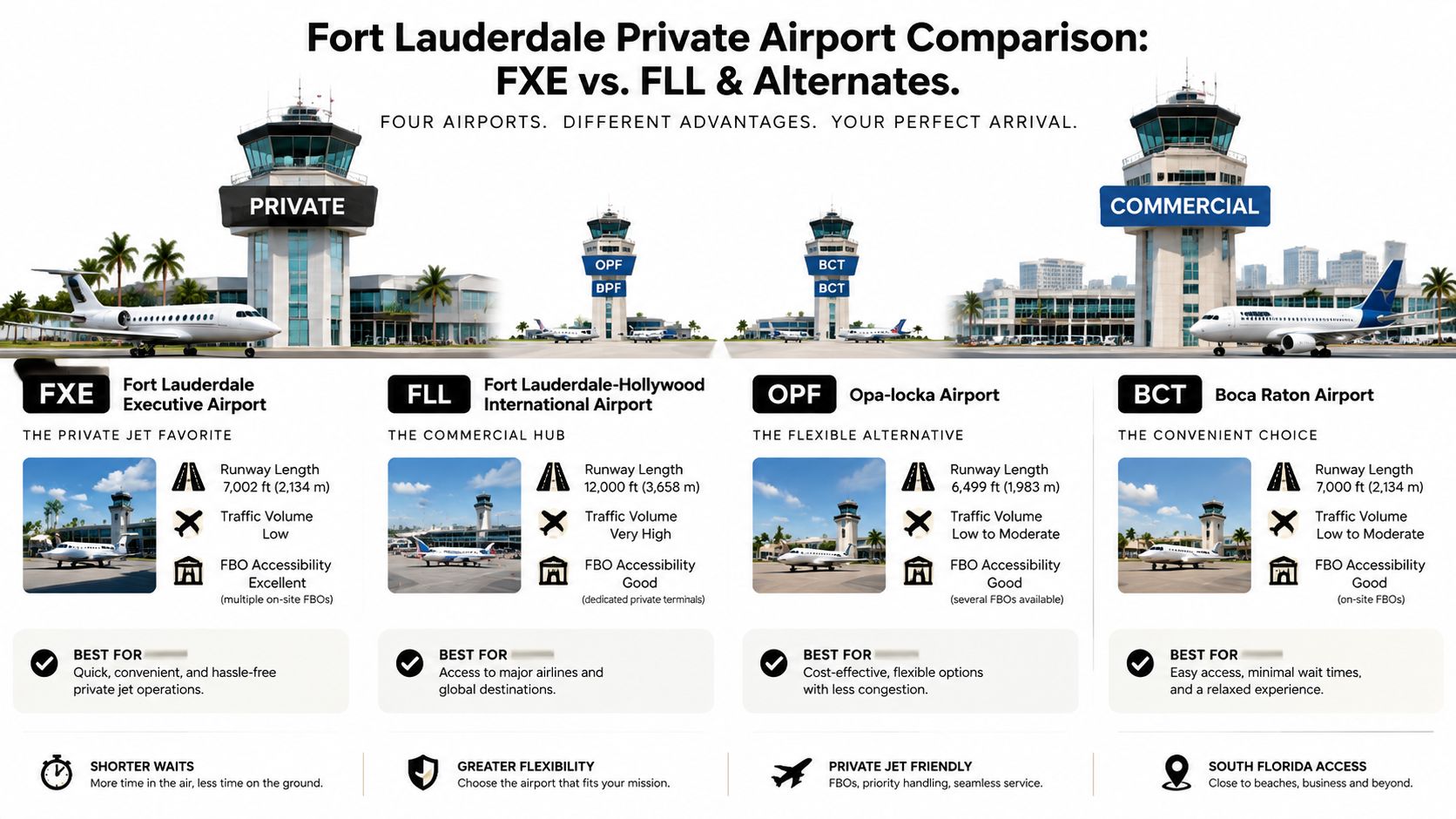
Fort Lauderdale Executive Airport, or FXE, is the region's dedicated business-aviation reliever field, while Fort Lauderdale-Hollywood International Airport, or FLL, also handles private flights through full-service FBOs. FXE sits about 5 miles north of downtown, and FLL about 3 miles southwest of the central business district. That geographic distinction, confirmed by Fort Lauderdale Executive Airport's location guidance, does not by itself determine the faster journey. Traffic, the airport-to-destination drive, customs processing, and the aircraft's starting position can add more time and cost than the airborne segment suggests.
Airport choice also affects the quote. An aircraft positioned at FXE may be convenient for one itinerary but require repositioning before or after your flight. FLL may reduce that cost for a larger or international mission, even when its runway is less convenient for the hotel. Ask the broker to show the full door-to-door plan and identify every repositioning charge.
That activity supports a mature charter and business-aviation market.
Start with the ground destination, then check customs, aircraft fit, availability, and positioning. Haute Jets uses a no-membership, per-flight model that connects travelers with FAA Part 135 operators, allowing comparisons of transparent quotes without a jet card.
Understanding FXE FLL and Alternate Airports
Airport selection should start with the ground destination, not the runway map. A nearby airport can still create a slower door-to-door journey if the vehicle must cross a congested corridor, wait for customs, or travel against peak traffic. Ask for the complete transfer plan before comparing flight times.
FXE for executive access
FXE suits many business-aviation missions because it focuses on general aviation, offers multiple FBO options, and avoids a conventional airline terminal for private departures. For a downtown office, northern Fort Lauderdale address, or yacht movement, that simpler departure may outweigh a small difference in airborne time.
FXE sits 5 miles north of downtown, making it practical when the destination is north or west of the central business district. Its location does not guarantee the fastest trip. The vehicle route, aircraft availability, and any repositioning requirement can change the result. Review the airport's private aviation facilities and access details before confirming the aircraft.
FLL for customs and larger missions
FLL is 3 miles southwest of the central business district. That positioning can work well for Port Everglades, southern Fort Lauderdale, Hollywood, and destinations connected efficiently to the airport's road network. Private aviation benefits include dedicated FBO operations, customs access, and facilities suited to a broad range of aircraft.
The trade-off is a busier commercial setting. Choose FLL when the itinerary requires on-site customs, a larger aircraft, or an easy connection with commercial service. FXE is often more efficient for a traveler heading north, especially when the FLL transfer would cross heavy traffic. Confirm whether the aircraft is already positioned at the selected airport. A lower base quote can lose its advantage after repositioning and vehicle costs are included.
OPF and Boca Raton as strategic alternates
Opa-locka can suit Miami, Coral Gables, and parts of South Beach. Boca Raton may be more practical for Boca Raton, Delray Beach, or Palm Beach County. North Perry and Pompano Beach also deserve review when aircraft availability, local access, or runway requirements make them operationally attractive.
Practical rule: Choose the airport that minimizes total transfer friction, not the one with the shortest advertised distance from “Fort Lauderdale.”
A yacht client bound for a northern marina may save transfer time through FXE. An international corporate group may prefer FLL for customs and its larger FBO network. These missions require different airport choices. Have your charter advisor compare the airport, aircraft, customs plan, vehicle route, and repositioning charges in one quote. That is the only reliable way to judge the actual end-to-end cost.
Common Charter Routes from Fort Lauderdale
A traveler leaving a Fort Lauderdale meeting for a same-day New York appointment should compare more than flight time. The drive to the airport, terminal processing, aircraft repositioning, and arrival transfer can determine whether FXE or FLL delivers the better itinerary. A lower charter quote can disappear once those pieces are added.
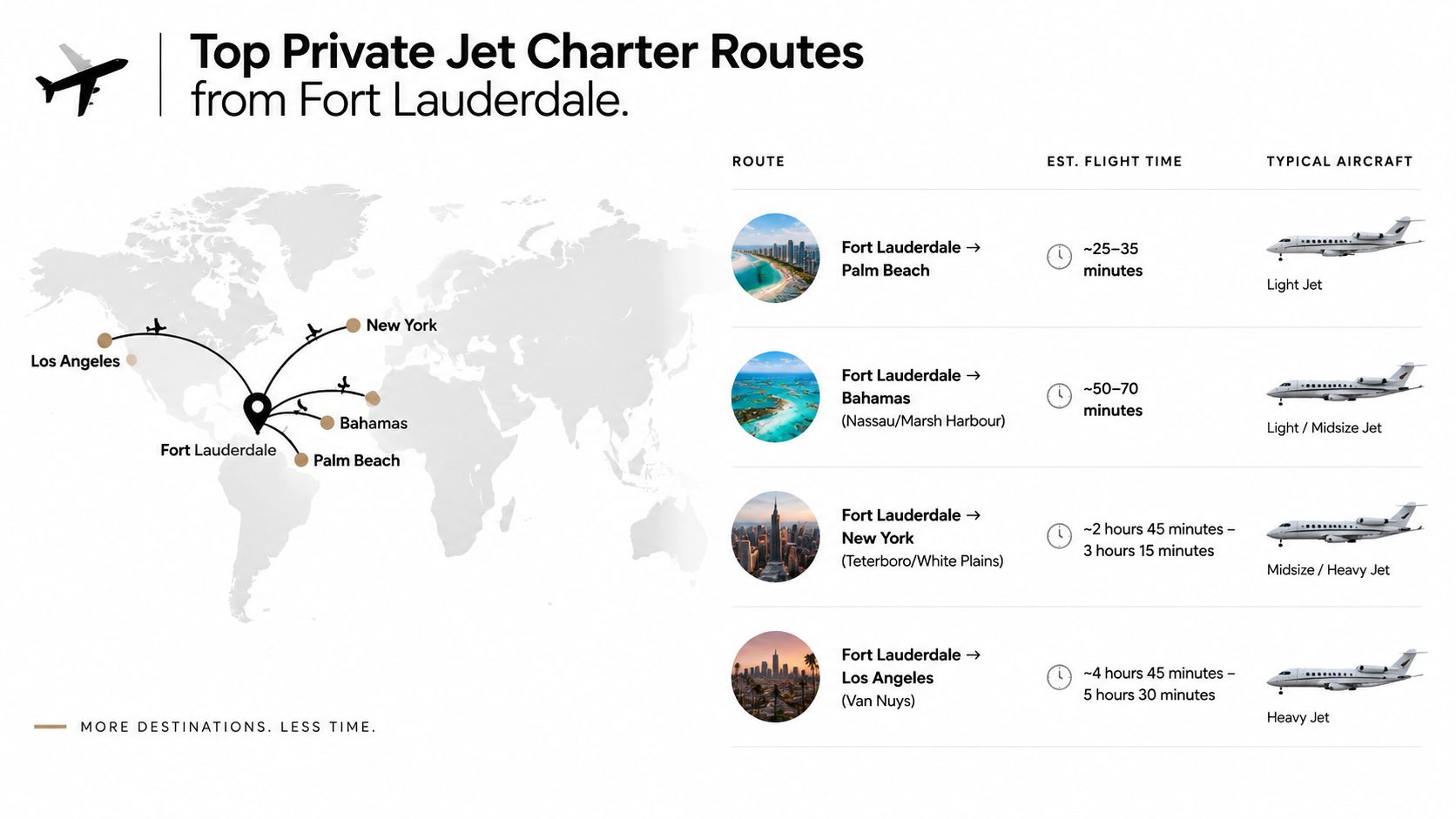
Fort Lauderdale's main private routes include short regional hops, Caribbean leisure sectors, and longer domestic business missions. Palm Beach suits executive meetings, estate access, and weekend travel. Nassau and Marsh Harbour fit yacht schedules, resort stays, and island transfers that do not match airline timetables. Turks and Caicos remains a popular winter choice for beach, yacht, and villa itineraries.
Route selection by mission
- Palm Beach: Choose this for short executive or leisure movements where the destination transfer matters more than airborne time. FXE may reduce total travel time for northern destinations, while FLL can make sense when the aircraft is already there.
- Nassau or Marsh Harbour: These Bahamas sectors suit yacht connections, resort weekends, and flexible island itineraries. Confirm customs arrangements and the aircraft's current position before accepting a departure airport.
- New York: Teterboro and White Plains support Manhattan access, corporate meetings, and seasonal South Florida travel. Compare the airport transfer at both ends, not just the quoted flight duration.
- Los Angeles: Van Nuys is the practical private-aviation gateway for entertainment, production, and West Coast business travel. A nonstop itinerary may still require a larger aircraft and a higher repositioning charge.
Set departure and return times around the meeting, marina, hotel, or event. An early departure can protect the destination day, while a later return may avoid an overnight stay. Ask the operator to show aircraft positioning, crew logistics, airport fees, customs handling, and vehicle transfers in the same proposal.
South Florida demand tightens around holidays, major events, boat shows, and winter travel. Request quotes early for peak dates, then compare FXE, FLL, and suitable alternates using total door-to-door time and total cost.
Typical Aircraft Options for Popular Routes
Aircraft selection should follow the mission, not the prestige of the badge on the tail. A light jet can be the efficient answer for a short Bahamas flight, while a midsize or heavy aircraft becomes more sensible when passengers need cabin space, baggage capacity, or nonstop range.
Light jets for short sectors
The Phenom 300 is a strong example for short regional work. Think of a light jet as the aviation equivalent of a sporty sedan. It gives you speed, privacy, and a comfortable cabin without carrying the operating burden of a large aircraft when the route is short.
Light jets suit smaller groups, limited baggage, and missions where the traveler values direct access more than a stand-up cabin. They can work well for Palm Beach, the Bahamas, and nearby domestic cities, provided the runway, weather, payload, and range all fit the flight plan.
Midsize cabins for longer business trips
A Citation Latitude offers a more substantial cabin environment for cross-country travel. Midsize aircraft generally make more sense when passengers need space to work, additional baggage capacity, a larger lavatory, or a quieter setting for an extended flight.
Use this category for longer Northeast missions, multi-passenger corporate travel, or itineraries where arriving rested matters. The correct comparison isn't only light versus midsize. Ask whether the smaller aircraft's cabin and baggage limits create operational compromises that outweigh its lower base rate.
Heavy jets for long-range comfort
The Gulfstream G550 represents the heavy-jet end of the decision. A heavy jet is closer to a luxury SUV than a sporty sedan. It carries more passengers and baggage, provides a larger cabin, and supports demanding domestic or international missions with greater comfort.
That capability comes with higher operating costs and more airport considerations. FLL may be preferable for a heavy aircraft when runway, handling, customs, or parking requirements make FXE less suitable.
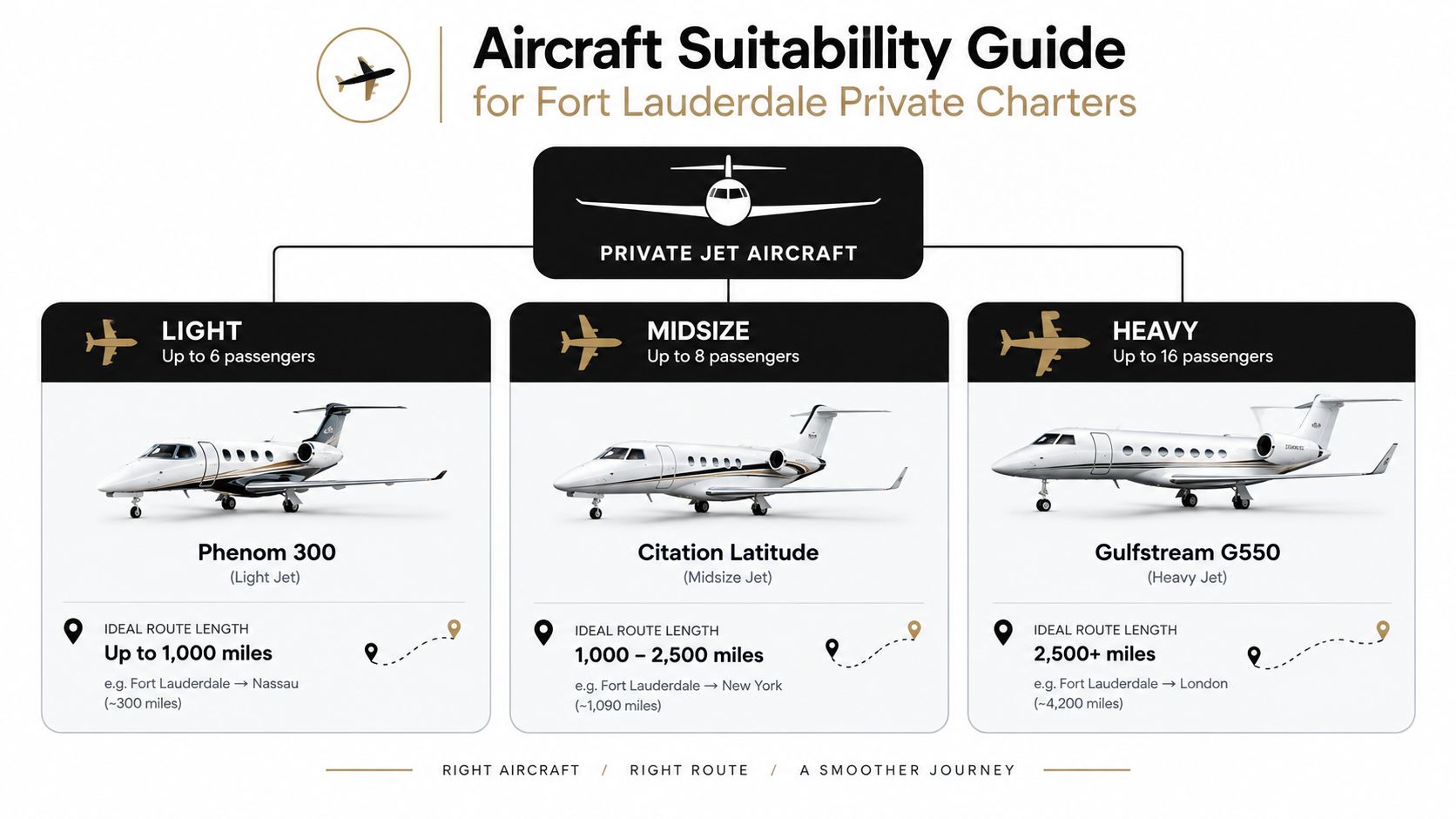
Before accepting a category recommendation, ask for the exact aircraft, cabin layout, baggage limitations, Wi-Fi specifications, catering plan, and operator safety credentials. Two aircraft in the same category can deliver very different passenger experiences. A route advisor should also explain whether the aircraft can depart from your preferred airport with the expected passenger and fuel load.
Pricing Factors and Cost Expectations
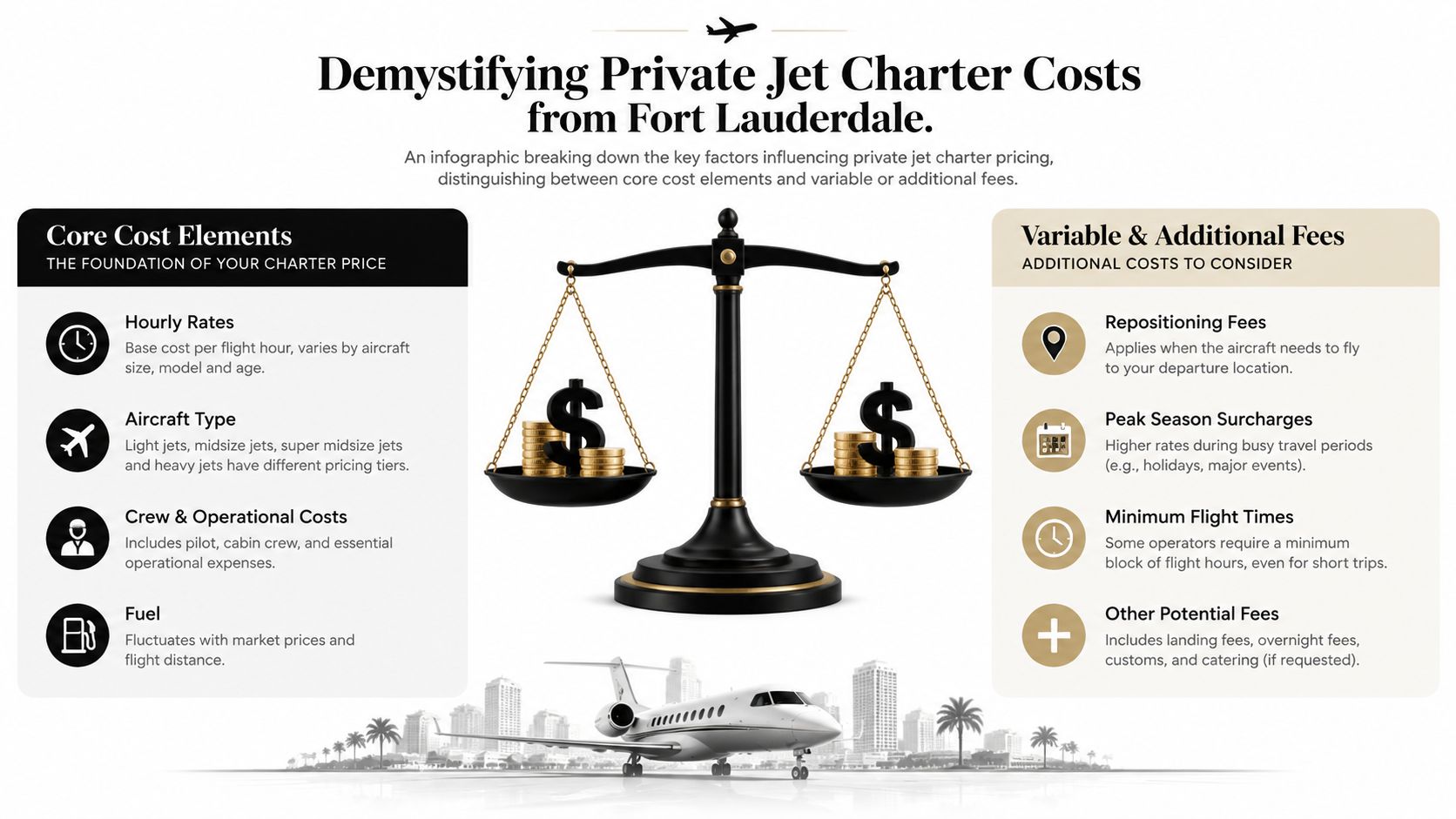
A Fort Lauderdale charter can look inexpensive on an hourly quote and become costly once the aircraft's location, airport choice, and return plan are included. Price the trip from your door to the destination, not only from wheels-up to landing. A shorter drive to FXE may still lose its advantage if the aircraft must reposition from FLL or another South Florida airport.
Repositioning is the hidden variable
An aircraft already near Fort Lauderdale usually produces a cleaner quote than one flying in from another market. One-way bookings often add positioning costs because the operator must move the aircraft to its next mission. A round trip can be more efficient when the aircraft remains with you or returns on a predictable schedule.
Your advisor should show the occupied flight, positioning legs, airport and handling charges, crew expenses, and taxes or international fees as separate lines. A single headline figure hides whether you are paying for your requested itinerary or for unrelated aircraft movements.
Haute Jets offers a private jet charter cost overview that helps travelers frame these questions before accepting a proposal.
Airport selection also affects the final total. FXE may reduce your road transfer and work well for certain aircraft, while FLL or another South Florida airport may offer better aircraft availability, customs support, or operating access. Compare the repositioning quote and the ground transfer together. A lower aircraft price can disappear after an inconvenient drive or an added ferry leg.
Why identical routes produce different totals
Consider two Bahamas itineraries with the same passengers and destination. In the first, an aircraft is already positioned in South Florida and can complete the round trip without a separate ferry requirement. In the second, a one-way booking requires the operator to bring the aircraft into Fort Lauderdale and later move it elsewhere. The route distance stays the same, but the commercial structure changes.
Schedule flexibility can reduce that burden. Accepting another departure airport, shifting the departure window, or considering an empty leg may expose aircraft already in the region. The trade-off is reduced control over timing, aircraft selection, or return planning.
Demand affects availability and pricing
Florida charter demand can rise sharply during busy periods, putting pressure on aircraft availability and rates. Airline disruptions and major yachting events can intensify that pressure by concentrating travelers on particular dates and airports.
Ask each provider to identify:
- Aircraft positioning: Where is the aircraft based before departure, and where must it go afterward?
- Trip structure: Is the quote one way, round trip, or dependent on repositioning?
- Minimums: Does the operator apply minimum billable flight time?
- Ancillary charges: Are FBO handling, catering, customs, parking, crew lodging, and ground transport included?
- Flexibility savings: Would another airport or departure window change the quote materially?
The best value is the proposal that connects aircraft location, airport choice, schedule, and total door-to-door time. The lowest hourly rate rarely answers that question by itself.
Ground Handling and FBO Tips at Fort Lauderdale Airports
The FBO is where a well-planned charter either becomes effortless or develops avoidable friction. Your advisor should confirm the exact facility, arrival instructions, ramp access, passenger screening, catering cutoff, vehicle staging, and customs plan before the day of travel.
FLL has a mature on-airport private-aviation ecosystem. Operators on site include Signature Aviation, Sheltair, Fontainebleau Aviation, National Jets, and Jetscape Services, giving travelers multiple handling options rather than a single boutique facility. FXE also supports a multi-FBO environment designed around general and business aviation.
FLL facility planning
Fontainebleau Aviation's new FLL private jet center opened in December 2024. The facility includes an 80,000-square-foot hangar, a 25,000-square-foot lobby and hangar offices, and an executive suite with an AV-equipped board room for up to 20 people, according to the facility announcement.
That infrastructure can be useful for corporate groups, executive briefings, and travelers who need a more formal pre-departure setting. It doesn't automatically make FLL the right airport. The correct choice still depends on the destination, aircraft, customs requirement, and road transfer.
A practical arrival checklist
- Confirm the FBO name: “FLL” or “FXE” isn't enough. Ask for the facility, address, phone number, and vehicle meeting point.
- Coordinate customs early: International arrivals and departures require a documented customs plan. Confirm whether the selected airport and FBO can handle the specific itinerary.
- Specify catering: Give the operator dietary requirements, preferred brands, service timing, and whether meals should be loaded for departure or return.
- Plan ground transport: Match the vehicle to the aircraft arrival time, terminal exit, luggage volume, and final destination.
- Flag pets in advance: Provide the animal's size and handling needs so the operator can confirm aircraft and FBO procedures.
Travelers unfamiliar with the terminology can review this guide to what an FBO means in private aviation. The important point is simple: the FBO is part of the itinerary, not an afterthought.
Booking Tips and Best Practices
Start the quote process with the details that change the economics: exact dates, passenger count, baggage, pets, preferred airports, destination address, customs needs, catering, Wi-Fi, and tolerance for schedule changes. “Fort Lauderdale to Nassau” is a useful starting point, but it isn't enough to produce a dependable proposal.
Request the specific tail number, year, make, model, cabin layout, operator, and safety rating before approving the flight. Confirm whether the quote includes positioning, and ask the advisor to show the difference between FXE, FLL, and any alternate airport that could reduce ground time or aircraft movement.
Haute Jets sources aircraft from vetted operators and works with Wyvern Wingman or Argus Gold and Platinum-rated operators, according to its stated network criteria. Its process includes confirming Wi-Fi, catering, pet policies, ground transport, tail number, crew bios, weather briefing, and passenger manifest before departure. The company offers on-demand booking without membership fees or prepaid jet-card hours.
Protect the experience before signing
- Book early for fixed plans: A firm date, popular route, or large group deserves early sourcing so the advisor can compare more than one aircraft.
- Use flexibility intelligently: Empty legs can work when you can accept a specific departure time and airport, but don't sacrifice a critical meeting or cruise connection for a nominal saving.
- Review blackout language: Ask whether holiday, event, or peak-season restrictions apply to the proposal.
- Lock service details: Confirm catering, connectivity, ground vehicles, and pet handling in writing.
If your Fort Lauderdale itinerary includes a yacht day, practical tips for Florida sailboat renters can help with the water-side portion of the trip. The same planning principle applies: coordinate the aircraft, vehicle, marina, and vessel schedule as one itinerary.
Conclusion and Next Steps
A successful Fort Lauderdale charter begins with the ground destination. Choose FXE when executive access and a northern Fort Lauderdale position fit the mission. Choose FLL when customs, larger aircraft, commercial connections, or southern access matter more. Consider OPF, Boca Raton, and other South Florida fields when they improve the complete transfer plan.
Then match the aircraft to passenger count, baggage, cabin expectations, runway requirements, and range. Ask for a quote that exposes positioning, minimums, handling, catering, customs, and crew costs instead of relying on an hourly figure alone. Confirm the FBO and ground vehicle before departure, and complete the final aircraft, crew, weather, and manifest review 24 hours ahead.
The practical next steps are simple: request a quote, compare airports, select the aircraft, review every fee, and confirm the flight details the day before travel.
For a Fort Lauderdale private jet charter, Haute Jets can compare FXE, FLL, and alternate South Florida airports while sourcing the exact aircraft and operator for your itinerary. Visit Haute Jets to request a personalized quote and plan the flight around your real destination, schedule, and ground-transfer priorities.