

A private jet charter Minneapolis trip can swing by tens of thousands of dollars on the same route, and the reason is usually not the hourly rate. It's the mission design. Minneapolis sits in a dense charter network with over 65 private jets within a 50-mile radius and 17 airports in easy driving range, including MSP, STP, ANE, and FCM, so the aircraft you get, the airport you choose, and whether the jet has to be repositioned often matter more than the first number a broker quotes Minneapolis charter market overview.
That's the part most city pages get wrong. They sell a headline hourly price, then bury the actual cost drivers, like aircraft category, local fleet availability, and whether the jet is already near your departure airport. If you're buying charter in the Twin Cities, start with the route, the airport, and the aircraft, not the sticker rate.
Why Minneapolis Is a Smarter Private Aviation Market Than Most Guides Suggest
Minneapolis works as a charter market because it gives buyers choices, and choices control price. A lot of city-page guides pretend every trip starts from the same airport and every aircraft is available on the same terms. That is not how this market works. In Minneapolis, local sourcing changes the math because charter providers report over 65 private jets within a 50-mile radius and 17 airports in convenient driving distance, so the operator does not always need to fly in a jet from somewhere else.
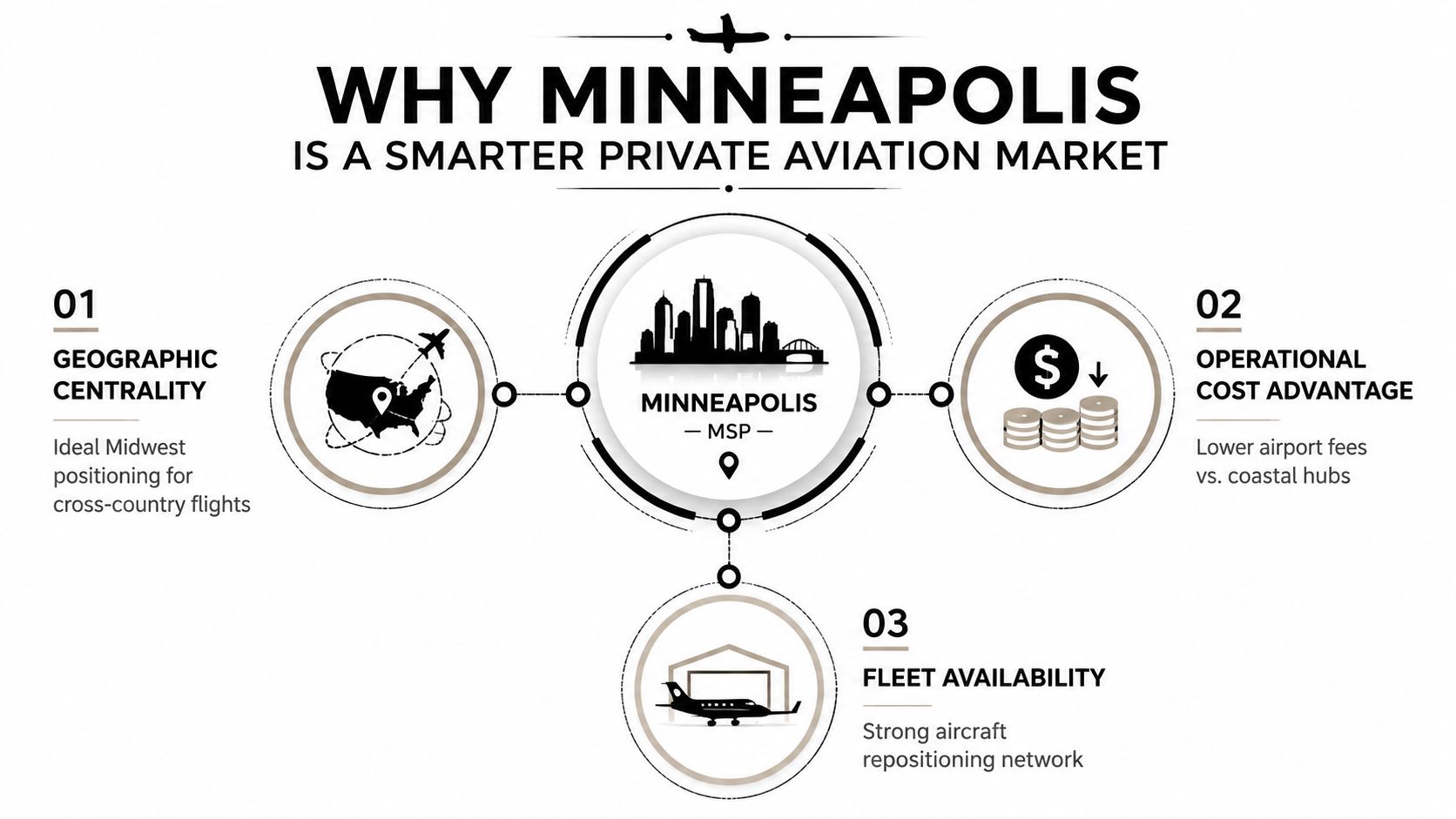
Mission design beats hourly-rate shopping
Treat charter like a routing problem. Decide what the trip needs first, then match the airplane and departure airport to that mission. If you start with the cheapest hourly figure, you usually miss the bigger cost driver, which is local availability and repositioning.
Practical rule: the first quote is just a starting point. The actual cost depends on where the jet is based, which airport works for your ground transfer, and how quickly the operator can stage the aircraft.
That is why Minneapolis deserves a different reading than a single-airport city page. The airport network matters operationally because airport choice affects repositioning, timing, and aircraft availability. A jet already sitting near your departure point can price very differently from one that has to be ferried in empty. Minneapolis airport details for KMSP are part of the same equation, because the airport you choose can help or hurt the quote before the flight even starts.
What the market range actually tells you
Minneapolis pricing also shows the market is broad enough to fit very different missions. Published regional pages place private charter costs from about $2,000 per hour in a turboprop to $10,000+ per hour for long-range aircraft or VIP airliners Minneapolis charter market overview. Another Minneapolis charter page quotes $4,500–$6,000 per flight hour for light jets and $11,000–$18,000 per hour for ultra-long-range aircraft Minneapolis charter market overview.
That spread is the point. Minneapolis is a multi-airport, multi-category charter market, not a one-price destination. The same route can move from a clean, local lift to a much higher final price if the operator has to reposition aircraft, use a less convenient FBO, or source the jet from outside the city. If you want a resource for people building careers on the aviation side of this industry, Superstar Nannies aviation careers is a useful starting point for private-aviation job seekers.
Choosing the Right Minneapolis Departure Airport
Most charter buyers default to MSP because it's the name they know. That's lazy planning. Minneapolis gives you usable airport choices, and the right one depends on the aircraft, the passenger's ground transfer, and how much friction you want to eliminate before wheels up.
MSP is the anchor, but it's not the only smart option. Published Minneapolis sources list Minneapolis–St. Paul International (MSP/KMSP), St. Paul Downtown (STP), Flying Cloud (FCM), and Anoka County (ANE) as part of the local charter conversation Minneapolis airport overview. The practical choice is simple, use the airport that shortens the trip, not the one with the biggest brand name.
When MSP wins
MSP is the easiest choice when the trip needs flexibility and aircraft size. It has 4 runways, including 4/22, 12R/30L, 12L/30R, and 17/35, and one private-jet directory notes there's no slot restriction there MSP airport data. The listed runway lengths of 3,355 meters, 3,048 meters, 2,499 meters, and 2,438 meters help explain why it can handle a wide mix of charter aircraft MSP airport data.
When STP, FCM, or ANE beats MSP
STP is the move when downtown convenience matters and your aircraft category fits the field. FCM usually makes sense when you want a lighter general-aviation footprint and faster access from the southwest metro. ANE can be the right answer for northern Twin Cities access or for itineraries that benefit from avoiding MSP traffic altogether.
The decision matrix is straightforward.
- Choose MSP when you need runway flexibility, a broader aircraft mix, or the cleanest option for larger charter aircraft.
- Choose STP when downtown proximity saves real ground time and the aircraft you're booking fits the airport profile.
- Choose FCM or ANE when local access and reduced friction beat the prestige of flying into the biggest airport.
If your chauffeur ride takes longer than your flight segment, you picked the wrong airport.
For a deeper look at the main airport option, see the dedicated Minneapolis–Saint Paul International Airport charter page.
Matching Aircraft Category to Your Minneapolis Route
Aircraft choice should follow the route, not the other way around. A short regional hop to Chicago is a different mission from a nonstop to New York, Miami, or Los Angeles, and pretending otherwise is how buyers overspend. The category has to fit stage length, cabin size, and luggage load.
The right jet for the right distance
For short Midwestern flying, a turboprop or very light jet can be the smart buy if the cabin fit works. Light jets are the usual sweet spot for regional business travel, midsize and super-midsize aircraft make more sense when the sector gets longer or the cabin needs more breathing room, and heavy or ultra-long-range aircraft earn their keep on coast-to-coast missions.
| Minneapolis private jet category benchmarks (2026) | ||
|---|---|---|
| Category | Hourly range (USD) | Best Minneapolis route fit |
| Turboprop | $1,200–$1,800 | Short regional hops, lower passenger counts |
| Very light jet | $1,500–$2,250 | Fast regional trips, light baggage |
| Light jet | $2,200–$3,000 | Chicago, Kansas City, Denver |
| Midsize jet | $2,800–$3,800 | Longer domestic trips, better cabin comfort |
| Super-midsize jet | $3,800–$5,000 | Coast-to-coast business missions |
| Heavy jet | $5,000–$8,000 | Long domestic and higher-load itineraries |
Those hourly bands come from the Minneapolis market benchmark and are exactly why cabin category matters more than passenger count alone Minneapolis charter workflow and category benchmarks. A 6 to 8 seat light jet can be plenty for a short regional leg, but once you stretch the sector or load more bags, the value moves quickly toward midsize or super-midsize aircraft.
Match the cabin to the mission
A Phenom 300 or Citation Latitude works when you want efficiency without overbuying cabin. A Challenger 350 or Gulfstream G550 starts to make sense when the route length, luggage, or cabin expectations justify the extra range and comfort. Don't book a heavy jet for a short run just because it sounds impressive.
The smartest buyers compare range, luggage envelope, and cabin size together. That's how you avoid paying for empty cabin volume you'll never use.
Key Cost Drivers for Minneapolis Charter Quotes
In Minneapolis, the quote that matters is the one tied to the full mission cost. Hourly rate is only one piece. The bigger swing comes from where the aircraft sits, whether it must reposition, how the crew schedule is built, and which airport or FBO the trip uses in the Twin Cities. That is where city-page guides usually get the math wrong.
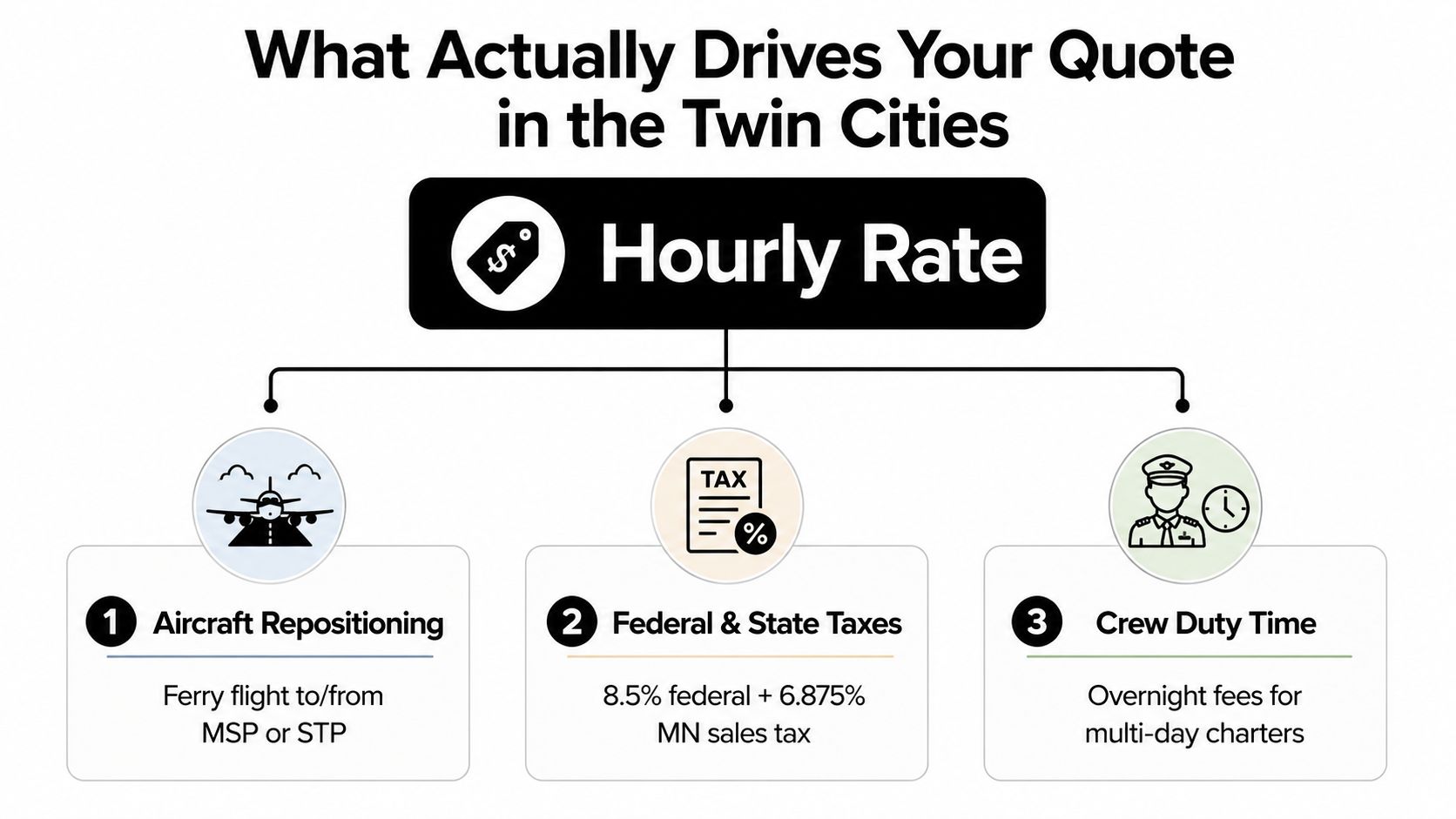
The line items most flyers miss
A serious quote can include aircraft repositioning, overnight crew expenses, and international handling when the mission calls for them. Published aviation guidance also notes that rates may exclude aircraft positioning flight time, overnight expenses, international handling, and federal excise taxes Minneapolis pricing benchmark. If the aircraft is not already in the Twin Cities, the quote climbs fast, and that extra cost is not a broker trick. It is the actual price of getting the jet to you.
A local charter workflow source says pricing shifts with aircraft make, model, year, routing, fuel prices, and scheduling availability Minneapolis charter workflow and pricing factors. That is the whole engine behind the number on the page. A jet already based near MSP or STP usually costs less than one that has to be flown in empty, and the gap can be large enough to change the aircraft you should book.
Route examples show how fast the bill changes
Route benchmarks make the spread hard to ignore. A light-jet flight from Denver to Minneapolis is listed at about $17,600, Miami to Minneapolis at about $26,200, and New York City to Minneapolis at about $20,300 Minneapolis route examples. Another Minneapolis source lists one-way pricing from Chicago to Minneapolis at $10,000 to $20,000, New York to Minneapolis at $25,000 to $50,000, and Los Angeles to Minneapolis at $45,000 to $85,000 Minneapolis route benchmarks.
That spread is why the same route can land on very different quotes, especially when one operator has a local aircraft and another has to reposition. A pricing gap analysis says those differences can run 20 to 40 percent in this market Minneapolis pricing gap analysis. The lower hourly rate often belongs to the airplane that is farther away, or to a quote that strips out costs the mission still has to pay.
One practical rule applies every time. Compare total trip cost, not the headline hourly number. FBO choice in the Twin Cities, aircraft sourcing, and empty reposition miles can swing the final quote by tens of thousands on the same route. For a broader breakdown of charter pricing, use the private jet charter cost guide.
Bottom line: compare total trip cost, not the headline hourly rate. If the aircraft is not local, the quote is not cheap.
The Booking Timeline From Inquiry to Wheels Up
The fastest way to waste money is to call too late and expect the perfect aircraft to magically appear. In Minneapolis, operators report they can sometimes arrange flights in 3 to 5 hours, but they recommend 24 to 48 hours for standard domestic trips, 3 to 5 days for international itineraries, and 2 to 3 months for peak-season travel if you want better aircraft choice and better rates Minneapolis charter workflow timing. That timeline is not a suggestion. It's how you avoid scrambling into an overpriced backup aircraft.
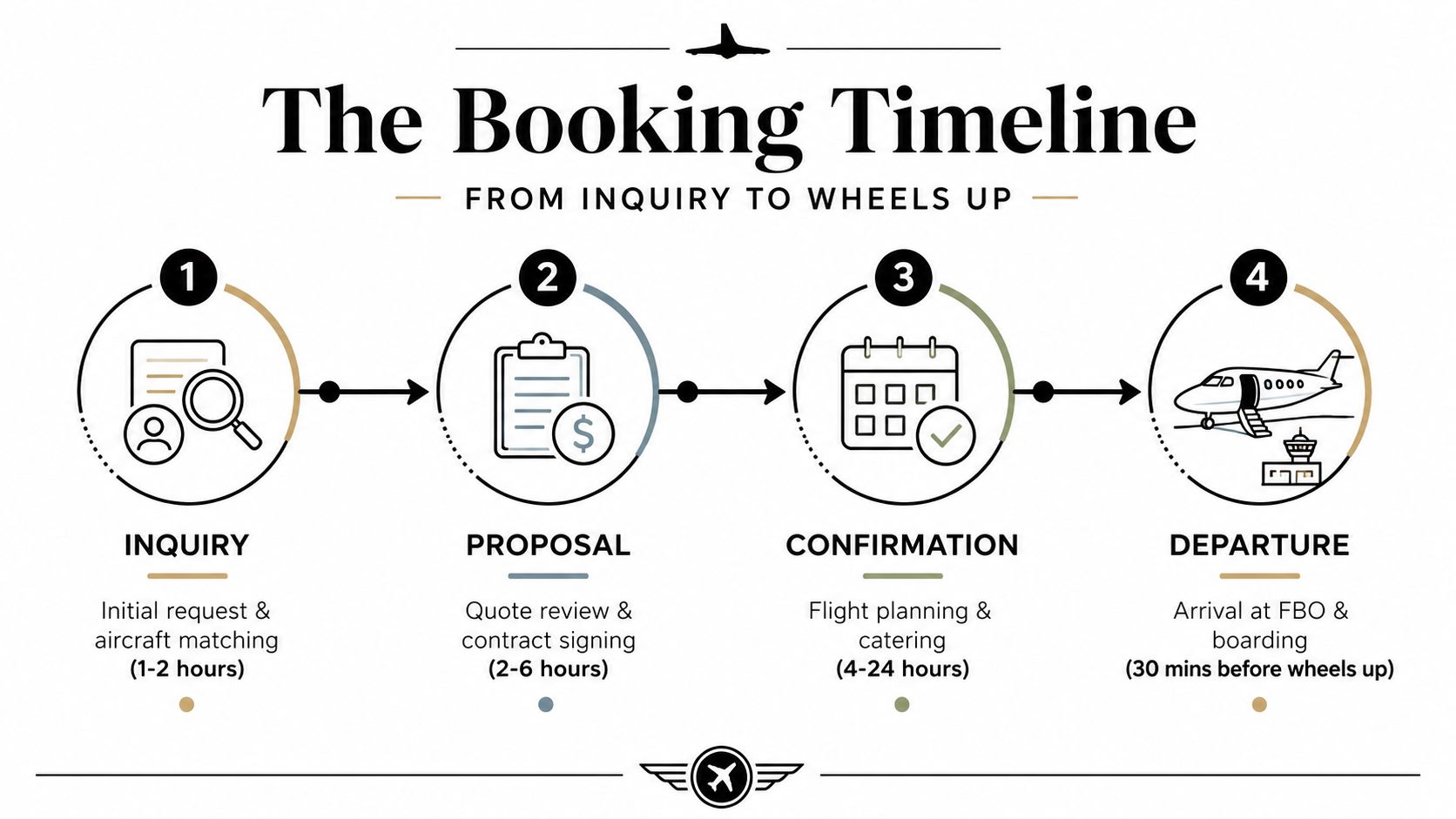
What to have ready before you ask for a quote
Send the operator the itinerary, passenger count, baggage count, pet details, catering preferences, and the ground address at both ends. Give names exactly as they appear on IDs. Add any special handling notes up front, because the quote is only useful if the aircraft and crew can support the trip.
The legal framework matters too. FAA Part 135 governs commuter and on-demand charter operations in the U.S., and an operator must hold an FAA Air Carrier Certificate before flying passengers for hire Part 135 overview. One industry explainer says Part 135 applies to aircraft with 30 seats or fewer, while Part 91 covers noncommercial operations Part 135 overview. If the operator can't explain that distinction clearly, move on.
Safety proof is non-negotiable
A serious charter operator should be able to show third-party safety standards without hesitation. In private aviation, that means checking whether the operator holds Wyvern Wingman or ARGUS Gold/Platinum ratings. If the broker gets vague about audits, they're asking you to ignore the most important part of the booking.
Ask for the tail number and the operator's safety audit before you wire anything. If they stall, you already have your answer.
A proper booking should tighten from proposal to contract, then to flight planning and catering, then to final confirmation before departure. That's the workflow that keeps the charter clean and predictable.
Ground Logistics, Catering, and Special Traveler Needs
The tarmac experience matters as much as the aircraft. At MSP, STP, or FCM, the FBO you choose shapes the entire trip, from how discreet the arrival feels to whether the traveler can step out of a car and board with almost no friction. That's especially important for executives, celebrities, family groups, and medical travelers who want speed without noise.
Catering is easy to get wrong if you wait too long. Ask early about hot meal options, snack preferences, alcohol, and dietary restrictions, then confirm Wi-Fi and pet policies before the booking is locked. If the passenger has accessibility needs, make sure the operator and FBO know the details before the crew begins planning.
Match the FBO to the itinerary
A corporate roadshow with three same-day meetings needs a different ground setup than a family heading to Aspen or Telluride. For the roadshow, prioritize quick vehicle access and minimal handoffs. For a Mayo Clinic medical itinerary, privacy and timing matter more than glossy service extras.
Ground transport into downtown Minneapolis, the Mall of America, or suburban business districts should be arranged alongside the flight, not after it. If the car is late, the charter advantage disappears. The same is true for catering and pet handling, because those details are part of the mission, not afterthoughts.
One useful way to think about it is simple.
- Discreet entry for high-profile guests.
- Conference space for executives who need to work on arrival.
- Pet-friendly handling when you're traveling with animals.
- Direct transfers when the schedule is tighter than the ground logistics.
A polished charter is never just an aircraft. It's the aircraft, the FBO, the car service, and the timing all working together.
Empty Legs, Back-to-Backs, and Your Pre-Booking Checklist
Empty legs can be useful, but they're not magic. If the schedule fits your trip, they can cut cost by a meaningful margin, and when the timing is flexible they're worth a hard look. If the timing doesn't fit, they become a cheap headline that costs you more in lost time and rebooking risk. For a broader primer on the concept, see the empty leg flight guide.
Back-to-back missions can also work well in the Twin Cities because local aircraft sourcing reduces deadhead waste. If your route sits inside a Midwest network, ask whether the operator already has a jet positioned for the next leg. That's where local inventory beats an isolated quote every time.
Use this checklist before you pay
- Define the mission clearly: origin, destination, passenger count, and timing.
- Request multi-airport quotes: MSP, STP, FCM, and ANE when they make sense.
- Confirm the operator's safety rating: Wyvern Wingman or ARGUS Gold/Platinum.
- Verify the exact aircraft and tail number: do this 24 hours before departure.
- Lock FBO, ground transport, and catering: don't leave those until the last minute.
The cheapest charter is the one that shows up with the right aircraft, from the right airport, at the right time.
Haute Jets matters here because it's built around local sourcing, exact aircraft selection, and per-flight booking without memberships. In a market like Minneapolis, that's the difference between paying for repositioning you didn't want and paying for the jet you need.
If you want a Minneapolis charter quote that reflects the mission economics, not just a headline hourly rate, talk to Haute Jets and compare aircraft by airport, routing, and cabin fit. Visit Haute Jets to request a Minneapolis itinerary and get matched with the right aircraft for your trip.