

You're comparing a commercial itinerary out of SEA with a private departure from Boeing Field, and the headline charter quote looks higher than expected. The problem may not be the aircraft. It may be the aircraft's location. In the Pacific Northwest, brokers often quote a jet that must first fly into Seattle, then pass that positioning cost to you.
That's why the right private jet charter Seattle strategy starts with airport selection and local aircraft sourcing, not a generic hourly rate. Seattle gives you two meaningful aviation gateways, a capable business-aviation airport near downtown, and access to a global operator network. Used correctly, that infrastructure can remove unnecessary repositioning charges and produce a cleaner, more predictable trip.
Why Seattle Is a Premier Private Aviation Hub
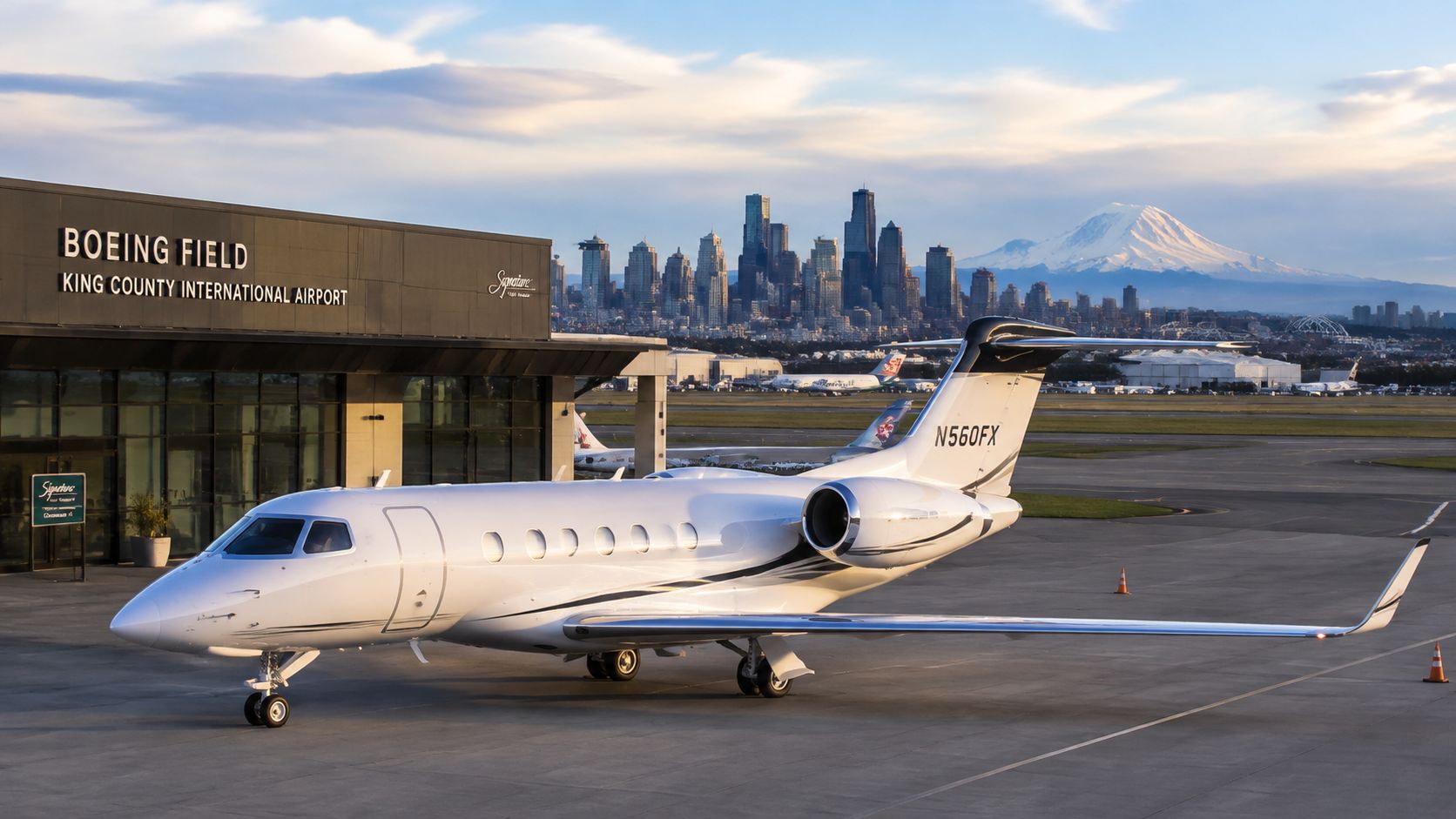
A Seattle executive leaving a delayed commercial flight at SEA has already spent time navigating congestion, terminal crowds, and an uncertain departure window. A Boeing Field client may instead arrive at an FBO, complete the required preflight process, and board directly beside the aircraft. The difference isn't only comfort. It affects ground timing, aircraft access, and the number of variables between the office and the runway.
Seattle–Tacoma International Airport handled over 52.7 million passengers in 2025, according to airport information from Fly Jet Options. SEA has three runways, including a longest runway of 11,901 feet, characteristics that support a broad mix of business aviation and long-haul private departures. For a traveler who needs international capability or a larger aircraft, SEA remains a serious operational option rather than merely a commercial airport.
A gateway with unusual depth
Seattle's aviation importance also has historical weight. SEA was constructed in 1944 and upgraded to international status in 1949, when it began flights to Tokyo, as documented by TransWorld Jets' Seattle airport guide. It remains a full port of entry with on-site U.S. Customs and Border Protection, which makes it particularly useful for private arrivals from transpacific and other international destinations.
Boeing Field, formally King County International Airport, gives local charter clients a different advantage. It sits about 5 miles south of downtown Seattle, and EvoJets identifies its 24/7 FBO access and central position as important operational benefits. The airport's dedicated business-aviation environment can reduce taxi time and limit exposure to the congestion associated with a large commercial terminal.
For Seattle households, trip planning also includes what happens before and after the flight. If a pet stays home while you travel, arranging trusted in-home pet care Seattle can keep the departure day organized without adding a kennel transfer to an already demanding schedule.
Why local sourcing changes the quote
Seattle's advantage is strongest when the broker sources an aircraft already positioned near the mission. Local availability can eliminate the empty flight required to bring a distant aircraft into the region. That is the central reason Seattle clients should evaluate the departure airport, operator location, and return itinerary together instead of accepting the first aircraft presented.
Choosing Your Departure Airport and FBO
For most Seattle charter clients, Boeing Field should be the default airport to request first. Its location, runway, and FBO infrastructure are aligned with the way private aviation is supposed to work. SEA remains valuable, but it shouldn't be selected automatically because it's the region's best-known airport.
Seattle Private Aviation Airports Compared
| Feature | Boeing Field (KBFI) | SEA-TAC (KSEA) |
|---|---|---|
| Primary role | General aviation and business aviation | Large-scale regional and international gateway |
| Downtown position | About 5 miles south of downtown Seattle | Located in the broader Seattle-Tacoma commercial airport corridor |
| Runways | Two runways, including a longest runway of 10,007 feet | Three runways, including a longest runway of 11,901 feet |
| FBO access | 24/7 FBO access supports private charter operations | Private aviation services are available within a major commercial airport environment |
| Best use | Local executive travel, regional missions, and schedules sensitive to ground delays | International arrivals, Customs processing, and missions needing SEA's larger-airport capabilities |
| Main tradeoff | Airport suitability still depends on aircraft and mission requirements | Commercial-airport congestion can add operational complexity |
The runway and airport figures in this comparison are supported by TransWorld Jets' Seattle airport reference and Clay Lacy's Boeing Field location information.
When Boeing Field is the better choice
Choose KBFI when your final destination is downtown, South Lake Union, Pioneer Square, or another central Seattle business district. The airport's position can simplify the ground portion of the trip, while 24/7 FBO availability gives the operator more flexibility for early, late, or time-sensitive departures.
Ask your provider to quote Boeing Field specifically, not merely “Seattle.” That small distinction forces the broker to evaluate the correct handling facility, aircraft access, ground transport, and possible positioning costs. For a dedicated private-terminal experience at SEA, review the Seattle-Tacoma International private terminal information before choosing the commercial airport environment.
When SEA makes sense
SEA is the practical choice for international arrivals that need on-site U.S. Customs and Border Protection. Its 24-hour airport operations and 11,901-foot main runway also make it suitable for a wide range of aircraft and scheduling requirements, according to Paramount Business Jets' SEA airport overview.
Airport rule: Tell the broker your true ground destination first. The closest airport on a map isn't always the fastest airport for the entire itinerary.
Private Jet Charter Costs and Pricing Breakdown
Private charter pricing should be discussed as a mission cost, not a seductive hourly number. The aircraft category, flight schedule, airport charges, crew requirements, and positioning all affect the quote. A provider that gives you only an hourly rate hasn't yet given you enough information to make a sound decision.
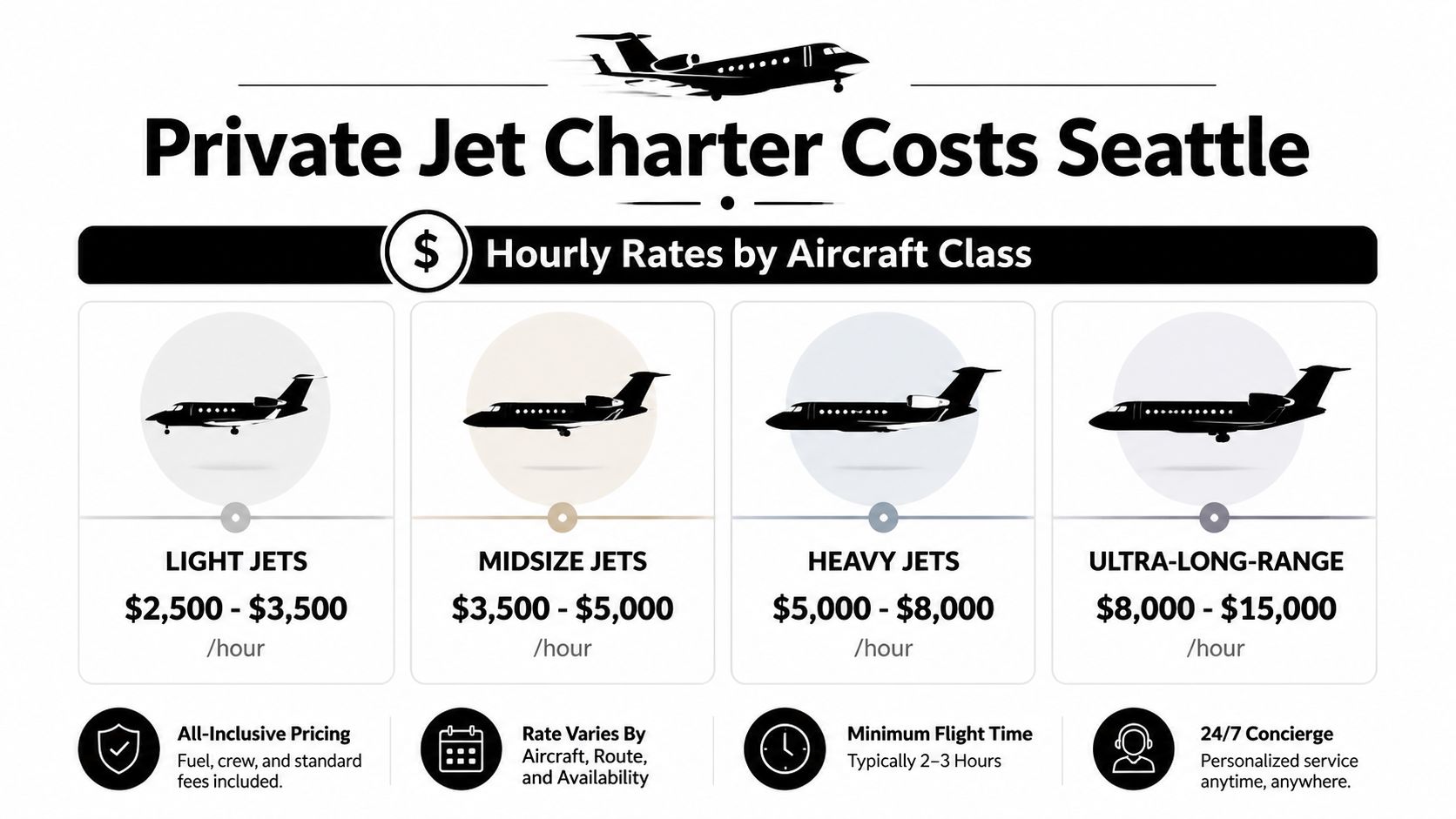
One industry pricing guide cites approximate starting hourly rates of $2,000 for turboprops, $5,000 for light jets, $7,000 for midsize jets, and $10,000 or more for long-range jets or VIP airliners. Those figures come from Air Charter Advisors' Seattle charter pricing guide. They're useful as a category framework, not as a guaranteed quote.
What each category is buying
- Turboprops: Starting around $2,000 per hour, they can make sense for shorter regional missions when passenger requirements and airport conditions fit the aircraft.
- Light jets: Starting around $5,000 per hour, they offer a faster, more private solution for smaller groups and regional or short national routes.
- Midsize jets: Starting around $7,000 per hour, they're appropriate when passengers need more cabin room, baggage capacity, or longer-range capability.
- Long-range jets and VIP airliners: Starting at $10,000 or more per hour, they're selected when nonstop range, larger groups, or premium cabin volume justifies the additional cost.
The repositioning charge most clients miss
The largest pricing trap in Seattle isn't always the aircraft rate. It's the aircraft's starting point. If a broker sources a jet from another city, the aircraft may need to fly empty to Seattle before collecting you. The broker can then include that positioning flight, plus related scheduling and airport costs, in your quote.
Traditional broker and jet-card structures can inflate Seattle charter prices by 20 to 40% through repositioning fees, according to the Haute Jets publisher information. Local sourcing targets that specific waste. A jet already near KBFI or SEA doesn't need to cross the region empty just to begin your trip.
Request a quote that separates the aircraft's base mission from positioning. Then ask whether a locally based alternative exists. You can also use this private jet charter cost guide to understand how aircraft type and trip structure influence the final proposal.
Pricing rule: Never compare two quotes until you know whether both aircraft are locally sourced and whether each proposal includes repositioning.
Selecting the Right Aircraft for Your Mission
Seattle's maritime climate brings low ceilings, rain, and changing visibility, so aircraft selection should include performance margins, not just seat count. Skyservice's Seattle FBO information highlights why handling flexibility and hangar support matter when local conditions change.
Start with the route, then test the aircraft
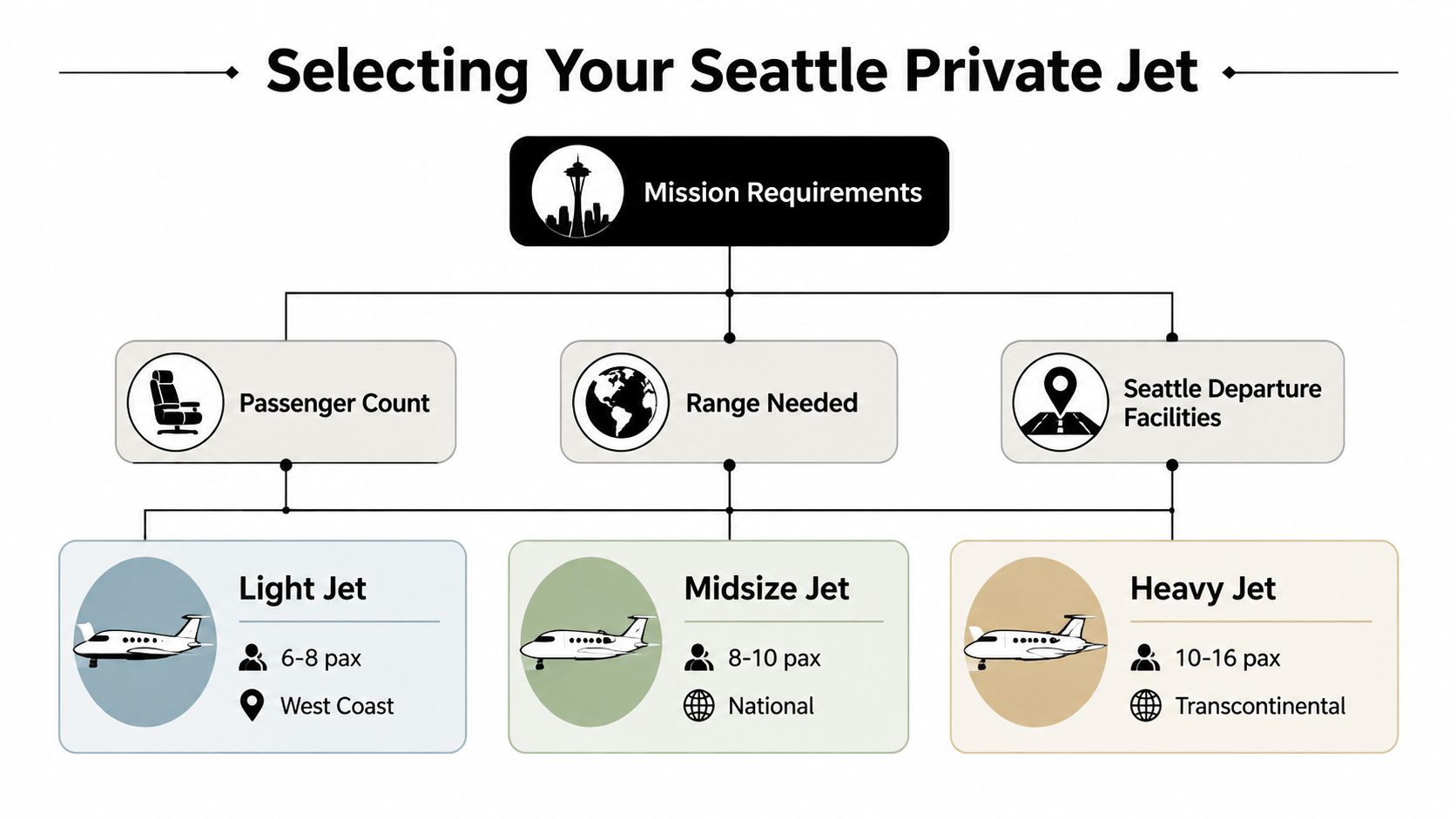
For regional hops to Portland, Boise, or Vancouver, turboprops and light jets are typically the sensible starting point. They can match the distance and passenger profile without forcing you to pay for a larger cabin or unnecessary range. The final choice still depends on airport suitability, baggage, weather, and the complete itinerary.
For coast-to-coast travel to New York or Miami, or for a mission involving Aspen and demanding schedule requirements, move the evaluation toward midsize and larger-cabin aircraft. The point isn't to buy the biggest jet available. It's to select enough range, cabin volume, and operational margin for the trip without paying for capability you won't use.
Use this selection sequence
- Define the passenger and baggage requirement. A small executive group with light luggage has different needs from a larger team carrying equipment or multiple bags.
- Set the range requirement. Regional travel usually points toward turboprops or light jets. National and transcontinental missions may require midsize or larger aircraft.
- Check Seattle departure facilities. Confirm that the selected aircraft can use the intended airport and that the FBO can support the schedule.
- Review the exact cabin. Category labels don't tell you whether the aircraft has the seating layout, Wi-Fi, lavatory configuration, or workspace you expect.
- Match the aircraft to the forecast. In Seattle, adequate performance margins matter when ceilings and visibility shift.
The most expensive mistake is choosing a category and assuming every aircraft within it feels the same. Ask for the exact year, make, model, cabin layout, Wi-Fi availability, catering plan, and pet policy. Haute Jets provides a fleet overview for comparing aircraft options, but the provider still needs to confirm the specific aircraft assigned to your mission.
Safety Standards and Operator Ratings Explained
A polished aircraft and responsive broker don't prove that an operator meets a rigorous safety standard. Seattle clients should insist on third-party operator ratings, specifically Wyvern Wingman or ARGUS Gold/Platinum, before discussing amenities or price.
These audits examine areas such as pilot training, maintenance procedures, operational history, and insurance requirements. They give the charter client an independent screening layer that marketing language cannot provide. A broker may describe an operator as experienced or highly regarded, but a recognized audit provides a more useful basis for comparison.
What the ratings change for the client
A rated operator has undergone external review rather than relying only on its own claims. That matters because charter buyers usually aren't in a position to inspect maintenance records, evaluate crew-training systems, or assess an operator's internal safety management process personally.
Use this checklist before signing:
- Verify the operator identity: Make sure the company operating the flight is clearly named, not hidden behind a generic fleet description.
- Confirm the rating: Ask whether the operator holds Wyvern Wingman or ARGUS Gold/Platinum status and whether that status applies to the assigned operator.
- Review the aircraft details: The exact tail number, model, and crew should be confirmed before departure.
- Demand operational clarity: The provider should explain who controls the aircraft, who manages the crew, and which company holds operational responsibility.
Haute Jets states that its network includes 3,500+ aircraft across 175 countries and restricts its operator network to Wyvern Wingman or ARGUS Gold/Platinum-rated providers, as described in the Haute Jets safety and network information. For a Seattle traveler, the value of that model is straightforward. It narrows the search to operators that have passed an external screening process rather than leaving the client to judge every provider from advertising alone.
Safety ratings don't eliminate weather, air-traffic, or aircraft-availability variables. They do establish a stronger baseline for selecting the company responsible for your flight.
How to Book a Private Jet in Seattle
A clean booking process starts with complete information. Send the provider your departure city, preferred airport, destination, travel dates, passenger count, baggage requirements, desired departure time, and return details. If you need a specific cabin layout, Wi-Fi, pet accommodation, catering, or ground transport, state that before the quote is built.
A practical booking sequence
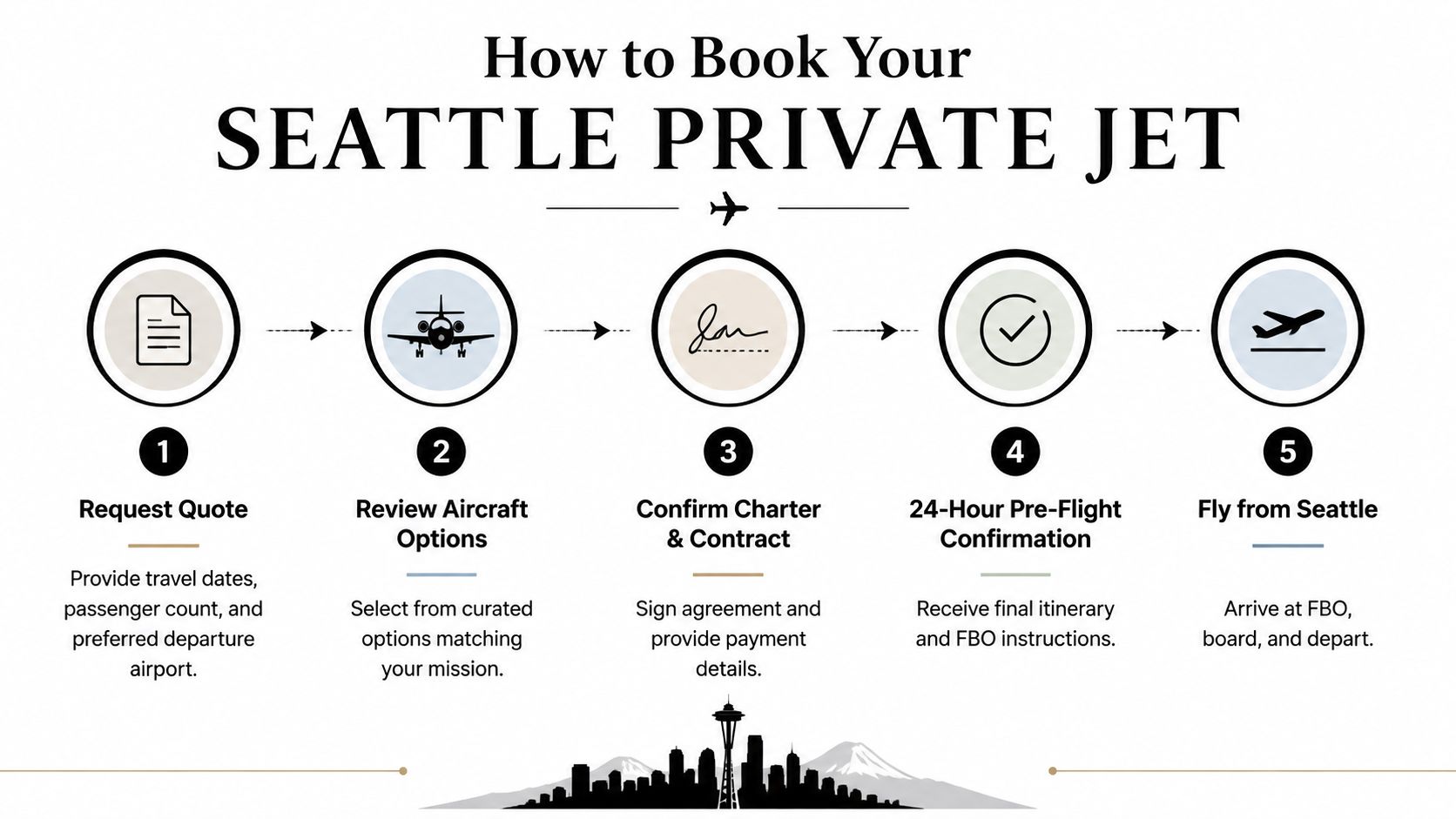
- Request the quote. Ask for KBFI and SEA options where both could serve the mission. Require the proposal to identify positioning costs and airport charges.
- Review aircraft choices. Compare the exact aircraft, not just “light,” “midsize,” or “heavy.” Check the cabin, model year, baggage capacity, Wi-Fi, and operator rating.
- Confirm the charter and contract. Review cancellation terms, payment requirements, routing, airport, FBO, and the company responsible for operating the flight.
- Receive the preflight package. Haute Jets describes a 24-hour confirmation containing the tail number, crew bios, weather briefing, and passenger manifest, as outlined in its private jet booking information.
- Arrive at the FBO and fly. Your ground transfer, passenger reception, luggage handling, and boarding instructions should already be confirmed.
On-demand versus jet cards
For travelers who fly irregularly or want to evaluate each mission independently, on-demand charter is usually the cleaner structure. You pay for the flight you book without annual fees, prepaid hours, or blackout dates. Jet cards can suit frequent travelers who value a predefined program, but they also introduce commitments that may not fit a Seattle client whose routes and aircraft needs change.
Ask for a wholesale-style quote, identify the operator, and compare the total trip cost. A low hourly rate can become expensive after repositioning, while a higher-looking rate may be more competitive when the aircraft is already close to Seattle.
Maximizing Value with Empty Legs and Smart Timing
Empty-leg flights can reduce the cost of private charter when an aircraft already needs to fly a particular route without passengers. The tradeoff is flexibility. You may need to accept a specific departure window, destination, or aircraft, and the flight can disappear if the underlying primary trip changes.
That makes empty legs useful for leisure travel and flexible business plans, but risky for a board meeting or an event with no tolerance for schedule movement. Ask whether the offer is a confirmed charter or an empty-leg opportunity dependent on another passenger's itinerary.
Combine three savings levers
Local sourcing comes first. A nearby aircraft avoids the repositioning problem that can add 20 to 40% to a charter quote, as stated in Haute Jets' local-sourcing explanation. This is more dependable than chasing a discounted aircraft that must first travel into Seattle.
Timing comes next. Flexibility around departure time can open more aircraft options, especially when the itinerary isn't tied to a fixed meeting. Adjusting the departure airport between KBFI and SEA can also help, provided the ground destination and FBO experience remain acceptable.
Aircraft discipline protects the budget. Choose a turboprop or light jet for a suitable regional hop rather than paying for a larger cabin you don't need. Select midsize or long-range equipment when nonstop capability, passenger load, baggage, or coast-to-coast range makes that capacity necessary.
Make the quote transparent
A good Seattle charter quote should identify the aircraft, operator, departure airport, FBO, routing, schedule, and any positioning component. It should also explain what happens if weather or airport conditions require a change. Seattle's infrastructure gives you choices, but those choices only create value when the broker presents them clearly.
The strongest approach is simple: request local aircraft first, evaluate an empty leg only when your schedule allows it, and compare the entire mission rather than one hourly figure. That combination keeps private aviation practical without sacrificing operational standards.
Haute Jets offers on-demand Seattle charter planning, access to aircraft sourced from owner-operators, and options built around KBFI or SEA, including one-way and empty-leg opportunities. Visit Haute Jets to request a quote with your dates, passenger count, preferred airport, and exact mission requirements.