
You're probably planning a first private charter because commercial travel has stopped fitting the trip. The schedule is too rigid, the airport process is too noisy, and the stakes are too high to leave details to chance. Maybe it's a family holiday with children and pets, a same-day investor roadshow, or a last-minute repositioning between homes where every handoff matters.
What surprises most first-time clients is this: the smoothest part of a private flight usually isn't the aircraft. It's the person managing the cabin. On Haute Jets Journal, that distinction matters, because an elite cabin experience doesn't happen through décor or catering alone. It happens because a trained professional turns a moving aircraft into a controlled, calm environment where service, timing, safety, and discretion all work together.
The Unseen Architect of Your Perfect Flight
A commercial flight asks you to adapt to the system. A private flight should feel like the system has adapted to you.
That difference starts before takeoff. You arrive at the FBO, move through a quiet terminal, and board without the friction that defines airline travel. Your preferred drink is already chilled. The cabin temperature feels right. A child's snack is placed where a parent can reach it quickly. A pet setup is handled without fuss. None of that is accidental.
A strong private jet flight attendant is coordinating far more than what you see. They've already checked catering, confirmed the galley setup, aligned service timing with the flight profile, and thought through how the cabin should function from wheels up to wheels down. If your arrival includes a complex ground handoff, they often become the person making that transition feel continuous rather than fragmented. For clients connecting into unfamiliar destinations, services like reliable private transfers in Algarve fit naturally into that same planning mindset because the standard shouldn't disappear once you step off the aircraft.
A private cabin feels effortless only when someone has done a great deal of work before you arrive.
The first-time charter client often notices the obvious details first. Good glassware. Correct meal pacing. Thoughtful presentation. The deeper value appears when something changes. A delayed departure. A catering substitution. A passenger who suddenly wants to sleep instead of dine. A child who needs routine preserved despite a moving schedule.
That's where the private jet flight attendant stops looking like a luxury extra and starts looking like what they really are. A trip-support professional operating inside a very small space where service errors, timing mistakes, and safety lapses are impossible to hide.
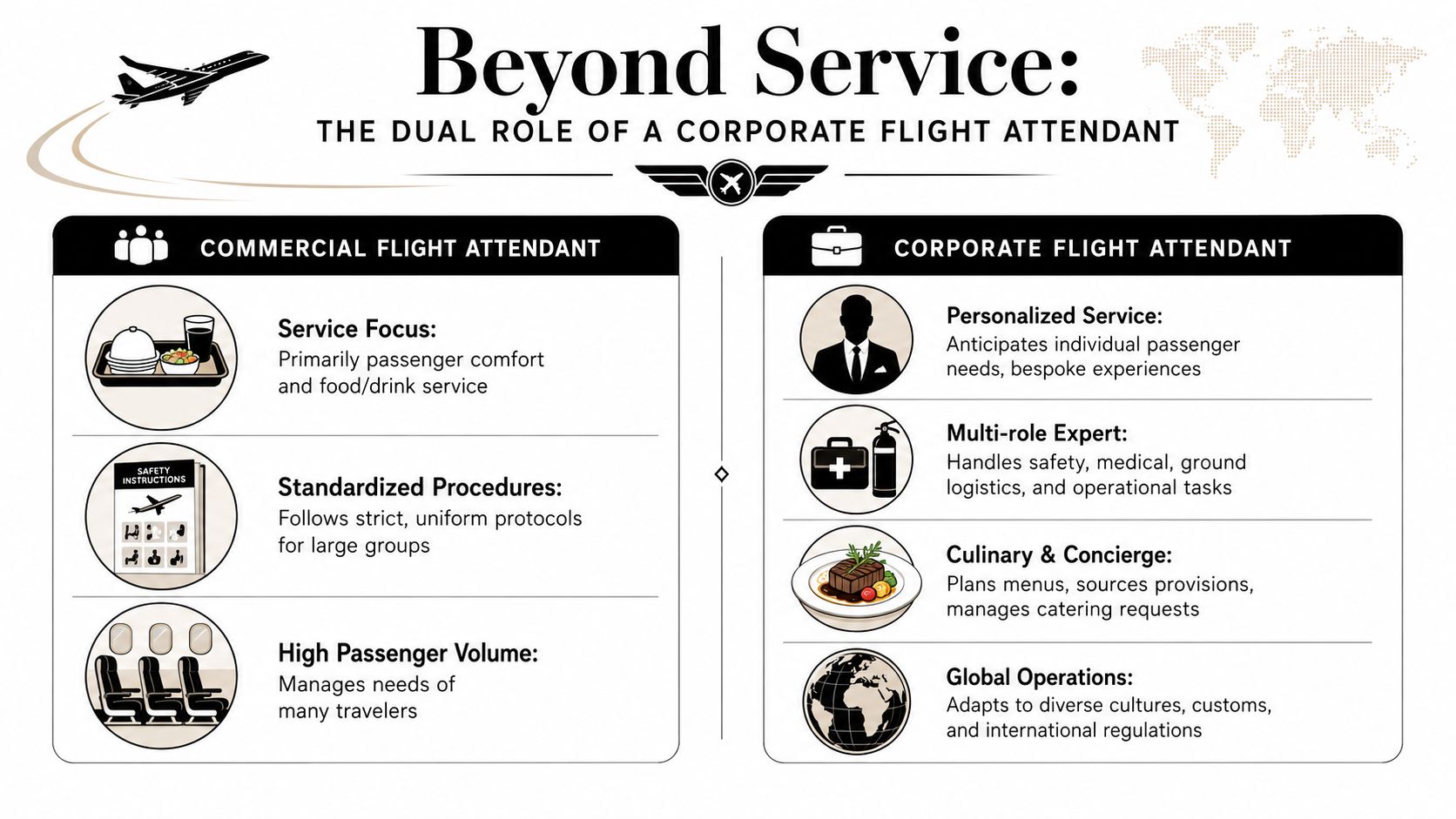
Beyond Service The Dual Role of a Corporate Flight Attendant
The biggest misunderstanding in private aviation is that cabin crew are there mainly to provide a polished meal service. That's part of the job. It isn't the center of the job.
Commercial airlines divide responsibility across a larger crew, fixed procedures, and a standardized environment. A corporate cabin often asks one person to handle the entire passenger-facing side of the flight while also acting as the cabin's safety authority. That changes everything about the role.
What changes on a private aircraft
On an airline, cabin service follows a system built for consistency. On a private jet, the cabin is built around the passenger, but safety still comes first. That means the attendant has to move between hospitality and operational judgment without missing a beat.
BlackJet notes that 85% of operators in 2024 require 2 to 3 years of commercial airline experience in premium cabins specifically for the safety side of the role, not just hospitality in its overview of private plane stewardess jobs. That requirement tells you how serious the cabin role is in private aviation.
A useful side-by-side view looks like this:
| Role area | Commercial cabin crew | Corporate cabin crew |
|---|---|---|
| Crew structure | Shared across several attendants | Often handled by a single attendant |
| Service model | Standardized for many passengers | Customized for a small group or family |
| Safety response | Team-based execution | Solo decision-making in the cabin |
| Ground coordination | Limited to airline process | Often includes catering, timing, and arrival support |
| Passenger expectations | Consistency and efficiency | Personalization, discretion, and adaptability |
What clients actually benefit from
A first-time charter client usually values comfort first, then realizes logistics offer the greatest relief. A skilled attendant can manage competing requests without letting the cabin feel busy or improvised.
That may include:
- Changing service tempo: Some passengers want a full meal after takeoff. Others want the lights dimmed and silence. Good crew read the room quickly.
- Handling unusual requests: Pets, medication timing, special diets, and child routines don't fit neatly into standard service carts.
- Maintaining cabin order: On a private aircraft, clutter affects comfort and workflow immediately. Small spaces punish sloppy execution.
- Protecting discretion: High-profile travelers often value what isn't said and what isn't asked.
For clients comparing options, Haute Jets has a useful page on whether private jets have flight attendants, and it's worth reviewing because not every aircraft category or mission profile carries cabin crew in the same way.
Practical rule: If a cabin attendant seems invisible in the best possible sense, they're probably doing the job well. They're solving problems before they reach you.
What doesn't work
Clients sometimes assume that any polished service background translates well into this role. It doesn't. Fine-dining confidence matters, but private aviation punishes crew who can only perform when the environment is stable.
What works is a rare mix: cabin safety discipline, emotional control, speed under pressure, and service instincts that don't become theatrical. The private jet flight attendant isn't there to perform luxury. They're there to deliver control, calm, and continuity.
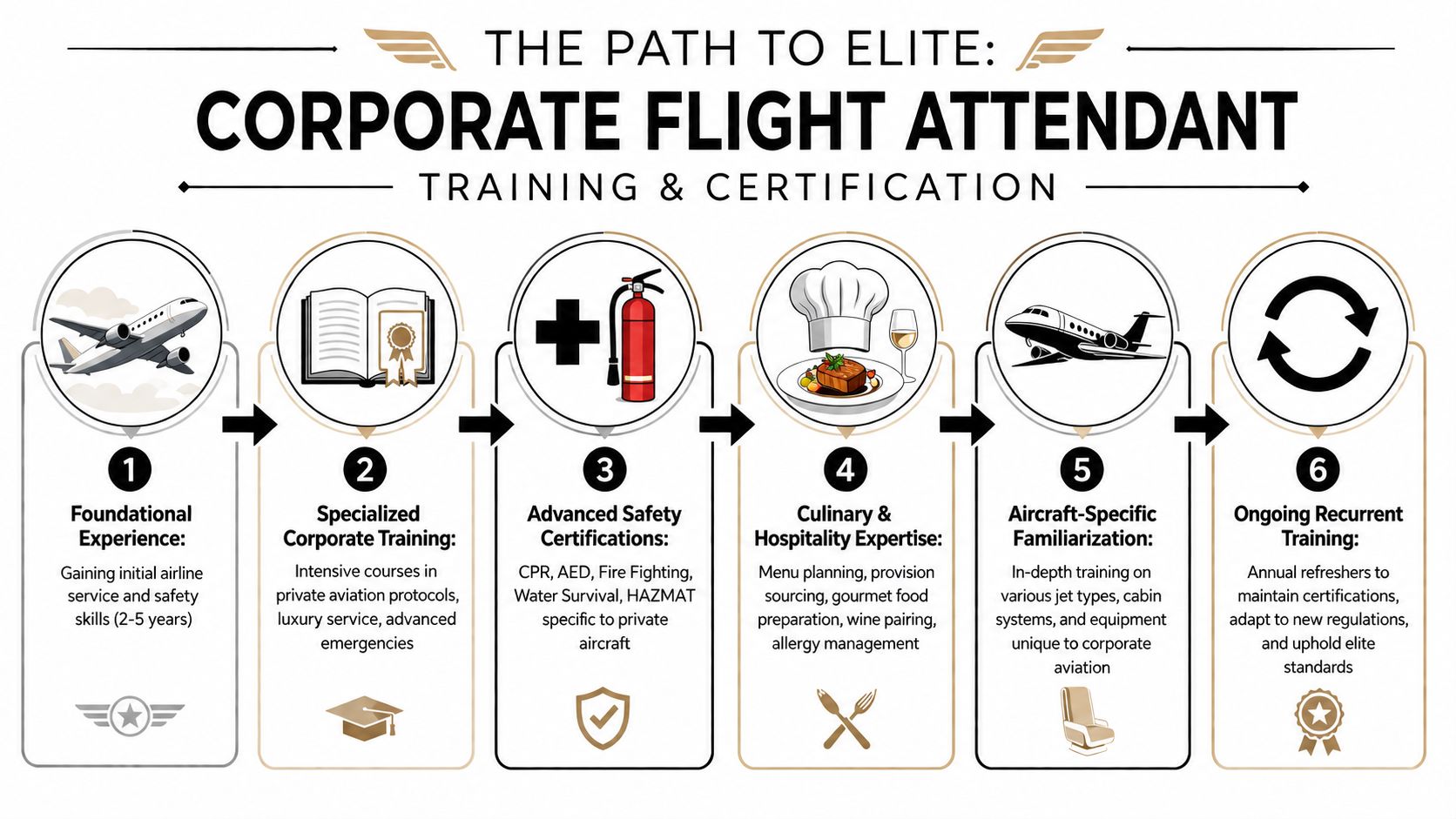
The Path to Elite Cabin Crew Training and Certification
No one serious in private aviation treats this role as improvised hospitality. The training path is structured, expensive, and intentionally demanding because the work is done in a compact environment where there's no room for uncertainty.
A client may only see the final result. A composed greeting, a polished meal, a quiet cabin. Underneath that are formal safety procedures, emergency drills, service standards, and aircraft-specific operating habits.
Experience comes first
VistaJet states that a candidate must possess a minimum of three years of prior corporate cabin crew experience to qualify for a private jet flight attendant role in its discussion of private jet flight attendant jobs. That prerequisite exists for a practical reason. Owner-directed flying is less predictable than scheduled airline work, and operators don't want to spend a flight teaching basics while passengers are onboard.
Experience matters because private flights create unusual combinations of responsibility. A crew member may need to manage service, coordinate a last-minute catering change, assist with pet handling, and maintain cabin safety standards on the same trip.
Formal programs that matter
The industry recognizes two main training paths for corporate flight attendants: FACTS and FlightSafety. According to a detailed discussion on becoming a private flight attendant, these initial courses typically cost $5,000 to $7,000 and run for six days, covering emergency procedures, cabin safety, culinary basics, and aviation security as part of the recognized training route for certification in private aviation (training overview for private flight attendants).
That curriculum tells you what operators value. Not glamour. Preparedness.
What this training changes for the passenger
When a cabin attendant has gone through specialized corporate training, the difference shows up in details clients often assume are simple.
- Emergency readiness: They know where equipment is, how to command a cabin, and how to respond without visible hesitation.
- Galley discipline: Premium service on a jet requires organization, not just presentation. Space is limited and timing is tight.
- Security awareness: Private terminals feel easy. That doesn't remove the need for controlled access and sound judgment.
- Catering execution: Luxury dining onboard is constrained by altitude, reheating limitations, and aircraft equipment. Training helps crew work within those limits without lowering standards.
The person pouring your coffee may also be the only medically trained responder in the cabin.
Why top operators won't compromise
Good operators know that private aviation clients remember the feel of a trip. But behind that memory sits a harder reality. Cabin crew who lack proper training create risk for passengers, pressure for pilots, and inconsistency for owners and charter clients alike.
That's why the strongest crews tend to come from a narrow pool. They've already worked demanding cabins, invested in specialist training, and learned how to operate without the support structure available on large commercial aircraft.
How Your Crew Is Selected Safety Standards and The Haute Jets Difference
A first-time charter client usually starts with the aircraft. The better question is who operates it, and how that operator staffs the cabin when something changes in flight.
In private aviation, a flight attendant reflects the discipline of the whole operation. A well-run operator gives cabin crew clear procedures, proper trip information, and the authority to act quickly if a medical issue, turbulence event, catering miss, or ground delay affects the plan. That support shows up in the passenger experience long before anyone notices service details.
Why third-party safety ratings matter
Terms like Wyvern and ARGUS are not sales language. They are outside benchmarks that help a broker and a client assess whether an operator follows documented standards across pilot qualifications, maintenance oversight, dispatch discipline, and operational control.
That matters in the cabin. Operators with strong ratings usually treat the flight attendant as part of the safety chain, not as an optional hospitality add-on. They are more likely to assign crew who fit the mission, brief them properly, and back them with procedures that hold up under pressure.
For clients, that changes the feel of the trip in a very practical way. You are less likely to board an aircraft where details were handled late, preferences were passed along loosely, or no one owns the transition between catering, ground transport, and cabin readiness.
What a careful broker should verify
A careful charter review goes past aircraft photos and seat counts. It checks whether the operator can produce the same standard trip after trip.
Here is the shortlist I use:
- Recognized safety standing: The operator should hold current third-party credentials and be able to identify them clearly.
- Mission-specific crew selection: A family flight, a senior executive roadshow, and a long-range overnight sector do not call for the same cabin profile.
- Early trip transparency: Tail number, operator identity, and crew details should be available with enough time for proper review.
- Confirmed service logistics: Wi-Fi capability, catering scope, pet handling, ground transfers, and special requests should be verified before the day of departure.
Clients who want to review how those operator checks are handled can see Haute Jets' private jet safety standards and operator screening process.
The link between ratings and peace of mind
Passengers usually notice the result, not the system behind it. The cabin feels calm. Timing is under control. Requests are anticipated. If plans shift, the response feels organized instead of improvised.
That consistency starts with the operator. A skilled flight attendant still needs accurate passenger notes, realistic catering windows, a legal and rested flight crew, and a dispatch team that communicates clearly. If those pieces are weak, the cabin is where the client feels it first.
Clients are not only buying an airplane. They are buying the standards behind the people running it.
Haute Jets states that it sources from owner-operators and works with Wyvern Wingman or ARGUS Gold and Platinum rated operators, with aircraft selection confirmed at the specific make, model, and cabin-layout level rather than as a broad category match. For a client, that means the crew discussion happens inside a vetted operating standard. It is not left to chance after the aircraft is booked.
What clients should pay attention to
A polished sales call can still hide a loose operation. Ask direct questions about the operator, the crew assignment, and how your trip details are being passed through.
| Strong signal | Warning sign |
|---|---|
| Specific operator details are shared | Aircraft is discussed only in broad category terms |
| Crew information is available before departure | Crew questions get vague or delayed answers |
| Safety ratings are named clearly | Safety language stays generic |
| Service requests are documented in advance | Preferences are treated casually |
When those pieces line up, the private jet flight attendant can do the job properly. They keep the cabin orderly, support the pilots, manage timing, and protect passenger confidence if the day does not go exactly to plan.
Maximizing Your In-Flight Experience Passenger Etiquette and Preparation
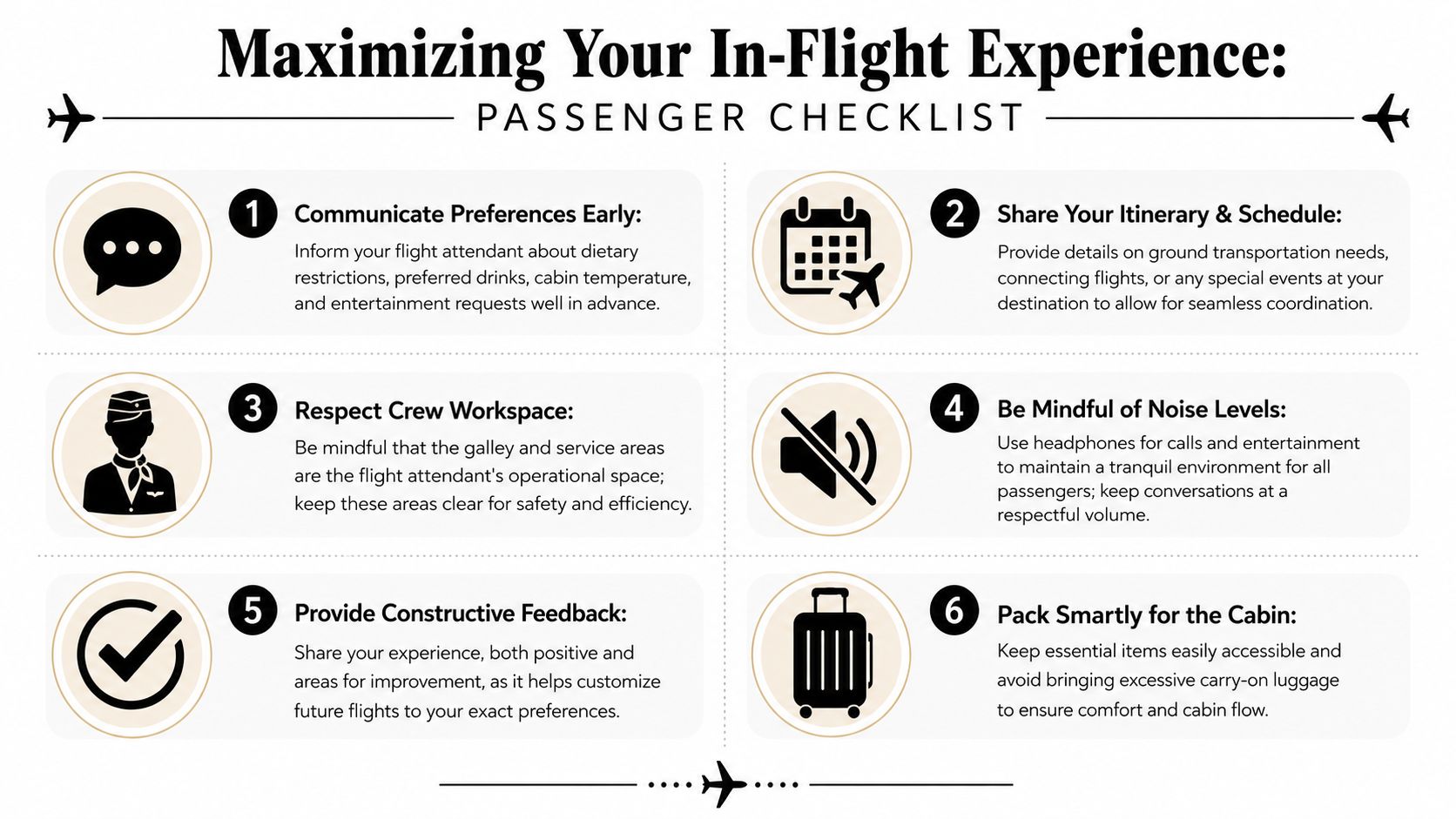
The best private flights are collaborative. You don't need to micromanage the cabin, but you do need to give the crew a useful brief.
Most service misses in private aviation don't come from indifference. They come from late information. If a family's dietary restrictions, a child's sleep schedule, or a pet's handling needs appear at the last moment, even excellent crew have fewer options.
What to share before departure
A short, practical brief helps more than a long wishlist. The goal is to tell the cabin attendant what affects safety, timing, comfort, and logistics.
Start with the essentials:
- Food and drink preferences: Include allergies, strong dislikes, brand preferences, and whether you want a full meal or lighter service.
- Passenger profile: Note children, elderly travelers, nervous flyers, or anyone likely to need a quieter setup.
- Pets: Mention size, temperament, and any handling needs early so the cabin setup works from boarding onward.
- Ground transitions: Car timing, terminal preferences, and destination handoffs are part of the experience, not separate from it.
- Cabin priorities: Some travelers want to work. Others want total quiet. Say which one applies.
If catering is important to your trip, this guide to private jet catering and in-flight dining is worth reading before you finalize requests, because it helps set smart expectations around what works well onboard.
What helps once you're in the air
Private cabins feel informal, but they still run on workflow. The crew needs room to prepare, secure, serve, and reset the cabin safely.
A few habits make the flight better for everyone:
- Be early with changes: If you decide to sleep instead of dine, say so early. Timing matters in a jet galley.
- Keep key items close: Medication, chargers, and comfort items should stay accessible so service doesn't turn into repeated searches.
- Use the crew as a resource: If you need a temperature adjustment, bedding, or a different service pace, ask. Clear requests are easier to execute than hints.
- Respect service areas: The galley and staging space may look small enough to step through casually. During service, they're working zones.
Good crew can personalize almost anything. What they can't do well is react to important information that arrives too late.
What passengers sometimes get wrong
Some clients stay silent because they don't want to appear demanding. Others issue constant micro-requests that break the rhythm of the cabin. Neither approach works especially well.
The better approach is simple. Be specific up front, then let the attendant do the job. If you've hired into a strong operation, they'll know how to pace service, when to check in, and when to disappear.
That balance is what makes the private jet flight attendant valuable. They don't just respond. They shape the environment so the trip feels smooth without requiring your attention.
Booking with Confidence Key Questions for Your Charter Broker
A discerning client doesn't ask only about cabin finishes and flight time. They ask how the trip will be operated.
The quality of the private jet flight attendant often reveals the quality of the charter process behind the scenes. If a broker can answer crew questions clearly, that usually means the trip is being handled with discipline. If the answers are vague, expect gaps elsewhere too.
Questions worth asking before you book
Use questions that force operational clarity.
- Who is operating the aircraft? You want the legal operator identified clearly, not hidden behind a sales layer.
- What third-party safety rating does that operator hold? This helps you understand whether standards are independently assessed.
- Will this trip have a cabin attendant? Don't assume one is included on every aircraft or route.
- What is that attendant's background? Ask whether the person regularly works corporate cabins and similar mission profiles.
- When will I receive crew and aircraft details? Serious operators provide this with enough lead time to review.
- How are catering, pets, and ground requests documented? Verbal assumptions create avoidable mistakes.
- Is the cabin attendant a regular crew member or an ad hoc contractor? Either can work, but the answer tells you something about continuity and operator control.
How to interpret the answers
Short answers aren't the problem. Soft answers are.
If the broker explains the operator standard, confirms whether a flight attendant is assigned, and can tell you how service requests are transmitted, you're hearing from someone who understands execution. If the answer leans on vague reassurance, broad luxury language, or “we'll sort that later,” keep digging.
The right charter partner doesn't just promise a smooth flight. They can explain how the crew, aircraft, and operator make that smooth flight possible.
Private aviation should feel calm because the planning is rigorous, not because everyone is pretending complexity doesn't exist. The more clearly a broker can discuss crew qualifications, operator standards, and passenger preparation, the more confidence you should have in the trip.
If you want a charter process that identifies the exact aircraft, confirms operator standards, and gives you a clear view of the crew and service details before departure, Haute Jets is a practical place to start.