

A one-way Miami to Orlando private flight typically runs $5,000–$7,500 for a light jet and $12,500–$16,500+ for a midsize, with airborne time of roughly 35–60 minutes. The price is driven more by minimum billing and aircraft positioning than by the route's approximately 168 nautical miles.
You're a Brickell executive with a 10 a.m. Orlando board meeting, a return flight to Miami, and a 5 p.m. investor dinner back in town. Driving means surrendering most of the day. Flying privately solves the schedule problem, but it doesn't turn a short sector into a cheap one. The aircraft may be airborne for less than an hour, while the operator still has to account for crew, handling, positioning, and minimum billable time.
That's the central issue on this route. Miami to Orlando is a minimum-charge problem disguised as a short hop. The right aircraft can protect your schedule and keep the invoice rational. The wrong one can add a large cabin you won't use.
Haute Jets Journal is an active editorial destination for charter guides and aviation news, and its Orlando-focused coverage is published within the same journal ecosystem. The Haute Jets Journal was last updated on 2026-08-20, while its Orlando charter page was last updated on 2026-07-02.
Why This Miami to Orlando Route Is Different
A Miami to Orlando private jet trip covers a compact intrastate distance, roughly 167–204 miles, depending on the airports used. Route guides commonly place nonstop block time around 39–43 minutes, while aircraft and airport pairings can produce estimates from about 31 to 53 minutes. By comparison, the road trip is cited at about 231 miles and 4 hours 37 minutes. (EvoJets route overview)
That sounds like an easy pricing win for a turboprop or very light jet. Sometimes it is. But charter quotes reflect more than time in the air. Operators may apply minimum billable periods, then add repositioning when the selected aircraft isn't already near Miami. Handling, crew scheduling, and the return plan can matter more than cruise speed.
The same-day executive test
For the Brickell executive with meetings in Orlando and dinner back in Miami, a light jet is usually the commercial center of gravity. It offers a fast cabin, weather avoidance, and enough room for work materials without forcing the client into a super-midsize bill.
A turboprop can be sensible for two or three passengers who care primarily about the lowest all-in price. A midsize or super-midsize only earns its premium when the passenger count, baggage, working environment, or onward itinerary justifies it.
Advisor's rule: Don't ask how short the flight is. Ask how much aircraft time the operator must reserve to deliver the mission.
Peak spring demand, event-related traffic, and hurricane-season reroutes can also reduce the availability of conveniently positioned aircraft. That pressure doesn't change the distance, but it can make the empty positioning leg more expensive. The practical response is to request a locally based aircraft first, rather than accepting the first attractive cabin category.

Route Basics and Airport Options
Airport choice determines the ground-time bill, not just the departure point. Miami offers Miami Executive Airport, Opa-Locka Executive, and Miami International. Orlando offers Orlando Executive, Orlando International, and Sanford, with each field serving a different destination and operating profile. (EvoJets airport and route details)
Orlando Executive Airport opened in 1928 and sits about 3 miles from Orlando, making it the practical choice for downtown meetings and central business travel. It also gives travelers an alternative to Orlando International's commercial traffic. Opa-Locka Executive is about 11 miles north of downtown Miami, with no commercial traffic, while Miami Executive is about 13 miles southwest of downtown Miami. (Air Charter Service's Florida airport guide)
Choose the field around the ground itinerary
For downtown Orlando, ORL is usually the cleanest choice. Theme-park travel points toward Orlando International, about 20 miles from Walt Disney World and 16 miles from Universal Studios. Sanford is farther out, about 33 miles from Walt Disney World and 36 miles from Universal Studios, so use it when aircraft availability or a northern Orlando destination outweighs the extra drive.
On the Miami side, OPF deserves the first quote for many private departures. TMB can shorten the ground transfer for passengers south of the city. MIA makes sense when a traveler is already at the commercial airport, needs a particular FBO, or is connecting through the airport corridor. For origin-terminal comparisons, Haute Jets lists a Miami International private terminal option.
| Airport Pair | Drive to Miami CBD / Disney | Typical FBO | Best For |
|---|---|---|---|
| OPF to ORL | About 11 miles to Miami CBD / central Orlando access | Private executive FBO | Business meetings and downtown Orlando |
| TMB to MCO | About 13 miles to Miami CBD / about 20 miles to Walt Disney World | Executive-airport handling | South Miami departures and theme-park stays |
| MIA to MCO | Central Miami airport / about 20 miles to Walt Disney World | Private terminal at a commercial airport | Commercial connections and airport-corridor hotels |
| OPF to SFB | About 11 miles to Miami CBD / about 33 miles to Walt Disney World | Executive-airport handling | North Orlando, Sanford, and aircraft availability |
The right pair follows the pickup point, final destination, aircraft position, and expected ground transfer. For a same-day executive run, choose the airport that reduces the full itinerary, even if its flight segment is not the shortest.
Turboprop vs Light Jet vs Super Midsize
Three aircraft classes cover nearly every sensible Miami to Orlando charter request. The decision is less about whether an aircraft can fly the route, because all three can, and more about what you're buying beyond transportation.
A turboprop such as a King Air 350i or Pilatus PC-12 is the cost-focused option. It can suit two or three passengers with modest baggage, especially when the operator has a local aircraft ready. The cabin is comfortable, but the propeller configuration and lower cruise speed make it a different experience from a jet. Haute Jets' turboprop fleet options are relevant when the mission favors efficiency over jet performance.
A light jet, including the Citation CJ3+, Phenom 300, or Learjet 75, is the default recommendation for most executives. The cabin supports a professional environment, the aircraft climbs above much of the weather, and the pricing aligns with the route's established light-jet market band.
Head-to-head aircraft comparison
| Aircraft Class | Typical Models | Seats / Cabin | Cruise Speed | One-Way Price (2026) |
|---|---|---|---|---|
| Turboprop | King Air 350i, Pilatus PC-12 | About 6–8 passengers, club seating | About 280–310 kt | About $2,800–$4,500 |
| Light Jet | Citation CJ3+, Phenom 300, Learjet 75 | About 6–7 passengers, stand-up cabin | About 400–450 kt | About $5,000–$7,500 |
| Super Midsize | Citation Sovereign+, Challenger 350 | About 8–9 passengers, full stand-up cabin | About 460–490 kt | About $12,500–$16,500+ |
The light jet wins for the classic same-day meeting. It gives two executives enough separation to work, handles ordinary business baggage, and avoids paying for a cabin that the route doesn't require.
A super-midsize is justified when you need eight or more seats, substantial equipment, a working cabin, or a second leg after Orlando. It isn't a better choice because it's larger. On this sector, the extra capability is valuable only when the itinerary uses it.
What a Miami to Orlando Private Flight Really Costs
The published hourly rate is only the starting point. A Miami to Orlando quote can contain four distinct cost layers: the aircraft rate, minimum billable time, repositioning, and airport handling.
The first layer is the aircraft itself. A Pilatus PC-12 may appear attractive at roughly $2,800–$3,800 per leg, while a Citation XLS+ may show a higher rate of about $5,500–$7,000. Yet the PC-12 can remain the better purchase when the aircraft is already local and the jet requires a ferry leg. The hourly number alone doesn't answer the question.
How the invoice builds
Minimums often determine the economics. Route guidance describes 1.5–2 hour daily minimums for turboprops and 2–2.5 hour minimums for light and midsize jets, meaning the short air leg represents only part of the billable reservation. (Miami Private Jet Rental's Orlando pricing guide)
Repositioning is the next variable. If the aircraft must travel empty to Miami, then return empty after dropping passengers in Orlando, those legs can overwhelm the apparent short-hop rate. A locally based tail can therefore beat a nominally cheaper aircraft that starts elsewhere.
| Aircraft Class | Hourly Rate (USD) | Daily Minimum | Repositioning Surcharge | Estimated One-Way Total | FBO Fees (each end) |
|---|---|---|---|---|---|
| Turboprop | About $2,800–$4,500 | About 1.5–2 hours | Depends on aircraft location | About $5,000–$7,500 market planning range | Quoted separately |
| Light Jet | About $5,000–$7,500 | About 2–2.5 hours | Depends on aircraft location | About $5,000–$7,500 market band | Quoted separately |
| Midsize / super-midsize | About $9,500–$16,500+ | About 2–2.5 hours | Depends on aircraft location | About $12,500–$16,500+ | Quoted separately |
For broader pricing context, review Haute Jets' guide to private jet charter cost. Ask the broker to separate aircraft time, positioning, handling, crew expenses, taxes, and any overnight requirement. Crew duty limits can create an overnight charge if a same-day plan stretches beyond the crew's legal schedule.
South Florida FBO handling, fuel, ramp, and related charges should still appear as line items, even though de-icing is rarely material in Florida. Federal excise tax also needs to be clarified in the quote rather than assumed. The reliable comparison is the all-in total for the exact itinerary, not the advertised hourly rate.
Booking a Same Day Charter Step by Step
A noon wheels-up request made at 7:00 a.m. is possible only when the broker moves quickly and the aircraft is available. The booking process should be operational, not conversational.
Start with the mission details
Send two or three Florida-based operators the same information: passenger count, baggage, pets if applicable, departure airport preference, Orlando destination, return requirement, and cabin needs. A vague request produces a vague comparison. An exact airport pair lets the operator test local aircraft first.
Confirm whether the proposed tail is already at OPF, FXE, or TMB, or whether it must reposition. This single question often matters more than a small difference in hourly rate. If you're choosing personal-care items for the cabin, review practical guidance such as cologne on a plane rules before departure.
Vet the operator, then lock the details
Ask for the operator's current safety credentials, insurance confirmation, and pilot information. ARG/US and Wyvern are useful screening references, but the broker should also explain who operates the aircraft, who holds operational control, and whether the quoted crew can legally complete the full itinerary.
Once selected, sign the contract and submit the passenger manifest. Coordinate the FBO, ground transportation, catering, and return handling at the same time, rather than treating them as afterthoughts.
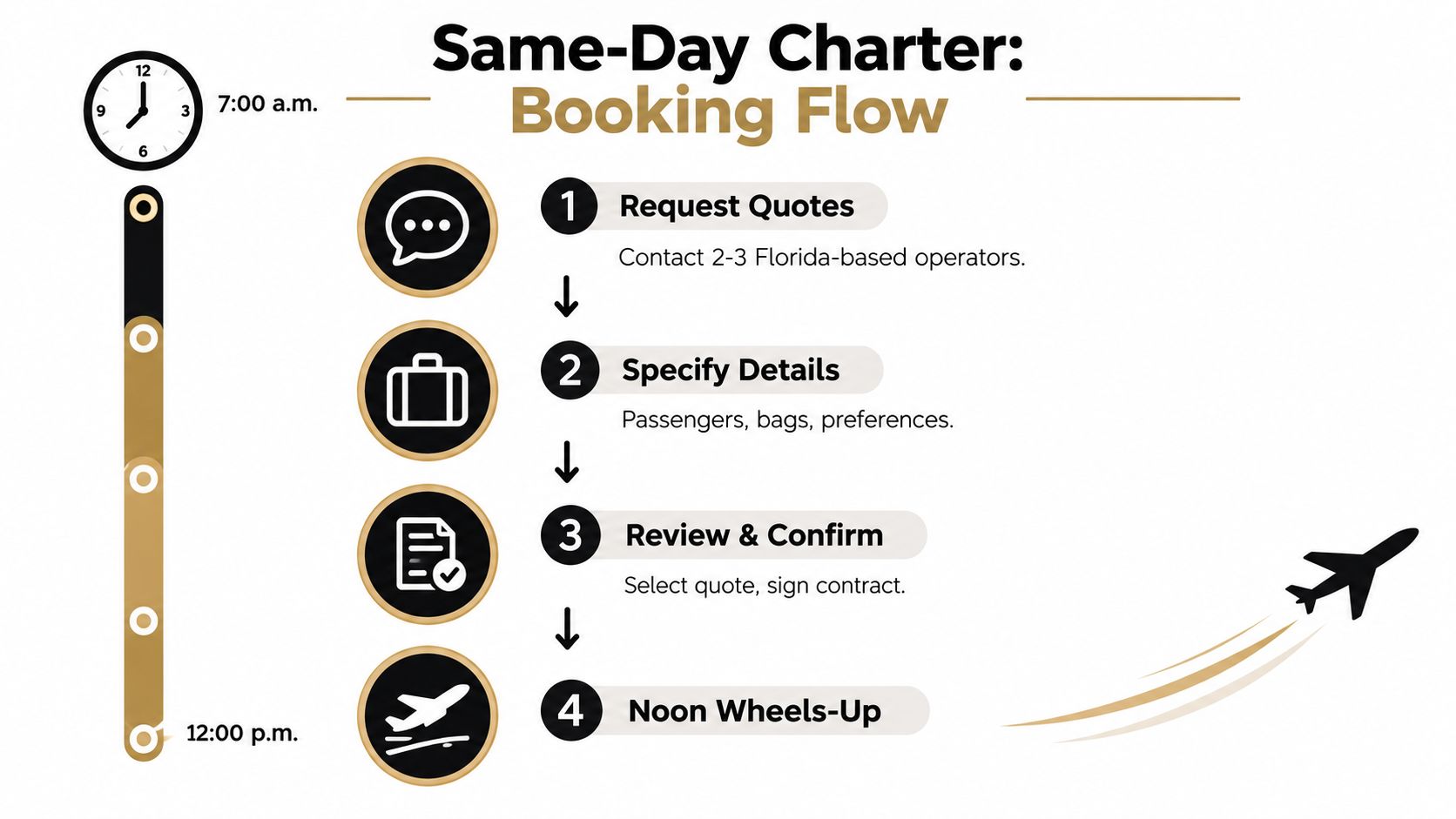
A disciplined confirmation sequence protects the schedule:
- At booking: Confirm aircraft category, exact model, airport pair, price inclusions, and cancellation terms.
- Before departure: Reconfirm the tail number, crew, weather, passenger manifest, and ground transportation.
- At the FBO: Ask the handler to confirm aircraft arrival, catering, baggage loading, and return arrangements.
- If the tail drops: Require the replacement aircraft to meet the same cabin, baggage, safety, and timing requirements before accepting it.
For OPF departures, give the handler the exact arrival and vehicle plan. On the Orlando side, coordinate the selected handler at ORL or MCO and ensure the driver knows whether the passenger is headed downtown, Lake Nona, or the theme-park corridor. The airport choice is part of the charter, not a detail to solve after landing.
Which Aircraft Fits Which Mission
The correct aircraft changes with the mission, even on the same airport pair. A family, a boardroom, and a production crew aren't buying the same form of transportation.
Family and theme-park travel
A family of five to seven with substantial luggage needs volume more than speed. A King Air 350 can be practical when baggage flexibility and total price matter, while a Phenom 300 brings jet speed and a more conventional business-jet cabin.
Recommendation: Choose a King Air 350 when the luggage is bulky and the aircraft is locally positioned. Choose a Phenom 300 when the group values a jet cabin and carries a manageable load.
Two executives and one meeting
Two executives with one briefcase each don't need a super-midsize cabin. A Citation CJ3+ or Phenom 100 can handle the meeting run efficiently, assuming the aircraft and crew are positioned for the return.
Recommendation: Book a light jet for the same-day round trip. The aircraft class matches the passenger count, work requirement, and schedule without paying for unused cabin volume.
Sports or production equipment
A team or production unit moving about 1,200 pounds of equipment needs a different calculation. External baggage access, floor loading, and cabin flexibility can matter more than the number of seats. A Challenger 350 or Praetor 500 gives the operator more practical room to manage gear.
Recommendation: Use a super-midsize when the equipment physically demands it. Don't force production cargo into a smaller cabin just to protect the headline price.
Multi-stop Florida loop
A Miami to Orlando trip that continues to Sarasota-Bradenton and Naples Municipal, or another Florida airport, should be evaluated as a network rather than a single leg. A light jet with useful range and efficient turnaround characteristics is usually the rational middle ground.
Recommendation: Choose a light jet when the day includes multiple stops and the group remains small. The aircraft should support the sequence without turning every short sector into a large-cabin purchase.
The useful ratio is passengers and baggage against the total mission cost. Seat count alone can mislead, especially when one passenger's equipment consumes more space than several passengers with briefcases.
Right Sizing the Jet for a Short Florida Hop
On a route of roughly 168 nautical miles, the biggest jet is rarely the smartest jet. A super-midsize aircraft can deliver a full stand-up cabin, enclosed lavatory, larger baggage capacity, and a more substantial working environment, but a 35–60 minute block leaves little time to use those benefits. (Amalfi Jets route guide)
The light jet usually provides the better balance. It's faster than a turboprop, more comfortable for business travel, and generally better aligned with the route's common one-way pricing. A turboprop wins when the passenger group is small, the baggage is reasonable, the aircraft is local, and cost discipline matters most.
The decision matrix
| Mission Variable | Turboprop | Light Jet | Super Midsize |
|---|---|---|---|
| Two executives | Cost-efficient if schedule allows | Best default | Excess capacity |
| Five to seven passengers | Works with manageable baggage | Strong fit | Consider only for space needs |
| Bulky luggage | Useful cabin flexibility | Check baggage volume carefully | Strongest option |
| Eight or more passengers | May be restrictive | May be restrictive | Best fit |
| Working cabin | Functional, slower cruise | Practical for short meetings | Valuable for longer or complex missions |
| Multi-stop itinerary | Efficient for regional hops | Best balance | Select when gear or group size demands it |
| Lowest all-in cost | Often strongest if local | Usually the practical sweet spot | Rarely wins on price alone |
Airport access reinforces the case for right-sizing. The Miami and Orlando markets offer several private-aviation fields, including OPF, TMB, ORL, MCO, and SFB, so the operator can match the aircraft and ground destination rather than defaulting to a large jet. (Mercury Jets Miami to Orlando guide)
A Citation Latitude illustrates the point. Textron publishes 2,700 nautical miles of range, a maximum cruise of 446 knots true airspeed, and a long-range cruise speed around 368 knots. On a sector of roughly 168 nautical miles, that performance is far beyond what the route requires, so the buyer is paying for cabin, luggage, dispatch resilience, and comfort, not endurance. (Citation Latitude brochure)
Defaulting to a midsize aircraft on every Florida short hop is a habit, not a strategy. Size the aircraft around passengers, baggage, weather flexibility, ground access, and the value of the schedule. If the mission doesn't use the extra cabin, the premium is difficult to defend.
Haute Jets arranges on-demand charter quotes across Miami and Orlando airport options, sourcing from a network of 3,500+ aircraft across 175 countries and offering access without memberships or jet cards. Visit Haute Jets with your passenger count, baggage requirements, airport preferences, and same-day schedule, and ask for a locally positioned aircraft with an itemized all-in quote.