

A private jet from Miami to Turks and Caicos is a quick 90-minute flight, with one-way charter costs typically ranging from $15,000 to over $35,000. That wide spread usually comes down to one thing most first-time flyers miss: the aircraft you choose is only half the story, and where that aircraft is sourced matters just as much.
If you're looking at this route right now, you're probably doing what most smart clients do the first time. You're comparing quotes, seeing numbers that don't line up, and wondering why one operator prices a simple South Florida to Provo hop like a short island transfer while another prices it like a mini transcontinental mission.
The answer is operational, not cosmetic.
A private jet Miami to Turks and Caicos trip is short, convenient, and straightforward when it's set up correctly. It becomes expensive and annoying when the aircraft isn't local, the customs process isn't planned properly, or the quote looks clean but hides repositioning cost. That's where people overpay.
This guide is written the way I advise a first-time client. Choose the right aircraft for the mission. Prioritize audited operators. Clear customs at the right airport without surprises. And above all, don't pay for someone else's empty leg just because a broker couldn't source a jet in South Florida.
Your Direct Route to Paradise
You can leave Miami after breakfast and be on the ground in Turks and Caicos before lunch. That's why this route keeps attracting travelers who want the control of private aviation without the drag of a long travel day.
For a weekend villa stay, a family escape, or a quick executive trip with some sun built in, this corridor works unusually well. The flight is short enough that you don't need a large cabin to be comfortable, but popular enough that bad sourcing can still make the quote swing more than it should.

Why this route is getting so much attention
Turks and Caicos has seen a 41.1% increase in private aviation arrivals year-to-date compared to 2019, which is why the Miami corridor now stands out as one of the Caribbean's fastest-growing private aviation lanes, according to Private Jet Card Comparisons' Caribbean arrivals analysis.
That growth tells you something important. This isn't a fringe route with patchy lift and awkward airport support. It's an established premium leisure market with steady private traffic, which usually means better aircraft availability, better handling familiarity, and more routing flexibility from South Florida.
If you're specifically comparing airports, fleet options, or current charter patterns on this corridor, Haute Jets' South Florida to Turks and Caicos route page is a useful route-specific reference.
What matters before you book
Most clients focus first on cabin photos and hourly rates. That's understandable, but it isn't how you get value on this trip.
Focus on these three things instead:
- Aircraft fit: A short Caribbean leg doesn't need unnecessary range.
- Operator quality: Safety audit status matters more than glossy branding.
- Sourcing logic: A local South Florida aircraft usually beats a cheaper-looking quote from farther away.
The smartest booking on this route usually isn't the flashiest jet. It's the aircraft that matches the mission cleanly, departs locally, and clears arrival formalities without friction.
Flight Time and Key Airports
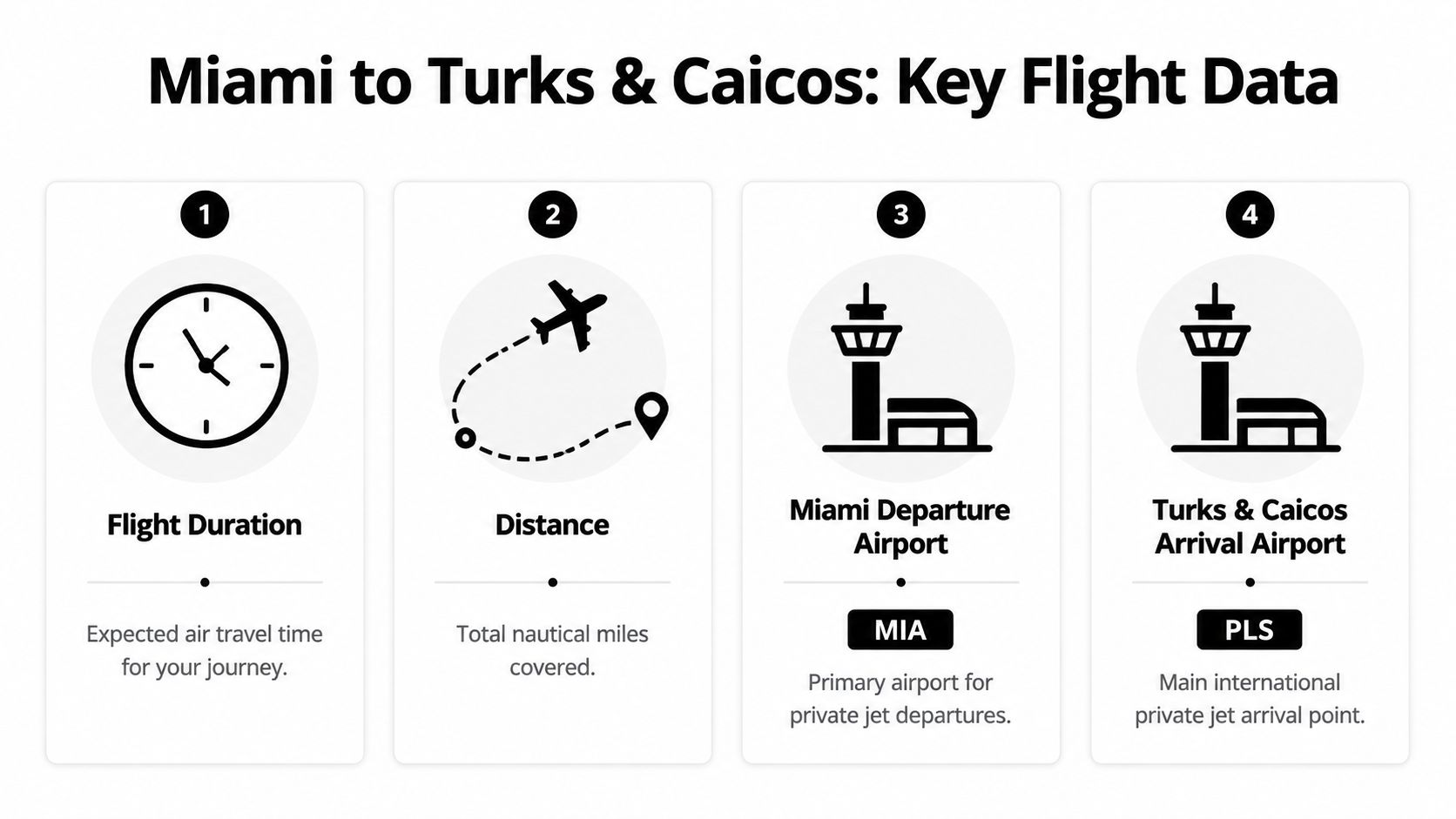
You can leave Miami after breakfast and be in Providenciales in time for a late lunch. That is why this route works so well for private aviation. The flying itself is straightforward. The main difference in cost and convenience comes from where the aircraft starts the day and which airport you use on the Florida side.
The sector is typically about 1 hour 30 minutes to 1 hour 50 minutes in the air, with route distance commonly cited in the 502 to 580 nautical mile range on route-specific charter references such as The Jet Collection's Miami to Turks and Caicos page. For a first-time charter client, that means you should judge the trip by total door-to-door efficiency, not just airborne time. A quote on a perfectly suitable jet can still be poor value if the aircraft has to reposition from another city before it ever picks you up.
Departure points in South Florida
Use the airport that cuts ground friction and matches the aircraft already available nearby.
Common South Florida departure choices include:
- Miami-Opa Locka Executive Airport: Usually the strongest option for private flyers. It is built around business aviation, ground handling is familiar with charter traffic, and it often gives you the cleanest curb-to-cabin process.
- Miami Executive Airport: A smart choice if you live or stay south of central Miami and want to avoid unnecessary ground transfer time.
- Fort Lauderdale area departures: Often worth checking if the best-positioned aircraft is already based there. In these instances, a modern sourcing approach can save real money, because a locally available jet can remove or reduce repositioning cost that many clients miss on the first round of quotes.
Miami International can handle private traffic, but it is rarely my first recommendation for this route unless your schedule or aircraft requirement points there for a specific operational reason.
Arrival airport that matters most
For most itineraries, Providenciales International Airport (PLS) is the arrival airport that matters. Air Journey's airport guide for Providenciales notes that PLS operates around the clock and serves private aircraft with a runway length suited to everything from light jets to larger cabin classes.
That gives you flexibility, but flexibility should not be confused with a reason to overspend. The airport can accept a wide range of aircraft. Your job is to choose one that fits the mission cleanly, keeps baggage practical, and does not import avoidable repositioning cost into a short Caribbean leg.
If you want a broader sense of which aircraft categories are well suited to island flying, this guide to private jets for Caribbean routes is a useful reference.
Smart airport selection on this route is simple. Depart from the South Florida field closest to you or closest to the aircraft, then fly into PLS with the smallest operationally sensible jet.
Choosing the Right Jet for Your Trip
This route doesn't reward overspending on unnecessary airplane. It rewards matching the aircraft to the mission.
The cleanest operational fit is usually a light jet or midsize jet. The route of 502 to 575 nautical miles is especially well suited to aircraft like the Cessna Citation XLS or Lear 45XR, whose cruise and fuel burn profile make them efficient for this exact mission, according to The Jet Collection's analysis of the Miami to Turks and Caicos corridor.
What each category feels like
A light jet is the right answer when you're flying as a couple, with a small family, or with a compact luggage profile. It's efficient, fast enough for a short island sector, and usually the most rational choice if you're not trying to turn the aircraft into a flying lounge.
A midsize jet is often the sweet spot. You get better cabin comfort, more room to work or relax, and better baggage flexibility without paying for capability you won't use on such a short leg.
A super-midsize jet makes sense if you care more about cabin presence, stand-up comfort, or carrying more people and bags with margin. It can be the right call, but many clients book this category when a midsize would have delivered the same practical outcome for less.
For broader context on island-suited aircraft types, this Caribbean private jet guide from Haute Jets Journal is worth reading.
Aircraft Comparison for Miami to Turks and Caicos
| Aircraft Category | Example Models | Passengers | Baggage Capacity | Best For |
|---|---|---|---|---|
| Light Jet | Citation CJ3, Lear 45XR | Small group | Limited to moderate | Couples, short leisure trips, lighter packing |
| Midsize Jet | Citation XLS, Hawker 800 | Moderate group | Better luggage flexibility | Families, executives, balanced comfort and value |
| Super-Midsize Jet | Challenger 300, Citation Latitude | Larger group | Strong baggage capability | Travelers who want more cabin room and premium comfort |
My recommendation by traveler type
- Weekend couple's trip: Book a light jet if your bags are under control and you want efficient pricing.
- Family with luggage: Move to midsize early. Don't try to force a light jet and then negotiate around baggage reality.
- Executive team or image-sensitive leisure group: A super-midsize can be justified if cabin comfort matters as much as transportation.
Practical rule: On this route, buy the cabin you will actually use, not the range you don't need.
The biggest mistake I see is clients shopping by category label alone. "Super-midsize" sounds better than "midsize," but that doesn't mean it creates better value on a short Caribbean mission. The right aircraft is the one that boards easily in South Florida, carries your actual baggage load, and doesn't saddle you with avoidable operating cost.
Decoding the Cost of Your Charter Flight
You request a Miami departure for Friday afternoon. One quote looks reasonable. Another, for what appears to be the same trip, is thousands higher. The difference usually has little to do with the cabin and everything to do with where the aircraft starts its day.
For this route, price is built from two cost buckets. The first is your actual mission: flight time, crew, airport handling, and standard trip expenses. The second is aircraft positioning. If the jet has to come in empty to pick you up, you pay for that movement whether it is labeled clearly or buried inside the quote.
Why the same trip gets quoted so differently
This is the part first-time charter clients miss.
A Miami to Turks and Caicos itinerary is short enough that repositioning can change the economics fast. If an aircraft is already in South Florida, the quote can be tight and logical. If the aircraft is sitting in another city, the operator may need to add an empty leg before your departure, and sometimes another one after drop-off. That is how two quotes for a similar aircraft class end up far apart.
The smart question is not, "Why is this one cheaper?" The smart question is, "Where is this airplane coming from, and is that cost already baked in?"
What a credible quote should show
Do not accept a category and a total number alone. Ask for the operating facts behind the price.
A quote is worth taking seriously when it makes these points clear:
- Exact aircraft assignment: You need the actual aircraft, not a vague promise of a light or midsize jet.
- Current aircraft location: A nearby aircraft usually means a cleaner cost structure.
- Repositioning treatment: The quote should show whether ferry time is included, excluded, or avoided because the aircraft is already local.
- Basic trip assumptions: Passenger count, baggage load, and expected ground time should match your real itinerary.
If any of that is fuzzy, the quote is not finished.
This short video gives a useful visual primer on how charter pricing works in practice:
My view on "cheap" quotes
Cheap quotes usually fail in one of two ways. They hide positioning cost until later, or they rely on an aircraft that was never a clean fit for your departure point in the first place.
For this corridor, I recommend judging value by total mission logic. Confirm the tail. Confirm where it is. Confirm what empty flying, if any, you are paying for. That is the true cost of a private jet Miami to Turks and Caicos charter.
Clients who do this well rarely overpay. Clients who shop only by headline number usually do.
Why Sourcing Your Jet Matters Most
If you remember one thing from this guide, make it this: sourcing is the key lever.
Most booking mistakes on this route start long before wheels up. They start when a client accepts a category-based quote from a seller who hasn't matched the mission with a nearby aircraft and a properly audited operator.
Safety isn't negotiable
For this corridor, safety and reliability hinge on Wyvern Wingman or Argus Gold-rated operators, which correlate to a 70% lower incident rate, according to Mercury Jets' Turks and Caicos charter safety notes.
That should narrow your field immediately. If an operator isn't clearly within that audited tier, move on. Private aviation gives you flexibility. It should not ask you to trade away standards for convenience.
What a modern sourcing model fixes
A strong sourcing model does three things at once:
- Cuts wasted cost: It looks for aircraft already positioned near South Florida instead of dragging in lift from elsewhere.
- Improves transparency: You know the actual aircraft, not just a category promise.
- Reduces day-of-travel surprises: You get manifest, operational, and crew details in advance.
Haute Jets is one example of this approach. It sources aircraft from owner-operators, limits options to Wyvern or Argus-audited operators, and provides 24-hour pre-flight manifests, which matters on a route where the same source notes a 15% weather diversion rate in the region.
The luxury isn't just the leather seat. It's knowing exactly what aircraft is coming, who is operating it, and what the day looks like before you leave for the airport.
My recommendation
Don't shop this route the way you'd shop a hotel room. Shop it like an air operation.
Ask for the tail-specific aircraft assignment. Ask where the aircraft is based. Ask whether the operator holds the relevant audit status. If those answers come slowly or vaguely, you're not looking at a polished operation. You're looking at a sales layer.
Streamlining Your Arrival in Turks and Caicos
Arrival is where first-time flyers either feel smart or feel ambushed by process. The main issue is customs.
A common mistake is assuming you can fly directly into a smaller island airfield and handle formalities there. For private flights into Turks and Caicos, even if your final destination is a smaller island, you must first clear customs and immigration at Providenciales International Airport (PLS), according to SouthJets' Miami to Turks and Caicos route guidance.

What that means in practice
If you're staying on Providenciales, this is straightforward. If you're headed onward to a smaller island, your itinerary needs to be built around that first stop.
That requires coordination with handlers before departure. If it isn't arranged cleanly, the trip slows down right when you expected private aviation to feel easiest.
Use this arrival checklist:
- Confirm first-stop clearance at PLS: Don't assume a smaller island arrival changes the rule.
- Send documents early: Passenger details need to be complete and accurate before departure.
- Coordinate onward movement: If you're continuing after customs, have that handoff locked in.
For a broader overview of international private jet arrival procedures, this customs and immigration guide from Haute Jets Journal is a practical primer.
Where clients lose time
They don't usually lose time in the air. They lose it on the ground because no one explained the sequence.
If your operator or broker hasn't walked you through the customs stop at PLS before departure, they're leaving a critical part of the trip to chance.
A smooth private jet Miami to Turks and Caicos experience should feel organized from curbside in South Florida through arrival formalities in Provo. That's not luck. That's planning.
Your Questions About Flying to Turks and Caicos Answered
Can I bring pets on this route
Often, yes, but don't treat pet travel like a last-minute add-on. Pet acceptance depends on the aircraft, the operator, and the destination documentation process. Ask for pet policy confirmation before you approve the aircraft, not afterward.
How much baggage can I bring
That depends more on aircraft type and cabin layout than one might initially assume. A light jet can work well for a couple or a small party with controlled luggage, but families or travelers carrying larger resort wardrobes should usually step up to midsize or beyond. Trying to "make it fit" after the aircraft is selected is where baggage problems start.
Should I book an empty leg
Sometimes, but only if your schedule is flexible and you don't care about exact aircraft choice. Empty legs can offer value when the routing lines up with your plans. If timing, cabin specification, or trip certainty matters, a dedicated charter is the better tool.
Is a larger jet always more comfortable
Not automatically. On this route, comfort comes from fit. A properly selected midsize aircraft can feel far more sensible than a larger jet that costs more, carries unnecessary capability, and complicates sourcing.
What's the smartest first-time booking move
Request a tail-specific quote from an audited operator and ask whether the aircraft is local to South Florida. Those two questions eliminate a surprising amount of bad pricing and weak execution.
Book the operation, not just the seat.
How early should I start
For a popular leisure route like this, earlier is usually better if you want a specific aircraft model or a tight weekend departure window. If your dates are fixed, don't wait for the market to magically improve. Good local lift gets taken.
If you're planning a private jet Miami to Turks and Caicos trip and want a clean, tail-specific quote without paying for unnecessary repositioning, Haute Jets is one place to compare audited aircraft options with exact aircraft details, local sourcing, and on-demand charter structure.