
You ask for a quote from Teterboro to Miami. The price looks straightforward. Then the actual bill shows up. Repositioning fees, crew costs, airport charges, and an aircraft that was never based near you in the first place. That is the mistake many first-time charter clients make. They assume "on-demand" means transparent.
It does not, unless the provider shows you exactly what you are buying.
Private jet on demand should be simple. You choose the trip, the departure time, and the aircraft that fits the mission. You pay for that trip only. No long-term commitment. No prepaid hours. No pressure to use a membership you already funded.
The value is not just flexibility. It is economic clarity. A true on-demand model sources aircraft locally whenever possible and lets you approve the exact aircraft, not a vague cabin category. That matters because hidden charter costs usually start in two places: the airplane is coming from somewhere else, and the aircraft being sold is not the aircraft you thought you booked.
This is the difference between traditional brokerage and a transparent model such as Haute Jets. Instead of pushing inventory, the job is to match the mission to a local aircraft with a clear operating cost profile. You see where the jet is based. You see what you are paying for. You avoid paying extra because someone solved the trip backward.
If you want real value in private aviation, focus on two questions first. Where is the aircraft coming from? Which exact aircraft am I booking? If a provider cannot answer both clearly, keep looking.
The Freedom of Flying On Your Terms
You need to leave Teterboro tomorrow morning, return the same night, and bring four passengers, golf bags, and a dog. The wrong charter model turns that into a sales process. The right one turns it into a flight plan with a clear aircraft, a clear price, and no wasted spend.
That is what clients are buying. Control, yes. But just as important, they are buying transparency. A true on-demand charter model lets you choose the exact aircraft for the trip, confirm where it is based, and pay for the mission in front of you instead of subsidizing a program structure that may not fit how you travel.
If you are still sorting out the basics, start with this plain-English guide to what a chartered jet is. Then focus on how the booking model affects cost and flexibility.
What travelers are really paying for
New charter clients rarely need “access” in the abstract. They need a practical answer to a specific trip. Which aircraft can do it comfortably? Is it close enough to avoid expensive repositioning? Does the cabin fit the passengers, baggage, pets, and schedule?
That is why on-demand charter remains the most rational choice for many flyers:
- You pay for the trip, not a program: No annual buy-in, no prepaid block of hours, no pressure to burn unused value.
- You choose based on the mission: A short regional flight, a family ski trip, and a transcontinental business run should not be forced into the same pricing structure.
- You approve the exact aircraft: That reduces the common disconnect between what was quoted, what was expected, and what appears.
Here is the practical test. If your schedule, passenger count, or routing changes often, fixed products usually create more compromise than convenience.
Why demand keeps rising
Private aviation keeps growing because more travelers want access without ownership overhead and without opaque package pricing. As noted earlier, analysts at Fortune Business Insights estimate the business jet market at USD 50.60 billion for 2026, with growth projected through 2034.
The reason is straightforward. Travelers have become less tolerant of paying for built-in inefficiency. They want to source closer to the point of departure, choose the aircraft that fits the trip, and see the cost logic before they approve the flight.
That is the primary appeal of private jet on demand, especially in a transparent model such as Haute Jets. Local sourcing cuts avoidable ferry costs. Aircraft-specific quoting cuts vague category selling. You keep flexibility without losing pricing discipline.
How On-Demand Private Jet Charter Works
You need a flight from Teterboro tomorrow morning. One broker sends a vague quote for a "midsize jet." Another sends a lower number, then adds repositioning cost later. A transparent on-demand model handles this differently. It starts with the actual mission, the actual aircraft, and the actual operating cost from the aircraft's real location.
That is how on-demand charter should work.
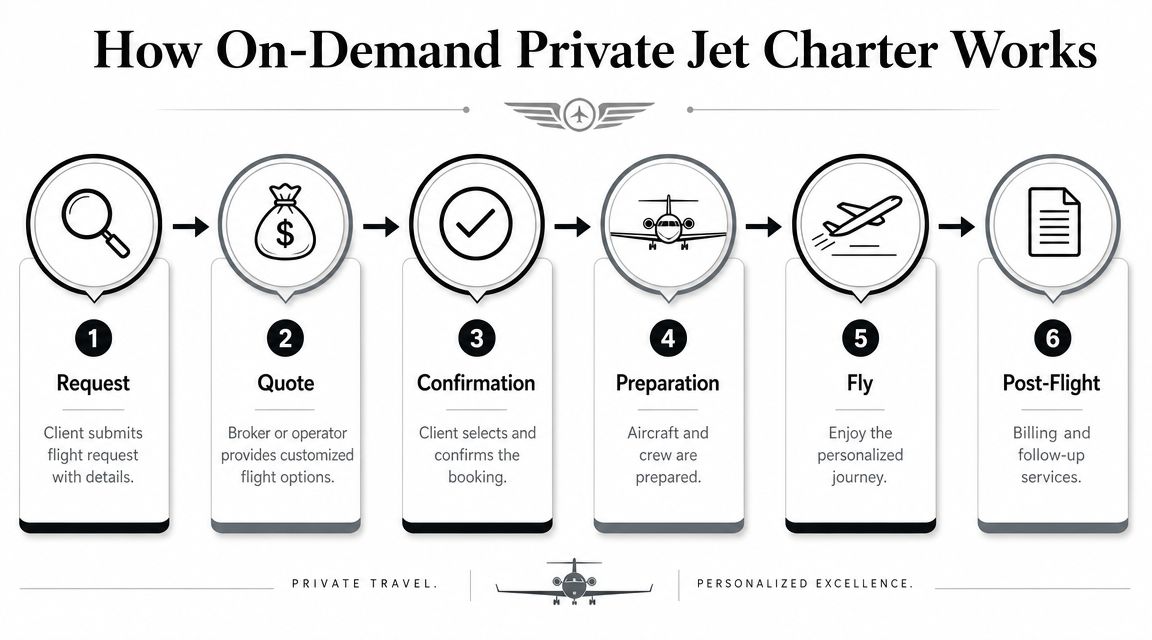
You send the trip details. The provider checks which aircraft can legally fly the mission, which ones are positioned sensibly, and which specific tail gives you the best fit on cost, cabin, range, and schedule. You review real options, approve one aircraft, and the operator prepares the flight. The process is straightforward. The value comes from disciplined sourcing and clear disclosure.
The basic booking chain
Here's what happens on a well-run trip:
You send the mission details
Provide departure point, destination, travel dates, passenger count, baggage, pets, catering requests, and any hard requirements such as Wi-Fi or cabin size.The provider sources aircraft options
This step determines whether you get efficiency or waste. A good provider looks for aircraft that fit the mission and are already near the departure airport, which helps reduce avoidable ferry expense.You receive a quote and aircraft details
You should see the specific aircraft being offered, not just a category label. That includes the cabin profile, luggage limits, range suitability, and any operational constraints that matter for your trip.You confirm the trip
Once you approve the aircraft and terms, the charter operator handles dispatch, crew assignment, scheduling, and airport coordination.You receive pre-flight details
You should have final timing, FBO or terminal information, crew contact procedures, and confirmed aircraft details before departure day.You fly and settle the final invoice
If the flight was quoted properly at the start, the final bill should match the logic you approved, not turn into a post-trip pricing dispute.
What separates a good process from an expensive one
The biggest cost mistake in charter happens before the flight ever leaves the ground. It happens during sourcing.
Private aircraft are spread across hundreds of airports and operator bases. If the seller pushes a jet from the wrong market, you pay for that positioning one way or another. If the seller hides behind broad aircraft categories, you lose the ability to judge whether the quote fits the trip. If the aircraft is sourced locally and presented specifically, pricing gets clearer fast.
That is why true on-demand charter beats generic brokerage language. You are not buying "access." You are approving a defined aircraft for a defined mission.
A transparent model such as Haute Jets keeps the process tighter by quoting the exact aircraft and prioritizing local sourcing where possible. That reduces the common problems in charter. Unnecessary deadhead cost, last-minute aircraft substitutions, and category-based quotes that look simple but conceal tradeoffs.
Who matters in the process
The operator matters more than the sales pitch. You should know who is operating the flight, who controls the aircraft, and who is responsible for execution on the day of departure.
If a seller cannot clearly identify the charter operator and explain why that aircraft fits your route, stop there.
For a deeper primer on the mechanics behind the category, Haute Jets' guide to what a chartered jet is is a useful starting point.
Why distributed access matters
On-demand charter works because supply is distributed. Aircraft are not sitting in one central fleet waiting for your request. They are scattered across different regions, operators, and operating schedules. The provider's job is to match your mission with the right aircraft in the right place under the right commercial structure.
Do that well and the trip runs smoothly. Do it poorly and you pay more for less control.
Comparing On-Demand Charter with Jet Cards and Fractional Ownership
If you're choosing between on-demand charter, a jet card, and fractional ownership, stop thinking in terms of prestige. Think in terms of commitment, pricing logic, and control.
Jet cards sell predictability. Fractional ownership sells structured access. On-demand charter sells flexibility. None of those are automatically wrong. But one of them is usually a much better fit for people whose schedules, routes, and aircraft needs change.
Side-by-side comparison
| Attribute | On-Demand Charter | Jet Card | Fractional Ownership |
|---|---|---|---|
| Upfront cost | Typically no membership or ownership buy-in | Usually requires prepaid commitment or program enrollment | Requires ownership stake and long-term financial commitment |
| Commitment level | Trip by trip | Medium commitment | High commitment |
| Pricing structure | Market-based and trip-specific | Program-based, often with fixed terms | Ownership costs plus operating structure |
| Aircraft consistency | Can vary by trip unless exact aircraft is specified | More standardized program experience | More structured fleet access |
| Booking flexibility | High | Moderate to high, depending on program rules | Less flexible than pure pay-as-you-go access |
| Best fit | Travelers with variable schedules and routes | Repeat flyers who value simplified repeat booking | Travelers with very frequent and predictable usage |
Where people get this wrong
Clients often assume a jet card is automatically cheaper because it feels more packaged. That's a mistake. Packaged doesn't mean efficient. It means the pricing logic is decided in advance, whether or not it suits your next trip.
Fractional ownership can make sense if you fly often enough, with enough consistency, to justify the complexity. But many buyers underestimate how much they're paying for structure they may not need. If your routes change, your passenger count varies, or your travel peaks around specific seasons, ownership can become an expensive way to chase flexibility you still don't fully have.
My recommendation
Use this simple filter:
- Choose on-demand charter if your flying is irregular, seasonal, route-diverse, or highly customized.
- Consider a jet card if you repeatedly fly similar missions and value a more programmatic booking process.
- Consider fractional ownership only if your volume is high enough to justify the financial and operational commitment.
The more your travel varies, the less sense it makes to lock yourself into a rigid product.
A key advantage of on-demand charter is that it doesn't ask you to predict your future flying pattern with perfect accuracy. It lets you make a fresh decision each time. That's usually smarter than prepaying for certainty you may not use.
Understanding Private Jet Pricing and Cost Drivers
The advertised hourly rate is useful, but it's not the number that matters most. The number that matters is the all-in trip cost.
That's where many buyers get burned. They compare one quote to another based on the aircraft's hourly range and miss the single biggest pricing trap in charter: where the aircraft starts its day.
What the hourly rate really tells you
Public charter guidance shows that on-demand charter rates can start around $2,000 per hour for turboprops or light aircraft and rise to over $14,000 per hour for large-cabin jets, with some market references going higher depending on aircraft type and mission, according to Paramount Business Jets' charter pricing guide.
That range is broad for a reason. Aircraft category matters, but mission economics matter just as much.
The cost components you should ask about
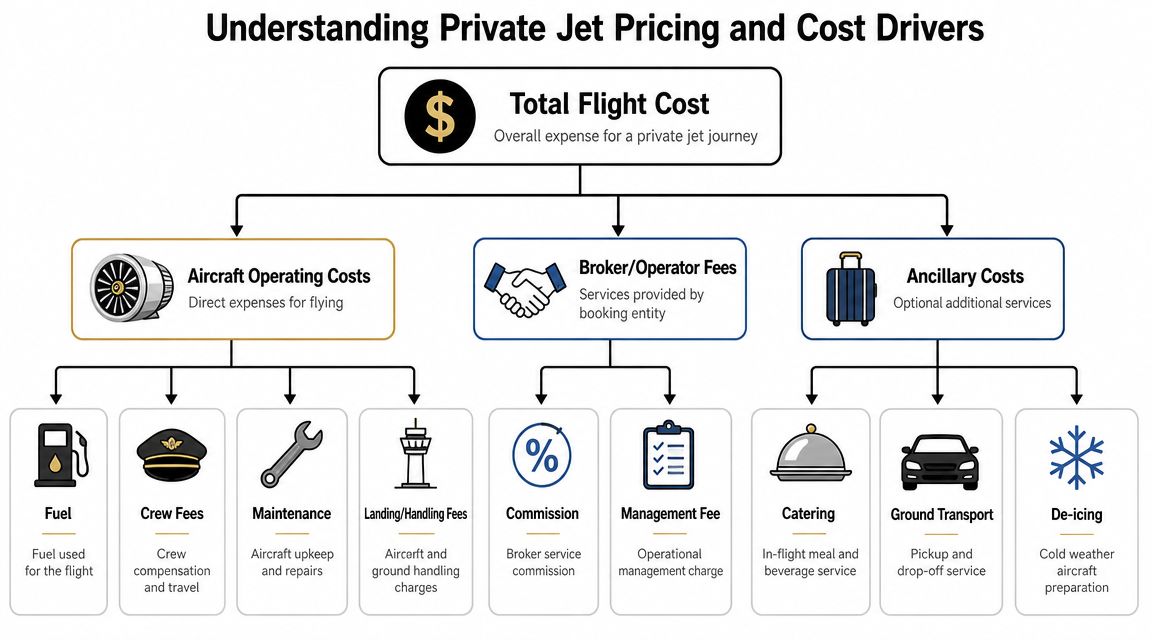
A solid quote typically reflects several layers of cost:
- Aircraft operating cost: Flight time, fuel burn, crew time, and aircraft-specific operating economics
- Airport charges: Landing fees, handling, and terminal coordination
- Crew-related expenses: Duty limits, overnights, and schedule complexity
- Trip extras: Catering, ground transport, de-icing if needed, and other service requests
- Positioning cost: Ferry time to get the aircraft to you, and sometimes to recover it afterward
The last item is where quotes become misleading.
Repositioning changes everything
If the aircraft is based far from your departure airport, you may be paying for empty flying before your trip even begins. That deadhead time can inflate the invoice, especially for one-way missions, smaller markets, and peak travel windows.
This is why “light jet at X dollars per hour” often tells you almost nothing by itself. A locally based midsize aircraft can produce a better all-in number than a cheaper hourly option that has to reposition from another city.
For a fuller breakdown of how charter invoices are built, Haute Jets' pricing guide for private jet charter costs is worth reading.
Ask one question before anything else: “Where is the aircraft coming from?” If the answer is vague, the quote is incomplete.
How to evaluate a quote correctly
Don't just ask for the aircraft category and the hourly rate. Ask for:
- The exact aircraft being quoted
- Its current or planned positioning
- Whether the trip includes billable ferry time
- Any overnight crew implications
- What's included versus estimated
My advice is blunt. Ignore any provider that sells the fantasy of simple hourly pricing without discussing repositioning. Charter is operationally driven. A transparent quote should reflect that reality instead of hiding it.
Ensuring Safety and Quality in On-Demand Charter
You approve a flight, show up at the airport, and learn the aircraft changed overnight. The replacement is legal, but it is not the cabin you expected, not the Wi-Fi setup you were promised, and not the operating story you thought you bought. That is the gap between a sale and a properly managed charter.
Safety starts with charter legality. In the U.S., an on-demand retail charter flight must be operated under Part 135. Treat that as the floor. It tells you the flight is being conducted under the correct commercial framework. It does not tell you whether the provider is transparent, whether the operator is strong, or whether the aircraft being quoted is the one that fits your trip.
Safety gets stronger when the sourcing is transparent
Opaque charter buying creates two problems at once. It hides cost drivers, and it hides operational accountability. If you do not know the operator early, you cannot vet the standards early. If you do not know the exact aircraft early, you cannot judge whether the proposed solution is appropriate or merely available.
True on-demand charter works better when the aircraft is sourced for the mission, preferably from the local market, and disclosed clearly. That reduces unnecessary repositioning, but it also sharpens safety and quality review because you are evaluating a real aircraft and a real operator, not a vague category and a sales promise.
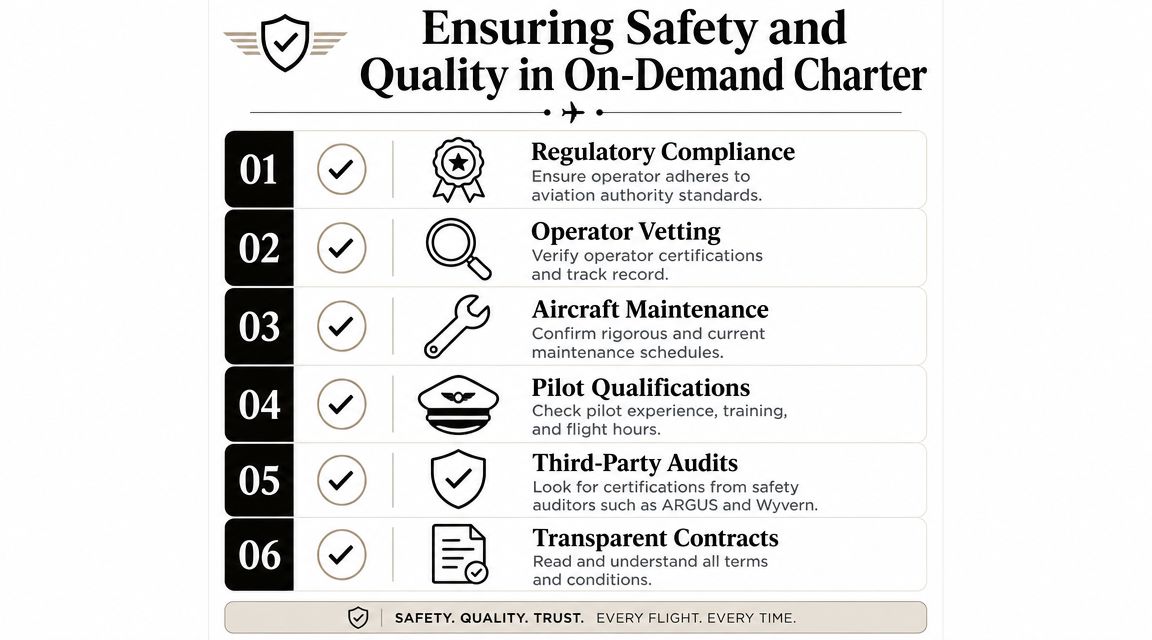
What to require before you approve a trip
Ask for specifics every time:
- Named operator: You should know which certificate holder is operating the flight.
- Exact aircraft details: Tail-specific information matters more than a generic cabin category.
- Current charter eligibility: The aircraft must be properly placed on the operator's certificate for charter use.
- Safety oversight: Ask whether the operator holds current third-party review status such as ARGUS or Wyvern.
- Crew and maintenance control: Confirm that the operator, not a middleman, controls crew standards and maintenance compliance.
- Substitution terms: Get clear language on when aircraft changes are allowed and how replacements are approved.
A polished booking flow means nothing if those answers stay vague.
Quality shows up on the day of travel
Clients usually discover quality failures too late. They find them in a surprise aircraft swap, weak cabin prep, unreliable connectivity, unclear pet approval, or a baggage fit problem that should have been addressed at booking.
The fix is simple. Buy charter the way an operator plans a trip. Match the exact aircraft to the mission, confirm the operating party, and document the service details before funds are sent. That is one reason transparent, on-demand sourcing beats rigid programs that sell access first and force-fit the trip later.
If you want a benchmark for what that review should cover, see Haute Jets' safety screening standards for on-demand charter.
Your Guide to Booking an On-Demand Flight
Booking well starts with giving better information. If you only send “Teterboro to Miami, four passengers,” don't be surprised when the quote comes back broad, generic, and hard to compare.
The best trips happen when the request is specific. Modern charter clients increasingly want more than cabin category. They want the exact aircraft, confirmed Wi-Fi reliability, and known amenities, a shift highlighted by Air Partner's on-demand private jet overview.

What to send with your request
A strong booking brief includes more than route and date:
- Passenger details: Total travelers, children, pets, and any mobility needs
- Luggage profile: Number of bags, garment bags, skis, golf clubs, or bulky cargo
- Schedule flexibility: Exact departure time or acceptable window
- Cabin needs: Wi-Fi, worktable setup, sleeping capability, and lavatory expectations
- Service preferences: Catering, ground transport, pet accommodation, and onboard requests
- Airport preference: If you have more than one usable airport, say so
That level of detail lets the provider match the aircraft to the mission instead of forcing the mission into the nearest category.
Match the aircraft to the mission
Here's the practical way to look at it:
- Short regional hops: Turboprops and light jets can be efficient when baggage and passenger count are modest.
- Business trips with more cabin expectations: Midsize aircraft often fit better when you need a stronger work environment.
- Longer flights or larger groups: Larger-cabin aircraft may be justified when range, luggage, and onboard comfort are essential.
Don't overspend for cabin size you don't need. Don't underspec the aircraft and create inconvenience you could have avoided.
A useful visual summary of the booking mindset is below.
Questions worth asking before you approve
Before you say yes, ask these:
- Is this the exact tail being offered or only a category estimate?
- Is Wi-Fi confirmed for this aircraft?
- Are pet policy and baggage limits confirmed for this specific trip?
- Is the aircraft local, or is it being brought in?
- What substitution rights exist if the original aircraft changes?
Book the mission, not the marketing label.
That one habit will eliminate a surprising amount of frustration.
The Haute Jets Advantage for True On-Demand Value
You approve a quote that looks reasonable. Then the actual cost shows up in the fine print. A distant aircraft has to be ferried in, the operator is interchangeable, and the cabin you expected is now a category estimate instead of a confirmed tail. That is the gap between marketed charter and true on-demand charter.
The better model is simple. Source the aircraft close to your departure point, quote the actual aircraft being offered, and show the client what is driving the price. That approach cuts waste and removes the usual broker fog around repositioning, substitutions, and inflated hourly-rate comparisons. As noted earlier, repositioning often distorts the actual trip cost, which is why local sourcing matters so much.
What a transparent model should include
A provider worth using should give you:
- Pay-per-flight access: No membership buy-in, no prepaid block hours, no pressure to use a program that may not fit your trip pattern.
- Exact aircraft disclosure: The specific aircraft, not a broad class label that leaves room for substitutions.
- Local sourcing discipline: Aircraft selected with positioning cost in mind, not pulled from wherever a broker can fill the trip.
- Operator clarity: A direct view of who is operating the flight and what standards they meet.
- Confirmed trip details before departure: Tail, schedule, and onboard expectations locked in before you go.
This is what creates value. Lower waste, fewer surprises, and better trip fit.
Haute Jets is a useful example of that model. The company states that it works through a large global network of owner-operators, focuses on sourcing aircraft near the client whenever possible, and limits flights to operators that meet recognized third-party safety standards such as Wyvern Wingman or ARGUS Gold or Platinum. For a buyer, the benefit is straightforward. You get better visibility into the actual aircraft, fewer hidden ferry costs, and none of the structural compromises that come with jet cards or fractional programs.
That last point matters more than many first-time charter clients realize. Jet cards often trade transparency for convenience. Traditional brokerage can do the same. A true on-demand approach gives you a cleaner transaction. You buy the mission you need, on the aircraft that fits it, at a price that reflects the actual operating setup instead of a packaged program.
My advice
Treat charter proposals like financial documents. Ask what aircraft is being quoted. Ask where it is based. Ask whether the price assumes repositioning. Ask whether the operator is fixed or subject to change. Ask what, exactly, is included.
Direct answers signal a provider that respects your budget and your time. Vague answers usually mean extra cost is hiding somewhere.
If you want a private jet on demand experience built around transparent sourcing, exact aircraft selection, and pay-per-flight flexibility, contact Haute Jets and request a trip quote based on your actual mission, not a generic category.