

Most advice about private jet pilots starts with prestige, pay, and the romance of the cockpit. That's the wrong angle. If you're paying for charter, what matters is whether the crew can manage pressure, fatigue, weather, procedure, and passenger expectations without improvising.
A strong pilot is not just a good stick, they're a disciplined decision-maker inside a regulated system. For charter clients, that difference shows up in schedule reliability, dispatch quality, and the absence of ugly surprises at the terminal. If you want the true story on private jet pilots, you have to look past the lifestyle narrative and into the operational grind.
The Day-to-Day Job of a Private Jet Pilot
The public image of private jet pilots is lazy. People picture polished uniforms, quiet cabins, and an easy route to luxury travel. The work is closer to running a high-stakes checklist under pressure, where one bad judgment call can disrupt a mission or compromise safety.
Workload separates good pilots from great ones
NASA's analysis of VLJ training says the hard problems are single-pilot resource management, cognitive load, currency, mentoring, standardized procedures, judgment, situation awareness, and automation management, because those factors materially affect safety in light jet operations (NASA VLJ training analysis). That is the part charter buyers miss. The hardest part of the job is often not flying the aircraft, it is managing competing demands while staying ahead of the airplane.
Practical rule: if a pilot talks only about flying skill and never about judgment, workload, or procedures, that is not a reassuring sign.
The workload becomes even clearer in smaller cockpits. NBAA's single-pilot guidance emphasizes workload management, external pressure, self-dispatching, personal minimums, weather, and automation as recurring safety topics. Those are not abstract concepts. In light jets and very light jets, the pilot is constantly making tradeoffs, and those tradeoffs matter more when passengers expect on-time departures and clean execution.
Charter pressure changes how pilots think
Charter flying adds commercial pressure to an already demanding environment. Pilots have to coordinate with dispatch, account for weather changes, manage passenger timing, and stay within procedural discipline even when everyone on the ground wants speed. The stereotype says private flying is easy because the cabin is smaller. Smaller crews leave less room for error.
A professional crew also has to resist pressure from the client side. A passenger may want to launch into marginal weather, depart before briefing is complete, or assume a short delay means the operator is disorganized. A good pilot does not bend the rules to keep the schedule pretty, they make the mission safe and explain the why clearly.
The pilot's judgment also affects the client's experience in ways people ignore. A crew that makes early, conservative calls protects schedule reliability, protects the cabin from unnecessary risk, and reduces the chance that a trip turns into a scramble. A weak crew creates the opposite pattern, late decisions, avoidable delays, and more friction for everyone involved.
For charter clients, consistency beats bravado. A well-vetted pilot makes conservative calls early, communicates them clearly, and protects the trip from avoidable risk. That is the standard that matters.
Certification and Training Requirements Explained
The certification ladder for private jet pilots exists for a reason. Each step filters for a different layer of competence, and none of them is optional when passengers are paying for commercial carriage. A charter-ready pilot is built, not declared.
The progression is deliberate
A private pilot certificate starts the path, and the FAA-linked benchmark is 40 hours for an initial private pilot certificate (14 CFR 61.103). That rating shows someone can operate safely in non-commercial flying, but it does not authorize carrying passengers for hire. Under 14 CFR § 61.113, a private pilot may not act as pilot in command of an aircraft carrying passengers or property for compensation or hire (14 CFR 61.113).
From there, the ladder tightens. A commercial pilot licence is the next commercial step, with a widely cited benchmark of about 250 hours for commercial qualification. For airline-transport-level qualification, the benchmark rises to roughly 1,500 total flight hours. That does not mean raw hours equal judgment. It means the industry requires structured experience before anyone is trusted with paying passengers in complex aircraft.
Type ratings are where competence gets specific
A Gulfstream, Citation, and Challenger do not fly the same way in practice. Type ratings are aircraft-specific because systems, performance envelopes, and emergency procedures differ from model to model. In major private aviation markets, charter pilots typically need an Airline Transport Pilot Licence or equivalent commercial-command qualification, plus a type rating for the exact aircraft model they fly, along with current medical certification and recency on that aircraft type (crew qualification guidance).
A good way to judge a crew is simple. Total flight time is only the starting point. Ask whether the pilot is instrument current, whether the pilot is model-current, and whether the pilot has trained recurrently on the exact aircraft you are boarding. Those details separate generic experience from operational readiness.
Recurrent training keeps the certificate alive
Certification is not static. Pilots stay current through recurrent training, simulator work, and aircraft-specific refreshers. That matters in instrument and low-visibility operations, where muscle memory and standardized procedures matter more than confidence.
The problem with most client conversations is that they stop at the résumé level. “He has a lot of hours” sounds reassuring, but it is vague. You want to know what aircraft the pilot is typed on, when recurrent training was last completed, and whether the operator tracks recency on the exact model scheduled for your trip. You should also ask whether the crew qualification process is documented in a way that matches the standards discussed in the essential guide to travel safety. That is the difference between a crew that looks qualified on paper and one that is prepared for actual operations.
Haute Jets also points clients to its own analysis of Wyvern and ARGUS safety ratings, because third-party verification is the only practical way to check whether training claims and crew oversight hold up outside a sales pitch.
Third-Party Safety Audits and What They Verify
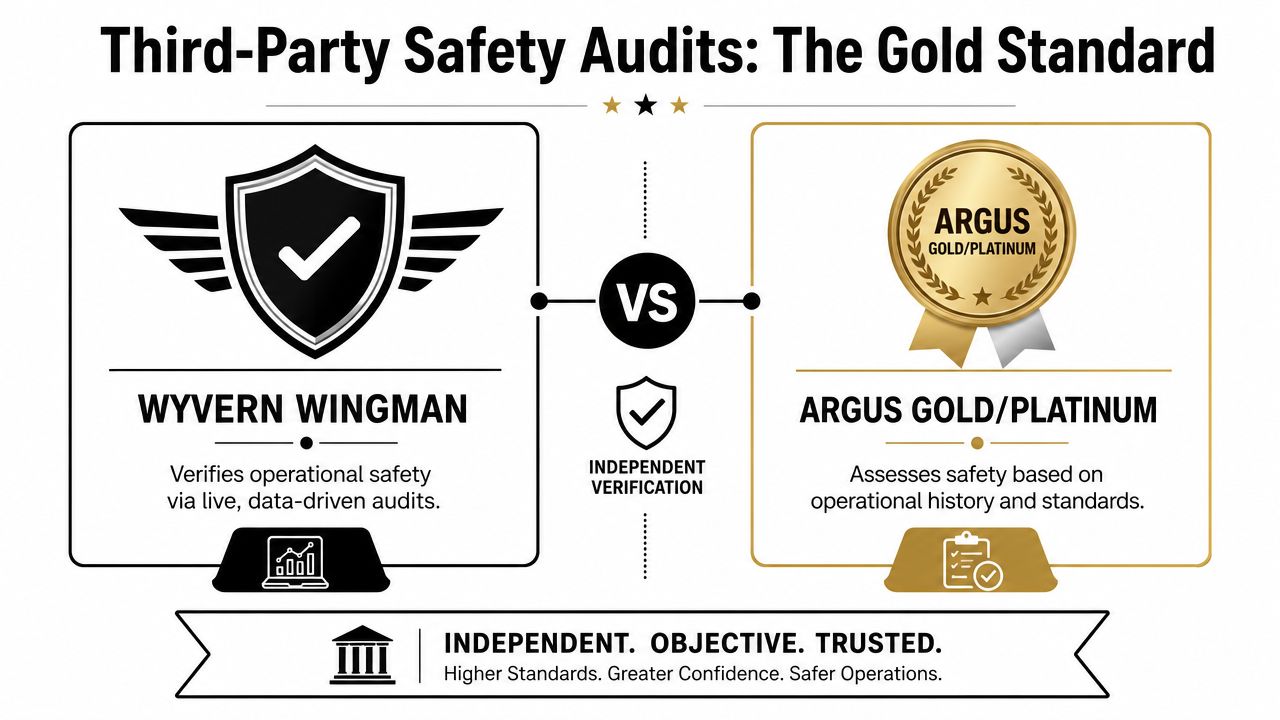
Operator self-certification isn't enough. Charter clients should care about independent audits because those audits force the operator to prove its standards instead of merely describing them. That's the difference between marketing language and verifiable discipline.
What these audits actually check
Wyvern Wingman and ARGUS Gold or Platinum ratings are not window dressing. They are independent safety audits that evaluate the operator's procedures, training systems, and operational controls, and Haute Jets states that it works only with Wyvern Wingman or ARGUS Gold or Platinum-rated operators through its network approach. For a deeper look at the framework, the company's own breakdown of Wyvern and ARGUS safety ratings is useful because it focuses on how third-party verification works in practical charter settings.
The point of an audit is not just to stamp a file. It's to verify that the operator maintains a live safety culture, with current pilot records, maintenance oversight, and documented procedures. That matters on charter flights because the client is often boarding an aircraft they don't own, on a schedule they didn't set, with a crew they may meet for the first time that day.
Independent verification beats verbal reassurance every time.
Why audit status matters to dispatch reliability
A good audit reduces the chance that an operator is cutting corners on training or recurrency. That doesn't just affect safety, it also affects whether a trip launches on time when weather goes soft or the mission changes late. Instrument flying demands process discipline, and third-party oversight helps keep that discipline from eroding under commercial pressure.
This is also where clients need to stop accepting vague claims. “We have strong internal standards” means very little without a recognized audit trail. “Our crews are experienced” means even less if the operator can't show you current procedures, current training, and a current safety framework.
For business travelers, a solid general resource on travel preparation is Max's Luxury Rides Inc.’s essential guide to travel safety, because the same basic principle applies across premium travel, verify before you depart. In private aviation, that principle should be strictly followed.
The audit question you should ask
If a broker can't tell you the operator's audit status, stop there. If they can, ask how often it's renewed and whether the specific tail you're being assigned is covered under that certificate. Don't accept generic comfort. Demand a name, a standard, and a current status.
Day-of-Flight Procedures and What to Expect
A proper charter day starts well before the terminal. The crew that looks prepared at departure has usually already done the hard work the day before, and that prep shows up in the details. You should expect exactness, not improvisation.
The 24-hour confirmation is not a courtesy, it's a control point
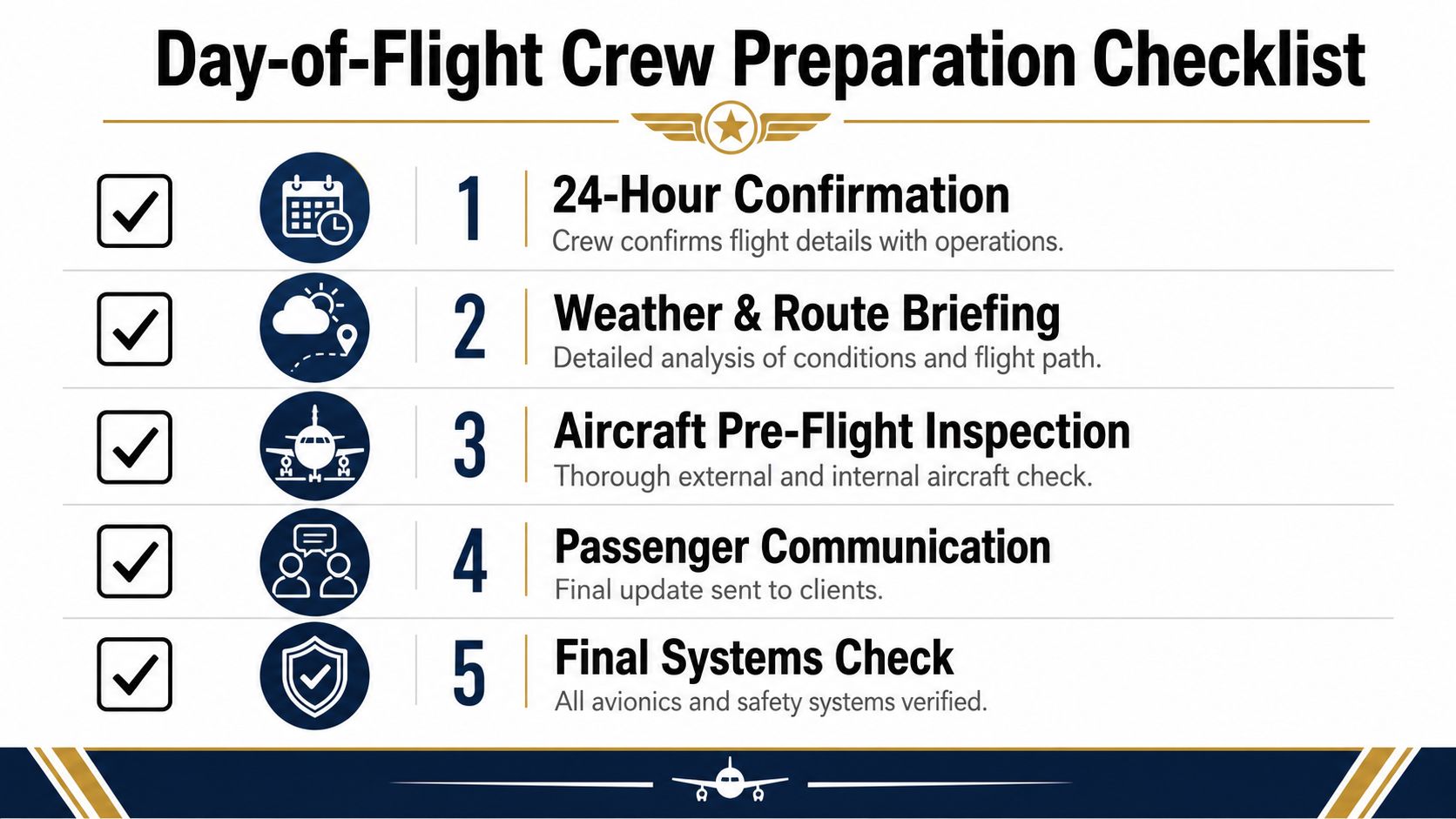
A well-run operator confirms the tail number, crew bios, weather briefing, and passenger manifest 24 hours before departure. That matters because it gives the client time to verify the aircraft, check the crew background, and catch errors before they become terminal problems. If those details arrive late, the operation is already behind.
The crew bio should tell you more than total career hours. It should show type ratings, recent hours on the specific aircraft, and recurrent training dates. A pilot with broad experience but no recent time in that exact model is a weaker choice than a more specialized pilot who is current and specific.
Practical rule: the right crew bio reads like a readiness document, not a marketing sheet.
What a professional briefing covers
A real crew briefing covers route planning, weather alternatives, fuel reserves, and emergency procedures. It also makes room for contingency logic, because a charter pilot has to think about weather at origin, weather at destination, and what happens if the plan changes midstream. That's not a luxury detail, it's operational housekeeping.
The cleanest sign of a serious operator is boring confidence. No scrambling at the FBO, no vague answers about the crew, no “we'll sort it out after you arrive.” The good ones already sorted it out. If you want to know whether a crew is ready, ask one question, what changed after the confirmation call? If the answer is nothing, that's exactly what you want.
Pilot Supply Constraints and What They Mean for Clients
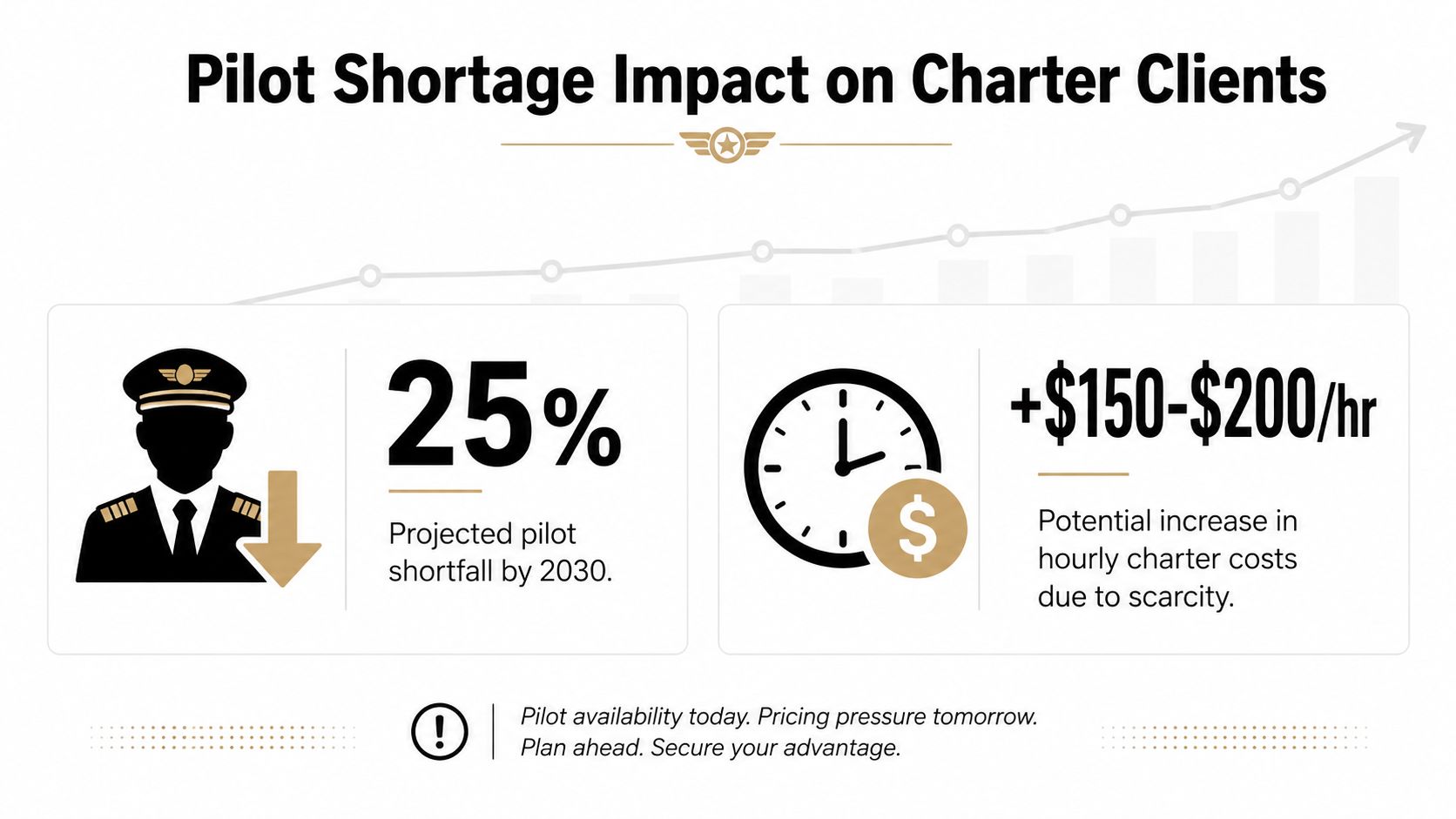
Private aviation has a pilot supply problem, and clients feel it in service quality before they ever hear about hiring headlines. When qualified crews are harder to source, operators lose flexibility on coverage, and that shows up in pricing, backup planning, and how reliably a trip can stay on schedule. The labor market is part of the charter experience whether buyers notice it or not.
The pipeline is growing, but the bottleneck is real
FAA-linked data shows instructional flying hours increased 71% from 2012 to 2022, while instructional flying's share of all flight hours rose from 15.3% to 23.7% (FAA activity-survey analysis). In the same period, original Private Pilot certificate issuances increased 47%, reaching 24,405 in 2022. More recent U.S. pilot summaries report active pilots crossed 887,000 in 2025, student pilots reached 370,286, and the private-pilot certificate pass rate was 75.1%, meaning roughly 1 in 4 applicants failed on the first attempt.
Those numbers matter because they show a larger pipeline that still leaks at the certification stage. More people are entering training, but not everyone is advancing cleanly through the system. For charter operators, that keeps hiring competitive, training expensive, and crew availability uneven in busy markets.
Diversity and economics shape who enters the cockpit
The FAA's civil airmen data shows the U.S. had 172,012 private pilots, and Women in Aviation International reports 15,379 women private pilots, equal to 8.9% of all private pilots in that dataset (FAA civil airmen statistics). That is not just a demographic talking point. It shows the pilot pool is still narrow relative to the demand on it.
FAA-affiliated research also notes that economic barriers, including the cost of entry and long training periods at reduced pay, impede recruitment of women into aviation, while the FAA's Women in Aviation report points to sexism, harassment, and the old boys' network during initial training (FAA WIAA recommendations report). A recent literature analysis identifies recruitment pipeline limitations, financial constraints, masculine organizational culture, mentorship deficits, and work-life integration challenges as major barriers as well.
The client impact is direct. Operators with deeper pilot networks and tighter training discipline absorb disruptions more cleanly. Operators without that depth show their weakness in delayed departures, less route flexibility, and poor response when your schedule changes at the last minute.
Supply pressure changes pricing and resilience
I will not invent a price formula, but scarcity always shows up somewhere. In charter, it usually appears as fewer available aircraft, tighter routing options, and less forgiveness when you need a same-day recovery. That is why operator depth matters as much as aircraft quality.
A serious brokerage or operator should be able to source from a broad network, maintain recency, and keep crews ready without stretching them too thin. If it cannot, you are not just buying a trip, you are taking on exposure to a fragile labor market.
Questions to Ask About Your Charter Crew
Most brokers are happy to sell the aircraft and vague about the people flying it. That's backwards. The crew is the safety asset, and clients should ask direct questions before they approve the trip.
Ask these, not generic reassurance
- What type rating does the pilot hold for this exact aircraft? A specific aircraft model matters more than broad jet time.
- When was the pilot's last recurrent training? Current training is a better sign than old experience.
- How many recent hours does the pilot have on this tail or this aircraft type? Recency on the exact model matters.
- What is the operator's Wyvern or ARGUS status? If they dodge this, treat it as a warning.
- How do you manage duty-time limits and fatigue? The answer should be concrete, not fluffy.
- Will I receive the tail number and crew bios in advance? You should.
A weak operator answers with generalities like “our pilots are highly experienced.” That phrase is worthless unless it's backed by current type ratings, recurrency, and independent audit status. A strong operator answers with documents, dates, and a process you can verify.
Compare marketing claims with operational proof
Marketing says “luxury.” Operations say “current, typed, audited, and briefed.” Marketing says “elite pilots.” Operations say “here are the crew bios and the aircraft assignment 24 hours in advance.” That's the gap you should focus on.
If the crew information feels hidden, the operator is asking you to trust a slogan instead of a system.
The standard should be simple. Ask for crew transparency, and if the operator treats that as unusual, move on. Good charter operators expect the question and answer it quickly.
How Haute Jets Ensures Vetted Pilots for Every Flight
Haute Jets is built around the idea that clients shouldn't have to gamble on the crew. Its network sourcing model uses Wyvern Wingman or ARGUS Gold or Platinum-rated operators, and that's the right filter because it forces third-party verification instead of relying on promises. The company's safety standards page makes that positioning explicit.
The structure matters more than the slogan
Haute Jets says it sources from 3,500+ owner-operators across 175 countries, which gives it breadth without pretending every aircraft is equal. The practical benefit is simple, it can source closer to the departure city, reducing the need to reposition aircraft unnecessarily. That helps control cost while keeping the operator pool tied to recognized safety standards.
It also uses a 24-hour pre-flight confirmation process that includes the tail number, crew bios, weather briefing, and passenger manifest. That is exactly the kind of operational transparency charter clients should expect. It turns the crew from a black box into a verified part of the booking.
Why this model works for clients
The no-membership, pay-per-flight structure keeps the transaction tied to the mission instead of a quota. That matters because you don't want a broker pushing the wrong jet just to satisfy an internal sales target. You want the exact aircraft, with the right crew, at the right time.
Haute Jets is one option in a market full of weak promises, and the reason it stands out structurally is because it ties access, audit standards, and pre-flight verification together. For clients who care about pilot quality, that combination is the point.
If you want a charter experience built around verified operators, current crew information, and fewer surprises at departure, book through Haute Jets and ask for the pilot details before you confirm the flight. That's the right way to buy private aviation when safety, timing, and crew quality matter.