
A creative brief lands in your inbox with the usual luxury cues. Clean tailoring. Polished skin. Champagne tones. Then the client adds the line that changes the whole production plan: they want the images to feel elite, mobile, and unmistakably expensive.
That's when a private jet stops being travel and starts being set design.
For a photographer, producer, or brand manager, private jet rental for photoshoot work lives in two different worlds. One is a grounded aircraft used like a controlled location. The other is a live charter where the aircraft is flying. They look similar in the final frame, but they behave nothing alike once permits, crew movement, power, timing, and airport access enter the picture.
The teams that get this right don't just book a jet. They build a production around the realities of aviation.
Elevate Your Vision The Ultimate Photoshoot Set
A private jet earns its place in a shot because it compresses a lot of brand signals into one environment. You get architectural lines, premium materials, narrow sightlines that force intimacy, and an instantly recognizable symbol of access. That matters whether you're shooting a fashion editorial, a founder brand campaign, a music video, or hospitality content.
The mistake is assuming the only way to get that look is to charter a real flight. It isn't.
Why the jet works so well on camera
A jet cabin does a few things ordinary luxury locations don't:
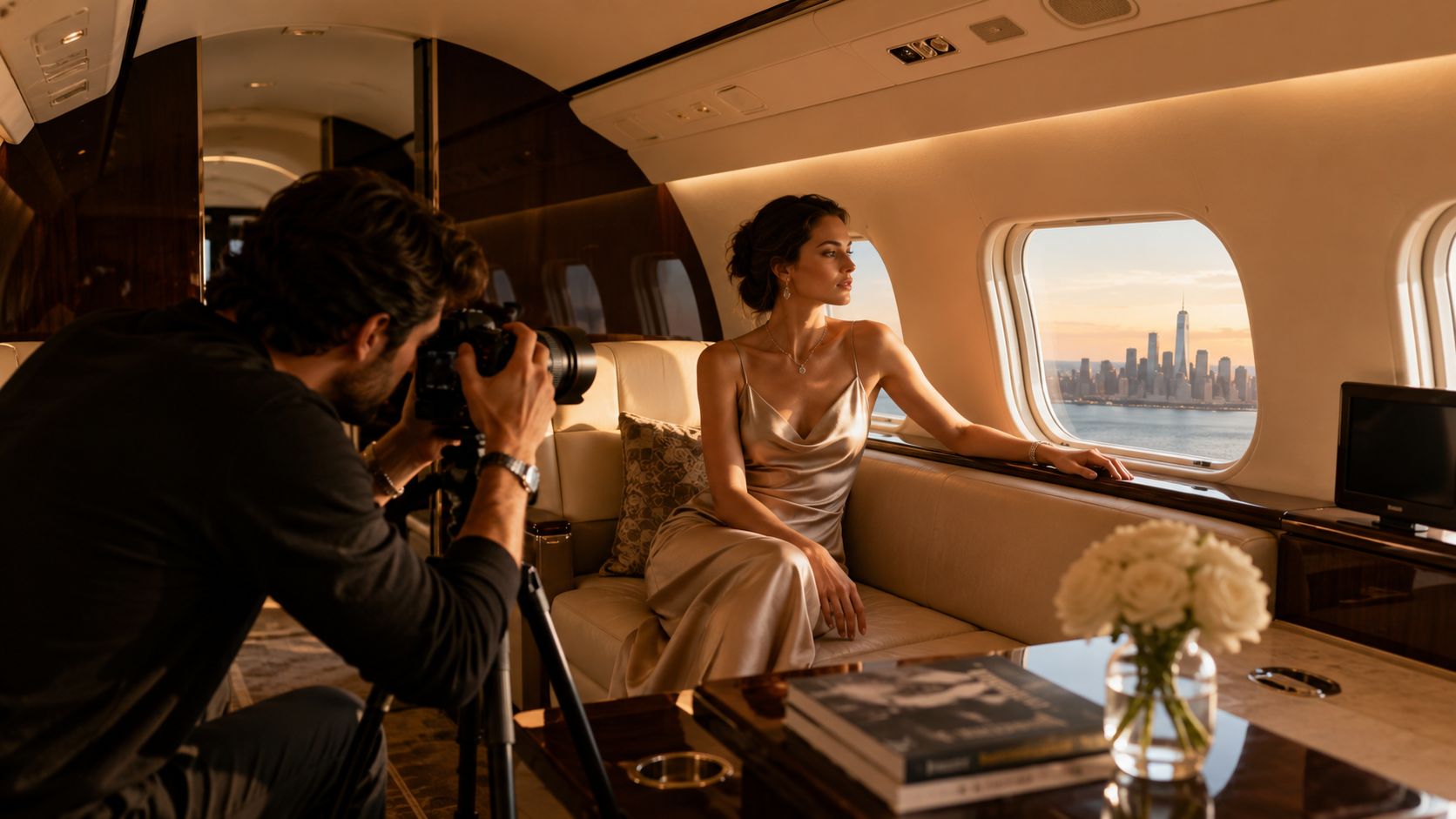
- It frames status fast. The seat stitching, oval windows, wood veneer, and galley details tell the story before the subject even moves.
- It creates natural composition. Aisles, seat backs, armrests, and window rhythm give photographers built-in leading lines.
- It gives brands range. You can shoot polished executive portraits, nightlife-adjacent fashion, aspirational lifestyle, or polished commercial content without changing location.
That visual efficiency is why production teams keep coming back to aircraft interiors.
The practical version of the dream
There's also a reason this niche became commercialized early. In October 2017, media reports documented a Moscow-based service called Private Jet Studio that rented a grounded Gulfstream G650 for staged luxury photos, charging 14,000 rubles for a two-hour shoot with a photographer and 11,000 rubles without one, while another report described bookings for as little as $240 for two hours through the same concept (Fox News coverage of the Moscow private jet studio). That's the key shift. For photo production, the aircraft can be the location, not the transport.
Practical rule: Decide early whether you need the idea of flight or the reality of flight. Most shoots only need the first one.
If your campaign also includes exterior approach shots, runway-adjacent establishing footage, or aerial environment plates, prep those separately. A lot of teams benefit from reviewing essential drone photography techniques before they lock the shot list, because the jet itself often looks stronger when the surrounding environment is handled with the same level of planning.
Static Set vs Live Charter Choosing Your Stage
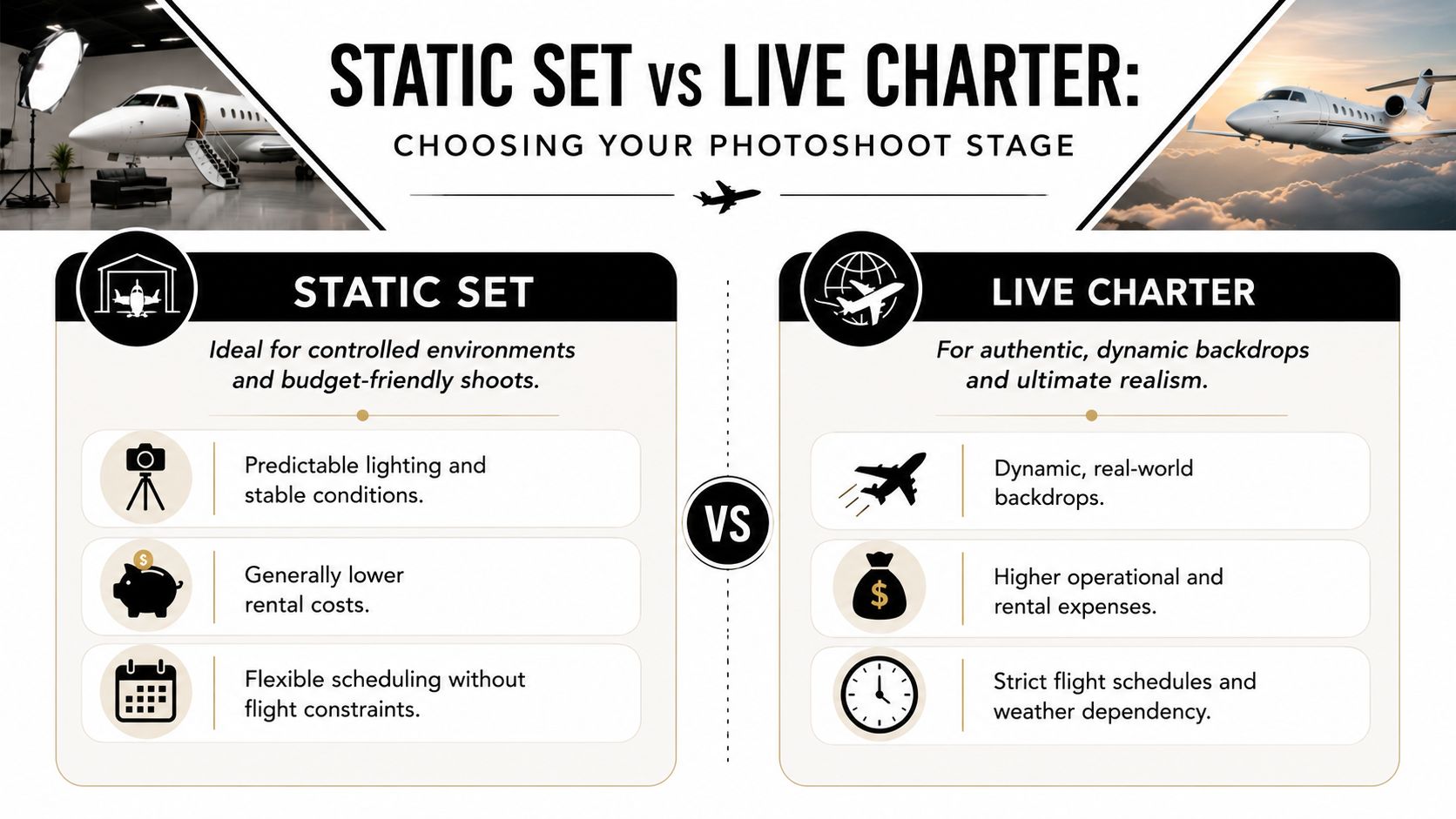
Miss this decision, and the shoot gets expensive fast. A grounded aircraft and an active charter run like two different productions, with different crew limits, timing pressure, lighting options, and approval workflows.
Static set
A static set is the safer production choice for most stills and a large share of branded video. The aircraft stays parked, so the day behaves more like a location booking than a flight operation.
For the photographer or DP, that means time to shape light, repeat angles, swap lenses, and hold a clean frame while talent resets. For the producer, it means a schedule that can absorb late glam, client indecision, and wardrobe changes without burning flight hours. For HMU and styling, it means people can work properly instead of trying to fix details in a narrow aisle during taxi or cruise.
The other advantage is coverage density. A parked jet gives you cabin shots, doorway portraits, stair poses, luggage beats, and detail inserts in one booking window. If the client asks for multiple versions of the same setup, static access gives you room to do that without the crew rushing every reset.
Static access also helps when the concept is visually polished rather than operationally authentic. If the windows are not the hero, and the story lives in the seat, table, glassware, wardrobe, or talent performance, a grounded aircraft usually does the job.
Live charter
A live charter earns its cost only when the final frames need proof of flight. Window light changes for real. The horizon shifts. Ice rattles in the glass. Seat belts, service, and body movement all read differently once the aircraft is airborne.
That realism comes with hard limits.
The captain controls what can happen and when. Cabin service windows affect shooting time. Taxi, climb, descent, and safety briefings break up the schedule. Crew count is usually tighter, gear needs to be smaller, and audio gets harder the moment engines and aircraft systems are part of the scene.
For the DP, live charter work favors a lean package and a shot list that can survive interruptions. For the producer, it means every setup has to justify its minutes. For the client, it means fewer looks and fewer resets than they expect.
| Production factor | Static set | Live charter |
|---|---|---|
| Lighting control | High | Tied to route, weather, and time in flight |
| Crew movement | Flexible | Restricted by cabin space and flight rules |
| Shot resets | Easy to repeat | Limited by schedule and safety windows |
| Exterior access | Strong | Tightly controlled around active operations |
| Sound control | More manageable | Affected by engines, systems, and cabin noise |
| Wardrobe and glam | Straightforward | Slower and cramped |
How to make the call
Use a static set if the brief is built around variety, polish, and approval-heavy execution. Fashion editorials, luxury lifestyle stills, product-led content, and social campaigns usually fit here because the team needs time more than altitude.
Use a live charter if the aircraft is part of the story, not just the backdrop. That usually means hero motion, narrative travel content, or commercial work where the audience needs to believe the plane is in active use.
A quick producer test helps. Ask what the viewer gains from actual flight that cannot be created on the ground. If the answer is real window movement, changing horizon, authentic cabin behavior, or service in motion, charter may be justified. If the answer is mood, status, or tight interior framing, static access is usually the better spend.
Before you lock either option, review the broader private jet rental cost factors for production planning. It helps frame the trade-off between paying for access time and paying for aircraft movement.
Budgeting and Booking Your Private Jet
A jet shoot usually goes off budget before the first call sheet goes out. The problem is usually in the quote request. If you ask for "private jet rental for a photoshoot" without defining whether the aircraft is a static set, a live charter, or a hybrid day with limited taxi or engine-on time, you will get numbers that are hard to compare and even harder to defend to a client.
Book this like a production location with aviation constraints attached.
Budget static access by production line item
For a grounded shoot, the aircraft fee is only one part of the spend. Producers get in trouble when they approve a base rate and miss the operational add-ons that show up later on the estimate or the final invoice.
Ask for the budget in separate lines:
- Aircraft access fee for the agreed window
- FBO or airport handling fees
- Site rep or operator supervision
- Aircraft cleaning and cabin reset
- Stairs or entry positioning
- Ground power unit rental if you need cabin lighting, powered seats, monitors, or practicals without draining the aircraft
- Hangar fee or ramp placement fee
- Overtime rates for the aircraft, crew escort, and airport-side access
- Vehicle escort costs if production vans or glam need airside access
- Protection requirements such as shoe covers, floor runners, or limits on grip gear
That last category matters more than people expect. I have seen a workable quote turn into a bad deal because the team assumed they could roll cases straight into the cabin, tape down cables, and use the galley as a styling station. On many aircraft, none of that is automatic.
Build live charter budgets around production time, not flight time alone
A live charter budget has aviation costs, but the production pressure points are what usually drive the spend. Early crew call, talent hold time, repositioning, slot timing, and missed reset opportunities can cost more than the flight itself if the schedule is too tight.
Start by mapping the shoot day backward from deliverables. How many setups need the aircraft in motion. How many require boarding shots, taxi visuals, or window movement. How much buffer is needed for safety briefings, passenger manifest checks, and cabin resets between looks. Once that is clear, ask for quotes against a defined operating plan rather than a generic route.
For a broader pricing framework, review these private jet rental cost factors for production planning.
Questions to settle before you book
These are the questions that save money and arguments later:
Are you buying a specific tail, or a visual type?
If the client needs a certain cabin finish, get current interior photos and the actual layout. Aircraft in the same class can frame very differently.What is the hard access window?
"Six hours on site" can mean four usable hours once security processing, escorting, and owner restrictions are applied.Does the operator allow production use, or only passenger-style access?
Some operators will permit a small stills crew but push back on larger commercial setups, lighting packages, sliders, or wardrobe racks.What happens if the aircraft gets pulled for operational use?
Private jets are working assets. You need the substitution terms, refund terms, and notice window in writing.What cabin systems can be used during the shoot? Ask about window shades, seat movement, cabin lighting, screens, lav access, galley use, and climate control.
Do you need exclusivity around the aircraft?
If the concept needs clean ramp lines or exterior beauty shots, shared access at a busy FBO can kill half the shot list.
Booking workflow that holds up under production pressure
Start with the shot list, not the aircraft model. A producer who leads with visuals gets better answers than one who leads with aspirational aircraft names.
Then lock these points in order:
- Usage type: static, live charter, or mixed-use day
- Deliverables: stills, motion, social clips, exterior, cabin-only, talent count
- Crew footprint: total headcount, gear volume, glam needs, client attendance
- Operating restrictions: access times, restricted zones, cabin rules, exterior permissions
- Commercial terms: deposit schedule, cancellation terms, substitution rights, overtime triggers
One practical rule helps here. If a quote does not tell you who controls the aircraft on the day, what exact time access starts, and what production activity is restricted, the quote is not ready to approve.
Booking advice: Ask for current cabin photos, tail-specific confirmation, and a written list of production restrictions before any deposit goes out. A polished broker deck is not enough. The aircraft that shows up, and the rules attached to it, are what determine whether the shoot works.
Navigating Permits Insurance and Airport Access
You can't run a jet shoot like a studio rental. Airports are controlled environments, and even a grounded aircraft sits inside someone else's security and operational system.
Start with the FBO, not the mood board
The FBO is often the practical gatekeeper. That's the private terminal or handling environment tied to the aircraft's location and access process. Even if the operator says the jet is available, your crew still needs a compliant path to reach it.
Use the first coordination call to clarify:
- Who controls crew entry
- Whether vehicles can approach the aircraft
- If exterior shooting is allowed
- Where holding, glam, and client review can happen
- What time hard access begins and ends
At this point, shoots either become smooth or turn into expensive waiting.
Insurance is not a formality
Aircraft owners and operators want proof that your production won't expose them to avoidable risk. Expect to provide a certificate of insurance that matches the operator's requirements and names the relevant parties correctly.
Common sticking points include:
- Entity mismatch: Production names don't match insured names.
- Late paperwork: The COI arrives after access lists are already submitted.
- Activity mismatch: The policy doesn't clearly contemplate filming, photography, crew movement, or equipment use around the aircraft.
If your broker, line producer, and insurance contact aren't aligned, the problem usually surfaces the night before the shoot.
A jet is a location, but it's also an active aviation asset. Treat the paperwork like aviation paperwork.
Access lists and security clearance
Private terminals still need to know who is arriving and why. Prepare final crew, talent, vendor, and vehicle details early. Last-minute swaps happen, but they should be the exception.
A clean access package usually includes:
- Full crew roster
- Talent and client names
- Vehicle information if ground-side approach is allowed
- Arrival schedule
- Primary production contact on site
For readers who want a better grounding in private-terminal logistics, this private jet airport guide gives useful context on how these environments typically operate.
The approval mindset
Don't ask only, “Can we shoot on the jet?” Ask finer questions.
- Can you open the main door for extended periods?
- Can styling carts come airside?
- Can cases roll inside, or do they need soft protection?
- Can the client stand on the stairs?
- Can anyone touch cockpit controls?
- Where do trash, catering, and wardrobe bags go?
Those details aren't glamorous, but they decide whether your schedule holds.
On-Set Production Mastering the Cabin Environment
A private jet cabin is elegant on camera and awkward for crew. This is how it stands. Narrow aisle. Reflective trim. Limited staging room. Surfaces that mark easily. If you don't walk in with a plan, the set starts fighting you immediately.
Light the cabin without making it look lit
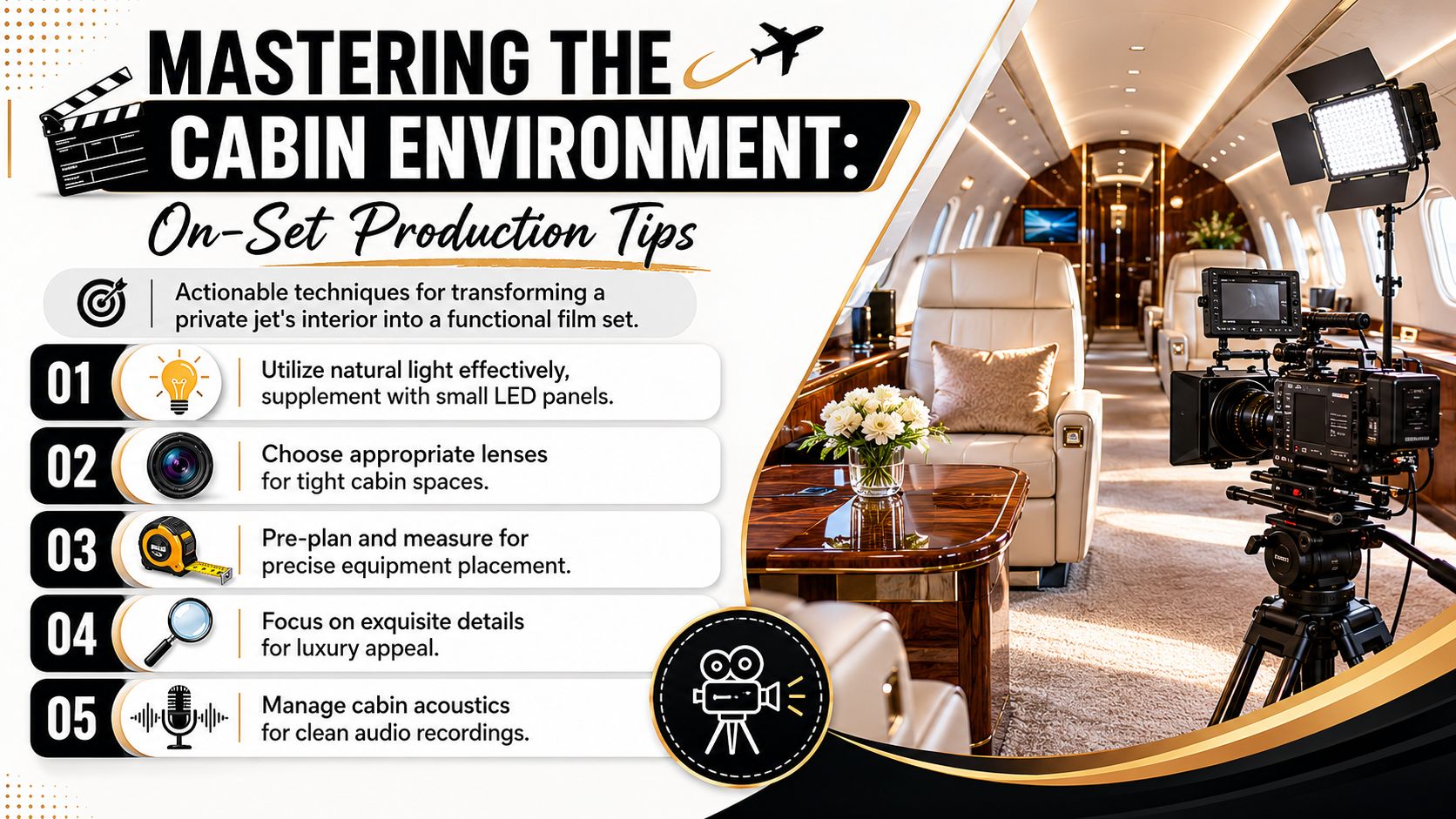
Teams often over-light jets. They bring in gear meant for a loft studio, then spend half the day fighting glare in wood veneer, chrome, glossy sidewalls, and window trim.
A better approach:
- Use the windows first. Decide whether they're key light, edge light, or background feature.
- Add compact LED units selectively. Small fixtures are easier to hide and faster to reposition.
- Bring negative fill. A small black flag or fabric can do more for face shape than another light.
- Control reflections early. Move the fixture a few inches before you start changing the entire setup.
For luxury imagery, less usually looks more expensive.
Lens choice matters more than crew expects
Wide lenses solve space problems but create another issue. They can make the cabin feel distorted and cheap if you push too far. Seats bow, walls curve more than they should, and talent near frame edge can look wrong.
Use wide glass carefully for establishing shots. For portraits, compress where you can and build the angle around the aisle, the seat geometry, and the window line.
Here's a useful visual reference before you walk onto set:
Protect the aircraft like it's rented art
Every stand, case, buckle, shoe sole, and rolling cart is a liability around high-finish interiors. Good crews don't wait for the operator to tell them this.
Set standards before load-in:
- Pad contact points. C-stand legs, ladder feet, monitor stands, and cases should never touch unprotected flooring.
- Limit hard cases in the cabin. Stage what you can outside and carry in only active tools.
- Assign one person to interior protection. Not glamorous, but it prevents expensive mistakes.
- Check wardrobe hardware. Studs, chains, sharp heels, and oversized bags can damage leather and veneer fast.
The aircraft owner remembers scratches longer than they remember your mood board.
Power, sound, and working comfort
Extended shoots need a power plan. If the aircraft systems are running, there may be operational limits and noise considerations. Ground power support can be cleaner for longer setups, especially when you need stable conditions for monitors, charging, or repeated takes.
Cabin audio also needs realism. The space is small, reflective, and full of system noise. If you're recording dialogue, don't assume a beautiful cabin is a quiet cabin.
Crew comfort matters too. The fastest way to lose time is forcing glam, styling, and client review inside the cabin when there's no room for any of it. Build a support footprint outside the aircraft and keep the cabin for active shooting.
If you're selecting aircraft based on layout and interior working conditions, this guide to cabin features on Haute Jets charters is a practical reference point.
The Pre-Flight Photoshoot Checklist
A strong jet shoot usually looks effortless in the final frames because the production was not effortless at all. It was organized. Every approval was handled early, every access point was confirmed, and every “small detail” got treated like a real schedule risk.
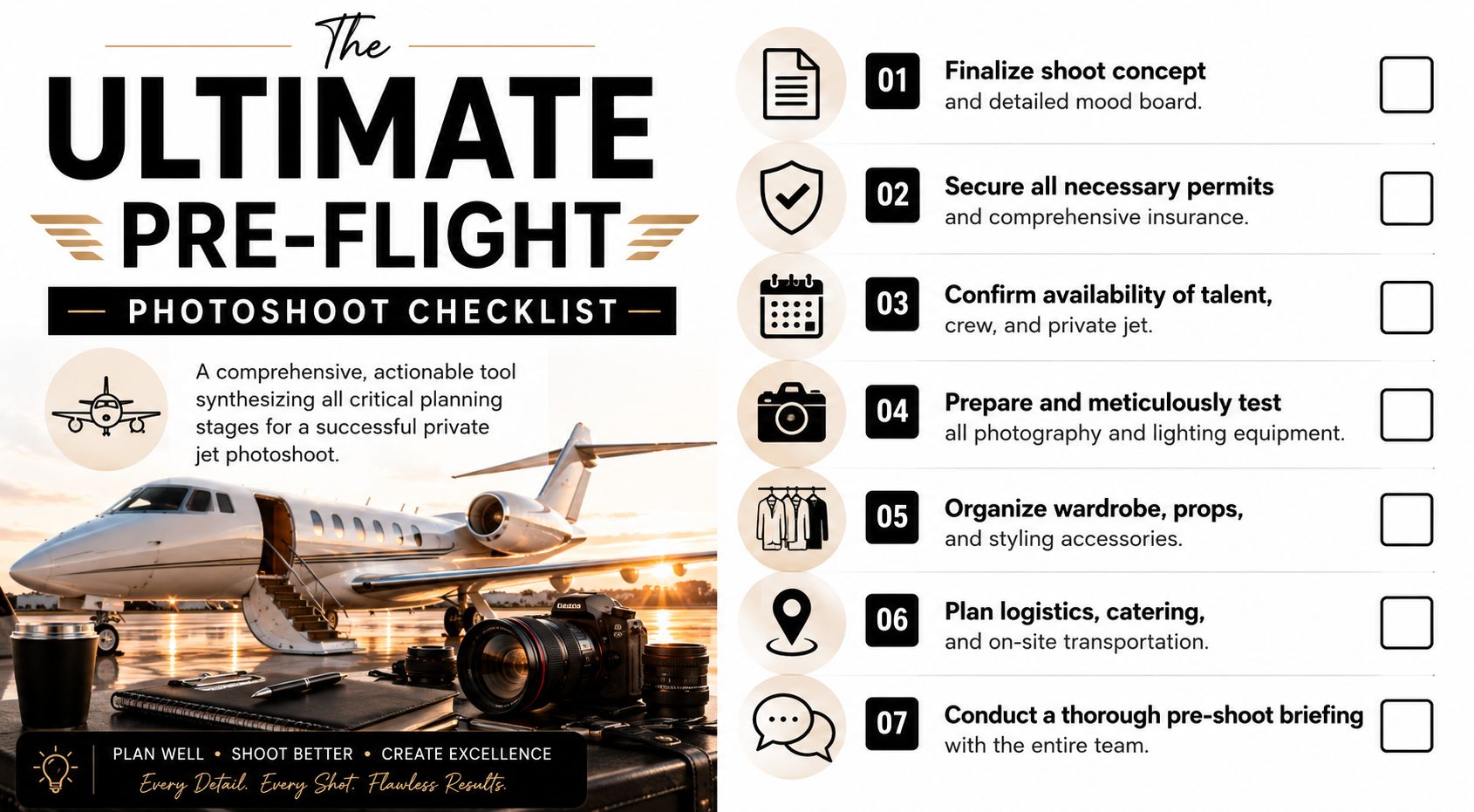
Booking and aircraft confirmation
- Lock the exact visual ask. Cabin-only, exterior-only, or both.
- Confirm the aircraft you're getting. Tail number, current cabin look, seat configuration, and usable angles.
- Verify access conditions. Ramp, hangar, FBO-adjacent, or airborne.
Pre-production and logistics
- Clear the paperwork early. Insurance, certificates, crew lists, and any airport-specific approvals.
- Align schedule with access reality. Don't promise dawn beauty shots on a jet you can't access until later.
- Build a realistic call sheet. Include security check-in, gear transfer, glam holding, and client review flow.
On-set equipment and protection
- Prep compact gear. Small LEDs, minimal stands, efficient lenses, and a reduced cabin footprint.
- Protect every contact surface. Flooring, thresholds, seat edges, and work zones.
- Have a power plan. Don't assume the aircraft will solve it for you.
Crew and talent coordination
- Brief everyone on aircraft etiquette. What can be touched, where people can stand, and how cases move.
- Stage support outside the cabin. Wardrobe, makeup, digital review, and catering should live off-aircraft if possible.
- Name one decision-maker on set. The operator and FBO need a single production contact, not six.
A polished private jet shoot isn't about acting expensive. It's about running the day with enough discipline that the luxury environment stays intact while the creative team gets the images they came for.
If you need an aircraft for a production that involves real charter logistics, specific cabin requirements, or exact aircraft sourcing, Haute Jets is one option to review. Their model centers on sourcing exact aircraft from owner-operators, which can be useful when a shoot depends on a particular cabin layout, tail-specific confirmation, and clear pre-flight details rather than a generic jet category.