

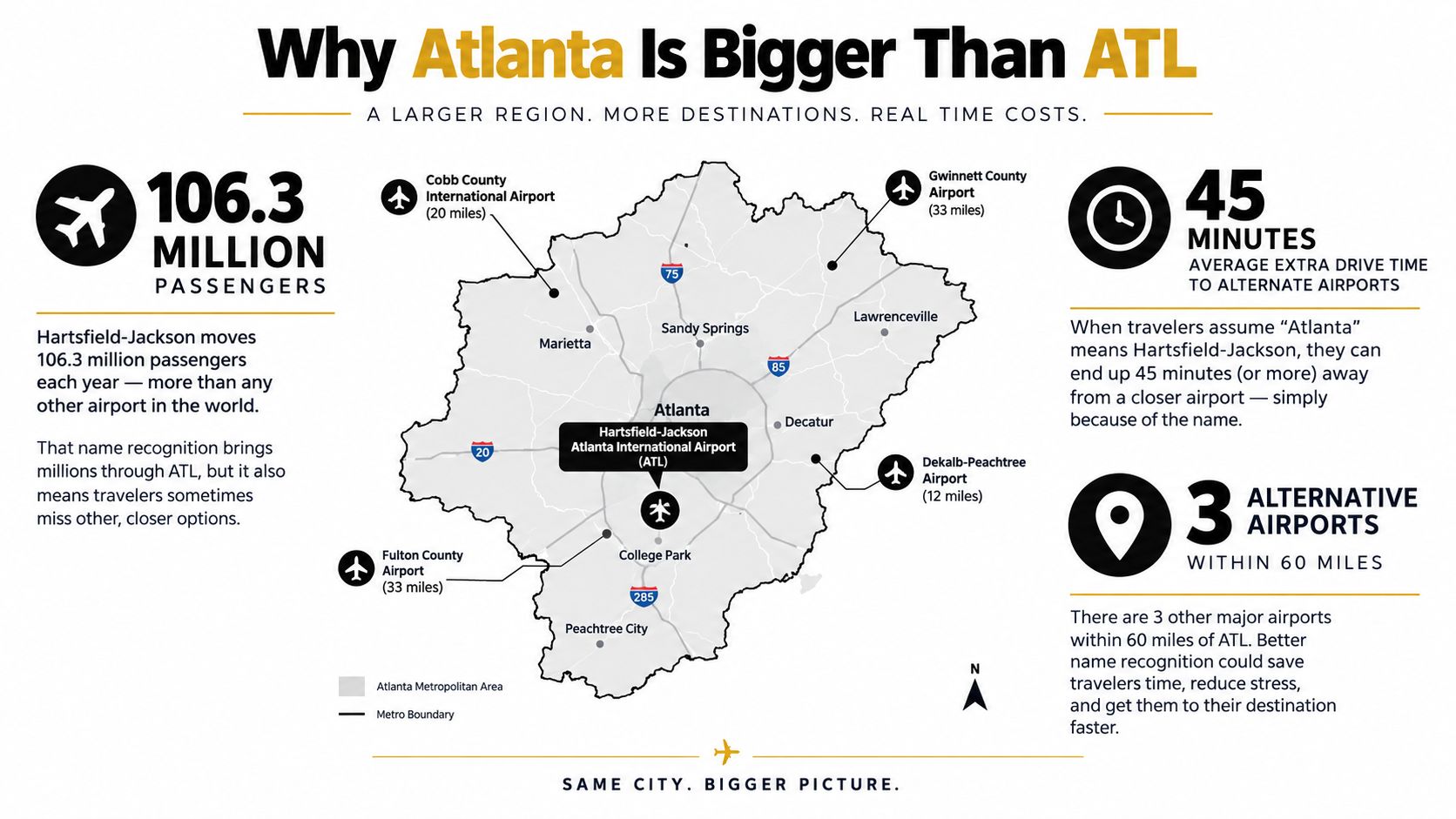
Most advice on a private jet to Atlanta starts with the wrong question. Travelers fixate on the aircraft first, then treat the airport as an afterthought. In Atlanta, that's backward. The airport choice changes the trip more than the cabin does, because this metro sits inside one of the busiest aviation systems on earth, with Hartsfield-Jackson Atlanta International Airport handling about 106.3 million passengers in 2025 and roughly 805,268 aircraft operations that same year, according to the airport's published history and traffic profile. Hartsfield-Jackson Atlanta International Airport overview
If you book Atlanta like a commercial flyer, you'll waste time in the wrong places. The smarter play is to pick the airport that cuts ground time, avoids terminal friction, and fits the customs or runway realities of the mission. That's the lens I use when I book Atlanta flights every week, and it's the lens that keeps clients from paying for convenience they never use.
Why Atlanta Is Bigger Than ATL
ATL is the name everyone knows, and that familiarity is exactly why it gets overused. Private aviation in Atlanta works better when you stop treating the commercial hub as the default answer. The question is which airport cuts ground time, avoids airline congestion, and matches the trip you are flying.
Name recognition is not a routing strategy
ATL sits at the center of a massive aviation system, and that scale shapes everything around it. The airport opened on September 15, 1926, and it has ranked as the world's busiest airport by passenger traffic for most years since 1998. That history explains the airport's importance, but it does not make it the right choice for a private itinerary. ATL airport history and traffic profile
If you are flying privately, the friction shows up at the edges. Commercial sequencing, surface traffic, and airport access can turn a simple arrival into a slow one. A meeting in Buckhead, a dinner downtown, or a destination north of the city usually points you away from ATL, not toward it.
Practical rule: book the airport that shortens the full door-to-door journey, not the one that sounds most familiar.
Atlanta's reliever airports exist for that reason. They are set up for general aviation, not airline volume, so the experience is different the moment you land. For a private jet to Atlanta, that difference is often what saves time.
Why the city's scale changes the decision
Atlanta is spread out, and the road network does not forgive a poor airport choice. An airport that looks central on a map can still leave you on the wrong side of traffic for a northside office or a downtown event. Private aviation should remove friction, so the airport decision has to be made around the final stop, not the city name.
Ask the operator a few direct questions before you book. Which airport gets you closest to the actual destination. Which field fits the aircraft without repositioning headaches. Which location handles customs if the trip starts abroad. Weak operators dodge those questions, and that usually means you are about to pay for convenience you will not feel.
Choosing Between ATL, PDK, FTY, and LZU
Atlanta has four airports that matter in private aviation conversations, but they don't do the same job. PDK is the default for a lot of corporate and executive traffic, FTY serves the west side and broader reliever role, LZU can make sense for north and northeast metro trips, and ATL stays relevant when airline connections, international handling, or operational needs force the issue. That's the right hierarchy, and it's the one too many brokers still get wrong.
What each airport actually does
PDK is the most important private-aviation field in metro Atlanta. DeKalb County identifies it as Georgia's second-busiest airport and the Atlanta region's premier general-aviation reliever facility, located about 8 miles from downtown. It averages about 170,000 annual operations over the past five years, has about 409 based aircraft, 125 aviation-related businesses, and an estimated annual economic impact of $819 million for DeKalb County. DeKalb-Peachtree Airport overview
FTY is the west-side reliever. Fulton County classifies it as a general-aviation airport and an FAA-designated reliever intended to reduce congestion at ATL. For travelers bound to west Atlanta, Midtown's western edges, or destinations that benefit from avoiding east-side surface traffic, it's often the cleaner option. Fulton County Executive Airport audit
LZU works best when the destination sits farther north or northeast in the metro. It's not the first airport people name, but that's exactly why it deserves a place in the conversation. A lot of Atlanta trips are really suburban or exurban trips, and the right reliever airport often matters more than the aircraft model.
ATL still has a role, but only for specific missions. If you need airline connections, a particular handling setup, or an international flow that makes ATL the cleanest arrival point, then use it. Don't default to it just because it's the city's flagship airport.
| Airport | Best For | Typical Use |
|---|---|---|
| PDK | Downtown, Buckhead, Midtown, north Atlanta | Corporate arrivals, executive travel, event access |
| FTY | West Atlanta, west metro, regional positioning | Reliever airport for private and corporate traffic |
| LZU | North and northeast metro destinations | Local access for suburban and exurban itineraries |
| ATL | International scale, airline connections, specific handling needs | Select private operations and mixed commercial itineraries |
If you're comparing arrival points, the practical question is simple. Which airport cuts the most total time, not just airborne time? For a routing example tied to the commercial side of ATL, see the Hartsfield-Jackson Atlanta private terminal page, then compare that against the reliever-airport options above.
Aircraft Categories for the Routes You Actually Fly
The right aircraft for Atlanta isn't the flashiest one. It's the one that covers your route cleanly, carries the people you have, and doesn't force a fuel stop or a wasteful upsell. If you're still choosing by cabin glamour, you're asking the wrong question.
Match the jet to the route
For short Southeast hops, light jets usually make the most sense. Think quick departures from nearby business centers, smaller passenger loads, and trips where a compact cabin is more than enough. They're the practical choice when you want speed, not ceremony.
For mid-continent city pairs, midsize jets are the workhorse. They're the category most Atlanta travelers should ask about first because they handle a broad set of domestic routes without overcommitting on cabin size. If you want a deeper look at that segment, Haute Jets' midsize jet fleet page is the right place to compare layouts and mission fit.
Super-midsize jets earn their keep when the trip stretches longer or the passenger load gets less forgiving. They're the cabin category you bring in when comfort starts to matter as much as range. For coast-to-coast missions, they're often the clean middle ground.
Heavy and ultra-long-range jets belong on international or especially demanding domestic itineraries. If the trip involves more people, more luggage, or a route where you want the aircraft to do the job in one clean push, that's where this category belongs. Don't book one just because it sounds premium. Book it because the mission needs it.
Operator test: ask which aircraft can fly the route without an inconvenient stop, then ask what the backup plan is if weather or payload changes that answer.
Route fit beats brand preference
Atlanta is well connected to major U.S. business centers, so the route usually tells you more than the brand name does. A lighter aircraft can be perfect for a short domestic hop and a terrible choice for a long leg that invites unnecessary complexity. A heavier cabin can feel luxurious and still be the wrong call if the route doesn't justify it.
That's why a serious booking conversation starts with origin city, passenger count, and baggage reality. Once those are clear, aircraft category becomes a routing decision instead of a lifestyle decision. That shift saves time and usually saves money too.
What Actually Moves the Price on a Charter to Atlanta
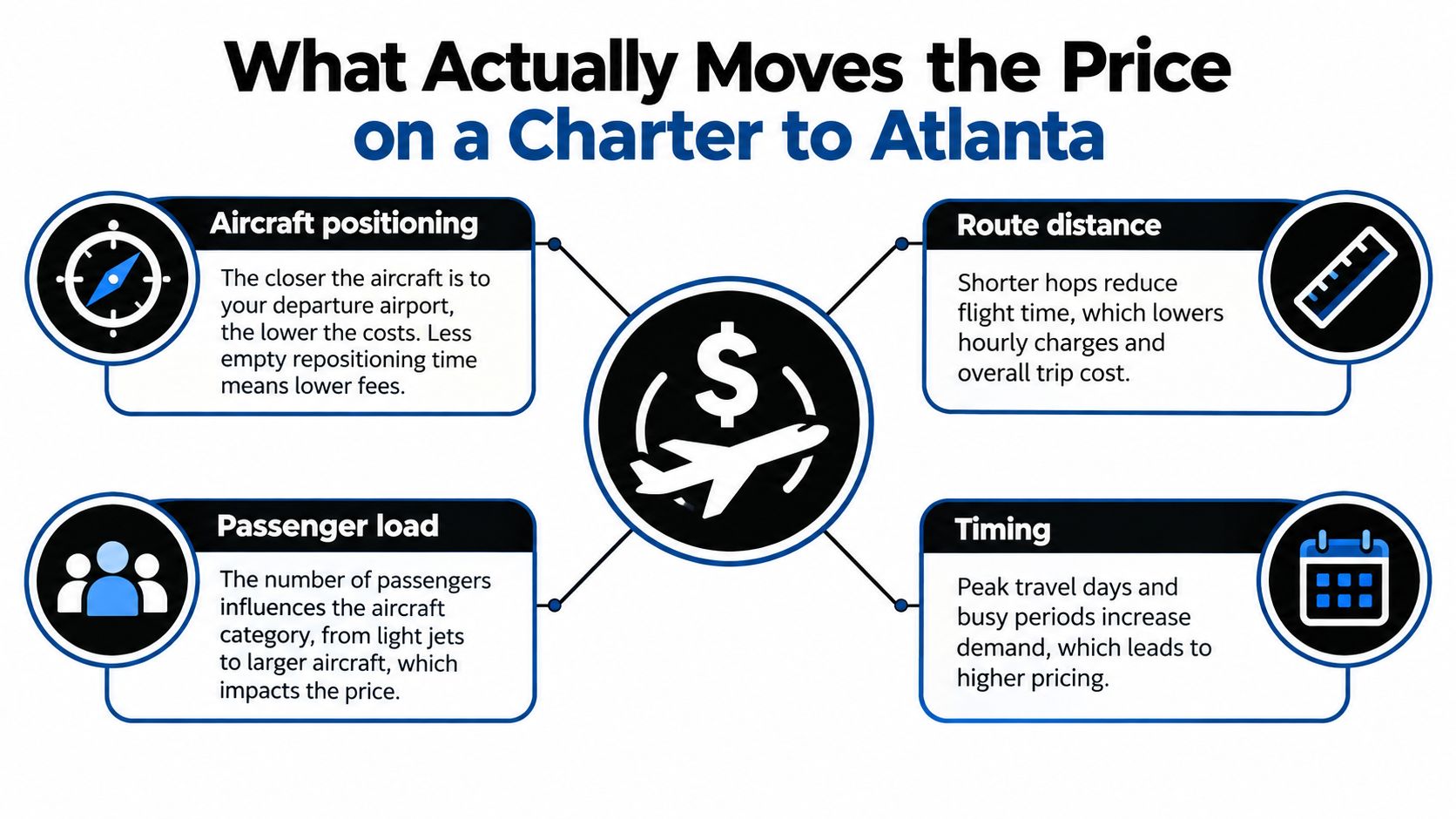
The biggest pricing mistake is assuming the hourly rate tells you the whole story. It doesn't. Atlanta quotes swing because aircraft positioning, route structure, crew timing, and airport handling all push the final number around in ways most travelers never see until the invoice lands.
Positioning is the hidden lever
Aircraft positioning is the first number I check. If the aircraft is already based near your departure city, you can avoid the repositioning leg that brokers and jet-card programs often bury in the quote. In charter pricing discussions, repositioning can inflate the trip by 20–40% when the aircraft has to be ferried in from somewhere else. Aircraft positioning and pricing mechanics
That's why two quotes for the same route can look wildly different. Same passengers. Same city pair. Same cabin category. Different aircraft location, different answer.
Practical rule: always ask where the tail is based before you ask for the final number.
The rest of the price is usually a stack of ordinary frictions. Crew duty time can force an overnight. Different airports can change landing or handling costs. Peak timing can tighten supply. If you're comparing quotes and nobody can explain those line items clearly, they're hiding something in the math.
What to ask before you sign
A good operator can tell you whether the aircraft is local, whether the quote includes positioning, and whether the route creates duty-time pressure. A weak one gives you a neat number and hopes you won't ask how it was built. That's where surprises happen.
If you want a straightforward cost framework, Haute Jets keeps a separate private jet charter cost guide that helps shoppers understand the moving parts before they compare quotes. For a more visual breakdown, the infographic below shows how those pieces fit together.
For travelers who want a studio-grade visual setup, the Private Jet studio rental from Encore Film And Music Studio can be useful when the itinerary is tied to production or branded content work.
Weather, Customs, and the Atlanta Pre-Flight Review
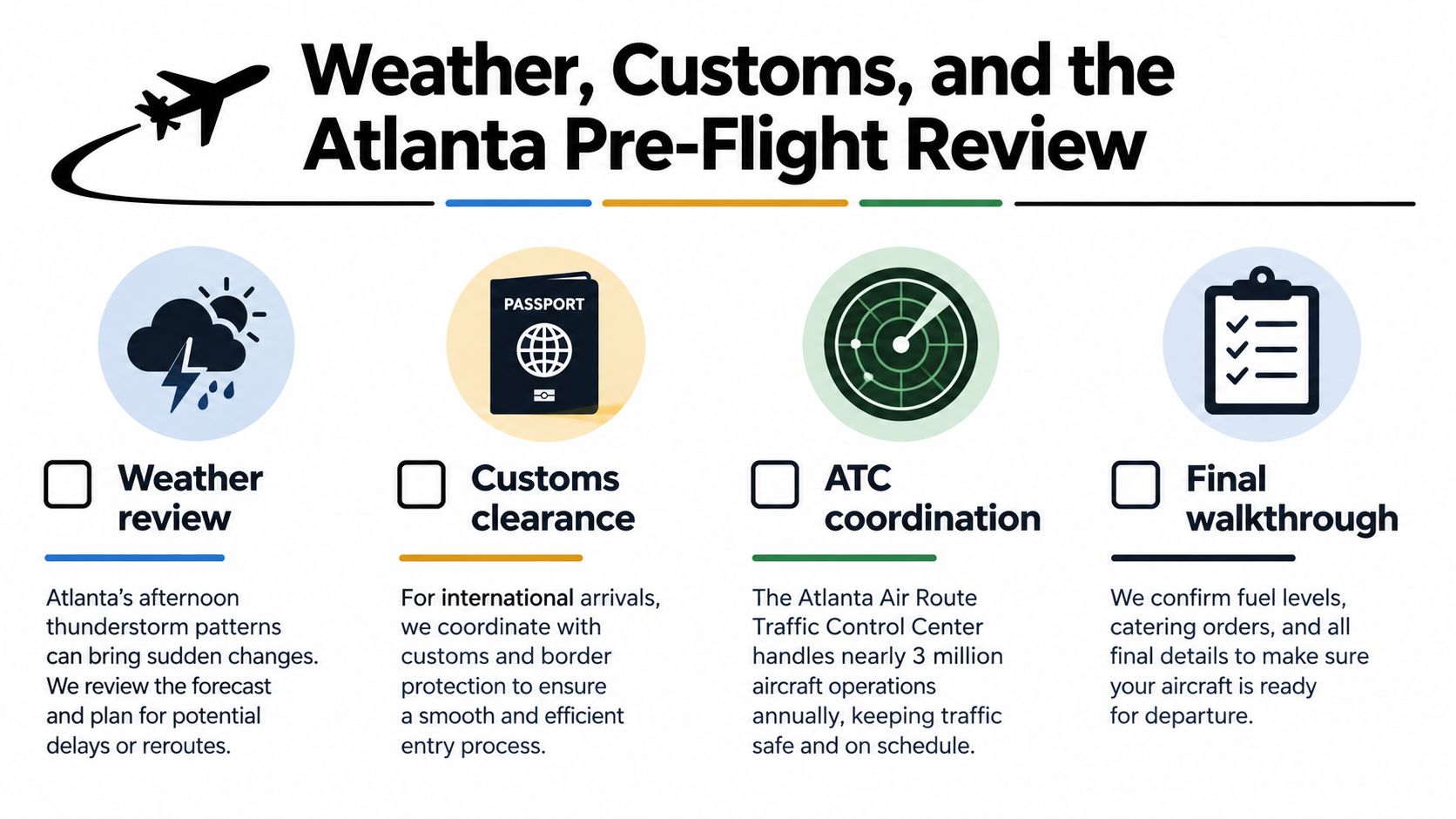
Private flying buys flexibility. It does not buy a pass on Atlanta weather, customs timing, or airport flow. The operators worth using treat the pre-flight review as part of the trip, because small misses here turn into delays fast.
What the dispatch review should cover
Atlanta sits under busy airspace control, and that matters on days when weather turns messy. The Atlanta Air Route Traffic Control Center overview explains how weather and traffic flow in the region can affect more than one airport at a time. Thunderstorms, low ceilings, icing, turbulence, and reduced visibility can all force reroutes, holding, or traffic management.
A proper departure review should answer four questions:
- Weather: What are the arrival and alternate minimums, and how is convective risk being handled?
- Alternates: If ATL or the primary field tightens, what airport is filed?
- Fuel: How much reserve is loaded if holding or rerouting starts?
- Dispatch assumptions: Is the operator planning for a clean arrival, or only hoping for one?
If those answers stay vague, the operator is guessing.
Customs timing is not a detail
International arrivals need the same discipline. U.S. Customs and Border Protection requires private aircraft to secure landing permission before departure and to give customs advance notice before arrival. Inspection availability is tied to specific airport arrangements and business hours, so the operator has to confirm the customs window before wheels-up, not after. If you want a clean international arrival into Atlanta, PDK handling, parking, and customs coordination must be settled in writing.
If the operator cannot confirm that plainly, you are not booked. You are hoping.
How to Vet the Operator Before You Confirm
The aircraft matters less than the operator flying it. Atlanta travelers should be ruthless about this, because a polished cabin means nothing if the operator runs a sloppy dispatch, weak maintenance program, or vague day-of communication. I'd rather have a modest jet from a disciplined operator than a nicer aircraft from a crew that improvises.
What the ratings do and don't tell you
Wyvern Wingman and Argus Gold or Platinum are the third-party safety audits I want to see first. They tell you the operator has passed a serious external review of its safety systems, but they don't answer every practical question about your specific flight. They don't tell you whether the crew has recent experience on your exact mission, whether the cabin setup fits your baggage, or whether the operator is being transparent about the day's weather picture.
That's where the conversation has to get sharper. Ask who's operating the tail, who the captain is, what maintenance program the aircraft follows, and what insurance coverage supports the booking. If the operator hesitates, keep looking.
The five-minute vetting script
A solid booking call should cover these items without drama:
- Tail number: What exact aircraft is being assigned?
- Crew bios: Who's flying, and what's their recent experience?
- Weather briefing: What risks are baked into the route?
- Passenger manifest: Is everyone and everything documented correctly?
- 24-hour confirmation: Will you receive the flight details in writing before departure?
That last item matters more than people think. A real operator confirms the flight cleanly before the day of travel, not after the FBO starts asking questions.
Bottom line: if the operator can't answer clearly before you pay, they won't get sharper after you book.
If you're evaluating options across the market, Haute Jets is one of the operators that sources from a broad owner-operator network and confirms the full trip details before departure. That's the standard Atlanta travelers should expect everywhere, not a special favor.
Peak Demand and the Atlanta Calendar
Atlanta gets busier in recognizable waves, and private aviation pricing and availability follow those waves more closely than most travelers admit. The city is an event market, which means airport choice, booking lead time, and aircraft sourcing all get tighter when the calendar fills up.
Event weeks change the sourcing game
Mercedes-Benz Stadium traffic pushes a lot of private demand toward the same arrival windows, and that creates pressure on the obvious fields first. SEC football Saturdays do the same thing. So do major conventions and other citywide events that bunch arrivals into short bursts. If you wait until the week of the event, you're often shopping from what's left, not from the full market.
World Cup 2026 adds another layer. Atlanta is a host-city market, and the private-jet guide tied to those match days notes that aircraft availability can tighten 7 to 10 days before knockout-round matches. World Cup 2026 private jet guide That's the kind of lead time many travelers underestimate.
Don't book the city on autopilot
When demand spikes, the airport with the best name is not always the airport that still has room. PDK and FTY absorb a lot of the private-aircraft overflow, while ATL can become harder to use efficiently because of broader system pressure. The best operators know this and start sourcing earlier than the client expects.
If you're handling sports, entertainment, or event travel, build the quote around the calendar, not around hope. Earlier sourcing gives you more aircraft choice, better airport flexibility, and fewer ugly surprises once the city gets busy.
Your Atlanta Charter Booking Checklist
A good private jet to Atlanta booking starts with one decision and ends with a written confirmation. Pick the airport that matches the destination, not the one that sounds familiar. Then force the operator to show its work on aircraft sourcing, repositioning exposure, customs timing, and weather contingencies.
Before you confirm, ask these questions:
- Which Atlanta airport fits the actual destination?
- Where is the aircraft based, and is repositioning included?
- What happens if weather or airspace constraints tighten the itinerary?
- If this is international, are customs permission and handling already sorted?
- Will I receive tail number, crew details, weather briefing, and passenger manifest 24 hours before departure?
- Does the operator hold Wyvern Wingman or Argus Gold or Platinum status?
That checklist separates a clean booking from a guess. If the answers are clear, you're probably dealing with a competent operator. If the answers are vague, keep shopping.
Haute Jets arranges private aviation with the same focus Atlanta travelers need, local sourcing, airport selection, and no surprises at the terminal. If you want a tighter charter process for Atlanta or any other city, visit Haute Jets and compare your options before you book.