
You've had that call before. The tail number you expected is suddenly “in maintenance,” the operator has sourced a substitute, and everyone insists the trip is still on. That's the exact moment most charter buyers realize the aircraft's rating was never the whole story.
Reliable jet maintenance is not a slogan. It's the discipline behind whether a specific aircraft is legally ready, mechanically ready, and operationally ready when your wheels are supposed to leave the ground. If you buy charter by brand reputation alone, you're guessing. If you check the tail number, the records, and the contingency plan, you're buying with eyes open.

What Reliable Jet Maintenance Actually Means
The first mistake charter buyers make is treating a strong operator rating like a guarantee that the aircraft on your trip is ready. It isn't. A clean safety rating tells you the operator has baseline discipline, but reliable jet maintenance lives at the tail-number level, where the actual aircraft's records, defects, parts, and release-to-service status either support the trip or sink it.
Three layers matter
Think in three layers, not one. Airworthiness and regulatory compliance answer whether the aircraft can legally fly. Mechanical dispatch reliability answers whether the jet is likely to go on time without a maintenance surprise. Schedule resilience answers what happens when a defect, part delay, or engine issue still interrupts the plan.
Practical rule: If a provider can't talk clearly about the specific aircraft, not just the fleet, you don't have enough information.
That's why I ignore vague answers about “our standards” and ask for details tied to the tail number. A jet can be safe and still be unavailable. A polished cabin can still sit because a component is in overhaul or a logbook entry is incomplete. Marketing copy won't tell you that, but the maintenance control system will.
If you want a useful framework for the difference between upkeep that prevents problems and work done after something breaks, preventive vs corrective maintenance is a solid general primer. For aviation-specific context, Haute Jets also publishes material on what MRO means in aviation, which helps frame why the back end matters as much as the aircraft you see on the ramp.
The contrarian point is simple. A top-tier operator badge is necessary, not sufficient. The buyer who wins is the one who checks the aircraft, not just the logo.
Continuing Airworthiness Explained Through an Analogy
A spotless dining room tells you nothing about the kitchen. That's the right analogy for continuing airworthiness. A jet can look immaculate on the ramp, but if the maintenance program behind it isn't controlled, documented, and current, the exterior means very little.
The kitchen behind the aircraft
In a serious maintenance system, approved technical data tells the technician what's allowed, controlled records show what's already been done, authorized return-to-service documentation proves the aircraft was released correctly, and ongoing airworthiness-directive compliance keeps the aircraft aligned with mandatory corrections. Those four pieces work together. Remove one, and the whole process becomes harder to trust.
The European continuing-airworthiness framework requires detailed maintenance records to be kept until another equivalent maintenance action is performed, and never for less than 36 months (EASA continuing-airworthiness FAQ). That floor matters because it gives operators, regulators, and maintenance teams a history of what was done, when it was done, and how the aircraft went back into service. It's a minimum, not a badge of quality.
The cause-and-effect chain is straightforward. Complete records let maintenance control establish configuration and regulatory status. Correct status helps prevent overlooked time-limited components or recurring defects. Authorized release-to-service documentation then proves the aircraft is legally and technically ready to operate.
A recent inspection isn't proof of control. A history of disciplined records is.
That's the question savvy buyers should ask: not “Was the jet inspected?” but “Can you show me the current status, the open items, the return-to-service sign-off, and the directive compliance history for this tail number?”

What Wyvern and ARGUS Ratings Really Cover
A Wyvern Wingman badge or ARGUS Gold or Platinum status is a strong starting filter. I would not book charter from an operator that fails a serious third-party audit. But those ratings review the operator, not the exact aircraft sitting on the ramp for your flight.
What the badge does, and doesn't, tell you
An operator audit shows the company has procedures, training, and oversight that meet a defined standard. That matters. It does not tell you whether the specific tail number has an open defect, how recent the audit was, what maintenance records were reviewed, or whether the approval covers the whole fleet or only selected aircraft.
Haute Jets says it sources only from operators with Wyvern Wingman or ARGUS Gold or Platinum status, and that is the right baseline to expect. If you want a closer look at that screening layer, Haute Jets' ARGUS-rated charter operators guide is useful.
Buyers get stuck at the badge. That is a mistake. A rated operator can still assign an aircraft that passes audit but is not the best fit for the trip, or one that looks fine on paper and is close to maintenance timing. Treat the rating as the entry ticket; the tail number and maintenance records are the actual proof.
What I ask after the rating is confirmed
- Which aircraft did the audit cover? I want to know whether the rating applies to the whole fleet or a narrower set of aircraft.
- How current is the audit status? Older approvals deserve a closer look.
- What parts of the operation were excluded? Training, documentation, and line maintenance can be covered differently.
- What changed since the last review? A recent swap in aircraft, management, or maintenance provider can matter more than the badge itself.
That is the right operator-level screening. It tells you whether the badge is meaningful, how broad it is, and where the blind spots may be. The badge opens the door. The specific aircraft records show whether the flight is ready.
Typical Service Intervals and What They Actually Catch
Scheduled maintenance isn't arbitrary. It exists because problems don't wait politely for a convenient time. Most private jets require checks every 50 to 100 flight hours or every 6 to 12 months, whichever comes first, while heavier and ultra-long-range aircraft can tighten that to 25 to 50 flight hours because their systems are more complex (Haute Jets Journal on maintaining private jet safety and reliability).
Intervals exist for a reason
Hours catch wear from utilization. Calendar limits catch the stuff flight hours miss, like corrosion, seal degradation, and stale documentation. That's why serious maintenance programs use both triggers together. A jet can fly lightly and still need attention because time keeps moving even when the aircraft is parked.
| Check Type | Light and Midsize Jets | Heavy and Ultra-Long-Range Jets | What It Catches |
|---|---|---|---|
| Scheduled inspection | Every 50 to 100 flight hours or every 6 to 12 months | Every 25 to 50 flight hours in some programs | General airframe, systems, and documentation issues |
| Engine inspections | Scheduled on manufacturer and utilization basis | Scheduled on manufacturer and utilization basis | Wear, contamination, and performance drift |
| Avionics testing and software updates | Periodic and model-specific | Periodic and model-specific | Navigation, communication, and system compatibility |
| Unscheduled repairs | As defects arise | As defects arise | Breakdowns, squawks, and AOG events |
The best simple example is the Gulfstream G-IVSP. It requires a major inspection after every 5,000 landings, and that structural check can coincide with a full paint refurbishment (Haute Jets Journal on the G-IVSP). That's not cosmetic fluff. It's a reminder that landing cycles matter just as much as hours or dates on the calendar.
If you want a deeper maintenance-planning lens, Haute Jets also covers preventive maintenance in aviation, which is the right mindset here. Plan work before the aircraft tells you it's overdue.
For broader maintenance-process thinking, a practical guide for plant reliability managers can also sharpen how you think about inspections, condition monitoring, and planned intervention. The aviation version is stricter, but the discipline is similar.
The Hidden Reliability Risk Nobody Talks About
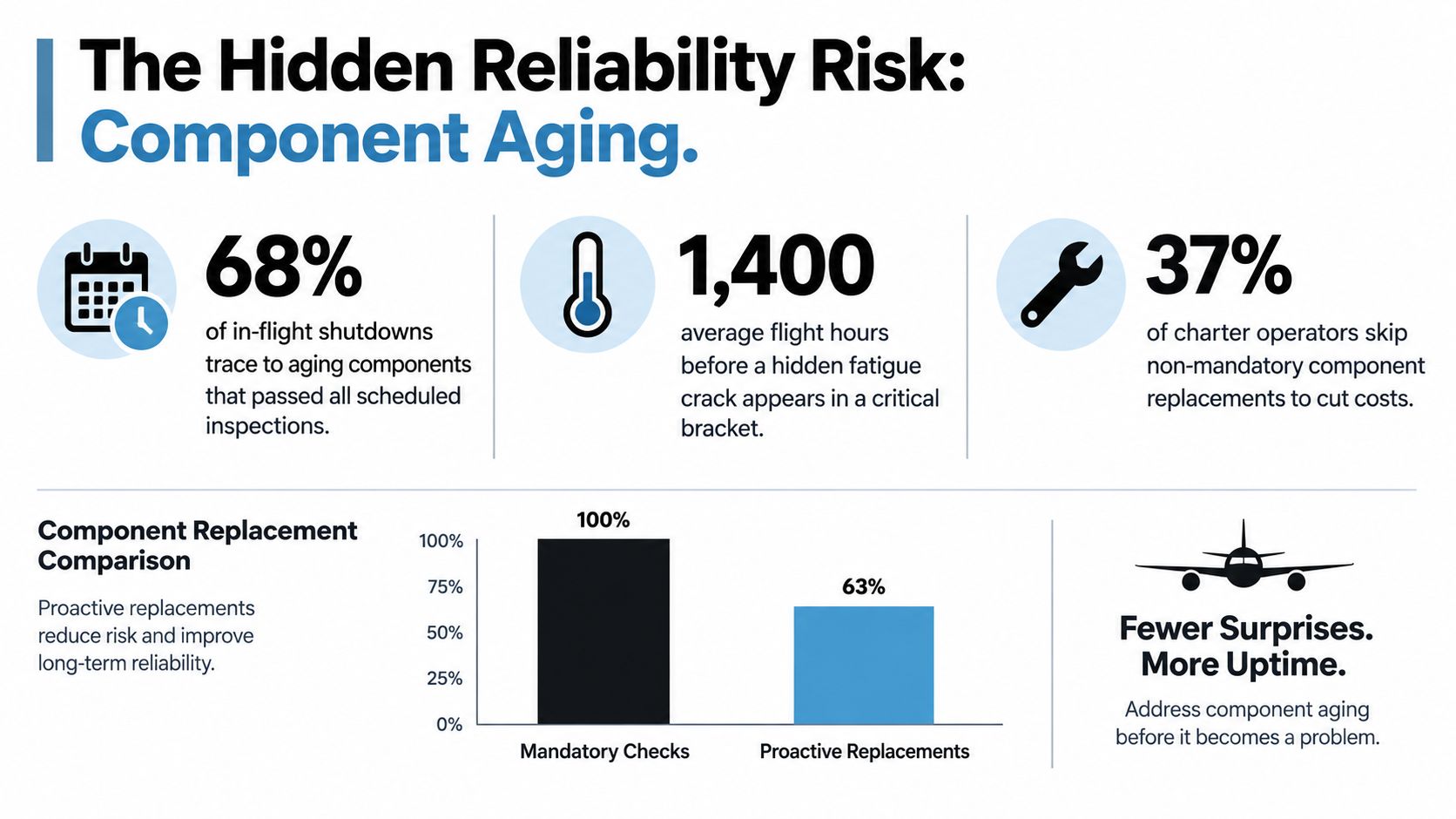
A perfectly maintained jet can still fail your trip if the maintenance ecosystem around it is strained. That's the part most charter content skips. Reliability is not just about the aircraft, it's about the labor, parts, and shop capacity available when something needs fixing.
Supply chain pressure changes the equation
Recent industry data show that global MRO spending exceeded $136 billion in 2025, two-thirds of surveyed MRO organizations said finding qualified technicians had become moderately to very challenging, and a separate analysis projects a global AMT shortfall of about 22,000 full-time employees by the end of 2026, potentially rising to about 60,000 by 2029 (Oliver Wyman on aviation MRO labor and supply chain pressure). That's not background noise. That's the operating environment.
Repair wait times for modern engine issues have reportedly increased 150% in the same market context (BCG on aerospace maintenance constraints). So a newer aircraft with a fancy cabin can still be the wrong choice if the exact engine or part it needs is stuck in line. Older aircraft with mature support networks can sometimes be more predictable than newer jets trapped in a bottleneck.
Human factors still break good systems
Human error doesn't need drama to cause trouble. Workload, task complexity, fatigue, and documentation quality all shape whether a maintenance action lands correctly. FAA human-factors guidance points to the need for current manufacturer procedures, independent inspections where required, standardized sign-offs, clear shift handovers, controlled access to records, and fatigue-aware staffing (FAA AC 119-2A).
Practical rule: If the operator can't explain handovers, inspection sign-offs, and defect tracking without hand-waving, the maintenance process is too loose for my taste.
A useful way to think about this is failure modes. For a general framework on how hidden failures show up in systems, failure mode analysis is a helpful reference point. In aviation, the principle is the same. Strong maintenance is not a single action, it's a chain of small controls that stop small mistakes from becoming trip-ending problems.
Your Preflight Maintenance Verification Checklist
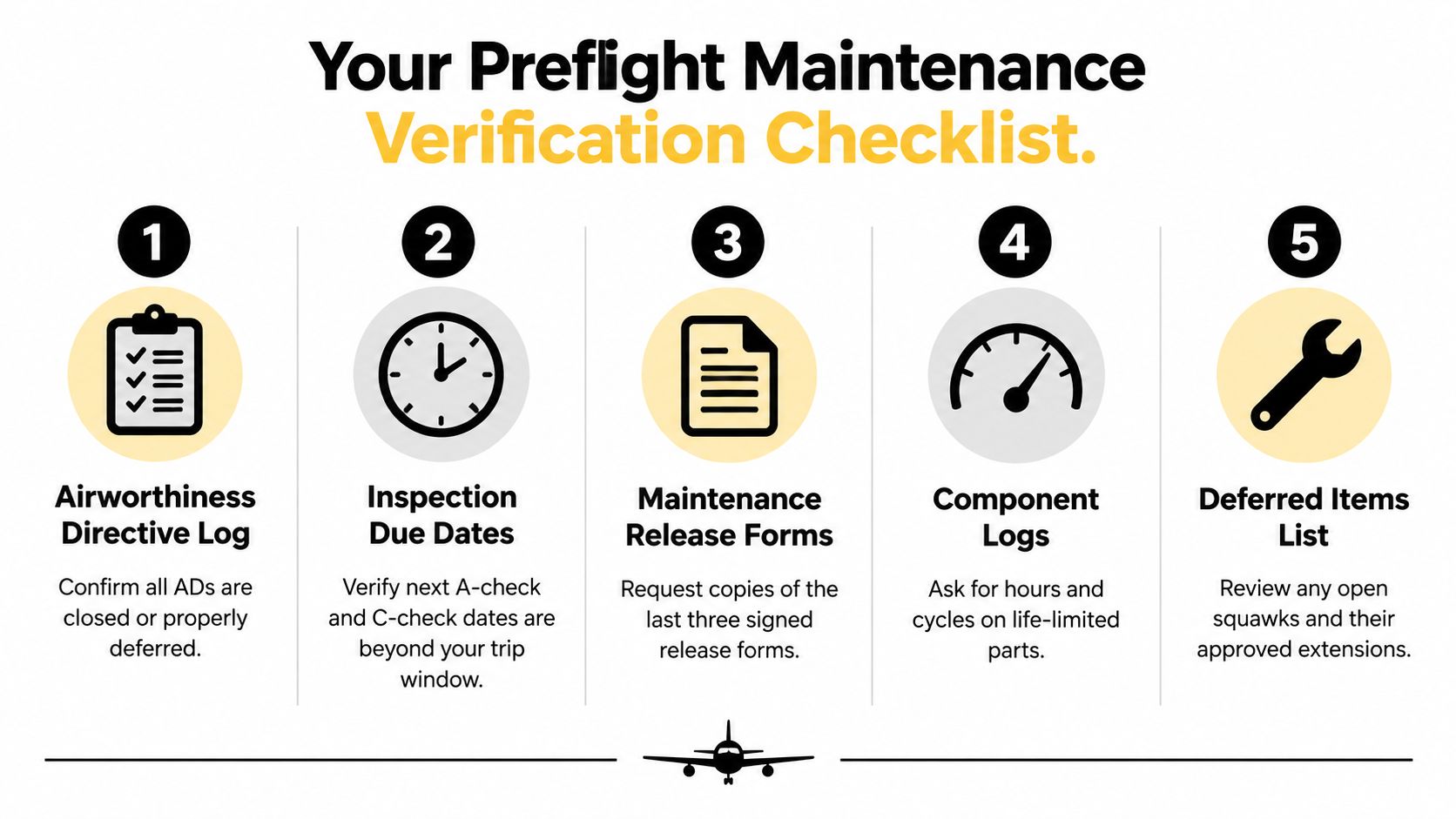
If you only keep one part of this article, keep this one. It's the checklist I'd hand to any charter desk before I'd trust the trip. It's short, direct, and focused on the exact points that separate a good-looking quote from a reliable departure.
Ask these questions by tail number
- Confirm the exact tail number 24 hours before departure. A vague fleet promise is worthless. You want the aircraft that will show up.
- Ask whether any deferred defects affect the trip. The right answer is plain language, not jargon. If there's an open item, ask whether it touches your itinerary.
- Request visibility on scheduled engine or major component work in the next 30 days. You're not asking for the shop's secrets, just the timing risk that could disrupt your flight.
- Verify the operator's third-party safety status. Wyvern Wingman or ARGUS Gold or Platinum should be easy for them to confirm.
- Ask about substitute aircraft and escalation contacts. If the assigned tail changes, you need a live human and a documented fallback.
The strongest operators answer these questions quickly and specifically. Weak operators stall, generalize, or redirect to brand reputation. That's how you know where control sits.
Practical rule: A good answer names the aircraft, the status, and the backup. A bad answer talks about the company.
Haute Jets says its standard 24-hour pre-flight confirmation discloses tail number, crew bios, weather briefing, and passenger manifest. That's the right kind of discipline to look for, because it forces the operator to show its work before the trip gets close.
How Schedule Resilience Completes the Picture
Two travelers can book the same route and have very different outcomes. One books through a broker that grabs whatever aircraft is repositioning closest. The other books through a provider that sources locally, confirms the tail number ahead of time, and has a real escalation path if the aircraft changes. When a maintenance event hits, those two choices don't behave the same way.
Resilience is operational, not cosmetic
Local sourcing removes a lot of repositioning noise, which matters because a perfectly good aircraft can still be the wrong aircraft if it's halfway across the country. It doesn't magically eliminate maintenance risk. An engine problem can still happen. A defect can still appear. What changes is how gracefully the provider handles it.
That's why I care about the questions behind the booking. Does the provider have access to multiple nearby operators? Are the re-quote or cancellation terms clear if the tail number changes? Is the confirmation deadline realistic, or is it just a sales tactic that hides the uncertainty until the last minute?
A reliable trip isn't one that never faces a maintenance issue. It's one that absorbs the issue without turning your schedule upside down.
The three-layer model comes back into focus. Airworthiness tells you the aircraft can fly. Dispatch reliability tells you it's likely to leave on time. Schedule resilience tells you what happens if reality intervenes anyway.
If you're comparing providers, judge them by the specificity of their answers, not the polish of their pitch deck. That's the difference between buying an aircraft seat and buying a controlled outcome.
Haute Jets builds charter around the exact controls serious buyers should demand, from tail-number confirmation to operator screening and contingency support. If you want a charter team that treats maintenance status as a booking requirement, not an afterthought, visit Haute Jets and ask for the aircraft-specific details before you commit.