
You're usually not choosing between a propeller aircraft and a jet because you care about image. You're choosing because the trip is awkward. Three meetings in secondary cities. A resort near a short runway. A factory visit followed by a dinner in another state. The glamorous answer is often the wrong answer.
That's why discerning charter clients keep coming back to small propeller aircraft, especially turboprops. They're not a compromise. They're a tool. Used correctly, they save time where it matters: airport access, ground transfer, short-hop efficiency, and multi-leg practicality.
At Haute Jets Journal, that's the essential conversation. Not “Is a jet nicer?” Sometimes it is. The smarter question is, “Which aircraft gets me closer, faster in total trip time, and with less waste?”
The Smartest Way to Fly Regionally
A common charter mistake is booking for cruise speed instead of mission fit. A client sees “jet,” assumes better, and ignores the fact that the destination sits near an airport a light jet can't comfortably use. Then the trip adds a longer drive, tighter slot coordination, and unnecessary cost.
Small propeller aircraft solve that problem cleanly. They shine when your day involves regional flying, multiple stops, smaller airports, or airfields that reward simplicity over prestige. If you need to leave a major metro in the morning, visit two plants, and get home that night, a turboprop is often the most rational aircraft on the board.
The market supports that reality. The IMARC aircraft propeller systems market forecast estimates the market at USD 381.1 million in 2025, projected to reach USD 542.9 million by 2034, with a 3.89% CAGR during 2026 to 2034. That matters because markets don't grow around obsolete tools. They grow around aircraft that still solve real transportation problems.
Small propeller aircraft remain relevant because regional travelers still need efficient lift into places the airline system and many jets don't serve well.
There's also a practical aerodynamic reason these aircraft continue to hold their place. Propellers convert rotational motion into thrust, functioning as rotating wings. In small aircraft, that translates into useful efficiency for lower-speed regional missions where runway flexibility and operating simplicity often matter more than top-end speed.
Where they make immediate sense
- Multi-stop business days: A turboprop handles frequent short sectors without making the economics absurd.
- Remote leisure access: Golf resorts, ranch properties, island strips, and mountain destinations often favor prop aircraft.
- Regional corporate shuttle flying: Teams moving between secondary cities need reliability and airport access more than cabin theater.
If the trip is under regional stage lengths and the destination infrastructure is limited, the propeller aircraft isn't the fallback. It's usually the right answer.
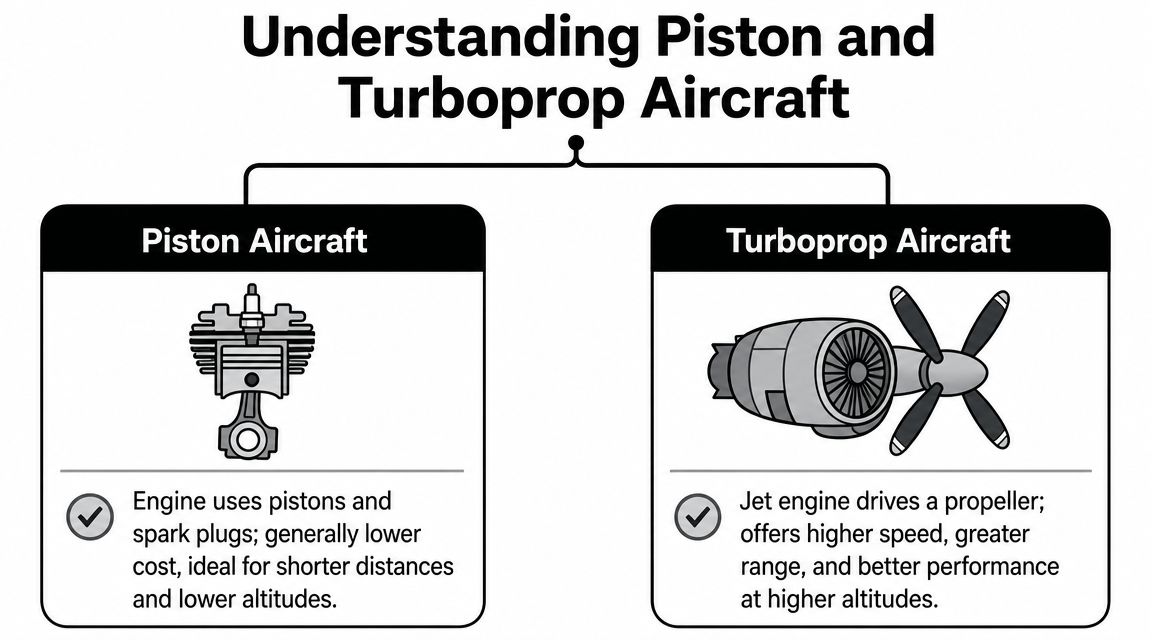
Understanding Piston and Turboprop Aircraft
Most clients don't need an engineering lecture. They need to know what kind of airplane they're stepping into and what that means for comfort, capability, and booking strategy.
The easy analogy is this. A piston aircraft is closer to a high-performance car engine in aviation form. A turboprop uses a turbine engine, more like a compact jet engine that turns a propeller instead of producing pure jet thrust. Both are propeller aircraft. They are not the same product.
What piston aircraft are good at
Piston aircraft are usually the entry point into private aviation. They work well for shorter trips, smaller groups, and straightforward missions where the client wants utility without paying for turbine performance.
You'll usually feel that simplicity onboard. Cabins tend to be tighter, noise levels can be more noticeable, and the experience feels closer to classic general aviation than executive transport. That doesn't make them bad. It makes them specific.
They make sense for:
- Short personal hops: Quick flights where convenience matters more than cabin refinement.
- Light loads: A few passengers and modest baggage.
- Budget-sensitive missions: When the mission is simple and the destination doesn't demand more capability.
Why turboprops are the serious regional tool
Turboprops are where private regional charter becomes strategic. They tend to offer a more polished cabin, better payload flexibility, stronger all-weather utility, and better performance from smaller airports. If you're moving executives, family, or clients, this is usually the category worth focusing on.
For a deeper look at the operational upside, Haute Jets has a useful breakdown on the advantages of a turboprop aircraft.
Practical rule: If you want the smallest aircraft that still feels purpose-built for business charter, start with turboprops, not pistons.
Why propeller design still matters to the passenger
Passengers don't need to calculate blade loading, but design constraints shape the experience they buy. The Embry-Riddle propeller engineering overview notes that designers generally keep blade tip speed below about Mach 0.85 at maximum RPM to avoid a sharp rise in drag and loss of efficiency. That forces a trade between larger, slower-turning propellers and the realities of gearbox complexity and ground clearance.
That sounds technical, but the result is simple. Aircraft designers are constantly balancing efficiency, noise, field performance, and packaging. On a good turboprop, you feel that as a mature product: stable mission capability, sensible short-field performance, and a cabin that works for regional travel instead of merely surviving it.
When to Choose Propeller Aircraft Over a Light Jet
The wrong comparison is “Which one is faster?” The right comparison is “Which one completes this trip better?” Those are not the same question.
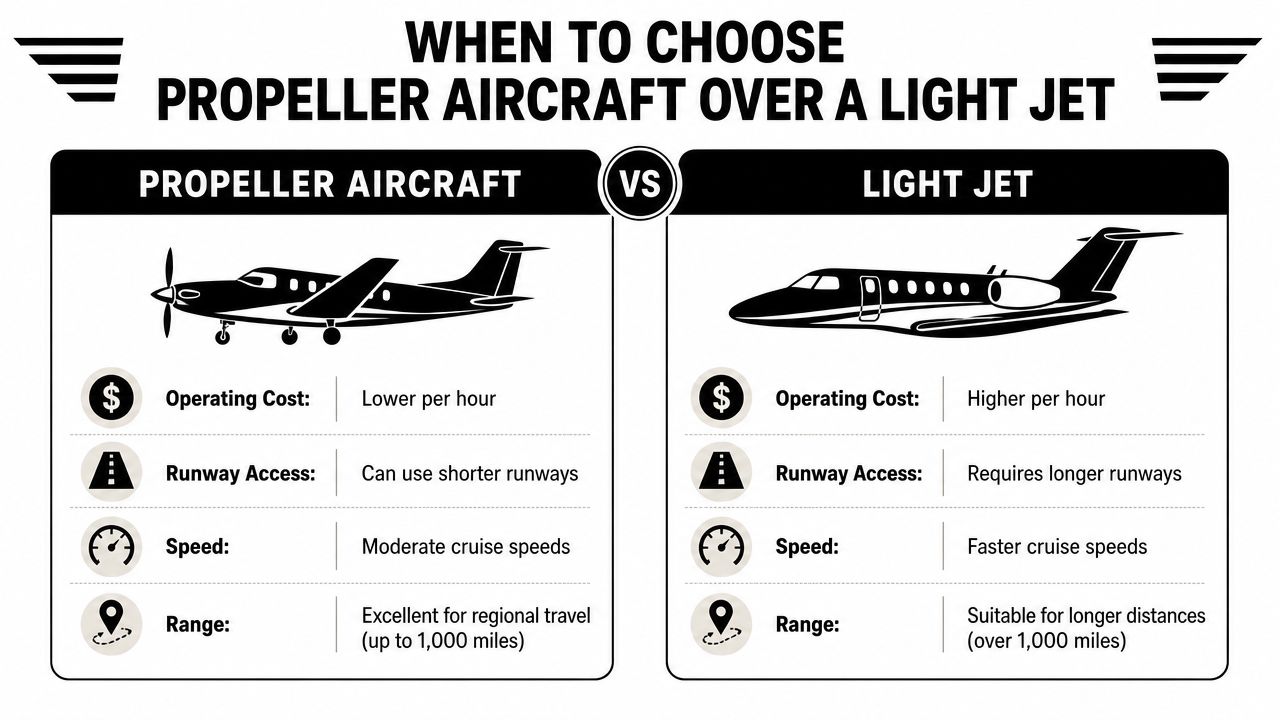
A light jet usually wins the airspeed contest. But charter clients don't live at cruise altitude. They live in the full trip. Drive time to the airport. Runway limits. Baggage handling. Turn time between stops. The airport nearest the actual destination. That's where turboprops start beating light jets in ways that matter.
Airport access changes the whole equation
The strongest reason to pick a turboprop is access. According to BlackJet's turboprop overview, turboprops can use short and even unpaved runways, and for trips under 1,500 km they often become the more practical choice than a light jet because of airport access and lower operating economics.
That point gets underestimated constantly. A faster airplane that lands farther away often creates a slower day. If your destination sits near a smaller airfield, the turboprop can erase much of the jet's speed advantage before the wheels ever leave the ground.
For a direct category comparison, Haute Jets also breaks down the light jet vs turboprop decision.
Best use cases for a turboprop
- Short regional sectors: If the mission is a series of short legs, the jet's speed advantage often doesn't justify its higher operating profile.
- Airports with limited runway: Turboprops cease to be merely sufficient and emerge as clearly superior.
- Leisure trips to remote destinations: Resorts, islands, lodges, and ranch strips often reward propeller capability.
- Dense schedules with several stops: Lower operating cost and easier field access usually beat jet branding.
Here's a useful visual if you're comparing the categories in practical terms.
When a light jet still wins
I'm not arguing that turboprops replace light jets. They don't.
A light jet is usually the better tool when:
- The route is longer: Once the mission stretches beyond the sweet spot of regional flying, jet speed starts paying for itself.
- Cabin perception matters: Investor flights, celebrity movements, or clients who care a great deal about brand optics may still prefer a jet.
- You need higher-altitude weather flexibility: Depending on the mission, a light jet may give you more routing and cruise advantages.
If the trip is short, runway-limited, or stop-heavy, I'd rather book the right turboprop than the wrong jet every time.
The decision test I use
Ask four questions.
| Decision factor | Turboprop advantage | Light jet advantage |
|---|---|---|
| Airport proximity | Better at smaller fields and shorter runways | Better if both ends are major airports |
| Trip length | Strong on regional sectors | Better on longer nonstop missions |
| Itinerary shape | Excellent for multi-leg days | Better for simpler longer routes |
| Client priority | Utility, access, efficiency | Speed, image, longer range |
If two or three of those answers lean toward access and regional utility, stop trying to force a jet into the mission.
Meet the Workhorses of Regional Charter
The category matters, but clients usually book aircraft, not theories. In real charter conversations, three names come up repeatedly because they each solve a different regional mission exceptionally well.
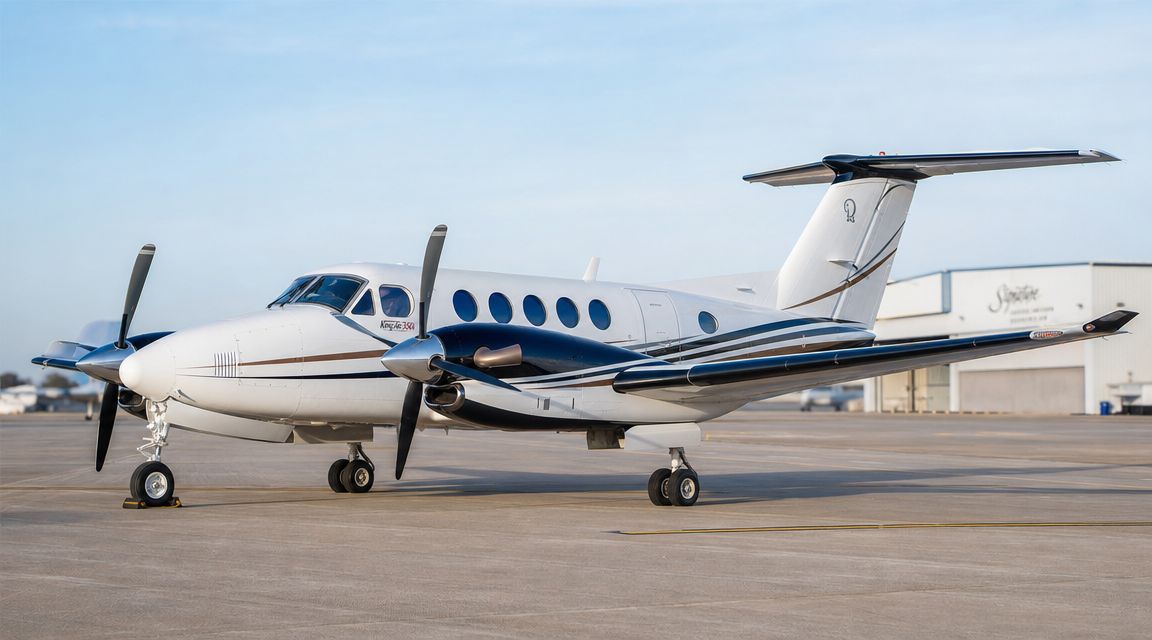
Beechcraft King Air
The King Air is the corporate classic. If a client tells me they need a dependable regional shuttle for executives, board members, or a same-day business circuit, this is often the first aircraft I think about.
It has the demeanor clients want from business aviation. Twin-engine confidence, a serious cabin environment, and the kind of dispatch reputation that made it a fixture in regional charter. It's not trying to be flashy. It's trying to be useful, and that's why it endures.
Best fit:
- Corporate day trips
- Regional team movements
- Clients who want a businesslike cabin without jet pricing pressure
Pilatus PC-12
The PC-12 is the Swiss Army knife of charter aviation. It has a loyal following for good reason. It blends executive comfort with unusual loading flexibility and excellent mission adaptability.
If the trip involves passengers plus bulky bags, ski gear, golf clubs, or a destination that rewards sturdy utility, the PC-12 often rises to the top. That's why it shows up in both executive and leisure charter conversations. If you want specifics on the platform, Haute Jets maintains a dedicated Pilatus PC-12 aircraft page.
The PC-12 is often the aircraft clients didn't ask for, then request again after one trip because it simply works.
Cessna Caravan
The Caravan is the rugged one. It's less about polish and more about mission honesty. You book it when the destination is the challenge.
This aircraft has a reputation for serving places that punish delicate assumptions. If the strip is rougher, the infrastructure is lighter, or the mission has an expedition flavor, the Caravan earns its keep. It's particularly useful for remote resorts, utility flying, and destinations where field conditions matter as much as onboard comfort.
Why these aircraft look the way they do
High-utility propeller aircraft aren't shaped by style alone. Their design reflects operational demands. The FAA-focused engineering discussion on small-airplane design constraints highlights recurring issues such as propeller ground clearance and engine cooling, which directly affect mission capability. That's why many capable prop aircraft use configurations like high wings or sturdy landing gear for reliable work at smaller and less-prepared airfields.
You can see that philosophy in this category:
- King Air: built for disciplined business transport
- PC-12: built for mixed passenger and luggage realities
- Caravan: built to keep going where smoother infrastructure ends
If your charter advisor can't explain not just what these aircraft are, but why they're different, you're not getting aircraft selection. You're getting menu reading.
Typical Missions and Expected Charter Costs
Start with the mission, not the aircraft. If you need to hit three cities in a day, use smaller airports, keep baggage flexible, and avoid wasting half the schedule on ground transfers, a propeller aircraft often gives you the better answer. Regional charter gets expensive when clients buy speed they do not need and lose access they did.
I will not give you made-up hourly rates. Serious charter pricing depends on the aircraft category, the routing, crew overnights, repositioning, airport fees, and how tightly the trip has to run. The useful question is simpler: does the aircraft fit the trip well enough to save time and avoid unnecessary cost?
Mission examples that favor propeller aircraft
A regional business roadshow
One day. Multiple meetings. Secondary airports. Tight turn times. A King Air is often the smart buy because it gets you closer to the actual appointment and keeps the day efficient. On this kind of trip, airport access usually matters more than squeezing out a little more cruise speed.
A family leisure trip with bulky baggage
The PC-12 makes sense when the passenger list includes real luggage, not theoretical luggage. Golf clubs, skis, strollers, pet gear, and soft-sided bags change the aircraft decision fast. A roomy cabin and practical loading beat a prettier spec sheet every time.
A remote resort or island transfer
A Caravan or similar utility turboprop is often the right tool when the destination airport is the limiting factor. Shorter runways, lighter infrastructure, and rougher field conditions reward aircraft built for honest access, not image.
What actually drives charter cost
- Aircraft location: Repositioning can turn an attractive quote into an overpriced one.
- Airport choice: The closer airport often creates better total value, even if the flight charge itself is not the lowest.
- Itinerary complexity: Multi-leg flying suits turboprops well, but each stop still adds time, coordination, and operating cost.
- Passenger and baggage profile: The wrong aircraft can force compromises, extra stops, or a second solution for luggage.
My recommendation on buying strategy
Broker sourcing discipline becomes critical at this stage. Regional propeller charters are especially sensitive to where the aircraft starts the day. If the airplane is already near your departure point, the quote usually looks cleaner because it is cleaner.
Haute Jets says it sources from a large global fleet and prioritizes local aircraft matching to reduce repositioning costs that can inflate charter pricing. That matters on turboprop missions because the economics are tied closely to practical routing, short sectors, and efficient aircraft placement.
A cheap-looking quote on the wrong airplane in the wrong city usually stops being cheap once the full routing appears.
Ask one direct question early: Is this aircraft already positioned near my departure airport? If the answer is vague, keep digging. That single detail often tells you whether you are buying a smart regional solution or paying for someone else's logistics problem.
A Non-Negotiable Approach to Safety and Booking
Some clients hesitate around small propeller aircraft because they assume “propeller” means less safe. That's lazy thinking. The propulsion type is only part of the picture. The operator, maintenance culture, and crew standards matter far more.

The available accident data points to where attention belongs. The WingTalkers analysis of small-airplane crashes reported 40% attributed to engine failure, 30% to pilot error, 18% to landing-gear failure, and 12% to bad weather or high wind. The same analysis said almost 60% of crashes were linked to equipment failures, and 90% of pilot-error incidents involved the aircraft leaving the runway during landing.
That tells me two things. First, maintenance discipline is not paperwork. It is central. Second, low-altitude phases of flight, especially landing, demand serious pilot standards and good operational judgment.
What clients should actually verify
- Operator audit status: I want a third-party safety audit, not a sales promise.
- Maintenance seriousness: Ask who maintains the aircraft and how the operator handles recurring inspections.
- Crew quality: Experience, training cadence, and operator culture matter more than brochure language.
Booking rule: If the operator can't clearly document its safety credentials and maintenance standards, move on.
Why propellers require respect, not fear
A propeller is a critical safety component. It isn't decorative, and it isn't mechanically casual. The same source discussion also points to formal propeller safety guidance that treats the assembly as hazardous even when the engine appears off. That should reinforce the bigger point. These aircraft demand professional handling from ramp to runway.
My standard for charter booking
I don't treat safety ratings as optional upgrades. They're the entry ticket. The useful benchmark in private charter is independent oversight such as Wyvern Wingman or ARGUS Gold/Platinum. If your booking process starts with aesthetics or cabin snacks before it starts with operator quality, the priorities are upside down.
A small propeller aircraft booked through a disciplined, well-audited operator can be a smart regional tool. A badly vetted airplane, in any category, is not.
Your Small Propeller Aircraft Charter FAQ
Are turboprops too noisy for executive travel
Not in the way many first-time clients expect. Modern turboprops are absolutely viable for executive missions. They won't feel identical to a light jet, but on the right route the trade is often well worth it because you gain better airport access and a more efficient overall trip.
Is a piston aircraft good enough for charter
Sometimes, yes. But for most premium regional charter needs, I'd steer clients toward turboprops first. Pistons can be perfectly useful for short, simple flying. Once the mission includes business schedules, weather flexibility, or more demanding passenger expectations, turbine equipment is usually the better fit.
Can small propeller aircraft use major airports too
Yes. They can operate alongside jets at major airports when the mission requires it. The point isn't that they only use small fields. The point is that they can use both, which gives you more routing freedom.
What about baggage
That depends on the aircraft, not the category label alone. A PC-12 and a smaller piston aircraft are completely different baggage conversations. Tell your broker exactly what you're bringing before the quote gets finalized.
Do turboprops handle turbulence worse than jets
They can feel different, especially at the lower altitudes where many regional flights operate. That doesn't automatically mean worse. It means different. On short sectors, most clients find the trade acceptable when the aircraft gets them closer to the actual destination.
What's the smartest way to choose
Use this short filter:
- Choose a turboprop if the trip is regional, airport access is tight, or you have multiple stops.
- Choose a light jet if the route is longer and speed or cabin image is the clear priority.
- Choose the operator carefully every single time, regardless of aircraft type.
Small propeller aircraft aren't the glamorous answer to every charter question. They're the correct answer to more trips than most clients realize.
If your next itinerary involves short runways, regional stops, or a destination beyond the reach of a practical light jet mission, Haute Jets can help you compare the exact aircraft that fit the trip, including turboprops, without a membership or jet card commitment.