
You're probably doing what most charter buyers do. You open a quote, see a shiny safety rating like Wyvern Wingman or ARGUS Platinum, and assume the hard part is done. That badge matters, but it's only the visible layer, like seeing a bank's logo and assuming its internal controls are perfect.
What sits behind that badge is the central question. A Safety Management System, or SMS, is the structure that tells you whether the operator is spotting hazards early, tracking them, fixing them, and proving the fixes work. For charter clients, that's the difference between a polished brochure and an operation that manages risk all day, every day.

A Canadian government evaluation found a correlation between SMS adoption and improved safety performance over the previous 10 years, which is why mature safety systems matter in a high-consequence industry like aviation (FAA SMS overview). If you're used to comparing vendors through quality controls or assurance frameworks, SQA testing strategies is a useful parallel, because both disciplines ask the same core question, what proves the system works in real use, not just on paper?
Beyond the Rating Understanding True Aviation Safety
A charter client usually doesn't book a jet to study safety governance. They book because the trip matters, the timing is tight, and the aircraft has to be right the first time. That's why ratings feel reassuring, they compress a lot of complexity into a simple signal.
The problem is that a rating is only a snapshot. It tells you an outside auditor has found evidence worth trusting, but it doesn't tell you how the operator runs safety on Tuesday afternoon when the weather shifts, a maintenance issue appears, or a crew member notices something unusual. That day-to-day discipline is what an SMS is built to handle.
The hidden system behind the badge
Think of SMS as the operator's operating system for safety. It runs continuously in the background, collecting reports, reviewing hazards, checking whether controls still work, and feeding lessons back into the business. The FAA describes SMS as a formal, top-down, organization-wide approach to managing safety risk and assuring the effectiveness of safety risk controls (FAA SMS definition).
That matters because a safety rating can confirm the operator has evidence of strong controls, but the SMS is what generates that evidence in the first place. In the same way a finance team needs accounting controls before an audit can mean much, an aviation operator needs reporting, oversight, and corrective action before a rating can reflect real safety maturity.
Practical rule: If an operator can't explain how it finds hazards before they become incidents, the rating alone isn't enough reassurance.
Aviation regulators have treated SMS as more than a niche idea for years, and the OECD notes that these systems have become increasingly prevalent in the past two decades, which reflects how central they've become to safety governance. For charter clients, that shift means the standard question is no longer “Do you have a certificate?” It's “How does your safety system work?”
When you're comparing aircraft providers, that distinction is similar to comparing basic compliance with measurable control. One is a minimum standard. The other is evidence of an organization that expects trouble, prepares for it, and learns from it.
What Is an Aviation Safety Management System
An SMS is a formal, top-down, organization-wide approach to managing safety risk and checking whether the controls around that risk are effective. In practice, it functions like a control system for safety, with reporting, oversight, and corrective action built into the operation rather than added after something goes wrong.
Aviation managers use it to spot hazards early, assign responsibility, and verify that procedures still hold up when schedules change, aircraft change, or crews change. For a charter client, that distinction matters because a safety rating can reflect the results of those controls, but the SMS is the mechanism that produces those results in the first place.
What it does in practice
A functioning SMS keeps asking the same operational questions. What hazards are showing up? Which risks can be accepted, which need controls, and which need escalation? Are those controls still effective after a route change, a staffing change, or a different aircraft assignment?
The system is proactive by design. It looks for weak signals before they become incidents, and it treats safety as a management function shaped by leadership decisions, resource allocation, and follow-through. That is the part charter clients should care about, because a rating without that discipline can look stronger on paper than it is in daily operations.
An SMS is also not a static manual sitting on a shelf. It has to absorb reports, investigate issues, monitor trends, and adjust procedures as conditions change. The strongest operators treat safety as a management system with clear ownership from the top down, not as a separate department that only appears after a problem.
A separate layer of policy and risk management also matters for global aviation governance, and a useful reference point for that broader perspective is policy analysis for international cooperation. For a charter buyer, the practical question is simple, can the operator explain how safety controls are embedded across the business, or does the rating rest on thinner evidence than it appears?
What a client should hear
Ask how safety reports are handled. Ask how leadership reviews risk. Ask what happens when the operation changes. A real SMS will give answers that sound operational, not decorative.
A strong SMS does not promise zero risk. It makes risk visible, managed, and continuously reviewed.
The Four Pillars of an Effective SMS
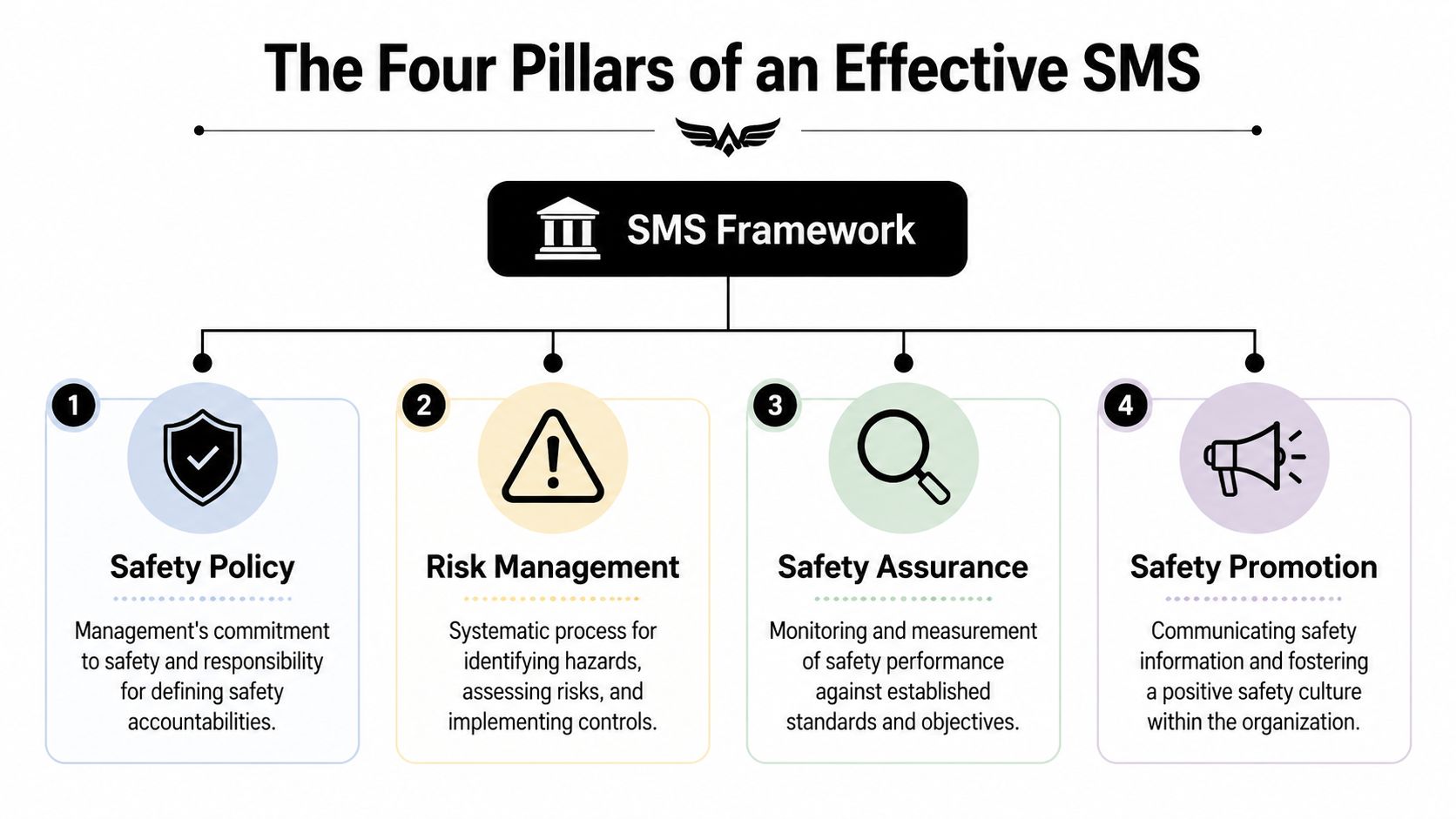
ICAO's framework gives SMS its structure, and that structure is why the system is useful across different types of aviation businesses. The framework rests on four components, Safety Policy and Objectives, Safety Risk Management, Safety Assurance, and Safety Promotion (ICAO SMS guidance). Together, they turn safety from an aspiration into a managed process.
Safety Policy and Objectives
Leadership makes the promise and owns the responsibility. A top-tier charter operator uses policy to define who is accountable, what safety priorities matter most, and how decisions should be made when convenience and risk pull in different directions.
At a practical level, that looks like written responsibility, visible leadership, and rules that don't bend when the schedule gets tight. If a company says safety is important but always rewards on-time pressure over risk reviews, the policy is theater.
Safety Risk Management
This pillar is the engine room. It covers hazard identification, risk assessment, and mitigation. The point isn't to log every issue for its own sake, it's to understand which ones matter, what control reduces the danger, and whether the control is strong enough.
A serious operator might track weather exposure, crew fatigue factors, maintenance deferrals, or ground-handling risks as part of this process. The exact hazard list depends on the operation, but the discipline is the same, spot it early, classify it clearly, and manage it before it becomes an event.
Safety Assurance
Safety Assurance checks whether the controls work. That means audits, monitoring, investigations, and follow-up. It's the operator's internal quality check, the part that asks, did the fix hold?
This is also where charter clients should care about consistency. A company can write a good procedure once. Safety Assurance tells you whether people still follow it six months later, after turnover, operational pressure, and normal drift.
Safety Promotion
Safety Promotion is the cultural layer. It includes training, communication, and the habits that make people speak up instead of staying quiet. A strong operator teaches crews and staff how to report, how to escalate, and how to learn from mistakes without hiding them.
For charter clients, that's the difference between a company that talks about safety and one that builds a reporting culture into daily work. If employees are trained, informed, and encouraged to raise concerns, the system is far more likely to catch weak signals before they spread.
A manufacturing engineer might think of this through FMEA in manufacturing, because both disciplines focus on finding failure modes before they become losses. Aviation adds a public-facing stakes level that makes the discipline even more important.
Global Regulations from ICAO to the FAA and EASA
A charter flight can be safe on paper and still feel inconsistent in practice if the operator's safety process changes from one country to another. SMS exists to prevent that kind of drift by giving aviation teams a common structure for identifying risk, deciding what to do about it, and checking whether the control proves effective.
ICAO provides the baseline framework that many aviation systems are built around. In the U.S., the FAA defines SMS as a formal, top-down, organization-wide approach to safety risk management and control effectiveness, and that framework is central to rules such as Part 135. The European approach is built on the same idea of structured safety management, so international operators often align their processes across jurisdictions instead of treating each one as a separate system.
Why that matters for charter buyers
A charter client may be flying under one authority, over another, and relying on support teams in more than one location. In that setting, safety cannot depend on local habits or whoever happens to be on duty that day. A shared SMS gives the operator, the crew, and the oversight team the same language for risk, escalation, and follow-up.
ICAO also says SMS implementation should be commensurate with the size of the organization and the complexity of the services provided (ICAO SMS framework). That point matters because a single-aircraft operator and a larger fleet should not look identical on paper. A proper SMS scales to the operation without becoming vague or overbuilt.
A good operator can explain how its safety structure fits the aircraft type, routes, maintenance support, and staffing pattern it uses. That explanation should be concrete, not just regulatory phrasing. If the process only works when conditions are perfect, it is weaker than it looks.
For a buyer, the practical lesson is simple. Global rules set the floor. Strong operators build above it so safety does not depend on geography, personalities, or one manager remembering to close the loop.
From Theory to Practice Implementing an SMS
Building an SMS takes more than a policy update. It requires leadership commitment, reporting channels, training, internal review, and enough discipline to keep the system alive after the launch phase. The aviation industry's practical frameworks go well beyond the four pillars and often include document management, occurrence reporting and investigation, emergency preparedness, management of changes, performance measurement, and continuous improvement (VAST SMS attributes).

A client doesn't need to build this system, but it helps to understand what a real implementation looks like. First comes the gap analysis, where leadership compares current practice against the target framework. Then comes design work, where reporting paths, review cadence, and escalation routes are written down. After that, staff training and management oversight have to make the system real.
What maturity looks like
Maturity is visible in small behaviors. Reports get logged and reviewed. Corrective actions are tracked to closure. Changes to schedules, aircraft, or staffing trigger reviews instead of assumptions. People know where to raise concerns, and they trust that someone will act on them.
Useful test: If an operator can show you how a concern moves from report to review to corrective action, you're looking at a living system, not a paper one.
The hard part is keeping that structure active. Many programs look excellent at launch and slowly weaken when daily pressure returns. That's why continuous improvement matters, because the ultimate value of SMS comes from repetition, review, and accountability, not from the first rollout.
The best operators treat implementation as an operating discipline, not a one-time project. That's the standard charter clients should expect when they ask whether a provider's safety system is mature.
How Third-Party Audits like Wyvern and ARGUS Verify SMS
Third-party ratings matter because they help answer a question internal teams can't answer alone, does the system hold up under outside scrutiny? That's where Wyvern and ARGUS become especially relevant for charter clients, because those audits test whether the operator's written processes match reality.
The deepest issue in SMS is the gap between documentation and effectiveness. MITRE's safety-management analysis notes that mature SMS programs need proactive hazard detection, reactive learning, and leading indicators that show weak points before accidents occur (MITRE SMS paper). External auditors help verify whether those parts are present in daily operations.
What the audit is really checking
A Wyvern or ARGUS review is more than a paperwork pass. Auditors look for how the operator handles maintenance records, crew training, reporting, investigations, and follow-up. They are checking whether the safety system can survive contact with real work, schedule pressure, and change.
That makes the rating useful in a very specific way. It tells you an independent reviewer has seen evidence that the operator's controls are functioning and that the organization is not relying on self-assessment alone. In practice, that's a strong signal that the SMS is being used, not just stored.
The deeper value for a charter client is confidence in execution. A strong rating doesn't replace your own judgment, but it does reduce ambiguity about whether the operator's safety discipline is real. If you want the broader context on how these ratings work, the guide to Wyvern and ARGUS safety ratings is a useful companion.
The best audits don't just verify compliance. They reveal whether the operator has a working feedback loop.
That's why ratings and SMS belong together. One gives external validation, the other gives internal structure. When both are strong, you get a clearer picture of how the operator behaves when nobody is looking.
A Charter Client Checklist for Vetting Operator Safety
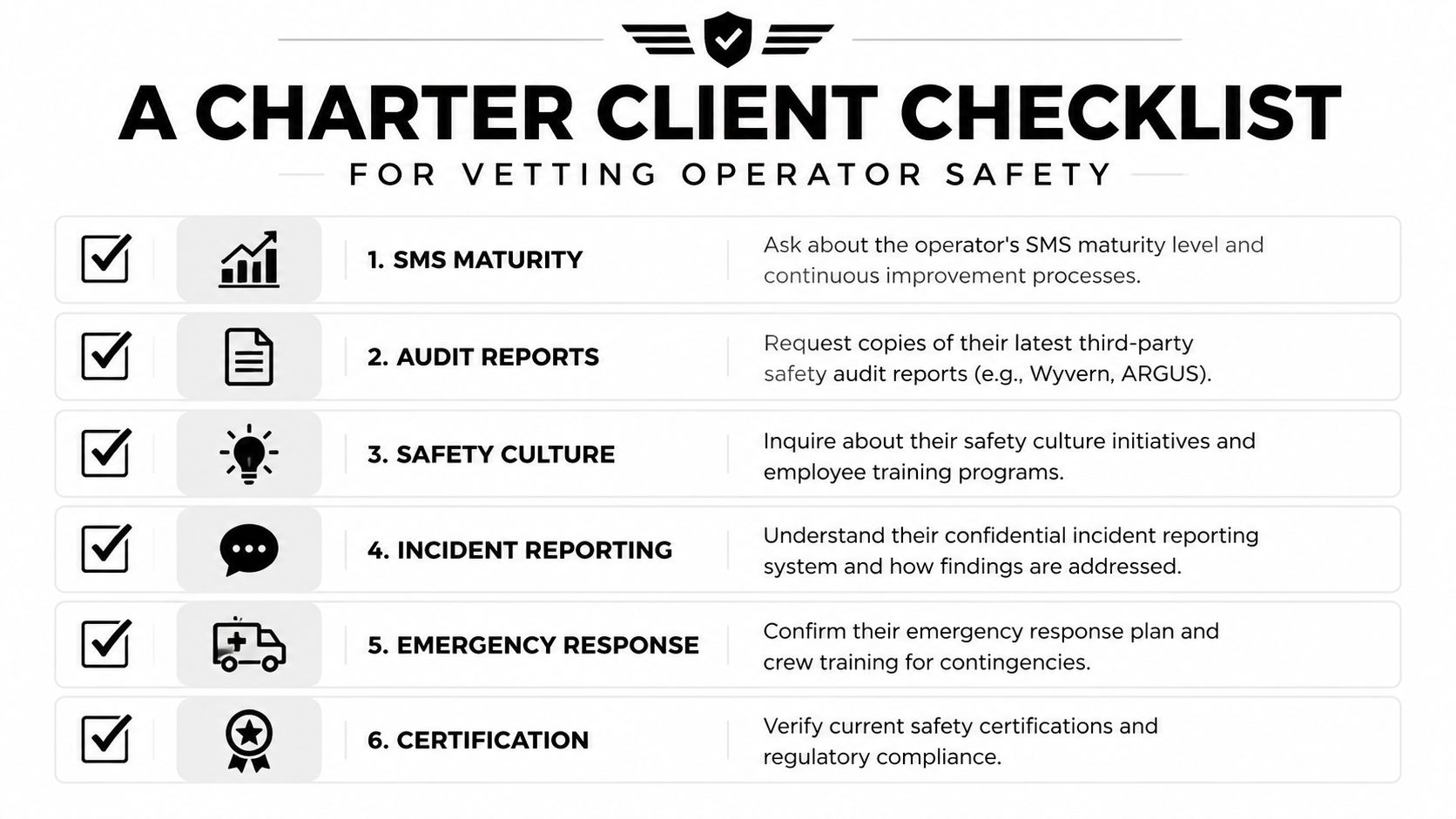
A smart buyer doesn't ask, “Are you safe?” That question is too broad and too easy to answer with marketing language. Better questions force an operator to describe the system behind the claim.
Questions worth asking
- SMS Maturity: Ask how the operator defines maturity in its safety system, and how it uses continuous improvement to close gaps.
- Audit Reports: Request the latest third-party audit result and ask what was reviewed, not just what rating was issued.
- Safety Culture: Ask how the team encourages reporting, training, and open communication when someone spots a hazard.
- Incident Reporting: Ask how confidential reporting works and what happens after a report is filed.
- Emergency Response: Ask how crews are trained for contingencies and how often those procedures are reviewed.
- Certification: Verify current safety certifications and confirm the operator stays aligned with applicable regulatory requirements.
These questions work because they move the conversation from image to process. If the answers are specific, consistent, and operational, that's a strong sign. If they're vague, defensive, or filled with slogans, you've learned something important.
For a practical pre-flight lens, the guide on what safety checks to ask before a private jet flight can help you turn those questions into a repeatable screening habit. That's the core advantage of understanding SMS, it gives you a better way to compare operators before you commit.
If you're planning a charter and want a safer way to compare operators, use this framework before you book. Reach out to Haute Jets for a flight that's vetted with safety, transparency, and the right operator standards in mind.