

You’re confirming a short private flight for the weekend. The itinerary looks simple, the weather looks good, and the aircraft is ready. Then you see a planning note that mentions a vfr flight plan.
For most clients, that phrase lands somewhere between technical jargon and background noise. It sounds like pilot paperwork. In reality, it’s one of the quiet systems that supports the experience you care about: a flight that’s safe, organized, and handled with discipline from the moment the crew starts planning until the aircraft is parked after arrival.
That matters most on the kinds of trips where private aviation feels most effortless. A short coastal flight. An island transfer. A scenic hop to a smaller airport where flexibility matters. You may never see the form itself, but the thinking behind it touches departure timing, routing, fuel planning, crew preparation, and what happens if anything goes off plan.
Your Guide to the VFR Flight Plan
A client booking a fast getaway from South Florida to the Bahamas usually asks the same practical questions. Will the aircraft leave on time? Will weather affect the departure window? Is this the kind of trip where a smaller aircraft makes more sense than a jet? Hidden behind those questions is the same operational issue: how the flight will be planned and conducted.
A vfr flight plan is part of that answer. It isn’t a luxury add-on or obscure administrative step. It’s a formal record of the intended flight, filed so key details are available if the crew needs support or if authorities ever need to start search and rescue.
For a traveler, the important point is simple. The flight plan turns a casual-looking short trip into a fully structured operation.
A polished private flight can feel effortless to the passenger because the structure sits behind the scenes.
That’s especially true on shorter regional routes, where clients sometimes assume the planning must be light because the flight time is short. In practice, shorter flights often demand careful decision-making. Crews still evaluate weather, terrain, airspace, fuel, timing, airport suitability, and the best operating method for the mission.
When people hear “visual flight,” they sometimes picture something informal. It’s the opposite. Professional crews use defined rules, documented routing, and clear procedures. The visible part is the smooth departure. The invisible part is the discipline that makes that departure possible.
What Is a VFR Flight Plan
A client boarding for a short island hop often sees a simple mission. Wheels up, a brief flight over water, then a quick transfer to the resort or yacht. On the operations side, that same trip still needs a clear record of who is flying, where the aircraft is expected to go, and what authorities should know if the aircraft does not arrive on schedule.
That record is the vfr flight plan.
Under Visual Flight Rules, the crew operates with the required visual conditions and uses outside references to maintain orientation. For you as a charter client, the more useful distinction is practical. A VFR flight plan is the formal itinerary filed for a flight conducted under those rules, so the trip is documented before departure rather than left to assumption.

What the filing actually includes
Under 14 CFR § 91.153, a VFR flight plan includes the aircraft identification, pilot information, departure point, proposed route, cruising altitude, true airspeed, destination, estimated time en route, and fuel on board.
To a passenger, that can read like paperwork. In practice, it works like a concierge brief crossed with an emergency reference file. Each entry answers a specific operational question before anyone has to ask it under pressure.
- Aircraft identification confirms exactly which aircraft is being tracked.
- Pilot information identifies the pilot in command.
- Departure point and destination establish the intended trip.
- Proposed route shows the expected path of flight.
- Cruising altitude and speed help estimate where the aircraft should be at a given time.
- Estimated time en route sets the expected arrival window.
- Fuel on board helps responders understand how long the aircraft could remain airborne if overdue.
Why this matters from the client side
Private aviation feels polished because the structure is built before you arrive at the airport. A VFR flight plan is part of that structure. If communication is lost or the aircraft becomes overdue, search and rescue teams are not starting from zero. They have the aircraft details, route, timing, and endurance information needed to begin in the right place.
That matters even more on regional charter flights, especially over coastline, islands, or sparsely populated areas, where a short route can still leave little margin for guesswork.
You may hear operational terms that sound unusual outside aviation. “Persons aboard” means the number of people on the aircraft. Some crews also use “souls on board” in radio or emergency contexts because the count must be unmistakably clear.
The modern filing format
In the United States, domestic VFR filing now uses the ICAO flight plan format rather than the older domestic form. For a charter client, the benefit is straightforward. The information is organized in a format that supports clearer coordination across systems and facilities.
That sounds technical, but the effect is easy to understand. Better information flow supports better decisions, fewer handoff errors, and a more controlled response if weather or operational conditions change. If you want a clearer sense of how weather planning affects whether a trip can be conducted visually or by instruments, our guide to private jet charters flying in any weather explains the client-facing side of that decision.
VFR vs IFR The Key Differences for Your Flight
Most private charter clients have flown many trips under IFR, or Instrument Flight Rules, without ever hearing the term. That’s normal. IFR is standard for much of business aviation because it supports travel through a wider range of weather conditions and relies heavily on instruments, procedures, and air traffic control.
VFR is different. It depends on the pilot maintaining the visual conditions required for that operation. That doesn’t make it inferior. It makes it situational.
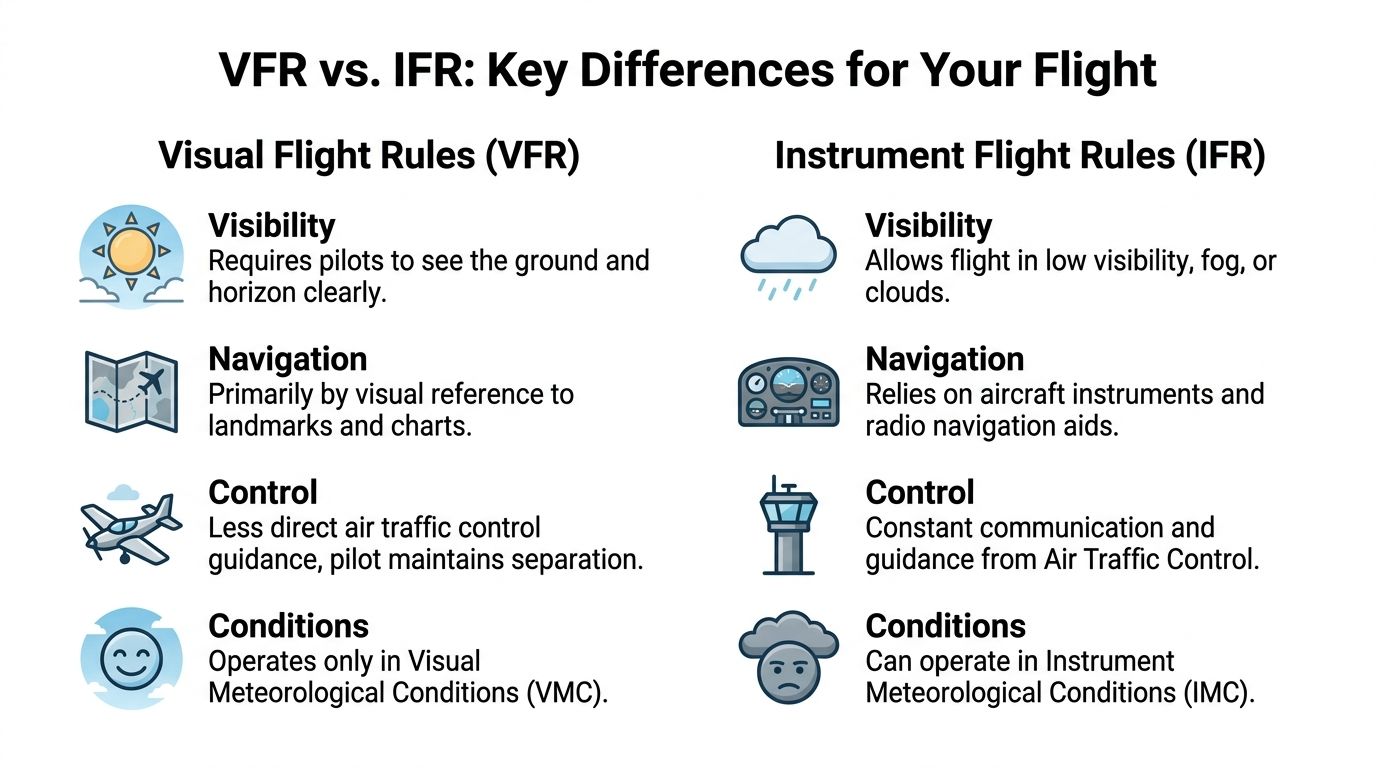
Comparison of VFR and IFR Flight Operations
| Aspect | Visual Flight Rules (VFR) | Instrument Flight Rules (IFR) |
|---|---|---|
| Primary reference | Pilot uses outside visual references, charts, and visible landmarks | Pilot relies on instruments, procedures, and navigation systems |
| Weather dependency | Requires visual conditions suitable for flying by outside reference | Can operate when visibility or cloud conditions are poorer |
| ATC relationship | Less structured ATC involvement in some situations | Continuous ATC structure is central to the flight |
| Routing flexibility | Can be more flexible on suitable short routes | Often follows defined clearances and structured routings |
| Passenger experience | Often used on shorter, fair-weather segments, including scenic or remote access flying | Common for longer-range, schedule-sensitive, and all-weather business travel |
| Typical charter fit | Useful for certain short regional missions and smaller-airfield access | Common choice for most jet charter and time-critical travel |
What this means in plain English
If you’re flying a longer business route, crossing busy airspace, or departing in conditions that aren’t visually straightforward, IFR is usually the operational backbone. If you’re taking a short daytime trip in good weather, especially into or out of a smaller airport, VFR may be the appropriate tool.
The passenger question shouldn’t be, “Which one is better?” The right question is, “Which one fits this trip?”
A short island transfer in clear weather can be an excellent VFR mission. A coast-to-coast jet flight with schedule commitments and changing weather along the route is exactly where IFR shines. One favors visual flexibility when conditions allow it. The other favors procedural consistency across a wider operational envelope.
Why private travelers often notice IFR more than VFR
Clients usually associate private aviation with reliability. That expectation naturally aligns with IFR because instrument operations support travel when the sky doesn’t look perfect. If you want a broader explanation of how private flights are managed when conditions are less cooperative, this overview of private jet charters flying in any weather is helpful.
Still, VFR matters because many premium travel experiences happen on the margins of the network. Resort transfers, short leisure sectors, scenic approaches, and service to smaller fields all sit in places where visual flying may be relevant.
The refined client experience isn’t tied to one set of flight rules. It comes from crews choosing the right operating method for the mission in front of them.
A useful mental model
Think of IFR as the executive highway system. It’s structured, managed closely, and built for consistency. Think of VFR as a carefully planned premium local route in excellent conditions. It can be direct, elegant, and efficient, but only when the environment supports it.
That distinction clears up a common source of confusion. VFR isn’t a stripped-down version of “real” aviation. It’s a formal operating framework with its own rules, limits, and best uses.
Why Filing a VFR Flight Plan Is a Non-Negotiable Safety Measure
A client boards for a short daylight hop to a resort airport. The weather is clear, the route is familiar, and the trip feels simple. Those are exactly the flights that can make paperwork look less important than it is.
For a professional operator, filing a vfr flight plan is part of the safety net behind that calm experience.
The reason is straightforward. If an aircraft becomes overdue or loses communication, the filed plan gives search and rescue teams a starting point that is already organized. They are not piecing together scraps from text messages, dispatch notes, or a last known departure time. They have the intended route, aircraft identification, estimated timing, and contact details that help them act faster and with better focus.
From a client perspective, that matters because luxury travel is not only about comfort in the cabin. It is also about what stands behind the service when conditions stop being routine. A filed plan helps turn uncertainty into a defined response process.
Why the form matters more than it appears
A VFR flight plan works like a well-prepared itinerary left with the right people before a yacht crossing or remote transfer. The trip may proceed exactly as expected. If it does not, the people responsible for helping know where to begin.
That changes the first minutes of a problem, and first minutes matter.
Instead of asking basic questions such as which route was intended or who should be contacted first, responders can work from a documented framework. For the traveler, that is the primary value of filing. It improves the quality of the response before anyone needs to improvise.
Here is what that documented framework provides:
- Quicker recognition of an overdue flight: There is a stated departure, route, and expected arrival to compare against reality.
- A narrower search area: Planned routing and timing give responders a more useful first picture of where to look.
- Clearer communication: Contact and aircraft details reduce confusion at the moment clarity matters most.
Why disciplined operators insist on it
Clients often judge safety by what they can see. The aircraft looks pristine. The crew is polished. The departure feels orderly. Those signals matter, but invisible discipline matters just as much.
Crews and flight support teams that file carefully are showing the same mindset they use for weather review, fuel planning, airport suitability, and contingency planning. It is a mark of an operator that treats risk management as a system, not a sales phrase. You can see that approach in Haute Jets' private aviation safety standards.
A professional crew documents the flight thoroughly before anyone has a reason to wish it had been done.
That is why filing is not just administrative housekeeping. For the charter client, it is part of the infrastructure that protects the trip, supports a faster response if something goes wrong, and reinforces the reliability you are paying for.
The Flight Plan Lifecycle From Filing to Closing
A client usually notices flight planning at two moments. Before departure, there may be a short pause while the crew finishes paperwork and confirms details. After landing, the aircraft may be on the ground, yet the crew still has one last administrative task to complete. Those bookends are part of the same safety process.
A vfr flight plan follows a simple chain. It is filed before departure, activated when the flight begins, referenced in the air, and closed after landing. For a charter client, that process works like a custody log for the trip. It records what was intended, when the flight started, and when the journey ended normally.
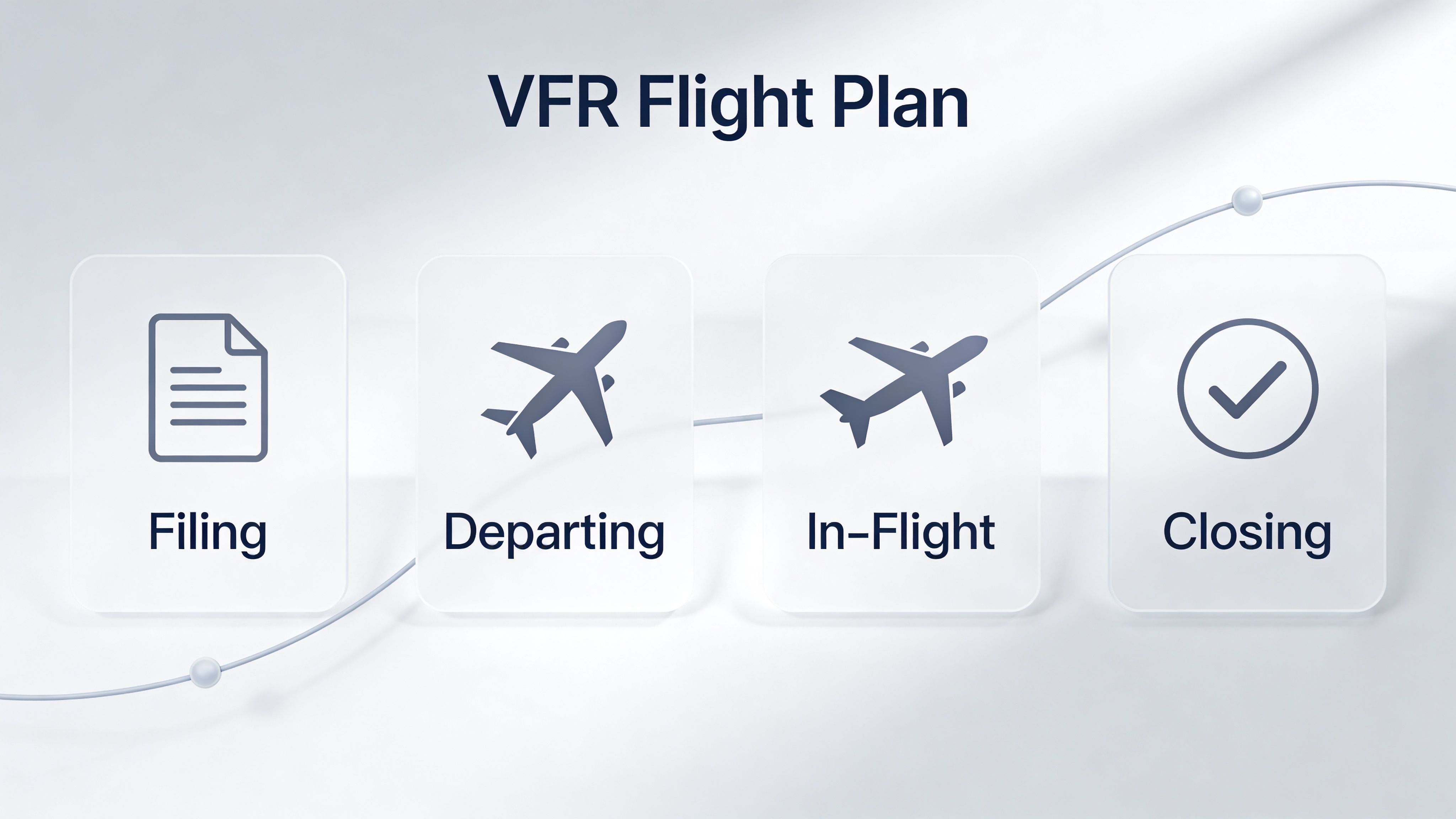
Filing
Before departure, the crew or flight coordination team submits the flight’s core details. That includes the aircraft, route, timing, and other identifying information needed to place the trip into the aviation system.
For the passenger, filing is the point where an itinerary becomes operational intent. Your trip is no longer just a calendar entry or a broker confirmation. It is documented in a format other aviation parties can recognize and use if conditions change or follow-up is needed.
That discipline supports the polished experience clients expect from private aviation, including the orderly ground flow you often associate with private FBO terminals and their traveler benefits.
Activation
A filed plan does not become active automatically. It must be opened when the flight departs.
That distinction is easier to understand if you compare it to checking into a secure car service. A reservation exists before pickup, but the live trip begins only when the car is en route. In aviation, timing matters for the same reason. A delayed departure, an early takeoff, or a cancelled leg changes how the flight should be tracked.
Clients rarely see this step, but experienced operators take it seriously because paperwork sitting in the system is not the same as a flight that has officially begun.
In flight
Once active, the plan becomes the reference point for the trip. It is not a rigid script. Pilots can still adjust for weather, traffic, airspace limits, or airport conditions. What the plan provides is a documented starting framework.
That matters more than it may seem.
If the crew needs to modify the route, there is an original plan to compare against. If someone later needs to confirm where the aircraft was expected to be, there is a recorded baseline. For a private charter client, this is part of what turns aviation from a series of verbal updates into a controlled operation.
A brief visual overview helps if you want to see the sequence in a practical way.
Closing
After landing, the plan must be formally closed. That final step tells the system the aircraft arrived safely and no follow-up action is required.
If that closure does not happen, the flight can appear overdue even when the passengers are already at their destination. That can lead to unnecessary alerts, wasted time, and avoidable confusion. Well-run operators treat this step with the same care they give departure planning because the record is not complete until the flight is closed out properly.
Operational note: Closing the plan is the last confirmation that the journey ended as intended.
The four-stage logic in one view
- File the plan so the trip is documented in the system.
- Open the plan when the aircraft departs.
- Reference the plan while the flight is underway.
- Close the plan after arrival to confirm the journey ended normally.
For the passenger, the value is straightforward. Your trip follows a documented process from start to finish, with clear accountability at each stage.
What a VFR Flight Plan Means for Your Haute Jets Charter
Most material about a vfr flight plan speaks to pilots. It tells them what to calculate, what to enter, and how to comply. It rarely explains what any of that means for the person paying for the trip.
That gap matters because clients don’t need flight-school detail. They need to understand how weather, terrain, airspace restrictions, and aircraft choice are evaluated before they ever receive a final trip confirmation. That missing client perspective is exactly the gap identified in the discussion around 14 CFR § 135.615 terrain clearance requirements.

What changes for the client
For the traveler, the practical effect of flight planning shows up in three places.
- Departure expectations: A short trip in clear weather can still have a narrow ideal departure window depending on local conditions and airport environment.
- Aircraft suitability: The best aircraft for the mission may be a turboprop or light aircraft rather than assuming a larger jet is always better.
- Routing confidence: The crew has already assessed whether a visual operation is appropriate or whether instrument procedures are the better fit.
Those decisions shape the travel experience well before the passenger reaches the terminal.
Why this improves the luxury experience
Luxury travel is often misunderstood as the absence of structure. In aviation, true luxury comes from invisible structure handled competently.
When the operational team has already evaluated the route, weather picture, terrain considerations, and airport specifics, the client gets what matters most: clarity. You know when to be at the FBO, what kind of aircraft makes sense for the trip, and whether the operation is built for a smooth departure or a more cautious timing window.
That’s part of why private travelers value the ground experience as much as the flight itself. The transition through an FBO is smooth because planning happened upstream. If you want a sense of how that environment supports the overall trip, this look at the benefits of private FBO terminals for jet travelers adds useful context.
The key takeaway for sophisticated travelers
You don’t need to file the plan, interpret every code, or debate the route. Your role is not to become a pilot.
Your role is to understand that meticulous planning is part of what you’re buying. The flight plan is one of the tools that turns private flying from a premium product into a professionally managed operation.
Common Misconceptions and Flight Plan Mistakes
The biggest misconception is that VFR automatically means “less safe.” It doesn’t. Safety depends on matching the operating method to the conditions, the route, the airport environment, and the crew’s judgment.
A second misconception is that short flights need less rigor. They don’t. In some cases, short segments into smaller airports call for sharper judgment because weather windows can be tighter and local conditions can matter more.
Misunderstandings that confuse clients
- “If the weather looks good from the ground, VFR must be simple.” Surface impressions can be misleading. Crews assess the full operating picture, not just what a passenger sees from the terminal.
- “A visual flight is basically informal.” It’s still rule-based, planned, and documented.
- “Flight plans are only important on long trips.” The need for structure doesn’t disappear because the destination is close.
Errors professionals work hard to prevent
One classic risk in visual flying is pressing ahead into worsening weather. Pilots sometimes call this “scud running.” Clients don’t need the slang so much as the lesson behind it: disciplined crews don’t force a visual plan to work when conditions no longer support it.
Another avoidable problem is failing to close the flight plan after landing. To a non-pilot, that can sound like a minor administrative oversight. It isn’t. It can trigger concern and unnecessary emergency action because the system may treat the aircraft as missing.
Good aviation judgment often shows up as a change of plan, not a stubborn defense of the original one.
Why this should reassure you
These aren’t reasons to be anxious about private flying. They are reasons to value professional standards.
A serious operator doesn’t romanticize visual flying, and doesn’t downgrade it either. The crew respects its limits, uses it when appropriate, and abandons it when the conditions demand something else. That is what mature decision-making looks like in aviation.
The Invisible Thread of Safety in Your Journey
A vfr flight plan is easy to overlook because, when everything goes right, you never feel it. You feel the polished car-to-cabin transition, the calm crew, the clean departure, and the confidence that the trip is under control.
But the flight plan is part of what makes that confidence real. It gives structure to a flight that might otherwise appear simple. It gives authorities a starting point if something unusual happens. It reflects a broader discipline that serious crews apply whether the trip is a short leisure hop or a tightly timed executive movement.
For private travelers, that’s its core value. Not the form itself, but what the form represents. Thought before motion. Planning before promise. Precision behind comfort.
When those standards are in place, safety and luxury stop looking like separate ideas. They become the same experience, seen from different angles.
If you want a charter experience built around that level of preparation, Haute Jets connects clients to Wyvern and Argus-rated operators, exact-aircraft sourcing, and a planning process designed to make every flight feel effortless because every critical detail has already been handled.