
You're booking a private jet. The cabin photos look flawless, the itinerary is tight, and the operator says all the right things. That's the easy part.
The harder question is the one most first-time charter clients don't ask soon enough: what proves this aircraft is being maintained the way it should be?
The answer isn't in the leather seats or the polished fuselage. It's in the aircraft maintenance records. Those records are the operating history, the compliance trail, and, in practical terms, the paperwork that supports the aircraft's airworthiness. If you charter often, or even if you're booking one important flight for your family or executive team, you should care about them.
This Haute Jets Journal guide gives you the client-side view. Not the mechanic's version. Not the regulator's version. Yours. What matters, what to ask, what red flags to spot, and why serious vetting matters long before you arrive at the FBO.
Beyond the Cabin The Unseen Shield of Safety
You walk across the ramp, glance at the tail, and step aboard. The crew greets you by name. Catering is set. Wi-Fi is ready. Everything feels under control.
That impression matters, but it's not what keeps you safe.
What matters first is the unseen record behind that airplane. An aircraft's maintenance history is its biography. Every inspection, repair, replacement, alteration, and return-to-service signoff builds a chain of evidence. If that chain is clean and traceable, you're looking at an operator that understands discipline. If it's messy, that's not a paperwork problem. That's a judgment problem.

Why clients misread safety
Most passengers judge what they can see. Clean cabin. Professional crew. Smooth booking process. Those things are useful signals, but they don't verify maintenance quality.
The safety picture sits in the records:
- Inspection continuity: Did required inspections happen on time, and is each one documented correctly?
- Repair traceability: Was work performed properly, by authorized personnel, with a clear record of what changed?
- Configuration control: Does the aircraft on the ramp match the aircraft described in the documents?
A disciplined operator can show that history. A weak one often deflects, delays, or buries you in vague reassurance.
Practical rule: If an operator is transparent about maintenance oversight, that's a good sign. If they become evasive when you ask basic safety questions, walk away.
What this means for you
As a charter client, you're not expected to read every maintenance entry yourself. You are expected to care whether someone competent has done that work.
That's the difference between buying an experience and buying peace of mind. The records aren't glamorous, but they're the foundation under every smooth departure, every uneventful cruise, and every normal landing. In private aviation, boring is good. Predictable is good. Documented is good.
A beautiful aircraft with weak records is a risk wrapped in luxury. A properly vetted aircraft gives you something far more valuable than aesthetics. It gives you confidence that the flight is backed by evidence, not sales language.
Decoding the Logbook What's Inside Aircraft Maintenance Records
You're about to board a charter jet with your family. The cabin looks perfect, the crew is polished, and the operator says the aircraft is "fully maintained." That statement means very little unless the records back it up.
Aircraft maintenance records are the proof file. They show what was inspected, what was repaired, which parts were replaced, who approved the work, and whether the aircraft can legally return to service. For a charter client, that matters more than polished leather or a branded safety pitch.
The FAA requirement to preserve inspection, maintenance, alteration, and airworthiness history is laid out in 14 CFR 91.417. If the flight is being sold to you under FAA Part 135 charter operating rules, record discipline should be even tighter because the operator is carrying passengers for hire.
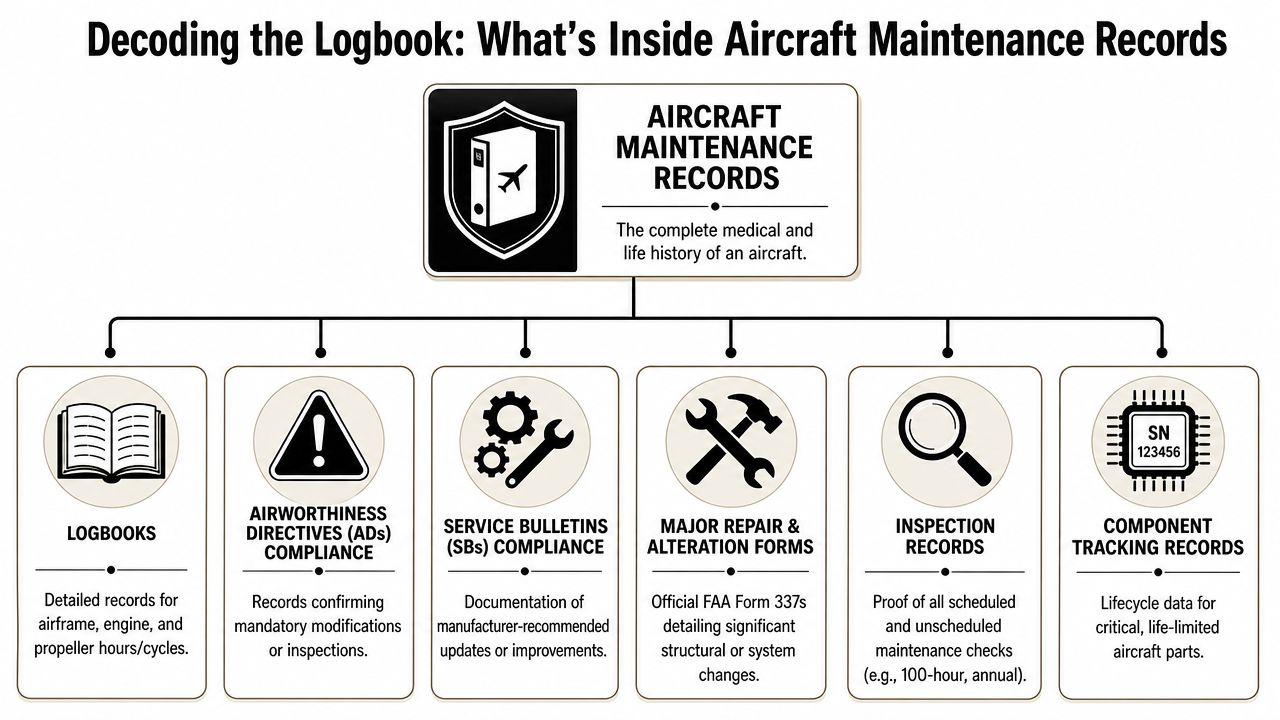
The core records that matter
These are the records that tell you whether an operator runs a serious maintenance program or just talks like one.
| Record type | What it tells you | Why you should care |
|---|---|---|
| Logbooks | Operating history for the airframe, engines, and major systems | Gaps, missing volumes, or inconsistent entries are warning signs |
| Inspection records | Proof that scheduled inspections were completed and signed off | A missed or unclear inspection record raises immediate questions about airworthiness |
| Airworthiness Directive compliance | Whether mandatory FAA safety actions were completed | If an applicable directive is overdue or undocumented, the aircraft should not be flying passengers |
| Service Bulletin records | Whether the operator followed manufacturer-recommended actions | These records show how aggressively the aircraft is maintained, not just whether minimums were met |
| Major repair and alteration records | Documentation of structural repairs, avionics changes, and system modifications | You need to know whether the aircraft's current setup matches approved paperwork |
| Component tracking | Remaining life, overhaul status, and installation history for controlled parts | Time-limited parts can create both legal and safety problems if tracking is weak |
What a proper maintenance entry looks like
A real maintenance entry is specific. It describes the work, gives the completion date, identifies the aircraft, and includes the signature and certificate details of the person approving the work for return to service.
That level of detail is the whole point.
If an entry is vague, unsigned, incomplete, or hard to match to the actual aircraft, a buyer, regulator, auditor, or charter broker has to start asking harder questions. Haute Jets handles that review for clients because first-time charter customers should not have to sort through technical paperwork alone.
Here's a useful walkthrough if you want to see how maintenance documentation fits into real-world aircraft oversight:
Records you should ask about first
If you ask only a few questions before a charter, ask about these:
- Airworthiness Directive status: Confirm all applicable directives are current and documented.
- Recent inspection signoffs: Ask whether the latest required inspections were completed on schedule and signed properly.
- Return-to-service approvals: After maintenance, someone authorized must approve the aircraft to go back into operation.
- Life-limited and overhauled components: Ask whether tracked parts are within limits and supported by current records.
A good operator can answer those questions quickly. A weak one stalls, stays vague, or sends paperwork that does not clearly match the aircraft you are chartering.
That is what the logbook tells you. It tells you whether safety is being managed with evidence or with sales language.
The Global Standard Regulatory Requirements for Record Keeping
You book a charter, the aircraft looks immaculate, and the crew is polished. Then an auditor asks for maintenance history and finds gaps. That aircraft can be grounded on paper before it ever becomes a problem in the air. For a charter client, that is the point of record-keeping rules. They protect you before you board.
In the United States, the foundation sits in 14 CFR Part 43 and Part 91. Those rules require maintenance entries, approvals for return to service, and retention of records that prove the aircraft's continuing airworthiness. Some items stay with the aircraft for the long term, such as total time, life-limited part status, and major alteration records. Other maintenance entries are kept for a defined period or until newer work replaces them, as noted earlier.
Internationally, the principle stays the same even when the regulator changes. The FAA, EASA, and other civil aviation authorities all expect an aircraft to carry a traceable maintenance history that a qualified reviewer can follow without filling in blanks. Names differ. The expectation does not.
That expectation comes down to three practical tests:
- Who performed the work: The entry must identify the person or organization responsible.
- What was done: The description has to be specific enough for another technician or inspector to understand the task.
- Why the aircraft is legal to fly next: Required signoffs, dates, times, and references must support continued airworthiness.
If any of those pieces are weak, the aircraft's compliance picture gets weak.
This matters even more in charter because the aircraft is being offered for hire. A serious operator needs documented maintenance control, not verbal reassurance from a sales desk. If you want the operating context behind that oversight, review how FAA Part 135 charter regulations apply to on-demand operators. Part 135 raises the compliance bar, and record discipline is part of that standard.
Good records also support reliability planning. Operators that track components, inspections, and recurring discrepancies well are better at addressing unplanned equipment downtime, which reduces avoidable disruptions and exposes maintenance issues earlier.
Here is what this means for you. You do not need to cite regulations to ask smart questions. You need to confirm that the operator can produce clear, current, aircraft-specific records and that an independent audit program has already tested that process. Haute Jets handles that vetting for clients because first-time charter customers should not be left guessing whether the paperwork behind the flight is real, current, and complete.
Clean records support trust. Broken records create delay, doubt, and extra scrutiny for exactly the right reason.
Why Records Matter for Safety Value and Your Peace of Mind
There's a direct line between paperwork on the ground and confidence in the air.
Complete maintenance records prove that inspections were performed, mandatory fixes were tracked, repairs were documented, and the aircraft's configuration hasn't drifted away from what future technicians expect to see. Incomplete records do the opposite. They create doubt. And in aviation, doubt is expensive for a reason.
A widely cited industry benchmark says missing or incomplete logbooks can reduce a jet's market value by 20% to 50%, according to Bourne Systems' discussion of maintenance records and resale value. That's not a small administrative penalty. It shows how strongly the market ties record quality to trust.
Why the money matters to safety
Clients sometimes dismiss resale value as an owner problem. It isn't. It tells you how seriously the industry treats documentation risk.
If poor records can erase that much value, owners and operators have every incentive to maintain a complete, defensible history. That creates a strong practical discipline around:
- Recording every service event
- Preserving inspection continuity
- Tracking parts and overhaul status
- Documenting modifications clearly
In other words, the economic pressure supports the safety culture.
Safety is also a systems issue
Good maintenance recordkeeping doesn't live in isolation. It sits inside a broader reliability mindset. In other industries, teams talk about addressing unplanned equipment downtime through disciplined asset lifecycle management. Aviation applies the same principle with higher stakes and stricter documentation. You don't wait for surprises. You build systems that reduce them.
That's why a well-documented aircraft usually reflects more than tidy admin work. It often reflects a more disciplined operation overall.
Missing records don't just hide history. They force everyone downstream to make assumptions, and assumptions are exactly what serious operators try to eliminate.
What peace of mind actually looks like
For a charter client, peace of mind isn't a slogan. It's knowing the aircraft's safety story can be backed up on paper.
That doesn't mean every safe aircraft has a glamorous record room. It means the operator can show continuity, legitimacy, and discipline when those records are reviewed by people who know what to look for. If the paperwork is weak, buyers discount the aircraft, financiers get nervous, and auditors dig harder. You should too.
The plain advice is simple. Choose operators and booking channels that treat aircraft maintenance records as part of the safety case, not a file cabinet issue.
Your Pre-Flight Due Diligence A Practical Verification Checklist
You don't need to audit an aircraft yourself. You do need a sharp shortlist of questions.
That matters because a true verification goes far beyond a basic logbook review. For higher-value aircraft, the full record set can include the Aircraft Maintenance Manual, Illustrated Parts Catalog, Structural Repair Manual, STCs, ICA, AD status list, and major repair or modification records, as outlined in this maintenance documentation overview. That's far more technical than most passengers should try to manage alone.
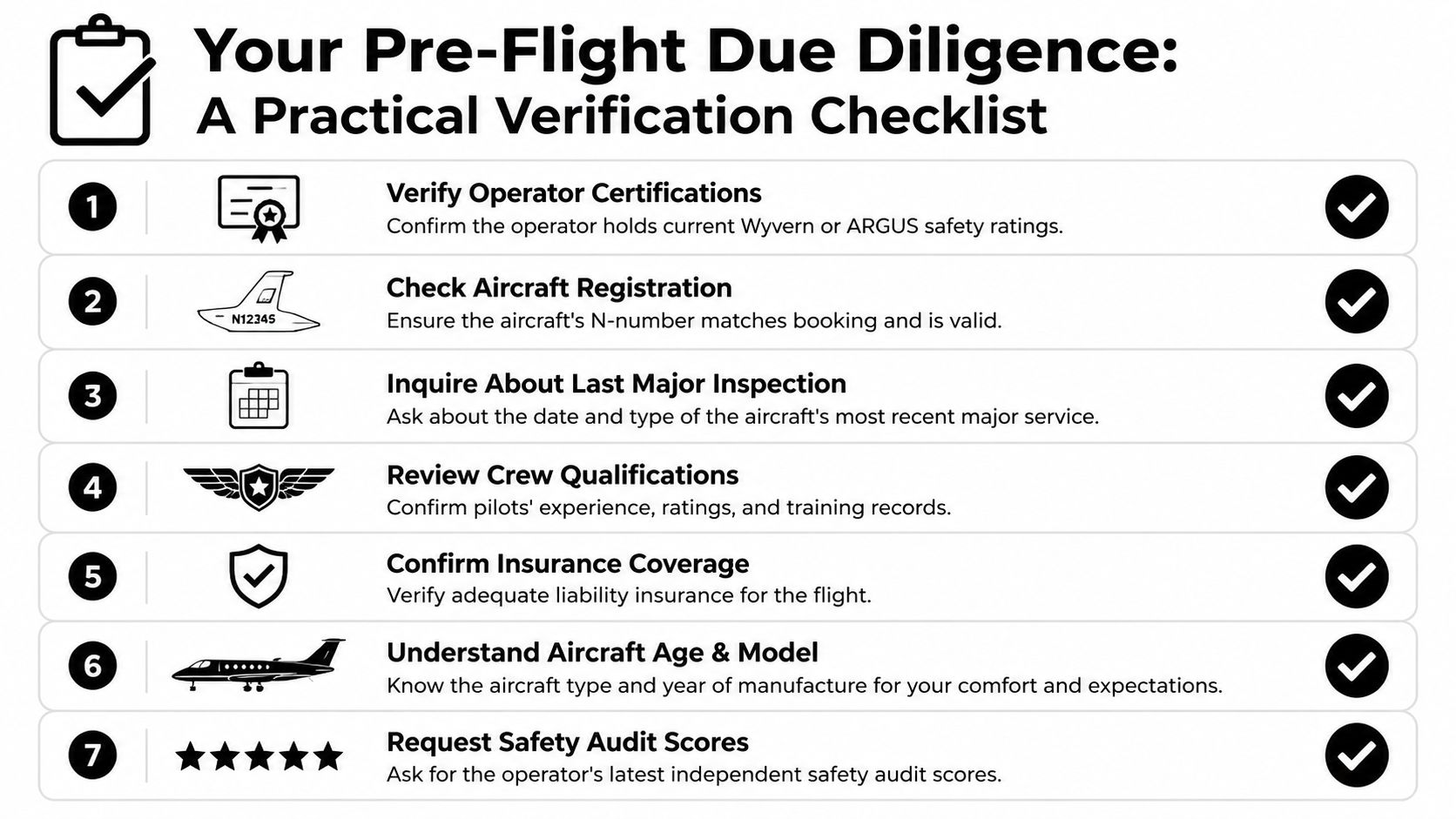
The questions worth asking before you book
Use this list when you're vetting a flight for yourself, your family, or your executive team.
Ask for the tail number early.
You want the specific aircraft identifier in advance, not at the last minute. That gives your broker or internal travel team time to verify the operator, aircraft details, and safety profile.Confirm the operator's safety credentials.
Don't settle for “we have high standards.” Ask what third-party safety audit framework applies and whether the operator maintains current standing under that framework.Ask when the aircraft last completed a major inspection.
You don't need the technical file. You want to hear a clear, direct answer that shows the operator tracks maintenance events with confidence.Request crew and operating details in advance.
Professional operators should be comfortable providing flight-specific information before departure, subject to standard privacy and operational limits.
Red flags clients should take seriously
Not every problem is obvious. Some show up as tone and timing.
- Evasive answers: If someone dodges basic questions about the aircraft or operator, assume there's a reason.
- Late tail number disclosure: Sometimes substitutions are legitimate. Constant vagueness isn't.
- Overreliance on sales language: “Perfect safety record” means very little without verifiable process behind it.
- No explanation of oversight: If nobody can explain who reviews maintenance status and how operator safety is vetted, the booking process is too thin.
Use specialists when the records are beyond your reach
That's where expert screening matters. Most clients will never see the full technical record library, and that's normal. The right move is to use people and tools that translate complexity into practical confidence.
If you want a broader sense of the training and decision-support mindset shaping modern flight operations, resources focused on enhancing pilot safety are useful context. For the client side, the more immediate question is whether you can review or request relevant documentation through your booking channel. This practical guide on seeing aircraft maintenance records is a good place to start.
Your goal isn't to become an inspector. It's to avoid being a passive passenger.
How Haute Jets Vets Operators Using Wyvern and ARGUS Audits
The hardest part of charter due diligence is that the client usually sees the end product, not the vetting process. That's why third-party operator audits matter.
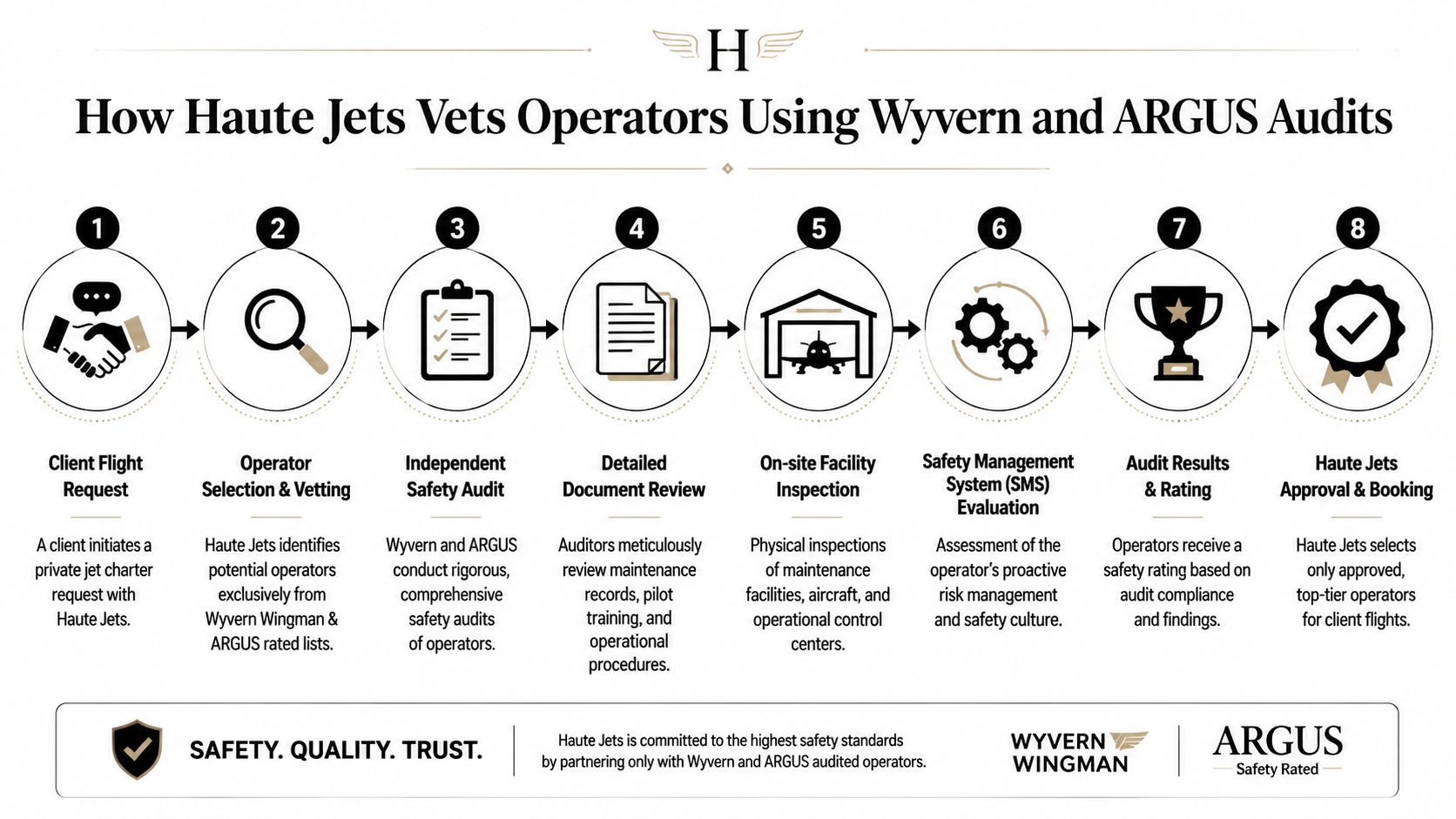
Haute Jets states that it charters only from operators with Wyvern Wingman or ARGUS Gold/Platinum standing. That matters because those audit frameworks are built to review the operator as an organization, not just the aircraft brochure. If you want the background on what those safety ratings represent, this deep dive into Wyvern and ARGUS safety ratings is worth reading.
Why third-party audits help
A proper audit approach connects the dots that clients can't reasonably connect on their own:
- aircraft maintenance discipline
- inspection and compliance procedures
- crew training oversight
- operational control standards
- safety management habits
That's the true value. Not a badge by itself, but an independent review process that checks whether the operator's claims line up with documented practice.
What this solves for the client
Most first-time charter clients don't have the time or technical depth to review records, question maintenance signoffs, or assess whether an operator's process is reliable. They shouldn't have to.
A broker or charter advisor using strict operator screening can reduce that burden by narrowing options to operators that already sit inside a recognized safety audit framework. That doesn't remove the need for questions. It does give those questions a stronger starting point.
The safest booking process is the one that doesn't rely on trust alone. It relies on documentation, third-party review, and operator transparency.
The practical recommendation
If you're booking charter regularly, insist on a process that starts with audited operators, not just available airplanes. Availability is not the standard. Verified oversight is.
That's where maintenance records, regulatory compliance, and third-party audits come together. The records show what happened. The regulations define what must be preserved. The audit process checks whether the operator lives by those standards in day-to-day practice.
For a client, that combination is what turns abstract safety talk into something useful.
Frequently Asked Questions About Aircraft Records and Charter Safety
Can I ask to see aircraft maintenance records before a charter flight
Yes, you can ask. Whether you'll see the full record set directly is another matter.
Operators often protect detailed maintenance files because they're technical, sensitive, and extensive. But a reputable booking channel should be able to explain how the aircraft and operator were vetted, what safety standards apply, and what level of documentation can be shared appropriately. If the answer is defensive or dismissive, take that seriously.
Do complete records guarantee a safe flight
No single factor guarantees safety. Aviation doesn't work that way.
What complete records do is remove uncertainty. They help qualified people verify that required work was done, that inspection history makes sense, and that the aircraft's current configuration matches its documented history. That's a major part of a sound safety picture. It's not the whole picture, but it is absolutely necessary.
What should concern me more, an older aircraft or weak records
Weak records. Every time.
An older aircraft with disciplined maintenance, proper inspections, and clean documentation can be a better charter choice than a newer aircraft with sloppy traceability. Age by itself tells you less than people think. Maintenance culture tells you far more.
If I'm using a broker, what's my role
Your role is to ask clear questions and expect clear answers.
At minimum, ask for the operator identity, the aircraft tail number in advance, the safety audit framework behind the flight, and how the aircraft's maintenance status is vetted before confirmation. A serious advisor won't act annoyed by those questions. They'll expect them.
What's the simplest way to think about aircraft maintenance records
Think of them as the aircraft's proof file.
They show whether the airplane has been cared for in a way that can be verified, not merely claimed. That's why they matter to regulators, buyers, auditors, financiers, and passengers. If you're stepping onto a private jet with people you care about, that proof should matter to you too.
If you want help booking a charter flight with operator vetting built into the process, Haute Jets provides aircraft-specific sourcing, advance flight details, and access to operators that meet its stated Wyvern and ARGUS rating standards.